2027 Courses to Expect in a Bachelor's in Early Childhood Education Program

Co-Founder and Chief Data Scientist
Understanding what courses a bachelor’s in early childhood education (ECE) will include isn’t just academic. It’s tied directly to real job requirements. For example, 24 states now require a bachelor’s degree for lead Pre-K teachers across all publicly funded programs. For future pre-K teachers, understanding the coursework highlights the practical skills you’ll build and how these align with licensing rules in your state.
It is more advantageous to get a clear picture of the classes most programs include. In this article, we’ll look at the core and specialized classes you can expect in a bachelor’s degree in early childhood education.
Key Things to Know About the Courses in a Bachelor's in Early Childhood Education Program
- Core ECE courses cover child development, curriculum planning, language and literacy, and classroom management.
- Specialized electives or concentration courses may focus on areas like special education, bilingual education, or leadership in early childhood settings.
- Course pacing usually involves 4-5 classes per semester, adding up to about 120-128 credits over four years.
- What courses are typically included in a bachelor’s in early childhood education program? Typical Courses
- What concentration tracks are most popular in early childhood education programs? Concentrations
- How do employers view specialized concentrations in early childhood education degrees? How do employers view specialized concentrations in early childhood education degrees?
- What types of practicum are included in early childhood education degrees? Practicum Types
- What skills do students gain from practicum courses in early childhood education? Core Skills
- Are mentorship programs available for early childhood education majors? Mentorship Programs
- Do universities offer bridge programs for students transitioning into early childhood education? Bridge Programs
- What new courses are being introduced in early childhood education programs in 2027? What new courses are being introduced in early childhood education programs in 2027?
- How long does it take to complete all required courses for the degree? Completion Time
- What are the career prospects and salary expectations for early childhood education graduates? What are the career prospects and salary expectations for early childhood education graduates?
- What certifications help graduates of early childhood education enter the workforce smoothly? Certifications
- How Can Advanced Degrees Enhance Your Career in Early Childhood Education? degrees
Introduction: What an Early Childhood Education Degree Actually Teaches
Choosing a bachelor’s in early childhood education is not just a decision about earning a teaching degree. It is a decision about whether you want to work with young children during the most developmentally important years of learning, behavior, language growth, and social-emotional formation. The courses, fieldwork, concentrations, and credentials in an ECE program determine what age groups you can serve, whether you may qualify for licensure, and how prepared you will be for classroom realities.
This guide explains what students typically study in an early childhood education bachelor’s program, how concentrations affect career options, what practicum experiences look like, how employers view specializations, and what questions to ask before choosing a program. It also covers certifications, bridge options, course timelines, current curriculum trends, and common mistakes to avoid when comparing schools.
Quick Answer: What Do You Study in a Bachelor’s in Early Childhood Education?
A bachelor’s in early childhood education usually combines child development, instructional methods, classroom management, assessment, family engagement, inclusive education, health and safety, and supervised fieldwork. Most programs prepare students to work with children from birth through early elementary grades, though the exact grade range depends on the state, school, and licensure track.
Students should pay close attention to three things before enrolling: whether the program leads to the license or credential they need, how much supervised classroom experience is included, and whether the concentration matches their intended career path.
What classes are usually required in a bachelor’s in early childhood education?
Early childhood education programs are built around how children grow, communicate, play, learn, and build relationships from infancy into the early grades. A strong ECE curriculum does not separate theory from practice. Students learn developmental research, then apply it through lesson planning, observation, assessment, and supervised classroom work.
The exact course titles vary by university, but most bachelor’s programs include the following core areas:
| Course Area | What Students Learn | Why It Matters in ECE |
| Child Development and Psychology | Developmental milestones, learning theories, cognitive growth, language development, attachment, and social-emotional behavior from infancy through early childhood. | Teachers need to know what is developmentally typical before they can plan lessons, identify concerns, or support children with different learning needs. |
| Teaching and Curriculum Methods | How to design age-appropriate lessons in literacy, math, science, social studies, art, movement, and play-based learning. | Young children learn differently from older students, so instruction must be active, concrete, responsive, and developmentally appropriate. |
| Classroom Management and Assessment | Behavior guidance, classroom routines, observation, developmental screening, checklists, documentation, and progress monitoring. | ECE teachers must create safe routines while also using assessment evidence to adjust instruction and support each child. |
| Teaching Diverse Populations | Inclusive instruction, culturally responsive teaching, dual-language learner support, disability awareness, family collaboration, and differentiated strategies. | Early childhood classrooms often include children with varied languages, cultures, abilities, and family structures. |
| Health, Safety, and Professional Practice | Child nutrition, first aid concepts, emergency planning, mandated reporting, ethical practice, legal responsibilities, and communication with families. | ECE professionals are responsible for children’s physical safety as well as their learning and emotional well-being. |
| Practicum or Student Teaching | Supervised classroom experience, lesson delivery, child observation, small-group instruction, and professional reflection. | Fieldwork helps students move from knowing about teaching to actually practicing it with children. |
Child Development and Psychology
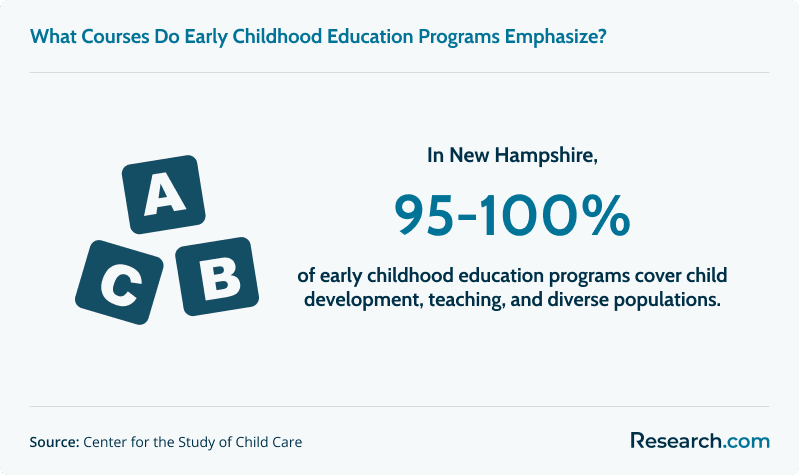
Courses in child development introduce students to the physical, cognitive, language, and social-emotional changes that occur from birth through the early elementary years. Students study developmental theories, milestones, temperament, attachment, play, brain development, and the ways early experiences shape learning. Learners who already have this foundation and want a shorter pathway may compare options such as accelerated early childhood development degree programs.
Teaching and Curriculum Methods
Curriculum courses show future teachers how to turn developmental knowledge into learning activities. Students practice writing lesson plans, selecting materials, using play as an instructional tool, and teaching early literacy, numeracy, science, social studies, music, art, and movement. These classes also emphasize how to adapt instruction for children at different developmental stages rather than using one approach for an entire group.
Classroom Management and Assessment
Classroom management in early childhood education is less about punishment and more about structure, relationships, routines, and prevention. Students learn how to guide behavior, support self-regulation, arrange the learning environment, and respond to challenging situations. Assessment courses teach future educators how to use observations, portfolios, developmental checklists, and screening tools to understand progress and adjust teaching.
Teaching Diverse Populations
ECE students also study how to teach children from different cultural, linguistic, economic, and developmental backgrounds. Coursework may cover dual-language learners, children with disabilities, inclusive classrooms, anti-bias education, family partnerships, and culturally relevant learning materials. These classes are especially important for students who plan to work in public schools, Head Start programs, inclusive preschools, or community-based early learning centers.
Health, Safety, and Professional Practice
Health and safety courses focus on the adult responsibilities that come with caring for young children. Topics commonly include sanitation, nutrition, injury prevention, emergency procedures, supervision, medication policies, reporting obligations, ethics, confidentiality, and respectful communication with families. These courses help students understand that early childhood educators are both teachers and child welfare professionals.
Practicum
Practicum courses place students in early learning settings where they can observe, assist, teach, and receive feedback. Under supervision, students may lead small-group lessons, document children’s behavior, support classroom transitions, communicate with cooperating teachers, and reflect on their decisions. This experience is often where students discover which age group or setting best fits them.
Which early childhood education concentrations are most useful?
Concentrations help students tailor an ECE degree to a specific career goal. Some students want to teach preschool or kindergarten. Others are drawn to infant and toddler care, special education, childcare administration, multilingual learning, literacy, behavior support, or family engagement. The best concentration is the one that aligns with the student’s intended work setting and state credential requirements.
Common early childhood education concentration tracks include:
| Concentration | Best For | Common Career Direction |
| Early Childhood Special Education | Students who want to support children with developmental delays, disabilities, autism, or early intervention needs. | Inclusive preschool teacher, early intervention educator, special education support role. |
| Child Development | Students interested in how young children grow cognitively, physically, socially, and emotionally. | Preschool teacher, child development specialist, family support role. |
| Administration and Leadership | Students who want to lead childcare centers, supervise staff, manage programs, or influence early learning policy. | Childcare center director, program coordinator, early learning administrator. |
| Infant and Toddler Education | Students who prefer working with children during the first three years of life. | Infant-toddler teacher, early care specialist, early intervention assistant. |
| Language and Literacy | Students focused on early reading, writing, oral language, and communication development. | Literacy support educator, early elementary teacher, multilingual learner pathway. |
| Family and Community Engagement | Students who want to strengthen communication between families, schools, and community services. | Family liaison, parent educator, community-based early learning role. |
| Applied Behavior Analysis | Students interested in behavior support strategies, especially for children with autism or behavioral needs. | Behavior support assistant, autism services role, specialized classroom support. |
| Educational Technology | Students who want to use age-appropriate digital tools in early learning environments. | Instructional support role, curriculum technology assistant, classroom teacher with edtech focus. |
| Trauma-Informed Education | Students preparing to work with children affected by stress, family disruption, adverse experiences, or community trauma. | Teacher in high-need settings, family support educator, social-emotional learning support role. |
- Early Childhood Special Education: This track prepares students to support children with developmental delays, disabilities, and individualized learning needs.
- Child Development: This option gives students a deeper understanding of how young children think, move, communicate, regulate emotions, and form relationships.
- Administration and Leadership: This concentration is designed for students who want to manage early learning programs, supervise teachers, oversee compliance, and lead center operations.
- Infant and Toddler Education: This specialization focuses on children from birth through age three, including sensory learning, attachment, early communication, and early intervention.
- Language and Literacy: This path emphasizes oral language, early reading, writing readiness, phonological awareness, vocabulary, and communication support. Students who want to continue into advanced language-focused teaching may later explore online master’s programs in multilingual learner education.
- Family and Community Engagement: This concentration prepares students to build trust with families, connect caregivers with resources, and support children across home, school, and community settings.
- Applied Behavior Analysis: This option introduces behavior-focused strategies often used to support children with autism or persistent behavioral challenges.
- Educational Technology: This track looks at how digital tools can support early learning when used intentionally and in developmentally appropriate ways.
- Trauma-Informed Education: This focus helps future educators recognize stress responses, create predictable routines, and support children who have experienced trauma.
Early Childhood Special Education is especially important because the need for qualified professionals remains a concern. The National Institute for Early Education Research has reported a shortage of qualified ECSE teachers in the United States. A recent study noted that nearly 520,000 three- and four-year-old children were receiving early childhood special education services, underscoring the need for educators who can serve young children with developmental needs in inclusive settings.
Do employers value specialized early childhood education concentrations?
Employers often view a concentration as evidence that a graduate has more targeted preparation than a general ECE major. A specialization can be especially helpful when it matches a hard-to-staff role, such as early childhood special education, infant-toddler care, behavior support, bilingual or multilingual learning, or center leadership.
The U.S. Bureau of Labor Statistics reports 35,900 openings for special education teachers each year. That figure is not limited only to early childhood roles, but it does show the broader need for special education professionals. Students who want to move beyond entry-level teaching may later consider advanced preparation such as the shortest online EdS programs in special education.
| Employer Need | Concentration That May Help | Why It Can Improve Fit |
| Serving children with disabilities or developmental delays | Early Childhood Special Education | Shows preparation in inclusive instruction, individualized supports, and developmental intervention. |
| Working with infants and toddlers | Infant and Toddler Education | Signals knowledge of attachment, early communication, caregiving routines, and age-specific safety needs. |
| Leading a childcare or preschool program | Administration and Leadership | Supports readiness for staff supervision, compliance, family communication, and program operations. |
| Supporting early reading and language development | Language and Literacy | Helps candidates demonstrate skill in vocabulary development, pre-reading instruction, and communication support. |
| Working in high-need or community-based settings | Trauma-Informed Education or Family and Community Engagement | Prepares graduates to build trust, use predictable routines, and coordinate with families and support services. |
Even when employers value specialization, students should not assume every concentration leads to a license. Licensing rules are usually set by states, not by concentration titles. Before enrolling, students should ask whether the degree leads to the exact credential required for their intended grade level and work setting.
What practicum and fieldwork experiences are included in ECE degrees?
Supervised fieldwork is one of the most important parts of an early childhood education program. It gives students a chance to see how children behave in real classrooms, how teachers adjust instruction, and how daily routines affect learning. Field experiences are common in bachelor’s programs and may also appear in graduate options such as the shortest online master’s degrees in early childhood education.
ECE fieldwork usually becomes more demanding over time. Students may begin by observing classrooms, then assist with activities, then plan lessons, and eventually complete student teaching or a capstone placement.
Preschool Practicum
Preschool practicum courses place students in classrooms with children who are typically preparing for kindergarten. Students observe developmental differences, assist with play-based learning, practice group management, and connect course concepts to classroom behavior. At California State University Dominguez Hills, students must complete a minimum of 100 hours of experience at university-approved practicum sites.
Infant and Toddler Practicum
Some programs offer fieldwork focused specifically on infants and toddlers. These placements differ from preschool practicums because they emphasize caregiving routines, attachment, sensory exploration, early communication, and responsive interaction. Central Ohio Technical College provides up to 375 hours of practicum experience, including courses such as ECE-285 Infant and Toddler Practicum.
Student Teaching
Student teaching is often the most intensive field experience in an ECE program. Students take on broader teaching responsibilities while working under supervision from a cooperating teacher and university supervisor. North Seattle College embeds practicum work in most upper-division ECE courses and requires students to spend at least 5 hours per week working directly with early learners at a practicum site.
| Fieldwork Type | Typical Student Role | What to Ask Before Enrolling |
| Observation | Watch teachers, document classroom routines, and connect observations to coursework. | How early in the program do field placements begin? |
| Practicum | Assist with classroom activities, work with small groups, and practice child observation. | How many total hours are required, and who approves placement sites? |
| Infant-Toddler Placement | Support caregiving routines, early communication, sensory activities, and responsive interaction. | Does the program include placements with the age group you want to teach? |
| Student Teaching | Plan, teach, assess, and gradually assume greater classroom responsibility under supervision. | Is student teaching required for licensure in your state? |
What practical skills do ECE students build during practicum?
Practicum experiences help students test their teaching skills in real classrooms instead of only studying them in textbooks. This is where future educators learn how to respond when a lesson does not go as planned, when children need different levels of support, or when classroom routines break down.
- Classroom management: Students practice creating predictable routines, guiding behavior, encouraging cooperation, and maintaining a safe learning environment.
- Lesson planning and instruction: Fieldwork gives students opportunities to design activities, teach small groups, adjust pacing, and choose materials that fit children’s developmental levels.
- Observation and assessment: Students learn to watch children carefully, document progress, recognize patterns, and use evidence to support instructional decisions.
- Communication and collaboration: Practicum placements require students to interact with children, cooperating teachers, families, aides, and supervisors in professional ways.
- Professional judgment and confidence: Real classroom experience helps students understand expectations, receive feedback, and develop the confidence needed for their first education role.
Students should also be careful not to confuse ECE credentials with unrelated professional certifications. For example, CRFAC certification requirements apply to forensic accounting, not early childhood teaching. The right credential depends on the career field, state rules, and employer requirements.
Are mentorship opportunities available for early childhood education majors?
Many ECE students benefit from mentorship because classroom work with young children can be complex, emotional, and highly situational. A mentor can help a student interpret child behavior, manage difficult classroom moments, plan career steps, and understand how early learning programs operate beyond coursework.
Examples of mentorship options for aspiring early childhood educators include:
- Early Childhood Networks' Mentor Network: This nonprofit arm of Central New Mexico Community College supports newer ECE professionals through long-term relationships with experienced mentors. Participants receive help with goal-setting, career navigation, evidence-based classroom practices, workshops, and collaborative learning.
- California Early Childhood Mentor Program: Funded by the California Department of Social Services, this program works with nearly 100 community colleges to support ECE students and professionals. Mentors may assist with leadership, curriculum planning, classroom practice, and program management across early childhood settings.
- Child Care Aware of Minnesota Mentorship Programs: Through Empower to Educate and TEACH Apprenticeship, this organization supports early childhood educators with mentoring, reflective practice, structured training, and professional development.
Mentorship can be especially valuable for students choosing flexible or less traditional pathways. For example, students comparing admissions-friendly options may also review online colleges with no SAT score requirements while confirming that any chosen ECE program still meets licensure or employment expectations.
Can career changers use bridge programs to move into early childhood education?
Bridge programs can help students who already have college credits, a bachelor’s degree in another field, or professional experience outside education transition into early childhood teaching. These programs usually focus on the content career changers are missing: child development, curriculum design, classroom management, assessment, fieldwork, and licensure preparation.
Examples of bridge-style or transition programs include:
University of Minnesota – Early Childhood Education M.Ed. (Licensure)
This program is designed for students seeking a teaching license for birth through third grade classrooms in Minnesota. It combines child development theory, research, coursework, and classroom experience for candidates preparing to enter the teaching profession.
Temple University – Graduate Certificate in Early and Elementary Education
This certificate is intended for individuals who already hold a bachelor’s degree and want to change careers into PreK-4 teaching in Pennsylvania. The coursework provides foundational preparation in child development and instruction for young learners.
Mount Saint Vincent University – M.S. in Early Childhood and Special Education Dual Certification
This 46-credit program prepares teacher candidates to serve young, diverse learners, including children with special needs. It combines early childhood pedagogy with special education preparation for students pursuing dual certification.
Career changers should verify admissions rules carefully because not every graduate program accepts applicants without the expected prior degree or prerequisite coursework. Students asking whether it is possible to get a master’s degree in education without a bachelor’s degree should compare actual school policies instead of assuming a bridge program removes all requirements.
What newer course topics are appearing in early childhood education programs?
Early childhood education curricula are evolving as schools respond to more diverse classrooms, stronger emphasis on inclusion, and growing attention to how play, culture, trauma, and brain development shape learning. Newer courses and program updates often focus on inclusive environments, global awareness, developmental play, and culturally responsive practice.
Examples of emerging or recently highlighted course themes include:
- Global Curriculum Integration: The Enchanted Garden in Ridgefield, Connecticut, is launching preschool classrooms built around a global curriculum. The model incorporates music, dance, and storytelling traditions from different cultures to help children build cultural awareness early.
- Inclusive Learning Environments: UCLA Extension offers “Introduction to Curriculum and Learning Environments,” a course focused on developmentally appropriate curriculum methods and inclusive classroom design for diverse learners.
- Developmental Play and Brain Growth: UCLA Extension also offers “Play and the Developing Brain in Early Childhood Education,” which examines how play supports brain development and executive function skills in young children.
Students should evaluate new course offerings alongside cost, format, transfer policy, and credential outcomes. Veterans and military-connected learners may also want to compare affordability-focused pathways such as affordable online bachelor’s programs for veterans.
How long does it take to finish the required ECE bachelor’s courses?
Most bachelor’s degrees in Early Childhood Education take around four years of full-time study and require 120 to 128 credit hours. A typical full-time student takes four to five courses per semester, or about 15-16 credit hours.
The first two years commonly include general education requirements such as English, math, social sciences, humanities, and introductory education courses. The final two years usually focus more heavily on child development, curriculum planning, classroom assessment, inclusive education, family engagement, and practicum or student teaching. Fieldwork can make the final year more demanding because students must balance coursework with scheduled classroom hours.
Some schools offer an accelerated online bachelor’s degree in early childhood education for students who already have an associate degree or transferable credits. These pathways may allow eligible students to finish in as little as 16 months while still earning a full bachelor’s credential.
| Student Situation | Likely Timeline | Key Consideration |
| First-time full-time bachelor’s student | Around four years | Plan for general education, major coursework, and field placements. |
| Transfer student with an associate degree | May be shorter depending on accepted credits | Ask for a transfer evaluation before enrolling. |
| Accelerated online student | As little as 16 months for eligible students | Confirm that speed does not reduce required practicum or licensure preparation. |
| Part-time working student | Often longer than full-time study | Check whether fieldwork can be completed around work obligations. |
What career and salary outcomes can ECE graduates expect?
A bachelor’s in early childhood education can lead to classroom, childcare, family support, early intervention, curriculum, and program leadership roles. Common settings include preschools, childcare centers, Head Start programs, public schools, private schools, nonprofit organizations, and community-based early learning programs.
Salary expectations vary widely by state, employer type, licensure status, experience, union coverage, funding source, and whether the role is in a public school or private childcare setting. Graduates should avoid relying on one national salary estimate when making a decision. Instead, they should compare local job postings, state salary schedules, public school pay scales, and credential requirements for the exact role they want.
| Career Path | Typical Focus | What Can Improve Advancement |
| Preschool or early childhood teacher | Planning lessons, guiding play, supporting early literacy and numeracy, and managing classroom routines. | State licensure, strong practicum experience, classroom management skills, and specialization in literacy or inclusion. |
| Infant-toddler educator | Supporting caregiving routines, attachment, sensory learning, and early communication. | Infant-toddler concentration, experience with developmental milestones, and family communication skills. |
| Early childhood special education role | Supporting children with developmental delays, disabilities, or individualized learning needs. | Special education coursework, licensure alignment, fieldwork in inclusive settings, and advanced credentials. |
| Childcare center administrator | Overseeing staff, licensing compliance, enrollment, family communication, and program quality. | Leadership concentration, administrative experience, state director credentials, and business or management skills. |
| Curriculum or instructional support role | Helping design age-appropriate learning activities, assessments, and classroom materials. | Experience teaching young children, curriculum coursework, and graduate study in education or leadership. |
Some graduates pursue advanced degrees to move into leadership, policy, curriculum, or higher-level administrative roles. For those seeking doctoral-level preparation, an option to compare is the fastest online EdD program pathway, though students should evaluate accreditation, dissertation or capstone requirements, cost, and career fit before enrolling.
Which certifications help ECE graduates enter the workforce?
Certifications and credentials can help new graduates show employers that they meet recognized professional standards. However, requirements differ by state and setting. A credential that is useful for a childcare center may not be enough for a public school teaching license, and a bachelor’s degree alone may not automatically qualify someone for every ECE role.
- Child Development Associate Credential: The CDA is a widely recognized early childhood credential in the U.S. and is accepted in all 50 states. It is often useful for childcare and early learning roles, especially for educators building practical classroom credentials.
- State-Specific Credentials and T.E.A.C.H. Programs: Many states maintain their own early childhood credential systems tied to educator competencies, workforce pathways, or childcare licensing. Nearly half of U.S. states run T.E.A.C.H. Early Childhood programs, which provide financial aid and academic support for educators pursuing degrees, credentials, or licenses in ECE.
Graduates who want more specialized preparation may also compare online graduate certificate programs in early childhood education. These shorter graduate pathways may strengthen skills in curriculum design, instructional strategies, inclusion, or multilingual learner support, depending on the program.
How can graduate study strengthen an early childhood education career?
Advanced degrees can help ECE professionals move beyond classroom entry roles into leadership, curriculum design, special education, higher education, advocacy, research, or program administration. A graduate program may be worth considering when it clearly supports a specific career goal, such as becoming a center director, instructional coach, early childhood special education specialist, policy advocate, or college-level instructor.
Not every advanced degree needs to be in early childhood education, but the connection should be intentional. For example, educators interested in children’s literature, school libraries, learning resources, or information access may compare related fields such as affordable online MLIS degree options. Students should choose advanced study based on job requirements, not simply because another credential sounds impressive.
How to choose the right early childhood education program
The best ECE program is not always the cheapest, fastest, or highest ranked. It is the one that prepares you for the specific age group, license, state, and work setting you want. Before applying, compare programs using practical criteria rather than marketing language.
- Confirm accreditation and approval: Check institutional accreditation and, when relevant, whether the program is approved for teacher preparation in your state.
- Match the program to your target credential: Ask whether graduates qualify for the license, endorsement, or childcare credential required for your intended role.
- Review fieldwork requirements: Look at total practicum hours, placement types, student teaching expectations, and whether online students must arrange local placements.
- Compare transfer policies: If you have prior college credits, request an official transfer evaluation before assuming how long the degree will take.
- Look beyond tuition: Include fees, books, background checks, testing costs, transportation to field sites, childcare, and lost work hours.
- Ask about support services: Strong advising, licensure guidance, mentorship, tutoring, and placement coordination can make a major difference.
- Check local employer expectations: Review job postings in your area to see which degrees, licenses, credentials, and experience employers request.
Common mistakes to avoid when comparing ECE programs
| Mistake | Why It Can Hurt You | Better Approach |
| Choosing a program without checking licensure alignment | You may graduate without meeting the requirements for the role or state where you want to work. | Ask the school to confirm in writing which licenses or credentials the program prepares students for. |
| Focusing only on tuition | Extra costs such as fees, tests, transportation, and field placement requirements can change the real cost. | Compare total cost of attendance and required out-of-pocket expenses. |
| Assuming online means fully flexible | Many online ECE programs still require scheduled practicum or student teaching hours in approved settings. | Ask how placements work for online students in your location. |
| Ignoring transfer credit rules | Credits from an associate degree or prior college may not all apply to the major. | Request a degree plan showing exactly which credits count. |
| Choosing a concentration only because it sounds interesting | The concentration may not improve employment prospects if it does not match your target role. | Compare concentrations against job postings and state credential requirements. |
| Assuming salary outcomes are guaranteed | Pay varies by region, employer, licensure, experience, and funding source. | Use local salary schedules and job postings to estimate realistic outcomes. |
What graduates say about their bachelor’s in early childhood education experience
- Leonora: "The mentoring I received made classroom problems feel less overwhelming. My mentor helped me think through behavior challenges, parent communication, and situations that looked simple in class but felt much harder in person."
- Cynthia: "My practicum forced me to learn quickly. I led small-group activities, lost children’s attention, adjusted my plans, and tried again. By graduation, I understood what teaching preschoolers actually required."
- Javier: "Specializing in Early Childhood Special Education changed my career direction. I learned how to adapt lessons for children with developmental delays, and one internship later turned into a job at a center serving children with autism."
References
- University of California, Berkeley, Center for the Study of Child Care Employment. The state of early childhood higher education in New Hampshire. http://cscce.berkeley.edu/wp-content/uploads/publications/NewHampshireReport_FINAL_7-18-2013.pdf
- Center for the Study of Child Care Employment. Teaching the teachers of our youngest children: The state of early childhood higher education in Oregon. https://files.eric.ed.gov/fulltext/ED614276.pdf
- Connecticut Insider. Ridgefield Arts and Education Center opens new preschool classrooms focused on a global curriculum. https://www.ctinsider.com/business/article/ridgefield-ct-daycare-preschool-enrollment-21014851.php
- New America. Surprising results in study of child care hiring practices. https://www.newamerica.org/education-policy/edcentral/surprising-results-study-child-care-hiring-practices/
- UCLA Extension. Early childhood educators courses. https://www.uclaextension.edu/education/early-childhood-educators/courses
- Administration for Children and Families. Examining and supporting credentialing. https://acf.gov/archive/ecd/examining-and-supporting-credentialing
- Community College of the District of Columbia. Early childhood education associate degree programs. https://www.ccdc.edu/academics/associate-degree-programs/early-childhood-education/
Key Insights
- A bachelor’s in early childhood education usually covers child development, curriculum methods, assessment, classroom management, inclusion, health and safety, family engagement, and supervised fieldwork.
- Concentrations matter most when they match a real career goal, such as early childhood special education, infant-toddler care, literacy, administration, or trauma-informed education.
- Fieldwork is not optional preparation; it is where students learn how to manage routines, teach small groups, observe children, and respond to classroom challenges.
- Most ECE bachelor’s programs take around four years and require 120 to 128 credit hours, though eligible transfer students in accelerated online programs may finish in as little as 16 months.
- Licensure and credential rules vary by state and employer, so students should confirm requirements before enrolling rather than assuming a degree title is enough.
- Salary outcomes depend heavily on location, employer type, licensure, experience, and whether the role is in a public school, private center, nonprofit, or specialized program.
- The strongest program choice is the one that combines accreditation, licensure alignment, strong practicum support, reasonable cost, and a concentration that fits the student’s intended career path.
Other Things You Should Know About the Courses in a Bachelor’s in Early Childhood Education Program
Most 2027 bachelor's programs require 12 to 16 weeks of student teaching, usually totaling 450 to 600 supervised hours. The placement is completed in a licensed early childhood classroom and is overseen by a university supervisor and a mentor teacher.
In 2027, prerequisites typically include a high school diploma or GED, completion of prerequisite courses in subjects like English and Math, and a minimum GPA requirement. Some programs may also require entrance exams or interviews as part of the admission process.