2027 Best Online Master’s in Multilingual Learner Education

Co-Founder and Chief Data Scientist
Access to quality education in a language students understand remains out of reach for 40% of the global population, according to UNESCO. This widespread linguistic gap highlights a critical need for educators who are skilled in multilingual instruction, inclusive teaching, and culturally responsive pedagogy.
In this guide, I will share the best online master’s programs in multilingual learner education. I will provide a comparison of top programs, available specializations, and common career paths. I will also provide tips on selecting a degree that fits your professional goals, whether you're entering education or advancing within the field.
What are the benefits of getting into an online master's in multilingual learner education degree?
- Online master's in multilingual learner education degree programs help balance school with teaching, caregiving, or other responsibilities, making graduate study more flexible.
- Students of this online program can use new teaching strategies and language tools right away in their classroom or workplace.
- These online programs lead to jobs that often pay $39,750 to $95,750, with room to grow into leadership or policy roles.
What can I expect from an online master's in multilingual learner education degree?
An online master’s in multilingual learner education helps educators build skills to support students from diverse language backgrounds. The flexible format fits around teaching schedules and other professional commitments.
Typical coursework covers:
- Second language acquisition
- Culturally responsive teaching
- Assessment methods for English learners
- Instructional strategies for bilingual or dual-language settings
Programs often include:
- Practicum or fieldwork in your local school or community
- Asynchronous classes for flexible scheduling
- Real-time application of strategies in your current role
- Collaboration with peers across regions
Some programs also offer specializations in TESOL, bilingual education, or equity-focused instruction aligned with licensure goals.
Where can I work with an online master's in multilingual learner education degree?
With an online master’s in multilingual learner education, you can work in a variety of educational and language-focused settings that support linguistically diverse communities.
Common career paths include:
- K–12 Schools: Teach as ESL, bilingual, or dual-language instructors supporting language-diverse students.
- Adult Education Centers: Instruct English as a second language to adult learners and newcomers.
- Colleges and Universities: Serve as instructors or coordinate language learning programs.
- School District Offices: Work as ELL program coordinators, instructional coaches, or policy advisors.
- Curriculum and Education Firms: Develop language and literacy programs for multilingual learners.
- Nonprofits and Community Organizations: Provide language instruction, advocacy, or family support services.
- Education Policy and Advocacy Groups: Influence legislation and equity-focused programs for multilingual populations.
The degree also supports transitions into educational leadership and teacher training roles.
How much can I make with an online master's in multilingual learner education degree?
A master’s degree in multilingual learner education can increase your earning potential and open doors to leadership roles. Salaries vary based on job type, experience, and setting.
Here is a closer look at the earnings for adult basic and secondary education and ESL teachers:
- Median annual wage: $59,950
- Lowest 10%: Under $39,750
- Highest 10%: Over $95,750
Here are the median wages for adult basic and secondary education and ESL teachers by industry:
- Local junior colleges: $61,430
- Local K–12 schools: $61,280
- State junior colleges: $55,910
- Private educational services: $51,010
- Best Online Master's in Multilingual Learner Education Degree Programs for 2027 List of Programs
- How long does it take to complete an online master's in multilingual learner education program? Completion Time
- How does an online master's in multilingual learner education compare to an on-campus program? How does an online master's in multilingual learner education compare to an on-campus program?
- What is the average cost of an online master's in multilingual learner education program? Program Cost
- What are the financial aid options for students enrolling in an online master's in multilingual learner education program? Financial Aid
- What are the prerequisites for enrolling in an online master's in multilingual learner education program? What are the prerequisites for enrolling in an online master's in multilingual learner education program?
- What courses are typically in an online master's in multilingual learner education program? What courses are typically in an online master's in multilingual learner education program?
- What types of specializations are available in online master's in multilingual learner education programs? What types of specializations are available in online master's in multilingual learner education programs?
- How to choose the best online master's in multilingual learner education program? How to choose the best online master's in multilingual learner education program?
- What career paths are available for graduates of online master's in multilingual learner education programs? Career Paths
- Is accreditation impacting program quality and career outcomes? Is accreditation impacting program quality and career outcomes?
- What is the job market for graduates with an online master's in multilingual learner education? Job Outlook
- How Does Interdisciplinary Learning Enhance Multilingual Education? How Does Interdisciplinary Learning Enhance Multilingual Education?
- How Do Student Support Services Influence Success in Online Master's Programs? How Do Student Support Services Influence Success in Online Master's Programs?
Best Online Master’s in Multilingual Learner Education Programs for 2027
Choosing an online master’s in multilingual learner education is not just a question of convenience. For many educators, it is a decision about licensure, salary mobility, classroom impact, and whether a program will actually prepare them to teach English learners, bilingual students, and multilingual communities effectively. The right program can help teachers strengthen instruction, qualify for ESL or bilingual endorsements, move into coaching or curriculum roles, or prepare for leadership in districts serving linguistically diverse learners.
This guide is designed for working teachers, career changers, paraprofessionals, adult education instructors, and education professionals comparing online graduate programs in bilingual education, TESOL, ESL, multilingual literacy, and culturally responsive teaching. It explains program options, costs, timelines, admissions requirements, specializations, career paths, accreditation, and common mistakes to avoid before enrolling.
Quick answer: Is an online master’s in multilingual learner education worth considering?
An online master’s in multilingual learner education can be a strong choice if you want advanced preparation in ESL, bilingual education, TESOL, multilingual literacy, or culturally responsive instruction while continuing to work. The best programs are accredited, aligned with your state’s licensure or endorsement rules, include practical field experiences when required, and offer coursework in language acquisition, assessment, bilingual literacy, pedagogy, and educational equity.
Before applying, confirm whether the program leads to licensure, endorsement, professional development only, or advanced non-licensure specialization. That distinction matters more than the program title.
How Research.com evaluates schools
Graduate education requires a serious investment, so program comparisons should be based on more than advertising claims. Research.com applies a research-based ranking methodology that considers credible education data and program-level information where available.
Sources used to inform rankings and school profiles include the Integrated Postsecondary Education Data System, Peterson’s Distance Learning Licensed Data Set, College Scorecard, and the National Center for Education Statistics (NCES). Students should still verify current tuition, admissions rules, licensure alignment, and practicum requirements directly with each university before enrolling.
Program comparison at a glance
| School | Online program focus | Program length | Credits | Cost per credit hour | Accreditation listed |
| Stonehill College | Bilingual Education | One to two years | 30 | $763 | New England Commission of Higher Education (NECHE) |
| Arizona State University | Educating Multilingual Learners | 18 to 24 months | 30 | $676 | Higher Learning Commission (HLC) |
| UNC Extended Campus | TESOL | 30 months | 30 | $668 | HLC |
| San Jose State University | Multilingual and Multicultural Literacy Education | Two years | 30 | $660 | Western Association of Schools and Colleges (WSCUC) |
| College of Charleston | Multilingual Learner Education | One and a half to two years | 30 to 33 | $533 | Council for the Accreditation of Educator Preparation (CAEP) |
| University of Illinois Urbana-Champaign | Bilingual/Bi‑Cultural concentration | 18 to 24 months | 32 | $538 | HLC |
| Arizona State University (Fulton) | Educating Multilingual Learners | 12 to 15 months | 30 | $676 | HLC |
| Texas A&M | Bilingual/ESL Education | 12 months | 36 | $367 | Texas State Board for Educator Certification |
| Kansas State University | ESL concentration | 16 months | 31 | $536 | HLC |
| Indiana University–Bloomington | Literacy, Culture & Language Education | One to two years | 36 | $539.36 | HLC |
1. Stonehill College
Stonehill College offers an online M.Ed. in Bilingual Education for educators who want deeper preparation in multilingual instruction, culturally responsive practice, and advocacy for students learning across languages.
The curriculum emphasizes second language acquisition, language assessment, literacy development, and instructional planning for bilingual and multilingual settings. Graduates may pursue work as bilingual educators, language specialists, instructional advocates, or school-based leaders supporting equitable learning environments.
- Program Length: One to two years
- Tracks/Concentrations: Bilingual Education
- Cost per Credit Hour: $763
- Required Credits to Graduate: 30
- Accreditation: New England Commission of Higher Education (NECHE)
2. Arizona State University
Arizona State University provides an online MA in Education with a concentration in Educating Multilingual Learners. The program is built for educators who want to improve instruction, policy understanding, and advocacy for linguistically diverse students.
Students study research and evaluation, bi/multilingual development, sustaining pedagogy, and language policy. The degree can support career growth in schools, districts, community organizations, or education policy environments focused on multilingual learners.
- Program Length: 18 to 24 months
- Tracks/Concentrations: Educating Multilingual Learners
- Cost per Credit Hour: $676
- Required Credits to Graduate: 30
- Accreditation: Higher Learning Commission (HLC)
3. UNC Extended Campus
University of Northern Colorado offers an online M.A. in Multilingual Education with a TESOL focus. It is a practical option for educators seeking advanced preparation in second language teaching, curriculum design, and culturally responsive instruction.
Coursework includes second language theory, ESL methods, academic literacy, multilingual education seminars, and graduate research. Graduates may work in K–12 schools, adult ESL programs, higher education, assessment-related roles, or continue toward doctoral study.
- Program Length: 30 months
- Tracks/Concentrations: TESOL
- Cost per Credit Hour: $668
- Required Credits to Graduate: 30
- Accreditation: HLC
4. San Jose State University
San José State University offers an online MA in Multilingual and Multicultural Literacy Education for educators focused on literacy, language equity, inclusive reading instruction, and California-aligned literacy expectations.
The program covers phonemic awareness, fluency, vocabulary, comprehension, language policy, and critical pedagogy. Graduates may pursue roles as reading specialists, literacy leaders, or advocates for multilingual and underserved student populations.
- Program Length: Two years
- Tracks/Concentrations: Multilingual and Multicultural Literacy Education
- Cost per Credit Hour: $660
- Required Credits to Graduate: 30
- Accreditation: Western Association of Schools and Colleges (WSCUC)
5. College of Charleston
College of Charleston offers an online M.A.T. in Multilingual Learner Education for students who did not major in education but want a pathway into teaching and licensure-focused preparation.
The program includes educational foundations, linguistics, ESOL methods, literacy for multilingual learners, assessment, and cultural diversity. Graduates are prepared for K–12 licensure and multilingual learner support roles in South Carolina and other settings where requirements are met.
- Program Length: One and a half to two years
- Tracks/Concentrations: Multilingual Learner Education
- Cost per Credit Hour: $533
- Required Credits to Graduate: 30 to 33
- Accreditation: Council for the Accreditation of Educator Preparation (CAEP)
6. University of Illinois Urbana-Champaign
The University of Illinois Urbana-Champaign offers an online M.Ed. with a Bilingual/Bi-Cultural concentration for educators who want to connect language development, equity, family engagement, and bilingual classroom practice.
Students examine bilingual methods, dual language instruction, language policy, and community engagement. The program can support advancement into teacher leadership, specialist, coordinator, or community-based education roles serving multilingual learners.
- Program Length: 18 to 24 months
- Tracks/Concentrations: Bilingual/Bi‑Cultural concentration
- Cost per Credit Hour: $538
- Required Credits to Graduate: 32
- Accreditation: HLC
7. Arizona State University (Fulton)
Arizona State University (Fulton) offers an online MA in Education with a concentration in Educating Multilingual Learners. This option is designed for students seeking a faster route to graduate-level training in language acquisition, multilingual policy, and inclusive literacy instruction.
Coursework includes research and evaluation in education, bilingual acquisition & development, sustaining pedagogy, and language policy. Graduates may apply the degree in instructional leadership, curriculum design, advocacy, and school or community-based multilingual learner support.
- Program Length: 12 to 15 months
- Tracks/Concentrations: Educating Multilingual Learners
- Cost per Credit Hour: $676
- Required Credits to Graduate: 30
- Accreditation: HLC
8. Texas A&M
Texas A&M offers an online M.Ed. in Bilingual/ESL Education for educators who want focused preparation in bilingual pedagogy, biliteracy development, ESL methods, and culturally responsive instruction.
Students complete courses such as Bilingual Oral Language Assessment, ESL Methodologies, Dual Language Teaching Strategies, Reading & Language Arts in bilingual settings, and Field Practicum. Graduates may move into classroom teaching, curriculum work, leadership support, or community advocacy for multilingual learners.
- Program Length: 12 months
- Tracks/Concentrations: Bilingual/ESL Education
- Cost per Credit Hour: $367
- Required Credits to Graduate: 36
- Accreditation: Texas State Board for Educator Certification
9. Kansas State University
Kansas State University offers an online M.S. in Curriculum & Instruction with an English as a Second Language concentration. The program is suited to educators who want to strengthen ESL methods, language assessment, and culturally responsive classroom practice.
The curriculum includes ESL/Dual-Language Methods, Linguistics, Culture & Language in Practice, Assessment, and Practicum. Built around the CLASSIC model, the program prepares graduates for ESL endorsement-related roles, curriculum leadership, and instructional coaching in multilingual education settings.
- Program Length: 16 months
- Tracks/Concentrations: ESL concentration
- Cost per Credit Hour: $536
- Required Credits to Graduate: 31
- Accreditation: HLC
10. Indiana University–Bloomington
Indiana University–Bloomington offers an online M.S.Ed. in Literacy, Culture, and Language Education for educators interested in literacy theory, language policy, and culturally informed instruction across school and community learning environments.
Students complete coursework in Instructional Issues in Literacy, Culture, and Language Education, Capstone work, inquiry and leadership studies, and electives such as language policy, mentoring, CALL, reading methods, and TESOL techniques. Graduates may pursue teaching, specialist, curriculum writing, or instructional support roles.
- Program Length: One to two years
- Tracks/Concentrations: Literacy, Culture & Language Education
- Cost per Credit Hour: $539.36
- Required Credits to Graduate: 36
- Accreditation: HLC
How long does an online master’s in multilingual learner education take?
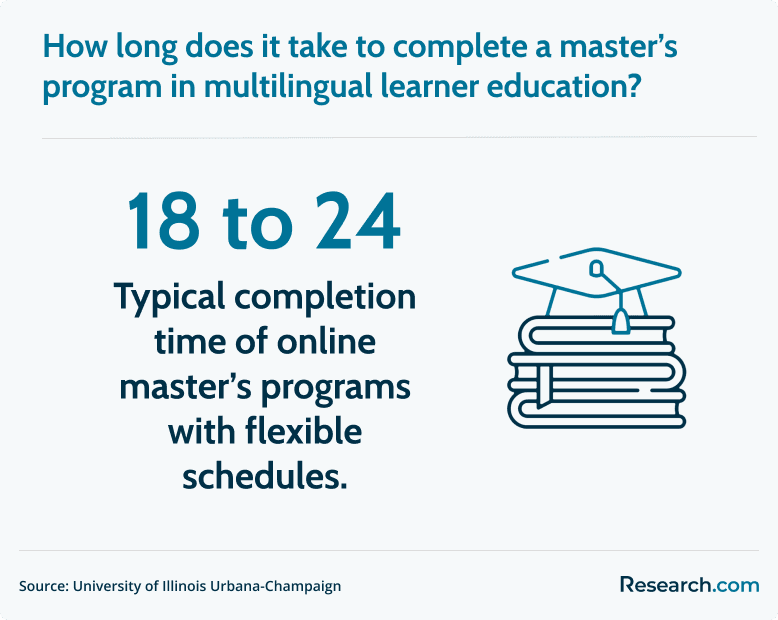
Most online master’s in multilingual learner education programs can be completed in one and a half to two years, although part-time study may extend the timeline up to three years. Many of the most affordable online master's in multilingual learner education programs use flexible, asynchronous, or hybrid course delivery so working educators can continue teaching while earning the degree.
Accelerated formats may allow completion in 12 to 15 months, depending on the number of credits, course load, practicum obligations, and whether the student is pursuing licensure or a non-licensure track. Zippia reports that 69.7% of ESL teachers hold a bachelor's degree, while 19.5% pursue a master’s, often to specialize or qualify for advancement.
The following chart from Zippia shows common degree levels among ESL teachers.
Online vs. campus programs: which format makes more sense?
Online and campus-based master’s programs in multilingual learner education can cover similar academic content, but the learning experience is different. Online programs usually work best for teachers who need schedule flexibility, live far from campus, or want to complete practicum requirements locally. Campus programs may be better for students who prefer in-person discussion, nearby faculty access, and structured weekly routines.
| Factor | Online master’s program | On-campus master’s program |
| Best for | Working educators, career changers, rural students, and students balancing family or school employment | Students who want face-to-face classes, campus resources, and local networking |
| Flexibility | Often asynchronous, hybrid, or evening-friendly | Usually follows fixed class times and campus attendance |
| Fieldwork | May be completed locally if the school approves the placement | Often arranged through nearby school partnerships |
| Interaction | Uses discussion boards, video meetings, group projects, and digital collaboration tools | Relies more heavily on in-person class discussion and campus events |
| Key risk | Assuming the program meets your state’s licensure rules without checking | Choosing a local program even if it lacks the specialization you need |
Online learning expectations also vary by field. A Christian studies online degree, for example, may not require the same field-placement planning as an education program tied to licensure. In multilingual learner education, students should verify practicum, endorsement, and state authorization requirements before enrolling. UNESCO has identified a projected global need for 44 million more teachers by 2030 to achieve universal education, making flexible teacher preparation pathways increasingly important.
How much does an online master’s in multilingual learner education cost?
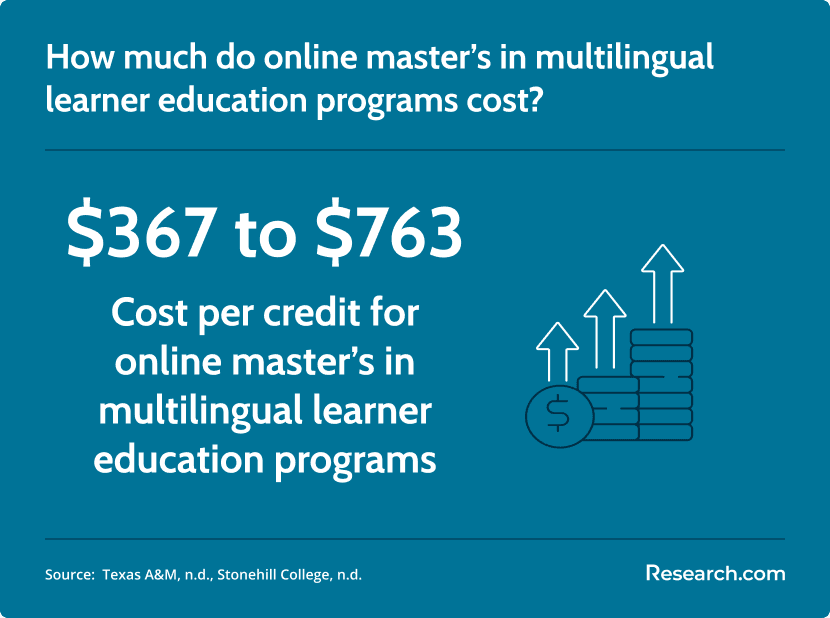
Tuition differs by school, residency rules, delivery format, and whether the university charges a separate online rate. Among the programs listed here, cost per credit ranges from $367 to $763. A 30 to 36 credit program may cost between $13,500 and $30,000 total, excluding fees, books, technology charges, background checks, licensure testing, and practicum-related expenses.
Public universities may offer lower pricing for in-state students, while some online programs charge one flat rate regardless of location. Private colleges may list higher tuition but sometimes offset costs through scholarships. Students comparing graduate education options may also review online EDS programs in leadership, which can have similar tuition structures but different career goals and credential outcomes.
Cost factors to compare before applying
- Tuition model: Ask whether tuition is per credit, per term, cohort-based, or different for online students.
- Residency pricing: Confirm whether out-of-state online students pay more than in-state students.
- Licensure expenses: Budget for tests, fingerprinting, background checks, and application fees when applicable.
- Practicum costs: Check whether you must travel, reduce work hours, or pay placement-related fees.
- Transfer credit policy: Ask whether prior graduate credits can reduce both cost and time to completion.
What financial aid options are available?
Graduate students in multilingual learner education may reduce out-of-pocket costs through federal aid, institutional scholarships, employer support, state grants, and loan forgiveness pathways. Funding rules vary, so students should confirm eligibility with the financial aid office and, when relevant, their school district or state education agency.
- FAFSA: Submit the Free Application for Federal Student Aid to determine eligibility for federal graduate aid.
- Institutional Aid: Ask the university about scholarships, assistantships, diversity-focused awards, and educator-specific funding.
- State Grants: Some states support teachers pursuing ESL or bilingual endorsements. Students who need a shorter credential may also compare the shortest ESL graduate certificate programs online.
- Employer Reimbursement: School districts and education employers may reimburse tuition for teachers filling high-need roles.
- TEACH Grants: These may be available to students planning to teach in high-need fields at low-income schools.
- Public Service Loan Forgiveness: Educators in qualifying K–12 public service positions may be eligible if they meet program rules.
What admissions requirements should applicants expect?
Admission requirements vary by university and track. Some programs are designed for licensed teachers seeking specialization, while others accept non-education majors who plan to earn teaching credentials through the program. Always distinguish between admission to the master’s program and eligibility for licensure or endorsement.
- Bachelor’s Degree: Most programs require an accredited bachelor’s degree, often in education or a related field, though some accept applicants from any major.
- GPA Minimum: A GPA of 2.75 or higher is typically expected.
- Teaching Experience: Some programs prefer or require classroom experience, especially tracks built for practicing educators. Applicants comparing career-change pathways may also look at a fast-track online master's in adult education if their goals involve adult learners rather than K–12 multilingual students.
- Basic Skills Test: Licensure tracks or state agencies may require basic skills testing. Zippia identifies working with young learners (44.03%) and using classroom tools like whiteboards (19.54%) as skills associated with ESL teacher roles.
- Additional Materials: Universities may request letters of recommendation, a statement of purpose, a resume, transcripts, and proof of current teaching credentials when applicable.
The chart below from Zippia highlights specific ESL teacher skills relevant to graduates of online multilingual learner education programs.
What courses are included in an online master’s in multilingual learner education?
Most programs combine language theory, applied teaching methods, assessment, literacy instruction, and equity-focused pedagogy. This training is especially relevant because English learners (ELs) make up 10.6% of public school students in the U.S.
Coursework may align with TESOL standards, bilingual education frameworks, state endorsement requirements, or district-level instructional expectations.
| Course area | What students learn | Why it matters in practice |
| Linguistics | Language structure, communication patterns, and how languages shape literacy and learning | Helps teachers understand student language development rather than treating errors as deficits |
| Second Language Acquisition | How students acquire a new language in academic and social settings | Supports realistic instruction, scaffolding, and progress monitoring |
| Bilingual Literacy | Reading and writing development in English and students’ home languages | Prepares educators to support biliteracy and content learning together |
| Pedagogy | Culturally responsive, inclusive, and differentiated instructional methods | Improves classroom access for students with varied language backgrounds |
| Assessment | Language proficiency evaluation, academic assessment, and equitable measurement tools | Helps prevent misplacement and supports appropriate instruction |
Electives may include curriculum development, language policy, instructional design, family engagement, educational leadership, or research methods. Students should choose electives based on their intended role, such as classroom teacher, literacy specialist, ESL coordinator, or curriculum designer.
What specializations are available?
Specializations help students match the degree to a specific professional goal. Some lead toward classroom teaching or endorsement, while others emphasize literacy, advocacy, policy, or leadership. Field-specific requirements matter: unlike online biotechnology graduate certificate programs, education specializations may be tied to state teaching standards, practicum hours, or licensure exams.
- Bilingual Education: Focuses on teaching academic content and language skills in two languages, often for dual-language or transitional bilingual programs.
- TESOL (Teaching English to Speakers of Other Languages): Prepares educators to teach English learners in U.S. or international contexts using research-based instructional strategies.
- Dual Language Immersion: Trains teachers to support programs where students learn in English and a partner language while developing biliteracy.
- Multicultural Education: Examines culture, identity, bias, inclusion, and equity in classrooms serving diverse learners.
- Literacy and Language Development: Emphasizes reading, writing, vocabulary, comprehension, and targeted interventions for multilingual students.
- Educational Equity and Inclusion: Prepares educators to identify and reduce barriers affecting multilingual and historically underserved students.
- ESL K–12 Licensure Preparation: Aligns coursework and fieldwork with requirements for teaching English as a Second Language in public schools.
- Heritage Language Instruction: Supports instruction for students who speak a non-dominant language at home and need opportunities to maintain language, identity, and academic growth.
Students who want to move from classroom practice into department leadership, mentoring, or schoolwide instructional improvement may also compare a fast-track master's in teacher leadership online with a multilingual learner education degree.
How to choose the best online master’s in multilingual learner education program
The best program is the one that matches your credential goals, state requirements, budget, learning format, and target student population. A low-cost program that does not meet your licensure needs can become expensive later. A highly ranked program may still be a poor fit if it lacks practicum support in your area.
As with evaluating a cyber security online bootcamp, you should look beyond format and marketing claims. Curriculum quality, instructor expertise, hands-on practice, outcomes, and support services all matter.
Decision checklist for applicants
- Accreditation: Confirm institutional accreditation and, when relevant, educator preparation approval.
- Licensure Alignment: Ask whether the program meets ESL, bilingual, TESOL, or endorsement requirements in your state.
- Faculty Expertise: Review whether instructors have teaching, research, or leadership experience in bilingual education, TESOL, literacy, or multilingual learner support.
- Curriculum Fit: Look for coursework in language acquisition, assessment, culturally responsive instruction, literacy, policy, and family/community engagement.
- Field Placement Support: Find out whether the program helps arrange local practicum placements or expects students to secure them independently.
- Online Format: Compare asynchronous courses, live online meetings, hybrid requirements, and residency expectations.
- Student Support: Prioritize programs with advising, tutoring, library access, technology help, career guidance, and licensure support.
- Total Cost: Compare tuition, fees, books, travel, testing, and lost work time—not just the advertised credit-hour price.
- Transfer and Pace Options: Ask whether prior graduate credits apply and whether you can study part time or accelerate.
- Graduate Outcomes: Request information about endorsement completion, job placement support, alumni roles, and employer partnerships.
Questions to ask before enrolling
- Does this program lead to licensure, endorsement, or professional development only?
- Will the degree meet requirements in the state where I plan to teach?
- Are practicum or fieldwork placements required, and who arranges them?
- Can I complete the program while teaching full time?
- What is the full cost after fees, materials, testing, and travel?
- What support is available if I struggle with online learning or licensure paperwork?
- Can I use transfer credits, district reimbursement, scholarships, or grants?
What careers can graduates pursue?
An online master’s in multilingual learner education can prepare graduates for classroom, coaching, curriculum, advocacy, and leadership roles. Career options depend on licensure status, prior teaching experience, state requirements, and whether the degree is focused on K–12, adult education, higher education, or policy.
| Career path | Typical work | Best fit for |
| ESL or Bilingual Classroom Teacher (K–12) | Teach English learners while supporting academic content, language development, and family communication | Licensed teachers or students completing licensure pathways |
| Adult ESL Instructor | Teach English in community colleges, literacy centers, workforce programs, or community organizations | Educators interested in adult learners; students may also compare the fastest online master's in adult education programs |
| Curriculum Developer | Create bilingual, ESL, dual-language, or culturally responsive instructional materials | Teachers with strong writing, standards alignment, and instructional design skills |
| Instructional Coach | Support teachers through modeling, data review, professional development, and classroom strategy guidance | Experienced educators who want schoolwide instructional impact |
| ELL Program Coordinator | Manage placement, compliance, family communication, curriculum alignment, and teacher support | Educators interested in leadership and program administration |
| Higher Education Instructor | Teach TESOL, multicultural education, literacy, or bilingual education courses | Graduates with advanced expertise and, often, additional graduate study or experience |
| Policy and Advocacy Professional | Work with agencies, nonprofits, or think tanks on language access, funding, and education equity | Graduates interested in systems change beyond the classroom |
| Community-Based Language Services Professional | Coordinate or teach language, refugee support, or family literacy programs | Educators who want to work with immigrant and multilingual communities outside K–12 schools |
| Teacher Trainer or Professional Development Specialist | Deliver workshops and coaching on language development, equity, and multilingual instruction | Experienced teachers with strong communication and mentoring skills |
Why accreditation matters for program quality and career outcomes
Accreditation helps students determine whether an institution or educator preparation program meets recognized quality standards. For multilingual learner education, accreditation and state approval can also affect whether coursework counts toward licensure, endorsements, salary advancement, or doctoral admission.
Do not assume that an online education degree automatically qualifies you to teach in every state. Licensure is state-specific, and requirements may include approved coursework, supervised fieldwork, exams, background checks, and existing teaching credentials. Students planning long-term academic leadership may also compare the fastest online EdD degree programs after confirming that their master’s degree will support doctoral admission goals.
What is the job market for multilingual learner education graduates?
Multilingual education specialists remain important in districts serving English learners, bilingual communities, immigrant students, and families navigating language access. The U.S. Department of Education continues to list ESL and bilingual educators as high-need roles across many states. Students who need a broader pathway into classroom teaching may compare an accelerated elementary education degree online before adding a multilingual learner specialization.
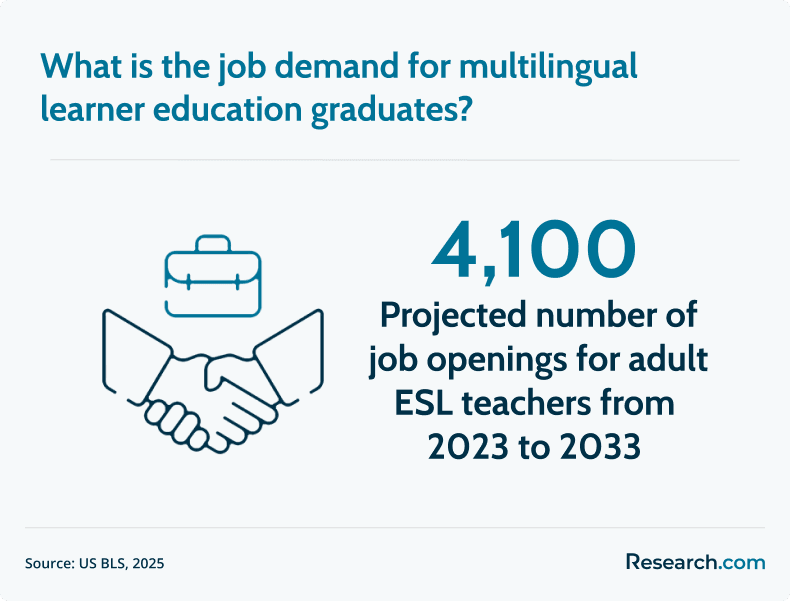
Job prospects vary by state, school funding, licensure area, grade level, and role. Employment for adult ESL teachers may decline by 13% from 2023 to 2033, but about 4,100 openings are projected annually due to workforce turnover. Graduates with specialized preparation may pursue opportunities in K–12 schools, adult learning centers, higher education, nonprofits, curriculum companies, and international education settings.
Current trends affecting multilingual learner education
Several trends are shaping how educators support multilingual learners. Schools are placing greater emphasis on culturally sustaining instruction, family engagement, language access, dual-language models, and equitable assessment. Digital learning tools and AI-supported translation can assist communication, but they do not replace trained educators who understand language development, academic scaffolding, cultural context, and student identity.
Interdisciplinary learning is also becoming more valuable. Coursework informed by fields such as linguistics, sociology, literacy studies, and anthropology online degrees can help educators understand how language, culture, migration, identity, and power shape classroom experiences.
What graduates say about online master’s programs in multilingual learner education
- : "The online format let me keep teaching while I studied language acquisition and applied new strategies with my students almost immediately. — Luis"
- : "Collaborating with classmates from different regions helped me see multilingual education beyond my own district. The culturally responsive teaching work changed how I plan lessons. — Elena"
- : "I expected online learning to feel distant, but regular faculty feedback and flexible coursework made the program feel personal and practical. — Nadia"
How student support services affect online master’s student success
Support services can strongly influence whether online students persist, complete fieldwork, and stay on track for licensure or career advancement. Look for dedicated academic advising, licensure guidance, technical help, virtual library access, tutoring, writing support, career counseling, and opportunities to network with peers and faculty.
This is especially important for working educators who may be completing coursework at night while managing teaching responsibilities during the day. Students comparing affordability and online support structures in other graduate fields may also review affordable MLIS online degrees for examples of how online programs present cost and student service information.
Common mistakes to avoid
- Choosing a program before checking licensure rules: Always verify state requirements before applying, especially if you may move after graduation.
- Focusing only on tuition: Fees, testing, books, background checks, travel, and reduced work hours can change the total cost.
- Assuming online means fully remote: Some programs require practicum placements, live sessions, residencies, or local school partnerships.
- Ignoring accreditation: Unrecognized or misaligned programs may not support employment, licensure, salary advancement, or doctoral admission.
- Using rankings as the only decision tool: A highly ranked program is not automatically the best fit for your state, schedule, specialization, or budget.
- Confusing TESOL, ESL, bilingual education, and dual language: These areas overlap, but they may lead to different credentials and career paths.
- Assuming salary outcomes are guaranteed: Pay depends on district contracts, location, licensure, experience, union rules, and role.
References
- DataUSA (n.d.). Bilingual & Multilingual Education. Retrieved from DataUSA bilingual and multilingual education profile
- UNESCO (2024). Multilingual Education: A Key to Quality and Inclusive Learning. Retrieved from UNESCO multilingual education article
- US BLS (2025). Adult Basic and Secondary Education and ESL Teachers. Retrieved from BLS adult basic and ESL teachers outlook
- Zippia (2025). What is an ESL Teacher and How to Become One. Retrieved from Zippia ESL teacher career profile
- ZipRecruiter (2025). Bilingual Education Teacher Salary. Retrieved from ZipRecruiter bilingual education teacher salary page
Key Insights
- An online master’s in multilingual learner education is best for educators who want advanced preparation in ESL, bilingual education, TESOL, multilingual literacy, or culturally responsive instruction without leaving the workforce.
- Program titles can be misleading. Confirm whether a degree leads to licensure, endorsement, professional development, or non-licensure specialization before enrolling.
- Among the listed programs, cost per credit ranges from $367 to $763, and program lengths range from 12 months to 30 months depending on pace and requirements.
- Accreditation and state approval are essential if you plan to teach in public schools or use the degree for endorsement, salary advancement, or future doctoral study.
- The strongest programs combine language acquisition, assessment, bilingual literacy, culturally responsive pedagogy, and supervised practice with strong online student support.
- Do not choose based on ranking or tuition alone. The better decision is the program that fits your state requirements, target learners, schedule, fieldwork needs, and long-term career plan.
Other Things You Should Know About the Best Online Master's in Multilingual Learner Education Programs
Yes. Most 30- to 36-credit online master’s programs require a capstone, action research project, or thesis before graduation. The final project usually shows how you apply bilingual or ESL instruction, assessment, and family engagement strategies in a classroom or school setting.
Yes, some 2027 online Master’s programs in Multilingual Learner Education do offer a practicum waiver for current teachers. This option is typically available to those with relevant professional experience, recognizing their practical insights and allowing them to focus on theoretical and research-based aspects of the curriculum.