
2027 Best Online Cybersecurity Bootcamps

Co-Founder and Chief Data Scientist
With an estimated 3.5 million unfilled cybersecurity jobs globally, the feeling that you're missing out on a major career opportunity is completely valid. For many people looking to make a change, the path seems unclear, expensive, or reserved only for those with years of specific experience.
High-quality online cybersecurity bootcamps have emerged as a powerful and direct answer to this challenge, designed to build job-ready skills in a fraction of the time of a traditional degree. To help you navigate this important decision, our career planning experts have developed this comprehensive guide to choosing the best program for your goals.
What are the benefits of getting an online cybersecurity bootcamp program?
- Enter a high-demand field where you can protect critical data for businesses and individuals, offering a clear path for career advancement.
- Achieve significant earning potential, with the median salary for information security analysts standing at $124,910 per year.
- Gain these skills with the flexibility of an online format that can fit around your current life and work commitments.
What can I expect from an online cybersecurity bootcamp program?
You should expect an accelerated and intensive learning environment. The core of the experience is hands-on learning. You won’t just be listening to lectures—you'll be actively working on projects that simulate real-world security challenges.
It’s best to view this program as the first, most critical step in your new career. From there, you can pursue specializations with credentials in areas like ethical hacking. Later, you can aim for management roles with advanced certifications like the CISM or CISSP.
Where can I work with an online cybersecurity bootcamp program?
Because virtually every organization needs to protect its digital assets, you can find work in almost any industry you can think of. Your skills won't be limited to traditional tech companies. This widespread demand means you have the flexibility to pursue a career in an industry that genuinely interests you, whether that's protecting patient data at a hospital or securing financial transactions at a bank.
Some of the top sectors employing cybersecurity professionals include computer systems design, finance and insurance, and information services. However, you'll also find critical roles in healthcare, government, and retail.
How much can I make with an online cybersecurity bootcamp program?
The earning potential in this field is significant. According to the U.S. Bureau of Labor Statistics, the median annual salary for information security analysts is $124,910.
You can view this as the midpoint for the entire profession. As a bootcamp graduate entering the field, your starting salary will be a solid foothold on a path toward that number. With a few years of experience and a proven track record, your potential for high earnings grows quickly.
- List of the Best Online Cybersecurity Bootcamp Programs for 2027 List of Bootcamps
- How long does it take to complete an online cybersecurity bootcamp program? Completion Time
- How does an online cybersecurity bootcamp program compare to an on-campus program? How does an online cybersecurity bootcamp program compare to an on-campus program?
- What is the average cost of an online cybersecurity bootcamp program? Program Cost
- What are the financial aid options for students enrolling in an online cybersecurity bootcamp program? Financial Aid
- What are the prerequisites for enrolling in an online cybersecurity bootcamp program? What are the prerequisites for enrolling in an online cybersecurity bootcamp program?
- What courses are typically in an online cybersecurity bootcamp program? What courses are typically in an online cybersecurity bootcamp program?
- What types of specializations are available in an online cybersecurity bootcamp program? What types of specializations are available in an online cybersecurity bootcamp program?
- What alternative academic opportunities can enhance my cybersecurity career? What alternative academic opportunities can enhance my cybersecurity career?
- How to Choose the Best Online Cybersecurity Bootcamp Program How to Choose the Best Online Cybersecurity Bootcamp Program
- What career paths are available for graduates of an online cybersecurity bootcamp program? Career Paths
- What is the job market for graduates with an online cybersecurity bootcamp program? Job Market
- How does an online cybersecurity bootcamp compare to a computer science accelerated degree? How does an online cybersecurity bootcamp compare to a computer science accelerated degree?
Best Online Cybersecurity Bootcamp Programs for 2027
Choosing an online cybersecurity bootcamp is a high-stakes decision: the right program can help you build job-ready security skills quickly, while the wrong one can leave you with debt, weak career support, or training that does not match employer expectations. This guide is designed for career changers, IT professionals, recent graduates, and working adults comparing online cybersecurity bootcamps for cost, schedule, curriculum quality, certification preparation, and career outcomes.
You will find a ranked list of online cybersecurity bootcamp programs, a practical comparison of bootcamps versus degrees, guidance on costs and financial aid, common courses and specializations, career paths, and a checklist for evaluating programs before you enroll.
Quick Answer: Are Online Cybersecurity Bootcamps Worth Considering?
Online cybersecurity bootcamps can be worth considering if you want focused, hands-on training for entry-level security roles and need a shorter path than a traditional degree. They are best for learners who can commit consistent weekly study time, build a portfolio, prepare for certifications such as CompTIA Security+, and actively network during the job search. They are not a guaranteed shortcut to employment, and they may not replace a degree for employers or roles that explicitly require one.
| Best for | Be cautious if | What to verify before enrolling |
| Career changers, IT support workers, junior developers, veterans, and motivated beginners who want structured cybersecurity training | You need federal financial aid, require a degree for promotion, cannot study consistently, or expect a job guarantee | Accreditation connection, curriculum depth, instructor background, hands-on labs, certification vouchers, career services, and graduate outcomes |
How We Rank the Programs
Because bootcamp tuition can be a major financial commitment, our ranking approach emphasizes transparency, verifiable school information, and practical value for students. Research.com uses trusted education data sources, including the IPEDS database, Peterson's database, the College Scorecard database, and The National Center for Education Statistics, to help evaluate programs and institutions. You can learn more about our evaluation process on the Research.com methodology page.
Online Cybersecurity Bootcamp Programs Compared
| Rank | Program | Format and Length | Cost | Accreditation Listed |
| 1 | University of California, Los Angeles Extension - Cybersecurity Certificate | Online or in person; 4 courses, self-paced | $5,475.00 | WASC Senior College and University Commission (WSCUC) |
| 2 | University of Texas at Austin - Texas McCombs Cybersecurity Program | Online; 20 weeks | $2,950.00 | Southern Association of Colleges and Schools Commission on Colleges (SACSCOC) |
| 3 | Woz U - Cybersecurity Training Program | Online training; 33 weeks | Pricing available upon request | Not available |
| 4 | University of South Florida - USF CTPE Online Cyber Security Bootcamp | 100% online; 6 months | $10,900.00 | Southern Association of Colleges and Schools Commission on Colleges (SACSCOC) |
| 5 | University of Maryland Global Campus - Cybersecurity Bootcamp | Online; 6 months | $10,900.00 | Middle States Commission on Higher Education (MSCHE) |
| 6 | University of Massachusetts Global - Online Cyber Security Bootcamp | Online; 6 months | $10,900.00 | WASC Senior College and University Commission (WSCUC) |
| 7 | Pennsylvania State University - Cybersecurity Bootcamp | Online platform; 32 weeks | $14,490.00 | Middle States Commission on Higher Education (MSCHE) |
| 8 | Central Washington University - Online Cybersecurity Bootcamp | 100% online; 10-18 weeks | $8,700.00 | Northwest Commission on Colleges and Universities (NWCCU) |
1. University of California, Los Angeles Extension - Cybersecurity Certificate
University of California, Los Angeles Extension offers a flexible cybersecurity certificate that students may complete online or in person. The four-course, self-paced structure is designed to introduce core security concepts while giving learners practice with both defensive and offensive tools. The curriculum also supports preparation for the CompTIA Security+ certification.
- Program Length: 4 courses (self-paced)
- Total Program Fee: $5,475.00
- Accreditation: WASC Senior College and University Commission (WSCUC)
2. University of Texas at Austin - Texas McCombs Cybersecurity Program
The University of Texas at Austin offers a 20-week online cybersecurity program focused on practical technical training, project work, and live mentorship. Students study areas such as network security, cloud security, penetration testing, and risk governance, making the program a strong fit for learners who want a structured but relatively short training path.
- Program Length: 20 weeks
- Program Fee: $2,950.00
- Accreditation: Southern Association of Colleges and Schools Commission on Colleges (SACSCOC)
3. Woz U - Cybersecurity Training Program
Woz U provides a 33-week cybersecurity training program centered on applied skills, including packet analysis, vulnerability analysis, and Python programming. The program is built by industry professionals and is intended to help students prepare for the CompTIA Security+ exam and for roles that involve protecting IT systems and infrastructure.
- Program Length: 33 weeks
- Total Tuition: Pricing available upon request
- Accreditation: Not available
4. University of South Florida - USF CTPE Online Cyber Security Bootcamp
The University of South Florida offers a six-month, fully online cybersecurity bootcamp that includes 55 labs and a mentor-supported capstone project. The program places emphasis on job preparation through 1:1 career coaching and includes a free voucher for the CompTIA Security+ certification exam.
- Program Length: 6 months
- Total Tuition: $10,900.00
- Accreditation: Southern Association of Colleges and Schools Commission on Colleges (SACSCOC)
5. University of Maryland Global Campus - Cybersecurity Bootcamp
The University of Maryland Global Campus delivers a six-month online cybersecurity bootcamp with hands-on projects and a mentor-led capstone. Students also receive 1:1 career coaching, and graduates are provided a voucher to take the CompTIA Security+ exam after completing the program.
- Program Length: 6 months
- Total Tuition: $10,900.00
- Accreditation: Middle States Commission on Higher Education (MSCHE)
6. University of Massachusetts Global - Online Cyber Security Bootcamp
The University of Massachusetts Global offers a six-month online cybersecurity bootcamp that combines 55 technical labs with a mentor-guided capstone project. The program includes 1:1 career coaching and a CompTIA Security+ exam voucher, which can add value for students planning to pursue certification soon after finishing.
- Program Length: 6 months
- Total Tuition: $10,900.00
- Accreditation: WASC Senior College and University Commission (WSCUC)
7. Pennsylvania State University - Cybersecurity Bootcamp
Pennsylvania State University offers a 32-week cybersecurity bootcamp delivered through an AI-powered online platform. The training uses role-based exercises and adaptive learning to help students progress from core security concepts to more advanced skills used in real cybersecurity work and certification preparation.
- Program Length: 32 weeks
- Program Fee: $14,490.00
- Accreditation: Middle States Commission on Higher Education (MSCHE)
8. Central Washington University - Online Cybersecurity Bootcamp
Central Washington University offers a 100% online cybersecurity bootcamp that can be completed in 10-18 weeks. Students gain applied experience through virtual labs and career simulations, and the program includes targeted preparation plus a voucher for the CompTIA Security+ exam.
- Program Length: 10-18 weeks
- Total Tuition: $8,700.00
- Accreditation: Northwest Commission on Colleges and Universities (NWCCU)
How Long Does It Take to Complete an Online Cybersecurity Bootcamp?
Most high-quality online cybersecurity bootcamps take between 18 and 33 weeks to complete, although individual programs may be shorter or longer depending on intensity, schedule, and required projects. Accelerated formats move quickly and may demand substantial weekly study time, while part-time formats are usually better for students balancing work, caregiving, or military responsibilities.
If speed is your top priority, compare bootcamps carefully against the shortest cybersecurity training programs, but do not choose based on duration alone. A shorter program is only valuable if it still includes labs, mentoring, portfolio work, and enough time to absorb technical material.
Plan Beyond the Last Class
Your real timeline should include more than the formal bootcamp calendar. Many students need time for pre-work before the first module, certification study during or after the program, portfolio refinement, resume updates, interview practice, and networking.
It is also realistic to expect the first cybersecurity job search to take additional time after graduation. Building employer-ready evidence of your skills is just as important as completing the curriculum.
| Timeline Component | Why It Matters | What to Do |
| Pre-work | Helps beginners get comfortable with networking, operating systems, or command-line basics | Ask whether the bootcamp provides required or optional preparation materials |
| Bootcamp training | Builds technical skills through lessons, labs, and projects | Confirm weekly time expectations before enrolling |
| Certification preparation | Can strengthen your resume for entry-level roles | Check whether the program aligns with CompTIA Security+ or another credential |
| Job search | Requires applications, interviews, networking, and portfolio presentation | Use career coaching early rather than waiting until graduation |
Online vs. On-Campus Cybersecurity Bootcamps: Which Format Is Better?
The best format depends on how you learn, how much structure you need, and what your schedule allows. Online cybersecurity bootcamps are usually the stronger choice for learners who need location flexibility, evening or weekend study options, or access to training without relocating. On-campus bootcamps may be better for students who prefer face-to-face interaction, fixed class times, and in-person peer accountability.
Employers are typically less concerned with whether a bootcamp was online or in person than with whether you can demonstrate real skills. Labs, projects, command-line fluency, security tools, documentation, communication, and problem-solving matter more than the delivery format.
| Factor | Online Bootcamp | On-Campus Bootcamp |
| Flexibility | Usually stronger for working adults and remote learners | Less flexible but more structured |
| Peer interaction | May rely on forums, chat, video sessions, and virtual labs | Often easier to build in-person study groups |
| Access | Available from anywhere with reliable internet | Limited by location and commute |
| Employer value | Depends on skills, projects, certification preparation, and career support | Depends on the same practical outcomes |
Bootcamp vs. Cybersecurity Degree
A bootcamp is designed for speed and applied job preparation. A degree usually provides broader academic grounding, general education, theory, and longer-term credential value. If your goal is to move into cybersecurity as quickly as possible, a bootcamp may be practical. If you want broader advancement options, graduate study later, or roles that require a bachelor's degree, a degree path may be stronger.
Students who want a degree but still care about speed can compare programs such as the fastest online bachelor's in cybersecurity. The right choice depends on your existing education, budget, target job descriptions, and how much time you can commit.
What Is the Average Cost of an Online Cybersecurity Bootcamp?
The programs listed in this guide range from $2,950 to $14,490, with a typical comprehensive program cost of around $9,200. Pricing may depend on program length, university partnership, live instruction, mentoring, lab access, career coaching, and whether certification exam fees are included. More advanced certification-focused options, including CISM online training, may have similar or higher costs depending on instructor expertise and bundled exam preparation.
Do not judge affordability by tuition alone. A lower-cost program may become less valuable if it lacks career support, updated labs, or certification alignment. A higher-cost program may be reasonable if it includes strong mentoring, employer connections, hands-on projects, and exam vouchers that you would otherwise pay for separately.
| Cost Item | Why It Affects Value | Question to Ask |
| Tuition | The largest direct cost | Is the published price the full amount, or are there added fees? |
| Certification exam voucher | Can reduce out-of-pocket costs for credentials such as CompTIA Security+ | Is the voucher included, and when can I use it? |
| Hardware or software | Some labs may require a capable computer or specific tools | What technical setup do students need before class starts? |
| Career services | Resume help, mock interviews, and job search coaching can influence outcomes | Are services included during and after the program? |
| Time away from work | Intensive programs may reduce available work hours | Can I realistically meet the weekly workload while employed? |
How to Think About Salary and Return on Investment
The average salary for a cybersecurity analyst is $88,422 per year, while the top 10% of analysts earn $117,000 or more. These figures show why many students view cybersecurity training as a career investment, but they should not be treated as guaranteed outcomes. Your compensation will depend on location, prior experience, certifications, interview performance, employer type, and the level of the role you obtain.
Graduates who build strong portfolios and target employers with mature security teams may find opportunities across technology, finance, insurance, consulting, government, and other sectors. Some students may also research employers such as the top 100 cybersecurity companies when planning a job search, but the best target list should match your skills and location preferences.
What Financial Aid Options Are Available for Online Cybersecurity Bootcamps?
Cybersecurity bootcamps do not always qualify for the same funding options as degree programs, so students should confirm payment choices before applying. While many bootcamps are not eligible for FAFSA, some learners may be able to use scholarships, employer tuition assistance, payment plans, personal loans, Income Share Agreements (ISAs), or workforce training funds such as the Workforce Innovation and Opportunity Act (WIOA).
Funding terms vary widely. Before signing an enrollment agreement, read the refund policy, interest terms, ISA repayment cap, late payment rules, and any conditions tied to job placement or income.
| Funding Option | Potential Advantage | Risk or Limitation |
| Scholarships | Can reduce tuition without repayment | May be competitive or limited to specific groups |
| Employer tuition assistance | Useful if your current employer needs cybersecurity skills | May require continued employment or manager approval |
| Payment plan | Spreads the cost over time | May include fees or strict payment deadlines |
| Personal loan | Can cover tuition upfront | Interest costs can increase the total price |
| Income Share Agreement | May delay payment until after employment | Repayment terms can be expensive if your income rises |
| WIOA or workforce funding | Can help eligible job seekers retrain | Availability depends on location and eligibility |
Two Funding Moves Students Often Miss
First, ask your employer whether cybersecurity training qualifies for tuition reimbursement or professional development funds. This is especially worth exploring if you already work in IT support, systems administration, networking, compliance, software development, or risk management.
Second, compare what each bootcamp includes in tuition. A program that bundles career coaching and a certification voucher may be more cost-effective than a cheaper option that requires you to pay for those services separately. Students comparing unrelated professional pathways, such as an online EdS degree in leadership, should use the same principle: calculate total cost, not only tuition.
What Are the Prerequisites for an Online Cybersecurity Bootcamp?
Many beginner-friendly cybersecurity bootcamps do not require a computer science degree, prior coding experience, or a formal IT background. They are often built for students who are motivated, analytical, and willing to learn technical material quickly. However, “beginner-friendly” does not mean easy. Cybersecurity requires persistence, troubleshooting, documentation, and comfort with unfamiliar systems.
Students come to cybersecurity from many fields, including education, operations, military service, customer support, and software development. Someone with an academic background outside technology, such as a master's in multilingual learner education online, may still transition successfully if they build technical fundamentals and can explain their transferable skills clearly.
Helpful Skills Before You Start
- Basic computer literacy: You should be comfortable installing software, managing files, and troubleshooting simple issues.
- Problem-solving: Security work often involves investigating unclear alerts and narrowing down possible causes.
- Communication: Analysts must explain risks, document incidents, and work with technical and nontechnical teams.
- Curiosity: Strong learners ask why systems fail, how attackers think, and how controls reduce risk.
- Time management: Labs and projects can take longer than expected, especially for beginners.
Do Cybersecurity Analysts Usually Have Degrees?
Many cybersecurity analysts do hold bachelor's degrees, but that does not mean a degree is the only possible entry route. Bootcamps can help learners build practical evidence of ability through labs, capstone projects, and certification preparation. The key is to translate training into visible proof: a portfolio, clear project writeups, a polished resume, and interview-ready explanations of what you built or investigated.
What Courses Are Usually Included in an Online Cybersecurity Bootcamp?
A strong online cybersecurity bootcamp should teach the fundamentals that entry-level analysts use on the job. The best programs go beyond lectures and include virtual labs, guided investigations, real-world scenarios, documentation practice, and a final project that demonstrates applied skills.
Like other career-change programs, including specialized options such as masters in nursing programs for non nurses, cybersecurity bootcamps are designed to help learners move from limited background knowledge toward a defined professional skill set in a compressed format.
| Course Area | What You Learn | Why Employers Care |
| Network Security | How networks operate, how traffic moves, and how to protect systems from unauthorized access | Most security incidents involve networks, endpoints, identity, or cloud infrastructure |
| Ethical Hacking | How attackers identify and exploit weaknesses so defenders can fix them | Helps analysts understand vulnerabilities from an offensive perspective |
| Cryptography | How encryption protects sensitive data and supports secure communication | Encryption is central to data protection, authentication, and compliance |
| Security Governance and Compliance | How policies, regulations, controls, and risk management guide security decisions | Many cybersecurity roles require documentation, audit readiness, and business judgment |
| Cloud Security | How to protect cloud environments, permissions, workloads, and configurations | Organizations increasingly rely on cloud infrastructure, which creates new security risks |
| Incident Response | How to detect, analyze, contain, and report security events | Entry-level analysts often begin by monitoring alerts and escalating incidents |
Current Trend: Cloud and AI Are Changing Bootcamp Curricula
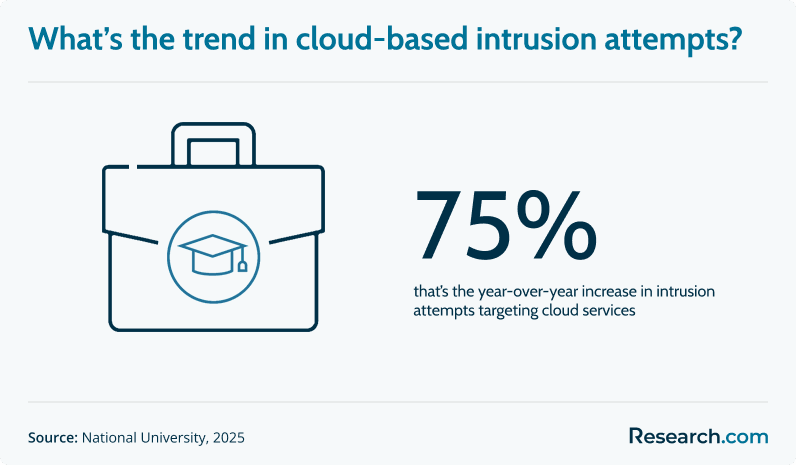
Cybersecurity training is shifting because modern attacks increasingly target cloud environments, identity systems, software supply chains, and poorly configured tools. With cloud environment intrusions increasing by 75% in just the last year, bootcamps that include cloud security, log analysis, access control, and incident response are more aligned with current employer needs.
AI is also influencing training delivery and security work. Some programs now use adaptive platforms or AI-supported practice environments, but students should still prioritize fundamentals. Tools change quickly; the ability to reason through risk, verify evidence, and communicate findings remains essential.
Students who want a narrower offensive-security path may compare foundational bootcamps with a fast-track program in ethical hacking, especially if their goal is penetration testing rather than general security analysis.
What Cybersecurity Bootcamp Specializations Are Available?
Most beginners should start with a broad cybersecurity foundation before specializing. After gaining experience, a specialization can help you qualify for more focused roles, higher-responsibility work, or management tracks.
| Specialization | Best Fit | Common Focus |
| Penetration Testing and Ethical Hacking | Learners who enjoy offensive security, testing systems, and writing technical findings | Vulnerability discovery, exploit testing, reporting, and remediation guidance |
| Cloud Security | Students interested in AWS, Azure, identity, configuration, and cloud infrastructure | Cloud access controls, workload protection, monitoring, and secure architecture |
| Digital Forensics | Learners who like investigation, evidence handling, and post-incident analysis | Breach investigation, log review, data recovery, and forensic reporting |
| Governance, Risk, and Compliance (GRC) | Professionals with strong communication, policy, audit, or business backgrounds | Risk assessment, compliance programs, security policies, and controls |
Using Certifications to Advance After a Bootcamp
A bootcamp can help you enter the field, but advanced certifications often become more useful after you have professional experience. For example, a learner who starts as a SOC analyst and later moves into risk or security management may eventually consider a fast-track program to CISM certification. The strongest certification strategy depends on your job target, experience level, and whether you want technical, managerial, or compliance-focused roles.
What Academic Options Can Strengthen a Cybersecurity Career?
A bootcamp is not the only way to build cybersecurity expertise. Some professionals combine bootcamp training with academic study to deepen theory, broaden career options, or move into specialized industries. For example, a technical professional interested in satellite systems, aerospace infrastructure, or space-sector security might explore an online space systems degree as a complementary path rather than a direct bootcamp substitute.
If you are comparing cybersecurity training with a broader technology degree, consider how much flexibility you want. A computer science accelerated degree usually covers programming, algorithms, systems, and broader computing foundations, while a cybersecurity bootcamp is more narrowly focused on practical security skills for faster workforce preparation.
How to Choose the Best Online Cybersecurity Bootcamp
The best online cybersecurity bootcamp is the one that matches your current skill level, schedule, budget, and target role. A polished website is not enough. You need evidence that the program teaches relevant skills, provides meaningful practice, and supports students through the job search.
Use This Bootcamp Evaluation Checklist
| What to Check | Why It Matters | Red Flag |
| Curriculum depth | Cybersecurity roles require more than definitions; you need labs, tools, and scenarios | The syllabus lists buzzwords but no projects or measurable skills |
| Instructor experience | Current practitioners can connect lessons to real security work | No clear instructor bios or recent industry experience |
| Hands-on labs | Employers want proof that you can use tools and investigate problems | The program is mostly video lectures or quizzes |
| Certification alignment | Credentials can help entry-level candidates pass resume screens | The program mentions certifications but does not prepare for a specific exam |
| Career services | Job search support can help you translate training into interviews | Vague promises of career help without details |
| Graduate outcomes | Placement data can help you judge risk | Only general employment claims, not cybersecurity-specific outcomes |
| Refund and payment terms | Bootcamp contracts can be expensive and binding | Unclear cancellation rules, ISA terms, or financing costs |
Questions to Ask Admissions Advisors
- What percentage of graduates obtain cybersecurity-related roles, not just any job?
- Which employers have hired recent graduates?
- How many hours per week should students realistically plan to study?
- What projects will I complete, and can I show them to employers?
- Who teaches the program, and what recent cybersecurity experience do they have?
- Does tuition include certification exam vouchers?
- What happens if I fall behind?
- Are career services available after graduation, and for how long?
- What is the refund policy if I withdraw early?
Common Mistakes to Avoid
| Mistake | Why It Can Hurt You | Better Approach |
| Choosing the cheapest program automatically | Low tuition may come with limited labs, weak support, or no certification preparation | Compare total value, not only price |
| Ignoring accreditation and institutional connection | Not all bootcamps have the same academic or employer recognition | Verify the school, provider, and accreditation listed |
| Assuming a bootcamp guarantees a job | Employment depends on skills, effort, market conditions, and interview performance | Treat career services as support, not a promise |
| Waiting until graduation to network | Cybersecurity hiring often rewards referrals and demonstrated engagement | Start building connections early through events, forums, and LinkedIn |
| Skipping fundamentals | Tools are easier to learn when you understand networks, systems, and identity | Strengthen basics before chasing advanced topics |
| Relying only on rankings | A highly ranked program may still be a poor fit for your schedule or goals | Use rankings as a starting point, then vet the program yourself |
What Career Paths Are Available After an Online Cybersecurity Bootcamp?
Cybersecurity bootcamps most often prepare students for entry-level or early-career roles. Your first position may not be your dream job, but it can provide the experience needed to move into higher-paying and more specialized work later.
| Role | Typical Responsibilities | Good Fit For |
| Cybersecurity Analyst | Monitor systems, review alerts, document incidents, and help protect networks and data | Students who want a broad defensive security role |
| SOC Analyst | Work in a Security Operations Center to detect, triage, and escalate threats | Entry-level candidates who enjoy investigation and shift-based monitoring |
| Security Consultant | Assess client environments, identify risks, and recommend improvements | Strong communicators who can explain technical findings to different audiences |
| Penetration Tester | Ethically test systems for vulnerabilities and write reports for remediation | Learners with strong technical curiosity and offensive-security interest |
Long-Term Advancement
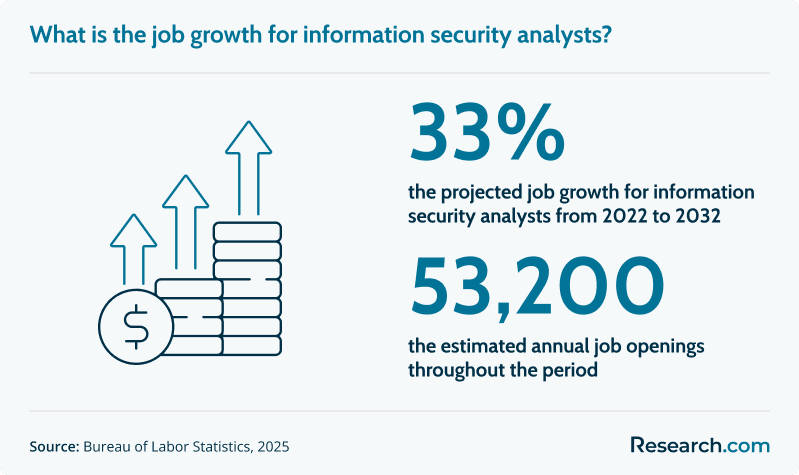
Employment for information security analysts is projected to grow 33% by 2033, with an average of 17,300 new openings each year. This outlook reflects the continued need for organizations to protect data, systems, infrastructure, and digital operations.
With experience, cybersecurity professionals may advance into roles such as senior analyst, security engineer, security architect, incident response lead, GRC manager, or Chief Information Security Officer (CISO). Those who want graduate-level preparation for leadership or advanced technical work can compare options such as the fastest online master's in cybersecurity.
What Is the Job Market Like for Cybersecurity Bootcamp Graduates?
The cybersecurity job market is strong, but entry-level hiring is still competitive. Employers need security talent, yet they also expect candidates to show practical ability. A bootcamp can help, but students should pair it with certification preparation, portfolio projects, networking, and clear evidence of transferable skills.
Cybersecurity demand is not limited to technology companies. Finance, insurance, information, consulting, healthcare, government, and management organizations all need security professionals. This gives graduates more flexibility to target industries where their previous experience may be an advantage.
How to Improve Your Chances After Graduation
- Build a portfolio: Document labs, capstone projects, incident response exercises, and security tool usage.
- Prepare for certification: If your program aligns with CompTIA Security+, set a study plan before graduation.
- Translate past experience: Customer service, military operations, compliance, teaching, software development, and IT support can all provide useful cybersecurity skills.
- Apply strategically: Target SOC analyst, junior security analyst, IT security specialist, and risk support roles rather than only advanced positions.
- Practice interviews: Be ready to explain what you did in labs, how you investigated alerts, and how you think through risk.
What Graduates Say About Online Cybersecurity Bootcamps
- Jessica: "After ten years in marketing, I assumed cybersecurity was out of reach. The program was demanding, but the instructors broke difficult topics into steps I could actually practice. Setting up a virtual network and learning how to defend it changed the way I saw my own abilities. A few months earlier, I barely understood firewalls; now I work with them every day."
- Mark: "I could not quit work or put my family life on hold, so the online part-time schedule mattered. I studied after my son went to sleep and used weekends for labs. It was a hard stretch, but it let me train for a better career without giving up stability. I accepted a job before I officially completed the program."
- Charles: "I came in as a developer who knew how to write code but not how attackers could abuse it. The bootcamp helped me understand SQL injection, cross-site scripting, and secure design from a completely different angle. That knowledge made me more useful on my team and opened career options I had not considered before."
How Does an Online Cybersecurity Bootcamp Compare to an Accelerated Computer Science Degree?
An online cybersecurity bootcamp is usually shorter, narrower, and more job-task focused than an accelerated computer science degree. It is built around practical security tools, labs, threat detection, risk concepts, and certification preparation. An accelerated computer science degree covers broader computing foundations and can support a wider range of technology roles beyond cybersecurity.
| Path | Best For | Main Trade-Off |
| Cybersecurity bootcamp | Learners who want focused security training in a shorter timeline | May not satisfy employers that require a degree |
| Accelerated computer science degree | Students seeking broader technology preparation and degree recognition | Usually requires more time and academic coursework |
| Bootcamp plus later degree or certification | Professionals who want to enter the field first and deepen credentials later | Requires long-term planning and additional investment |
References
- AP News. (2024). Technology news release (via EIN Presswire). Retrieved May 24, 2024, from AP News technology release
- Cybersecurity Education. (2023, May 23). Cyber security bootcamps: Everything you need to know. Retrieved May 24, 2024, from Cybersecurity Education bootcamp guide
- National University. (2025). Cybersecurity statistics. Retrieved May 24, 2024, from National University cybersecurity statistics
- U.S. Bureau of Labor Statistics. (2025). Information security analysts. Occupational Outlook Handbook. Retrieved May 24, 2024, from BLS Information Security Analysts profile
- Zippia. (2025). Cyber security analyst demographics and workforce stats. Retrieved May 24, 2024, from Zippia cybersecurity analyst demographics
- Zippia. (2025, January 8). Cyber security analyst education requirements. Retrieved May 24, 2024, from Zippia cybersecurity analyst education requirements
- Zippia. (2025, January 8). Cyber security analyst salaries. Retrieved May 24, 2024, from Zippia cybersecurity analyst salaries
Key Insights
- Online cybersecurity bootcamps are best for learners who want focused, hands-on security training and can commit to labs, projects, certification study, and an active job search.
- Program cost varies widely, from $2,950 to $14,490 among the listed options, so compare total value rather than tuition alone.
- A strong bootcamp should include practical labs, portfolio-worthy projects, instructor access, career coaching, and clear alignment with entry-level cybersecurity roles.
- Bootcamps can support career entry, but they do not guarantee employment and may not replace a degree for roles that explicitly require one.
- Cybersecurity career growth is supported by strong labor demand, with information security analyst employment projected to grow 33% by 2033 and an average of 17,300 new openings each year.
- The smartest enrollment decision comes from asking hard questions about outcomes, refund policies, certification vouchers, instructor experience, and the exact support available after graduation.
Other Things You Should Know About Online Cybersecurity Bootcamp Programs
The admissions process for top online cybersecurity bootcamps in 2027 typically involves submitting an application, taking an assessment test, and undergoing an interview. Some bootcamps may also require a prerequisite coding knowledge or completion of preliminary courses. Each bootcamp has its own specific set of criteria to assess the readiness of applicants.
Networking during your bootcamp is extremely important for your future job search. You should make an effort to build relationships with your instructors, any guest speakers, and your fellow students. These individuals become your first professional network in the industry. Many job opportunities come from referrals, so the connections you make during your program can be just as valuable as the technical skills you learn.
In 2027, top online cybersecurity bootcamps generally require a high school diploma or equivalent, familiarity with IT concepts, and sometimes basic programming skills. Some bootcamps may ask for a personal interview or an entrance test to assess aptitude and motivation.


