
2027 Best Online Direct Entry MSN Programs for Non-Nurses

Co-Founder and Chief Data Scientist
A Master of Science in Nursing (MSN) gives healthcare professionals a significant edge in today’s evolving medical landscape. With advanced training in clinical care, leadership, and healthcare systems, an MSN can lead to high-demand roles known for strong job growth and competitive salaries.
The good news is that individuals without a nursing background can now enter the field through direct-entry MSN programs, making a career shift into nursing more accessible than ever, without having to start from scratch. What’s more, there are flexible, online options, allowing students to earn their degree while balancing other commitments.
In this article, we’ll guide you through the best online direct entry MSN programs for non-nurses to help you take the next step toward a meaningful and impactful healthcare career.
What are the benefits of pursuing online direct-entry MSN programs for non-nurses?
Pursuing an online direct-entry MSN program offers a strategic and accessible path for non-nurses to launch a career in advanced nursing. These programs come with a range of benefits that make the transition into healthcare both practical and rewarding.
- Accessible to Non-Nurses: Designed specifically for individuals without a nursing background, allowing career changers to enter the healthcare field without starting over.
- Flexible Learning Format: Online programs offer the convenience of learning from home, making it easier to balance studies with work or personal commitments.
- Accelerated Career Path: Combines foundational nursing education with graduate-level coursework, helping you earn both RN licensure and an MSN in a streamlined program.
- Preparation for Advanced Roles: Graduates qualify for high-demand positions like nurse practitioner, clinical nurse leader, or nurse educator.
- Strong Job Outlook and Earning Potential: Advanced practice nurses often enjoy greater job stability, autonomy, and higher salaries compared to entry-level RNs.
- Diverse Student Backgrounds: Programs value non-traditional applicants, allowing those from fields such as biology, psychology, or public health to bring fresh perspectives to nursing.
- Personal and Professional Impact: Enables a career shift into a meaningful, people-focused profession with opportunities to make a real difference in patient outcomes.
What can I expect from online direct entry MSN programs for non-nurses?
Online direct-entry MSN programs are designed to take non-nurses from foundational nursing knowledge to advanced practice in a condensed, intensive format. Most programs begin with a pre-licensure phase, where you’ll study core nursing subjects like anatomy, pharmacology, and clinical practice.
After passing the NCLEX-RN exam and earning your RN license, you'll move into the graduate-level coursework, which focuses on advanced topics such as healthcare leadership, population health, and your chosen specialization (e.g., family nurse practitioner or nurse educator).
While the coursework is primarily online, expect to complete in-person clinical hours and possibly on-campus intensives, depending on the school. These hands-on components are essential for gaining real-world experience and meeting licensure requirements.
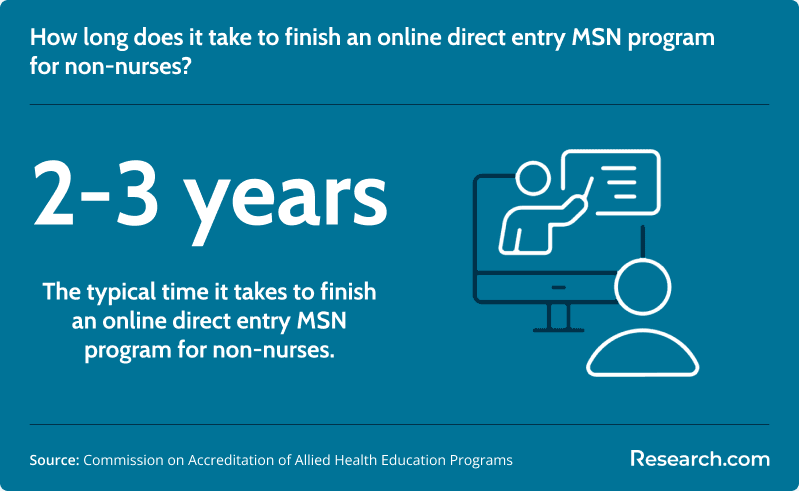
Programs typically take 2 to 3 years to complete, depending on whether you study full-time or part-time. Overall, you can expect a rigorous but rewarding experience that prepares you to deliver high-quality care and take on leadership roles in the healthcare system.
Where can I work with an online direct-entry MSN degree?
Earning an online MSN degree prepares you for a variety of advanced roles in the healthcare field, far beyond traditional bedside nursing. Whether you’re interested in clinical practice, education, administration, or public health, an MSN equips you with the skills and credentials to thrive in multiple settings.
- Hospitals and Medical Centers: Work as a nurse practitioner, clinical nurse specialist, or nurse administrator in inpatient or outpatient care settings.
- Private Practices and Clinics: Provide primary or specialized care in roles like family nurse practitioner or women's health nurse practitioner.
- Community Health Organizations: Address population health needs, promote wellness, and manage care for underserved communities.
- Academic Institutions: Teach nursing students and contribute to curriculum development as a nurse educator.
- Telehealth and Remote Care: Offer virtual patient consultations, expanding access to healthcare services.
- Public Health and Government Agencies: Influence healthcare policy, lead community health programs, or work in disaster preparedness.
- Healthcare Administration: Oversee teams, manage operations, and drive improvements in quality and efficiency within healthcare systems.
- Research and Innovation: Contribute to clinical studies, health technology projects, or evidence-based practice initiatives.
How much can I make with an online direct-entry MSN degree?
Graduates of online direct-entry MSN programs can expect strong earning potential, especially as they move into advanced practice or leadership roles. Salaries vary based on specialization, experience, and location, but MSN-prepared nurses typically earn significantly more than those with only a bachelor's or associate degree in nursing.
- Nurse Practitioners (NPs): Median annual salary of around $128,490 as of 2023, according to the U.S. Bureau of Labor Statistics (BLS).
- Nurse Educators: Average salary of approximately $94,980, depending on the academic setting and region.
- Nurse Administrators and Managers: Median salary of about $104,830, with higher earnings in large healthcare systems.
- Clinical Nurse Leaders and Specialists: Earnings typically range from $90,000 to $120,000+, depending on specialty and setting.
- Public Health Nurses: Salaries vary widely but generally range from $70,000 to $100,000, with opportunities for advancement in government or nonprofit sectors.
Overall, an MSN degree—whether earned online or on-campus—offers a solid return on investment, opening doors to higher-paying, stable, and impactful careers in healthcare.
- List of the Best Online Direct Entry MSN Programs for Non-Nurses for 2027 List of Programs
- How long does it typically take to complete online direct entry MSN programs? Completion Time
- What are the prerequisites for enrolling in online direct entry MSN programs for non-nurses? Requirements
- What is the average cost of online direct entry MSN programs for non-nurses? Program Cost
- What are the financial aid options for students enrolling in online direct entry MSN programs for non-nurses? Financial Aid
- What courses are typically included in online direct entry MSN programs for non-nurses? What courses are typically included in online direct entry MSN programs for non-nurses?
- How can I choose the best online direct entry MSN program for non-nurses? How can I choose the best online direct entry MSN program for non-nurses?
- What are the differences between on-campus and online direct entry MSN programs for non-nurses? What are the differences between on-campus and online direct entry MSN programs for non-nurses?
- What is the job outlook for graduates of online direct entry MSN programs for non-nurses? Job Outlook
- What career paths are available for graduates of online direct entry MSN programs for non-nurses? Career Paths
- How do online direct entry MSN programs differ from accelerated BSN programs? How do online direct entry MSN programs differ from accelerated BSN programs?
- What challenges might students face during online direct entry MSN programs for non-nurses? What challenges might students face during online direct entry MSN programs for non-nurses?
Best Online Direct Entry MSN Programs for Non-Nurses in 2027
A direct entry MSN is built for people who already hold a bachelor’s degree in a field other than nursing and want to become registered nurses through a graduate-level pathway. The appeal is clear: instead of earning a second bachelor’s degree first, career changers can complete pre-licensure nursing training and master’s-level coursework in one accelerated program.
However, “online direct entry MSN” can be misleading. Nursing cannot be completed fully online because students must complete supervised clinical hours, skills labs, simulations, and sometimes campus residencies. In most programs, the online portion applies mainly to didactic coursework, while clinical training happens in person.
This guide helps you compare online and hybrid direct entry MSN programs for non-nurses, understand admissions requirements, estimate cost, evaluate accreditation and NCLEX preparation, and decide whether this path fits your timeline, budget, and career goals.
Quick Answer: What Is an Online Direct Entry MSN for Non-Nurses?
An online direct entry MSN for non-nurses is a graduate nursing program for students with a non-nursing bachelor’s degree. These programs typically combine foundational nursing education, clinical rotations, NCLEX-RN preparation, and MSN-level coursework. Most take 20 to 36 months, require in-person clinical experiences, and may prepare graduates for RN licensure, clinical nurse leader roles, or future advanced nursing study depending on the curriculum.
This path is best for career changers who want an accelerated graduate route into nursing and can commit to an intensive schedule. It may not be the best fit for students who need a fully online program, cannot attend clinical placements, or are unsure whether they want to work in direct patient care.
How We Rank Schools
Research.com evaluates programs using multiple education data sources, including the IPEDS database, Peterson's database, including its Distance Learning Licensed Data Set, the College Scorecard database, and the National Center for Education Statistics.
Because a direct entry MSN is a major academic and financial commitment, our ranking approach emphasizes transparency, program structure, accreditation, cost information, and practical value for students changing careers into nursing.
Programs in this list include online or hybrid coursework, but none should be understood as 100% online. Nursing education requires in-person clinical training, and some programs also require campus residencies, labs, or face-to-face class sessions. For more information about our ranking process, visit our methodology page.
Program Comparison at a Glance
| School | Program Format | Length | Credits and Clinical Hours | Cost Information | Accreditation |
| Elmhurst University | Online coursework with local clinicals and one on-campus residency | 20 months | 71 credit hours and 810 clinical hours | $845.07 per credit hour | Commission on Collegiate Nursing Education (CCNE) |
| University of South Carolina | Hybrid format with synchronous face-to-face classes, online courses, and clinical experiences | 5 semesters | 68 credits | $44,455 (In-State); $86,020 (Out-of-State) | Southern Association of Colleges and Schools Commission on Colleges (SACSCOC); Commission on Collegiate Nursing Education (CCNE) |
| Marquette University | Milwaukee cohorts are predominantly in person; Pleasant Prairie cohorts offer didactic coursework predominantly online | 5-8 semesters | 75 credits | $67,000-$69,000 | Higher Learning Commission (HLC); CCNE |
| Rush University | Mostly in person with some online components | 2-3 years | 74 credits and 1,120 clinical hours | $1,131 per credit | Higher Learning Commission (HLC), CCNE |
| Herzing University | 100% online didactic classes with in-person clinical requirements | 20-24 months | 60-77 credits | $790 per credit | HLC, CCNE |
1. Elmhurst University
Elmhurst University offers a Master’s Entry in Nursing Practice (MENP) for students who already have a bachelor’s degree outside nursing and want to transition into professional nursing. The full-time program can be completed in 20 months and is designed to prepare students for the National Council Licensure Examination for Registered Nurses (NCLEX-RN) and the clinical nurse leader (CNL) certification exam.
The academic coursework is delivered 100% online, but students must complete nursing clinicals near their local area and attend one on-campus residency. The curriculum focuses on direct patient care and clinical nurse leadership. Graduates who later want to move into a nurse practitioner role may need a post-graduate certification program or a doctor of nursing (DNP) degree, depending on their target specialty and state requirements.
- Location: Elmhurst, IL
- Program Length: 20 months
- Credits Required: 71 credit hours and 810 clinical hours
- Cost Per Credit Hour: $845.07
- Accreditation: Commission on Collegiate Nursing Education (CCNE)
2. University of South Carolina
University of South Carolina offers a Master's Entry to Practice Nursing (MEPN) for applicants who hold a bachelor’s degree in another field and want to enter nursing with a master’s-level credential. The format is hybrid rather than fully online, combining synchronous face-to-face classes, online courses, and required clinical experiences.
Applicants must complete prerequisite coursework in anatomy, microbiology, chemistry, and human growth and development. The program reports a 100% NCLEX pass rate, which is an important data point for students comparing pre-licensure nursing programs.
- Location: Columbia, SC
- Program Length: 5 semesters
- Credits Required: 68
- Estimated Total Cost: $44,455 (In-State); $86,020 (Out-of-State)
- Accreditation: Southern Association of Colleges and Schools Commission on Colleges (SACSCOC); Commission on Collegiate Nursing Education (CCNE)
3. Marquette University
Marquette University offers a Direct Entry Master of Science in Nursing for students who want to use a non-nursing bachelor’s degree as the foundation for a nursing career. The program may be completed in as little as five semesters, with an extended option that allows students to complete coursework over eight semesters.
Marquette offers the program at two Wisconsin locations: the main campus in Milwaukee and a satellite site in Pleasant Prairie. Milwaukee cohorts complete coursework in a predominantly in-person format, while Pleasant Prairie cohorts complete didactic coursework predominantly online.
Marquette University's Direct Entry MSN students achieved an NCLEX-RN score of 93.86% in 2024.
- Location: Milwaukee, WI | Pleasant Prairie, WI
- Program Length: 5-8 semesters
- Credits Required: 75
- Cost of Program: $67,000-$69,000
- Accreditation: Higher Learning Commission (HLC); CCNE
4. Rush University
Rush University offers a Generalist Entry Master’s in Nursing (MSN) for Non-Nurses: Clinical Nurse Leader program. It is intended for students with a bachelor’s degree in another field who want to become nurses and develop clinical leadership competencies.
The GEM program requires a minimum of 74 term hours of didactic instruction and 1,120 clock hours of clinical instruction. After completing the program, graduates are eligible to sit for both the NCLEX-RN and the CNL exam. The curriculum includes some online components, but most instruction is delivered in person.
- Location: Chicago, IL
- Program Length: 2-3 years
- Credits Required: 74 credits and 1,120 clinical hours
- Tuition Per Credit: $1,131
- Accreditation: Higher Learning Commission (HLC), CCNE
5. Herzing University
Herzing University offers an online MSN Direct Entry program with 100% online didactic classes. Coursework includes both on-demand and real-time learning, which can help students who need more scheduling flexibility while completing a demanding nursing curriculum.
The program covers areas such as pathophysiology & pharmacology, scholarly practice, mental health nursing, nursing informatics and healthcare technology, and population health. Students may use the degree as a foundation for later advanced specialty study through a post-master's certificate. Herzing also offers transfer credit, stackable credentials, adaptive learning technology, and the opportunity to earn dual credit toward a Doctor of Nursing Practice (DNP).
- Location: Birmingham, AL
- Program Length: 20-24 months
- Credits Required: 60-77
- Cost: $790 per credit
- Accreditation: HLC, CCNE
How Long Does It Take to Complete an Online Direct Entry MSN?
Most online direct entry MSN programs take 20 to 36 months to complete. The exact timeline depends on the school’s curriculum, the number of required clinical hours, whether you study full time or part time, and whether you have already completed prerequisite science courses.
- Accelerated full-time options, including some of the shortest online MSN programs, may take 20 to 24 months.
- Flexible or part-time formats may extend to 3 years or more.
- Many programs include pre-licensure coursework before students move into graduate-level MSN content.
- Clinical placements, campus intensives, and skills labs can affect the total completion time even when coursework is online.
Students should evaluate the schedule carefully before enrolling. A 20-month program can be efficient, but it may require full-time availability, limited outside work, and a high level of academic stamina.
What Are the Prerequisites for Online Direct Entry MSN Programs for Non-Nurses?
Direct entry MSN programs are designed for students without a nursing degree, but they are not beginner-level college programs. Applicants usually need a completed bachelor’s degree, prerequisite science coursework, strong academic readiness, and evidence that they understand the demands of nursing.
As with other intensive career-change programs, such as a data analytics bootcamp online, schools want to see that applicants have the foundation needed to move quickly into advanced training.
- Bachelor’s Degree in a Non-Nursing Field: Most programs require a bachelor’s degree from a regionally accredited institution. Biology, psychology, public health, and related majors may align well, but many programs consider applicants from any academic background.
- Prerequisite Coursework: Common prerequisites include anatomy and physiology, microbiology, statistics, nutrition, and human development. Some schools require these before admission, while others allow students to complete them before the nursing sequence begins.
- Minimum GPA: Many programs look for a cumulative GPA of 2.75 to 3.0, though some may review applicants with lower GPAs if the rest of the application is strong.
- Letters of Recommendation: Programs commonly request 2–3 letters from academic or professional references who can comment on your readiness for graduate-level study and healthcare work.
- Personal Statement or Essay: Applicants typically explain why they are entering nursing, what experiences shaped their goals, and why a direct-entry MSN is the right path.
- Resume/CV: A resume should highlight healthcare exposure, volunteer service, leadership, research, work history, or relevant science coursework.
- Interview: Some schools use a virtual or phone interview to assess communication skills, motivation, and fit.
- Background Check and Immunizations: These are usually required before clinical placements because students will work in healthcare environments.
Even the easiest direct entry MSN programs still require applicants to show academic preparation, professional maturity, and readiness for clinical training.
How Much Do Online Direct Entry MSN Programs Cost?
The cost of online direct entry MSN programs for non-nurses varies widely by institution, residency status, program length, and clinical requirements. A typical full-program estimate ranges from $60,000 and $100,000. This may include tuition, fees, and some course materials, but students should also budget for costs that are not always included in advertised tuition.
Program costs can differ substantially, much like other specialized career-training pathways such as freight broker training online programs. For direct entry MSN students, the biggest cost drivers are tuition structure, clinical placement requirements, travel, campus visits, and whether the school is public or private.
- Public universities may cost less for in-state residents, with examples ranging from $50,000 to $80,000.
- Private institutions often cost between $80,000 and $100,000 or more, especially when the program is accelerated or highly structured.
- Additional expenses may include background checks, immunization records, health screenings, uniforms, equipment, travel to clinical sites, and NCLEX-RN fees.
- Financial aid, scholarships, payment plans, and employer tuition reimbursement may reduce out-of-pocket costs.
Students comparing programs should calculate total cost, not just tuition per credit. A program with lower tuition may become more expensive if it requires repeated travel, unpaid relocation for clinicals, or fewer transfer credits. Students seeking lower-cost options can also compare the cheapest online MSN programs.
If you are weighing the return on investment of an MSN, compare the cost of attendance with likely career options, licensure requirements, and the earning potential of your intended nursing role. The chart below shows average annual wage information for selected RN and graduate-level nursing roles.
What Financial Aid Is Available for Online Direct Entry MSN Students?
Students in accredited online direct entry MSN programs may qualify for several types of financial aid. The first step is usually completing the Free Application for Federal Student Aid (FAFSA), which schools use to determine eligibility for federal loans and other aid. Students in other healthcare bridge pathways, such as a dental assistant to dental hygienist bridge program online, often use similar funding channels.
- Federal Student Loans: Graduate students may use federal loans to help pay for tuition and approved education expenses.
- Scholarships and Grants: Funding may be available from universities, private foundations, nursing associations, and healthcare organizations.
- Employer Tuition Reimbursement: Some employers provide education support, particularly for employees already working in healthcare or healthcare-adjacent roles.
- State and Institutional Aid: Depending on residency and school policy, students may qualify for state-based aid or university scholarships based on need or merit.
- Loan Forgiveness and Repayment Programs: After graduation, options such as Public Service Loan Forgiveness (PSLF) or NURSE Corps Loan Repayment may help eligible nurses reduce debt if they work in qualifying settings.
Apply early, ask each school for a full financial aid estimate, and confirm whether the program’s accreditation and enrollment status qualify you for the aid you plan to use.
What Courses Are Included in an Online Direct Entry MSN?
Direct entry MSN curricula usually move through two phases. The first phase builds the nursing foundation needed for RN licensure. The second phase adds graduate-level coursework in leadership, evidence-based practice, population health, and specialty preparation.
Unlike fully online technical certificates, such as landscaping technology certification courses online, nursing programs require hands-on clinical work because students must demonstrate patient-care competencies in supervised settings.
Common Pre-Licensure Nursing Courses
- Anatomy and Physiology
- Microbiology
- Pharmacology
- Foundations of Nursing Practice
- Health Assessment
- Pathophysiology
- Nursing Ethics and Law
- Clinical Practicum and Simulations
Common MSN-Level Courses
- Advanced Health Assessment
- Advanced Pharmacology
- Advanced Pathophysiology
- Evidence-Based Practice
- Leadership and Management in Nursing
- Healthcare Policy and Advocacy
- Population and Community Health Nursing
- Specialty Courses, such as Family Nurse Practitioner, Nurse Educator, or Clinical Nurse Leader
- Capstone Project or Thesis
- Advanced Clinical Practicums
The right curriculum depends on your goal. If you want to become an RN and later decide on a specialty, a generalist or clinical nurse leader program may be appropriate. If you already know you want an advanced practice role, confirm whether the program includes that track or whether you will need post-master’s certification later.
The table below shows employment projections for nurse practitioners, nurse anesthetists, and nurse midwives. These roles are often discussed by students considering graduate-level nursing education and advanced practice options.
| Occupation | Projected Employment Growth Rate (2023-2033) | Projected Total Number of Jobs to be Added (2023-2033) |
| Nurse Anesthetists | 10 | 5,200 |
| Nurse Midwives | 7 | 500 |
| Nurse Practitioners | 46 | 135,500 |
How to Choose the Best Online Direct Entry MSN Program
Choosing among direct entry MSN programs online requires more than comparing tuition and program length. You need to verify that the program can lead to RN licensure, fits your schedule, provides clinical placement support, and aligns with your long-term role.
- Accreditation: Look for nursing accreditation from the Commission on Collegiate Nursing Education (CCNE) or Accreditation Commission for Education in Nursing (ACEN), and confirm institutional accreditation as well.
- State Licensure Fit: Ask whether the program meets RN licensure requirements in the state where you plan to practice.
- NCLEX-RN Preparation: Review first-time pass rates and how the program supports students preparing for the NCLEX-RN.
- Clinical Placement Support: Confirm whether the school arranges clinical sites or expects students to find their own placements.
- Program Format: Determine whether courses are asynchronous, synchronous, hybrid, or mostly in person.
- Residency and Travel Requirements: Ask how often you must travel to campus or approved clinical sites.
- Specialization Options: If you want to become a Family Nurse Practitioner, Nurse Educator, Clinical Nurse Leader, or another specialist, verify that the program supports that path.
- Total Cost: Compare tuition, fees, travel, equipment, lost income, and financial aid packages.
- Student Support: Strong advising, tutoring, simulation support, clinical coordination, and faculty access can be especially important for non-nurses.
Questions to Ask Before Enrolling
| Question | Why It Matters |
| Is the nursing program accredited by CCNE or ACEN? | Accreditation can affect licensure eligibility, financial aid, employer acceptance, and future graduate study. |
| Does the program meet licensure requirements in my state? | Online and hybrid programs may not automatically satisfy every state’s nursing board requirements. |
| Who finds my clinical placements? | Students may struggle if they must independently secure clinical sites in a competitive area. |
| How many campus visits are required? | Residencies, skills labs, and intensives can add travel costs and scheduling challenges. |
| What is the program’s NCLEX-RN pass rate? | Licensure exam performance helps you evaluate how well the program prepares students for RN practice. |
| What happens if I fail a course or need to slow down? | Accelerated programs can have strict progression policies that affect cost and completion time. |
Passing the NCLEX-RN exam is a key milestone for direct entry MSN students. The chart below provides context on first-time NCLEX performance by nursing degree level.
Online vs. On-Campus Direct Entry MSN Programs
Online and on-campus direct entry MSN programs can both prepare students for RN licensure and graduate-level nursing roles, but they differ in how students complete coursework, interact with faculty, and manage clinical expectations.
| Factor | Online or Hybrid Direct Entry MSN | On-Campus Direct Entry MSN |
| Course Delivery | Lectures, assignments, and discussions may be delivered online, sometimes with live sessions. | Students attend most classes in person on a fixed campus schedule. |
| Flexibility | Better for students who need some geographic or scheduling flexibility. | Better for students who prefer a structured classroom routine. |
| Clinical Training | Still completed in person, often near the student’s location if approved by the school. | Usually coordinated near the campus or with local healthcare partners. |
| Campus Requirements | May include residencies, simulations, labs, or intensives. | Labs, simulations, and faculty meetings are generally built into the weekly schedule. |
| Best For | Career changers, working adults, and students who live far from campus but can attend clinicals. | Students who want face-to-face learning, frequent peer interaction, and immediate campus access. |
The most important point: online does not mean clinical-free. Students should only choose an online or hybrid MSN if they can reliably attend in-person clinical experiences and any required campus sessions.
Job Outlook for Direct Entry MSN Graduates
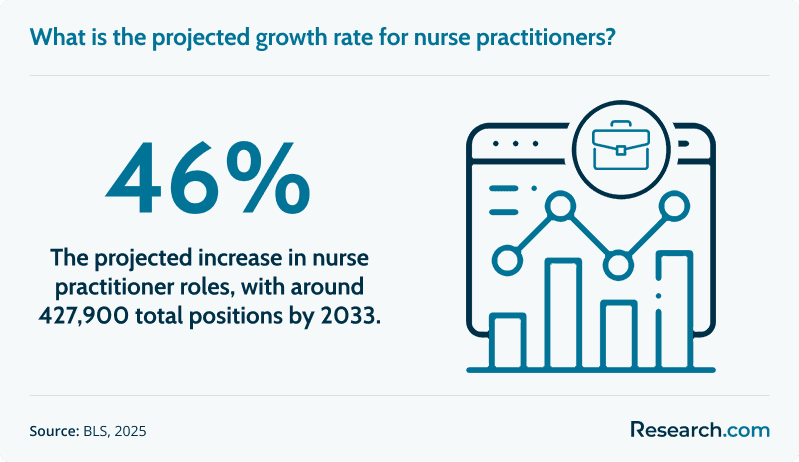
The job outlook for graduate-prepared nurses is strong, especially in advanced practice and leadership roles. According to the United States Bureau of Labor Statistics, employment of nurse practitioners is projected to grow by 46% from 2023 to 2033. The same source reports about 31,900 openings for nurse practitioners, nurse midwives, and nurse anesthetists each year from 2023 to 2033.
Healthcare also added 51,000 jobs in April 2025, and NPs were ranked as the “best job in America” by U.S. News & World Report because of demand, stability, and income potential. Nurse practitioners, clinical nurse leaders, nurse educators, and public health nurses may benefit from healthcare systems’ continued need for skilled clinicians and care coordinators.
Still, students should be careful when interpreting job outlook data. A direct entry MSN may qualify you for RN licensure and certain master’s-prepared roles, but it does not automatically qualify you for every advanced practice role. Nurse practitioner, nurse midwife, and nurse anesthetist roles have specific education, certification, and licensure requirements. If you are still comparing options, review the different types of master degree in nursing.
Career Paths After an Online Direct Entry MSN
Graduates of online direct entry MSN programs may pursue several nursing and healthcare roles, depending on their program track, licensure status, certifications, and state rules. Some graduates begin as registered nurses and later move into advanced practice, leadership, or education. Others complete programs that prepare them more directly for clinical nurse leader or specialty pathways.
| Career Path | Typical Focus | Important Consideration |
| Nurse Practitioner | Provides primary or specialty care in settings such as clinics, hospitals, or private practices. | May require a specific NP track, national certification, and state advanced practice licensure. |
| Clinical Nurse Leader (CNL) | Coordinates care, supports quality improvement, and works with interprofessional healthcare teams. | Some direct entry MSN programs are specifically designed around CNL preparation. |
| Nurse Educator | Teaches nursing students or trains clinical staff in academic or healthcare settings. | Teaching roles may prefer or require additional experience or credentials. |
| Public Health Nurse | Works with communities, outreach programs, prevention initiatives, and population health efforts. | Public health roles may value community experience and policy knowledge. |
| Nurse Administrator or Manager | Leads nursing teams, supports budgeting, manages operations, and improves care delivery. | Leadership roles often require clinical experience after licensure. |
| Case Manager or Care Coordinator | Helps patients move through complex healthcare systems and access appropriate services. | Strong communication and systems knowledge are essential. |
| Informatics Nurse Specialist | Uses data, technology, and clinical workflows to improve care and efficiency. | Technology skills and informatics coursework can strengthen this path. |
An MSN can also support future doctoral study. Students who want to move quickly into a doctoral nursing pathway can compare accelerated DNP programs, but they should confirm admission requirements and whether their MSN track aligns with DNP specialization goals.
How Are Direct Entry MSN Programs Different From Accelerated BSN Programs?
Direct entry MSN and accelerated BSN programs both serve students who already have a non-nursing bachelor’s degree, but they lead to different credentials and may fit different career plans. A direct entry MSN combines pre-licensure nursing education with graduate-level study. An accelerated BSN focuses on the bachelor’s-level preparation needed to become an RN.
| Factor | Direct Entry MSN | Accelerated BSN |
| Credential | Master of Science in Nursing or related master’s nursing credential | Bachelor of Science in Nursing |
| Primary Goal | RN preparation plus graduate-level nursing education | RN preparation through a second bachelor’s degree |
| Best For | Career changers who want a graduate pathway and may pursue leadership, education, or advanced study | Career changers who want the most direct route to RN eligibility before deciding on graduate study |
| Clinical Requirements | Required in person | Required in person |
| Long-Term Flexibility | May reduce the need for a separate MSN later, depending on career goals | May be followed by an MSN, DNP, or graduate certificate later |
If your immediate goal is to become an RN and you are not sure you want graduate-level nursing study yet, accelerated BSN programs online may be worth comparing before committing to a direct entry MSN.
Who Should Choose a Direct Entry MSN?
A direct entry MSN can be a strong option if you are certain you want to enter nursing, can handle an accelerated graduate workload, and want a credential that may support leadership or advanced study later.
- Choose this path if: You already have a bachelor’s degree, want a fast graduate route into nursing, can complete in-person clinicals, and are comfortable with rigorous science and clinical coursework.
- Consider another path if: You need a fully online program, want to keep working full time without schedule disruption, are unsure about patient care, or want the lowest-cost route to RN eligibility.
- Compare alternatives if: You are deciding between direct entry MSN, accelerated BSN, associate degree in nursing, or post-master’s nursing certificates.
Common Mistakes to Avoid
| Mistake | Why It Can Hurt You | Better Approach |
| Assuming “online” means no campus or clinical attendance | Nursing programs require in-person training, and missing these requirements can delay graduation. | Ask for a complete list of clinical, lab, residency, and travel obligations before applying. |
| Choosing a program without verifying accreditation | Accreditation can affect licensure, financial aid, employment, and future education. | Confirm institutional accreditation and nursing program accreditation directly with the school. |
| Looking only at tuition per credit | Fees, travel, supplies, clinical costs, and lost income can change the real cost. | Build a full cost estimate for the entire program. |
| Ignoring state licensure requirements | A program may not meet requirements in every state. | Contact the state board of nursing where you plan to practice. |
| Assuming an MSN automatically makes you a nurse practitioner | NP roles require specific education, certification, and state authorization. | Check whether the program includes an NP track or whether post-master’s study is required. |
| Underestimating the pace | Accelerated nursing programs can be academically and emotionally demanding. | Plan your work schedule, family support, study time, and finances before starting. |
What Challenges Might Students Face in Online Direct Entry MSN Programs?
Students entering nursing from another field often face a steep transition. The academic workload is heavy, the clinical environment may be unfamiliar, and students must quickly learn how to apply science, communication, ethics, and patient-safety principles in real healthcare settings.
The biggest challenge is usually balance. Online coursework may offer flexibility, but clinical rotations happen on fixed schedules and may require travel. Students also need time for simulations, exams, care plans, group projects, and NCLEX preparation.
- Clinical adjustment: Students without healthcare experience may need time to become comfortable with patient interaction, documentation, and team-based care.
- Science intensity: Pathophysiology, pharmacology, health assessment, and evidence-based practice require consistent study.
- Time pressure: Accelerated formats leave little room for falling behind.
- Emotional demands: Nursing education exposes students to illness, stress, ethical decisions, and high-stakes communication.
- Placement logistics: Clinical scheduling can be difficult, especially for students in rural areas or competitive healthcare markets.
Students who want a less graduate-intensive path into nursing may also compare easiest BSN accelerated programs before committing to a direct entry MSN.
Current Trends Affecting Direct Entry MSN Students
Nursing education and healthcare hiring are changing quickly. Direct entry MSN students should pay attention to several trends before choosing a program.
- Hybrid nursing education is now common: More schools use online lectures, simulations, and learning platforms, but clinical competency remains in person.
- Clinical placements are a major differentiator: Programs that provide strong placement support may reduce student stress and delays.
- Technology skills matter: Nursing roles increasingly involve electronic health records, telehealth workflows, clinical decision-support tools, informatics, and data-informed care.
- Graduate nursing pathways are becoming more specialized: Students should verify whether a program leads to generalist RN practice, CNL preparation, NP preparation, or another outcome.
- Cost and debt require careful planning: Accelerated graduate programs can be expensive, so students should compare total cost, aid, and realistic career goals before enrolling.
Student Perspectives on Direct Entry MSN Programs
- : "I spent almost ten years in marketing before I decided I wanted work that felt more personal and service-oriented. The direct-entry MSN helped me change careers without going back to the very beginning. The pace was intense, but the clinical training gave me the confidence to move into nursing practice. — Melissa"
- : "My first degree was in psychology, and I always wanted to connect that background with hands-on patient care. The direct-entry MSN became the bridge between what I already knew and the clinical skills I needed. I now work in community health, and the career feels like the right fit. — Donna"
- : "I came from business and did not think nursing was still realistic for me. The program gave me a structured way to move from no nursing experience into advanced clinical preparation. I now work as a clinical nurse leader in a major hospital, and the career change was worth the effort. — Penny"
References
- Carlton, G. (2025, May 20). Nurse Practitioner Job and Salary Outlook 2025: By the Numbers. NurseJournal.
- Fottrel, Q. (2025, May 2). If you read April’s jobs report, you won’t be surprised by the No. 1 ‘best job’ in America. MarketWatch.
- Hanson, M. (2024, August 31). Cost of Online Education vs. Traditional Education. Education Data Initiative.
- Lee, E. (2025, February 7). Best Nurse Practitioner (NP) Career and Salaries in 2025. allnurses.
- Roberts, A. (2024, March 20). The Best Online Direct-Entry MSN Programs. NursingEducation.
- United States Bureau of Labor Statistics. (2025, July 29). Occupational Employment and Wage Statistics Query System. BLS.
- United States Bureau of Labor Statistics. (2025, April 18). Occupational Outlook Handbook | Nurse Anesthetists, Nurse Midwives, and Nurse Practitioners. BLS.
Key Insights
- Online direct entry MSN programs are not fully online; students must complete in-person clinical training, and some programs require campus residencies or face-to-face classes.
- The typical completion timeline is 20 to 36 months, with accelerated full-time programs requiring significant time and academic commitment.
- Accreditation, state licensure eligibility, NCLEX-RN pass rates, and clinical placement support should matter more than convenience or advertised speed.
- Total program cost can range from $60,000 and $100,000, so students should compare tuition, fees, travel, clinical expenses, financial aid, and potential debt before enrolling.
- A direct entry MSN can support RN licensure and graduate-level nursing opportunities, but it does not automatically qualify every graduate for nurse practitioner or other advanced practice roles.
- Students who want a faster or lower-cost path to RN eligibility should compare accelerated BSN programs before choosing a direct entry MSN.
Other Things You Should Know About the Best Online Direct Entry MSN Programs for Non-nurses
Yes, prerequisites typically include courses in anatomy, physiology, microbiology, and statistics. Additionally, candidates usually need a bachelor's degree in a non-nursing field. Requirements can vary, so checking specific program criteria is essential for accurate enrollment information.
Most online direct-entry MSN programs require about 500 to 1,000 supervised clinical hours, plus additional simulation hours in some states. Clinical placements must meet board of nursing standards, and students usually complete them in approved healthcare settings near their home.
Financial aid for 2027 online direct-entry MSN programs includes federal student loans, scholarships, and possibly grants offered by individual schools. Some programs may offer specific scholarships targeted at non-nurses entering the field. Prospective students should consult the financial aid office of the programs they are interested in for specific options.


