2027 Best Online MSN in Nurse Executive Leadership Programs

Co-Founder and Chief Data Scientist
Considering an online Master of Science in Nursing (MSN) in Nurse Executive Leadership program in the USA is a fantastic step toward advancing your career. However, finding precise and reliable information on the best programs can be a real challenge. The sheer volume of options and varied program details often makes it difficult to pinpoint what truly aligns with your goals.
As an education and career planning expert, I'm here to simplify this process for you. We'll explore key aspects of these programs, from costs and prerequisites to career paths and future trends, ensuring you have the clear insights needed to make an informed decision about your executive nursing future.
What are the benefits of getting an online MSN in Nurse Executive Leadership program?
- Career Advancement: Opens pathways to senior leadership and administrative roles such as Chief Nursing Officer, Director of Nursing, and Nurse Manager, preparing you to lead diverse teams and improve healthcare systems.
- Earning Potential: Professionals with this advanced degree can command significantly higher salaries. For instance, Chief Nursing Officers average around $150,000 to $244,000 annually, while Nurse Managers typically earn in the range of $99,000 to $118,000.
- Flexible Learning: The online format provides the convenience of studying from anywhere, allowing you to balance advanced education with your current nursing career and personal commitments.
What can I expect from an online MSN in Nurse Executive Leadership program?
- Focused Advanced Topics: Expect an intensive curriculum centered on key areas like financial management in healthcare, strategic planning, human resources, and healthcare policy.
- Structured Curriculum: Delivery typically combines recorded video lectures, live online class sessions, case studies, and team projects, often with required practicum hours.
- Applied Strategic Knowledge: Emphasis on solving real-world challenges through data analysis, evidence-based practice, and strategic decision-making to impact patient care and organizational outcomes.
- Condensed Timeline: Programs are designed to be completed efficiently, often ranging from 18 to 24 months, to accelerate your career transition or promotion.
- Networking Opportunities: Connect with experienced faculty who are often current or former nurse executives, and a diverse cohort of professional peers from various healthcare settings.
Where can I work with an online MSN in Nurse Executive Leadership program?
- Hospitals and Health Systems: Lead nursing operations across departments, manage budgets, and ensure regulatory compliance in acute care settings.
- Long-Term Care and Rehabilitation Facilities: Oversee care delivery for aging or medically complex populations, improving staffing models and patient outcomes.
- Government Agencies and Public Health Departments: Lead policy development, manage public health initiatives, and shape large-scale health programs.
- Academic Medical Centers and Universities: Contribute to shaping the future of nursing through academic leadership, faculty development, or clinical education oversight.
- Healthcare Technology Firms and Consulting Companies: Provide clinical leadership for the development of digital health tools, data systems, and innovative care models.
- Nonprofit Organizations: Design and implement programs addressing social determinants of health and expanding access to care in underserved communities.
How much can I make with an online MSN in Nurse Executive Leadership program?
- Entry-Level Leadership Roles: For positions like Nurse Manager or Clinical Nurse Leader, salaries typically range from $85,000 to $110,000 annually.
- Mid-Level Executive Roles: Individuals in roles such as Director of Nursing or Nurse Administrator can expect salaries ranging from $105,000 to $135,000 per year.
- Senior & Chief Executive Roles: Top-tier positions like Chief Nursing Officer (CNO) or Chief Nurse Executive (CNE) command significantly higher salaries, often ranging from $140,000 to over $250,000 annually, depending on the organization's size and location.
- Best Online MSN in Nurse Executive Leadership Programs for 2027 List of Programs
- What is the average cost of an online MSN in Nurse Executive Leadership program? Program Cost
- What are the financial aid options for an online MSN in Nurse Executive Leadership program? Financial Aid
- What are the prerequisites for enrolling in an online MSN in Nurse Executive Leadership program? What are the prerequisites for enrolling in an online MSN in Nurse Executive Leadership program?
- What courses are typically in an online MSN in Nurse Executive Leadership program? What courses are typically in an online MSN in Nurse Executive Leadership program?
- What types of specializations are available for MSN in Nurse Executive Leadership graduates? Specializations
- How do you choose the best online MSN in Nurse Executive Leadership program? How do you choose the best online MSN in Nurse Executive Leadership program?
- What career paths are available for graduates of online MSN in Nurse Executive Leadership programs? Career Paths
- How much can I earn with an online MSN in Nurse Executive Leadership? Salaries
- What is the job market like for graduates of an online MSN in Nurse Executive Leadership? Job Market
- How can I successfully balance work, study, and leadership responsibilities? How can I successfully balance work, study, and leadership responsibilities?
- What are some current and future trends in nurse executive leadership? What are some current and future trends in nurse executive leadership?
- Is the Program Accredited and How Does Accreditation Influence Career Outcomes? Is the Program Accredited and How Does Accreditation Influence Career Outcomes?
Best Online MSN in Nurse Executive Leadership Programs for 2027
An online MSN in Nurse Executive Leadership is designed for registered nurses who want to move from bedside, unit-level, or charge nurse responsibilities into roles that shape staffing, budgets, quality improvement, patient safety, and organizational strategy. The decision matters because nurse leaders are being asked to manage workforce pressure, digital health adoption, value-based care requirements, and increasingly complex healthcare operations.
This guide is for licensed nurses comparing online nurse executive MSN programs, RN-to-MSN leadership pathways, and related nursing administration tracks. You will find ranked program options, cost and financial aid considerations, admissions requirements, typical coursework, career paths, salary information, job market trends, and practical questions to ask before enrolling.
Quick answer: Is an online MSN in Nurse Executive Leadership worth it?
An online MSN in Nurse Executive Leadership can be worth it if you already have nursing experience and want to qualify for management, director, administrative, quality improvement, or executive-level roles. The strongest candidates choose accredited programs with practical leadership coursework, accessible practicum arrangements, transparent tuition, and career outcomes aligned with their target role. It may not be the best fit if you prefer advanced clinical practice as a nurse practitioner or if you are not ready to take on budgeting, staffing, policy, and organizational accountability.
How to use this ranking
Use this list as a starting point, not as the only factor in your decision. Compare each program’s accreditation, tuition model, practicum expectations, admission requirements, leadership focus, and fit with your schedule. A lower-cost program is not always the best value if it lacks the support, flexibility, or practicum structure you need.
How do we rank schools?
Because graduate nursing education requires a meaningful investment of time and money, Research.com uses a transparent ranking methodology that draws from established education data sources. These include:
- IPEDS database
- Peterson's database, including the Distance Learning Licensed Data Set
- College Scorecard database
- National Center for Education Statistics
Here are the selected online MSN nurse executive leadership programs to consider.
| School | Leadership focus | Program length | Credits or courses | Listed tuition | Accreditation |
| Benedictine University | Nurse Executive Leader | About 2 years (part-time) | 36 credits | $670/credit | CCNE, HLC |
| Regis College | Nurse Executive among multiple leadership tracks | 2 years | 39 credits, 300 clinical hours | $51,420/year | CCNE |
| Sacred Heart University | Nursing Management and Executive Leadership | 2 years | 36 credits | $695/credit | CCNE |
| Capella University | Nurse Executive | Typically 1.5–2 years | 54 credits | $2,985 per 12-week billing session | CCNE |
| Stony Brook University | Nursing Leadership with executive focus | 2 years | 36 credits | Not specified | CCNE |
| University of South Alabama | Executive Nurse Leadership | 2 years | 36 credits | In-state: $423/credit; out-of-state: $846/credit | CCNE |
| University of Texas Medical Branch | Executive Nurse Leader | 6 semesters | 15 courses | Texas Resident: $50/credit; Non-Resident: $455/credit | CCNE |
| Western Governors University | Nursing Leadership and Management | Varies; self-paced; typically 32 months, can be shorter | 36 courses | $5,325 per 6-month term for the undergraduate portion; $5,035 per 6-month term for the graduate portion | CCNE |
| Indiana Wesleyan University | Nursing Administration—Executive | About 2 years | 14 courses | $595/credit | CCNE |
| Northeastern University | Administration/Nurse Executive, AI Applications, Patient Safety, Postsecondary Teaching | Varies | 53 credits | Full-Time: $33,995/term | CCNE |
1. Benedictine University
Benedictine University offers an online MSN with a Nurse Executive Leader concentration for nurses preparing to manage teams, departments, and service lines in healthcare organizations. The program is built around leadership competencies such as communication, collaboration, strategic thinking, organizational analysis, and systems-level decision-making, and it aligns with American Association of Colleges of Nursing outcomes.
The Nursing Leadership concentration is a practical option for students who want to understand the business side of nursing departments while continuing to ground decisions in patient care quality. Students complete an on-ground practicum that may be arranged at an approved clinical site near home, along with a capstone project that addresses a real nursing leadership problem.
Benedictine also offers a dual M.S.N./M.B.A. pathway for nurses who want stronger business training alongside graduate nursing preparation. Graduates may pursue roles such as nursing director or clinical nurse manager, depending on experience, employer requirements, and local market demand.
- Program Length: About 2 years (part-time)
- Tracks/Concentrations: Nurse Executive Leader
- Tuition Cost: $670/credit
- Required Credits to Graduate: 36 credits
- Accreditation: Commission on Collegiate Nursing Education (CCNE), Higher Learning Commission (HLC)
2. Regis College
Regis College provides an online Master of Science in Clinical Nurse Leader program that supports nurses preparing for leadership roles that blend clinical judgment, organizational improvement, and administrative thinking. Students can focus on areas such as health administration, health informatics, health policy, or the Clinical Nurse Leader role.
The curriculum covers nursing theory, leadership concepts, organizational structure, ethics, law, research, and management-related skills. A required internship gives students a chance to apply graduate coursework in a professional environment while developing contacts and practical leadership experience.
This program may fit nurses who want leadership preparation without fully leaving clinical influence behind. Potential career directions include Clinical Nurse Leader, nursing professor, information manager, and healthcare administrator.
- Program Length: 2 years
- Tracks/Concentrations: Nurse Executive (among multiple leadership tracks)
- Tuition Cost: $51,420/year
- Required Credits to Graduate: 39 credits (300 clinical hours)
- Accreditation: Commission on Collegiate Nursing Education (CCNE)
3. Sacred Heart University
Sacred Heart University offers a fully online MSN in Nursing Management and Executive Leadership for nurses who want to lead departments, teams, facilities, or improvement initiatives. The coursework is 100% online and does not require campus visits, which can be useful for working nurses who need scheduling flexibility.
Students study strategic planning, quality improvement, human resource management, budgeting, and process management. The program includes a 120-hour clinical practicum with a community-based preceptor, and students may pursue an international study abroad option to complete part of the capstone hours.
The specialization is intended for leadership work in settings such as hospitals, outpatient clinics, and long-term care facilities. Graduates are expected to apply nursing theory, collaborate across disciplines, advocate for equitable care, and lead change in complex healthcare environments.
- Program Length: 2 years
- Tracks/Concentrations: Nursing Management and Executive Leadership
- Tuition Cost: $695/credit
- Required Credits to Graduate: 36
- Accreditation: Commission on Collegiate Nursing Education (CCNE)
4. Capella University
Capella University offers an online MSN with a Nurse Executive specialization for nurses who want to build administrative, operational, and communication skills. The program includes an integrated capstone and practicum experience in which students work with organizations on applied healthcare challenges.
Coursework addresses healthcare leadership, quality and safety, ethics, finance, operations, and advanced nursing concepts. Students preparing for roles such as Chief Nursing Officer or Nurse Manager may find the curriculum relevant to organizational leadership and change management.
Capella also notes that many healthcare organizations partner with the university and support employee education through benefits. Students should verify whether their own employer participates and what reimbursement rules apply before relying on employer funding.
- Program Length: Typically 1.5–2 years
- Tracks/Concentrations: Nurse Executive
- Tuition Cost: $2,985 per 12-week billing session
- Required Credits to Graduate: 54 credits
- Accreditation: Commission on Collegiate Nursing Education (CCNE)
5. Stony Brook University
Stony Brook University offers a Master of Science in Nursing Leadership that prepares nurses for leadership across healthcare settings and levels of responsibility. The curriculum connects scientific knowledge, evidence-based care, affordability, collaboration, and business principles.
Students examine care coordination, informatics, system effectiveness, and strategic partnerships. The program may be a strong match for nurses who want to influence quality, safety, and operational improvement across the care continuum.
RN applicants who hold a non-nursing bachelor’s degree may need to submit a clinical practice portfolio after conditional admission, so prospective students should review admissions details carefully before applying.
- Program Length: 2 years
- Tracks/Concentrations: Nursing Leadership (executive focus)
- Tuition Cost: Not specified
- Required Credits to Graduate: 36 credits
- Accreditation: Commission on Collegiate Nursing Education (CCNE)
6. University of South Alabama
The University of South Alabama offers an online MSN in Executive Nursing Administration for nurses targeting roles such as Nurse Manager, Director of Nursing, or Chief Nurse Executive. The program emphasizes administrative leadership, management, communication, quality, safety, and systems change.
Graduate core courses and Executive Nursing Administration courses are available fully online. Orientation is completed through a web conference, so students are not required to travel to campus for that component.
The program’s leadership content aligns with foundational nursing administration knowledge described by the American Nurses Association and the American Organization of Nurse Executives. Clinical practice experiences are a major part of the program and can often be completed with approved preceptors in the student’s community, with faculty guidance during field study and internship work.
- Program Length: 2 years
- Tracks/Concentrations: Executive Nurse Leadership
- Tuition Cost: In-state: $423/credit; out-of-state: $846/credit
- Required Credits to Graduate: 36 credits
- Accreditation: Commission on Collegiate Nursing Education (CCNE)
7. University of Texas Medical Branch (UTMB)
The University of Texas Medical Branch (UTMB) offers an Executive Nurse Leader program focused on change leadership, collaboration, innovation, and the application of new healthcare approaches. The program draws on research into transformational leadership competencies and includes opportunities to interact with nursing and healthcare leaders.
Applied experiences are embedded in major courses and in a practicum, helping students connect leadership theory with operational challenges. Coursework develops skills in identifying improvement opportunities, leading change, and strengthening safety and care delivery.
The ENL program also emphasizes cost-effective problem-solving, process improvement, risk assessment, and cost reduction. Applicants need at least one year of recent RN experience, and recent management or leadership experience is preferred.
- Program Length: 6 semesters
- Tracks/Concentrations: Executive Nurse Leader
- Tuition Cost: Texas Resident: $50/credit; Non-Resident: $455/credit
- Required Credits to Graduate: 15 courses
- Accreditation: Commission on Collegiate Nursing Education (CCNE)
8. Western Governors University
Western Governors University offers an online RN to MSN in Nursing Leadership and Management for registered nurses who need a bridge pathway from associate-level or diploma nursing preparation into graduate nursing leadership. Students first complete BSN-level coursework and then continue into graduate-level leadership and management study.
As students approach completion of the BSN portion, they select an MSN specialty such as Nursing Education, Leadership and Management, or Nursing Informatics. By the time the BSN is conferred, they have also completed graduate-level coursework and earned a post-baccalaureate certificate, which can document progress toward advanced education before the full MSN is finished.
The curriculum is evidence-based and reflects American Nurses Association standards for nurse administrators. WGU does not require RN work experience for admission, but applicants must hold an associate degree or diploma in nursing and an active, unencumbered RN license in the state where they live or work. Before clinical placement, students must complete a criminal background check and provide current immunization documentation.
- Program Length: Varies (self-paced; typically 32 months, can be shorter)
- Tracks/Concentrations: Nursing Leadership and Management
- Tuition Cost: $5,325 per 6-month term (undergraduate portion of the program); $5,035 per 6-month term (graduate portion of the program)
- Required Credits to Graduate: 36 courses (RN-to-MSN)
- Accreditation: Commission on Collegiate Nursing Education (CCNE)
9. Indiana Wesleyan University
Indiana Wesleyan University offers an online MSN in Health Systems Leadership for nurses who want to guide system-level change in patient care, healthcare facility management, and medical records environments. The program emphasizes leadership approaches that can support broader innovation across healthcare organizations.
Students study nursing leadership foundations, collaborative leadership, transformative leadership, and evidence-based communication. IWU also provides student support such as tutoring and technology assistance, and its Christian faculty teach from a biblical worldview.
A capstone practicum allows students to apply their learning at a site of their choosing. Admission requires an active RN license and a Bachelor of Science in Nursing, along with a resume, transcripts, statement of purpose, and letters of recommendation.
- Program Length: About 2 years
- Tracks/Concentrations: Nursing Administration—Executive
- Tuition Cost: $595/credit
- Required Credits to Graduate: 14 courses
- Accreditation: Commission on Collegiate Nursing Education (CCNE)
10. Northeastern University
Northeastern University offers a Master of Science in Nursing Leadership for nurses preparing to improve care delivery and move into higher-responsibility leadership positions. The program combines evidence-based clinical practice, interdisciplinary collaboration, organizational systems analysis, quality improvement, healthcare services, and fiscal responsibility.
Students can further focus their studies through concentrations such as administration/nurse executive, AI applications, patient safety, or postsecondary teaching. These options may support career goals in nurse management, executive leadership, education, quality improvement, or technology-informed healthcare leadership.
Applicants must hold a current US Nursing license and a Bachelor of Science in Nursing degree. Northeastern requires a minimum GPA of 3.0 across previous academic work, at least one to two years of clinical experience in leadership, management, or mentorship, and a professional resume or curriculum vitae.
- Program Length: Varies
- Tracks/Concentrations: Administration/Nurse Executive, AI Applications, Patient Safety, Postsecondary Teaching
- Tuition Cost: Full-Time: $33,995/term
- Required Credits to Graduate: 53 credits
- Accreditation: Commission on Collegiate Nursing Education (CCNE)
What is the average cost of an online MSN in Nurse Executive Leadership program?
Online MSN in Nurse Executive Leadership tuition varies widely by school type, residency rules, credit requirements, and billing model. Based on the program information above, total tuition can range from approximately $18,000 to over $57,000. Students should calculate the full program price rather than comparing only the per-credit rate.
| Cost factor | Why it matters | What to verify before enrolling |
| Public or private institution | Public universities may charge different rates for in-state and out-of-state students, while private universities often use one tuition rate. | Ask whether online students qualify for in-state, out-of-state, or separate online tuition. |
| Credit or course total | A lower per-credit price can still lead to a higher total cost if the program requires more credits. | Confirm the exact number of credits or courses needed for graduation. |
| Program pace | Accelerated or competency-based formats may reduce time in school, but billing structures differ. | Compare total cost for your expected pace, not the fastest advertised path. |
| Fees and materials | Technology fees, course materials, background checks, immunizations, and practicum-related costs can add to tuition. | Request a complete cost of attendance estimate. |
| Practicum placement | Some programs expect students to help locate approved preceptors or sites. | Ask whether the school assists with placement and whether there are local restrictions. |
Leadership-focused graduate programs outside nursing, such as online Masters in Management and Leadership degrees, may have similar cost drivers, but tuition and career outcomes are not interchangeable with an MSN. Nurses should compare programs based on their specific leadership goals, licensure background, and employer expectations.
Before applying, review each school’s tuition page, fee schedule, refund policy, and financial aid options. If your employer offers reimbursement, confirm annual limits, grade requirements, repayment obligations, and whether the program must be preapproved.
What are the financial aid options for an online MSN in Nurse Executive Leadership program?
Graduate nursing students may use several funding sources to reduce out-of-pocket costs. The best approach is to combine aid options where possible and to understand which funds must be repaid.
- Federal Student Aid: Federal loans are commonly used by graduate students, while some students may qualify for grants that do not require repayment.
- Scholarships: Nursing associations, private foundations, employers, and universities may offer scholarships for graduate nursing students or future nurse leaders.
- Grants: Need-based awards may be available through federal, state, institutional, or private sources and generally do not need to be repaid.
- Employer Tuition Reimbursement: Hospitals and healthcare systems may help pay for advanced degrees, especially when the degree supports leadership, retention, quality improvement, or workforce planning.
- Payment Plans: Some schools let students divide tuition into smaller payments during a term, which can reduce the need to borrow upfront.
- Loan Forgiveness Programs: Some borrowers working in qualifying public service or underserved settings may be eligible for loan forgiveness, depending on program rules.
Completing the Free Application for Federal Student Aid (FAFSA) is usually the first step for federal aid eligibility. After that, contact each school’s financial aid office and nursing department to ask about program-specific scholarships, assistantships, clinical partnership discounts, and payment options.
Students should not assume that higher future earnings will automatically offset the cost of the degree. Instead, compare the total cost of attendance with your likely career path, current salary, employer support, debt tolerance, and local leadership opportunities.
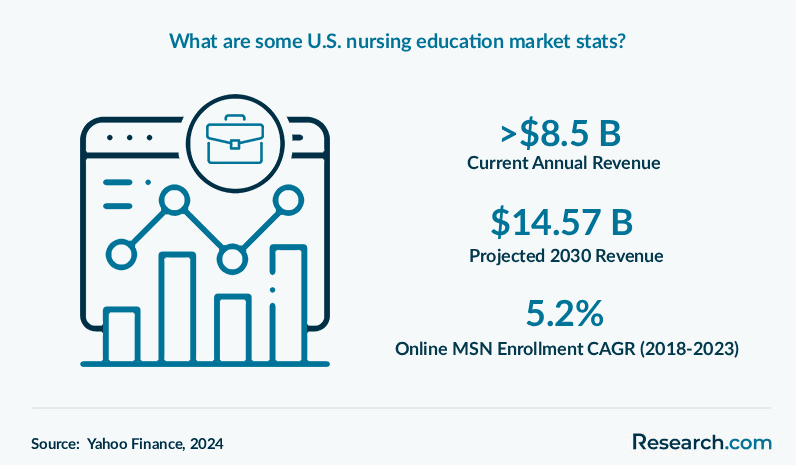
According to a 2024 report by Validated Insights in Yahoo Finance, the nursing education market is valued at over $8.5 billion annually and represents nearly 3% of all higher education revenue.
The same report projects an annual growth rate of just over 11%, bringing the market to $14.57 billion by 2030 while maintaining its 3% share of higher education revenue. However, the enrollment picture varies by program type, as shown in the graphic below.
The data shows stronger enrollment performance in accelerated options such as Direct-Entry MSNs and BSN to DNP programs. New enrollment in BSN programs increased by 7.1% from Fall 2023 to Fall 2024.
At the same time, the RN to BSN pipeline is weakening, and the share of nursing schools reporting declining enrollment rose from 33% in 2022 to 37% in 2024. Career demand for registered nurses is also changing: the number of licensed RNs increased by 16.8% from 2019 to 2024, while the number employed in the field grew by only 7.1%.
What are the prerequisites for enrolling in an online MSN in Nurse Executive Leadership program?
Most online MSN nurse executive leadership programs expect applicants to have a nursing foundation, current RN licensure, and the academic readiness to complete graduate-level work. Requirements vary by school, but the following are common.
| Requirement | Typical expectation | Why it matters |
| BSN or nursing bridge eligibility | Many programs require a Bachelor of Science in Nursing from an accredited program. | The BSN prepares students for graduate nursing theory, evidence-based practice, and leadership coursework. |
| RN license | A current, unencumbered U.S. RN license is usually required. | Leadership coursework assumes active nursing practice and professional accountability. |
| Minimum GPA | Many programs expect about a 3.0 undergraduate GPA on a 4.0 scale. | Graduate nursing courses require strong academic preparation. |
| Professional nursing experience | Some programs prefer or require one to two years of clinical nursing experience. | Leadership assignments are easier to apply when students understand clinical operations firsthand. |
| Statistics coursework | An undergraduate statistics course is often required. | Nurse leaders use data to evaluate outcomes, quality, staffing, budgets, and safety. |
| Application materials | Official transcripts, resume or CV, references, and sometimes a statement of purpose. | Schools use these materials to evaluate readiness, goals, and professional background. |
If you are an RN with an associate degree rather than a BSN, compare ADN to MSN bridge programs before assuming you must complete a separate BSN first. Bridge programs can create a more direct route, but they may require additional undergraduate-level coursework.
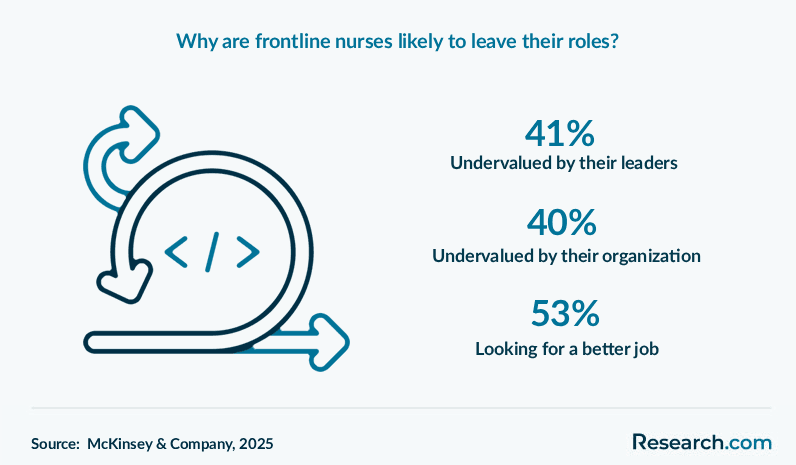
Leadership preparation is especially relevant because nurse managers affect retention and care quality. According to a 2025 McKinsey Nursing Pulse Survey, strong nurse managers are associated with a 68% increase in frontline-nursing retention, fewer patient falls, and a lower rate of hospital-acquired infections. Among frontline registered nurses likely to leave their roles, 41% cited not feeling valued by leaders and 40% cited not feeling valued by their organization. The most common reason was “looking for a better job,” cited by 53% of nurses, as shown in the graphic below.
What courses are typically in an online MSN in Nurse Executive Leadership program?
An MSN in Nurse Executive Leadership combines graduate nursing knowledge with management, finance, quality, policy, informatics, and organizational leadership. The exact course names differ by institution, but students commonly study the following topics.
- Accounting and Finance for Nurse Executives: Budgeting, financial analysis, cost control, and resource allocation in healthcare organizations.
- Change Management in Healthcare Systems: Methods for planning, communicating, implementing, and sustaining organizational change.
- Ethical and Legal Issues in Executive Nursing Practice: Legal responsibilities, ethical decision-making, compliance, and risk management for nurse leaders.
- Health Informatics and Data-Driven Decision-Making: Use of electronic systems, data analytics, and information technology to improve operations and outcomes.
- Health Policy and Economics: Policy development, healthcare financing, advocacy, and the economic forces affecting care delivery.
- Healthcare Strategic Planning and Analysis: Development and evaluation of organizational goals, service lines, and long-term initiatives.
- Interprofessional Collaboration and Communication: Strategies for leading teams across nursing, medicine, administration, finance, and allied health.
- Management of Human Resources in Nursing: Staffing, retention, performance evaluation, recruitment, scheduling, and employee development.
- Organizational Psychology/Behavior: Motivation, culture, conflict, leadership styles, and human behavior in healthcare organizations.
- Practicum/Capstone Experience: A supervised leadership project or field experience that applies coursework to a real organizational issue.
- Quality Improvement Strategies: Tools for measuring and improving patient safety, care processes, regulatory performance, and outcomes.
- Role of the Nurse Executive Leader: Responsibilities, leadership models, professional standards, and executive decision-making.
- Theoretical Foundations of Nursing Practice and Research: Nursing theory, research methods, and evidence-based practice for advanced nursing leadership.
Students without a nursing background generally need a different route because nurse executive MSN programs are built for licensed nurses. If you are changing careers into nursing, compare direct entry MSN programs for non-nurses online instead.
What types of specializations are available for MSN in Nurse Executive Leadership graduates?
Nurse Executive Leadership is already a specialized MSN pathway, but some schools allow students to add concentrations, certificates, or dual degrees that sharpen their career direction.
| Specialization or pathway | Best for nurses who want to... | Common career direction |
| Clinical Nurse Leader (CNL) | Improve patient outcomes through care coordination and unit-level leadership. | Clinical Nurse Leader, outcomes coordinator, quality-focused clinical leader. |
| Dual MSN/MBA Degree | Pair nursing expertise with broader business training. | Nurse executive, service line leader, operations leader. |
| Dual MSN/MHA Degree | Focus on healthcare administration, systems, and facility operations. | Healthcare administrator, director, executive manager. |
| Global Health Leadership | Lead programs across international or cross-cultural health settings. | Global health program leader, nonprofit healthcare manager. |
| Healthcare Quality and Safety | Drive safety culture, reduce errors, and improve care processes. | Quality improvement director, patient safety officer. |
| Nurse Educator | Teach, mentor, and develop nurses in academic or clinical environments. | Nursing faculty, clinical educator, staff development leader. |
| Nurse Executive/Administrator | Oversee nursing departments, budgets, staffing, and strategic initiatives. | Nurse manager, director of nursing, chief nursing officer. |
| Nursing Informatics for Executive Leaders | Use technology and data to improve workflows, reporting, and decision-making. | Nursing informatics leader, digital health operations manager. |
| Policy and Advocacy in Nursing | Influence healthcare legislation, regulation, and institutional policy. | Policy advisor, advocacy leader, public health administrator. |
| Public Health Nursing Leadership | Manage population health initiatives and community programs. | Public health nurse leader, community health program director. |
Nurses who want business-heavy preparation can review the best online MSN/MBA programs to compare whether a dual degree better supports their executive goals.
Trends in virtual care and team-based models are also shaping specialization choices. The 2025 FutureCare Nursing Survey, based on feedback from 157 nurse leaders, found strong momentum toward virtual care models. A total of 66% of these leaders plan to launch new telehealth models, and 65% of chief nursing officers cited value-based care as the main driver for the shift.
Traditional care models remain important: value-based care was reported at 87%, collaborative care at 81%, and team-based nursing at 74%. Telehealth and virtual nursing are gaining momentum at 66%.
The same survey highlights demand for newer roles, including nurse informaticists at 52%, care coordinators at 50%, and telehealth-trained RNs at 47%. Nurse leaders also identified training priorities: understanding financial metrics at 62%, developing behavioral health skills at 54%, and improving communication across transitions at 43%.
For prospective students, these findings suggest that informatics, financial literacy, virtual nursing, care coordination, and communication skills may become increasingly valuable parts of nurse executive preparation.
How do you choose the best online MSN in Nurse Executive Leadership program?
The best online MSN in Nurse Executive Leadership is the one that matches your career goal, background, budget, schedule, and practicum needs. Do not choose based on ranking position alone. A program that works well for an experienced nurse manager may not fit an RN who needs a bridge pathway or a nurse who wants a future CNO role.
| Selection factor | What to look for | Red flag |
| Accreditation | Programmatic nursing accreditation such as CCNE or ACEN, plus institutional accreditation. | The school cannot clearly document recognized accreditation. |
| Curriculum fit | Courses in finance, staffing, policy, quality, informatics, strategy, and organizational leadership. | The program is mostly generic management with limited nursing leadership content. |
| Practicum design | Clear expectations for hours, site approval, preceptor qualifications, and local placement support. | Students are fully responsible for placement with little guidance. |
| Admission pathway | BSN-to-MSN, RN-to-MSN, or bridge options that match your current degree. | You apply before confirming whether your nursing background qualifies. |
| Flexibility | Online format, asynchronous courses, part-time pacing, or competency-based options if needed. | Required live sessions conflict with your work schedule. |
| Total cost | Full tuition, fees, books, clinical costs, travel, and payment options. | The program advertises only per-credit tuition without a complete estimate. |
| Faculty and support | Faculty with leadership experience, responsive advising, career services, and technical support. | Limited access to advisors or unclear support for online students. |
| Career alignment | Preparation for your target role, such as nurse manager, director, quality leader, or executive. | The program’s outcomes do not match the jobs you want. |
Questions to ask before enrolling
- Is the MSN program accredited by CCNE or ACEN?
- Does the curriculum prepare graduates for nurse executive, administration, quality, or informatics leadership roles?
- How many practicum hours are required, and who helps secure the site and preceptor?
- Are there any campus visits, synchronous sessions, or state authorization restrictions?
- What is the total estimated program cost, including fees and materials?
- Can I study part time while working full time?
- Does my employer recognize this program for promotion or tuition reimbursement?
- What support is available for online graduate nursing students?
- Are graduates working in the types of roles I want?
What career paths are available for graduates of online MSN in Nurse Executive Leadership programs?
Graduates of online MSN nurse executive leadership programs can pursue administrative, operational, quality, safety, informatics, and executive roles across healthcare settings. The right role depends on your prior nursing experience, management background, employer needs, and geographic market.
- Chief Nurse Executive (CNE): Provides strategic oversight of nursing practice across facilities or systems.
- Chief Nursing Officer (CNO): Leads nursing operations, budgets, quality priorities, workforce planning, and executive-level representation for nursing.
- Clinical Director: Manages clinical operations for departments, service lines, or patient populations.
- Healthcare Administrator/Executive Manager: Oversees organizational planning, policy implementation, facility operations, or growth initiatives.
- Long-Term Care Administrator: Directs operations and nursing care in nursing homes, rehabilitation centers, or assisted living environments.
- Magnet Program Director: Coordinates work related to the Magnet Recognition process and nursing excellence standards.
- Nurse Director/Director of Nursing: Supervises nursing departments, staffing, compliance, budgets, and care delivery priorities.
- Nurse Manager: Leads a unit or department, including scheduling, staffing, performance management, and quality improvement.
- Nursing Consultant: Advises healthcare organizations on operations, leadership, compliance, quality, or strategy.
- Nursing Informatics Leader: Uses clinical knowledge and data systems to improve workflows, reporting, decision-making, and patient outcomes.
- Patient Safety Officer: Leads safety culture, harm reduction, event analysis, and compliance initiatives.
- Public Health Nurse Leader: Designs and manages community health programs and population health initiatives.
- Quality Improvement Director: Develops system-wide initiatives to improve outcomes, reduce errors, and meet regulatory standards.
Who should choose this MSN path?
- Nurses who want to move into management, administration, quality, or executive leadership.
- Charge nurses, assistant nurse managers, or nurse managers who want formal graduate preparation.
- RNs interested in budgeting, staffing, policy, process improvement, and systems-level care delivery.
- Nurses who want to influence healthcare organizations without becoming nurse practitioners.
Who may want a different graduate nursing path?
- Nurses who want to diagnose and treat patients independently may prefer a nurse practitioner program.
- Nurses who want to teach full time may prefer a nurse educator concentration.
- Nurses drawn to data systems may prefer nursing informatics if they want less direct operational management.
- Non-nurses should look for direct-entry nursing programs rather than nurse executive MSN programs.
How much can I earn with an online MSN in Nurse Executive Leadership?
An MSN in Nurse Executive Leadership may increase earning potential when it helps a nurse move into management or executive responsibilities, but salary is never guaranteed. Compensation depends on job title, experience, employer size, region, union environment, facility type, and whether the role includes budget or system-level accountability. For a broader comparison, review Research.com’s guide to MSN salary outcomes.
- Average MSN Nurse Salary: Generally higher than those with a BSN, often exceeding $100,000 annually.
- Chief Nursing Officer (CNO): Salaries may range from $140,000 to over $250,000, depending on healthcare system size and location.
- Nurse Administrator/Director: Typically earn between $90,000 and $130,000 annually.
- Nurse Manager: Expected to earn from $70,000 to $120,000 annually.
- Medical and Health Services Managers: Median salaries often exceed $110,000.
PayScale data from 2025 for nursing and healthcare leadership roles shows broad salary variation. An area operations manager earns $73,782.
Among the listed roles, a staff nurse earns $81,514, while a nurse case manager earns $82,772 when meeting the appropriate nurse case manager qualifications. A registered nurse, utilization review, averages $83,811. A risk manager earns $88,482, and a facilities director earns $89,773.
Several management roles fall higher in the range. A registered nurse supervisor earns $90,598, a program director, healthcare, averages $91,323, a clinical nurse manager earns $91,922, and a clinical operations manager earns $96,956. A director of surgical services earns $108,845, a cardiac catheterization lab manager earns $120,556, and a clinical director earns $133,215.
The highest-paying roles in this data set are emergency department manager at $138,309, regulatory affairs director at $143,606, chief nursing officer at $157,431, and chief operating officer/chief nursing officer at $164,423.
What is the job market like for graduates of an online MSN in Nurse Executive Leadership?
The job market for nurse executive leadership graduates is supported by demand for healthcare managers who can lead clinical operations, workforce planning, quality improvement, compliance, technology adoption, and cost control. However, opportunities vary by region, employer type, and the candidate’s leadership experience.
- Demand for healthcare managers: Nurse executive graduates may qualify for roles related to medical and health services management, depending on experience and employer requirements.
- Aging population: Healthcare organizations need leaders who can coordinate complex care and respond to the challenges of an aging society in the United States.
- Healthcare complexity: Value-based care, changing regulations, digital health, and data-driven operations require leaders who understand both nursing and systems management.
- Workforce pressure: Nurse executives are central to retention, staffing models, burnout prevention, mentorship, and professional development.
- Strategic influence: Senior nurse leaders help shape policy, quality, patient outcomes, and organizational priorities.
- Multiple employment settings: Graduates may work in hospitals, long-term care facilities, academic medical centers, government agencies, public health organizations, consulting, and healthcare technology settings.
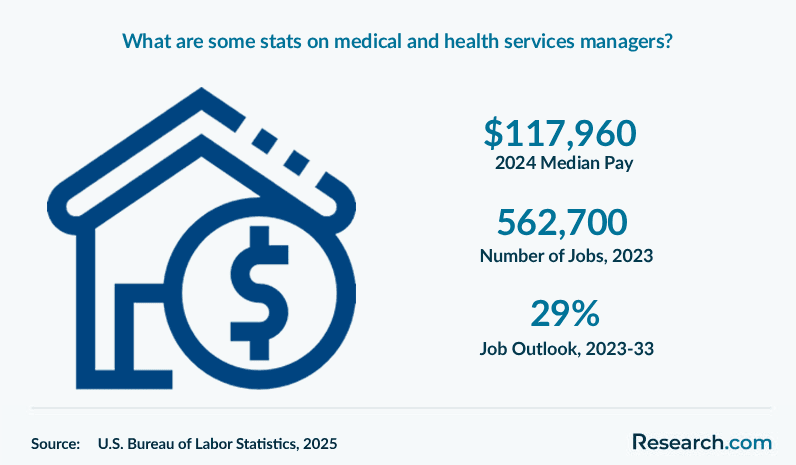
According to the graphic below, medical and health services managers had median pay of $117,960 per year, or $56.71 per hour, in 2024.
As of 2023, there were 562,700 jobs in the field. Employment is projected to grow by 29% from 2023–33, much faster than the average for all occupations, with a projected employment change of 160,600 jobs during that period.
How can I successfully balance work, study, and leadership responsibilities?
Balancing graduate school with nursing work requires more than good intentions. It requires a realistic schedule, support from your workplace and family, and a program format that fits your life.
- Map your weekly schedule before applying. Identify work shifts, commute time, family responsibilities, and predictable study windows.
- Choose a course format you can sustain. Asynchronous courses may work better for rotating shifts, while live classes can provide more structure.
- Start practicum planning early. Ask your program when site approval begins and whether your current workplace can serve as a practicum setting.
- Use coursework at work when appropriate. Leadership assignments often connect to quality improvement, staffing, finance, or process issues in your organization.
- Set boundaries during heavy terms. Graduate leadership programs require reading, writing, group work, data analysis, and practicum time.
- Ask for support before you fall behind. Use academic advising, faculty office hours, peer groups, writing support, and technology help.
If you are still completing earlier nursing education, you may also want to ask whether are there any online accelerated BSN programs that better fit your current stage before moving into MSN-level leadership study.
What are some current and future trends in nurse executive leadership?
Nurse executive leadership is being reshaped by workforce challenges, digital care models, financial pressure, and changing expectations for safety and equity. Graduate programs that address these trends may better prepare students for modern leadership roles.
- Value-Based Care Models: Leaders must connect staffing, quality, outcomes, patient experience, and cost-effectiveness.
- Technology Integration and Digital Health: Telehealth, electronic health records, AI, and analytics require leaders who can evaluate tools, manage adoption, and protect care quality.
- Workforce Development and Retention: Nurse leaders are expected to address burnout, turnover, mentorship, professional growth, and staffing models.
- Health Equity and Social Determinants of Health: Organizations increasingly expect leaders to reduce disparities and improve access to care.
- Crisis Management: Nurse executives must guide teams through emergencies, staffing disruptions, policy changes, and rapid operational shifts.
- Interprofessional Collaboration: Effective leadership depends on cooperation across clinical, administrative, financial, and technology teams.
- Policy Influence and Advocacy: Nurse leaders are increasingly involved in institutional policy, public health decisions, and advocacy for nursing practice.
Is the program accredited, and how does accreditation influence career outcomes?
Accreditation is one of the first items to verify when comparing online MSN in Nurse Executive Leadership programs. Recognized nursing accreditation, such as Commission on Collegiate Nursing Education (CCNE) or Accreditation Commission for Education in Nursing (ACEN), signals that a program has been reviewed against professional nursing education standards.
Accreditation can affect eligibility for federal financial aid, employer tuition reimbursement, transfer credit review, graduate certificate options, and employer confidence. It may also matter if you later pursue doctoral study, academic roles, or leadership positions in organizations that require graduates of accredited nursing programs.
RN students who still need a BSN-level bridge should also evaluate whether an easiest RN to BSN bridge program is a better first step before applying to an MSN leadership pathway.
Common mistakes to avoid when choosing an online MSN in Nurse Executive Leadership
| Mistake | Why it can hurt you | Better approach |
| Choosing without checking accreditation | It may affect aid, transferability, employer acceptance, and future education options. | Verify institutional and nursing program accreditation directly with the school and accreditor. |
| Comparing only per-credit tuition | Total cost depends on credits, fees, terms, books, and practicum expenses. | Request a full cost estimate for your expected pace. |
| Ignoring practicum logistics | Finding an approved site or preceptor can be stressful if requirements are unclear. | Ask who secures placements and whether your state or employer is eligible. |
| Assuming all leadership programs are the same | Some emphasize administration, while others focus on clinical leadership, informatics, education, or policy. | Match coursework and concentrations to your target role. |
| Relying only on rankings | A highly ranked school may not fit your budget, schedule, or career needs. | Use rankings as one input alongside cost, flexibility, support, and outcomes. |
| Expecting the degree alone to guarantee an executive title | Senior roles usually require leadership experience, organizational results, and strong references. | Use the program to build a leadership portfolio, measurable projects, and professional networks. |
Here's What Graduates Say About Their Online MSN in Nurse Executive Leadership Programs
- Riya: "The online format made it possible for me to keep working full time as a charge nurse while studying leadership topics I could use immediately. Courses in strategic decision-making and staff development helped me become more confident, and I later moved into a director role."
- Andrew: "The program helped me turn clinical experience into administrative judgment. Budgeting, policy work, and faculty mentorship changed how I viewed leadership and helped me think beyond bedside advocacy."
- Jonek: "Returning to school felt intimidating at first, but the structure and applied curriculum made the transition manageable. I now lead a multi-unit team and approach patient safety work with a clearer systems perspective."
Key Insights
- An online MSN in Nurse Executive Leadership is best for licensed nurses who want to lead teams, departments, budgets, quality improvement, staffing, and organizational change.
- Accreditation should be nonnegotiable. Look for recognized nursing accreditation such as CCNE or ACEN, along with institutional accreditation.
- Total cost is more important than per-credit tuition. Compare credits, fees, billing terms, practicum costs, and employer reimbursement rules.
- Practicum requirements can determine whether a program is realistic. Ask early about preceptor approval, local site rules, and placement support.
- Career outcomes depend on experience as well as the degree. The MSN can support advancement, but senior roles usually require demonstrated leadership results.
- Current nurse leadership priorities include retention, virtual care, informatics, financial literacy, value-based care, quality improvement, and health equity.
- Use rankings as a filter, not a final answer. The right program should match your current degree, license, schedule, budget, and target leadership role.
References:
- American Organization for Nursing Leadership. (2025, March). Nursing leadership insight study: Navigating evolving challenges and opportunities in a complex health care landscape. American Organization for Nursing Leadership.
- McKinsey & Company. (2025, May 6). Nurse managers: The backbone of a strong nursing workforce. McKinsey & Company.
- PayScale. (2025). Master of Science in Nursing (MSN), Management & Leadership Degree Salary. PayScale.
- Telehealth.org. (2025, April 24). Virtual nursing on the rise: Insights from the FutureCare 2025 survey. Telehealth.org.
- U.S. Bureau of Labor Statistics. (2024, April 16). Medical and health services managers. U.S. Department of Labor.
- Yahoo Finance. (2024, May 2). Validated Insights report released: Nursing workforce trends and challenges. Yahoo Finance.
Other Things You Should Know About Online MSN in Nurse Executive Leadership Programs
Students should learn to use electronic health records, analyze quality and safety data, and apply basic healthcare analytics. Many programs include coursework in informatics, data-driven decision-making, and population health, with supervised practice hours often tied to technology-based leadership projects.
Essential technology tools for 2027 online MSN in Nurse Executive Leadership programs include learning management systems like Canvas or Blackboard, video conferencing software such as Zoom, and digital libraries for research. Access to simulation software for practical leadership scenarios is also crucial.
Admission requirements for 2027 online MSN in Nurse Executive Leadership programs typically include a BSN from an accredited institution, an active RN license, and a minimum GPA. Additional requirements may involve relevant clinical experience, letters of recommendation, and a statement of purpose.