
2027 Fastest Online Master's Programs in Cybersecurity

Co-Founder and Chief Data Scientist
Choosing a fast online master’s degree in cybersecurity is usually a career-timing decision: you want advanced security, risk, or leadership skills without stepping away from work for several years. That decision matters more as cyberthreats continue to expand; over 6.5 billion malware attacks were recorded in 2024, an 8% year-over-year increase. Organizations need professionals who can secure networks, manage incidents, guide compliance, and translate technical risk into business decisions.
This guide is for working IT professionals, career changers with technical experience, military and government professionals, and bachelor’s graduates comparing accelerated cybersecurity graduate programs. You will learn what to expect from online study, how the fastest programs compare, what the degree may cost, which careers it can support, and how to decide whether a cybersecurity master’s is the right next step.
Quick answer: Is a fast online master’s in cybersecurity worth it?
A fast online master’s in cybersecurity can be worth it if you already have some technical background and want to move into higher-level security, risk, engineering, or management roles more quickly. Full-time students often finish online cybersecurity master’s programs in 1.5 to 2 years, while accelerated formats may shorten that timeline to about one year. The degree is most valuable when the program is accredited, includes hands-on labs or projects, aligns with your target role, and costs an amount you can reasonably justify based on your career goals.
It is not automatically the best option for everyone. If you are new to IT, a bachelor’s degree, bootcamp, entry-level certification, or employer-sponsored training may be a more practical first step. If you already hold strong experience and certifications, compare the degree’s cost and time commitment against targeted credentials such as CISSP, CEH, or CompTIA Security+.
What are the main benefits of an online master’s degree in cybersecurity?
- Strong salary potential: Information security analysts earn an average yearly salary of $127,730 and a median yearly salary of $124,910.
- Multiple career directions: Graduates can pursue roles such as information security analyst, cybersecurity manager, security architect, penetration tester, incident response specialist, and security consultant.
- Flexible study options: Online programs often make graduate school more realistic for working adults because courses may be asynchronous, hybrid, or scheduled outside standard work hours.
- Potential cost advantages: Online study can reduce commuting, relocation, and housing costs, though tuition and fees vary widely by institution.
- Professional networking: Many online cybersecurity programs provide access to faculty, alumni networks, career services, industry projects, and peer groups across different regions and sectors.
What can I expect from an online master’s degree in cybersecurity?
An online master’s degree in cybersecurity is typically a technical and applied graduate program designed to prepare students for advanced cyber defense, risk management, policy, and leadership work. The best programs do more than teach theory. They require students to analyze threats, secure systems, assess vulnerabilities, write policies, respond to incidents, and apply security frameworks to real organizational problems.
Common course topics include network defense, cryptography, ethical hacking, cloud security, secure software development, cybersecurity law, digital forensics, and incident response. Many programs also include virtual labs, simulated attacks, case studies, team projects, or a capstone that asks students to solve a practical security problem.
Online delivery usually includes recorded lectures, live sessions, discussion boards, remote lab environments, and digital collaboration tools. This format can be convenient, but it also requires discipline. Students need enough weekly time for reading, labs, coding or scripting, writing assignments, and troubleshooting technical problems without the structure of daily campus attendance.
Where can I work with an online master’s degree in cybersecurity?
Cybersecurity graduates are hired across sectors because nearly every organization depends on digital systems, cloud platforms, customer data, payment systems, networks, or operational technology. The right workplace depends on whether you prefer hands-on technical work, policy and compliance, investigation, consulting, or leadership.
| Work setting | Typical cybersecurity needs | Good fit for students interested in |
| Government agencies | Cyber intelligence, national security, digital investigations, infrastructure protection, and incident response | Public service, classified or sensitive environments, cyber policy, and forensic work |
| Private corporations | Data protection, compliance, security operations, business continuity, identity management, and breach prevention | Finance, healthcare, manufacturing, retail, technology, or enterprise security |
| Cybersecurity firms | Penetration testing, vulnerability assessments, managed security services, and security monitoring for clients | Hands-on technical work, offensive security, consulting, and varied client environments |
| Consulting firms | Risk assessments, compliance frameworks, security strategy, audits, and executive advisory work | Client-facing work, business communication, governance, and risk management |
| Educational institutions and research labs | Cybersecurity research, curriculum development, training, lab operations, and applied security studies | Teaching, research, workforce development, and emerging security topics |
How much can I make with an online master’s degree in cybersecurity?
Many graduates pursue information security analyst roles, which are among the most common cybersecurity career paths. According to the United States Bureau of Labor Statistics (BLS), information security analysts earn an average yearly salary of $127,730 and a median yearly salary of $124,910. A master’s degree may help some professionals qualify for advanced technical or leadership responsibilities, but salary still depends on experience, location, industry, clearance requirements, certifications, and job scope.
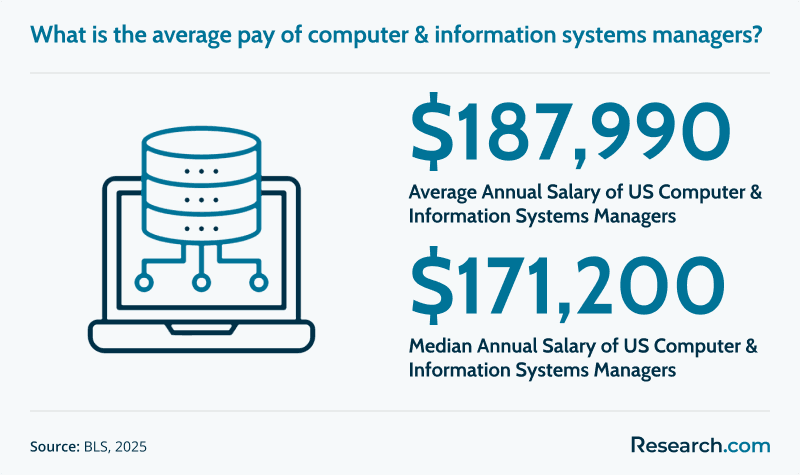
Some experienced professionals move into management. BLS data shows that computer and information systems managers, including cybersecurity managers, earn an average annual salary of $187,990 and a median annual salary of $171,200. These figures are well above the collective median yearly pay of all occupations in the United States, which is $49,500.
| Career category | Average yearly salary | Median yearly salary | What affects pay |
| Information security analysts | $127,730 | $124,910 | Technical depth, certifications, industry, location, security clearance, and incident response experience |
| Computer and information systems managers | $187,990 | $171,200 | Leadership scope, budget responsibility, team size, sector, executive reporting, and risk ownership |
| All occupations in the United States | Not specified | $49,500 | Occupation, education, geography, and experience |
- Fastest Online Master's Programs in Cybersecurity for 2027
- How long does it take to complete an online master's degree in cybersecurity?
- How does an online master's degree in cybersecurity compare to an on-campus program?
- What is the average cost of an online master's degree in cybersecurity?
- What are the financial aid options for students enrolling in an online master's degree in cybersecurity?
- What are the prerequisites for enrolling in an online master's degree in cybersecurity?
- What courses are typically in an online master's degree in cybersecurity?
- What types of specializations are available in online master's degrees in cybersecurity?
- How to choose the best online master's degree in cybersecurity?
- What career paths are available for graduates of online master's degrees in cybersecurity?
- What is the job market for graduates with an online master's degree in cybersecurity?
- What challenges should I expect with an online master's degree in cybersecurity?
- How can interdisciplinary skills boost cybersecurity careers?
- What additional certifications can enhance an online master's degree in cybersecurity?
- How do emerging technologies impact cybersecurity education and careers?
Fastest Online Master's Programs in Cybersecurity for 2027
How do we rank schools?
Accelerated online cybersecurity master’s programs require a serious commitment of time, money, and technical effort. To make the list more useful for prospective students, the ranking process emphasizes transparent data, accreditation, program structure, and factors that affect educational value.
Research.com uses information from trusted sources including the IPEDS database, College Scorecard, Peterson's database, and the National Center for Education Statistics. Accredited programs receive priority because accreditation helps verify institutional quality and eligibility for many forms of financial aid. Readers can review the complete ranking approach on the Research.com methodology page.
1. University of South Florida Online MBA in Cybersecurity
The University of South Florida offers an online MBA with a cybersecurity concentration for students who want business leadership training combined with information security management. The program is designed for roles that connect cybersecurity strategy, business continuity, risk planning, and organizational decision-making. Students complete 33–64 credit hours and may finish in about 1.5 years, with tuition and fees totaling around $16,000. The curriculum includes 12 concentration hours, three of which are electives, and students may also pursue a 12-credit Information Assurance Graduate Certificate.
- Program length: 1.5 years
- Required credits to graduate: 33 to 64
- Cost per credit: $750
- Accreditation: Southern Association of Colleges and Schools Commission on Colleges
2. James Madison University Master of Business Administration in Information Security
James Madison University provides a hybrid MBA concentration in Information Security for professionals with at least two years of work experience. The program combines business administration with cybersecurity-focused management topics, including risk assessment, security decision-making, and the use of information security practices in business operations.
- Program length: 1 year
- Required credits to graduate: 42
- Cost per credit: $900
- Accreditation: Association to Advance Collegiate Schools of Business
3. Missouri State University MBA Information Technology and Cybersecurity Emphasis
Missouri State University offers an online MBA with an Information Technology and Cybersecurity emphasis for students seeking a shorter and more affordable graduate business path. The curriculum blends core MBA topics with cybersecurity content such as data protection, network security, digital forensics, and IT risk management. Students can complete the 34-credit program in as little as one year through fully online or evening courses.
- Program length: 1 year
- Required credits to graduate: 34
- Cost per credit: $507.35
- Accreditation: Association to Advance Collegiate Schools of Business
4. Saint Leo University Master's Degree in Business Administration - Cybersecurity Management
Saint Leo University offers a 36-credit online MBA specialization in Cybersecurity Management. The program is built for students who want to develop management capability while learning how organizations assess security needs, build cyber strategies, and protect digital assets. Its emphasis is less about narrow technical specialization and more about leading cybersecurity functions in business settings.
- Program length: 2 years
- Required credits to graduate: 36
- Cost per credit: $780
- Accreditation: Southern Association of Colleges and Schools Commission on Colleges
5. Grand Canyon University Master of Business Administration with an Emphasis in Cybersecurity
Grand Canyon University offers a 54-credit online MBA with an Emphasis in Cybersecurity through the Colangelo College of Business. Students study business strategy alongside cybersecurity topics such as cyber warfare prevention, enterprise security design, operational management, and strategic planning. The curriculum is aligned with frameworks such as NIST.
- Program length: 8 weeks
- Required credits to graduate: 54
- Cost per credit: $665
- Accreditation: Higher Learning Commission
6. University of Texas at Tyler Master of Business Administration with a Concentration in Cyber Security Online
The University of Texas at Tyler offers a fully online MBA with a Cyber Security concentration for students who want to understand the business side of cybersecurity. The 36-credit, AACSB-accredited program can be finished in as few as 12 months and is designed for professionals who want to connect executive leadership priorities with cybersecurity team needs, including those without a deeply technical background.
- Program length: 1 year
- Required credits to graduate: 36
- Cost per credit: $856.10
- Accreditation: Association to Advance Collegiate Schools of Business
7. Cedarville University Online MBA in Cybersecurity Management
Cedarville University offers a 36-credit online MBA in Cybersecurity Management that combines cybersecurity management coursework with a Christian worldview. Students examine topics such as cybersecurity law, risk management, and enterprise security architecture while also considering ethical decision-making and stewardship.
- Program length: 1 year
- Required credits to graduate: 36
- Cost per credit: $680
- Accreditation: Accreditation Council for Business Schools & Programs
8. Colorado Technical University Master of Science in Computer Science - Cybersecurity Engineering
Colorado Technical University offers a 48-credit online Master of Science in Computer Science with a concentration in Cybersecurity Engineering. This option is better suited for students who want a technical graduate program rather than a cybersecurity-focused MBA. Coursework emphasizes systematic problem-solving, critical thinking, software development, and cybersecurity engineering concepts.
- Program length: 1.5 years
- Required credits to graduate: 48
- Cost per credit: $610
- Accreditation: Higher Learning Commission
9. California State University, San Marcos Online Master of Science in Cybersecurity
California State University, San Marcos offers a fully online Master of Science in Cybersecurity for working professionals preparing for cyber defense leadership. The 5-semester, non-thesis program combines advanced technical cybersecurity training with MBA-level business education. The school is recognized by the NSA and DHS as a Center of Academic Excellence in Cyber Defense Education, and the program includes evening cohort classes plus a real-world capstone project with a cybersecurity company.
- Program length: 1 year
- Required credits to graduate: 38
- Cost per credit: $875
- Accreditation: National Professional STEM Master's Association
10. Baker College Master of Science in Information Systems
Baker College offers a fully online Master of Science in Information Systems for IT professionals who want to move toward leadership roles such as CIO, CTO, or information systems department manager. The 30-credit program combines technical study with business-oriented topics including strategic planning, risk management, and project leadership. It is accredited by the National Professional Science Master’s Association and includes immersive extended reality learning experiences.
- Program length: 1.5 to 2 years
- Required credits to graduate: 30
- Cost per credit: $695
- Accreditation: National Professional Science Master’s Association
How long does it take to complete an online master's degree in cybersecurity?
Most full-time online master’s programs in cybersecurity take 1.5 to 2 years to complete. Part-time students often need 2.5 to 3 years, especially if they are balancing a full-time job, military service, caregiving, or other obligations. Program length depends on the credit requirement, course load, academic calendar, transfer policy, and whether courses are offered year-round.
Accelerated programs can shorten the timeline to 12 to 15 months, but they usually require a heavier workload. Competency-based formats may also allow some students to progress faster if they can demonstrate mastery of required skills. This type of timeline comparison is also useful in other fields, including students reviewing MSN to FNP online programs or the fastest online master's in reading and literacy programs.
| Study pace | Typical completion time | Best for | Trade-off |
| Accelerated full-time | 12 to 15 months | Students who can handle a demanding course load | Less schedule flexibility and limited time for breaks |
| Standard full-time | 1.5 to 2 years | Students who want steady progress without the most intensive pace | Requires consistent weekly availability |
| Part-time | 2.5 to 3 years | Working professionals with major personal or professional commitments | Longer time before graduation and possible tuition changes over time |
| Competency-based | Varies by student progress | Experienced learners who can move quickly through familiar material | Requires strong self-direction and careful review of employer recognition |
The chart below shows the US states that offer the highest average salaries to information security analysts.
How does an online master's degree in cybersecurity compare to an on-campus program?
Online and on-campus cybersecurity master’s programs can cover the same core subjects: network defense, threat analysis, digital forensics, cryptography, secure systems, and cybersecurity governance. The major differences are how students access instruction, labs, peers, faculty, and career support.
| Factor | Online cybersecurity master’s | On-campus cybersecurity master’s | Decision tip |
| Schedule | Often asynchronous, hybrid, or designed for working adults | Usually follows set class times and campus calendars | Choose online if work flexibility is essential; choose campus if you need external structure |
| Learning environment | Uses virtual labs, recorded lectures, forums, and remote collaboration | Uses in-person lectures, physical labs, and face-to-face interaction | Online works best for independent learners; campus may help students who learn through direct interaction |
| Hands-on practice | Remote labs, simulations, cloud environments, and capstones | Physical labs, campus equipment, and in-person technical support | Ask online programs exactly how labs are delivered before enrolling |
| Networking | Digital group projects, alumni platforms, virtual events, and online career services | Campus career fairs, student organizations, research events, and local employer visits | Online students should be proactive about networking |
| Cost and access | May reduce relocation, transportation, and housing costs | May include higher living and campus-related costs | Compare total cost, not just tuition |
Students comparing online and campus formats should also review how other fields handle flexibility, cost, and advising. For example, similar considerations appear in the cheapest online LPC programs and the best online PhD programs in neuropsychology, even though licensure and fieldwork requirements differ by discipline.
What is the average cost of an online master's degree in cybersecurity?
The estimated average cost of an online master’s degree in cybersecurity is around $31,000 to a little over $33,000. Public institutions average about $27,000, while private nonprofit schools are closer to $35,000. These averages are only a starting point because total cost can differ sharply by school, residency policy, program length, fees, and financial aid.
Public universities may offer lower-cost options, with some total tuition ranges from $9,000 to $18,000. Mid-tier public and private programs commonly fall between $18,000 and $40,000. For example, Boise State’s program costs around $18,400, while the University of the Pacific charges about $38,400. Higher-priced private universities such as Georgetown and Johns Hopkins can cost between $50,000 and $80,000.
Some programs reduce the effective cost through scholarships or alternative pricing models. NYU’s Cyber Fellows program, for example, lowers tuition to around $18,000. Competency-based options at Western Governors University or Georgia Tech may cost as little as $7,000 to $12,000. Students comparing graduate tuition models may find it helpful to review cost structures in other accelerated online degrees, such as the fastest online master's in science education degree programs.
| Cost factor | Why it matters | Question to ask |
| Tuition per credit | Credit pricing drives most of the bill | Is the posted rate the same for online, out-of-state, and part-time students? |
| Required credits | A lower per-credit price can still be expensive if the program requires many credits | How many total credits are required to graduate? |
| Fees | Online learning, technology, graduation, and course fees can add up | What is the total program cost including fees? |
| Transfer credits | Accepted credits may shorten time and reduce tuition | Can graduate credits, military training, or certificates reduce requirements? |
| Employer support | Tuition reimbursement can reduce out-of-pocket cost | Does my employer cover cybersecurity graduate coursework? |
| Career return | ROI depends on role, experience, salary growth, and debt | What roles do graduates actually enter, and what support does the school provide? |
Cybersecurity salaries can help graduates recover education costs over time, especially in advanced analyst or management roles. Still, students should avoid assuming a degree guarantees a specific salary. A practical ROI estimate should include tuition, fees, lost time, loan interest, certifications, and the experience required for target jobs. Readers comparing salary-to-education decisions in other careers may also review Research.com’s guide to care case manager salary and career paths for a different example of cost-benefit planning.
What are the financial aid options for students enrolling in an online master's degree in cybersecurity?
Financial aid can make an online cybersecurity master’s degree more manageable, but students should understand which funding options must be repaid and which reduce the total cost. This same cost-planning mindset applies to many graduate programs, including students reviewing the average cost of PsyD program options or the fastest online bachelor's in emergency management programs.
- FAFSA: Students in accredited programs may qualify for federal options such as Direct Unsubsidized Loans and Grad PLUS Loans. Graduate grants are uncommon, but the FAFSA is still the starting point for federal aid.
- School scholarships and fellowships: Universities may offer merit-based, need-based, or cybersecurity-specific awards. Some are automatic with admission, while others require separate applications.
- Graduate assistantships: These are less common in fully online programs but may provide stipends or tuition reductions for teaching, research, or administrative support.
- Employer tuition assistance: Technology, defense, finance, healthcare, and government employers may help pay for cybersecurity graduate study if the degree supports business needs.
- Military and veterans benefits: Eligible students may be able to use GI Bill® benefits, Tuition Assistance, or Yellow Ribbon Program support for approved online programs.
- Private scholarships: Organizations such as (ISC)², SANS, and the Center for Cyber Safety and Education offer cybersecurity-related scholarships for graduate students. Awards often range from a few hundred to several thousand dollars.
- Payment plans and institutional discounts: Some schools allow monthly or semester payment plans. Others offer discounts for alumni, in-state students, military-connected learners, or partner-organization members.
What are the prerequisites for enrolling in an online master's degree in cybersecurity?
Admission requirements differ by school, but most online cybersecurity master’s programs expect applicants to show academic readiness, technical preparation, and a clear professional purpose. Students without a strong technical background may need bridge courses or foundational training before taking graduate-level security courses. A focused option such as a shortest online ethical hacking dual certification can help some learners build practical exposure before applying.
| Requirement | What programs commonly expect | How to prepare |
| Bachelor’s degree | A degree from an accredited institution, often in computer science, computer engineering, electrical engineering, or a related technical field | Confirm whether non-technical degrees are accepted with experience or prerequisite coursework |
| Technical foundation | Knowledge of programming, networking, operating systems, data structures, algorithms, and discrete mathematics | Take bridge courses or complete certificates if gaps are significant |
| Programming ability | Experience with languages such as Java, C++, or Python may be expected | Build a portfolio with scripts, security labs, or small projects |
| GPA | Many programs commonly expect around 3.0 on a 4.0 scale | Ask whether professional experience, certifications, or probationary admission can offset a lower GPA |
| Work experience | Some programs prefer or require experience in cybersecurity, IT, information systems, or related fields | Highlight security-related responsibilities, projects, tools, and certifications on your resume |
| Application materials | Transcripts, resume or CV, recommendation letters, essays, and sometimes proof of English proficiency for international students | Tailor your statement of purpose to the program’s technical focus and your target role |
| Provisional admission | Some schools admit students conditionally if they need prerequisite courses | Clarify whether bridge courses add time, credits, or cost |
According to Zippia, as shown in the chart below, 62% of information security managers in the United States earned a bachelor's degree, 19% have a master's degree, 14% finished an associate degree, and 2% completed a certificate program.
What courses are typically in an online master's degree in cybersecurity?
Cybersecurity master’s programs usually combine theoretical foundations, applied technical labs, policy work, and a final project or thesis. Students who are earlier in their academic path may want to compare graduate expectations with the shortest online cybersecurity bachelor's degree programs to understand the difference between undergraduate preparation and advanced study.
| Course area | What students learn | Career relevance |
| Foundations of Cybersecurity | Risk management, threat modeling, security frameworks, and core principles of cyber defense | Builds the baseline for analyst, engineer, and governance roles |
| Network Security | Firewalls, intrusion detection, secure architectures, traffic analysis, and network protection methods | Supports SOC, network defense, and security engineering work |
| Cryptography | Encryption methods, key management, cryptographic protocols, and secure communications | Useful for secure systems, cloud security, and data protection roles |
| Ethical Hacking and Penetration Testing | Authorized attack simulation, vulnerability discovery, exploit testing, and reporting | Prepares students for offensive security and penetration testing work |
| Cybersecurity Law and Policy | Privacy, compliance, legal responsibilities, ethics, and organizational security policy | Supports governance, risk, compliance, and management roles |
| Digital Forensics | Evidence collection, preservation, analysis, and investigation of computers, mobile devices, and networks | Relevant to investigations, incident response, and cybercrime analysis; students interested in investigative work may also compare the fastest online forensic accounting degree programs |
| Secure Software Development | Security practices in the software development lifecycle, secure coding, testing, and vulnerability prevention | Useful for application security, DevSecOps, and software security roles |
| Incident Response and Disaster Recovery | Detection, containment, recovery, post-incident analysis, and business continuity | Critical for security operations and crisis-response roles |
| Cloud and Mobile Security | Cloud platform risks, access controls, data protection, mobile device security, and compliance concerns | Supports cloud security, enterprise architecture, and modern infrastructure roles |
| Capstone Project or Thesis | Applied research or a real-world cybersecurity problem solved through planning, implementation, and analysis | Provides portfolio evidence for employers and demonstrates graduate-level synthesis |
What types of specializations are available in online master's degrees in cybersecurity?
Specializations help students align the degree with a specific career direction. A student aiming for penetration testing needs a different course mix than someone targeting compliance leadership, cloud security, or critical infrastructure protection. Students interested in data-heavy security work may also compare cybersecurity pathways with an accelerated online degree in data analytics.
| Specialization | Focus | Best fit for |
| Cybersecurity Policy and Governance | Security policies, compliance, enterprise risk, privacy, and leadership decisions | Students aiming for GRC, security management, or compliance roles |
| Digital Forensics | Cybercrime investigation, evidence handling, forensic tools, and incident analysis | Students interested in investigations, law enforcement support, or breach analysis |
| Cyber Operations or Offensive Security | Penetration testing, ethical hacking, vulnerability exploitation, and adversarial thinking | Students targeting red team, penetration testing, or offensive security roles |
| Security Engineering or Network Security | Secure network design, system hardening, architecture, and infrastructure defense | Students who want technical engineering or architecture positions |
| Cloud Security | Cloud infrastructure, identity and access management, data protection, and cloud compliance | Students working with cloud platforms or enterprise migration projects |
| Information Assurance | Confidentiality, integrity, availability, controls, risk assessment, and audit readiness | Students pursuing security assurance, risk analysis, or compliance-oriented roles |
| Health Care Security or Critical Infrastructure | Sector-specific security, privacy, operational risk, and regulatory requirements | Students in healthcare, energy, finance, utilities, or public-sector environments |
Some concentrations can lead to different types of opportunities and compensation patterns, much as readers see when comparing the highest paying criminology jobs. Before choosing a specialization, review job postings for your target role and note which tools, frameworks, certifications, and experience levels employers request.
How to choose the best online master's degree in cybersecurity?
The best online master’s in cybersecurity is not simply the fastest or cheapest program. It is the one that fits your current background, target role, budget, schedule, and preferred learning style while meeting recognized academic standards.
- Verify accreditation: Look for regional accreditation at the institutional level. Also consider whether the program is recognized as a Center of Academic Excellence in Cyber Defense (CAE-CD) by the NSA and DHS.
- Match the curriculum to your goal: A policy-heavy program may be excellent for governance roles but weaker for penetration testing. A technical MS may be better for engineering, architecture, and hands-on roles than an MBA concentration.
- Review lab quality: Ask whether students use remote labs, cloud environments, capture-the-flag exercises, malware analysis sandboxes, or industry tools.
- Check faculty and industry connections: Faculty with cybersecurity practice, research, government, or industry experience can add practical insight. Employer partnerships may improve project and networking opportunities.
- Compare format and workload: Confirm whether classes are synchronous, asynchronous, cohort-based, self-paced, part-time, full-time, or accelerated.
- Calculate total cost: Include tuition, fees, books, software, certifications, travel, residency requirements, and loan interest.
- Ask about career outcomes: Request information on career services, employer relationships, alumni roles, internship access, and capstone partners.
| Question to ask before enrolling | Why it matters |
| Is the institution accredited? | Accreditation affects academic quality, credit transfer, employer recognition, and financial aid access |
| Does the curriculum match my target role? | Cybersecurity roles vary widely; the wrong curriculum can slow your career transition |
| How are hands-on labs delivered online? | Cybersecurity requires applied practice, not just readings and exams |
| What is the total cost from enrollment to graduation? | Program affordability depends on total cost, not advertised tuition alone |
| Can I finish while working full time? | Accelerated schedules can be difficult for working adults |
| Are certifications built into the program? | Some employers value certifications alongside degrees |
| What support is available when technical problems arise? | Online labs can require strong technology support and responsive faculty |
What career paths are available for graduates of online master's degrees in cybersecurity?
Graduates can move into technical, investigative, governance, consulting, and leadership roles. The best path depends on prior experience. A student with network administration experience may move toward security engineering, while a student with audit or compliance experience may be better positioned for governance, risk, and compliance. Students who want a broader software-building path may also consider a fast-track online software engineering degree as another route into technology careers with security relevance.
| Career path | Primary responsibilities | Typical preparation advantage |
| Information Security Analyst | Monitors systems, investigates alerts, analyzes threats, and recommends safeguards | Security operations, networking, incident response, and risk analysis |
| Information Systems Manager | Leads IT operations, manages teams and budgets, and aligns systems security with business goals | Leadership, project management, infrastructure knowledge, and business strategy |
| Penetration Tester | Conducts authorized attacks to identify vulnerabilities before adversaries exploit them | Ethical hacking, scripting, reporting, and vulnerability assessment |
| Cybersecurity Engineer | Builds and maintains secure systems, tools, networks, and infrastructure | Systems administration, network security, cloud security, and automation |
| Security Architect | Designs enterprise security frameworks and ensures technology is implemented securely | Engineering depth, architecture planning, risk analysis, and stakeholder communication |
| Incident Response Specialist | Detects, contains, investigates, and helps organizations recover from security incidents | Forensics, malware analysis, log review, and crisis coordination |
| Digital Forensics Analyst | Examines devices, networks, and data to support investigations | Evidence handling, forensic tools, legal awareness, and investigative methods |
| Chief Information Security Officer | Oversees cybersecurity strategy, budget, policy, teams, and executive risk communication | Extensive experience, leadership, governance, and business risk management |
| Cybersecurity Consultant | Advises clients on risk, controls, compliance, testing, and security strategy | Technical breadth, client communication, documentation, and industry frameworks |
| Compliance or Risk Manager | Manages cybersecurity requirements, audits, policies, and organizational risk | Governance, regulatory knowledge, controls, and documentation |
| Cybersecurity Researcher or Educator | Develops new knowledge, teaches cybersecurity concepts, or trains future professionals | Research skills, advanced technical knowledge, writing, and instruction |
According to a report by the World Economic Forum, 35% of small organizations believe their cyber resilience is inadequate, compared to just 7% of large organizations.
What is the job market for graduates with an online master's degree in cybersecurity?
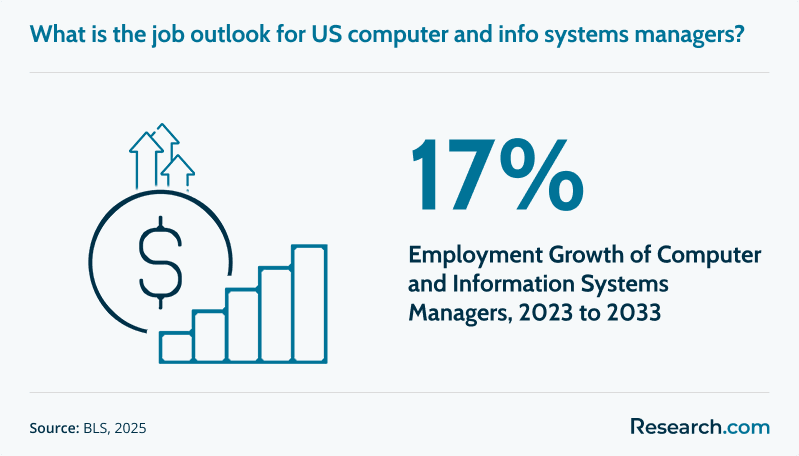
The labor market for cybersecurity professionals remains strong. According to the BLS, employment of information security analysts is projected to grow by 33% from 2023 to 2033, which is more than 8 times higher than the national average of 4%. For management-oriented roles, employment of computer and information systems managers, including cybersecurity managers, is projected to grow by 17% during the same period.
BLS projects 17,300 openings for information security analysts each year in that period. There are currently over 5,000 openings for the role in the United States, while candidates pursuing cybersecurity management can find more than 8,000 openings for information security managers.
The largest employers of information security analysts, as shown in the chart below, are computer systems design and related services at 22%, finance and insurance firms at 15%, and information companies at 10%. For computer and information systems managers, the biggest employers are computer systems design and related services at 21%, information companies at 14%, and finance and insurance firms at 12%.
What challenges should I expect with an online master's degree in cybersecurity?
Online cybersecurity graduate study is flexible, but it is not easy. Students often underestimate the time needed for labs, troubleshooting, reading, and group projects. Limited real-time interaction can also make mentorship and immediate feedback harder to access unless the program is designed with strong faculty availability and technical support.
| Common challenge | Why it matters | How to reduce the risk |
| Weak time management | Cybersecurity coursework can include long labs and technical troubleshooting | Block weekly study hours before classes begin and avoid overload in accelerated terms |
| Limited hands-on access | A program without strong labs may not build job-ready skills | Ask for examples of lab platforms, capstone projects, and security tools used |
| Technology problems | Remote labs and virtual machines may require specific hardware or software | Review technical requirements and confirm support hours |
| Isolation | Online learners can miss informal peer and faculty interaction | Join study groups, attend live sessions, use office hours, and participate in professional associations |
| Outdated curriculum | Cybersecurity changes quickly, and old material can reduce career value | Check how often courses are updated and whether faculty have current industry experience |
| Cost surprises | Fees, tools, books, and certification costs can raise the total price | Request a full cost breakdown before enrolling |
Students evaluating online graduate support may also compare practices in adjacent STEM fields, such as the most affordable online biotechnology master's degree options, to see how schools handle affordability, advising, and remote learning resources across disciplines.
What do graduates say about online master's degrees in cybersecurity?
-
: "
“The online format gave me access to a broader cybersecurity community than I would have found locally. I worked with classmates from different regions and industries, which sharpened how I think about threat intelligence, secure design, and career networking.” — Barry
"
-
: "
“I was able to keep my full-time job while applying new cybersecurity concepts almost immediately at work. Being able to review difficult lessons more than once helped me build confidence without putting my career or personal responsibilities on hold.” — Joel
"
-
: "
“I worried that online cybersecurity classes would feel disconnected, but the virtual labs and discussions were more useful than I expected. Replaying lectures and working through hands-on exercises at my own pace helped me understand secure coding and risk management more deeply.” — Jillian
"
How can interdisciplinary skills boost cybersecurity careers?
Cybersecurity is no longer isolated from the rest of technology and business. Professionals who understand software development, data analytics, cloud systems, human behavior, project management, and communication can often identify risks that purely technical specialists may miss. For example, secure application design requires knowledge of both software development and threat modeling, while security leadership requires the ability to explain technical risk to executives.
Cross-disciplinary learning can be especially useful for students who want to work in application security, DevSecOps, product security, cyber risk, or user-centered security design. Even fields such as online game development programs can introduce concepts related to interactive systems, user behavior, performance constraints, and secure architecture that may inform cybersecurity thinking.
What additional certifications can enhance an online master's degree in cybersecurity?
A master’s degree can strengthen academic and strategic preparation, while certifications can validate specific technical or professional competencies. Employers may use certifications as evidence that candidates can work with recognized tools, frameworks, and security practices.
| Certification | How it can complement the degree | Best for |
| CISSP | Signals advanced knowledge across security domains and management concepts | Experienced professionals pursuing security leadership or architecture |
| CEH | Focuses on ethical hacking concepts and attacker methodologies | Students interested in penetration testing or offensive security foundations |
| CompTIA Security+ | Validates baseline cybersecurity knowledge across common security topics | Career changers or early-career IT professionals building credibility |
Students aiming for cybersecurity leadership may also benefit from management-focused training. For example, the fastest online masters engineering management programs can help technical professionals think about projects, teams, operations, and strategy—skills that are often important in senior cybersecurity roles.
How do emerging technologies impact cybersecurity education and careers?
Artificial intelligence, machine learning, blockchain, cloud computing, and automation are changing both cybersecurity threats and defenses. Graduate cybersecurity programs increasingly need to prepare students to secure cloud environments, evaluate AI-enabled tools, understand automated threat detection, and assess risks created by interconnected systems.
AI can help identify patterns in large volumes of security data, but it also creates new concerns around model security, data privacy, adversarial attacks, and misuse by threat actors. Cloud computing expands flexibility but introduces identity, configuration, shared-responsibility, and compliance challenges. Blockchain and decentralized systems create their own risk models, especially around smart contracts, key management, and transaction integrity.
Students who want deeper preparation in AI-related security may compare cybersecurity coursework with the cheapest online masters in artificial intelligence options. The goal is not to chase every trend, but to build enough technical breadth to understand how new systems change organizational risk.
Common mistakes to avoid when choosing an online cybersecurity master’s
- Choosing only by speed: The fastest program may not provide enough hands-on practice, support, or specialization for your goals.
- Ignoring accreditation: Accreditation affects quality assurance, transfer options, financial aid eligibility, and employer confidence.
- Comparing tuition but not total cost: Fees, books, labs, certifications, software, and loan interest can significantly change affordability.
- Assuming online means easier: Online cybersecurity labs can be demanding, especially in accelerated programs.
- Overlooking prerequisites: Students without programming, networking, or operating systems knowledge may struggle unless bridge support is available.
- Choosing the wrong specialization: A governance track may not prepare you for penetration testing, and an engineering track may not provide enough policy training for compliance leadership.
- Expecting the degree alone to guarantee a job or salary: Hiring outcomes depend on experience, projects, certifications, interview performance, location, and employer needs.
- Relying only on rankings: Rankings can narrow your list, but the best program is the one that fits your career target and constraints.
Key Insights
- A fast online master’s in cybersecurity is best for students who already have technical preparation and want to accelerate advancement into analyst, engineering, risk, or management roles.
- Most full-time online cybersecurity master’s programs take 1.5 to 2 years, while accelerated options may take 12 to 15 months. Faster programs require stronger time management and a heavier workload.
- Information security analysts earn an average yearly salary of $127,730 and a median yearly salary of $124,910; computer and information systems managers earn an average annual salary of $187,990 and a median annual salary of $171,200.
- The cybersecurity job market is strong: BLS projects 33% employment growth for information security analysts from 2023 to 2033 and 17% growth for computer and information systems managers during the same period.
- The estimated average cost of an online master’s degree in cybersecurity is around $31,000 to a little over $33,000, but program prices range widely. Always compare total cost, not only tuition per credit.
- Accreditation, lab quality, curriculum fit, faculty experience, employer connections, and career services are more important than speed alone.
- Certifications such as CISSP, CEH, and CompTIA Security+ can complement a graduate degree by validating specific skills employers recognize.
- Emerging technologies such as AI, machine learning, cloud computing, and blockchain are reshaping cybersecurity education, making adaptable technical skills and continuous learning essential.
References
- BLS (2024, April 3). 11-3021 Computer and Information Systems Managers. BLS
- BLS (2024, April 3). 15-1212 Information Security Analysts. BLS
- BLS (2025, April 18). Computer and Information Systems Managers. BLS
- BLS (2025, June 30). Industry: Cross-industry, Private, Federal, State, and Local Government Period: May 2024. BLS BLS occupational employment data
- BLS (2025, April 18). Information Security Analysts. BLS College Board career education profile
- Martin, J. (2025, June 6). How Many Cyber Attacks Occur Each Day? (2025). Exploding Topics
- World Economic Forum (2025, January 13). Global Cybersecurity Outlook 2025. World Economic Forum
- Zippia (2025, January 8). Information Security Manager Education Requirements. Zippia
Other Things You Should Know About Online Master's Degrees in Cybersecurity
Admission requirements for the fastest online master's programs in cybersecurity often include a bachelor's degree in a related field, relevant work experience, and proficiency in computer science fundamentals. Applicants may also need to submit GRE scores, recommendation letters, and a statement of purpose demonstrating their commitment to the cybersecurity field.
Typically, the fastest online master's programs in cybersecurity require around 30-36 credit hours for completion in 2027. This condensed credit requirement allows students to graduate more quickly, often within 12 to 18 months, compared to traditional two-year programs.
Yes. Many 30- to 36-credit online cybersecurity master’s programs accept up to 6 or 9 transfer credits, and some allow waivers for prior graduate coursework. Schools usually require official transcripts, a minimum grade of B or better, and approval from the program director.


