2027 Fastest Online Master's in Reading and Literacy

Co-Founder and Chief Data Scientist
Choosing an accelerated online Master's in Reading and Literacy is not just a question of finding the shortest completion time. For teachers, literacy coaches, curriculum specialists, and education professionals, the bigger question is whether a fast program will actually support certification, deepen instructional expertise, and improve career options without sacrificing quality.
This guide is designed for working educators and career changers comparing the fastest online Master's in Reading and Literacy programs. It explains what these programs cover, how long they take, what they cost, which schools offer strong accelerated options, and how to judge whether a program is rigorous enough for your goals. You will also learn how to compare accreditation, licensure alignment, practicum requirements, salary outcomes, job-market risks, and long-term return on investment.
The main takeaway: speed can be useful, but only when the program is accredited, clinically grounded, aligned with your state requirements, and realistic for your schedule.
Quick answer: What is the fastest credible online Master's in Reading and Literacy?
The fastest online Master's in Reading and Literacy programs can often be completed in 12-18 months, although many reputable programs take 18 months to two years. The quickest credible options usually use accelerated 7- or 8-week courses, year-round enrollment, and structured course sequencing. However, applicants should be careful: the fastest program is not always the best program if it lacks regional accreditation, does not include supervised literacy practice, or does not meet reading specialist or literacy coach licensure requirements in the student's state.
For most licensed teachers, the best accelerated program is one that balances completion speed with state certification alignment, evidence-based reading instruction, assessment training, and field-based practice. Programs that advertise speed but do not clearly explain accreditation, practicum expectations, or licensure outcomes should be reviewed cautiously.
Who should consider an accelerated online Master's in Reading and Literacy?
| Best fit | Why this path may make sense | What to verify first |
| Licensed K-12 teachers | A master's in reading and literacy can support advancement into reading specialist, literacy coach, or instructional leadership roles. | Confirm whether the program meets your state's reading specialist, literacy teacher, or literacy coach certification rules. |
| Teachers seeking district leadership | Coursework in assessment, intervention, curriculum design, and coaching can prepare educators for school- or district-level literacy initiatives. | Check whether the program includes leadership courses, coaching practice, and data-analysis training. |
| Educators working with struggling readers | Graduate study can strengthen skills in diagnostic assessment, explicit instruction, intervention planning, and progress monitoring. | Look for coursework aligned with evidence-based reading instruction and supervised practice with learners. |
| Teachers interested in ESOL or bilingual literacy | Some programs include ESOL, multilingual learner, or cultural diversity pathways. | Make sure the ESOL or bilingual option leads to the credential you need, if credentialing is your goal. |
| Non-certified literacy professionals | Some programs accept nonprofit staff, tutors, adult literacy educators, or educational consultants. | Understand that a master's alone may not lead to teacher certification if you do not already hold a teaching license. |
What are the benefits of getting a qualification from the fastest online Master's in Reading and Literacy programs?
- Faster access to literacy leadership roles: An advanced literacy credential may help educators qualify for positions such as reading specialist, literacy coach, curriculum coordinator, instructional lead, or district literacy support professional, depending on state and employer requirements.
- Potential salary growth: A master's degree in reading and literacy can elevate a reading specialist's median salary from the $40,752-$43,312 range to a curriculum director's national average salary of approximately $94,614, with top earners making over $124,000 annually.
- Flexible graduate study for working educators: Online accelerated formats can make it easier to continue teaching while completing graduate coursework on a compressed schedule.
- Immediate classroom application: Many programs focus on assessment, intervention, differentiated instruction, and literacy coaching strategies that teachers can apply directly in their current classrooms.
- Preparation for high-need literacy challenges: With national reading performance concerns continuing, educators with advanced training in reading development, intervention, and data-driven instruction can play an important role in school improvement efforts.
What can I expect from the fastest online Master's in Reading and Literacy programs?
Accelerated online reading and literacy master's programs are intensive graduate degrees focused on how students learn to read, why reading difficulties occur, and how educators can assess, intervene, coach, and lead literacy improvement. They are usually designed for practicing teachers, although some programs also admit education professionals who are not seeking certification.
| Program feature | What it usually includes | Why it matters |
| Core literacy theory | Reading development, language acquisition, literacy research, and sociocultural foundations of reading and writing. | Strong theory helps educators select interventions based on how literacy skills develop, not on isolated teaching techniques. |
| Assessment and intervention | Diagnostic reading assessments, interpretation of student data, intervention planning, and progress monitoring. | Reading specialists and literacy coaches must be able to identify skill gaps and design targeted instruction. |
| Instruction for diverse learners | Strategies for English learners, students with disabilities, multilingual students, and learners with reading difficulties. | Literacy professionals often work with students whose needs require more than standard classroom instruction. |
| Coaching and leadership | Teacher collaboration, professional development, literacy program design, curriculum evaluation, and instructional leadership. | Many graduates move beyond direct instruction into schoolwide or districtwide literacy improvement roles. |
| Practicum or clinical work | Supervised tutoring, assessment projects, literacy clinics, field-based assignments, or coaching practice. | Clinical experience is a key signal that a fast program still includes applied professional preparation. |
| Condensed schedule | Many accelerated programs use 7- or 8-week courses and year-round enrollment. | The pace can shorten completion time, but it also requires steady weekly commitment. |
- Focused advanced coursework: Expect graduate-level study in literacy theory, diagnostic assessment, intervention design, instructional strategies for diverse learners, digital literacy, and literacy leadership.
- Structured online delivery: Programs commonly combine asynchronous modules, recorded lectures, discussion boards, live seminars, applied projects, and field-based assignments.
- Practical skill development: Students typically learn to use reading data, plan differentiated instruction, evaluate curricula, and support teachers through coaching or professional learning.
- Compressed completion timeline: Programs are designed to move quickly, often in 12-18 months, although many high-quality options take closer to two years.
Where can I work with a qualification from the fastest online Master's in Reading and Literacy programs?
Graduates may work in schools, districts, nonprofits, tutoring organizations, publishing, educational technology, consulting, or higher education support roles. The exact options depend on prior certification, state licensure rules, professional experience, and the program's credential alignment.
- Public and private K-12 schools: Graduates often work as reading specialists, literacy coaches, intervention teachers, or classroom teachers with advanced literacy expertise.
- School districts: District-level opportunities may include curriculum specialist, instructional coordinator, literacy program lead, or director of curriculum and instruction roles.
- Nonprofit organizations: Literacy graduates may manage adult literacy, early childhood literacy, family literacy, tutoring, or educational equity programs.
- Private education companies: Educational technology companies, publishers, test-preparation firms, and tutoring organizations may hire literacy experts to design materials and programs.
- Consulting firms: Experienced professionals may advise schools, districts, or education organizations on literacy curriculum, intervention systems, professional development, and evaluation.
- Higher education: Some graduates support teacher preparation, literacy clinics, continuing education, or program coordination in colleges and universities.
- Leadership pathways: With additional experience and credentials, the degree can support movement toward roles such as Director of Education, Chief Academic Officer, or state-level literacy consultant.
How much can I earn with an online Master's in Reading and Literacy degree?
Salary depends heavily on role, district, location, union contracts, years of experience, leadership responsibilities, and whether the position is in K-12 education, higher education, nonprofit work, or the private sector. A master's degree can strengthen qualifications, but it does not guarantee a specific salary or promotion.
| Career level | Common roles | Salary information stated in available data |
| Instructional-level roles | Instructional Coaches, Lead Teachers, Reading Specialists, ESL Teachers | Instructional Coaches and Lead Teachers typically earn $58K–$75K. BLS reports a $74,720 median for instructional coordinators (May 2024). Coaches average $58K–$64K, with top earners in the mid-$70Ks. |
| Coordinator-level roles | Instructional Coordinators, Curriculum Specialists, Literacy Program Leads | Instructional Coordinators and Curriculum Specialists earn $69K–$93K+, with Salary.com listing $69K for entry-level specialists and experienced ones reaching the low $90Ks. Top 10% earn over $115K (BLS). |
| Administrative-level roles | Assistant Principals, Principals, Curriculum Directors | Assistant Principals earn $95K–$111K (avg. ~$97K–$98K). Principals earn $104K+, often exceeding $121K based on district and level. |
- Fastest Online Master's in Reading and Literacy for 2027
- Average cost of an online Master's in Reading and Literacy
- Financial aid options for online Reading and Literacy master's students
- Admissions requirements and prerequisites
- Common courses in Reading and Literacy master's programs
- Available specializations in reading and literacy
- How to choose among the fastest online programs
- Career paths for Master's in Reading and Literacy graduates
- Salary expectations after an online Master's in Reading and Literacy
- How to check rigor, accreditation, and quality
- Online versus campus program rigor
- Risks of accelerated online literacy programs
- Long-term cost-effectiveness and ROI
- Job market for Reading and Literacy master's graduates
- Current and future trends in reading and literacy
Fastest Online Master's in Reading and Literacy for 2027
The programs below are online or primarily online graduate options in reading, literacy, or closely related education fields. They are presented for students who want a faster path but still need credible academic preparation. If you are comparing accelerated education programs more broadly, you may also find it useful to review Research.com's guide to fast online master's programs in science education.
How do we rank schools?
Research.com's school-ranking process is designed to make program comparisons more transparent. Our methodology considers data from established education sources, including:
- the IPEDS database
- Peterson's database, including distance learning data
- the College Scorecard database
- the National Center for Education Statistics
- additional institutional data checks through IPEDS
Use the ranking as a starting point, not as the only decision factor. Before applying, confirm tuition, state authorization, licensure alignment, practicum rules, and current admissions requirements directly with the university.
| School | Program length | Credits | Best for |
| Clemson University | 2 years | 30 | Educators seeking literacy teacher, literacy coaching, or ESOL pathways. |
| East Carolina University | 2 years | 30 | Working professionals preparing for reading specialist roles and advanced K-12 Reading licensing. |
| Louisiana State University Shreveport | Flexible, typically 1–2 years | 30 | Teachers seeking reading and literacy concentration coursework with possible add-on certification. |
| Saint Joseph's University | 18–24 months | 36 | Educators seeking a PK-12 Reading Specialist concentration with IDA-aligned standards. |
| State University of New York at Albany | Flexible, typically 1–2 years | 30 | Certified and non-certified applicants seeking advanced literacy study. |
| State University of New York (SUNY) Oneonta | As little as 1 year | 30 | New York educators seeking literacy education and professional certification preparation. |
| University of Florida | 4–6 semesters | 36 (M.Ed.), 30 (MA) | Students choosing between non-thesis professional study and thesis or project-based research. |
| University of Georgia | 2 years (part-time) | 36 | Certified teachers interested in digital literacies, culture, and literacy instruction. |
| University of North Carolina at Charlotte | 2 years | 33 | Classroom teachers and aspiring literacy specialists seeking advanced K-12 Reading Education preparation. |
| University of South Florida | 2–3 years | 36 | Educators interested in literacy leadership, media literacy, global literacies, and disciplinary literacy. |
1. Clemson University
Clemson University offers a fully online Master of Education in Literacy for educators who want to deepen literacy instruction, prepare for literacy leadership, or add expertise in English for Speakers of Other Languages. The program can typically be completed in two years and includes pathways for Literacy Teacher, Literacy Coaching, and ESOL Teacher preparation.
The Literacy Coaching strand is intended for applicants with three years of teaching experience and includes coursework for both Literacy Teacher and Literacy Coach certifications. Students in this strand study supervision and administration in literacy and complete an action research project focused on literacy coaches as agents of change.
The ESOL strand is designed for practicing teachers and leads to both Literacy Teacher and ESOL add-on certifications. It includes coursework in linguistics, cultural diversity, and a practicum focused on ESOL learners at elementary and secondary levels. The program is a strong option for educators who want multiple credential pathways and practical preparation for diverse classrooms.
- Program Length: 2 years
- Tracks/Concentrations: Literacy Teacher, Literacy Coaching, ESOL Teacher
- Tuition Cost: $7,560 (in-state), $20,822 (out-of-state) total cost per semester
- Required Credits to Graduate: 30
- Accreditation: Southern Association of Colleges and Schools Commission on Colleges (SACSCOC); International Literacy Association (ILA)
2. East Carolina University
East Carolina University offers an online Master of Arts in Reading and Literacy Education for professionals who want to support K-12 literacy development and prepare for reading specialist work. The degree can be completed in just two years and follows a web-based format designed for working educators.
The program emphasizes literacy instruction for diverse learners and includes courses such as "Diversity and Equity in Literacy" and "Literacy Leadership and Coaching." Faculty members are active in literacy research and publication, which can benefit students who want instruction grounded in current scholarship.
During the final semester, students complete a practicum involving direct assessment work with K-12 students. Graduates are prepared for roles such as literacy coach and reading specialist. After completing the degree, graduates are eligible to take the Reading Specialist exam and apply for an advanced M-level K-12 Reading license.
- Program Length: 2 years
- Tracks/Concentrations: General Reading and Literacy Education
- Tuition Cost: Not specified
- Required Credits to Graduate: 30
- Accreditation: Southern Association of Colleges and Schools Commission on Colleges (SACSCOC)
3. Louisiana State University Shreveport
The online Master of Education in Curriculum and Instruction at Louisiana State University Shreveport includes a reading and literacy concentration for educators who want stronger instructional, assessment, and program-design skills. The program studies current reading theories and models and includes field-based experience in schools and classrooms.
Students learn how to assess reading ability, apply reading techniques, design reading programs for individual needs, and understand program administration and leadership. This makes the degree useful for classroom teachers as well as educators preparing for broader school leadership responsibilities.
Students who already hold a teaching certificate may qualify for an add-on certification after completing the program. Applicants should verify certification requirements with their state and district before enrolling.
- Program Length: Flexible, typically 1–2 years
- Tracks/Concentrations: Reading and Literacy (with options for endorsement)
- Tuition Cost: $378/credit
- Required Credits to Graduate: 30
- Accreditation: Southern Association of Colleges and Schools Commission on Colleges (SACSCOC)
4. Saint Joseph's University
Saint Joseph's University offers an online Master of Science (MS) in Education with a PK-12 Reading Specialist concentration. The program is designed for educators who want preparation in reading instruction, assessment, intervention, and literacy leadership.
Coursework is delivered asynchronously, and the summer capstone internship is structured to support working professionals. Students study intervention strategies for diverse learners and benefit from small virtual classes and student support services.
The program is accredited by the International Dyslexia Association (IDA), which indicates alignment with the IDA Knowledge and Practice Standards for Teachers of Reading. Admission requires a bachelor's degree and a minimum 3.0 GPA. Students can complete the program in 18–24 months.
- Program Length: 18–24 months
- Tracks/Concentrations: PK-12 Reading Specialist
- Tuition Cost: $879/credit
- Required Credits to Graduate: 36
- Accreditation: International Dyslexia Association (IDA) Knowledge and Practice Standards for Teachers of Reading
5. State University of New York (SUNY) at Albany
The State University of New York at Albany offers a fully online Master of Science in Reading for educators and literacy professionals working in K-12 or adult learning settings. The curriculum focuses on literacy development, language acquisition, and literacy instruction across content areas.
The program includes required coursework but also allows students to personalize their studies through literacy electives. It is open to applicants with initial teaching certification in any area, as well as non-certified applicants such as literacy volunteers and counselors.
Prospective students should note an important limitation: the program does not make non-certified students eligible for teacher certification. It is best viewed as an advanced academic literacy credential unless the student already has the necessary certification background.
- Program Length: Flexible, typically 1–2 years
- Tracks/Concentrations: General Reading, Literacy Electives
- Tuition Cost: $6,954 (in-state), $12,485 (out-of-state) per semester
- Required Credits to Graduate: 30
- Accreditation: Middle States Commission on Higher Education (MSCHE)
6. State University of New York (SUNY) Oneonta
The online M.S.Ed. in Literacy Education at State University of New York (SUNY) Oneonta is available in full-time and part-time formats, and students can complete the program in as little as 1 year. Graduates earn a master's in education and meet educational requirements for professional teaching certification in New York State.
The program includes clinical experiences rooted in inquiry pedagogy and is structured to prepare teachers to support 21st-century literacy skills. Online literacy clinic courses require students to tutor children in educational settings, record selected tutoring interactions, and receive feedback based on instructional and technology requirements.
Students can pursue All Grades certification through Birth–Grade 6 and Grades 5–12 options. The program offers fall, spring, and summer starts, and applications are accepted on a rolling basis until seats are filled.
- Program Length: As little as 1 year
- Tracks/Concentrations: Birth–Grade 6, Grades 5–12
- Tuition Cost: NYS Resident: $471, Non-Resident: $988, Non-Resident Online: $565/credit
- Required Credits to Graduate: 30
- Accreditation: Middle States Commission on Higher Education (MSCHE); Association for Advancing Quality in Educator Preparation (AAQEP)
7. University of Florida
The University of Florida offers both a Master of Education (M.Ed.) and a Master of Arts in Education (M.A.E.) in reading education. These options are designed for practicing and prospective teachers and can be completed online or on campus.
Most students finish within four to six semesters. The M.Ed. is a non-thesis option focused on professional reading education coursework, including content tied to standards from organizations such as the International Literacy Association.
The M.A.E. includes research that leads to a thesis or significant project developed with a faculty committee. It may be a better fit for students interested in research, international applicants who meet qualifications, or candidates whose main goal is not state certification.
- Program Length: 4–6 semesters
- Tracks/Concentrations: M.Ed. (non-thesis), MA (thesis)
- Tuition Cost: $448.73/credit
- Required Credits to Graduate: 36 (M.Ed.), 30 (MA)
- Accreditation: Southern Association of Colleges and Schools Commission on Colleges (SACSCOC)
8. University of Georgia
The University of Georgia offers an online Master of Education in Reading Education for certified teachers who want to design literacy curricula for learners from pre-kindergarten through grade 12. The program gives special attention to new and digital literacies, preparing educators to teach reading across print, digital, and multimedia environments.
This part-time program can be completed in two years and includes twelve courses. Students complete a literacy core, four specialization courses in new and digital literacies, and a practicum in reading instruction and assessment that includes tutoring.
Admissions are reviewed holistically, with attention to qualifications and recommendation letters. Most admitted students have at least a 3.0 undergraduate GPA, and two or more years of teaching experience are preferred, although applicants with less experience may still be considered. Online students have access to career services, library resources, and the university alumni network.
- Program Length: 2 years (part-time)
- Tracks/Concentrations: Digital Literacies, Culture and Literacy
- Tuition Cost: $23,220 total cost
- Required Credits to Graduate: 36
- Accreditation: Southern Association of Colleges and Schools Commission on Colleges (SACSCOC)
9. University of North Carolina at Charlotte
The University of North Carolina at Charlotte offers a fully online Master of Education in Reading Education for classroom teachers and aspiring literacy specialists. The program emphasizes research-based teaching practices and preparation for improving literacy programs for all learners.
Graduates who hold a North Carolina professional educator's license typically qualify for an advanced K-12 Reading Education license. Coursework helps teachers use literacy research, assessment data, and intervention methods to design more effective instruction.
Experiential requirements may be completed in a student's own school or classroom, allowing practicing teachers to apply research-based strategies in their current professional setting.
- Program Length: 2 years
- Tracks/Concentrations: General Reading Education
- Tuition Cost: $268.94 (in-state), $1,145.94 (out-of-state) per credit
- Required Credits to Graduate: 33
- Accreditation: Southern Association of Colleges and Schools Commission on Colleges (SACSCOC)
10. University of South Florida
The University of South Florida offers an online Master of Arts in Reading Education for educators preparing to become expert literacy teachers and literacy leaders. The program frames literacy as a tool for communication, evidence-based decision-making, and critical engagement with texts.
Students study disciplinary literacy, academic knowledge development across subjects, critical literacy, and media literacy. The curriculum incorporates video production, analysis, and educational gaming as part of its broader focus on digital and media-rich learning environments.
The program also develops literacy coaching skills through demonstrations and applied activities relevant to school and out-of-school settings. It is a strong fit for educators interested in global literacies, digital literacy, and literacy leadership in the digital age.
- Program Length: 2–3 years
- Tracks/Concentrations: General Reading Education
- Tuition Cost: $347.91 (in-state), $431.43 (out-of-state)
- Required Credits to Graduate: 36
- Accreditation: Southern Association of Colleges and Schools Commission on Colleges (SACSCOC)
What is the average cost of an online Master's in Reading and Literacy program?
Online Master's in Reading and Literacy costs vary by institution type, residency status, credit requirement, fees, and whether the program is public or private. The same cost patterns appear in other teacher-preparation fields, including accelerated online master's programs in elementary education.
- Credit requirements: Most programs require between 30 to 36 credit hours.
- Residency differences: Public universities often charge different rates for in-state and out-of-state students, which can make the same program much more expensive for nonresidents.
- Private university pricing: Private institutions are often less dependent on residency status, but total program costs often range from $25,000 to over $40,000.
- Fees and materials: Students should budget for technology fees, application fees, digital textbooks, assessment materials, and possible costs tied to practicum or fieldwork.
- Completion speed: Faster programs can reduce time away from advancement opportunities, but they may not always reduce tuition if the credit requirement is similar.
| Cost factor | Why it changes the total price | Question to ask before enrolling |
| Per-credit tuition | A 30-credit program at a lower per-credit rate may cost far less than a 36-credit program at a private university. | What is the total tuition for the full degree, not just the per-credit rate? |
| Residency status | Out-of-state students may pay higher tuition at public universities. | Does the online program charge a separate online rate for nonresidents? |
| Licensure requirements | Some certification-aligned programs require practicum, internship, or additional coursework. | Will I need extra courses or exams to qualify for my state's credential? |
| Employer support | District tuition reimbursement can lower out-of-pocket costs. | Does my employer reimburse graduate tuition or offer salary advancement for a master's? |
| Fees | Online, technology, graduation, and course-material fees can add to the advertised tuition. | What mandatory fees apply to online graduate students? |
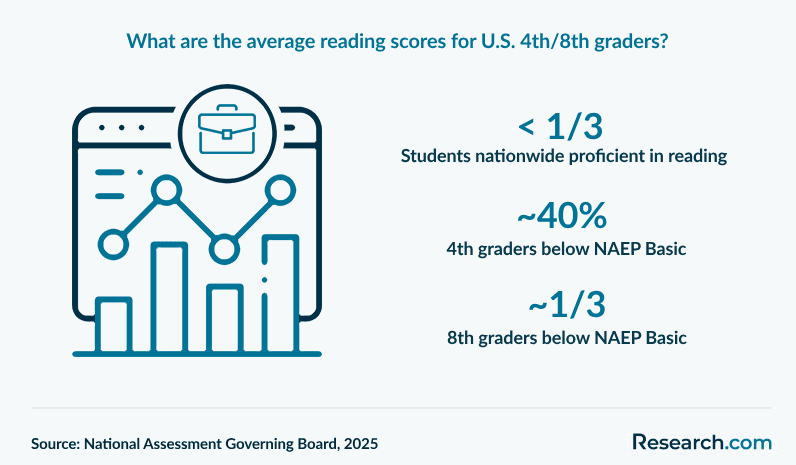
Cost should also be weighed against the scale of the literacy challenge educators are preparing to address. Based on the 2025 Nation's Report Card, average reading scores for both 4th and 8th graders show a continuing decline. Scores dropped by 2 points from 2022 to 2024, compounding a previous 3-point decline that occurred between 2019 and 2022.
Fewer than one-third of students nationwide demonstrated proficiency in reading. Approximately 40% of 4th graders and around one-third of 8th graders performed below the NAEP Basic Level of Reading. The data suggest that broad reading recovery has not yet occurred, with only two states surpassing their pre-pandemic 2019 scores in any single grade or subject.
What are the financial aid options for an online Master's in Reading and Literacy program?
Graduate education can be expensive, but many reading and literacy students reduce costs through federal aid, employer benefits, scholarships, grants, and state programs. Students preparing for in-demand education careers should compare aid options early because funding rules and deadlines vary.
- Federal student aid: Students can complete the Free Application for Federal Student Aid (FAFSA) to determine eligibility for federal loans and other aid options available to graduate students.
- Employer tuition assistance: School districts and education employers may provide tuition reimbursement or professional development funding, especially when the degree supports instructional improvement.
- Scholarships and grants: Universities, education foundations, and professional organizations may offer funding for graduate students in literacy and education. The International Literacy Association is one professional organization students may want to review.
- State-specific support: Some states offer grants, tuition support, or loan forgiveness programs tied to high-need education fields, including reading, special education, and teacher shortage areas.
- Payment plans: Some universities allow students to spread tuition payments across a term, which may help working educators manage cash flow.
What are the prerequisites for enrolling in an online Master's in Reading and Literacy program?
Admissions requirements vary, but most online Master's in Reading and Literacy programs expect applicants to show academic readiness and, in many cases, teaching experience. Certification-focused programs usually have stricter requirements than general literacy studies programs.
- Bachelor's degree: Applicants usually need a bachelor's degree from a regionally accredited institution.
- Minimum GPA: Many programs prefer or require a minimum undergraduate GPA near 3.0 on a 4.0 scale, although some universities offer conditional admission.
- Teaching license: Programs leading to reading specialist, literacy teacher, or literacy coach credentials often require a current teaching license.
- Teaching experience: Some accelerated and certification-oriented programs require one to three years of relevant classroom experience. State rules vary, so review reading specialist certification requirements before applying.
- Application documents: Expect to submit official transcripts, a resume, recommendation letters, and a statement of purpose explaining your literacy goals.
- Standardized tests: Many programs are test-optional, but some may still request GRE scores or use them in holistic review.
| If your goal is... | Pay special attention to... | Why it matters |
| Reading specialist certification | State licensure alignment, practicum hours, and testing requirements. | A program can be academically strong but still not meet your state's certification rules. |
| Literacy coaching | Teaching experience requirements and coaching coursework. | Coaching roles often require both classroom credibility and leadership preparation. |
| Adult literacy or nonprofit work | Whether the program admits non-certified students. | Not all literacy degrees are designed only for licensed teachers. |
| Doctoral study later | Research methods, thesis or project options, and faculty research expertise. | A research-oriented master's can be better preparation for a future doctorate. |
What courses are typically in an online Master's in Reading and Literacy program?
Online Master's in Reading and Literacy curricula blend reading theory, assessment, intervention, curriculum design, coaching, and applied practice. Like other accelerated graduate programs, including an accelerated online master's in marriage and family counseling, the value comes from combining foundational theory with supervised professional application.
- Foundations of Reading and Literacy: Introduces the cognitive, linguistic, psychological, historical, and sociocultural foundations of literacy development.
- Literacy Assessment and Intervention: Teaches students how to administer, score, interpret, and use reading assessments to plan targeted instruction.
- Content Area Literacy: Focuses on reading and comprehension strategies across subjects such as science, mathematics, social studies, and technical content.
- Children's and Young Adult Literature: Examines how to select and use diverse literature to build comprehension, engagement, vocabulary, and critical thinking.
- Literacy Coaching and Professional Development: Covers coaching models, teacher collaboration, adult learning, mentoring, and schoolwide literacy improvement.
- Digital and New Literacies: Explores how technology, multimedia, online texts, and digital tools change literacy teaching and learning.
- Supporting Diverse Learners: Prepares educators to adapt literacy instruction for English learners, multilingual students, and students with reading disabilities.
Students comparing program content may also want to review broader online Master's in Reading and Literacy programs to see how accelerated options differ from standard-paced degrees.
Literacy preparation matters because adult and student literacy outcomes vary widely. 2025 state-level data from World Population Review shows New Hampshire with a 94.2% literacy rate, where 5.8% of adults lack basic prose literacy skills. Other high-ranking states include Minnesota at 94.0%, North Dakota at 93.7%, Vermont at 93.4%, and South Dakota at 93.0%. The data also note that Vermont has the most libraries per capita (29.8 per 100,000 people), and 69.9% of Minnesota residents are registered library users.
At the other end of the data, California has a 76.9% literacy rate, with 23.1% of adults lacking basic prose literacy skills. New York follows at 77.9%, Florida at 80.3%, Texas at 81.0%, and New Jersey at 83.1%. New Jersey's ranking is notable because it also has the country's fifth-highest percentage of adults with a Bachelor's degree or higher (38.6%).
These differences show why literacy professionals need more than a single method or curriculum. Effective practice requires assessment skill, cultural understanding, access to learning resources, and the ability to tailor instruction to specific communities.
What types of specializations are available for Master's in Reading and Literacy graduates?
Specializations help students match graduate study to a specific career goal. Some education programs offer broad pathways in the same way that unrelated fields, such as accelerated online bachelor's programs in history, may include concentrations for different professional interests.
| Specialization | Best for | Typical focus |
| Reading Specialist or Literacy Coach | Teachers who want to work with struggling readers or support other teachers. | Assessment, intervention, coaching, data use, and schoolwide literacy improvement. |
| Digital or New Literacies | Educators working in technology-rich classrooms or media-focused literacy settings. | Digital texts, multimodal composition, media literacy, and online reading comprehension. |
| English as a Second Language or Bilingual Education | Teachers serving multilingual learners. | Language acquisition, culturally responsive teaching, bilingual literacy, and ESOL strategies. |
| Special Education or Reading Disabilities | Educators working with dyslexia, specific learning disabilities, or intensive intervention needs. | Diagnostic assessment, structured literacy, intervention planning, and disability-informed instruction. |
| Curriculum and Instruction | Teachers moving toward curriculum design or instructional coordination. | Curriculum development, evaluation, instructional materials, and program leadership. |
| Adult Literacy and Remedial Education | Professionals in adult education, community programs, or workforce literacy. | Foundational reading and writing for adult learners, GED preparation, and community literacy. |
How do you choose the best among the fastest online Master's in Reading and Literacy programs?
The right accelerated program depends on your current credentials, state, career target, budget, and capacity for intensive study. Do not choose based on speed alone. Use the same level of scrutiny you would apply when comparing other accelerated graduate options, such as fast online master's programs in public policy.
- Confirm institutional accreditation: The university should hold recognized regional or institutional accreditation. For educator preparation, also look for relevant programmatic quality indicators when available.
- Verify state licensure alignment: If you want reading specialist, literacy teacher, ESOL, or coaching certification, ask the program in writing whether it meets requirements in your state.
- Review practicum expectations: A fast program should still include meaningful work with learners, assessment practice, tutoring, coaching, or field-based assignments.
- Compare curriculum depth: Look for explicit instruction in reading development, assessment, intervention, diverse learners, digital literacy, and leadership.
- Check faculty expertise: Faculty should have experience in literacy research, reading instruction, intervention, coaching, or educator preparation.
- Ask about online support: Confirm advising, library access, technical support, career services, and help arranging clinical experiences.
- Calculate full cost: Include tuition, fees, books, assessments, certification exams, travel, lost time, and whether employer reimbursement applies.
- Assess workload honestly: A 12-18 month program can be difficult for full-time teachers, especially during practicum-heavy terms.
Questions to ask before applying
- Is the program fully online, or are there campus visits, live sessions, internships, or local placement requirements?
- Does the program meet reading specialist or literacy coach certification requirements in my state?
- Can I complete practicum or clinical work in my current school?
- Are courses asynchronous, synchronous, or a mix of both?
- How many hours per week should students expect to spend on coursework?
- What percentage of students complete the program on the advertised accelerated timeline?
- Does the degree lead to a pay increase in my district or state salary schedule?
- What support is available if I fall behind in an accelerated term?
What career paths are available for graduates of online Master's in Reading and Literacy programs?
A Master's in Reading and Literacy can support careers in direct instruction, coaching, curriculum development, administration, nonprofit education, and private-sector learning design. The degree combines specialized literacy knowledge with practical problem-solving, similar in spirit to how an accelerated online data analytics degree builds applied expertise for data-driven decisions.
| Career path | What the role does | Who it fits best |
| Reading Specialist | Provides targeted reading instruction, assesses reading difficulties, and supports struggling readers. | Teachers who want to work directly with students needing intensive literacy support. |
| Literacy Coach | Models instruction, supports teachers, leads professional learning, and helps schools improve literacy practices. | Experienced teachers who enjoy mentoring adults and leading instructional change. |
| Curriculum Specialist or Coordinator | Designs, selects, reviews, and evaluates literacy curricula and instructional resources. | Educators interested in curriculum systems, materials, and districtwide planning. |
| Instructional Coordinator | Oversees instructional programs, analyzes student data, and coordinates teacher development. | Professionals interested in school improvement and instructional leadership. |
| ESL Teacher | Supports English language development and literacy growth for multilingual learners. | Teachers interested in language acquisition, cultural responsiveness, and bilingual education. |
| Nonprofit Program Manager | Leads literacy, early childhood, adult education, tutoring, or community learning programs. | Professionals interested in education access, community impact, and program management. |
| Education Product or Curriculum Developer | Creates literacy materials, digital tools, assessments, or intervention resources. | Educators interested in publishing, educational technology, or private-sector learning products. |
How much can I earn with an online Master's in Reading and Literacy?
Earnings vary by position, state, school district, years of experience, credential level, and leadership scope. As with graduates of an accelerated online bachelor's in cybersecurity, the credential may open doors, but salary depends on the role and employer.
- Specialist-level roles: Reading Specialist or ESL Teacher roles commonly fall between $40,000 and $60,000 annually.
- Coaching and coordination roles: Literacy Coach, Instructional Coordinator, or Curriculum Specialist roles often range from $58,000 to $70,000.
- Director-level roles: Senior curriculum or instructional leadership positions can exceed $83,000 and may reach over $120,000 depending on district, location, and experience.
Based on 2025 PayScale.com data, salaries for professionals with a master's in reading and literacy show a progression from teaching roles to leadership positions. Preschool teacher salaries average $33,360, while special education teachers average $44,552 and general educators average $47,388. Elementary and middle school teacher roles fall in the low $50,000s, while reading specialist salaries average $58,191 and ESOL teacher salaries average $64,853.
Leadership roles show higher averages in the same data. A supervisor of special education earns an average of $62,706, while a director of special education reaches $75,508. This pattern suggests that compensation generally rises as responsibilities expand from direct instruction to supervision, program design, and administration.
Before assuming a salary increase, check your district's salary schedule, state credential rules, and whether the degree qualifies for a pay lane change or leadership eligibility.
What criteria ensure a program's academic rigor and accreditation?
A rigorous online Master's in Reading and Literacy should be accredited, transparent, clinically meaningful, and aligned with current literacy research. Accreditation confirms that the institution meets recognized quality standards, while program design shows whether students receive practical preparation for real educational settings.
- Recognized institutional accreditation: Confirm that the university is accredited by an accepted accrediting body.
- Clear licensure disclosures: Certification-oriented programs should clearly state which state credentials they prepare students for.
- Evidence-based curriculum: Courses should cover reading development, phonological and phonemic awareness, phonics, fluency, vocabulary, comprehension, assessment, intervention, and diverse learners where applicable.
- Qualified faculty: Look for faculty with literacy research, K-12 experience, reading intervention expertise, or teacher-preparation leadership.
- Clinical or practicum experience: A high-quality accelerated program should not eliminate hands-on assessment, tutoring, coaching, or field-based work.
- Student support: Advising, technical support, library access, placement guidance, and career resources are especially important in accelerated online formats.
Students interested in later educational leadership roles may also compare academic rigor in advanced programs such as fast online EdD programs.
Are online Master's programs in Reading and Literacy as rigorous as traditional programs?
Online Master's in Reading and Literacy programs can be as rigorous as campus-based programs when they use the same faculty standards, learning outcomes, accreditation expectations, assessment requirements, and practicum expectations. The delivery format alone does not determine quality.
A strong online program should include challenging readings, faculty feedback, live or interactive learning opportunities, research-based assignments, applied assessment work, and supervised practice. The main difference is learning environment: online students need more self-direction, time management, and comfort with digital tools.
Prospective students should be cautious if an online program is vague about faculty interaction, practicum placement, or assessment expectations. For educators considering continued graduate study after the master's level, Research.com also provides information on affordable online doctoral programs in educational leadership.
What are the potential challenges of choosing an accelerated online Master's in Reading and Literacy program?
Accelerated online programs can be convenient, but the shorter timeline creates real trade-offs. The main risks are workload intensity, limited recovery time between courses, reduced flexibility during clinical assignments, and possible difficulty balancing graduate study with full-time teaching.
| Common challenge | Why it matters | How to reduce the risk |
| Heavy weekly workload | Short terms compress readings, assignments, discussions, and projects. | Ask for a sample course schedule and weekly time estimate before enrolling. |
| Burnout | Full-time teaching plus accelerated coursework can become unsustainable during grading periods or practicum terms. | Plan lighter work commitments during the most demanding courses when possible. |
| Licensure mismatch | A fast program may not satisfy your state's reading specialist or coach credential rules. | Confirm licensure alignment with the program and your state education agency. |
| Weak clinical preparation | Speed should not replace supervised assessment, tutoring, or coaching practice. | Choose programs with clearly described practicum or fieldwork requirements. |
| Limited interaction | Some asynchronous programs may offer less real-time faculty engagement. | Ask how often students interact with faculty, advisors, and peers. |
Accelerated study is not unique to literacy education. Students comparing pace and depth across disciplines may want to see how other fast programs are structured, such as accelerated online philosophy degrees.
Is an online Master's in Reading and Literacy program cost-effective in the long run?
An online Master's in Reading and Literacy can be cost-effective if it leads to a credential, pay increase, leadership eligibility, or career shift that justifies the total cost. It may be less cost-effective if the program does not meet state requirements, does not qualify for district salary advancement, or is significantly more expensive than comparable accredited options.
Calculate return on investment using total program cost, not advertised tuition alone. Include fees, materials, certification exams, possible travel, and the opportunity cost of time. Then compare that cost with likely salary schedule changes, promotion opportunities, tuition reimbursement, and the number of years you expect to remain in the field.
Affordability comparisons can also be useful across education-related fields. For example, students considering literacy, libraries, and information services may want to compare costs with affordable online MLIS programs.
Common mistakes to avoid
- Choosing the shortest timeline without checking accreditation: A fast degree has limited value if the institution is not properly accredited.
- Assuming all online programs meet licensure rules: State requirements vary, and out-of-state online programs may not qualify you for your target credential.
- Looking only at tuition: Fees, books, exams, and practicum expenses can change the real cost.
- Ignoring clinical requirements: A literacy degree should include applied work with learners or educators, especially for specialist and coaching roles.
- Assuming a master's guarantees a raise: District salary schedules and promotion rules differ. Confirm your employer's policy before enrolling.
- Relying only on rankings: Rankings are useful, but fit, cost, licensure, schedule, and support matter more for your individual outcome.
What is the job market like for graduates of an online Master's in Reading and Literacy?
The job market for reading and literacy graduates is mixed. Literacy needs are significant, but hiring varies by role. K-12 schools and districts continue to need educators who can support reading instruction, assessment, intervention, and coaching. At the same time, some adult education roles face projected contraction.
Education employers increasingly value professionals who can analyze student data, select evidence-based interventions, support multilingual learners, and help teachers implement stronger literacy instruction. Private-sector opportunities may also exist in educational technology, publishing, curriculum design, and tutoring services. The skill mix is different from technology training, but the applied problem-solving mindset is comparable to career preparation in programs such as accelerated online software engineering bootcamps.
- Government and school settings: The U.S. Bureau of Labor Statistics projects stable growth in education-related employment. Positions for instructional coordinators are projected to grow by 2% between 2022 and 2032.
- High-need literacy areas: Demand is especially relevant for early literacy, digital literacy, English language learners, and students with disabilities.
- Private sector: Educational technology and publishing companies may hire literacy experts to develop products, curricula, assessments, and intervention tools.
- Nonprofit sector: Adult literacy, early childhood education, after-school programming, and education equity organizations continue to employ literacy professionals. Students interested in younger learners may also compare online Master's in Early Childhood Education programs.
According to the U.S. Bureau of Labor Statistics for 2025, the median pay for adult basic and secondary education and ESL teachers in 2024 was $59,950 per year, or $28.82 per hour. The typical entry-level education is a bachelor's degree, and no prior work experience is required. However, the field is projected to decline: there were 41,700 jobs in 2023, and the 2023-33 outlook projects a 13% decline, equal to a loss of 5,300 jobs.
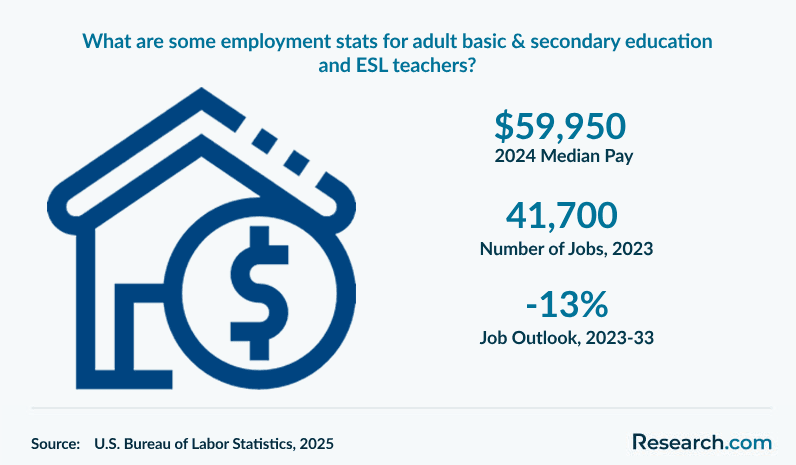
This decline does not mean all literacy careers are shrinking. It does mean students should distinguish between adult education, K-12 reading specialist roles, district literacy leadership, and private-sector literacy work. If you have not yet earned a bachelor's degree, Research.com's guide to the most affordable online Bachelor's in Education programs can help you evaluate entry-level education pathways.
What are some current and future trends in reading and literacy?
Reading and literacy education is being reshaped by research, technology, equity concerns, and accountability pressure. Graduate students should choose programs that prepare them for these realities, not only for traditional reading instruction.
- Science of Reading: Many states and districts are aligning instruction with the "Science of Reading," a body of cognitive science research emphasizing explicit, systematic instruction in foundational skills such as phonics.
- Digital and multimodal literacy: Students increasingly need to interpret, evaluate, and create texts that combine print, images, video, audio, and interactive media.
- Equity and culturally responsive teaching: Schools are focusing more attention on literacy instruction that supports students from varied cultural, linguistic, and socioeconomic backgrounds.
- Data-driven instruction: Diagnostic assessment and progress-monitoring data are now central to intervention planning and instructional decision-making.
- Artificial intelligence: AI tools are beginning to influence literacy instruction through adaptive learning platforms, automated writing feedback, and personalized reading recommendations.
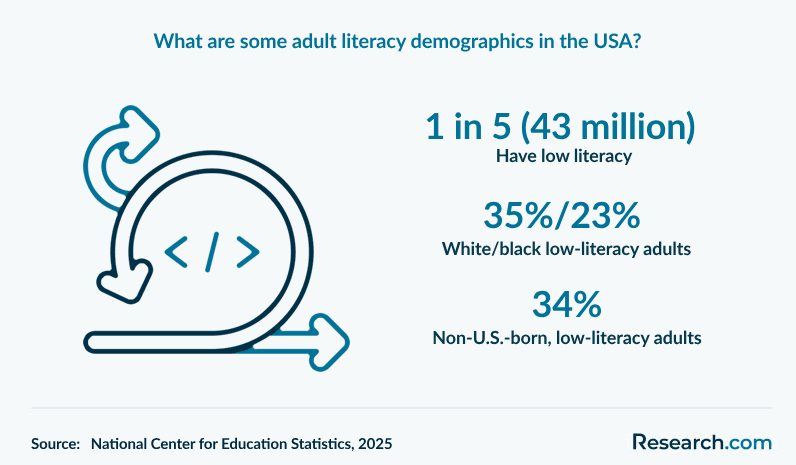
According to the National Center for Education Statistics (NCES), approximately 79% of U.S. adults have English literacy skills sufficient for everyday tasks. One in five adults, or about 43.0 million people, have low literacy skills. Among adults with low literacy, 34% are Hispanic, 35% are White, 23% are Black, and 8% are of other races or ethnicities. Non-U.S.-born adults account for 34% of the population with low literacy.
These trends increase the need for literacy professionals who can evaluate technology responsibly, use data ethically, and select instruction based on evidence rather than trends alone.
Key Insights
- The fastest credible programs are not just short: Strong accelerated online Master's in Reading and Literacy programs combine compressed scheduling with accreditation, practicum work, assessment training, and state credential alignment.
- Completion time varies: Some programs can be completed in as little as 1 year, while many reputable options take 18–24 months or two years.
- Licensure alignment is critical: A program may be excellent academically but still fail to meet your state's reading specialist, literacy coach, ESOL, or teacher certification requirements.
- Costs differ widely: Most programs require 30 to 36 credits, and total price depends on tuition rate, residency, fees, and whether the university is public or private.
- Salary outcomes depend on role: 2025 PayScale.com data show averages ranging from $33,360 for preschool teacher to $75,508 for director of special education, with higher pay generally tied to leadership responsibilities.
- Reading needs remain serious: The 2025 Nation's Report Card shows average reading scores for 4th and 8th graders dropped 2 points from 2022 to 2024, after a previous 3-point decline from 2019 to 2022.
- Student proficiency remains low: Fewer than one-third of students are proficient in reading, with approximately 40% of 4th graders and around one-third of 8th graders performing below the basic level.
- Adult literacy varies by state: 2025 state-level data show literacy rates ranging from 94.2% in New Hampshire to 76.9% in California.
- The job market is role-specific: Instructional coordinator roles are projected to grow by 2% between 2022 and 2032, while adult basic and secondary education and ESL teacher employment is projected to decline by 13% from 2023-33.
- The best decision is personal: Choose the program that fits your state, career target, schedule, budget, and need for clinical experience—not simply the one with the shortest advertised timeline.
References:
- Bureau of Labor Statistics. (2025, April 18). Adult literacy and GED teachers. U.S. Department of Labor, Occupational Outlook Handbook. Bureau of Labor Statistics.
- National Assessment Governing Board. (2025, January 29). The Nation's Report Card shows declines in reading, some progress in 4th grade math [Press release]. National Assessment Governing Board.
- PayScale. (2025). Master of Education (MEd), Reading & Literacy salary. PayScale.
- National Center for Education Statistics. (2025). The Nation's Report Card. National Center for Education Statistics.
- World Population Review. (2025). U.S. Literacy Rates by State. World Population Review.
Other Things You Should Know About Online Master's in Reading and Literacy Programs
Most programs offer online academic advising, digital library access, writing support, and help with practicum or fieldwork placement. Many also provide access to learning management systems, tech help desks, and faculty office hours, which are important for students finishing accelerated graduate coursework in 2027.
Students need a reliable high-speed internet connection, a computer with updated software, and a web camera for interactive classes. Specific programs might also mandate access to digital learning platforms and e-books to participate fully in 2027.