2027 Fastest Online Master's in Elementary Education Programs

Co-Founder and Chief Data Scientist
A fast online master’s in elementary education is designed for teachers and career changers who want graduate-level preparation without spending several years in school. The main decision is not simply which program is shortest. You also need to know whether the degree supports teacher licensure, fits your work schedule, offers useful specializations, and provides enough value to justify the cost.
This guide explains how accelerated online elementary education master’s programs work, what they cost, how long they take, which careers they can support, and how to compare schools. It is built for working educators, bachelor’s degree holders considering K–6 teaching, and teachers who want to move into literacy, curriculum, leadership, ESOL, or specialized instructional roles.
Quick answer: Is a fast online master’s in elementary education worth it?
A fast online master’s in elementary education can be worth it if the program is accredited, matches your licensure goals, and helps you qualify for a district salary increase, endorsement, or advanced instructional role. Many accelerated programs can be completed in 12 to 18 months, while broader or licensure-focused options may take closer to 2 years. The best choice depends on whether you are already licensed, need initial certification, want a specialization, or plan to move toward curriculum leadership or administration.
| Best fit | Why it may make sense | What to verify before enrolling |
| Licensed elementary teachers | Can deepen classroom practice, pursue pay-scale advancement, or specialize in literacy, STEM, ESOL, gifted education, or special education. | Confirm whether the degree supports your state’s renewal, endorsement, or salary schedule requirements. |
| Career changers | Licensure-track MAT or M.Ed. programs can provide graduate coursework plus clinical practice for entry into K–6 teaching. | Check whether the program leads to initial teacher certification in your state. |
| Teachers seeking leadership roles | Curriculum, instructional coordination, teacher leadership, and education technology coursework can support advancement beyond one classroom. | Ask whether the program includes field projects, coaching practice, or district-level curriculum work. |
| Busy working adults | Online delivery, asynchronous courses, short terms, and multiple start dates can make graduate study easier to manage. | Review weekly workload, practicum expectations, and whether any live sessions are required. |
What are the benefits of getting a fast online master’s in elementary education?
- Greater scheduling control: Online courses let many working teachers complete assignments outside regular school hours while continuing to teach full time.
- Faster career impact: Completing a degree sooner may help you pursue eligible salary-step changes, endorsements, or leadership opportunities more quickly.
- Lower opportunity cost: A shorter program can reduce the time spent balancing tuition, work, and family responsibilities before seeing potential professional benefits.
- Focused graduate preparation: Accelerated formats often concentrate on practical teaching improvement, curriculum design, literacy instruction, assessment, and classroom research.
- Comparable convenience to other accelerated education pathways: Students who like condensed formats may also compare related options such as the fastest online bachelor's in early childhood education when planning long-term education goals.
What can I expect from a fast online master’s in elementary education degree program?
A fast online master’s in elementary education usually compresses graduate coursework into shorter terms while covering the same core areas expected in advanced teacher preparation. You can expect classes in curriculum planning, literacy, assessment, child development, classroom management, differentiated instruction, and research-based teaching practices for elementary learners.
Many accelerated programs use 5- to 8-week courses, allowing students to focus on one or two subjects at a time. Some programs are fully asynchronous, while others include scheduled virtual meetings, cohort discussions, online practicum requirements, or a classroom-based research project. If the program leads to licensure, it may also require student teaching, supervised fieldwork, or state-specific testing.
| Program element | What it usually involves | Why it matters |
| Accelerated terms | Shorter course sessions, often taken year-round. | Can shorten time to graduation but increases weekly workload. |
| Core education courses | Graduate study in instruction, curriculum, literacy, assessment, development, and classroom management. | Builds practical skill for K–6 teaching and leadership. |
| Field experience | Practicum, action research, student teaching, or classroom-based projects. | May be required for licensure or professional application. |
| Specializations | Options such as reading, STEM, special education, ESOL, gifted education, or educational technology. | Can align the degree with high-need school roles or endorsement goals. |
| Online student support | Advising, technology support, library access, licensure guidance, and faculty feedback. | Important for staying on track in a fast program. |
Where can I work with an online master’s degree in elementary education?
An online master’s in elementary education can support work in public schools, private schools, charter schools, online learning environments, district offices, education nonprofits, curriculum companies, and teacher training programs. The exact roles available depend on your teaching license, endorsements, state rules, and professional experience.
Many graduates remain in the elementary classroom as advanced or lead teachers. Others move toward reading intervention, curriculum development, instructional coaching, ESOL support, special education, teacher mentoring, or administrative preparation. If you are considering roles outside general classroom teaching, check whether your program includes the specialization or endorsement required for that path.
How much can I make with an online master’s in elementary education?
Pay varies by state, district salary schedule, school type, years of experience, union agreements, and role. Existing salary examples in this guide show that graduates may earn average annual pay in the $55,000 to $75,000 range, while some curriculum, consulting, or specialist roles can exceed $80,000 per year. A master’s degree does not guarantee a raise, but many districts use salary lanes that reward approved graduate credits or advanced degrees.
Before enrolling, ask your human resources office whether the program you are considering qualifies for salary advancement. Also compare total tuition, required fees, practicum time, and how quickly any salary benefit may offset your cost.
- Fastest Online Master’s in Elementary Education Programs for 2027
- How long does an online master’s in elementary education take?
- Online vs. on-campus elementary education master’s programs
- Average cost of an online master’s in elementary education
- Financial aid options for online elementary education graduate students
- Admission requirements for online master’s programs in elementary education
- Common courses in an online elementary education master’s program
- Specializations in online elementary education master’s programs
- Accreditation and quality benchmarks to check
- Challenges of accelerated online master’s programs
- Return on investment for an online master’s in elementary education
- How interdisciplinary study can strengthen elementary teaching
- How to choose the best online master’s in elementary education
- Career paths for graduates
- Job market for elementary education master’s graduates
List of the Fastest Online Master’s in Elementary Education Programs for 2027
The programs below are designed for students who want an online route to advanced elementary education training. Some are intended for licensed teachers, while others support initial K–6 licensure. Review each program’s accreditation, state authorization, clinical requirements, and whether it matches your certification status before applying.
How do we rank schools?
Research.com evaluates programs using our methodology, with attention to academic quality, affordability, availability of online study, institutional data, and student-focused outcomes. The ranking process draws on recognized education data sources, including:
- IPEDS database
- Peterson's database, including the Distance Learning Licensed Data Set
- College Scorecard database
- National Center for Education Statistics
Program comparison at a glance
| School | Program | Length | Credits or format | Good fit for |
| Ball State University | MA in Education, Elementary Education | Four to six semesters | Online, customizable concentrations | Teachers who want concentration and specialty options |
| University of North Dakota | Master’s in Elementary Education Online | Two years | 30 credit hours | Licensed K–6 teachers seeking advanced instructional skills |
| Liberty University | MAT in Elementary Education | 18 to 24 months | 45 credit hours, 8-week courses | Students pursuing initial K–6 licensure |
| Arizona State University | Online Master of Education in Elementary Education | One to two years | 30 credits, 15 courses | Bachelor’s degree holders who want K–8 knowledge without certification |
| University of Alabama | MA in Elementary Education | 1.5 to 2 years | 30 to 36 credit hours | Educators seeking K–6 certification or expanded credentials |
| University of Missouri | M.Ed. in Learning, Teaching, and Curriculum: Elementary Education | Two years | Online cohort format | Licensed K–6 teachers seeking instructional leadership growth |
| Kansas State University | MAT Elementary | At least 12 months | Online licensure pathways | Career changers and professionals seeking K–6 licensure |
| Georgia Southern University | M.Ed. in Elementary Education | One to two years | 36-credit cohort program | Experienced teachers who want a fast cohort model |
| Missouri State University | Elementary Education Graduate Program | Two years | 30+ credit hours | Licensed teachers who want elective or certificate flexibility |
| University of Phoenix | MAEd/Elementary Teacher Education | 21 to 22 months | 15–16 core courses plus clinical practice | Bachelor’s degree holders preparing for K–6 teaching |
1. Ball State University - MA in Education (Elementary Education)
Ball State University offers an online Master of Arts in Education in Elementary Education with room for personalization. Students can choose among early childhood, elementary education, and reading/literacy concentrations, then add focused study in areas such as autism, TESOL, gifted education, or educational technology. The program is built around applied coursework, small online classes averaging about 20 students, and faculty mentorship from educators with K–6 experience.
- Program Length: Four to six semesters
- Tracks/concentrations: Early Childhood, Elementary Education, Reading/Literacy; plus specialty focuses such as autism, gifted education, and TESOL
- Cost per Credit/Tuition: Provided through Ball State’s tuition calculator, with online program rates varying by student situation
- Accreditation: Council for the Accreditation of Educator Preparation (CAEP)
2. University of North Dakota - Master’s in Elementary Education Online
The University of North Dakota provides a fully online, 30-credit Master of Education in Elementary Education for licensed K–6 teachers and education professionals. The program emphasizes curriculum planning, assessment, diverse learners, and applied professional practice. Students complete online coursework, participate in an online practicum, and choose among electives, a thesis, independent study, or a scholarly project.
- Program Length: Two years (30 credit hours)
- Tracks/concentrations: N/A
- Cost per Credit/Tuition: $626 per credit
- Accreditation: CAEP
3. Liberty University - MAT in Elementary Education
Liberty University offers a fully online Master of Arts in Teaching in Elementary Education with a faith-integrated curriculum. The 45-credit program uses 8-week courses and is intended for students working toward initial K–6 licensure. A semester-long student teaching placement in a local classroom is completed under the supervision of a licensed educator.
- Program Length: 18 to 24 months
- Tracks/concentrations: Elementary education and special education
- Cost per Credit/Tuition: $430 per credit for full-time students; $290 per credit for military students
- Accreditation: Council for the Accreditation of Educator Preparation (CAEP)
4. Arizona State University - Online Master of Education in Elementary Education
Arizona State University offers a 30-credit online Master of Education in Elementary Education made up of 15 courses lasting 15 weeks each. The program is designed for bachelor’s degree holders who want to strengthen K–8 teaching knowledge without pursuing certification. Coursework addresses equitable learning environments, language and literacy methods, and applied research through a culminating project connected to real educational problems.
- Program Length: One to two years
- Tracks/concentrations: General Elementary Education
- Cost per Credit/Tuition: Varies by enrollment status; ASU directs students to its online tuition estimator
- Accreditation: CAEP
5. University of Alabama - MA in Elementary Education
The University of Alabama delivers a fully online Master of Arts in Elementary Education for educators who want to deepen instructional practice and earn K–6 certification. The 30–36-credit curriculum combines education theory, inclusive teaching practices, and practicum experiences that connect research to classroom challenges. Courses are offered asynchronously and taught by on-campus faculty.
- Program Length: 1.5 to 2 years (30 to 36 credit hours)
- Tracks/concentrations: Elementary Education K–6; already-certified teachers may add Early Childhood Education P–3
- Cost per Credit/Tuition: $480 per credit
- Accreditation: CAEP
6. University of Missouri - Master of Education (Elementary Education)
The University of Missouri offers an online Master of Education in Learning, Teaching, and Curriculum with an Elementary Education emphasis. The program is designed for licensed K–6 teachers who want stronger instructional practice and leadership capacity. Students learn in small cohorts through a mix of asynchronous learning and some synchronous sessions, with faculty from the Department of Learning, Teaching & Curriculum.
- Program Length: Two years
- Tracks/concentrations: N.A
- Cost per Credit/Tuition: $589 per credit hour
- Accreditation: Higher Learning Commission (HLC)
7. Kansas State University - Master of Arts in Teaching Elementary
Kansas State University provides an online Master of Arts in Teaching in Elementary Education for career changers and professionals pursuing K–6 licensure. The program includes two pathways: a Practitioner track for students teaching full time in Kansas under a Restricted license and a License-Seeking track for students employed in other settings.
- Program Length: at least 12 months
- Tracks/concentrations: N/A
- Cost per Credit/Tuition: $551.14 per credit
- Accreditation: National Council for Accreditation of Teacher Education (NCATE)
8. Georgia Southern University - MEd in Elementary Education
Georgia Southern University offers a fully online Master of Education in Elementary Education for grades P–5. The 36-credit cohort program builds on existing teaching experience and focuses on improving instruction and leadership. Students can complete the program in just one year by starting in summer and finishing the following summer.
- Program Length: One to two years
- Tracks/concentrations: N/A
- Cost per Credit/Tuition: $367 per credit hour
- Accreditation: Southern Association of Colleges and Schools Commission on Colleges
9. Missouri State University - Elementary Education Graduate Program
Missouri State University offers an online Master of Science in Elementary Education with both a standard two-year format and an accelerated option. The program is designed for licensed K–6 teachers who want to strengthen practice and pursue specialty credentials. Students complete 30+ credit hours and can customize about half of the program through electives or graduate certificates in fields such as literacy, STEM, gifted education, dyslexia, and educational technology.
- Program Length: Two years
- Tracks/concentrations: Optional graduate certificates in Gifted & Talented, STEM, Literacy, Technology, Dyslexia, and more
- Cost per Credit/Tuition: $4,562 in-state for 9 credit hours; $8,090 out-of-state for 9 credit hours
- Accreditation: HLC
10. University of Phoenix - Online Master's in Elementary Education
The University of Phoenix offers a Master of Arts in Education/Elementary Teacher Education for bachelor’s degree holders preparing to teach K–6. The online program includes 15–16 core courses and at least 12 weeks of full-time clinical practice in a local classroom. Program specialists support students through licensure preparation and placement steps.
- Program Length: 21 to 22 months
- Tracks/concentrations: N/A
- Cost per Credit/Tuition: $540–$615 per credit under a locked-in tuition model
- Accreditation: HLC
How long does it take to complete an online master’s degree in elementary education?
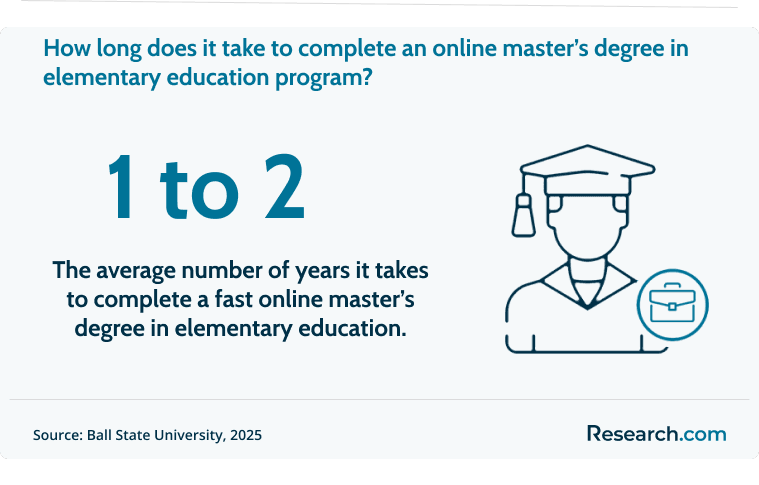
Most online master’s degrees in elementary education take 1 to 2 years to finish. The fastest options can be completed in 12 to 18 months, especially when students enroll full time, take accelerated courses, and continue through summer terms. Programs commonly require 30 to 45 credit hours.
Licensure-track programs may take longer than non-licensure programs because they can include student teaching, practicum hours, background checks, testing, or state approval steps. This is similar to other credential-based education pathways, where requirements such as those described in physical education teacher certification can affect completion timelines.
| Enrollment pace | Typical timeline | Best for | Potential drawback |
| Accelerated full time | 12 to 18 months | Students who can handle intensive weekly coursework | Less room for schedule disruptions during busy teaching seasons |
| Standard full time | 1 to 2 years | Teachers who want progress without the heaviest course load | May still require summer or back-to-back terms |
| Part time | Two years or more | Working adults with family, coaching, leadership, or district responsibilities | Longer time before the degree can affect advancement or pay |
| Licensure track | Often longer than coursework-only programs | Career changers or uncertified teachers | Student teaching and state requirements can limit flexibility |
How does an online master’s degree in elementary education program compare to an on-campus program?
Online and campus-based master’s programs in elementary education can cover similar academic content, but the student experience is different. Online programs usually offer more scheduling flexibility, while campus programs may provide more immediate face-to-face access to faculty, classmates, and local school partnerships.
Accelerated online formats are common across many fields, including programs such as a fast track bachelor's in emergency management online. In elementary education, speed should not be the only factor. You still need to check fieldwork, licensure alignment, faculty access, and whether you learn well in a virtual environment.
| Factor | Online master’s program | On-campus master’s program | Decision tip |
| Schedule | Often asynchronous or partly asynchronous, with assignments completed around work hours. | Usually follows fixed class meeting times. | Choose online if you need flexibility during the school year. |
| Interaction | Uses discussion boards, video meetings, group projects, and digital feedback. | Relies more on in-person discussion and classroom-based networking. | Choose campus if you strongly prefer live, in-person learning. |
| Fieldwork | Often completed in your local area, subject to school and state approval. | May use established local placement partnerships. | Ask how placements are arranged before enrolling. |
| Student services | May include remote tutoring, digital libraries, advising, and technology support. | May include campus resource centers and in-person advising. | Compare actual support hours, not just the list of services. |
| Learning style | Requires independence, planning, and strong written communication. | Provides more structured weekly routines. | Be honest about how you perform without regular in-person reminders. |
Both formats can include complex education topics, including how learning, behavior, and student support differ across fields. For example, understanding the difference between educational psychology and school psychology can help teachers interpret student needs more accurately and collaborate more effectively with support professionals.
What is the average cost of an online master’s degree in an elementary education program?
The cost of an online master’s in elementary education depends on tuition per credit, required credits, residency rules, fees, books, clinical placement costs, and whether the student qualifies for discounts. Some accelerated or specialized education programs, including options like fast track multilingual learner education online, may use different pricing structures based on format or focus area.
The examples below show how costs can differ among programs already discussed in this guide:
| Program cost example | Published figure used in this guide | What the figure means |
| University of North Dakota | $18,780 total for 30 credit hours | Based on UND’s $626 per-credit cost for the online Master of Education in Elementary Education. |
| Liberty University, full time | $19,350 total for 45 credit hours | Reflects the full-time per-credit rate for Liberty’s online MAT in Elementary Education. |
| Liberty University, part time | $29,025 total for 45 credit hours | Shows how enrolling below the full-time threshold can increase the total tuition calculation. |
| Liberty University, military graduate rate | $13,050 total for 45 credit hours | Applies to eligible military students using Liberty’s discounted graduate rate. |
When comparing programs, do not stop at tuition. Ask about technology fees, course materials, background checks, testing fees, travel for fieldwork, and whether you must reduce work hours during student teaching. If you plan to continue into leadership credentials later, reviewing options such as the most affordable online education specialist degree in leadership can help you map a longer-term education budget.
The chart below provides a sample cost comparison between two universities mentioned above:
What are the financial aid options for students enrolling in an online master’s degree in elementary education program?
Online graduate education students may qualify for many of the same aid categories available to campus students. As with accelerated programs in other disciplines, including a fast-track master's in legal studies online, eligibility depends on the school, enrollment status, program approval, and student circumstances.
- Federal financial aid: Graduate students should begin with the Free Application for Federal Student Aid (FAFSA) to determine eligibility for federal student loans and other aid programs.
- School-based scholarships: Colleges of education may offer merit-based, need-based, or educator-focused awards for graduate students.
- External grants and scholarships: Teacher associations, community foundations, professional organizations, and education nonprofits may fund current or future educators.
- Graduate assistantships: These are more common on campus, but some programs may offer remote research, administrative, or instructional support roles.
- Military and veteran benefits: Eligible students may use GI Bill benefits, tuition assistance, housing allowances, Yellow Ribbon Program support, or related military education benefits.
- Employer or district tuition support: Some school districts reimburse or partially fund graduate study when it relates to a teacher’s current assignment or district needs.
Questions to ask about affordability
- Is the quoted tuition locked for the full program or subject to annual increases?
- Are online students charged different fees than campus students?
- Does the program require unpaid student teaching or daytime fieldwork?
- Will my school district recognize this degree for a salary lane change?
- Can I use transfer credits, prior graduate coursework, or employer reimbursement?
What are the prerequisites for enrolling in an online master’s degree in elementary education program?
Admission requirements vary by school and by program type. The most important distinction is whether the degree is for licensed teachers seeking advanced preparation or for students pursuing initial teacher certification. Accelerated programs in technical or specialized fields, such as fast track artificial intelligence certification online, often screen for readiness; elementary education programs do the same through academic, professional, and licensure requirements.
| Requirement | What schools commonly ask for | Why it matters |
| Bachelor’s degree | A degree from a regionally accredited institution. | Confirms readiness for graduate-level study. |
| Minimum GPA | Often around 2.5 to 3.0, with some conditional admission policies. | Schools use GPA to evaluate academic preparation. |
| Teaching license | Required for some advanced-practice programs but not all licensure-track MAT programs. | Determines whether the program is appropriate for current teachers or career changers. |
| Official transcripts | Records from previous colleges and universities. | Used to verify degree completion and prerequisite coursework. |
| Recommendations | Usually academic or professional references. | Helps the admissions team assess professionalism and graduate potential. |
| Personal statement | An essay explaining goals, teaching philosophy, and reasons for graduate study. | Shows fit with the program and career direction. |
If your long-term goal may shift into another student-support profession, confirm requirements early. For example, the question of can you become a speech pathologist with an education degree involves additional specialized training and certification beyond an elementary education master’s.
What courses are typically in an online master’s degree in elementary education program?
Coursework in an online master’s in elementary education is built to improve how teachers design lessons, assess learning, manage classrooms, support diverse students, and use research in practice. Programs for licensed teachers often emphasize advanced pedagogy, while initial licensure programs add clinical teaching and certification preparation.
- Foundations of Elementary Education: Examines the historical, social, and philosophical purposes of elementary schooling and how those ideas shape current classrooms.
- Curriculum Design and Instruction: Teaches students to plan, adapt, and evaluate curriculum for subjects such as reading, math, science, and social studies.
- Classroom and Behavior Management: Focuses on routines, engagement, positive behavior supports, conflict resolution, and inclusive classroom culture.
- Assessment and Data-Driven Instruction: Covers formative and summative assessment, data analysis, progress monitoring, and instructional adjustment.
- Child and Adolescent Development: Explores cognitive, social, emotional, and developmental patterns that affect learning in elementary grades. This foundation is also useful for teachers considering specialized study such as an affordable master’s in gifted education online.
- Teaching Reading and Literacy: Addresses phonemic awareness, vocabulary, fluency, comprehension, reading intervention, and literacy assessment.
- Research Methods or Action Research: Prepares teachers to investigate classroom problems, evaluate instructional strategies, and use evidence in decision-making.
- Capstone, Practicum, or Student Teaching: Requires a final project, supervised teaching experience, or applied classroom research depending on the program’s goals.
What types of specializations are available in an online master’s degree in elementary education program?
Specializations let students focus a general elementary education master’s degree on a specific learner group, instructional need, or leadership goal. This targeted structure is common across accelerated academic programs, including focused options such as a fast-track public policy degree online.
| Specialization | What it emphasizes | When to consider it |
| Reading and literacy | Reading assessment, intervention, comprehension, language development, and literacy coaching. | Choose this if you want to support struggling readers or pursue literacy specialist roles. |
| Special education | Inclusive instruction, accommodations, individualized supports, and collaboration with families and specialists. | Consider it if you want to work more effectively with students with disabilities. |
| ESOL or English learners | Language acquisition, culturally responsive instruction, and support for multilingual students. | Useful for teachers in districts with large English learner populations. |
| STEM education | Elementary math, science, inquiry-based learning, and integrated problem-solving. | Good for teachers who want to strengthen science and math instruction. |
| Gifted education | Advanced learner identification, enrichment, acceleration, and differentiated instruction. | Relevant if you teach or plan to support high-ability learners. |
| Educational technology | Digital tools, online learning design, technology integration, and instructional media. | Helpful for teachers leading classroom technology adoption or virtual learning projects. |
| Teacher leadership or curriculum | Instructional coaching, curriculum alignment, mentoring, and school improvement. | Best for educators aiming to influence instruction beyond their own classroom. |
Specializations may add coursework, field experiences, or endorsement requirements. Before choosing one, ask whether it appears on your transcript, leads to an endorsement, or simply functions as an informal concentration.
What accreditation and quality benchmarks guarantee program excellence?
No accreditation label can guarantee that a program will be perfect for every student, but accreditation is one of the strongest quality signals to verify. Start with institutional accreditation, then check whether the teacher preparation program is recognized by CAEP or another appropriate education accreditor. If licensure matters, confirm state approval directly with the program and the relevant state education agency.
Quality also depends on faculty expertise, field placement support, updated curriculum, advising access, online learning design, student outcomes, and licensure exam preparation. Educators planning beyond the master’s level may also compare doctoral pathways such as 2 year Ed.D. programs online, especially if their goals include district leadership, policy, or higher education roles.
What challenges should I consider before enrolling in an accelerated online master’s program?
Accelerated online graduate study is convenient, but it is not easier. Short terms can mean heavy reading, frequent assignments, fast feedback cycles, group work, and limited time to recover if work or family responsibilities spike. Teachers may find certain parts of the school year especially difficult, such as report card periods, testing windows, parent conferences, and the start or end of the academic year.
| Challenge | Why it matters | How to reduce the risk |
| Compressed workload | Falling behind in a short course can quickly affect grades. | Block weekly study time before the term starts and avoid overloading during peak teaching months. |
| Limited face-to-face contact | Some students miss spontaneous conversations and immediate clarification. | Use office hours, cohort chats, tutoring, and faculty messaging early and often. |
| Fieldwork logistics | Student teaching or practicum requirements may conflict with employment. | Ask how placements work, who approves sites, and whether your current classroom can be used. |
| Licensure complexity | Online programs may not meet every state’s certification rules. | Get written confirmation from both the school and your state licensing authority. |
| Technology demands | Online learning requires reliable internet, video tools, learning platforms, and file management. | Test systems before classes begin and confirm technology support hours. |
If your long-term plans include administration or district leadership, look beyond the master’s program and compare later options such as affordable educational leadership online doctoral programs before committing to a pathway.
What is the return on investment for an online master’s degree in elementary education?
The return on investment depends on total program cost, how quickly you finish, whether your district rewards the degree, and whether the program leads to roles with higher pay or greater responsibility. A shorter program may reduce opportunity cost, but only if it also meets your professional requirements.
Consider ROI in three layers: immediate salary effects, long-term career mobility, and nonfinancial value. Some teachers earn more because their district salary schedule recognizes the master’s degree. Others use the degree to move into literacy, ESOL, curriculum, or leadership roles. Some primarily want stronger classroom practice or confidence serving diverse learners.
Accelerated study can be valuable in many disciplines, including programs like an accelerated online bachelor's degree in philosophy, but elementary education ROI is tightly connected to licensure rules and district pay policies. Always verify those details before enrolling.
ROI questions to ask before applying
- Will my district recognize this specific degree for salary advancement?
- How much will I pay after scholarships, reimbursement, military benefits, or grants?
- Will I need to reduce working hours for practicum or student teaching?
- Does the program lead to an endorsement or only a concentration?
- What roles do recent graduates actually pursue?
- How long will it take for any pay increase to offset tuition and fees?
How can interdisciplinary studies enhance elementary education outcomes?
Elementary teachers work with students whose learning needs cross many professional domains, including language development, behavior, psychology, disability support, technology, and family engagement. Interdisciplinary study can help teachers recognize issues earlier, collaborate more effectively with specialists, and design instruction that supports the whole child.
For example, knowledge related to speech and language development can help teachers support vocabulary growth, classroom communication, and early literacy. Educators interested in that area may explore how online SLP master's programs approach assessment and intervention, while recognizing that speech-language pathology is a separate licensed profession with its own requirements.
How do I choose the best online master’s degree in elementary education program?
Choosing the right program requires more than comparing speed. A fast degree that does not support your license, schedule, or career goal can be a costly mistake. The best program is the one that fits your current certification status, state requirements, budget, and preferred learning format. This kind of careful vetting applies across accelerated study options, from education programs to a fast-track public safety degree online.
- Start with accreditation: Confirm institutional accreditation and review whether the education program is recognized by the Council for the Accreditation of Educator Preparation (CAEP) or another appropriate body.
- Match the program to your license status: Determine whether you need initial licensure, license renewal, an endorsement, or advanced professional study.
- Check state authorization: Online programs may not meet certification requirements in every state, even when the school itself is accredited.
- Compare total cost: Include tuition, fees, course materials, testing, travel, background checks, and lost income during clinical practice.
- Review the course sequence: Make sure required courses and specialization options match the students and roles you want to serve.
- Evaluate support services: Look for advising, licensure guidance, tutoring, placement help, faculty access, and technical support.
- Ask about flexibility: Clarify whether courses are asynchronous, synchronous, cohort-based, full time, part time, or year-round.
- Request outcome information: Ask about completion rates, licensure exam support, graduate roles, and employer partnerships when available.
Common mistakes to avoid
| Mistake | Why it can hurt you | Better approach |
| Choosing the shortest program automatically | The fastest option may not meet your licensure or workload needs. | Balance speed with accreditation, fieldwork, state approval, and support. |
| Looking only at tuition per credit | Fees, required credits, and clinical costs can change the final price. | Calculate the full program cost from enrollment through graduation. |
| Assuming online means fully flexible | Some programs require live meetings, cohort pacing, or daytime placements. | Ask for a sample schedule and fieldwork calendar. |
| Ignoring state licensure rules | A program approved in one state may not qualify you in another. | Confirm requirements with your state education agency before applying. |
| Relying only on rankings | A highly ranked program may still be a poor fit for your goals. | Use rankings as a starting point, then compare fit, cost, outcomes, and licensure. |
| Assuming salary outcomes are guaranteed | Pay depends on district policy, role, location, and experience. | Verify salary schedule rules with your employer or target district. |
What career paths are available for graduates of an online master’s degree in elementary education?
Graduates may remain in K–6 classrooms, specialize in a high-need instructional area, support other teachers, or move toward curriculum and leadership roles. Your options depend on licensure, endorsements, state rules, experience, and the focus of your master’s program.
| Career path | Estimated salary noted in this guide | Typical responsibilities | What may be required |
| Elementary School Teacher | $62,310 | Teach reading, math, science, social studies, and other core subjects to elementary students. | State teaching license; a master’s may support salary advancement or lead roles. |
| Reading or Literacy Specialist | $59,940 | Assess reading needs, provide interventions, support literacy instruction, and coach teachers. | Reading coursework, endorsement, or specialist credential may be required. |
| Instructional Coordinator/Curriculum Specialist | $74,720 | Develop, evaluate, and align curriculum and instructional practices across classrooms or schools. | Teaching experience and graduate preparation in curriculum or instruction are often expected. |
| Educational Consultant | $84,006 | Advise schools, districts, publishers, or organizations on curriculum, training, and classroom strategy. | Strong experience, subject expertise, and professional network are important. |
| ESOL or Special Education Teacher | $64,270 | Support English learners or students with disabilities through specialized instruction and accommodations. | Appropriate endorsement, certification, or licensure may be required. Students interested in disability support should review what does a special education teacher do. |
A master’s degree can improve instructional effectiveness and may increase competitiveness for advanced roles. However, it is not a substitute for required licenses or endorsements. If your target job requires a specialist credential, confirm that your program directly supports it.
The chart below summarizes potential career directions and the salary estimates referenced in this guide.
What is the job market for graduates with an online master’s degree in elementary education?
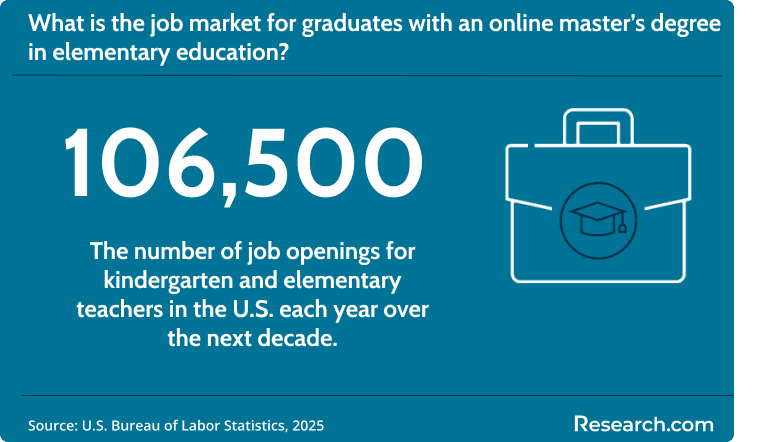
The labor market for elementary educators is mixed. The U.S. Bureau of Labor Statistics expects overall employment for kindergarten and elementary school teachers to decline slightly, yet the field still has substantial annual hiring needs because teachers retire, relocate, or change careers. BLS projects about 106,500 openings for kindergarten and elementary school teachers each year, on average, over the next decade.
Graduates with advanced preparation may be more competitive when they also hold in-demand endorsements or experience in areas such as special education, literacy intervention, and English language instruction. Some educators also broaden their qualifications through adjacent graduate study, similar to how a fast track online masters degree in clinical mental health counseling can expand professional preparation in a different student-support field.
For the strongest job prospects, align your master’s program with actual district needs. Review local job postings, talk with principals or district HR staff, and ask whether your target schools prioritize literacy, ESOL, special education, STEM, technology integration, or instructional coaching experience.
Here’s what graduates have to say about their fast online master’s degree in elementary education:
-
: "
I was teaching full time and did not think I could finish a master’s so quickly. The asynchronous format let me work ahead on weekends, and the assignments connected directly to problems I was seeing in my classroom. — Lena
"
-
: "
The program moved quickly, but I still felt connected. I worked with classmates from different states, received feedback from experienced faculty, and left with the confidence to pursue literacy specialist opportunities. — Jerome
"
-
: "
The online structure helped me manage parenting, teaching, and graduate school at the same time. Finishing efficiently gave me momentum and helped me earn a promotion before graduation. — Tanya
"
Key Insights
- A fast online master’s in elementary education is most valuable when it is accredited, state-aligned, affordable, and connected to a clear career goal.
- Most programs take 1 to 2 years, with many accelerated options requiring 30 to 45 credit hours and some full-time students finishing in 12 to 18 months.
- Licensure-track programs may take longer because they can include student teaching, practicum placements, testing, and state approval steps.
- Costs vary widely. Compare total program price, not just tuition per credit, and ask whether your district offers reimbursement or salary-lane recognition.
- Career outcomes may include elementary teacher, reading or literacy specialist, instructional coordinator, educational consultant, ESOL teacher, or special education teacher, depending on credentials and experience.
- Salary outcomes are not guaranteed. This guide includes estimates such as $62,310 for elementary school teacher, $59,940 for reading or literacy specialist, $74,720 for instructional coordinator/curriculum specialist, $84,006 for educational consultant, and $64,270 for ESOL or special education teacher.
- The job market remains active despite a slight projected decline in overall kindergarten and elementary teacher employment, with about 106,500 projected openings per year on average over the next decade.
- The biggest enrollment mistakes are ignoring licensure rules, choosing only by speed, underestimating workload, overlooking hidden costs, and assuming every online program qualifies graduates in every state.
References:
- Ball State University. (2025). Master of Arts in Education, Elementary Education. BSU
- Glassdoor. (2025). Educational Consultant in the United States 2025 - Salaries. Glassdoor
- Indeed. (2025). Reading specialist salary in the United States. Indeed
- Liberty University. (2025). MAT in Elementary Education – 45 Hours. LU Online
- U.S. Bureau of Labor Statistics. (2025). Occupational Outlook Handbook: Kindergarten and Elementary School Teachers. U.S. BLS
- University of North Dakota. (2025). Online Elementary Education Master's Cost. UND
Other things you should know about online master’s degree programs in elementary education
Many accelerated programs require a valid teaching license or teaching certificate for admission, especially those designed for current classroom teachers. Some programs accept applicants with a provisional license or proof of eligibility for licensure, and they often ask for official transcripts showing a bachelor’s degree from an accredited institution.
Admission requirements often include a minimum GPA of 3.0 for the fastest online master's programs in elementary education in 2027. However, some universities may accept lower GPAs if other criteria such as work experience or recommendations are strong.