
2027 Most Affordable Online Master’s in Gifted Education Programs

Co-Founder and Chief Data Scientist
Choosing an online master’s in gifted education is not just a question of finding the lowest tuition. For working teachers, curriculum specialists, and school leaders, the bigger decision is whether a program will help them identify advanced learners more fairly, design stronger enrichment and acceleration options, meet state endorsement requirements, and move into higher-responsibility roles without pausing their careers.
This guide explains what online Master’s in Gifted Education programs typically include, how to compare affordable options, what admissions requirements to expect, how online study differs from campus-based learning, and which career paths may open after graduation. It also highlights salary data, equity concerns in gifted identification, and practical questions to ask before enrolling.
Quick Answer: Is an Online Master’s in Gifted Education Worth It?
An online Master’s in Gifted Education can be worthwhile for licensed educators who want to specialize in advanced learners, qualify for gifted endorsement or add-on certification where available, move into curriculum or program leadership, or deepen their skills in differentiation and talent development. It is usually a better fit for current teachers than for career changers with no education background, because many programs expect classroom experience, a teaching license, or access to school-based fieldwork.
The strongest programs combine gifted identification, curriculum design, social-emotional support, equity-focused assessment, practicum experiences, and preparation for state-specific requirements. Before applying, confirm institutional accreditation, total cost, endorsement alignment in your state, field placement rules, and whether your school district rewards the degree through a salary lane or stipend.
What are the benefits of getting an online Master's in Gifted Education?
- Specialized career mobility: The degree can support movement into roles such as gifted education teacher, gifted program coordinator, curriculum specialist, instructional coach, or district-level advanced academics leader.
- Potential salary growth: Some educators may see salary-lane increases or stipends after earning a graduate degree, with reported annual gains often ranging from $5,000 to $10,000 depending on district policy, experience, and location. Always verify this with your collective bargaining agreement or HR office before enrolling.
- Flexible study for working educators: Online programs often let teachers complete coursework outside school hours through asynchronous modules, scheduled virtual sessions, discussion boards, and locally arranged practica.
- Stronger service to advanced learners: Graduate coursework helps educators move beyond “more work” for high-achieving students and toward evidence-based acceleration, enrichment, differentiation, and social-emotional support.
- Preparation for leadership and advocacy: Many programs train educators to evaluate gifted programs, communicate with families, reduce identification bias, and advocate for services across diverse student populations.
What can I expect from an online Master's in Gifted Education program?
An online Master’s in Gifted Education is a graduate program for educators who want advanced preparation in identifying, teaching, supporting, and advocating for gifted, talented, creative, high-ability, or academically/intellectually gifted students. Program titles vary by state and institution, but most focus on advanced learners in K-12 settings.
Students can expect coursework that blends theory, research, instructional design, assessment, and field-based application. Many programs are designed for working teachers and use online learning platforms, recorded lectures, discussion forums, virtual meetings, and practicum assignments completed in local schools.
| Program Component | What It Usually Covers | Why It Matters |
| Foundations of gifted education | Definitions of giftedness, talent development models, historical debates, and service models | Helps educators understand why gifted programs vary widely across states and districts |
| Identification and assessment | Screening tools, multiple measures, underidentification, bias, and data-informed decisions | Supports more accurate and equitable access to gifted services |
| Differentiated instruction | Curriculum compacting, acceleration, enrichment, flexible grouping, and advanced questioning | Gives teachers practical strategies for learners who need greater depth, pace, or complexity |
| Curriculum design | Advanced units, interdisciplinary learning, creativity, problem-based learning, and assessment design | Prepares graduates to build programs rather than rely only on packaged enrichment materials |
| Social-emotional development | Perfectionism, asynchronous development, peer relationships, motivation, and family collaboration | Recognizes that gifted learners need more than academic challenge |
| Practicum, internship, or capstone | Local fieldwork, action research, program evaluation, or applied projects | Connects graduate learning to real students, classrooms, and district needs |
Where can I work with an online Master's in Gifted Education qualification?
Graduates most often remain in K-12 education, but the degree can also support roles in curriculum design, professional development, advocacy, consulting, and educational program leadership. Job eligibility depends on state licensure rules, district staffing models, and the graduate’s prior credentials.
- Public school districts: Many graduates work as gifted education teachers, advanced academics specialists, enrichment teachers, or gifted program coordinators at the school or district level.
- Private and independent schools: Some schools hire educators to design advanced learning pathways, honors programming, enrichment clusters, or individualized talent development opportunities.
- Curriculum and instruction offices: Curriculum specialists use gifted education training to design rigorous units, support acceleration options, and coach teachers on differentiation.
- Educational consulting: Experienced graduates may advise districts, schools, parent groups, or enrichment providers on identification systems, program design, and professional learning.
- Nonprofit and advocacy organizations: Roles may involve policy work, family education, resource development, or advocacy for advanced learners.
- Higher education after further study: Some graduates later pursue doctoral work to teach future educators, conduct research, or lead university-based gifted education initiatives.
How much can I make with an online Master's in Gifted Education qualification?
Salary depends heavily on role, state, district pay scale, years of experience, and whether the position is classroom-based or administrative. PayScale.com data cited in this guide shows leadership roles at the higher end: a school principal with gifted program responsibilities averages $92,000 annually, and a director of special education averages $82,000. Mid-range roles include gifted program coordinator and instructional coordinator at $67,000, while academic coaches and special education teachers average $54,000 and $56,000, respectively.
For classroom teachers, the most important question is not only the degree title but whether your district recognizes the master’s for a salary lane, stipend, endorsement, or leadership assignment. Review your local pay schedule before assuming the degree will automatically increase earnings.
- Most Affordable Online Master's in Gifted Education Programs for 2027
- How to Choose the Best Online Master's in Gifted Education Program for Your Goals
- Prerequisites and Application Process for Online Master's in Gifted Education Programs
- Essential Skills You Can Learn in a Strong Online Master's in Gifted Education Program
- Career Prospects After an Online Master's in Gifted Education
- Program Costs and Financing Options
- Salary Expectations After an Online Master's in Gifted Education
- Online vs. In-Person Master's in Gifted Education Programs
- How to Evaluate Accreditation and Program Quality
- Common Challenges for Online Master's in Gifted Education Students
- Networking and Mentorship in Online Gifted Education Programs
- Diversity, Equity, and Inclusion in Gifted Education Programs
- Dual Degrees, Add-On Credentials, and Certifications
- Subspecialties and Career Paths for Gifted Education Graduates
- Job Market for Online Master's in Gifted Education Graduates
- Current Trends and Future Outlook
Most Affordable Online Master's in Gifted Education Programs for 2027
The programs below are listed as affordable online options for educators interested in gifted education. Use this list as a starting point, not a final decision. Tuition is only one part of value; also compare accreditation, state endorsement alignment, fieldwork expectations, faculty expertise, course sequencing, and whether the program fits your current teaching license.
| School | Program Focus | Credits | Listed Tuition Cost | Typical Length |
| Arkansas State University | Gifted, Talented, and Creative Education | 30 | $8,640 (all students) | As little as 18 months (accelerated) |
| Emporia State University | Gifted, Talented & Creative | 30 | $11,296 (in-state), $15,388 (out-of-state) | Typically 2 years (part-time) |
| Fort Hays State University | Gifted Education | 30 | $10,748 (all students) | Typically 2 years (part-time) |
| Georgetown College | Teacher Leader / Gifted Education (P-12) | 30 | $12,975 (all students) | Typically 2 years (part-time) |
| Lamar University | Teacher Leadership – Gifted & Talented | 36 | $11,664 (all students) | Typically 18–24 months |
| University of Arkansas at Little Rock | Gifted, Creative, and Talented Education (K-12) | 30 | $11,460 (in-state), $9,600 (military) | Typically 2 years (part-time) |
| University of Nebraska at Kearney | High Ability Education | 36 | $13,248 (in-state), $17,892 (out-of-state) | Typically 2 years (part-time) |
| University of North Carolina at Charlotte | Academically or Intellectually Gifted (AIG) | 33 | $9,273 (in-state), $17,226 (out-of-state) | Part-time, typically 2 years |
| University of North Carolina-Wilmington | Academically & Intellectually Gifted (AIG) | 33 | $9,735 (in-state), $36,102 (out-of-state) | Typically 2 years (part-time) |
| Upper Iowa University | Talented & Gifted | 36 | $12,060 (all students) | Typically 2 years (part-time) |
1. Arkansas State University
The online Master of Science in Education in Gifted, Talented and Creative at Arkansas State University is built for educators who want concentrated preparation in gifted, talented, and creative learner services. The program emphasizes identification, assessment, instructional models, program planning, and the social-emotional dimensions of giftedness. Its curriculum is aligned with recommendations from the Council for Exceptional Children and CAEP, and the internship gives students structured practice in organizing, managing, and planning gifted education experiences. Graduates may pursue gifted education licensure, although requirements differ by state.
- Program Length: As little as 18 months (accelerated)
- Tracks/Concentrations: Gifted, Talented, and Creative Education
- Tuition Cost: $8,640 (all students)
- Required Credits to Graduate: 30
- Accreditation: Council for the Accreditation of Educator Preparation (CAEP)
2. Emporia State University
Emporia State University offers an online Master of Science in Special Education – Gifted, Talented & Creative for educators seeking deeper expertise in advanced learners. Coursework addresses gifted identification, assessment, creative teaching, curriculum planning, advocacy, and behavior intervention. Supervised practice at the elementary and secondary levels helps students connect theory with real instructional decisions. Because the track is non-licensure, applicants should confirm whether it fits their state endorsement or professional goals.
- Program Length: Typically 2 years (part-time)
- Tracks/Concentrations: Gifted, Talented & Creative (Non-Licensure)
- Tuition Cost: $11,296 (in-state), $15,388 (out-of-state)
- Required Credits to Graduate: 30
- Accreditation: Council for the Accreditation of Educator Preparation (CAEP)
3. Fort Hays State University
The online Master of Science in Special Education – Gifted at Fort Hays State University prepares educators to identify gifted learners, design differentiated curriculum, understand social-emotional needs, and plan services for varied school contexts. The program’s asynchronous format is intended for working professionals, and practicum experiences may be completed locally. Students interested in licensure or endorsement should verify state-specific requirements before enrolling.
- Program Length: Typically 2 years (part-time)
- Tracks/Concentrations: Gifted Education
- Tuition Cost: $10,748 (all students)
- Required Credits to Graduate: 30
- Accreditation: Council for the Accreditation of Educator Preparation (CAEP)
4. Georgetown College
Georgetown College offers an online Master of Arts in Education in Teacher Leader with Gifted Education (P-12) for certified teachers who want to combine gifted education specialization with teacher leadership preparation. Students study advanced instruction, curriculum design, social-emotional learning, advocacy, and equity in gifted services. Field experiences and a capstone project require students to demonstrate practical program design and implementation skills. The program is designed to support add-on certification in gifted education.
- Program Length: Typically 2 years (part-time)
- Tracks/Concentrations: Teacher Leader / Gifted Education (P-12)
- Tuition Cost: $12,975 (all students)
- Required Credits to Graduate: 30
- Accreditation: Council for the Accreditation of Educator Preparation (CAEP)
5. Lamar University
Lamar University provides an online Master of Education in Teacher Leadership – Gifted & Talented that combines leadership training with gifted education practice. The curriculum covers advanced curriculum development, instructional strategies for gifted and talented students, social-emotional needs, and program implementation. Asynchronous coursework and multiple start dates make the format accessible for working educators. Graduates may use the program toward gifted and talented endorsement or certification where state rules allow.
- Program Length: Typically 18–24 months
- Tracks/Concentrations: Teacher Leadership – Gifted & Talented
- Tuition Cost: $11,664 (all students)
- Required Credits to Graduate: 36
- Accreditation: Council for the Accreditation of Educator Preparation (CAEP)
6. University of Arkansas at Little Rock
The online Master of Education in Gifted, Creative, and Talented Education (K-12) at the University of Arkansas at Little Rock is intended for educators who want advanced preparation in gifted identification, differentiated instruction, curriculum design, social-emotional support, and equity in gifted services. Students complete field experiences and a capstone project to apply graduate learning in practice. Licensure or endorsement outcomes depend on state requirements.
- Program Length: Typically 2 years (part-time)
- Tracks/Concentrations: Gifted, Creative, and Talented Education (K-12)
- Tuition Cost: $11,460 (in-state), $9,600 (military)
- Required Credits to Graduate: 30
- Accreditation: Council for the Accreditation of Educator Preparation (CAEP)
7. University of Nebraska at Kearney
The online Master of Arts in Education in Special Education – High Ability Education at the University of Nebraska at Kearney focuses on high-ability learners, gifted identification, curriculum differentiation, assessment, and social-emotional support. Students complete practicum and capstone work that connects coursework to real educational settings. The program is designed for practicing educators and may support endorsement depending on state rules.
- Program Length: Typically 2 years (part-time)
- Tracks/Concentrations: High Ability Education
- Tuition Cost: $13,248 (in-state), $17,892 (out-of-state)
- Required Credits to Graduate: 36
- Accreditation: Council for the Accreditation of Educator Preparation (CAEP)
8. University of North Carolina at Charlotte
The online Master of Education in Special Education: Academically or Intellectually Gifted (AIG) at the University of North Carolina at Charlotte is a part-time program centered on advanced competencies for AIG teaching and leadership. The 11-course, 33-credit curriculum includes the Graduate Certificate in AIG as an entry point. Coursework is writing-intensive and emphasizes classroom application, data-informed decision-making, leadership, advocacy, and a capstone research project. The program prepares students for North Carolina’s professional educators continuing license in special education: AIG.
- Program Length: Part-time, typically 2 years
- Tracks/Concentrations: Academically or Intellectually Gifted (AIG)
- Tuition Cost: $9,273 (in-state), $17,226 (out-of-state)
- Required Credits to Graduate: 33
- Accreditation: Southern Association of Colleges and Schools Commission on Colleges (SACSCOC)
9. University of North Carolina-Wilmington
The online Master of Education in Academically & Intellectually Gifted (AIG) at UNC Wilmington prepares educators for AIG add-on licensure and advanced practice with gifted and talented learners. Courses are delivered online in half-term sessions, supporting flexibility for working teachers. The curriculum addresses curriculum options, instructional strategies, social-emotional development, leadership, advocacy, program development, and practical experience through local practicum mentors.
- Program Length: Typically 2 years (part-time)
- Tracks/Concentrations: Academically & Intellectually Gifted (AIG)
- Tuition Cost: $9,735 (in-state), $36,102 (out-of-state)
- Required Credits to Graduate: 33
- Accreditation: Council for the Accreditation of Educator Preparation (CAEP)
10. Upper Iowa University
Upper Iowa University offers an online Master of Education in Talented & Gifted for educators who want to strengthen instruction, curriculum planning, technology integration, and multicultural perspectives in gifted education. Courses such as “Introduction to Gifted Education” and “Methods & Curriculum: Gifted Education PK–12” emphasize applied teaching strategies. Graduates may pursue endorsement or certification where state requirements permit.
- Program Length: Typically 2 years (part-time)
- Tracks/Concentrations: Talented & Gifted
- Tuition Cost: $12,060 (all students)
- Required Credits to Graduate: 36
- Accreditation: Higher Learning Commission (HLC)
How to Choose the Best Online Master's in Gifted Education Program for Your Goals
The best program is the one that fits your license status, state requirements, budget, schedule, and intended career path. A low-cost program can still be a poor choice if it does not meet endorsement requirements in your state or if fieldwork cannot be completed where you live.
| Decision Factor | What to Check | Why It Should Affect Your Choice |
| Accreditation | Institutional accreditation and, when relevant, CAEP or educator-preparation accreditation | Accreditation affects credibility, financial aid eligibility, transferability, and employer recognition |
| State endorsement alignment | Whether the program leads to gifted endorsement, add-on licensure, or professional license renewal in your state | Licensure rules are state-specific; an out-of-state online program may not automatically qualify you |
| Curriculum focus | Courses in 2e learners, creativity, equity, program evaluation, AIG, leadership, or curriculum design | Your coursework should match the role you want after graduation |
| Fieldwork requirements | Practicum hours, internship rules, mentor qualifications, and local placement approval | Working teachers need to know whether they can complete requirements in their own school or district |
| Faculty expertise | Faculty research, K-12 experience, gifted education publications, and mentorship availability | Specialized mentorship can be valuable for capstones, research projects, and leadership goals |
| Format and pace | Asynchronous courses, live meetings, accelerated terms, part-time sequencing, and start dates | A program that conflicts with teaching duties can quickly become unsustainable |
| Total cost | Tuition, fees, books, residency charges, technology fees, and travel for any required meetings | The cheapest tuition is not always the lowest total cost |
Before applying, ask the program director for a written explanation of how the program supports your state’s gifted education requirements. If you are a classroom teacher, also ask your district whether the degree qualifies for salary advancement.
The need for strong educators is visible in national achievement data. The percentage of U.S. students scoring below the "low" benchmark on the TIMSS scale increased from 2015 to 2023. In Grade 4 math, the percentage below the low benchmark rose from 5% in 2015 to 7% in 2019 and then to 13% by 2023. In Grade 8 math, the percentage moved from 9% in 2015 to 13% in 2019 and reached 18% in 2023, as shown in the graphic below.
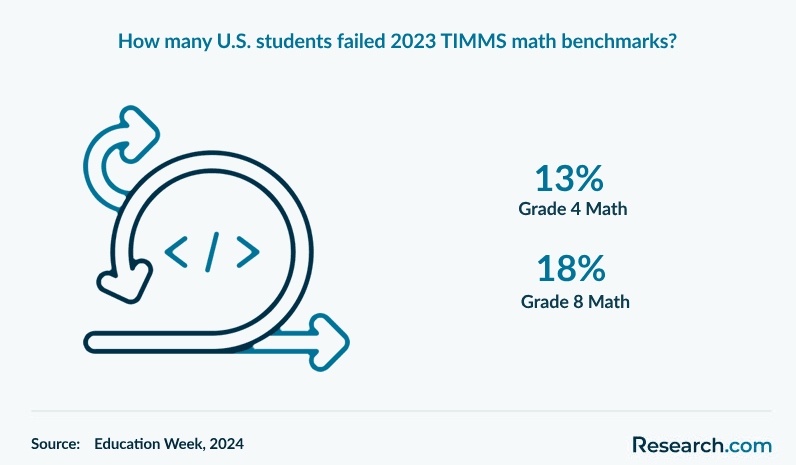
Education Week reported in 2024 that TIMSS 2023 showed more U.S. students at the lowest math achievement level than in prior results. While gifted education is not a direct remedy for foundational math gaps, the trend reinforces the importance of better differentiated instruction across the achievement spectrum: struggling learners need support, and advanced learners need appropriate challenge rather than being left to wait.
Prerequisites and Application Process for Online Master's in Gifted Education Programs
Admissions requirements vary by institution, but most online master’s programs in gifted education are built for educators or applicants with a background in teaching, child development, special education, curriculum, or a related field.
- Bachelor’s degree: Applicants generally need a bachelor’s degree from an accredited institution. A background such as an online elementary education degree can be especially relevant, though some programs admit candidates from related fields.
- Official transcripts: Schools usually require transcripts from every college or university attended.
- Minimum GPA: Many graduate programs specify a minimum undergraduate GPA or offer conditional admission for applicants who need to show readiness.
- Teaching license or experience: Some programs require current teacher certification, while others recommend school-based experience or access to a classroom for fieldwork.
- Recommendation letters: Expect to submit two or three recommendations from supervisors, professors, principals, or colleagues who can speak to your teaching ability and graduate-level potential.
- Statement of purpose: Programs often ask why you want to study gifted education, what populations you hope to serve, and how the degree fits your career goals.
- Resume or CV: Include teaching experience, leadership roles, professional development, curriculum projects, and work with advanced learners.
- Standardized tests: GRE requirements are less common in education master’s programs than they once were, but some institutions may still request scores.
For educators comparing advanced graduate options, the most affordable online education specialist degrees in leadership can provide a useful contrast: those programs often emphasize administrative leadership and professional experience, while gifted education degrees focus more directly on advanced learner services and instructional design.
Essential Skills You Can Learn in a Strong Online Master's in Gifted Education Program
A high-quality gifted education master’s program should produce more than general awareness of gifted learners. It should help educators make better instructional, assessment, and program decisions in real classrooms.
| Skill Area | What You Learn | How It Applies in Schools |
| Gifted identification | How to use multiple measures, reduce bias, and recognize giftedness across cultures, languages, disability profiles, and income levels | Improves access for students who may be missed by traditional nomination or test-only systems |
| Differentiation and acceleration | How to adjust pace, depth, complexity, grouping, content, and assessment | Prevents advanced learners from repeating mastered material |
| Curriculum development | How to create advanced units, inquiry projects, interdisciplinary tasks, and performance assessments | Supports rigorous learning rather than isolated enrichment activities |
| Program planning | How to design service models, evaluate outcomes, and communicate program goals | Prepares graduates for coordinator, specialist, or district leadership roles |
| Advocacy and collaboration | How to work with families, administrators, counselors, and general education teachers | Helps gifted services become part of a schoolwide support system |
| Social-emotional support | How giftedness can intersect with perfectionism, asynchronous development, motivation, peer relationships, and identity | Encourages a whole-child approach rather than focusing only on achievement |
| Educational technology | How digital tools can support differentiation, independent research, remote collaboration, and personalized learning | Useful for teachers building advanced learning experiences in online, hybrid, or technology-rich classrooms |
Many affordable online education degrees include foundations in pedagogy and assessment, but gifted education programs go deeper into the needs of advanced learners. Educators who want an even stronger technology focus can compare gifted education programs with the most affordable online master's in education technology, especially if their career goals involve digital curriculum design or instructional innovation.
Parent demand for advanced academic opportunities remains visible. In an EdChoice survey conducted between June 5 and June 7, 2024, among U.S. adults with at least one gifted child (N=563), 46% reported that their gifted child participated in Honors Course(s), while 34% reported participation in a dedicated Gifted/Advanced Academic Program.
The same survey found that 27% of gifted students took AP or IB courses, and 26% were enrolled in courses for college credit while still in high school. Another 16% attended a full-time school for academically advanced students, and 15% participated in other advanced academic programs. The chart below shows how families use multiple pathways to seek appropriate academic challenge.
Career Prospects After an Online Master's in Gifted Education
Career outcomes depend on prior teaching credentials, state licensure, district staffing, and experience. The degree is most directly useful for educators who want to work with advanced learners or lead gifted programming in K-12 systems.
| Career Path | Main Responsibilities | Who It Fits Best |
| Gifted education teacher | Teach gifted learners in pull-out, push-in, cluster, honors, enrichment, or specialized classroom models | Teachers who want daily student-facing work |
| Gifted program coordinator | Manage identification, service models, professional learning, family communication, and program evaluation | Educators interested in school or district leadership |
| Curriculum specialist | Design advanced curriculum, coach teachers, align learning goals, and evaluate instructional materials | Teachers who enjoy instructional design and cross-grade planning |
| Instructional coach | Support teachers in differentiation, assessment, grouping, and advanced learning strategies | Experienced educators who want to influence classroom practice across a school |
| Educational consultant | Provide training, program reviews, curriculum support, or family guidance | Professionals with strong experience, networks, and independent consulting skills |
| Advocacy or nonprofit specialist | Develop resources, support families, analyze policy, or promote gifted education access | Educators interested in systems change and community engagement |
| Teacher educator or researcher | Teach, study, or evaluate gifted education at the postsecondary level | Graduates planning further doctoral study |
Leadership and planning skills can overlap with other graduate pathways. For example, educators comparing gifted education with the low cost MS in organizational leadership online should consider whether they want a school-specific instructional specialization or broader leadership training that can apply across sectors.
Program Costs and Financing Options
Online Master’s in Gifted Education programs can differ sharply in total price. Tuition may be quoted per credit, per course, per term, or as a full-program estimate. In general, total program costs often range from $15,000 to $40,000, with public universities frequently offering lower rates for in-state students and some online programs charging the same tuition regardless of residency.
- Tuition: Compare full-program cost, not only per-credit rates. A 36-credit program may cost more than a 30-credit program even if the per-credit price is similar.
- Fees: Online programs may charge technology, distance learning, graduation, placement, or course-specific fees.
- Books and materials: Budget for textbooks, digital resources, assessment tools, and software. These costs can add several hundred to a thousand dollars per year.
- Fieldwork expenses: Practicum requirements may involve background checks, fingerprinting, liability insurance, or travel to local placement sites.
- Federal student aid: Graduate students commonly begin by completing the FAFSA to determine eligibility for federal loans, including Stafford loans and Grad PLUS loans.
- Scholarships and grants: Check institutional scholarships, teacher association awards, state education grants, and funding for educators in shortage or specialized fields.
- Employer tuition support: Some districts offer tuition reimbursement, professional development funds, or salary-lane incentives for approved graduate coursework.
- Payment plans: Monthly or term-based payment plans can reduce the need to borrow the full amount at once.
| Cost Question | Why It Matters |
| Is tuition charged the same for online out-of-state students? | Some programs are affordable for all students, while others have major in-state and out-of-state differences. |
| Does the program qualify for federal financial aid? | Eligibility generally requires enrollment at an accredited institution and meeting aid requirements. |
| Will my district reimburse this specific program? | District reimbursement often depends on prior approval, relevance to your role, and minimum grade requirements. |
| Does the degree move me to a higher salary lane? | A raise is not automatic unless your district’s salary schedule recognizes the degree or credits. |
| Are there required campus visits? | Even “online” programs may have occasional in-person requirements, which can add travel costs. |
Salary Expectations After an Online Master's in Gifted Education
Salary outcomes are not guaranteed by the degree alone. They depend on job title, state, district budget, teacher contract, years of service, leadership duties, and whether the role is classroom-based or administrative. Still, graduate preparation in gifted education can improve eligibility for specialized and leadership positions.
According to PayScale.com data as of 2025, the highest average annual salary among the cited roles is school principal (Gifted Program) at $92,000. Director of special education averages $82,000, and education administrator (K-12) averages $72,000. Educators interested in related special education pathways may also compare options such as the most affordable online Master's in Special Education.
| Role | Average Annual Salary Cited | Typical Career Context |
| School Principal (Gifted Program) | $92,000 | School leadership with responsibility for gifted programming or advanced academic services |
| Director of Special Education | $82,000 | District-level leadership, often overseeing specialized student services |
| Education Administrator (K-12) | $72,000 | Administrative leadership in elementary or secondary education |
| District Instructional Specialist | $70,000 | Districtwide instructional support, coaching, curriculum, and professional learning |
| Gifted Program Coordinator | $67,000 | Gifted identification, service coordination, teacher support, and program evaluation |
| Instructional Coordinator | $67,000 | Curriculum alignment, assessment, and instructional improvement |
| Department Chair (K-12) | $65,000 | Subject-area or grade-level leadership |
| Education Consultant | $64,000 | Advising schools, districts, or families on education programs and services |
| Curriculum Specialist | $63,000 | Designing, evaluating, and improving curriculum |
| Educational Diagnostician | $63,000 | Assessment and student evaluation support |
| Education Program Manager | $61,000 | Program coordination, implementation, and evaluation |
| School Counselor | $61,000 | Student academic, career, and social-emotional support |
| Special Education Teacher | $56,000 | Direct instruction and support for students with disabilities |
| Academic Coach | $54,000 | Instructional support, coaching, and student achievement initiatives |
The salary pattern is clear: roles with administrative scope, districtwide responsibility, or specialized program oversight tend to report higher averages than direct support roles. The graph below summarizes the cited PayScale.com salary data.
To evaluate return on investment, compare the total program cost with your likely salary-lane increase, stipend opportunities, leadership openings, and long-term career plan. A lower-cost program that meets state requirements and district pay policies may offer stronger value than a better-known program that does not improve your eligibility or compensation.
Online vs. In-Person Master's in Gifted Education Programs
Online and campus-based gifted education programs can both be academically strong. The better choice depends on your schedule, learning preferences, access to local fieldwork, and need for face-to-face networking.
| Factor | Online Program | In-Person Program |
| Schedule | Often better for full-time teachers because coursework may be asynchronous or offered after school hours | May require commuting and fixed class meeting times |
| Access | Allows students to enroll without relocating, including in programs outside their state | Limited by geography unless the student can move or commute |
| Interaction | Requires intentional participation in forums, virtual meetings, and group projects | Offers more spontaneous face-to-face discussion and campus networking |
| Fieldwork | Usually completed locally, but approval rules can vary | May be coordinated through nearby partner districts |
| Self-management | Requires strong time management and comfort with digital platforms | Provides more built-in structure through regular campus attendance |
| Best fit | Working educators who need flexibility and can stay organized independently | Students who prefer in-person discussion, campus services, and a fixed routine |
Benefits of Online Programs
- Flexible pacing: Many programs are designed around the schedules of working educators.
- Broader school choice: Students can compare programs nationwide instead of being limited to nearby campuses.
- Diverse peer perspectives: Online cohorts may include teachers from different states, districts, school types, and gifted service models.
- Local application: Assignments and practica can often be connected directly to the student’s own classroom or district.
Drawbacks of Online Programs
- Less informal interaction: Students must be proactive about contacting faculty and building peer relationships.
- Greater need for self-discipline: Online success depends on planning ahead, meeting deadlines, and managing workload during the school year.
- Technology dependence: Reliable internet, comfort with learning platforms, and digital communication skills are essential.
- Licensure complexity: Enrolling in an out-of-state online program can create endorsement questions that must be resolved before admission.
How to Evaluate Accreditation and Program Quality
Accreditation is one of the first quality checks for any online graduate program. At minimum, the institution should hold recognized institutional accreditation. For educator preparation, programmatic accreditation or alignment with professional standards can also matter, especially when the degree is connected to licensure, endorsement, or certification.
- Verify institutional accreditation: Confirm the university is accredited by a recognized accreditor, such as SACSCOC, HLC, or another recognized institutional accreditor.
- Check educator-preparation accreditation: Programs that list CAEP accreditation should explain whether it applies to the educator preparation unit, the program, or both.
- Ask about state approval: Accreditation does not automatically mean the program meets your state’s gifted endorsement requirements.
- Review curriculum depth: Strong programs cover identification, curriculum, differentiation, equity, social-emotional needs, program evaluation, and field-based practice.
- Look for transparent outcomes: Ask about completion rates, endorsement pass rates where applicable, alumni roles, and employer partnerships.
- Evaluate support services: Online students should have access to advising, library resources, technical support, field placement guidance, and faculty office hours.
If you are comparing master’s programs with doctoral options, review how accreditation and quality expectations differ in the cheapest EdD programs. Doctoral degrees usually serve different goals, such as executive leadership, research, or system-level improvement.
Common Challenges for Online Master's in Gifted Education Students
Online graduate study can be manageable for teachers, but it is not effortless. The biggest challenges usually involve time, isolation, technology, fieldwork logistics, and balancing coursework with school-year demands.
| Common Challenge | Better Strategy |
| Waiting until deadlines are close | Map each course calendar against grading periods, parent conferences, testing windows, and holidays |
| Assuming online means self-paced | Confirm whether courses are asynchronous, synchronous, cohort-based, or accelerated |
| Not arranging fieldwork early | Ask about practicum approval, mentor requirements, and district permissions before the first term |
| Choosing only by tuition | Compare endorsement alignment, total fees, faculty support, and program outcomes |
| Staying invisible in online courses | Attend virtual office hours, join discussion groups, and connect with classmates intentionally |
| Ignoring technical requirements | Test the learning platform, video tools, library access, and assistive technology before classes begin |
Educators who want a broader comparison of affordable graduate teaching options can also explore cheap online masters in education, but should remember that not every teaching master’s includes gifted education coursework or endorsement preparation.
Networking and Mentorship in Online Gifted Education Programs
Online programs can support strong professional relationships when they design networking intentionally. Look for programs that create recurring opportunities to interact with faculty, gifted education practitioners, alumni, and classmates beyond required discussion posts.
- Faculty mentorship: Ask whether students are assigned advisors or capstone mentors with expertise in gifted education.
- Cohort learning: A cohort model can help students build relationships over multiple courses instead of starting over each term.
- Virtual events: Webinars, guest speakers, research presentations, and professional panels can expose students to current practice.
- Collaborative projects: Group curriculum design, program evaluation, or case analysis assignments can build practical networks.
- Professional association connections: Strong programs may encourage conference participation, publication, or involvement in gifted education organizations.
- Alumni access: Ask whether graduates mentor current students, share job leads, or participate in program advisory boards.
For educators planning eventual senior leadership or research roles, some programs may also help students understand doctoral pathways, including options such as cheap accredited online EdD programs.
Diversity, Equity, and Inclusion in Gifted Education Programs
Equity is central to modern gifted education because identification and access have long varied by race, income, language background, disability status, and school resources. A strong master’s program should prepare educators to question narrow definitions of giftedness, use multiple identification measures, examine referral patterns, and design services that reach students who are often overlooked.
- Bias-aware identification: Programs should address teacher referral bias, test limitations, local norms, universal screening, and nonverbal or performance-based measures.
- Culturally responsive curriculum: Coursework should help teachers design advanced learning that reflects students’ identities, communities, languages, and interests.
- Support for multilingual gifted learners: Educators need strategies for recognizing advanced reasoning or creativity even when English proficiency is still developing.
- Twice-exceptional learners: Gifted students with disabilities may be missed when disability-related needs mask advanced ability, or vice versa.
- Family engagement: Programs should train educators to communicate clearly with families who may not know how gifted services are accessed.
- Program evaluation: Graduates should be able to analyze participation data and ask whether services reflect the full student population.
Educators interested in the broader policy context behind educational equity may find interdisciplinary study useful. For example, the cheapest online bachelor political science programs can provide background in public policy, governance, and social systems, although they serve a different academic purpose than graduate teacher preparation.
Dual Degrees, Add-On Credentials, and Certifications
Some educators use a master’s in gifted education as a core credential and then add complementary training in special education, educational leadership, literacy, multilingual learner education, instructional technology, counseling, or assessment. This can make sense when your district serves students with complex academic and developmental profiles.
| Additional Credential Area | When It Makes Sense | Decision Caution |
| Special education | You want stronger preparation for twice-exceptional learners or inclusive services | Check whether the credential leads to licensure or only professional knowledge |
| Educational leadership | You want to become a coordinator, director, principal, or district administrator | Leadership licensure has separate state rules |
| Instructional technology | You want to design advanced digital learning, virtual enrichment, or personalized pathways | Technology skills should support pedagogy, not replace it |
| Multilingual learner education | You want to identify and serve gifted students who are also English learners | Giftedness and language proficiency must be assessed carefully and separately |
| Speech-language pathology or related services | You work with learners whose communication needs intersect with advanced ability | Clinical fields have strict accreditation and licensure requirements |
For comparison, programs such as the University of South Florida SLP masters online follow a different professional pathway and may involve clinical licensure expectations. Use complementary credentials strategically rather than collecting degrees without a clear career purpose.
Subspecialties and Career Paths for Gifted Education Graduates
Gifted education is not a single uniform specialty. Graduate students may focus on particular learner groups, service models, or leadership functions depending on their interests and school context.
- Twice-exceptionality (2e): Supporting students who are gifted and also have disabilities, learning differences, ADHD, autism, or other educational needs.
- Creativity and innovation: Designing learning experiences that cultivate original thinking, problem solving, invention, and creative production.
- Early childhood gifted education: Recognizing and nurturing advanced development in young children. Educators focused on younger learners may compare related preparation through online colleges for early childhood education.
- Curriculum and instruction: Building advanced units, differentiated assessments, interdisciplinary projects, honors pathways, and acceleration options.
- Gifted program administration: Leading identification systems, service delivery, teacher training, family communication, policy implementation, and program evaluation.
- Social-emotional development: Supporting motivation, belonging, identity, perfectionism, asynchronous development, and mental well-being among advanced learners.
- Equity and access: Improving identification and services for students from underrepresented racial, linguistic, socioeconomic, rural, and disability backgrounds.
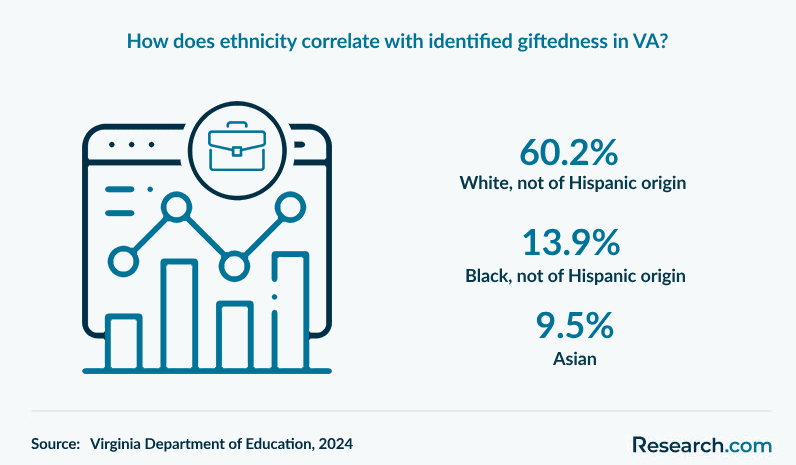
Equity concerns are visible in state-level gifted participation data. According to the Virginia Department of Education's 2023-2024 Gifted Annual Report for All Divisions, among the 12,670 identified gifted students in G12, White, not of Hispanic origin, students were the largest group, with 7,631 individuals, or approximately 60.2% of the total G12 identified gifted population. Asian students numbered 1,210, or about 9.5%. Black, not of Hispanic origin, students accounted for 1,766, or approximately 13.9%, while Hispanic students numbered 1,163, or about 9.2%. Non-Hispanic students of two or more races totaled 823, or approximately 6.5%; American Indian or Alaska Native students numbered 25, or approximately 0.2%; and Native Hawaiian or Pacific Islander students numbered 22, or approximately 0.2%.
The graphic below illustrates this distribution. The data raises important questions about representation in gifted identification and the policies districts use to recognize advanced potential across student groups.
Job Market for Online Master's in Gifted Education Graduates
The job market for gifted education graduates is tied to state policy, district budgets, local gifted education mandates, teacher turnover, and how schools define advanced academic services. Some districts employ dedicated gifted specialists, while others expect classroom teachers or instructional coaches to provide enrichment and differentiation as part of broader roles.
- Public schools remain the primary employer: Most positions are in elementary, middle, and high schools or district curriculum departments.
- State rules shape openings: Districts in states with gifted mandates, endorsements, or defined service requirements may have more specialized roles.
- Leadership roles are competitive: Coordinator and director positions usually require experience, strong communication skills, and evidence of program impact.
- Curriculum expertise is transferable: Graduates may move into instructional coaching, advanced academics, honors/AP support, or curriculum specialist roles.
- Consulting requires experience: Independent consulting is usually more realistic after building a strong record in schools or districts.
- Doctoral study can expand options: Graduates who want research, higher education, or executive leadership may later pursue a doctorate in education.
Educators with multiple specializations may be more adaptable in inclusive schools. For example, graduates of low cost master's in multilingual learner education online programs may bring language-development expertise that complements gifted education in districts serving multilingual advanced learners.
Current Trends and Future Outlook
Gifted education is changing as schools pay more attention to equity, student well-being, personalized learning, and technology-supported instruction. Online master’s programs are increasingly expected to prepare educators for these realities rather than focusing only on traditional pull-out enrichment models.
- Equity in identification: Districts are reexamining referral systems, test cutoffs, and access barriers that can exclude students from underrepresented groups.
- Talent development: Many programs now emphasize developing potential over time rather than treating giftedness as a fixed label.
- Twice-exceptional support: Educators need better preparation for students whose advanced abilities coexist with disabilities or learning differences.
- Social-emotional learning: Gifted learners may need support with perfectionism, isolation, underachievement, identity, and motivation.
- Technology and AI: Digital tools can support personalized enrichment, research, creative production, and differentiated learning, but educators must still evaluate quality, bias, and appropriate use.
- Interdisciplinary and real-world learning: Advanced learners often benefit from complex problems, independent inquiry, mentorships, and authentic audiences.
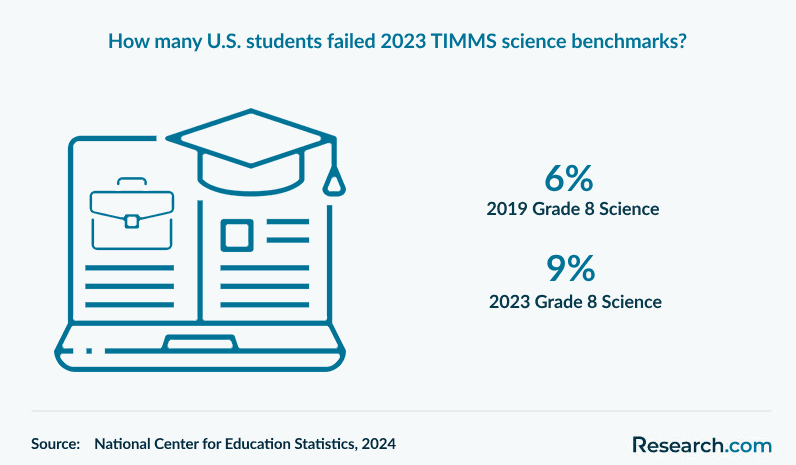
National performance data adds urgency to improving instruction across all achievement levels. In science, the percentage of U.S. 4th-grade students scoring below the "low" benchmark on the TIMSS international science assessment rose from 6% in 2019 to 9% in 2023.
The data below, compiled from the National Center for Education Statistics' 2024 report on the Trends in International Mathematics and Science Study (TIMSS) 2023, shows a larger share of 4th-grade students not reaching the most basic science benchmark. For gifted education leaders, the implication is not that advanced learners should receive less attention, but that schools need more precise instruction for every learner: remediation for students below benchmarks and acceleration or enrichment for students ready to move faster or deeper.
The future of gifted education will likely reward educators who can combine advanced curriculum design, equity-focused identification, social-emotional support, family engagement, and technology-rich learning. Graduates who develop those skills can contribute meaningfully whether they remain in the classroom, coordinate programs, or move into broader educational leadership.
What Graduates Say About Online Master's in Gifted Education Programs
-
: "
I needed a graduate program that fit my teaching schedule without feeling like a shortcut. The online format gave me flexibility, but the coursework still pushed me to rethink how I identify and support gifted learners. After finishing the degree, I felt prepared to step into a gifted specialist role at my school. Lora
"
-
: "
The asynchronous structure helped me balance work, family, and graduate study. What stood out most was how invested the faculty were in gifted education as a real practice, not just a theory. The program reminded me why I became a teacher. Amy
"
-
: "
I was unsure whether an affordable online program would be rigorous, but the projects were practical and evidence-based. I finished with strategies I could use immediately with advanced learners. For my career, it was a smart investment. Zach
"
Common Mistakes to Avoid When Choosing a Program
- Assuming every program leads to endorsement: Gifted education requirements vary by state. Get written confirmation before enrolling.
- Comparing tuition without fees: Technology fees, books, fieldwork costs, and out-of-state tuition can change the real price.
- Ignoring your district’s salary policy: A master’s degree may not increase pay unless your employer recognizes the credits or degree category.
- Choosing a program with no practical fieldwork: Gifted education is applied work. Strong programs connect coursework to classrooms, students, and program evaluation.
- Overlooking equity preparation: Programs should address underidentification, cultural and linguistic diversity, and twice-exceptionality.
- Relying only on rankings: Affordability and reputation matter, but fit, licensure alignment, faculty support, and outcomes matter more.
- Not asking about online support: Advising, library access, tech help, and field placement guidance are essential for remote learners.
Questions to Ask Before Enrolling
- Does this program meet gifted endorsement or add-on licensure requirements in my state?
- Is the institution regionally or institutionally accredited, and is the education program CAEP-accredited where relevant?
- Can I complete practicum or internship requirements in my current school or district?
- What is the total program cost, including fees, books, and fieldwork expenses?
- Does my employer offer tuition reimbursement or salary advancement for this degree?
- How often are live class meetings required, and are they scheduled around working teachers?
- What gifted education topics are required: 2e, equity, curriculum design, social-emotional development, program evaluation, and assessment?
- Who teaches the courses, and what experience do they have in gifted education research or practice?
- What roles have recent graduates moved into?
- What student supports are available for online learners?
Key Insights
- The best program is state-specific: Gifted endorsement and licensure rules differ by state, so confirm requirements before choosing an out-of-state online degree.
- Affordability should be measured by total value: Tuition matters, but accreditation, fieldwork, faculty expertise, and salary-lane eligibility determine whether the investment pays off.
- Career benefits are strongest for current educators: Licensed teachers can use the degree to move into gifted teaching, coordination, curriculum, coaching, or leadership roles more directly than applicants without teaching credentials.
- Salary gains vary by role: PayScale.com data cited here shows higher averages for leadership roles such as school principal (Gifted Program) at $92,000 and director of special education at $82,000, while direct support roles report lower averages.
- Equity is now essential preparation: Gifted educators must understand underidentification, twice-exceptionality, multilingual learners, and culturally responsive identification practices.
- Online learning can work well for teachers: The format is flexible, but success requires planning, self-discipline, proactive communication, and early fieldwork coordination.
- Current achievement trends reinforce the need for better differentiation: TIMSS data showing rising percentages of students below low math and science benchmarks highlights the broader need for instruction that responds accurately to varied readiness levels.
References:
- Aldis, A. (2024, July 30). Gifted education important to parents in latest monthly poll. EdChoice.
- National Center for Education Statistics. (2024). Trends in International Mathematics and Science Study (TIMSS) 2023: Compiled report. U.S. Department of Education. National Center for Education Statistics.
- PayScale. (2025). Academic Coach Salary. PayScale.
- PayScale. (2025). Curriculum Specialist Salary. PayScale.
- PayScale. (2025). Department Chair (K-12) Salary. PayScale.
- PayScale. (2025). Director of Special Education Salary. PayScale.
- PayScale. (2025). District Instructional Specialist Salary. PayScale.
- PayScale. (2025). Education Administrator, K-12 Salary. PayScale.
- PayScale. (2025). Education Consultant Salary. PayScale.
- PayScale. (2025). Education Program Manager Salary. PayScale.
- PayScale. (2025). Educational Diagnostician Salary. PayScale.
- PayScale. (2025). Gifted Program Coordinator Salary. PayScale.
- PayScale. (2025). Instructional Coordinator Salary. PayScale.
- PayScale. (2025). School Counselor Salary. PayScale.
- PayScale. (2025). School Principal Salary. PayScale.
- PayScale. (2025). Special Education Teacher, Preschool, Kindergarten, or Elementary School Salary. PayScale.
- Schwartz, S. (2024, December 4). 'Sharp, steep declines': U.S. students are falling behind in math and science. Education Week.
- Virginia Department of Education. (2024, October 23). 2023–2024 gifted annual report for all divisions. Virginia Department of Education.
Other Things You Should Know About Online Master's in Gifted Education Programs
Most programs require a bachelor’s degree, official transcripts, a minimum 2.75 to 3.0 GPA, a résumé, a statement of purpose, and two recommendation letters. Some schools also ask for a valid teaching license, though many online gifted education master’s programs accept applicants without one.
Financial aid for these programs often includes scholarships, federal and state grants, and student loans. Schools may offer specific scholarships for gifted education students, and it's essential to check each institution's financial aid office for detailed options and eligibility criteria.


