
2027 Most Affordable Online MS in Organizational Leadership Degree Programs

Co-Founder and Chief Data Scientist
Choosing an online MS in Organizational Leadership is usually a career decision, not just an academic one. You may already manage people, coordinate projects, work in HR, lead teams informally, or want to move from a technical role into broader organizational responsibility. This degree is designed for that transition: it focuses on how people, systems, culture, ethics, communication, and change interact inside an organization.
An MBA typically gives broad business training across finance, marketing, accounting, operations, and strategy. A Master of Science in Organizational Leadership, often called an MSOL, is more concentrated on leading people and improving organizations. In this guide, you will learn what online MSOL programs include, how long they take, what they cost, how they compare with MBA and Executive MBA options, what careers they can support, and how to choose a program that fits your goals, schedule, and budget.
Quick answer: Is an online MS in Organizational Leadership worth considering?
An online MS in Organizational Leadership can be a strong option for professionals who want to move into leadership, human resources, training and development, operations, consulting, nonprofit management, or organizational change roles. It is especially useful if you want a people-centered graduate degree without the broader finance-heavy structure of an MBA. The degree is not a guaranteed promotion or salary increase, but it can strengthen your qualifications for management roles, especially when paired with relevant work experience.
What are the benefits of getting an online MS in Organizational Leadership degree?
- Broad leadership applicability: MSOL graduates may pursue leadership roles across corporate, nonprofit, government, healthcare, education, and faith-based organizations, including positions such as training and development manager, human resources director, operations manager, and organizational development consultant.
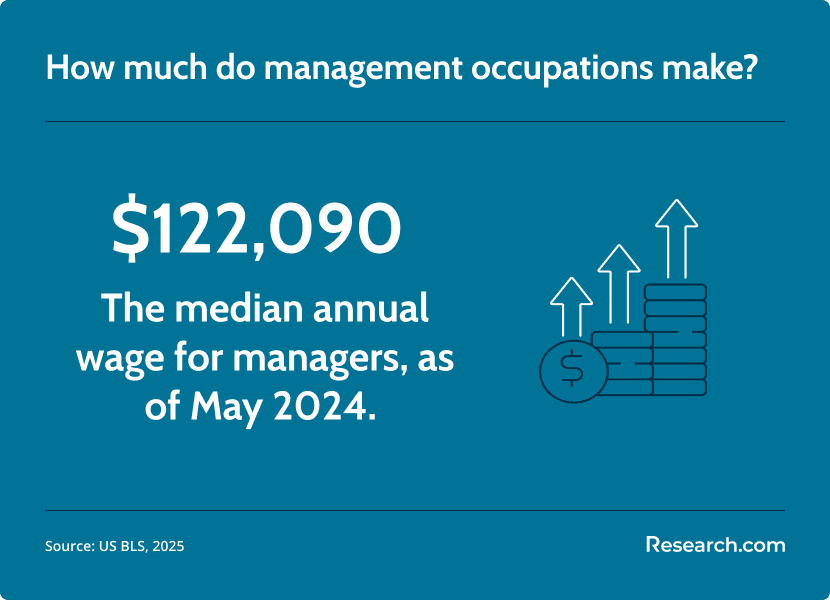
- Access to higher-paying occupational groups: According to the U.S. Bureau of Labor Statistics (BLS), management occupations had a median annual wage of $122,090 in 2024, significantly higher than the median for all occupations.
- Career mobility for experienced professionals: Many students use the degree to move from supervisory or mid-level roles into positions with more strategic planning, team leadership, culture-building, and change-management responsibility.
What can I expect from an online MS in Organizational Leadership degree?
An online MSOL is a graduate program focused on leadership practice, organizational behavior, communication, ethics, and change. Instead of training you for one narrow occupation, it builds transferable leadership skills that can be applied in many industries.
| Program feature | What it usually means for students |
| Program structure | Most programs require 30–36 credits and can often be completed in 12–24 months, depending on course load, term length, and whether the program uses accelerated sessions. |
| Course delivery | Many online MSOL programs use asynchronous coursework, though some include live seminars, scheduled cohort meetings, group presentations, or synchronous leadership simulations. |
| Core curriculum | Common topics include leadership theory, organizational culture, change management, ethical decision-making, strategic communication, research methods, and team development. |
| Applied learning | Students often complete case analyses, consulting-style projects, leadership assessments, simulations, or a final capstone tied to a real workplace problem. |
| Peer collaboration | Online discussion boards, team projects, cohort activities, and virtual networking events help students practice leadership in remote and hybrid environments. |
| Career relevance | The degree can support careers in management, HR, training, consulting, operations, nonprofit leadership, and organizational change; management analysts are projected to grow 11% from 2023 to 2033. |
Where can I work with an online MS in Organizational Leadership degree?
MSOL graduates often work in roles where the central responsibility is improving how people, teams, departments, and systems function together. The degree is most relevant when combined with professional experience, industry knowledge, and a clear leadership direction.
- Human resources: Lead hiring strategy, employee relations, talent development, workforce planning, and organizational policy implementation.
- Management analysis and consulting: Evaluate organizational processes, identify inefficiencies, recommend improvements, and help leaders implement change.
- Training and development: Assess workforce learning needs, design leadership development programs, manage training teams, and measure program outcomes.
- General and operations management: Coordinate daily business operations, manage staff and resources, create policies, and align departments with organizational goals.
- Executive leadership: Set strategic direction, build leadership teams, guide culture, and make organization-wide decisions in senior roles.
The degree is best suited for people who want to lead across functions rather than specialize only in accounting, analytics, engineering, or another technical field.
How much can I make with an online MS in Organizational Leadership degree?
Earnings vary by role, industry, location, employer size, prior experience, and level of responsibility. The MSOL itself does not determine salary, but it can help prepare graduates for management occupations with strong compensation potential. According to the BLS, as of May 2024, median annual wages for selected roles related to MSOL career paths include:
| Occupation | Median annual wage, May 2024 |
| Human Resources Manager | $140,030 |
| Training and Development Manager | $127,090 |
| Management Analyst | $101,190 |
| General and Operations Manager | $101,280 |
| Top Executive | $105,350 |
Some leadership roles may also include bonuses, incentive pay, or expanded benefits, but these vary widely by employer. When comparing an MSOL with an MBA, focus less on broad salary averages and more on the kinds of roles you want: an MSOL may be a better match for human capital, organizational development, training, culture, and change-management roles, while an MBA may be more useful for finance, consulting, entrepreneurship, or general business leadership.
- Online MS in Organizational Leadership degree programs for 2027
- How long does an online MS in Organizational Leadership degree take?
- Online vs. on-campus MS in Organizational Leadership programs
- Average cost of an online MS in Organizational Leadership degree
- Financial aid options for online MSOL students
- Admissions requirements and prerequisites
- Common MSOL courses
- Available MSOL specializations
- Challenges online MSOL programs help students address
- MSOL vs. Executive MBA
- How an MSOL complements a finance background
- How to evaluate ROI for an online MSOL
- Certifications that can strengthen a leadership career
- How to choose the best online MSOL program
- Career paths for MSOL graduates
- Job market outlook for MSOL graduates
List of Online MS in Organizational Leadership Degree Programs for 2027
How do we rank schools?
Finding the right online MSOL program requires more than scanning tuition rates or choosing the fastest option. Program length, accreditation, concentration choices, course format, student support, and total cost all affect whether a degree will fit your professional life. Research.com’s ranking process is designed to make those comparisons easier. Our methodology reviews factors such as completion timelines, tracks and concentrations, cost per credit, curriculum depth, and accreditation so readers can evaluate programs side by side.
Program data come from sources that include the Integrated Postsecondary Education Data System (IPEDS database), Peterson’s Distance Learning Licensed Data Set, the U.S. Department of Education’s College Scorecard, and the National Center for Education Statistics (NCES).
1. Hannibal-LaGrange University
Hannibal-LaGrange University provides a fully online Master of Arts in Leadership built around 36 credits and eight-week courses. The curriculum combines organizational leadership study with Christian perspectives, making it relevant for students interested in both secular leadership and faith-based service environments. Its “Your Degree, Your Time” structure allows completion in as few as nine months or up to five years, with a flat tuition model that helps students plan costs in advance. Students choose from Business Administration or Christian Studies tracks.
- Program Length: 36 credits; recommended 2-year pace, 9-month minimum, 5-year maximum
- Tracks/concentrations: Business Administration; Christian Studies
- Cost per Credit: $385 per semester credit
- Required Credits to Graduate: 36 semester credits
- Accreditation: Regional accreditation recognized by U.S. Department of Education and the Higher Learning Commission (HLC)
2. William Woods University
William Woods University offers a fully online Master of Arts in Organizational Leadership for working adults who want a compact, applied graduate program. The 30-credit curriculum is delivered through ten five-week courses, allowing motivated students to finish in as few as nine months or extend their studies up to five years. The Tuition Promise locks the tuition rate for students who remain continuously enrolled. Faculty backgrounds include Fortune 500 leadership, military strategy, and behavioral sciences, and students complete a capstone project that connects leadership theory to an organizational challenge.
- Program Length: 30 semester credits, 10 five-week courses, 9-month minimum to 5-year maximum
- Tracks/concentrations: Core curriculum only (no additional specializations)
- Cost per Credit: $550 per credit hour
- Required Credits to Graduate: 30 semester credits
- Accreditation: Regional accreditation recognized by U.S. Department of Education and HLC
3. Campbellsville University
Campbellsville University offers an online Master of Management and Leadership that blends organizational leadership concepts with a Christian servant-leadership orientation. The program requires 30 credit hours and uses eight-week sessions. Students may begin in January or July and can finish in one year by taking two courses per term or choose a two-year pace. Flat-rate tuition, interest-free payment plans, and military-friendly benefits are available for eligible students.
- Program Length: 30 credit hours; eight-week courses; one- to two-year completion window
- Tracks/concentrations: Core Master of Management and Leadership curriculum
- Cost per Credit: $529 per semester credit
- Required Credits to Graduate: 30 semester credit hours
- Accreditation: Southern Association of Colleges and Schools Commission on Colleges (SACSCOC); International Accreditation Council for Business Education (IACBE)
4. Indiana Institute of Technology
Indiana Institute of Technology offers an online Master of Science in Organizational Leadership built for students who want a research-informed and practice-focused leadership program. The 36-credit curriculum is delivered in accelerated six-week sessions and can be completed in as few as 12 months or extended up to five years. Courses cover topics such as human capital development, organizational excellence, decision analysis, change management, strategy implementation, and applied leadership. Textbooks are included in course fees, which can make budgeting more predictable.
- Program Length: 36 credit hours; six-week course terms; 12-month minimum to five-year maximum
- Tracks/concentrations: Core Organizational Leadership curriculum
- Cost per Credit: $545 per semester credit hour
- Required Credits to Graduate: 36 credit hours
- Accreditation: HLC
5. Fresno Pacific University
Fresno Pacific University offers a Master of Arts in Strategic and Organizational Leadership intended for experienced professionals who want to become ethical change leaders. The 36-unit program follows a cohort model, meeting one evening per week with blended online components. Students work with 12–22 peers on applied projects and complete a capstone that connects leadership concepts to practice. Ethical leadership is built throughout the curriculum rather than treated as a stand-alone topic.
- Program Length: 5 semesters, or approximately less than 20 months
- Tracks/concentrations: Core Strategic and Organizational Leadership curriculum
- Cost per Credit: $530 per credit hour or approximately $8,480 total
- Required Credits to Graduate: 36 semester units
- Accreditation: Regional accreditation through WASC Senior College and University Commission
6. Newberry College
Newberry College provides an online Master of Science in Organizational Development and Leadership for early and mid-career professionals. The program requires 30 credits and is delivered through ten intensive 7.5-week courses. Rolling admissions and flexible pacing allow students to complete the degree in as few as 12 months while applying leadership concepts directly to workplace challenges. The flat tuition rate includes course-related fees.
- Program Length: Ten 7.5-week courses; completion in as few as 12 months
- Tracks/concentrations: Core Organizational Development and Leadership curriculum
- Cost per Credit: $575 per credit hour (includes course-related fees)
- Required Credits to Graduate: 30 semester credit hours
- Accreditation: SACSCOC
7. Toccoa Falls College
Toccoa Falls College offers a fully online Master of Arts in Organizational Leadership grounded in a biblically informed view of leadership. The 33-credit program combines strategic leadership theory, character formation, and applied organizational problem-solving. Asynchronous coursework and rolling admissions allow students to begin in any term and move at a flexible pace. Total tuition is under $18,000, and students complete a capstone project focused on real organizational application.
- Program Length: 33 credit hours; flexible pacing with a 12-month minimum to 5-year maximum
- Tracks/concentrations: Core Organizational Leadership curriculum
- Cost per Credit: Approximately $545 per credit (total tuition under $18,000)
- Required Credits to Graduate: 33 semester credit hours
- Accreditation: SACSCOC
8. Calvary University
Calvary University offers an online Master of Science in Organization Development for pastors, ministry leaders, and professionals who want to approach organizations through a consulting and systems-design lens. The 44-credit program is biblically grounded and prepares students to lead change in faith-based and secular environments. Courses are offered in flexible modular formats, including evening and intensive options, and open enrollment allows students to start any session. The program can be completed in as few as 18 months or extended up to five years. Its 5-Year BS-MSOD pathway allows business administration undergraduates to complete both degrees in five years.
- Program Length: 44 credit hours; open enrollment; 18-month minimum to five-year maximum
- Tracks/concentrations: Core Organization Development curriculum
- Cost per Credit: $480 per credit hour or approximately $10,560 total
- Required Credits to Graduate: 44 credit hours
- Accreditation: HLC and the Commission on Accreditation of the Association of Biblical Higher Education
9. Western Kentucky University
Western Kentucky University offers a 100% online Master of Arts in Organizational Leadership with an interdisciplinary curriculum and a military- and transfer-friendly structure. The 30-credit program includes rolling admissions and multiple start dates, allowing students to finish in as little as one year or progress over several years. Approved electives may also apply toward a standalone Graduate Organizational Leadership Certificate, giving students a dual-credential option without adding credits. The program is designed for working adults and service members who want small-cohort interaction and online support.
- Program Length: 30 credit hours with flexible pacing; completion in 12–24 months depending on course load
- Tracks/concentrations: Core Organizational Leadership curriculum; elective pathway available to earn a Graduate Organizational Leadership Certificate
- Cost per Credit: Standard graduate tuition varies by residency and program; Tuition Assistance rate of $250 per credit hour for eligible military students
- Required Credits to Graduate: 30 semester credit hours
- Accreditation: SACSCOC
10. Montreat College
Montreat College offers a fully online Master of Arts in Organizational Leadership focused on practical soft skills such as conflict resolution, strategic communication, and change leadership. The program uses eight-week modules and has rolling admissions, with no GRE or GMAT requirement. Students can complete the degree in as few as 12 months or extend enrollment up to five years. Small cohorts, faculty feedback, and a faith-informed ethical leadership framework shape the student experience.
- Program Length: Eight-week sessions, two per semester; full-time students take six credit hours per semester; self-paced completion in as few as 12 months or extended up to five years
- Tracks/concentrations: Core Organizational Leadership curriculum only
- Cost per Credit: $630 per credit hour for graduate programs (2025–26 rate)
- Required Credits to Graduate: 30 credit hours
- Accreditation: SACSCOC
How long does it take to complete an online MS in Organizational Leadership degree program?
Most online MSOL programs fit the NCES definition of a master’s degree and require one to two years of full-time graduate study after a bachelor’s degree. Because these programs generally include at least 30 semester-hours, your completion time depends on course load, term structure, and whether the program offers accelerated enrollment.
| Enrollment option | Typical timeline | Best for |
| Full-time enrollment | About 12–18 months when taking 9 credits per term across 3–4 consecutive 16-week semesters | Students who can handle a heavier graduate workload while working reduced hours or with strong schedule flexibility |
| Part-time enrollment | Roughly 24–36 months when taking 6 credits per term across 5–6 semesters | Working professionals balancing school with a full-time job, caregiving, or military service |
| Accelerated format | Often 10–12 months for full-time students in 8- to 10-week terms or programs allowing prior learning or work-experience credit | Students who want the fastest path and can manage compressed deadlines |
| Capstone or thesis path | May add an extra semester depending on project scope, practicum requirements, or thesis review | Students who want a substantial applied project, research experience, or consulting-style portfolio piece |
| Year-round enrollment | Can shorten time to completion when programs offer three or four terms each year | Students who prefer continuous progress instead of long academic breaks |
Many universities set a maximum time-to-degree of five years, which can help students pause or slow down when work, family, or finances change. This flexibility is one reason online graduate programs are common among online degrees for working adults. Before enrolling, ask whether taking fewer courses affects financial aid, employer reimbursement, or cohort progression.
How does an online MS in Organizational Leadership degree program compare to an on-campus program?
Online and campus-based MSOL programs can lead to the same degree, especially when offered by the same accredited university. The more important question is whether the delivery format supports how you learn, network, and manage your time.
| Factor | Online MSOL | On-campus MSOL |
| Schedule | Often asynchronous or offered in short modules, which can make study easier around work and family obligations | Requires attendance at specific times and locations, which may be better for students who need structure |
| Interaction | Uses virtual discussions, group projects, video meetings, and online collaboration tools | Offers face-to-face networking, informal campus connections, and in-person cohort activities |
| Support services | Provides remote access to advising, digital libraries, career coaching, tutoring, and technical help | May offer easier access to in-person faculty office hours, campus events, libraries, and career fairs |
| Costs | May reduce commuting, relocation, housing, and parking expenses, though tuition may be similar | May involve campus fees, transportation, and housing costs, depending on the student’s location |
| Technology needs | Requires reliable internet, a capable computer, comfort with learning platforms, and digital collaboration skills | Relies more on campus infrastructure, though many courses still use online platforms |
| Enrollment trends | Graduate enrollment in exclusively distance education programs rose by 1.9 % to 4,982,428 in Fall 2023; in Fall 2021, 43% of graduate students were enrolled part time, many in online formats (NCES, 2024) | Remains valuable for students who want campus immersion, local networking, and in-person learning routines |
What is the average cost of an online MS in Organizational Leadership degree program?
The cost of an online MSOL depends on the university, residency rules, number of credits, fees, program length, and whether tuition is charged per credit or as a flat rate. Because many programs require about 30 semester-hours, even small per-credit differences can change the total price substantially.
- Public in-state: Even in the best 1 year masters programs, the average graduate tuition and required fees can cost $8,961 per year; completing 30 credits over two years equates to approximately $15,000–$18,000 total.
- Public out-of-state: Average of $19,327 per year; over two years totals about $35,000–$40,000.
- Private nonprofit: Published tuition and fees average $43,350 per year; a two-year program approaches $86,700.
- Per-credit online pricing: In-state public online tuition averages $341.05 per credit (approximately $10,230 for 30 credits); private online averages $516 per credit (approximately $15,480 for 30 credits).
Tuition is only part of the total cost. Students should also plan for:
- Required fees: Technology, library, student service, and activity fees may add $200–$400 per semester, depending on the institution.
- Books and materials: Textbooks, case-study subscriptions, software, and digital resources often total $500–$1,000 annually.
- Capstone or practicum expenses: Some programs charge extra for field placements, proctoring, special assessments, or final project requirements.
Before financial aid, scholarships, employer support, or transfer credit, a realistic total investment may range from about $12,000 at lower-cost public institutions to $90,000 or more at higher-priced private schools.
When comparing graduate tuition, it can be useful to benchmark against related business programs. For example, low cost MBA in project management online options can help students compare credit requirements, accreditation, and pricing models across leadership-focused graduate degrees.
The chart below shows historical tuition fee trends across multiple types of institutions.
What are the financial aid options for students enrolling in an online MS in Organizational Leadership degree program?
About 60% of graduate students receive some form of aid, including federal loans, grants, or tuition reimbursement through employers (College Board, 2023). MSOL students can combine several funding sources, but each option has different eligibility rules, repayment terms, and long-term implications.
Federal student loans
- Direct Unsubsidized Loans: Graduate students may borrow up to $20,500 per academic year; interest accrues during enrollment and grace periods.
- Direct Graduate PLUS Loans: These loans may cover remaining costs beyond unsubsidized loan limits; a credit check is required, and the fixed rate is 9.08% for loans disbursed July 2024–July 2025.
Institutional aid
- Merit scholarships and fellowships: Universities may award aid for academic achievement, leadership experience, professional accomplishments, or service background; award amounts vary by school.
- Graduate assistantships: Some programs offer stipends or tuition waivers in exchange for teaching, research, administrative, or program support work, though online students may have fewer assistantship options.
Employer tuition reimbursement
Employer reimbursement can be one of the most valuable funding options for students already working in leadership, HR, operations, or training roles. Similar to students in online MBA HR programs, MSOL students may need to remain employed, earn minimum grades, and stay with the employer for a set period after receiving support.
Private education loans
Private lenders may help cover costs not met by federal loans or institutional aid. Terms vary widely, and many borrowers need a creditworthy cosigner. Compare interest rates, fees, repayment options, and borrower protections before choosing this route.
Average aid environment
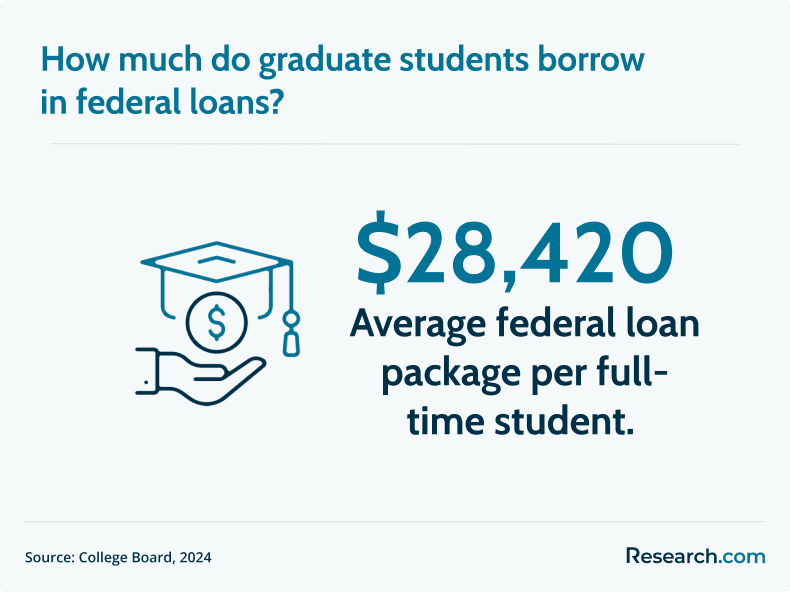
According to the latest data, 61% of graduate students borrow federal loans and among those receiving any aid, the average package totals about $28,420 per full-time equivalent student in 2023–24 (Education Data, 2025).
A sound funding plan should start with the FAFSA, then move to institutional scholarships, employer benefits, and only then additional borrowing if needed.
What are the prerequisites for enrolling in an online MS in Organizational Leadership degree program?
Admissions requirements for online MSOL programs are usually similar to campus-based programs at the same institution. Schools want evidence that applicants can handle graduate-level reading, writing, research, and applied leadership work.
| Requirement | What to expect | How to strengthen your application |
| Accredited bachelor’s degree | Most programs require a bachelor’s degree from a regionally accredited institution in any major; some prefer business, psychology, social sciences, or related fields. | Highlight leadership experience even if your undergraduate major is unrelated. |
| Transcripts and GPA | Programs commonly request official transcripts and may expect a cumulative GPA between 2.75 and 3.0 on a 4.0 scale. | If your GPA is below the preferred range, emphasize career progression, professional training, and recent academic success. |
| GRE or GMAT | Some schools require test scores, but many make them optional or waive them for applicants with strong academic or professional records. | Confirm whether a waiver is available before spending time and money on testing. |
| Professional résumé | Applicants typically submit a résumé showing work history, leadership duties, project ownership, team supervision, or organizational improvement experience. | Use measurable examples, such as teams led, programs managed, process improvements, or training initiatives. |
| Statement of purpose | A 500–1,000-word essay often asks about career goals, leadership philosophy, and fit with the program. | Connect your goals to specific curriculum features, not just a general desire to “be a better leader.” |
| Recommendations | Two to three letters may be required from supervisors, faculty, or professional mentors. | Choose recommenders who can describe your leadership judgment, communication skills, and growth potential. |
Applicants comparing MSOL programs with online MBA programs should note that MBA admissions may place more emphasis on quantitative readiness, business experience, or standardized testing, depending on the school.
Graduate admissions requirements vary across disciplines. For example, students researching the cheapest online master's in science education programs may also encounter recommendation letters, statements of purpose, and occasional GRE requirements, but the professional focus and evaluation criteria will differ.
What courses are typically in an online MS in Organizational Leadership degree program?
Many MSOL curricula align with the National Center for Education Statistics’ (NCES) Classification of Instructional Programs (CIP). Under CIP code 52.0213, “Organizational Leadership,” the field emphasizes leadership, organizational planning, communication, ethics, team dynamics, and strategic decision-making.
- Organizational planning and strategy: Covers how leaders design structures, align goals, manage resources, and guide long-term direction.
- Leadership theory and practice: Explores leadership styles, influence, motivation, power, and decision-making in organizations.
- Team building and group dynamics: Teaches methods for creating trust, collaboration, accountability, and high-performing teams.
- Conflict resolution and mediation: Focuses on diagnosing workplace conflict, negotiating solutions, and rebuilding working relationships.
- Communication for leaders: Develops skills in persuasive communication, organizational messaging, listening, feedback, and stakeholder engagement.
- Financial management fundamentals: Introduces budgeting, resource allocation, and financial reporting for non-financial managers.
- Ethical and socially responsible leadership: Examines ethical frameworks, corporate responsibility, values-based decision-making, and leadership accountability.
- Research methods and data-driven decisions: Trains students to use qualitative and quantitative methods to investigate organizational problems.
- Capstone project or practicum: Requires students to integrate program learning through an applied project, consulting assignment, or research thesis.
Electives may address coaching, digital transformation, diversity and inclusion, change management, nonprofit leadership, healthcare leadership, or public-sector leadership.
What types of specializations are available in online MS in Organizational Leadership degree programs?
Specializations allow students to connect leadership theory to a field, function, or career goal. Not every program offers concentrations, so students should check whether specialization courses are built into the degree or offered only as electives.
| Specialization | Best fit for students interested in |
| Healthcare Leadership | Leading hospitals, clinics, public health agencies, or healthcare teams; this field had over 515,000 positions nationally as of May 2023. |
| Nonprofit and Social Sector Leadership | Fundraising, mission strategy, volunteer management, board relations, and stakeholder engagement. |
| Educational Leadership | Administration, academic programs, student services, policy implementation, or institutional leadership in K-12 or higher education. |
| Global and Cross-Cultural Leadership | Managing international teams, multicultural communication, global projects, and cross-border organizational issues. |
| Organizational Development and Change Management | Diagnosing organizational problems, designing interventions, improving culture, and leading transformation. |
| Executive Coaching and Talent Management | Leadership assessment, coaching conversations, succession planning, and employee development. |
| Diversity, Equity and Inclusion | Inclusive leadership, bias reduction, equitable policies, belonging, and organizational culture change. |
| Digital Transformation and Technology Leadership | Leading virtual teams, adopting technology, using data-informed decisions, and managing technology-driven change. |
| Public Sector and Government Leadership | Public administration, civic engagement, policy implementation, interagency collaboration, and community-facing leadership. |
What challenges do online MS in Organizational Leadership programs address?
Online MSOL programs are designed for many of the same challenges leaders face at work: communicating across distance, motivating people without daily face-to-face contact, managing ambiguity, and leading change with limited time. Students also practice balancing graduate coursework with professional and personal responsibilities.
- Remote collaboration: Group projects, video meetings, and digital workspaces help students practice leading distributed teams.
- Time management: Accelerated courses require disciplined planning, especially for students working full time.
- Applied problem-solving: Case studies and simulations help students translate leadership theory into decisions.
- Professional networking: Cohorts, online events, and discussion-based coursework can create connections beyond a student’s local area.
- Digital leadership readiness: Online learning helps students strengthen the communication and technology habits needed in hybrid workplaces.
Students comparing the cost and structure of leadership-related graduate options may also look at cheap MBA programs to understand how business and leadership degrees differ in pricing, curriculum, and career focus.
How does an online MS in Organizational Leadership differ from an Executive MBA?
An online MSOL and an Executive MBA can both support leadership careers, but they are built for different purposes. The MSOL is more focused on people, culture, ethics, organizational behavior, and change. An Executive MBA is broader and typically covers advanced business management topics such as finance, operations, strategy, accounting, and executive decision-making.
| Degree | Primary focus | Best for | Possible limitation |
| Online MS in Organizational Leadership | Leadership, culture, change management, communication, ethics, and organizational development | Professionals who want to lead teams, improve workplace systems, manage change, or work in HR, training, nonprofit, public-sector, or people-focused leadership roles | May offer less depth in finance, accounting, analytics, and traditional business administration than an MBA |
| Executive MBA | Advanced business management across finance, strategy, operations, marketing, and leadership | Experienced managers and executives who want a broad business credential for senior corporate leadership | May be less specialized in organizational culture, talent development, and change leadership than an MSOL |
If you want executive business training with attention to cost, compare MSOL programs with the best affordable executive MBA programs. The better choice depends on whether your target roles require broad business administration or deeper expertise in leading people and organizational change.
How does an online MS in Organizational Leadership complement an online bachelors degree in finance?
A finance background helps professionals interpret numbers, evaluate risk, allocate resources, and support data-informed decisions. An MSOL adds the people and systems side of leadership: communication, team alignment, change management, ethics, and organizational strategy. Together, the combination can be useful for professionals who want to move from analysis into management.
For someone with an online bachelors degree in finance, an MSOL may support career movement into roles that require both financial judgment and cross-functional leadership. Examples include operations leadership, business transformation, corporate training, financial services management, or strategic planning roles where the leader must translate financial insights into team action.
What is the Return on Investment (ROI) of an online MS in Organizational Leadership degree?
ROI depends on what you pay, how long you study, how much debt you take on, whether your employer contributes, and whether the degree helps you qualify for higher-responsibility roles. Because leadership outcomes are influenced heavily by prior experience, students should evaluate ROI carefully rather than assuming the degree will automatically produce a salary increase.
| ROI factor | Questions to ask before enrolling |
| Total program cost | What is the full cost after tuition, fees, books, technology charges, and capstone expenses? |
| Debt burden | How much will you borrow, and what monthly payment would be manageable after graduation? |
| Employer support | Does your employer offer tuition reimbursement, and are there grade or service requirements? |
| Career target | Does the curriculum match the roles you want, such as HR leadership, training, operations, consulting, or nonprofit management? |
| Opportunity cost | Will you need to reduce work hours, delay other goals, or pass on professional opportunities while studying? |
| Credential value | Do employers in your target field value an MSOL, or would an MBA, certificate, or industry credential be more recognizable? |
To benchmark affordability, compare MSOL pricing with other online graduate options such as the cheapest masters in economics online. A lower-cost accredited program may offer stronger ROI than a more expensive program if both support the same career objective.
How can complementary certifications enhance my leadership career?
Certifications can make an MSOL more targeted. The degree provides the leadership foundation, while credentials can show specific capability in project management, change management, coaching, HR, agile methods, operations, or digital transformation.
| Certification area | How it can complement an MSOL |
| Project management | Supports leaders responsible for planning, executing, monitoring, and closing complex initiatives. |
| Agile or change management | Helps professionals lead iterative work, organizational transitions, and stakeholder adoption. |
| Human resources or talent development | Strengthens preparation for workforce planning, employee development, and people operations. |
| Executive coaching | Builds skills in assessment, feedback, leadership development, and one-on-one performance improvement. |
| Digital transformation | Signals readiness to lead technology-enabled change and virtual teams. |
Students who want deeper project-focused preparation may also compare certifications with a project management degree online. The best add-on credential depends on the problems you want to solve at work.
How to choose the best online MS in Organizational Leadership degree program?
The best online MSOL program is not necessarily the fastest, cheapest, or highest ranked. It is the program that fits your leadership goals, learning style, financial limits, and schedule while meeting recognized accreditation standards. Students drawn to quick online degrees should be especially careful to confirm that speed does not come at the expense of support, depth, or credibility.
Step-by-step checklist for choosing an MSOL program
- Confirm accreditation first. Make sure the institution is accredited by an agency recognized by the U.S. Department of Education. Accreditation affects financial aid eligibility, transferability, and employer acceptance.
- Match the curriculum to your career goal. If you want HR leadership, look for talent management and employee development courses. If you want consulting, prioritize organizational diagnosis, change management, research methods, and capstone consulting projects.
- Review completion and retention data. Use NCES College Navigator to examine outcomes where available. Stronger student persistence can indicate better support and program structure.
- Evaluate the faculty. Look for instructors with both academic qualifications and leadership experience in sectors relevant to your goals.
- Compare delivery formats. Check whether courses are asynchronous, synchronous, cohort-based, self-paced, accelerated, or scheduled around live meetings.
- Calculate the full cost. Include tuition, fees, books, software, travel if required, and any capstone or assessment charges.
- Ask about career support. Strong programs should offer resume help, career coaching, alumni connections, networking events, and leadership portfolio opportunities.
- Check specialization options. Concentrations in healthcare, nonprofit, digital leadership, DEI, or organizational development can make the degree more aligned with your target role.
- Review transfer and prior-learning policies. Some schools may accept graduate transfer credits or recognize relevant professional learning, which can reduce cost and time.
- Talk to an advisor and current students. Ask direct questions about workload, faculty responsiveness, group projects, graduation timelines, and career outcomes.
Leadership skills apply in many industries, including specialized fields. For example, even niche programs such as the most affordable online fashion merchandising programs may include business, management, and leadership components, which shows why students should choose an MSOL with a career context in mind.
Common mistakes to avoid when choosing an online MSOL program
- Choosing only by tuition: A low price is helpful, but weak advising, limited courses, or poor career support can reduce value.
- Ignoring accreditation: An unaccredited or poorly recognized institution can create problems for financial aid, employment, and future doctoral study.
- Assuming online means easier: Accelerated online courses can be demanding and require consistent weekly work.
- Overlooking live attendance requirements: Some “online” programs still require scheduled sessions, residencies, or synchronous presentations.
- Expecting guaranteed salary outcomes: A graduate degree can strengthen qualifications, but salary depends on experience, industry, geography, and employer demand.
- Relying only on rankings: Rankings can narrow your search, but program fit, cost, curriculum, and support should drive the final decision.
What career paths are available for graduates of online MS in Organizational Leadership degree programs?
Online MSOL graduates may move into leadership roles in private companies, nonprofits, healthcare organizations, schools, government agencies, consulting firms, and faith-based institutions. The degree is especially relevant for roles that require strategic thinking, communication, change leadership, and people management.
| Career path | Typical responsibilities | Why an MSOL can help |
| Organizational Development Consultant | Diagnose organizational problems, guide change initiatives, improve culture, and advise leaders on performance improvement. | MSOL coursework often covers change management, research methods, communication, and organizational systems. |
| Human Resources Director | Oversee talent strategy, employee engagement, workforce planning, policy, and leadership development. | The degree strengthens understanding of people systems, ethics, culture, and leadership behavior. |
| Training and Development Manager | Design learning programs, manage training teams, assess workforce development needs, and evaluate program impact. | MSOL programs often emphasize adult learning, team development, coaching, and organizational effectiveness. |
| Nonprofit Executive Director | Lead operations, fundraising, staff, volunteers, partnerships, and mission-driven strategy. | The degree can support ethical leadership, stakeholder communication, and resource coordination. |
| Corporate Strategy Manager | Coordinate cross-functional initiatives, align teams with long-term goals, and support organizational planning. | MSOL training helps leaders manage collaboration, change, and communication across departments. |
| Operations Manager or Director | Improve processes, manage staff, coordinate resources, and ensure business units meet performance goals. | The degree can add leadership and change-management skills to operational experience. |
| Chief of Staff or Chief People Officer | Support executive decision-making, internal communication, culture, people strategy, and organizational priorities. | MSOL study aligns with strategic communication, organizational design, and values-based leadership. |
| Higher Education Administrator | Manage academic programs, student services, institutional initiatives, or leadership development efforts. | The degree supports planning, communication, team leadership, and organizational improvement. |
Graduates who combine leadership training with technical skills may have additional options. For instance, students who complete the cheapest data analytics degree online can pair analytics with leadership to support data-informed management and cross-functional decision-making.
What is the job market for graduates with an online MS in Organizational Leadership degree?
The job market for MSOL graduates is strongest for professionals who already have work experience and want to move into broader management, HR, training, consulting, or organizational change responsibilities. The degree can also serve as a stepping stone toward advanced study, including an online doctorate in organizational leadership, for students interested in research, teaching, consulting, or senior-level leadership development.
According to the U.S. Bureau of Labor Statistics (BLS), employment in management occupations is projected to grow 5% from 2022 to 2032 — faster than the average for all occupations (BLS, 2025). This will add about 1.1 million new jobs over the decade. Key roles aligned with MSOL competencies such as training and development managers, human resources managers, and administrative services managers, are all projected to grow between 5% and 7% during that period.
Several workplace trends support continued interest in organizational leadership: hybrid work requires stronger communication systems, AI and automation are changing job design, employers are emphasizing change readiness, and organizations need leaders who can build resilient cultures. These trends do not guarantee individual job outcomes, but they do increase the importance of leaders who can guide people through complexity.
The chart below illustrates the projected growth rates for top executive and management positions, typical occupations for MSOL degree holders.
What graduates say about online MS in Organizational Leadership programs
Student experiences vary by program, employer, and career stage. The examples below should be read as individual outcomes rather than guaranteed results.
- "The online format made it possible to keep my full-time job and family schedule while completing 36 credits in 18 months. The case studies and virtual team assignments helped me prepare for a major department restructuring." – Taylor
- "After finishing the MSOL, I moved from a mid-level supervisor role into a director position within a year. The program helped me speak more confidently in strategic conversations and lead larger teams." – Warren
- "I had felt stalled professionally for years. The MSOL helped me rethink my leadership approach, and the online format made graduate school realistic. Within six months of graduating, I accepted a new role with a 20% pay increase." – Antonio
Key Insights
- An online MS in Organizational Leadership is best for professionals who want to lead people, guide change, improve culture, and manage organizational systems rather than focus primarily on finance, accounting, or technical specialization.
- Some online MSOL programs can be completed in as little as 1 year when taking 2 courses per term, but accelerated formats require strong time management and consistent weekly availability.
- In the Fall term of 2023, graduate enrollment in online programs rose by 1.9 % to 4,982,428, showing continued acceptance of distance graduate education.
- The average graduate tuition and required fees for public in-state institutions for MSOL degrees is $8,961 per year, as of 2024, while published tuition and fees for private non-profit institutions offering MSOL programs average $43,350 per year, approaching $86,700 for a two-year program.
- In 2023–24, the average federal aid package is about $28,420 per full-time equivalent student, but students should minimize borrowing where possible through scholarships, employer reimbursement, and careful program selection.
- Management occupations are projected to grow 5% from 2022 to 2032, translating to about 1.1 million new jobs over the decade. This is faster than the average for all occupations.
- The strongest MSOL choice is an accredited program with a curriculum tied to your target role, transparent total costs, useful student support, and a format you can realistically complete.
References:
- Hanson, Melanie. “Student Loan Debt Statistics” (March 16, 2025). EducationData.org. https://educationdata.org/student-loan-debt-statistics
- Introduction to the Classification of Instructional Programs: 2010 Edition (CIP-2010). (2010). IPEDS. https://nces.ed.gov/ipeds/cipcode/files/introduction_cip2010.pdf
- Ma, J., et.al. (2023). Trends in College Pricing and Student Aid 2023. College Board. https://research.collegeboard.org/media/pdf/Trends%20Report%202023%20Updated.pdf
- Management Analysts. (2025, April 18). Bureau of Labor Statistics. https://www.bls.gov/ooh/business-and-financial/management-analysts.htm
- Management occupations. (2025, April 18). Bureau of Labor Statistics. https://www.bls.gov/ooh/management/
- Top executives. (2025, April 18). Bureau of Labor Statistics. https://www.bls.gov/ooh/management/top-executives.htm
- Trends in Student Aid Highlights - College Board research. (2024). https://research.collegeboard.org/trends/student-aid/highlights
Other Things You Should Know About Online MS in Organizational Leadership Degree Programs
In 2027, tuition rates significantly impact the affordability of online MS in Organizational Leadership programs. Institutions offering competitive tuition and robust financial aid packages, including scholarships and grants, enhance accessibility. Prospective students should compare these factors to determine the most cost-effective options.
Graduates of affordable online MS in Organizational Leadership programs in 2027 can expect roles such as project manager, human resources director, or organizational consultant. On average, salaries for these positions range from $70,000 to $120,000 annually, depending on experience and location.
Many affordable online MS in Organizational Leadership programs accept up to 9 to 12 transfer credits from regionally accredited graduate coursework. Schools usually require a minimum 3.0 GPA, and some limit transfer credit to courses completed within the past five to seven years.


