2027 Best Computer Science Certifications

Co-Founder and Chief Data Scientist
Choosing a computer science certification is not just a question of which credential looks strongest on a resume. The better question is which certification matches your current skill level, target role, budget, and timeline. Certifications can help entry-level learners prove job-ready IT skills, help working professionals move into cloud, cybersecurity, networking, data, or software roles, and help experienced technologists document expertise in highly specialized systems.
According to a 2024 survey by Global Knowledge, 80% of IT professionals who earned certifications reported an increase in their salary, with an average pay raise of 8%. That does not mean every certification guarantees a raise, but it does show why credentials remain an important part of professional development in technology. This guide explains what computer science certifications can do, which credentials are commonly recognized, how much they cost, how long they may take, and how to decide whether certification, a degree, or another learning path is the better investment.
Quick answer: Are computer science certifications worth it?
Computer science certifications can be worth it when they are aligned with a specific job goal, recognized by employers in your target field, and affordable relative to the role you want. They are especially useful for careers in cybersecurity, cloud computing, networking, IT support, digital forensics, and data-related roles. A certification is not a substitute for experience in every situation, but it can validate focused skills, strengthen a resume, and help candidates qualify for interviews.
What are the benefits of getting a computer science certification?
- A computer science certification can prepare learners for roles in cybersecurity, data science, cloud computing, network administration, software support, and related technology fields.
- Based on the salary information cited in this guide, having a computer science certification can be associated with earning $83,109 per year, although actual pay depends on role, experience, employer, location, and specialization.
- Online computer science certifications can be flexible for working adults, career changers, and students who need self-paced or part-time study instead of a full-time degree program.
- Certifications can help employers quickly understand which tools, platforms, or technical domains you have studied, such as AWS, Azure, Cisco networking, or CompTIA security fundamentals.
What can I expect from a computer science certification?
A computer science certification usually focuses on a defined technical skill set rather than the broad academic foundation of a degree. Depending on the credential, you may study networking, cybersecurity, cloud architecture, programming, data systems, digital forensics, or IT troubleshooting. Most certification paths end with an exam, and some advanced credentials include a hands-on lab or performance-based assessment.
For example, CompTIA Security+ is designed around baseline security skills, while Cisco Certified Network Associate (CCNA) and higher-level Cisco credentials focus on network design, implementation, or security. A strong certification path should help you build practical knowledge, prepare for role-specific tasks, and communicate your capabilities to hiring managers.
| What to expect | Why it matters |
| Focused technical curriculum | You study the specific tools, systems, and concepts tied to a job function. |
| Exam-based validation | Passing the exam gives employers a third-party signal of your knowledge. |
| Hands-on practice for many technical paths | Labs and practice environments help you move beyond memorization. |
| Renewal or continuing education for some credentials | You may need to keep learning to maintain the certification over time. |
Where can I work with a computer science certification?
Computer science certifications can support employment in technology companies, software publishers, higher education, government agencies, healthcare organizations, financial institutions, startups, and computer systems design firms. Common roles include Junior Test Engineer, Help Desk Agent, Software Engineer, IT support specialist, network administrator, cybersecurity analyst, and cloud support associate.
The right workplace depends on the certification. A CompTIA A+ credential may fit entry-level support and help desk roles, while an AWS professional certification is more relevant to cloud architecture and infrastructure positions. Cybersecurity certifications may be useful in government, finance, healthcare, consulting, and managed security services.
How much can I make with a computer science certification?
Salary outcomes vary widely because a certification is only one factor in compensation. Employers also consider work experience, job title, industry, technical portfolio, location, degree level, and the difficulty of the credential. In general, a computer science certification can support entry-level roles with salaries ranging from approximately $51,000 to $103,000 per year for roles like software developers. The average annual salary for someone with a computer science certificate is about $83,109.
Use these figures as a planning reference, not a guarantee. A new IT support professional with one foundational certification will usually have a different earning profile than an experienced cloud architect or cybersecurity engineer with advanced credentials.
- Best computer science certifications for 2027
- How long does it take to complete a computer science certification?
- Computer science certification vs. on-campus program
- Average cost of a computer science certification
- Financial aid options for computer science certification students
- Common prerequisites for computer science certifications
- Typical courses and topics in computer science certifications
- Computer science certification specializations
- How an advanced degree can complement a certification
- Game development certifications and computer science careers
- Interdisciplinary opportunities for computer science certification holders
- Additional education options for career growth
- How to keep computer science skills current
- How to choose the best computer science certification
- Long-term ROI of computer science certifications
- Certification renewal and maintenance
- Career paths after a computer science certification
- Job market for graduates with a computer science certification
- Interdisciplinary career growth with computer science certifications
Best computer science certifications for 2027
The best computer science certification depends on the job you want. For entry-level IT support, a foundational credential such as CompTIA A+ may make sense. For cybersecurity, Security+, CEH, CHFI, or Cisco security credentials may be more relevant. For cloud architecture, AWS and Azure certifications can help demonstrate platform-specific knowledge. For networking and data center roles, Cisco expert-level credentials can carry weight with employers that use complex Cisco environments.
Before choosing a credential, compare four factors: employer recognition, role alignment, cost, and prerequisites. A difficult expert certification may be valuable, but it is usually not the right first step for someone without relevant experience.
How should readers use this certification list?
This list is designed as a decision tool, not a universal ranking. Credentials differ by level, vendor, difficulty, cost, and purpose. To evaluate education providers and school-based certificate programs, useful data sources include the Integrated Postsecondary Education Data System, Peterson’s database, College Scorecard, and the National Center for Education Statistics.
- Integrated Postsecondary Education Data System, also known as the IPEDS database
- Peterson’s database, including Distance Learning Licensed Data Services
- College Scorecard database
- National Center for Education Statistics
| Certification | Best fit | Estimated cost | Experience level |
| Cisco Certified Design Expert (CCDE) | Network design architects | $450 written exam; $1,600-$1,900 lab exam | Advanced to expert |
| CCIE Data Center | Data center infrastructure professionals | $450 written exam; $1,600-$1,900 lab exam | Advanced to expert |
| CCIE Security | Cybersecurity and network security experts | $400 core exam and $1,600 hands-on lab exam | Advanced to expert |
| CompTIA A+ | Entry-level IT support and troubleshooting | $253 per exam | Beginner |
| CompTIA Security+ | Core cybersecurity roles | $404 | Beginner to intermediate |
| CompTIA Network+ | Networking support and administration | $369 | Beginner to intermediate |
| Certified Ethical Hacker (CEH) | Offensive security and ethical hacking | $950-$1,199 | Intermediate |
| Computer Hacking Forensic Investigator (CHFI) | Digital forensics investigations | $650 | Intermediate |
| Microsoft Certified: Azure Data Fundamentals | Foundational Azure data concepts | $99 | Beginner |
| AWS Certified Solutions Architect - Professional | Advanced AWS cloud architecture | $300 | Advanced |
1. Cisco Certified Design Expert (CCDE) Certification
The Cisco Certified Design Expert (CCDE) certification is built for professionals who design complex enterprise networks and make architecture decisions based on business requirements. Unlike credentials that emphasize device configuration, CCDE focuses on design strategy, trade-offs, infrastructure planning, security considerations, and network architecture. Candidates should expect a demanding preparation process that tests judgment as much as technical recall.
- Estimated Cost: $450 (CCDE written exam), $1,600-$1,900 (lab exam)
- Prerequisites: Recommended 5-7 years of experience designing and architecting network solutions and related work
2. CCIE Data Center Certification
The CCIE Data Center certification verifies expert-level ability to plan, design, deploy, operate, and troubleshoot sophisticated data center environments. It is most appropriate for experienced professionals working with modern infrastructure, automation, orchestration, cloud integration, performance, scalability, and high availability.
- Estimated Cost: $450 (CCDE written exam), $1,600-$1,900 (lab exam)
- Prerequisites: 5-7 years of experience with data center solutions and technologies recommended
3. Cisco Certified Internetwork Expert (CCIE) Security Certification
The Cisco Certified Internetwork Expert (CCIE) Security certification is an expert Cisco credential for professionals who design, deploy, operate, and optimize advanced security solutions. The certification covers areas such as network security, cloud security, content security, endpoint protection, secure access, and practical implementation of security principles in complex environments.
- Estimated Cost: $400 (core exam) and $1,600 (hands-on lab exam)
- Prerequisites: 5-7 years of professional cybersecurity experience recommended; no formal prerequisites required
4. CompTIA A+
The CompTIA A+ certification is a common starting point for people entering IT support. It covers hardware, software, operating systems, networking basics, troubleshooting, mobile devices, and basic security practices. The exams are designed to show that candidates can identify issues, support users, work with devices, and solve common technical problems.
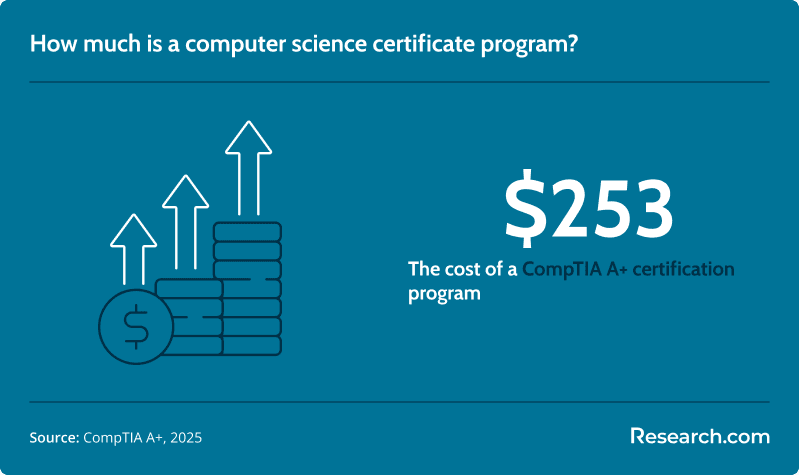
- Estimated Cost: $253 per exam
- Prerequisites: None; 9-12 months of experience recommended
5. CompTIA Security+
The CompTIA Security+ certification measures baseline skills for core cybersecurity work. Students prepare for topics such as threats, attacks, vulnerabilities, secure architecture, cloud security, identity and access management, and risk-based security recommendations. It is often used as an early cybersecurity credential for professionals moving beyond general IT support.
- Cost: $404
- Prerequisites: Two years of experience in IT administration with a security focus and experience with CompTIA Network+
6. CompTIA Network+
The CompTIA Network+ certification focuses on the technical foundations of networking. Candidates study the OSI model, network devices, cloud concepts, connectivity options, routing, switching, wireless systems, network operations, security concepts, and troubleshooting methods. It can be a useful bridge between entry-level support work and more specialized network administration roles.
- Cost: $369
- Prerequisites: Must hold the CompTIA A+ Certification and 9-12 months of networking experience
7. Certified Ethical Hacker (CEH)
The Certified Ethical Hacker (CEH) certification from EC-Council focuses on lawful offensive security techniques. Candidates study how attackers identify weaknesses and how security professionals can use similar knowledge to assess systems responsibly. Preparation commonly includes hacking concepts, tools, command-line work, network protocols, security testing methods, and ethical boundaries.
- Cost: $950-$1,199
- Prerequisites: At least two years of professional experience in information security, complete an official EC-Council training or hold a CEH certification of version 1-7
8. Computer Hacking Forensic Investigator (CHFI)
The Computer Hacking Forensic Investigator (CHFI) certification from EC-Council is aimed at professionals interested in digital evidence, cybercrime investigation, and forensic analysis. Students learn about evidence acquisition, preservation, analysis, reporting, file system forensics, operating system forensics, network forensics, database forensics, malware forensics, and mobile device forensics.
- Cost: $650
- Prerequisites: Possess at least two years of professional experience in information security and education in digital security or complete an official EC-Council training
9. Microsoft Certified: Azure Data Fundamentals
The Microsoft Certified: Azure Data Fundamentals credential validates introductory knowledge of data concepts and Microsoft Azure data services. Candidates review relational and nonrelational data, analytics, visualization, Azure Cosmos DB, Azure SQL Database, Azure Synapse Analytics, and Azure Data Lake Storage.
- Cost: $99
- Prerequisites: Azure fundamentals training and certification (for anyone new to Azure) and familiarity with relational and nonrelational data and data workloads
10. AWS Certified Solutions Architect - Professional
The AWS Certified Solutions Architect - Professional certification is intended for experienced cloud professionals who design, deploy, and operate scalable, secure, and highly available applications on AWS. Preparation typically includes advanced AWS services, architecture patterns, business-to-technical translation, documentation review, hands-on labs, and practice with AWS environments.
- Cost: $300
- Prerequisites: Minimum of two years of AWS Cloud experience recommended
How long does it take to complete a computer science certification?
The timeline depends on the certification level, study format, and your existing technical background. Some skill-focused programs in web development or programming can be completed in under a year through boot camps or certificate tracks. Noble Desktop’s Full Stack Web Development Certificate, for example, can be completed in 14 to 17 weeks full-time or seven to ten months part-time. Some graduate certificates in computer science may take between one to two years to complete and require an average weekly commitment of 15-20 hours for lecture and homework assignments.
Some unrelated certificate formats, such as the shortest online pmhnp certificate programs, show how program length can vary by field, course load, and part-time enrollment. For computer science, your timeline is usually shorter if you already have experience with the subject and longer if you need to build prerequisites first.
| Certification path | Typical learner | Planning consideration |
| Entry-level IT certification | Career starter or help desk candidate | May require less background but still benefits from hands-on practice. |
| Boot camp or applied certificate | Career changer building a portfolio | Often intensive and project-based. |
| Graduate computer science certificate | Degree holder seeking advanced study | May take between one to two years and require steady weekly study time. |
| Expert vendor certification | Experienced IT or engineering professional | Preparation can be lengthy because exams may test complex real-world judgment. |
How does a computer science certification compare to an on-campus program?
A computer science certification is usually narrower, faster, and more job-skill-focused than an on-campus degree or academic certificate program. An on-campus program may offer broader theory, faculty interaction, structured schedules, labs, peer networking, and access to campus resources. A certification, especially a vendor credential, is more likely to focus on a platform, tool, or job function.
| Option | Best for | Trade-offs |
| Online certification | Working adults, self-directed learners, and professionals targeting a specific skill | Flexible and focused, but may require strong self-discipline and may not replace a degree for some employers. |
| On-campus program | Students who want structured instruction, in-person support, and broader academic development | Can provide deeper learning and networking, but may be less flexible and more time-intensive. |
| Degree plus certification | Learners who want both broad credentials and specialized proof of skills | Potentially stronger long-term profile, but requires more time and money. |
If your goal is a single technical skill, a certification may be enough. If your goal is long-term advancement in software engineering, research, systems architecture, or leadership, pairing certifications with a degree may provide a stronger foundation.
What is the average cost of a computer science certification?
The cost of a computer science certification can range from a relatively low exam fee to several thousand dollars when training, labs, materials, and retakes are included. Entry-level certifications, such as CompTIA IT Fundamentals or Microsoft Azure Fundamentals, typically cost between $99 and $150 per exam. Mid-level certifications like CompTIA A+ or Network+ can range from $232 to $348 per exam. More advanced certifications, such as Cisco CCNP or AWS Professional certifications, can cost around $700 to $1,600 per exam. Expert-level certifications, such as Cisco CCIE, are significantly more expensive, often costing upwards of $2,300.
Do not evaluate cost by exam fee alone. Study guides, official training, practice tests, online labs, exam retakes, and travel can increase the total price. Some certifications require more than one exam. For example, the CompTIA Trifecta, which includes A+, Network+, and Security+, can cost approximately $1,000.
What are the financial aid options for students enrolling in a computer science certification?
Financial aid for computer science certifications depends on whether the program is offered through an accredited college, a boot camp, an employer, or a vendor. Some school-based certificate programs may qualify for federal aid, while standalone vendor exams often do not. Similar to learners comparing options such as the cheapest paralegal certificate online, computer science students should look beyond tuition and examine total cost, eligibility, and repayment obligations.
- Scholarships: Computer science students may find awards such as the AFCEA STEM Majors Scholarships ($2,500-$5,000) and institutional scholarships such as Florida State University's NSF S-STEM Scholarship (up to $10,000 per year).
- Federal Grants: Pell Grants and Federal Supplemental Educational Opportunity Grants may be available to eligible students in qualifying programs and do not require repayment.
- Federal Student Loans: Students who complete FAFSA may qualify for subsidized or unsubsidized loans, including options with deferred payment or income-based repayment plans.
- Employer Assistance: Many IT employers reimburse employees for certifications that are directly connected to their jobs, particularly credentials in security, cloud, networking, and systems administration.
Financial aid improves ROI only when the credential supports a realistic career move. For example, a professional researching a systems analyst salary should compare the cost of training with the skills employers request for systems analysis roles.
What are the prerequisites for enrolling in a computer science certification?
Prerequisites vary by certification. Some beginner credentials require no formal background, while advanced credentials may expect several years of professional experience. Graduate-level computer science certificates may have academic requirements that are very different from vendor exams.
- Bachelor’s Degree: Many graduate-level computer science certifications require a BS degree in computer science, engineering, or sciences from an accredited institution with a minimum GPA of 3.0. Some programs consider applicants from other fields if they have completed additional coursework or credentials, such as a Computer Programming Certificate.
- Programming Knowledge: Many technical programs expect familiarity with object-oriented programming languages such as Java, Python, or C++, along with data structures and algorithms.
- Work Experience: Some credentials, including CISSP or CompTIA Cloud+, require several years of relevant experience in IT, cybersecurity, networking, or cloud-related work.
What courses are typically in a computer science certification?
Course content depends on whether the certification focuses on programming, networking, cybersecurity, cloud platforms, web development, or data. However, many computer science certificates include one or more of the following topic areas:
- Programming Fundamentals: Introductory work in Python, Java, C++, or similar languages, including variables, data types, control flow, functions, and basic debugging.
- Data Structures and Algorithms: Study of arrays, linked lists, trees, sorting methods, search strategies, and efficient ways to organize and process data.
- Cloud Computing: Training in cloud architecture, virtualization, cloud services, deployment models, and platform-specific tools from providers such as AWS or Azure.
- Web Development: Front-end and back-end development topics such as HTML, CSS, JavaScript, server-side programming, databases, and application deployment.
What types of specializations are available in a computer science certification?
Computer science certifications allow learners to specialize without necessarily committing to a full degree. Students comparing a certification with an online computer science degree should consider whether they need a narrow credential, a broad academic program, or both.
- Network Security: Focuses on firewalls, intrusion detection and prevention, access control, and secure network protocols.
- Digital Forensics: Covers cybercrime investigation, evidence handling, data recovery, and forensic reporting.
- Cloud Architecture: Prepares learners to design, deploy, and maintain cloud-based infrastructure and applications.
- Data Engineering: Centers on data pipelines, storage systems, infrastructure, and large-scale data workflows.
- Web Development: Includes front-end technologies such as HTML, CSS, and JavaScript and back-end tools such as Python, Java, or Node.js.
- Systems Administration: Emphasizes server management, operating systems, user access, maintenance, and system reliability.
How can an advanced degree complement my computer science certification?
A certification can prove a specific technical skill, while an advanced degree can build deeper theory, research ability, and broader problem-solving capacity. Combining certification with an online master computer science program may benefit professionals who want both applied skills and graduate-level knowledge in algorithms, systems, software engineering, artificial intelligence, or advanced computing topics.
This combination is most useful when your target roles require both strategic thinking and technical fluency, such as senior software engineer, systems architect, data science lead, cybersecurity manager, or technical product leader.
Can game development certifications enhance my computer science career?
Game development can expand a computer science career by blending software engineering, graphics, simulation, user experience, physics, and interactive design. A professional interested in creative technology may use game development credentials to build a portfolio that demonstrates programming ability in a visible and project-based way. Learners comparing pathways can review gaming schools online to understand how game-focused curricula differ from general computer science programs.
Can computer science certifications unlock opportunities in interdisciplinary domains?
Computer science certifications can be useful outside traditional technology departments because nearly every industry relies on data, security, automation, and software systems. Health informatics is one example. Professionals who combine technical certification with healthcare knowledge may help improve data workflows, support analytics, and connect clinical teams with technology teams. To explore that direction, review Research.com’s guide to careers in health informatics.
What additional educational opportunities can elevate your computer science career?
After earning a certification, many professionals continue into more specialized education. Postgraduate study can deepen technical expertise and prepare learners for leadership or research-oriented work in cybersecurity, data analytics, artificial intelligence, or advanced software systems. For example, affordable online master's programs in artificial intelligence may appeal to professionals who want to move from general programming or IT into AI-focused roles.
How do you keep your computer science skills current?
Technology credentials lose value if the skills behind them become outdated. Professionals should monitor certification updates, practice in current tools, attend technical webinars, complete workshops, review vendor documentation, and build new projects. Those who want deeper data expertise can also compare options such as the cheapest online data science master's programs as part of a longer-term learning plan.
How to choose the best computer science certification?
The best certification is the one that connects your current experience to your next realistic role. This same decision logic applies across many professional education choices, whether someone is comparing cloud credentials, cybersecurity programs, or a construction management online degree.
- Start with the job title. Decide whether you want IT support, cybersecurity, networking, cloud architecture, data analysis, software development, or another role.
- Check job postings. Look for certifications repeatedly mentioned by employers. For software roles, review expectations for software development work and the skills tied to those positions.
- Match the credential to your level. Do not start with an expert-level certification if you lack the required background.
- Calculate full cost. Include exam fees, training, practice exams, lab access, travel, renewal, and retake costs.
- Verify recognition. Prioritize credentials from reputable organizations such as CompTIA, (ISC)², EC-Council, Microsoft, AWS, Google Cloud, and Cisco when they match your goal.
- Plan beyond the exam. Build projects, labs, or work experience so the certification is supported by evidence of skill.
| If your goal is... | Consider certifications in... | Avoid this mistake |
| First IT job | IT support, networking fundamentals, troubleshooting | Choosing an advanced credential before building basic experience. |
| Cybersecurity role | Security fundamentals, ethical hacking, digital forensics, network security | Assuming a security certification alone replaces hands-on practice. |
| Cloud role | AWS, Azure, architecture, cloud data, cloud operations | Studying only theory without using the platform directly. |
| Software or data role | Programming, data structures, data platforms, analytics, cloud data services | Ignoring portfolio projects and coding practice. |
How do computer science certifications contribute to long-term ROI?
Certifications can improve long-term ROI when they help you qualify for higher-value work, keep your skills current, or move into a growing specialty. The return is strongest when the credential supports a career path you can sustain through experience, projects, and ongoing learning. Professionals in adjacent fields may also use technical credentials to expand into specialized roles, similar to how people exploring masters in biotechnology jobs may combine domain expertise with data, automation, or computational skills.
Do computer science certifications require ongoing maintenance or renewal?
Many computer science and IT certifications require renewal to show that the credential holder remains current. Maintenance may involve continuing education credits, updated exams, professional development, refresher courses, or recertification. This is especially important in cybersecurity and cloud computing, where tools and threats change quickly. Professionals focused on security may also compare additional education options such as the cheapest online master's in cyber security to support both expertise and long-term credential value.
Common mistakes to avoid when choosing a computer science certification
- Choosing by popularity instead of job fit: A famous certification is not useful if it does not match the role you want.
- Ignoring prerequisites: Advanced exams may assume years of experience, even when there are no formal requirements.
- Looking only at exam fees: Training, labs, retakes, study materials, and renewal can change the real cost.
- Assuming online means easier: Online certification study can be flexible, but it still requires discipline and hands-on practice.
- Relying only on the credential: Employers often want proof that you can apply the skill through projects, work samples, labs, or experience.
- Skipping accreditation checks for school-based programs: If you enroll in a college certificate, confirm institutional accreditation and transfer policies before paying.
What career paths are available for graduates of a computer science certification?
Computer science certifications can lead to different career paths depending on the credential and the learner’s prior background. A person with a support-focused certification may pursue help desk or IT technician roles, while someone with cloud, security, or data credentials may aim for more specialized positions. Career flexibility varies by field; for comparison, learners sometimes ask broad career questions such as what can you do with an MFA in creative writing, but technology certifications tend to be most useful when tied to specific technical job functions.
- Security Analyst: Watches for security incidents, reviews risks, investigates alerts, and helps implement protections.
- Data Analyst: Organizes, cleans, processes, and interprets data to support business decisions.
- AI Specialist: Works on intelligent systems that may involve speech recognition, decision support, automation, or related AI tasks.
- Network Engineer: Designs, supports, and maintains computer networks that allow organizations to communicate and operate reliably.
Certifications such as AWS Certified Solutions Architect, CISSP, or Google Data Engineer can support employability in specialized areas such as cloud computing, cybersecurity, and data science. Professionals in finance may also pair data, cybersecurity, or AI certifications with business training. Just as students research what are the highest paying finance degree jobs, finance professionals can use technical credentials to strengthen their value in analytics-heavy and technology-driven finance roles.
What is the job market for graduates with a computer science certification?
The job market for people with computer science certifications or an accelerated computer science degree remains shaped by demand for cloud computing, cybersecurity, artificial intelligence, big data, software development, and IT infrastructure. According to the U.S. Bureau of Labor Statistics, computer science and IT occupations are projected to grow by 26% between 2023 and 2033, significantly faster than the average for all occupations.
Certifications can help candidates compete for roles, especially when paired with experience, projects, internships, or a degree. Common opportunities include software developer, information security analyst, data scientist, network administrator, support specialist, cloud specialist, ethical hacker, and machine learning engineer. Entry-level credentials such as CompTIA certifications may help with early IT roles, while advanced credentials are more often connected to specialized or senior responsibilities.
Technical skills can also strengthen careers outside traditional IT teams. For example, graduates from the best sales degree programs may use computer science certifications to stand out in technology sales, customer success, sales engineering, CRM analytics, or data-driven sales operations.
Can computer science certifications drive interdisciplinary career growth?
Yes. Computer science certifications can support career growth in healthcare, finance, education, public service, manufacturing, media, and other fields where digital systems are central to operations. A healthcare professional, for example, may combine informatics, data, and systems knowledge with clinical experience. Learners interested in that direction can compare options such as the cheapest online nursing informatics degree programs to see how domain-specific education can complement technical credentials.
How to evaluate whether a certification is the right next step
- Ask employers first: Review job descriptions and talk to professionals in your target role before enrolling.
- Check skill gaps honestly: If you lack foundational knowledge, start with a beginner credential or prerequisite coursework.
- Compare certification with degree options: A credential may be enough for a specific platform skill, while a degree may be better for broad advancement.
- Estimate payback: Compare total cost with likely job opportunities, not just advertised salaries.
- Look for hands-on learning: Prioritize programs that include labs, projects, simulations, or portfolio-ready work.
- Plan renewal: If the certification expires, include continuing education time and cost in your decision.
Key Insights
- Computer science certifications are most valuable when they are selected for a specific role, such as cybersecurity analyst, cloud architect, network engineer, IT support specialist, or data professional.
- Some graduate certificates in computer science may take between one to two years to complete, while shorter boot camp-style programs can take weeks or months depending on format and intensity.
- Programming knowledge in Java, Python, or C++ is often important for technical computer science certificates, especially those involving software development, algorithms, or data structures.
- Cost varies widely. Entry-level exams may cost far less than expert credentials, while certifications such as Cisco CCIE can cost upwards of $2,300 once exam components are included.
- Financial aid, scholarships, grants, loans, and employer reimbursement can reduce out-of-pocket cost, but eligibility depends on the type of program and provider.
- Computer science and IT occupations are projected to grow by 26% between 2023 and 2033, but certifications do not guarantee employment or salary increases without relevant skills and experience.
- The strongest certification strategy combines exam preparation with hands-on practice, portfolio projects, professional experience, and ongoing learning.
References:
- Bureau of Labor and Statistics. (2023). Occupational Outlook Handbook: Computer and Information Research Scientists. Computer and Information Research Scientists: Occupational Outlook Handbook: U.S. Bureau of Labor Statistics
- CompTIA (2020, November). IT INDUSTRY OUTLOOK 2022. CompTIA IT industry trends analysis
- Data USA (N.D.). Computer Engineering. DataUSA computer engineering profile
- PayScale (N.D.). Average Computer Scientist Salary. PayScale computer scientist salary data
- Salary.com (N.D.). Computer Engineer Salary in the United States. Salary.com computer engineer salary data
Other Things You Should Know About Computer Science Certifications
Yes, certifications often require regular renewals or updates to remain valid. For example, certifications like CompTIA A+ often need renewal every three years to ensure the holder is up-to-date with current industry standards and technologies.
Yes. Many widely recognized computer science certifications expire after three years and require renewal through continuing education, retesting, or both. For example, CompTIA Security+ is valid for three years, and AWS certifications are also typically renewed on a three-year cycle.
Prerequisites vary by certification but often include a bachelor's degree in a related field or relevant work experience. Some certifications require prior coursework in programming or network fundamentals. Check specific program details for more tailored requirements in 2027.