
2027 Best Online Associate in Information Technology Programs

Co-Founder and Chief Data Scientist
An online associate degree in information technology is often the first college credential students consider when they want to enter tech without committing immediately to a four-year degree. It can be a practical route for career changers, recent high school graduates, working adults, military learners, and people who want structured training in networking, cybersecurity, programming, databases, and technical support.
The decision is not simply whether “IT is a good field.” You need to know whether a two-year online credential can help you qualify for real entry-level roles, whether the cost is reasonable, how employers view online degrees, and whether the credits can transfer into a bachelor’s program later. This guide explains what online associate in information technology programs include, how long they take, what they cost, which careers they may support, and how to compare programs before enrolling.
Quick answer: Is an online associate in information technology worth considering?
Yes, an online associate in information technology can be worth considering if you want an affordable, flexible path into entry-level IT work or a transfer-friendly starting point for a bachelor’s degree. The strongest programs combine accredited coursework, hands-on labs, career support, and preparation for industry certifications. However, the degree alone may not be enough for every role; many students improve their job prospects by adding certifications, internships, projects, or a later bachelor’s degree.
| Question | Short answer |
| Typical length | Usually 2 years for full-time students, though transfer credits and accelerated formats can shorten the timeline. |
| Common credits required | Many programs require 60 credits. |
| Common career targets | Help desk technician, network technician, IT support specialist, junior web developer, database support, cybersecurity support, and systems support roles. |
| Online format advantage | Flexibility for students balancing work, family, military service, or other obligations. |
| Main caution | Check accreditation, transfer policies, hands-on lab access, certification alignment, and total cost before enrolling. |
What are the benefits of getting an online associate in information technology?
- An online Associate in Information Technology can prepare students for several entry-level technology roles, including help desk technician, network technician, cybersecurity specialist, web developer, database administrator, and systems administrator.
- Pay varies by job title, location, experience, employer, and certifications, but many IT support roles pay competitive wages for an associate-level pathway. For example, the median annual wage for computer user support specialists was $60,810 in May 2023.
- Online study can make the degree more accessible for working adults. Students can often review course materials from home, complete assignments around work schedules, communicate with instructors remotely, and avoid some commuting or relocation costs.
What can I expect from an online associate in information technology?
An online associate in information technology program usually covers the technical foundations employers expect from entry-level IT workers. Students learn how computers, networks, databases, operating systems, web applications, and security practices work together in an organization. Many programs also include general education courses in communication, math, writing, or business because IT professionals need to explain technical problems clearly to nontechnical users.
The best online IT associate programs are not limited to reading assignments. They include virtual labs, troubleshooting exercises, programming projects, network configuration practice, database assignments, and cybersecurity scenarios. These applied components matter because employers often want proof that graduates can solve problems, not just define technical terms.
| Program component | What it helps you learn | Why it matters for jobs |
| Networking | LANs, WANs, routers, switches, IP addressing, and connectivity troubleshooting | Supports help desk, network technician, and systems support work |
| Cybersecurity basics | Threats, access controls, secure practices, incident response concepts, and risk awareness | Builds a foundation for security support and later cybersecurity specialization |
| Programming | Logic, scripting, debugging, and languages such as Python, Java, or C# | Useful for automation, web development, software support, and technical problem-solving |
| Databases | Database design, SQL, data storage, queries, and data integrity | Applies to database support, reporting, analytics support, and business systems roles |
| Technical support | Hardware, software, operating systems, user support, and documentation | Directly prepares students for many entry-level IT positions |
Where can I work with an online associate in information technology?
Graduates with an associate in information technology can work anywhere organizations rely on computers, cloud tools, internal networks, websites, databases, security controls, or user support. That includes technology companies, corporate IT departments, hospitals, schools, government offices, banks, nonprofits, managed service providers, and remote support teams.
Many first IT jobs are support-oriented because they build broad troubleshooting experience. From there, graduates may move toward networking, cybersecurity, systems administration, cloud support, database work, web development, or software support depending on their interests and additional training.
How much can I make with an online associate in information technology?
Earnings depend heavily on the role, region, industry, experience level, shift schedule, employer size, and certifications. An associate degree can help you qualify for entry-level work, but it does not guarantee a particular salary. Your income may rise as you gain experience, complete certifications, build a portfolio, or transfer into a bachelor’s program.
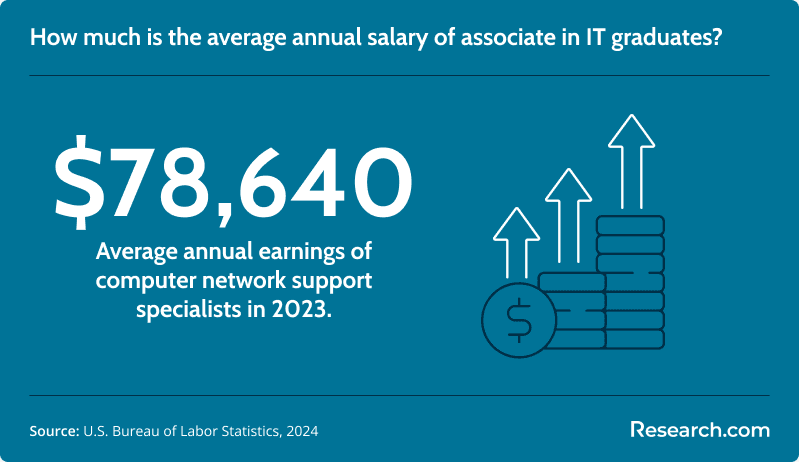
As a broad starting point, a help desk technician might earn around $40,000 to $50,000 per year, while a network administrator could earn between $50,000 and $70,000. For a related benchmark, computer user support specialists had a median annual wage of $60,810 in May 2023, and computer network support specialists earned $78,640 on average in 2023.
- 2027 best online associate in information technology programs
- How long does an online associate in information technology take?
- Online vs. on-campus associate in IT programs
- Average cost of an online associate in information technology
- Financial aid for online associate in IT students
- Admissions requirements and prerequisites
- Common courses in an online associate in IT program
- Specializations in online associate in IT programs
- Fast-tracking an online associate in IT degree
- Advanced specialization and online cybercrime study
- Using an associate in IT toward an accelerated computer science degree
- How to choose the best online associate in information technology program
- Career paths after an online associate in IT
- Job market for online associate in IT graduates
- Preparing for high-paying computer jobs
- Career placement services in online IT associate programs
- Emerging tech fields after an associate in IT
- Whether an online associate in IT is a worthwhile investment
- Adding AI specialization to an IT pathway
- Employer views of online associate in IT degrees
- Using an associate in IT as a bridge to advanced degrees
- Cost-effective advanced degree optionsAdvanced degree bridgeEmployer recognitionHigh-paying computer jobsJob marketAdditional career considerations
2027 Best Online Associate in Information Technology Programs
How do we rank schools?
Choosing an online associate in information technology program affects your budget, transfer options, schedule, and early career preparation. Research.com evaluates programs to help readers compare options using data-informed criteria instead of relying only on advertising claims or name recognition.
This ranking follows a transparent methodology and uses information from sources such as the Integrated Postsecondary Education Data System (IPEDS), Peterson's databases including the Distance Learning Licensed Data Set, and the College Scorecard from the National Center for Education Statistics. Rankings should be used as a starting point, not the only basis for enrollment. Always confirm tuition, fees, transfer rules, online availability, accreditation, and program requirements directly with the school.
| Rank | School | Program length | Credits | Estimated cost | Accreditation |
| 1 | Keiser University | 2 years | 60 | $20,800 | Southern Association of Colleges and Schools Commission on Colleges (SACSCOC) |
| 2 | Saint Leo University | 2 years | 60 | $23,990 | Southern Association of Colleges and Schools Commission on Colleges (SACSCOC) |
| 3 | Peirce College | 2 years | 60 | $14,400 | Middle States Commission on Higher Education (MSCHE) |
| 4 | Randolph Community College | 2 years | 60 | $2,280 | Southern Association of Colleges and Schools Commission on Colleges (SACSCOC) |
| 5 | Union County College | 2 years | 60 | $10,562 | Middle States Commission on Higher Education (MSCHE) |
| 6 | Minnesota State Community and Technical College | 2 years | 60 | $5,267 | Higher Learning Commission (HLC) |
| 7 | Campbell University | 2 years | 60 | $35,580 | Southern Association of Colleges and Schools Commission on Colleges (SACSCOC) |
| 8 | College of Southern Maryland | 2 years | 60 | $7,200 | Middle States Commission on Higher Education (MSCHE) |
| 9 | St. Petersburg College | 2 years | 60 | $1,943 | Southern Association of Colleges and Schools Commission on Colleges (SACSCOC) |
| 10 | Northern Virginia Community College | 2 years | 60 | $5,051 | Southern Association of Colleges and Schools Commission on Colleges (SACSCOC) |
1. Keiser University
Keiser University offers an Associate of Science in Information Technology for students preparing for entry-level technical roles. The program includes concentration options in networking administration, programming, and cybersecurity, allowing students to focus their coursework around a specific area of IT.
- Program Length: 2 years
- Tracks/Concentrations: Networking Administration, Programming, Cybersecurity
- Estimated Cost: $20,800
- Required Credits to Graduate: 60
- Accreditation: Southern Association of Colleges and Schools Commission on Colleges (SACSCOC)
2. Saint Leo University
Saint Leo University provides an Associate of Science in Information Technology that introduces students to core areas such as networking, cybersecurity, and programming. The program is designed for learners who want a broad technical base before entering the workforce or continuing into further study.
- Program Length: 2 years
- Tracks/Concentrations: Not specified
- Estimated Cost: $23,990
- Required Credits to Graduate: 60
- Accreditation: Southern Association of Colleges and Schools Commission on Colleges (SACSCOC)
3. Peirce College
Peirce College offers an Associate of Science in Information Technology with coursework intended to build practical skills for IT roles. Areas of study include network administration, cybersecurity, and web development, making the program suitable for students who want applied preparation in several technical domains.
- Program Length: 2 years
- Tracks/Concentrations: Not specified
- Estimated Cost: $14,400
- Required Credits to Graduate: 60
- Accreditation: Middle States Commission on Higher Education (MSCHE)
4. Randolph Community College
Randolph Community College provides an Associate in Science in Computer Information Technology that covers database management, networking, and programming. The program can support entry-level employment goals and may also serve students planning to continue toward a bachelor’s degree.
- Program Length: 2 years
- Tracks/Concentrations: Not specified
- Estimated Cost: $2,280
- Required Credits to Graduate: 60
- Accreditation: Southern Association of Colleges and Schools Commission on Colleges (SACSCOC)
5. Union County College
Union County College offers an Associate in Science in Computer Science that covers a wide range of computing and IT topics. Students may use the program to prepare for transfer to a four-year institution or to pursue entry-level technology positions.
- Program Length: 2 years
- Tracks/Concentrations: Not specified
- Estimated Cost: $10,562
- Required Credits to Graduate: 60
- Accreditation: Middle States Commission on Higher Education (MSCHE)
6. Minnesota State Community and Technical College
Minnesota State Community and Technical College offers an Associate of Applied Science in Computer Information Technology with online coursework in areas such as networking, cybersecurity, and programming. Students can choose from several specialization options to align the degree with career goals.
- Program Length: 2 years
- Tracks/Concentrations: Cybersecurity, Networking, Web Development
- Estimated Cost: $5,267
- Required Credits to Graduate: 60
- Accreditation: Higher Learning Commission (HLC)
7. Campbell University
Campbell University provides an Associate of Science in Computer Information Technology focused on programming, networking, cybersecurity, and other IT fundamentals. The program is intended to help students build the technical base needed for support and operations-oriented roles.
- Program Length: 2 years
- Tracks/Concentrations: Not specified
- Estimated Cost: $35,580
- Required Credits to Graduate: 60
- Accreditation: Southern Association of Colleges and Schools Commission on Colleges (SACSCOC)
8. College of Southern Maryland
College of Southern Maryland offers an Associate of Applied Science in Computer Information Technology with specialization options in cybersecurity, networking, and web development. The program can support either entry-level IT employment or continued study at a four-year institution.
- Program Length: 2 years
- Tracks/Concentrations: Cybersecurity, Networking, Web Development
- Estimated Cost: $7,200
- Required Credits to Graduate: 60
- Accreditation: Middle States Commission on Higher Education (MSCHE)
9. St. Petersburg College
St. Petersburg College offers an Associate in Science in Computer Information Technology that introduces students to networking, cybersecurity, programming, and related IT concepts. The degree is designed for students preparing for entry-level work or transfer opportunities.
- Program Length: 2 years
- Tracks/Concentrations: Not specified
- Estimated Cost: $1,943
- Required Credits to Graduate: 60
- Accreditation: Southern Association of Colleges and Schools Commission on Colleges (SACSCOC)
10. Northern Virginia Community College
Northern Virginia Community College offers an Associate of Applied Science in Computer Information Technology with concentration options such as cybersecurity, networking, and cloud computing. The program may fit students who want online access to a community college pathway with technical career preparation.
- Program Length: 2 years
- Tracks/Concentrations: Cybersecurity, Networking, Cloud Computing
- Estimated Cost: $5,051
- Required Credits to Graduate: 60
- Accreditation: Southern Association of Colleges and Schools Commission on Colleges (SACSCOC)
How long does it take to complete an online associate in information technology program?
An online associate in information technology commonly takes 2 years of full-time study. In academic year 2020 to 2021, a total of 34,184 computer and information science associate degrees were conferred, showing that associate-level computing programs remain a common entry point into the field.
Your actual completion time depends on your course load, transfer credits, academic calendar, and whether the program offers accelerated terms. Students who attend part time may need longer, while students who bring in prior credits or take heavier course loads may finish sooner.
- Transfer credits: Prior college coursework may reduce the number of credits you need to complete at the new institution.
- Course load: Taking more courses per term can shorten your timeline, but it can also increase workload and stress.
- Accelerated terms: Some schools use condensed sessions that let students complete courses more quickly.
- Prior learning assessment: Certain programs may evaluate military training, professional experience, or certifications for credit.
- Personal schedule: Work hours, caregiving responsibilities, and study habits strongly affect how quickly online students progress.
After earning the associate degree, some students transfer into a bachelor’s program and later pursue an online master of information technology degree if their career goals require graduate-level preparation.
How does an online associate in information technology compare to an on-campus program?
Online and campus-based associate in IT programs can cover similar academic material, but the student experience differs. The right choice depends on your schedule, learning style, access to technology, need for in-person support, and budget.
Online learning is often the better fit for students who need flexible scheduling or cannot commute regularly. Campus programs may work better for students who prefer face-to-face instruction, structured class times, and direct access to labs or campus services.
| Factor | Online associate in IT | On-campus associate in IT |
| Schedule | Often more flexible, especially for working adults | Usually follows set class meeting times |
| Location | Can be completed from anywhere with reliable internet access | Requires commuting or living near campus |
| Interaction | Uses discussion boards, video meetings, email, chat, and virtual office hours | Offers in-person interaction with instructors and classmates |
| Labs | May use virtual labs, remote desktops, cloud tools, or simulations | May provide physical computer labs and in-person equipment access |
| Best for | Self-directed learners who need flexibility | Students who want routine, live classroom support, and campus resources |
| Main risk | Requires discipline, time management, and dependable technology | Less flexible for students with changing work or family schedules |
What is the average cost of an online associate in information technology program?
The cost of an online associate in information technology varies widely by school type, residency status, fees, technology requirements, books, and whether credits transfer in. Tuition alone does not show the full cost, so students should compare the total price of attendance before enrolling.
Public institutions are often less expensive for in-state students, with an average around $3,860 for a two-year associate's degree. Out-of-state tuition may be much higher and can double or triple the in-state rate. Private institutions usually charge more, with tuition ranging from $10,000 to $30,000 or more per year. Students should also plan for textbooks, software, hardware, online course fees, exam fees, and certification costs when applicable.
| Cost item | Why it matters |
| Tuition | The largest direct cost and the easiest number to compare across schools. |
| Fees | Online, technology, lab, graduation, and student service fees can change the real price. |
| Books and digital materials | Some IT courses require software subscriptions, e-texts, or lab platforms. |
| Computer and internet access | Online students need reliable equipment and connectivity for labs, exams, and projects. |
| Certification exams | Some students pursue industry certifications alongside the degree, which may add exam costs. |
| Transfer credit policy | Accepted credits can reduce both time and total tuition. |
What are the financial aid options for students enrolling in a online associate in information technology program?
Students in accredited online associate in information technology programs may qualify for several types of financial aid. Computer network support specialists earned $78,640 on average in 2023, but students should still evaluate debt carefully because earnings vary and no program can guarantee employment or salary. Similar aid planning principles can also apply later if you compare options such as a cheap masters in computer science online.
Federal financial aid
- Federal Pell Grant: A need-based grant for eligible undergraduate students that does not typically need to be repaid.
- Federal Student Loans: Loans, including those offered through the Federal Direct Loan Program, may help cover education costs but must be repaid with interest.
- Work-Study: Eligible students may earn money through part-time work while enrolled.
State grants and scholarships
Many states provide grants or scholarships for eligible residents, including students in online programs. Requirements vary, so students should check their state higher education agency and confirm whether the online program qualifies.
Institutional aid
- Scholarships: Colleges may offer awards based on academic performance, financial need, program of study, military status, or other criteria.
- Grants: Some institutions provide grant aid that can lower tuition and fee costs for eligible students.
Employer tuition reimbursement
Some employers help pay for job-related education. If you are already working, ask whether your company offers tuition reimbursement, whether the program must be preapproved, and whether you must remain employed for a certain period after receiving assistance.
Military benefits
Veterans, active-duty service members, and eligible family members may be able to use benefits such as the GI Bill to help pay for tuition and fees. Students should confirm benefit eligibility and school participation before enrolling.
Most students start by completing the Free Application for Federal Student Aid (FAFSA). Schools may also request tax information, income documentation, verification forms, or scholarship applications.
What are the prerequisites for enrolling in a online associate in information technology program?
Most online associate in information technology programs require a high school diploma or GED equivalent. Selective programs may also review GPA, placement test scores, prior math coursework, or computer literacy. While IT hiring is expected to grow, 63% of senior tech leaders believe it is currently difficult to hire skilled IT talent, which makes foundational preparation important for students entering the field.
An associate degree can help students build technical fluency in computing, systems, and problem-solving. It can also complement later training in areas such as analytics, where strong data analyst skills may be useful.
- High school diploma or GED: This is the most common baseline admission requirement.
- Minimum GPA: Some schools set a GPA threshold or use GPA for placement and advising.
- Math readiness: Programs may require or recommend algebra or other quantitative preparation.
- Computer literacy: Students should be comfortable using email, operating systems, word processing tools, file management, and online learning platforms.
- Placement tests: Colleges may assess math, writing, or reading skills to place students in appropriate courses.
Admission requirements can change, and program names can be similar while requirements differ. Always review the catalog and speak with an admissions or academic advisor before applying.
Students who later want to combine IT with analytics may eventually compare graduate options such as the easiest data science masters programs, but those programs usually require additional undergraduate preparation beyond the associate level.
What courses are typically in a online associate in information technology program?
Coursework in an online associate in information technology program is designed to build broad technical competence. Students who want a preview of the subject area can also compare the best information technology courses online before committing to a full degree.
Core IT courses
- Introduction to Information Technology: Introduces IT systems, professional roles, computing concepts, and the way technology supports organizations.
- Computer Hardware and Software: Covers computer components, operating systems, applications, installation, configuration, and troubleshooting.
- Networking Fundamentals: Explains LANs, WANs, internet connectivity, network devices, IP addressing, and basic troubleshooting.
- Database Management: Teaches database structure, design principles, queries, data integrity, and basic administration concepts.
- Web Development: Introduces HTML, CSS, JavaScript, and the fundamentals of building websites and web applications.
- Cybersecurity: Covers threats, safe computing practices, access controls, security policies, and incident awareness. This subject also forms part of the foundation for an affordable cyber security degree online.
Programming and development courses
- Programming Fundamentals: Builds logic, syntax, debugging, and problem-solving skills using languages such as Python, Java, or C#.
- Web Development: Applies HTML, CSS, JavaScript, and sometimes frameworks such as React or Angular to create interactive sites.
- Database Programming: Uses SQL and related tools to retrieve, update, and manage data.
What types of specializations are available in online associate in information technology programs?
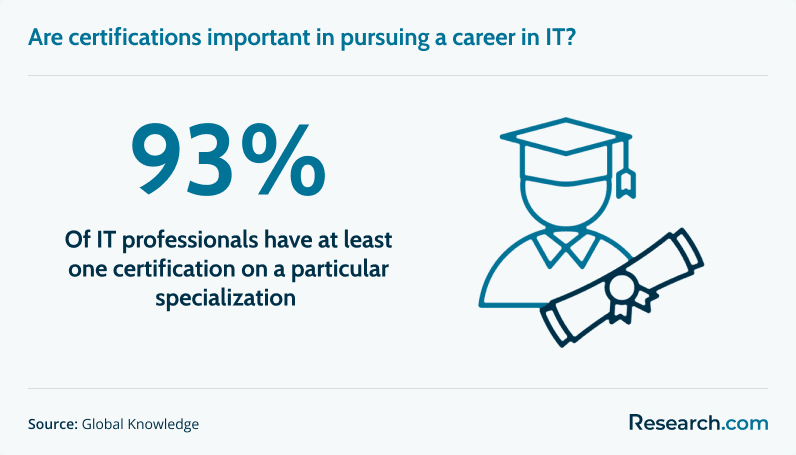
Specializations let students focus their electives or applied projects around a specific area of IT. They can also help students decide which certifications, internships, or bachelor’s concentrations to pursue next. Among IT professionals, 93% reported having at least one certification on a particular specialization, which shows how often workers combine academic study with skill-specific credentials.
| Specialization | What it emphasizes | Best fit for students interested in |
| Cybersecurity | Security controls, threats, defensive practices, risk awareness, and incident response basics | Security support, risk analysis, compliance, and later cybersecurity study |
| Network Administration | Network setup, configuration, monitoring, maintenance, and troubleshooting | Network technician, systems support, and infrastructure roles |
| Web Development | Website design, front-end development, scripting, and user-facing applications | Junior web development, site maintenance, and digital production roles |
| Software Development | Programming, testing, debugging, and application development fundamentals | Software support, junior development, and later study through an affordable online software engineering degree |
| Database Administration | Database design, SQL, access, security, backups, and data reliability | Database support, reporting, and data operations |
| IT Support | Hardware, software, user support, documentation, ticketing, and troubleshooting | Help desk, desktop support, and technical support roles |
Can I fast-track my online associate in information technology degree?
Some students can finish an online associate in information technology faster than the standard timeline, but acceleration depends on school policy and student readiness. The most common ways to shorten the degree are transfer credits, heavier course loads, year-round enrollment, accelerated terms, and approved credit for prior learning.
Fast-track options work best for students who already have college credits, strong study habits, stable weekly time for coursework, and enough technical confidence to move quickly through labs and assignments. They may not be ideal if you are new to college, working long hours, or still building math and computer fundamentals. Students comparing compressed formats can review options such as an associate degree in 6 months online, while confirming whether the timeline is realistic for their situation.
Should I pursue advanced specialization like an online cybercrime degree?
An associate in IT can introduce cybersecurity concepts, but cybercrime investigation usually requires deeper study in digital forensics, law, incident response, evidence handling, network security, and investigative methods. If your goal is to work in cyber investigations, fraud analysis, digital forensics, or security operations, a more focused program may be useful after you complete foundational IT coursework.
Students who want this direction can compare an online cybercrime degree after clarifying whether they need law enforcement preparation, private-sector cybersecurity skills, or digital forensic analysis training. The right path depends on the roles you want and the credentials employers in your target market request.
Can an online Associate in Information Technology accelerate my path to a computer science accelerated degree?
An online associate in information technology may help you move into an accelerated computer science bachelor’s program if the credits transfer cleanly. The key issue is alignment. IT associate programs often emphasize applied support, networking, security, and systems, while computer science programs may require more math, algorithms, theory, and programming depth.
Before enrolling, ask the associate program and the target bachelor’s program for a transfer evaluation. If your long-term goal is software engineering, data systems, or advanced computing, a computer science accelerated degree may be a logical next step, but only if the associate credits reduce your remaining requirements.
How to choose the best online associate in information technology program?
The best online associate in information technology program is the one that fits your career goal, budget, schedule, transfer plans, and learning needs. Students comparing IT programs may also want to review broader affordability options such as cheap online degrees, but price should not be the only factor.
| What to check | Why it matters | Questions to ask |
| Accreditation | Accreditation affects financial aid, transfer credit, employer recognition, and academic quality controls. | Is the institution regionally accredited? Is any program-specific accreditation, such as ABET, relevant to this program? |
| Curriculum | Courses should match your career target and cover current technical foundations. | Does the program include networking, cybersecurity, databases, programming, and hands-on labs? |
| Certification alignment | Certifications can strengthen an associate-level resume. | Do courses prepare students for credentials such as CompTIA A+, Network+, Security+, or Microsoft certifications? |
| Hands-on learning | IT jobs require practical troubleshooting and technical execution. | Are there virtual labs, projects, simulations, capstones, or internship options? |
| Transfer pathways | Many students use an associate degree as the first half of a bachelor’s pathway. | Does the school have articulation agreements with four-year colleges? |
| Student support | Online learners need accessible help when they get stuck. | Are tutoring, advising, technical support, library access, and career services available online? |
| Total cost | Fees, books, technology, and certification exams can change affordability. | What is the full estimated cost after tuition, fees, and materials? |
Common mistakes to avoid when choosing a program
- Choosing based only on tuition: A low sticker price may not include fees, software, books, or equipment.
- Ignoring accreditation: Unaccredited or poorly recognized programs can create problems with transfer, aid, and employer acceptance.
- Assuming all credits transfer: Transfer decisions are made by the receiving school, not just the school where you earned the credits.
- Overlooking hands-on labs: IT employers value practical troubleshooting experience, not just completed lectures.
- Skipping career services: Resume help, interview preparation, employer connections, and internship support can matter for first jobs.
- Believing salary outcomes are guaranteed: Pay depends on job market, location, experience, certifications, and performance.
What career paths are available for graduates of online associate in information technology programs?
An associate in information technology can be one of the quick degrees that pay well for students who use it strategically, especially when paired with projects, certifications, and work experience. In 2023, the top-paying industry for associate in IT graduates includes web search portals, libraries, archives, and other information services with a mean hourly wage of $63.41.
| Career path | Typical responsibilities | Helpful next steps |
| Help Desk Technician | Respond to user issues, troubleshoot software and hardware problems, document tickets, and escalate complex cases. | Build customer service skills and consider support-focused certifications. |
| Network Technician | Install, configure, test, and maintain network hardware and connectivity. | Strengthen networking knowledge and practice configuration labs. |
| Cybersecurity Specialist | Support security monitoring, apply controls, identify vulnerabilities, and assist with incident response. | Add cybersecurity coursework, labs, and security certifications. |
| Web Developer | Create and maintain websites using HTML, CSS, JavaScript, and related tools. | Build a portfolio of working web projects. |
| Database Administrator | Maintain databases, support access, protect data integrity, and help ensure availability. | Practice SQL and learn backup, security, and performance basics. |
| Software Developer | Write, test, debug, and maintain code using languages such as Python, Java, or C#. | Create coding projects and consider further study in software development or computer science. |
| Systems Administrator | Support servers, user accounts, operating systems, updates, and system reliability. | Gain experience with operating systems, scripting, and cloud tools. |
| IT Consultant | Help organizations assess, implement, or improve technology systems. | Build broad technical experience and communication skills. |
What is the job market for graduates with a online associate in information technology?
The job market for associate-level IT graduates is supported by the continued need for technical support, secure systems, reliable networks, and cloud-connected infrastructure. Computer network support specialist roles are expected to grow 7% through 2033. However, competition can still be strong for desirable roles, especially remote jobs and positions in specialized areas.
- Organizations across industries need workers who can keep systems, devices, networks, and applications running.
- An associate degree may qualify graduates for support and technician roles, while specialized positions may require certifications, experience, or additional education.
- Remote work has expanded some IT opportunities, but it has also increased competition because applicants may come from a broader geographic area.
- Certifications can help demonstrate job-specific skills when a candidate has limited professional experience.
To improve job prospects, students can pursue practical certifications related to their target roles. Examples include online certifications that pay well, such as CompTIA A+, Network+, Security+, or Microsoft certifications. Projects, internships, volunteer IT work, and a well-documented portfolio can also strengthen applications.
How does an online associate in information technology prepare you for high paying computer jobs?
An online associate in information technology can help students build the base required for higher-paying computer careers, but it is usually the beginning of the pathway rather than the final credential. Students gain practical experience in troubleshooting, networking, databases, cybersecurity, programming, and systems support. Those skills can later support advancement into specialized roles if combined with work experience, certifications, and possibly a bachelor’s degree.
Students interested in long-term earning potential should identify target roles early and compare the skills required for high paying computer jobs. Some of those careers require more advanced computer science, engineering, security, or data training than an associate program alone provides.
Do Online Associate in IT Programs Offer Career Placement Services?
Many online associate in IT programs offer career support, but the quality and depth of services vary. Useful services may include resume reviews, interview coaching, virtual career fairs, job boards, internship coordination, employer partnerships, and help translating coursework into marketable skills.
Ask whether career services are available to fully online students, not just campus students. Also ask whether the school has employer relationships in your region or target field. Students exploring more specialized creative technology paths may later compare programs such as game design schools online, where portfolios and project work can be especially important.
Can an Online Associate in IT Degree Propel You into Emerging Tech Fields?
An online associate in IT can introduce the technical building blocks used in emerging technology fields, including cloud systems, cybersecurity, automation, artificial intelligence, Internet of Things environments, and data-driven applications. It usually will not be enough by itself for advanced emerging-tech roles, but it can help students build the foundation for later specialization.
For example, students who combine IT fundamentals with biology, analytics, and advanced computing may eventually explore an online masters degree bioinformatics. The associate degree can support the early technical foundation, while later credentials provide the domain-specific depth.
Is an Online Associate in IT Degree a Worthwhile Investment?
An online associate in IT can be a worthwhile investment when the program is accredited, affordable, hands-on, and aligned with your career or transfer goals. It is less likely to pay off if the school is expensive, has weak support, lacks practical labs, or does not help you prepare for roles employers actually hire at the associate level.
Students should compare total cost against likely entry-level opportunities, not just potential long-term salaries. Cybersecurity-focused students, for example, can review the average salary of a 2-year cybersecurity degree, but they should also consider whether their program includes labs, certification preparation, and local employer relevance.
Is Enhancing Your IT Degree with AI Specialization Worthwhile?
Artificial intelligence is increasingly affecting IT work through automation, analytics, security monitoring, help desk tools, software development support, and workflow optimization. For associate-level students, the practical question is whether AI training strengthens the career path they actually want.
Introductory AI coursework can be useful if it helps you understand automation, data, scripting, and AI-enabled tools. A deeper AI specialization may make more sense after completing foundational IT, programming, math, and data coursework. Students planning advanced study can compare options such as the cheapest online master's in artificial intelligence, while checking prerequisites carefully.
Do Employers Value Online Associate in Information Technology Degrees?
Employers generally care most about whether a candidate has relevant skills, an accredited credential, practical experience, communication ability, and evidence of technical competence. The online format itself is usually less important when the program is credible and the graduate can demonstrate job-ready skills.
Students can improve employer confidence by choosing an accredited school, completing hands-on projects, earning relevant certifications, and documenting skills clearly on a resume or portfolio. If cybersecurity is the goal, it is also wise to understand program costs and options by reviewing resources such as How much is a cyber security degree?.
Can Your Associate in IT Degree Bridge to Advanced Degrees?
Yes, an associate in IT can serve as a bridge to further education if credits transfer into a bachelor’s program. This is one reason many students choose a community college or associate pathway first. The main risk is assuming transfer will happen automatically. It will not. Students should ask for written transfer guidance and compare degree maps before enrolling.
After earning a bachelor’s degree or meeting prerequisite requirements, some IT professionals pursue graduate study in cybersecurity, data science, artificial intelligence, analytics, or IT management. For example, an online masters in artificial intelligence may be relevant for students who later build strong programming, math, and data foundations.
Which Advanced Degree Programs Are Both Cost-Effective and Career-Enhancing?
The most cost-effective advanced degree is not always the cheapest one. It is the program that fits your career goal, accepts prior credits when relevant, offers strong instruction, and improves your qualifications without creating unnecessary debt. IT associate graduates should compare advanced options only after clarifying whether they need a bachelor’s degree first, which prerequisites are required, and what roles they are targeting.
Fields such as cybersecurity, data analytics, artificial intelligence, software development, and IT management can build on an IT foundation. Students interested in analytics leadership or technical data roles may eventually compare options such as the cheapest online data science masters, while evaluating prerequisites, curriculum quality, and employer alignment.
References
- Bureau of Labor Statistics. (2024, September 8). Computer Network Support Specialists.
- CompTIA. (2023, December). IT Industry Outlook 2025.
- Global Knowledge. (2024). 2024 IT Skills and Salary Report.
- National Center for Education Statistics. (2023). Associate's degrees conferred by postsecondary institutions, by sex of student and field of study: Table 321.10.
- Spiceworks (2024). State of IT.
Key Insights
- An online associate in information technology is best suited for students who want a flexible, lower-commitment entry into IT or a transfer pathway toward a bachelor’s degree.
- Most programs take 2 years full time and commonly require 60 credits, but transfer credits, accelerated terms, and prior learning policies can affect completion time.
- Accreditation, hands-on labs, certification preparation, transfer agreements, and career support are more important than ranking position alone.
- Costs vary widely. Public in-state options may be much less expensive, while private institutions can charge $10,000 to $30,000 or more per year.
- Entry-level roles may include help desk technician, network technician, web developer, cybersecurity support, database support, and systems support, but specialized or higher-paying roles often require experience, certifications, or further education.
- The degree can have strong value when paired with practical projects, internships, certifications, and a clear career plan. It is weaker when students choose a program without checking accreditation, total cost, transfer rules, or employer relevance.
Other Things You Should Know About the Best Online Associate in Information Technology
In 2027, an associate degree in information technology offers a foundational understanding of IT principles, creating pathways to entry-level roles. It provides a comprehensive base in networking, cybersecurity, and database management, equipping students with essential skills required in an evolving tech landscape, including AI integration.
When selecting an online associate in information technology program, consider accreditation, faculty expertise, curriculum relevance, and support services. Additionally, check for opportunities in hands-on projects or labs that align with current industry needs, as these foster practical skills. Look for programs with strong industry partnerships for exposure to real-world scenarios.
In 2027, online associate programs in information technology are being shaped by trends like increased integration of artificial intelligence, emphasis on cybersecurity education, and the inclusion of remote work skills training. These trends ensure that graduates are better prepared to meet the evolving demands of the tech industry.


