
2027 How Long Does It Take to Become a Dental Hygienist?

Co-Founder and Chief Data Scientist
Becoming a dental hygienist is a relatively structured healthcare career path, but the timeline is not the same for every student. Your starting point, prerequisite courses, program type, clinical schedule, licensure requirements, and funding plan can all change how long it takes. For many students, the fastest realistic route is an accredited associate degree followed by board exams and state licensure; for others, a bachelor’s or graduate degree makes more sense for teaching, public health, research, leadership, or long-term advancement.
This 2026 guide explains how long it takes to become a dental hygienist, what requirements you must complete, how clinical training affects the timeline, what the education may cost, and how to compare traditional, online, accelerated, and advanced-degree options. It is designed for high school graduates, college students, dental assistants, career changers, and working dental professionals deciding whether dental hygiene is the right next step.
Quick answer: How long does it take to become a dental hygienist?
Dental hygienist programs can take 17 months to 4 years, depending on the credential and school format. The most common entry-level route is an associate degree in dental hygiene, which typically takes two years. Students may also need four to eight months of prerequisite coursework before admission, and licensure requires passing the National Board Dental Hygiene Examination, a clinical examination, and any state-specific requirements. For many students, the full path from prerequisites to licensure takes around three years.
- Associate degree programs are usually the standard entry point and typically take two years.
- Bachelor’s programs usually take four years and may support advancement into leadership, education, public health, or broader healthcare roles.
- Master’s programs usually take one to two additional years after a bachelor’s degree and are most useful for education, research, administration, or specialized career goals.
- The Bureau of Labor Statistics projects 9% employment growth for dental hygienists from 2023 to 2033.
- Programs may cost from $6,000 to over $50,000, with associate degrees averaging $22,692, bachelor’s degrees averaging $36,382, and master’s degrees averaging $30,421.
- Clinical experience is not optional; it is central to skill development, board-exam preparation, and readiness for patient care.
- There are over 59,611 dental hygienists currently employed in the United States.
Dental hygienist requirements: education, exams, licensure, and skills
To work as a dental hygienist, you generally need to graduate from an accredited dental hygiene program, complete supervised clinical training, pass required examinations, and meet the licensing rules in the state where you plan to practice. The exact sequence can vary by state, but the core requirements are similar across the profession.
Education requirement: CODA-accredited dental hygiene program
The usual minimum credential for entry-level dental hygiene practice is an associate degree in dental hygiene. These programs are commonly offered by community colleges, technical colleges, and some universities. Students study oral anatomy, general anatomy, pharmacology, radiography, periodontology, dental materials, patient assessment, infection control, and preventive care. They also complete clinical rotations where they treat patients under supervision.
Dental hygiene education is more time-intensive than some allied health options, including many pharmacy technician career pathways, but it can lead to a licensed clinical role with a defined scope of practice and strong long-term demand.
| Education path | Typical timeline | Best for | Decision notes |
| Associate degree in dental hygiene | Typically two years | Students seeking the most common entry-level route to licensure | Often the practical choice for students who want to enter clinical practice as efficiently as possible. |
| Bachelor’s degree in dental hygiene | Typically four years | Students who want broader preparation for leadership, public health, education, or advanced roles | Compare tuition carefully. If affordability is a priority, review options for the cheapest online bachelor’s degree, but make sure any dental hygiene pathway meets accreditation and clinical requirements. |
| Master’s degree | Usually one to two years after a bachelor’s degree | Licensed hygienists interested in teaching, research, public health, program leadership, or specialization | A graduate degree is not usually required for entry-level clinical work, so pursue it only when it supports a specific career goal. |
| Prerequisite coursework | Typically four to eight months | Applicants who still need required science, social science, or general education courses | Common prerequisites may include courses such as introductory psychology or sociology. Students exploring broader social science graduate options can also review what careers are possible with a master’s in sociology. |
Accreditation requirement
The most important quality check is accreditation by the Commission on Dental Accreditation. CODA is the main accrediting body for dental and dental hygiene programs in the United States. In most cases, graduating from a CODA-accredited dental hygiene program is required to qualify for the National Board Dental Hygiene Examination and state licensure.
Before applying, confirm the program’s accreditation status directly through CODA or the school’s official program page. Do not rely only on marketing language such as “career-ready,” “approved,” or “industry-aligned.” Accreditation affects exam eligibility, licensure, transferability, and employer confidence.
National Board Dental Hygiene Examination
The National Board Dental Hygiene Examination is a written exam that evaluates whether candidates understand the biomedical, dental science, clinical, and case-based knowledge needed for safe practice. The exam has a total time limit of 7.5 hours and includes multiple-choice and case-based questions. Graduates of CODA-accredited dental hygiene programs are eligible to take the exam, and results are available online approximately three to four weeks after the test date.
Clinical examination
Clinical examinations test whether candidates can perform dental hygiene procedures safely and effectively. These exams may include patient assessment, radiography, periodontal therapy, instrumentation, and other hands-on skills. Depending on the state or region, candidates may complete exams through agencies such as the Central Regional Dental Testing Service or the Western Regional Examining Board.
State-specific licensing requirements
Licensure is state-based. Some states require additional steps beyond the national and clinical exams, such as a jurisprudence exam covering state dental laws and regulations. Some also require background checks. Because licensing rules can change, applicants should verify requirements through the dental board in the state where they plan to work before enrolling, especially if they are considering relocation.
Core skills dental hygienists need
- Manual dexterity: Dental hygienists work with small instruments in confined spaces, so hand-eye coordination and precise movement are essential.
- Communication: Hygienists explain procedures, educate patients, answer questions, document findings, and coordinate with dentists and other staff.
- Attention to detail: Accurate charting, measurements, infection control, radiographs, and periodontal assessments require consistent precision.
- Professional judgment: Hygienists must recognize changes in oral health, follow protocols, and know when to involve the dentist.
- Patient-centered care: The role requires empathy, patience, and the ability to support patients who may be anxious, uncomfortable, or unfamiliar with preventive care.
Dental hygienist career paths and how long each path may take
Dental hygiene is often associated with private dental offices, but the profession can lead to clinical, public health, education, corporate, administrative, and entrepreneurial roles. It is also one of the healthcare-related trade school jobs that pay well, especially for students who want a licensed clinical career without completing medical school or dental school.
Some dental hygienists earn nearly $100,000 annually or more, depending on location, experience, work setting, specialty, and schedule. That earning potential can compare favorably with some roles discussed in guides to exercise science degree salary and career options, though no salary outcome is guaranteed.
The right career path depends on how quickly you want to enter practice, whether you enjoy patient care, and whether you eventually want to move into teaching, public health, business, or leadership.
| Career path | Typical preparation timeline | What the work involves | Who should consider it |
| Clinical dental hygienist | Often around three years from prerequisites through licensure | Provides preventive care, patient education, periodontal assessments, radiographs, cleanings, and documentation in a dental office or clinic. | Students who want direct patient care and a relatively clear route into employment. |
| Advanced clinical roles | Usually after gaining experience as a licensed hygienist | May focus on patient groups such as children, older adults, medically complex patients, or periodontal care. | Clinicians who want deeper expertise without leaving patient care. |
| Public health hygienist | Entry may begin after licensure; advancement may require more education | Supports oral health programs, screenings, prevention initiatives, health fairs, community education, and outreach. | Hygienists interested in population health, access to care, and community-based work. |
| Education and research | Often requires at least a bachelor’s degree; some roles require a graduate degree | Teaches dental hygiene students, contributes to curriculum, conducts research, or works with academic, corporate, government, or nonprofit organizations. | Experienced hygienists who enjoy mentoring, evidence-based practice, and academic work. |
| Corporate dental hygiene | Usually after clinical experience | Works in product education, sales, training, operations, customer success, or administrative support for dental companies. | Hygienists with strong communication skills and interest in technology, products, training, or business development. |
| Entrepreneurial hygienist | Usually after licensure and experience | May build a consulting, staffing, product development, mobile care, or practice management business. | Professionals who are comfortable with risk, marketing, compliance, and business operations. |
| Dental hygiene program director | Typically requires substantial experience and advanced education | Oversees curriculum, faculty, clinical education, accreditation standards, and student outcomes. | Educators and leaders who want to shape future dental hygiene training. |
| Veterinary dental hygiene support | Varies by employer and applicable rules | Applies oral health knowledge to animal dental care settings, often in coordination with veterinarians. | Hygienists interested in animal health and cross-disciplinary work. |
| Administrator | Often strengthened by business or healthcare management training | Manages dental office operations, staffing, budgets, workflows, quality standards, and patient systems. | Hygienists who want to move from chairside care into management. If this path appeals to you, it may be useful to ask, is business administration a good major? |
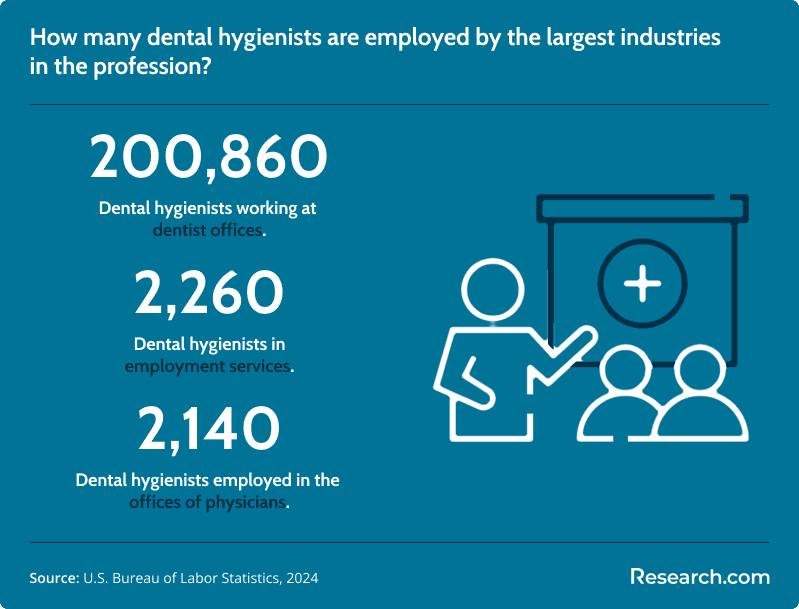
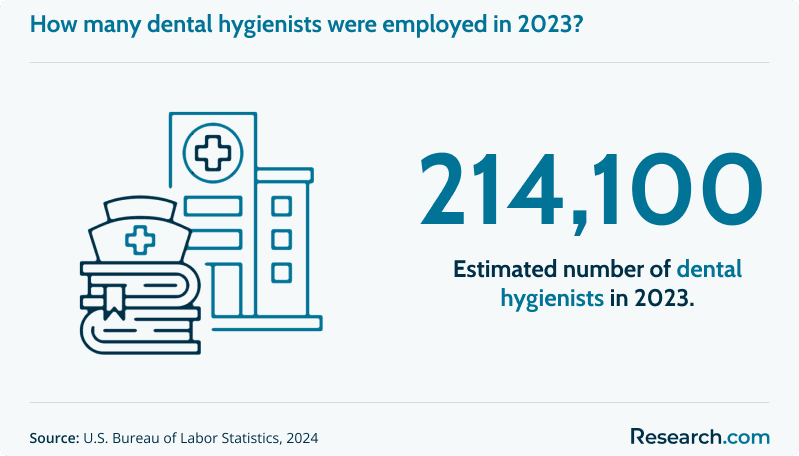
In 2023, dental hygienists held about 214,000 jobs. The chart below shows the largest employers of dental hygienists.
How clinical experience affects the timeline and readiness for practice
Clinical training is one of the main reasons dental hygiene programs take longer than short certificate programs. Students must learn not only the theory behind oral health but also the patient-care skills required to work safely and efficiently. Clinical education helps students build confidence with instruments, improve assessment skills, manage different patient needs, and prepare for board exams.
When estimating how long it takes to become a dental hygienist, include the time needed for clinical rotations, not just classroom courses. A faster program is not automatically better if it gives students limited supervised practice or leaves them underprepared for real dental office expectations.
- Readiness for patient care: More hands-on exposure can help new graduates feel more prepared when they begin working independently.
- Technical skill development: Repeated practice helps students improve instrumentation, radiography, periodontal assessment, charting, infection control, and patient education.
- Professional confidence: Clinical rotations expose students to different patients, time constraints, and care plans before they enter the workforce.
- Board-exam preparation: Clinical experience reinforces the applied knowledge tested through written and practical exams.
- Transition to work: Graduates with limited real-world practice may struggle in production-based settings where appointment timing and efficiency matter.
- Instruction quality: Clinical instructors influence student learning significantly, and instructor preparation can affect the consistency of training.
- Improvement strategies: Strong programs may use mentorship, self-assessment, realistic schedules, instructor development, and structured feedback to support clinical growth.
Some licensed hygienists later add business, leadership, or administrative training to broaden their options. For example, online master’s degree programs that take 6 months may appeal to professionals comparing short graduate options, although dental hygienists should choose advanced study based on accreditation, relevance, and career goals rather than speed alone.
How much does it cost to become a dental hygienist?
The cost of becoming a dental hygienist depends on the credential, school type, residency status, location, clinical fees, supplies, and living expenses. Tuition is only one part of the total price. Students should also budget for equipment, licensing, transportation, immunizations, uniforms, exam fees, and time away from work.
| Cost category | Amount or item | Why it matters |
| Program tuition range | $6,000 to over $50,000 | The price varies widely by school, location, and degree level. |
| Average associate degree tuition | $22,692 | This is often the most common entry-level dental hygiene route. |
| Average bachelor’s degree tuition | $36,382 | A bachelor’s degree may support advancement but can increase upfront cost. |
| Average master’s degree tuition | $30,421 | Graduate study is usually best for specific goals such as education, research, public health, or leadership. |
| Additional expenses | Books, supplies, housing, transportation, personal expenses, medical insurance, instruments, uniforms, CPR certification, memberships, liability insurance, and licensure fees | These costs can materially affect affordability even when tuition looks manageable. |
How long does it take to secure funding?
Funding can take several months because students often need to file aid forms, wait for school award letters, apply for scholarships, compare loan options, and meet program deposit deadlines. The safest approach is to begin before the application cycle becomes urgent.
- FAFSA: Students use the Free Application for Federal Student Aid to access federal aid, grants, and work-study. The priority deadline is February 15, although applications remain open. Always confirm school-specific deadlines with the financial aid office.
- Scholarships and grants: These are preferable to loans because they do not usually need to be repaid. The American Dental Hygienists’ Association Institute scholarships application window runs from October 1 to February 17.
- Work-study: Some schools offer on-campus employment that can help cover indirect expenses.
- Federal student loans: Many students review federal loans first because they do not require a credit score.
- Private student loans: These may fill remaining gaps, but students should compare rates, repayment rules, and borrower protections carefully.
- Employer tuition reimbursement: Dental assistants or current healthcare workers should ask whether their employer helps pay for dental hygiene education.
- Early planning: Many students begin financial aid steps as early as December 31 of the year before enrollment.
Best financing options for dental hygiene students
The strongest financing plan usually combines low-cost program selection, grants, scholarships, federal aid, careful borrowing, and realistic budgeting. Instead of choosing a school based only on advertised tuition, compare the full cost of attendance and the likelihood that you can complete the program without stopping out for financial reasons.
| Funding option | Best use | Watch out for |
| Federal grants and aid | Reducing upfront cost for eligible students | Deadlines and eligibility rules vary, so file early and check school requirements. |
| Scholarships | Lowering tuition or supply costs without adding debt | Applications can be competitive and may require essays, references, or proof of enrollment. |
| Work-study or part-time work | Covering living costs or small recurring expenses | Dental hygiene programs can be demanding, so avoid overcommitting work hours during clinical terms. |
| Federal loans | Covering remaining costs after grants and scholarships | Borrow only what you need and understand repayment obligations. |
| Private loans | Filling funding gaps when other aid is insufficient | Terms may be less flexible than federal loans, and credit requirements may apply. |
| Employer reimbursement | Helping working dental assistants or healthcare employees move into hygiene | Some employers require a work commitment after graduation. |
Some students consider related healthcare training to earn income while pursuing longer-term goals. A low-cost medical billing and coding online program may be worth comparing if you need a flexible healthcare-adjacent skill, but it is not a substitute for CODA-accredited dental hygiene education or licensure.
Can additional healthcare certifications improve career options?
Complementary healthcare credentials can help some dental hygienists broaden their knowledge, but they should be chosen strategically. Training in patient management, billing systems, public health, technology, or imaging concepts may support roles outside traditional chairside care. However, not every healthcare certification will directly improve dental hygiene employment.
For example, online sonography programs may interest healthcare professionals who want to understand imaging-focused career paths, but dental hygienists should evaluate whether such training connects to their actual career plan. In many cases, dental-specific continuing education, local anesthesia authorization where applicable, laser therapy training, public health coursework, or management education may be more directly relevant.
Job placement prospects after graduation
Dental hygienists with strong clinical training, professional references, licensure readiness, and local networking often have better job-search outcomes after graduation. Employers typically look for candidates who can provide safe patient care, communicate well, document accurately, manage time, and adapt to office technology and workflow.
Some graduates also strengthen their marketability by understanding administrative systems. For example, accredited medical billing and coding programs can help dental or healthcare professionals understand claims, documentation, and revenue-cycle processes, though they do not replace dental hygiene credentials.
To improve job placement prospects, students should build relationships during clinical rotations, join professional dental associations, ask instructors for feedback, prepare for interviews before licensure is finalized, and research which offices, clinics, public health agencies, and corporate dental organizations hire new graduates.
How the job market affects the time it takes to get hired
The job market can shorten or lengthen the time between licensure and employment. Demand is influenced by local population needs, dental office staffing patterns, oral health awareness, wages, scheduling preferences, and the number of nearby graduates entering the market at the same time.
- Projected openings: An estimated 16,400 dental hygienist jobs are expected to open each year in the coming decade.
- Employment growth: The Bureau of Labor Statistics projects 9% growth for dental hygienists from 2023 to 2033.
- Current workforce: There are over 59,611 dental hygienists currently employed in the United States.
- Location: Dental hygienists are most in demand in New York, while New Hampshire is the best state for dental hygienists to live.
- Specialized skills: Additional competencies such as laser therapy and comfort with current dental technology may help candidates stand out.
- Practice setting: Dental hygienists are significantly more likely to work in private companies than in educational settings, with a 77% higher probability.
- Public awareness: Greater attention to oral health can increase demand for preventive dental care.
The chart below shows the 2023 median annual wages for dental hygienists in the top industries where they worked.
Traditional vs. online dental hygiene programs: timeline differences
Dental hygiene education is highly clinical, so fully online entry-level dental hygiene programs are not the norm. Students preparing for first-time licensure should expect on-campus labs and supervised clinical practice. Online formats are more common for licensed dental hygienists who already completed clinical training and want to finish a bachelor’s degree.
| Program format | Typical timeline | Clinical requirement | Best fit |
| Traditional associate degree | Typically two years, often including summer sessions | Yes | First-time students seeking the standard entry-level path to licensure. |
| Entry-level bachelor’s degree | About 22 months in some formats | Yes | Students who want an intensive route with broader bachelor’s-level preparation. |
| Bachelor’s or master’s after an associate degree | May add four to six years, depending on pacing and degree structure | Usually depends on whether the student is already licensed | Licensed hygienists pursuing advancement, teaching, research, public health, or leadership. |
| Online BSDH completion program | Often 15-16 months; part-time options may extend to six years | Typically no new clinical requirement because students are already licensed | Working dental hygienists with an associate degree who want a bachelor’s completion pathway. |
Compared with some medical coding and billing certification options, dental hygiene usually requires more time, clinical training, and licensure steps. The trade-off is that dental hygiene leads to a licensed patient-care role with a distinct professional scope.
What can delay or accelerate becoming a dental hygienist?
Two students can enroll with the same career goal and finish at very different times. The difference often comes down to prerequisites, transfer credits, program availability, clinical scheduling, finances, family responsibilities, and licensing paperwork.
| Factor | Can speed up or slow down? | How it affects the timeline | What to do before enrolling |
| Accelerated curriculum | Can speed up | Condenses coursework, often benefiting students with prior degrees or completed prerequisites. | Ask about weekly workload, clinical expectations, and board pass preparation. |
| Prior college credits | Can speed up | Transfer credits may reduce general education or prerequisite time. | Request a written transfer-credit evaluation before committing. |
| Advanced standing | Can speed up | Some foreign-educated students may qualify for advanced placement. | Confirm eligibility, documentation, and state licensure implications. |
| Planned gap year | Can help or delay | A gap year can improve readiness but adds time before graduation. | Use the time for prerequisites, observation, savings, or application strengthening. |
| Limited program seats | Can delay | Competitive admissions, waitlists, and capacity limits can postpone entry. | Apply to multiple accredited programs and track deadlines carefully. |
| Financial barriers | Can delay | Unresolved funding gaps may force part-time attendance or stop-out periods. | Build a full funding plan before the first term begins. |
| Family or work responsibilities | Can delay | Clinical schedules may be difficult to combine with full-time work or caregiving. | Ask for the actual weekly schedule, not just the catalog description. |
| GPA requirements | Can delay | Strict admission standards may require retaking courses or improving grades. | Meet with an advisor early and identify high-impact prerequisite courses. |
| Program closures or limited access | Can delay | Funding issues, geographic shortages, and fewer nearby options can reduce availability. | Check program stability, accreditation status, and recent admissions data. |
| Licensure paperwork | Can delay | Missing documents, background checks, or state forms can postpone employment. | Create a licensure checklist before graduation. |
| Burnout | Can delay | Heavy workload may reduce course load or work hours. | Plan for rest, support, finances, and realistic study time. |
The chart below shows dental hygienists by degree level.
Physical and mental demands of dental hygiene training
Dental hygiene programs are academically demanding and physically repetitive. Students must adapt to long clinic sessions, fine motor tasks, close visual work, patient communication, and high standards for safety and documentation. Some students adjust quickly, while others need more time to build stamina, confidence, and efficient technique.
Physical demands
- Musculoskeletal strain: Repetitive hand movements and sustained postures can stress the neck, back, arms, wrists, and hands and may contribute to issues such as carpal tunnel syndrome.
- Endurance: Students and professionals often sit, stand, bend, and maintain focused positioning for extended periods.
- Strength and mobility: Programs may require students to lift up to 25 pounds, assist with patient positioning, and work in compact treatment areas.
- Fine motor control: Scaling, polishing, probing, and radiographic tasks require precise finger movement and steady hand-eye coordination.
Mental and cognitive demands
- Clinical judgment: Dental hygienists rely on cognitive, sensory, emotional, and motor skills to assess patients and make safe care decisions. Students interested in cognition-focused work outside dentistry can also explore cognitive psychology careers.
- Visual detail: Hygienists must see small measurements, tissue changes, calculus, margins, and radiographic details.
- Stress management: Patients may be anxious, medically complex, or difficult to schedule, requiring emotional control and professionalism.
- Communication: Clear speech, active listening, and accurate documentation are essential for patient education and team coordination.
How students can adapt
- Use sharp, ergonomic, and appropriately weighted instruments when available to reduce hand strain.
- Balance complex and less demanding patient cases when scheduling allows.
- Build core strength, flexibility, and general fitness to support posture and endurance.
- Ask instructors for ergonomic feedback early, before poor habits become routine.
- Communicate with faculty, dentists, and managers about barriers that affect safety, efficiency, or learning.
How advanced education can support dental hygiene career growth
Additional education can help dental hygienists move beyond routine clinical practice, but it should be tied to a specific professional outcome. A bachelor’s degree may support public health, corporate, management, or education-related opportunities. A master’s degree can be useful for teaching, research, policy, program development, or leadership roles.
Dental hygienists interested in community oral health, prevention programs, and health policy may want to compare top MPH online programs or related public health degrees. Public health education can be especially relevant for professionals who want to address access to care, prevention, and community-level oral health challenges.
Moving from clinical dental hygiene into healthcare leadership
Leadership roles require more than clinical excellence. Hygienists who want to supervise teams, manage clinics, improve systems, or move into administration should build skills in operations, compliance, budgeting, scheduling, quality improvement, and strategic planning. Professional mentorship and association involvement can also help clinicians understand what leadership roles actually require.
For hygienists comparing management-oriented pathways, it may be useful to review high-paying healthcare administration careers. The strongest candidates usually combine patient-care credibility with business and organizational skills.
Staying competitive as dental hygiene changes
Dental offices increasingly rely on digital radiography, electronic records, patient communication systems, scheduling platforms, and data-informed workflows. Hygienists who stay current with technology, continuing education, infection control expectations, and patient communication practices are better positioned for long-term employability.
Not every leadership or management degree is directly related to dental hygiene. For example, affordable online sports management programs may help some learners build general management knowledge, but dental hygienists should compare such options against healthcare administration, public health, business, or dental education pathways that may align more closely with their goals.
Using business skills to advance as a dental hygienist
Business training can be valuable for hygienists who want to manage a dental practice, consult, lead teams, work in corporate dentistry, or start an independent service-related venture. Useful topics include budgeting, staffing, marketing, patient retention, compliance, workflow design, and financial reporting.
An accelerated online business degree may be worth considering for working professionals who want a faster business-focused credential. Still, the best choice depends on whether the program’s content supports your intended role in dental practice management, healthcare leadership, consulting, or entrepreneurship.
Common mistakes to avoid when planning your dental hygiene timeline
| Mistake | Why it can hurt you | Better approach |
| Choosing a program without checking CODA accreditation | You may not qualify for the NBDHE or state licensure. | Verify accreditation before applying or paying deposits. |
| Focusing only on tuition | Supplies, instruments, transportation, exam fees, insurance, and lost work hours can change the real cost. | Compare total cost of attendance and ask for a fee breakdown. |
| Assuming online means faster | Entry-level dental hygiene requires clinical training, and online completion programs are usually for licensed hygienists. | Confirm whether the program is entry-level or degree-completion. |
| Ignoring state licensure rules | Requirements may differ if you plan to move after graduation. | Check the dental board requirements in each state where you may practice. |
| Underestimating prerequisites | Missing courses can add four to eight months or delay admission by an application cycle. | Map prerequisites before choosing an intended start date. |
| Assuming salary outcomes are guaranteed | Pay varies by location, setting, experience, schedule, and specialization. | Research local job postings and ask programs about graduate outcomes. |
| Overworking during clinical terms | Clinical schedules and board preparation can be difficult to balance with heavy work hours. | Plan finances so you can reduce work hours when necessary. |
Questions to ask before choosing a dental hygiene program
- Is the program currently accredited by CODA?
- What prerequisites are required, and how long will they take me to complete?
- How many students are admitted each cycle, and is there a waitlist?
- What is the total cost, including instruments, uniforms, exams, insurance, and licensing fees?
- Where do students complete clinical rotations?
- Does the schedule allow part-time work, or is it effectively full-time?
- What support does the program provide for the NBDHE and clinical examination?
- What percentage of graduates obtain licensure and employment?
- Does the program meet requirements in the state where I plan to work?
- If I already have college credits, which credits will transfer?
Graduate perspectives on becoming a dental hygienist
-
: "
Dental hygiene offers a mix of patient connection and technical work. The routine can be steady, but every patient brings a different opportunity to improve oral health. - Shalimar
"
-
: "
The career can lead to different settings, including private practice and public health. Ongoing professional development is important for keeping the work engaging and building new options. - Enrique
"
-
: "
One of the rewarding parts of dental hygiene is seeing visible results and building trust with patients over time. Preventive care makes the work feel meaningful. - Xyriel
"
Key insights
- The most common route to becoming a dental hygienist is a CODA-accredited associate degree, which typically takes two years, but prerequisites, exams, and licensing can make the full timeline closer to around three years for many students.
- Program timelines range from 17 months to 4 years, with longer paths making sense when they support leadership, public health, teaching, research, or advancement goals.
- Clinical training is a major part of dental hygiene education. Do not judge programs only by speed; supervised patient-care experience affects confidence, skill development, and exam readiness.
- Costs vary widely, from $6,000 to over $50,000. Students should compare total cost, not just tuition, and begin financial aid and scholarship planning early.
- Licensure is state-specific. Before enrolling, confirm CODA accreditation, NBDHE eligibility, clinical exam requirements, and any state jurisprudence or background-check rules.
- The job outlook is favorable, with 9% projected employment growth from 2023 to 2033 and an estimated 16,400 openings each year in the coming decade, but hiring speed still depends on location, experience, specialization, and local demand.
- Online dental hygiene options are usually best for licensed hygienists completing a bachelor’s degree. First-time students should expect in-person labs and clinical requirements.
- The best program is not always the fastest or cheapest. The right choice is the accredited option that fits your timeline, finances, state licensure goals, clinical preparation needs, and long-term career plan.
References
- American Dental Association. (n.d.). National Board Dental Hygiene Examination (NBDHE). https://jcnde.ada.org/nbdhe
- American Dental Education Association. (n.d.). The importance of manual dexterity. https://www.adea.org/GoDental/health-professions-advisors/supporting-students/the-importance-of-manual-dexterity
- Bureau of Labor Statistics, U.S. Department of Labor. (2024). Dental Hygienists. Occupational Outlook Handbook. https://www.bls.gov/ooh/healthcare/dental-hygienists.htm
- Zippia. (2025). Dental Hygienist demographics and statistics in the US. https://www.zippia.com/dental-hygienist-jobs/demographics
Other Things You Should Know About Becoming a Dental Hygienist
Before enrolling in a dental hygienist program, applicants in 2027 typically need a high school diploma or GED, completion of science courses such as biology and chemistry, and possibly shadowing experience in a dental office. Each program may have specific additional requirements.
To become a dental hygienist in 2027, you generally need an associate degree in dental hygiene. It typically takes three years to complete. Followed by passing the National Board Dental Hygiene Examination and obtaining state licensure, these steps make you eligible to practice as a dental hygienist.
To become a dental hygienist in 2027, you typically need an associate’s degree in dental hygiene from an accredited program. Entry-level positions may require passing the National Board Dental Hygiene Examination (NBDHE) and acquiring a state license to practice, which includes meeting the educational qualifications.
Most candidates must pass the National Board Dental Hygiene Examination (NBDHE) and a clinical exam required by the state dental board. Licensure is then issued by the state board of dentistry or dental hygiene board, which sets the final practice requirements.


