
2027 Fastest Online Bachelor's in Computer Science Programs

Co-Founder and Chief Data Scientist
A fast online bachelor’s in computer science can be a practical route into software, data, cybersecurity, cloud computing, and other technology roles—especially if you need to keep working, use transfer credits, or avoid relocating for school. The decision is not simply “online or on campus.” You need to compare accreditation, pace, total cost, technical rigor, portfolio opportunities, and whether the program actually prepares you for competitive entry-level hiring.
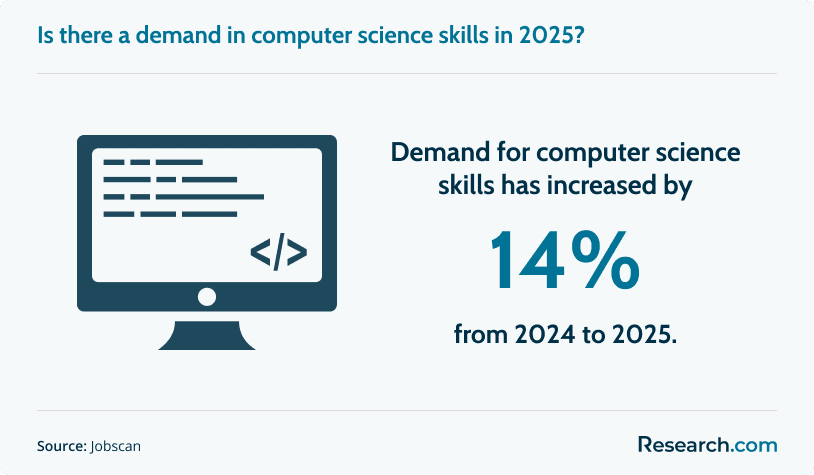
Demand for computer science education has expanded sharply. In the 2022–23 academic year, U.S. institutions awarded 112,700 bachelor’s degrees in computer and information sciences, twice as many as a decade earlier. This guide explains what to expect from accelerated online computer science degrees, how much they may cost, which programs offer faster completion options, and how to choose a program that fits your career goals.
Quick answer: Is a fast online bachelor’s in computer science worth it?
Yes, a fast online bachelor’s in computer science can be worth it when the school is accredited, the curriculum includes substantial programming and systems coursework, and you graduate with projects that show employers what you can build. The strongest options combine flexible scheduling, transfer-credit policies, practical tools such as Git and cloud platforms, and career support for internships or entry-level roles.
The main trade-off is intensity. Accelerated online programs can shorten the path to graduation, but compressed terms require consistent weekly study time, strong self-direction, and comfort learning technical material independently.
What are the benefits of taking an online bachelor’s in computer science program?
- Career flexibility: Graduates may pursue roles such as software developer, data analyst, cybersecurity specialist, systems administrator, or technical support engineer across many industries.
- Strong earning potential: The median annual salary for computer and information technology occupations was $104,420 in 2023, more than double the national average.
- Faster completion options: Some programs use self-paced, competency-based, or accelerated course formats. Others offer year-round starts so students can continue without waiting for a traditional semester.
- Lower non-tuition expenses: Online learners can often avoid campus housing, commuting, relocation, and some in-person fees, although they still need reliable technology and may pay for software, proctoring, or lab access.
What can I expect from an online bachelor’s in computer science program?
An online bachelor’s in computer science usually covers the same core areas as a campus program: programming, algorithms, databases, computer systems, software engineering, networking, and mathematics for computing. The best programs do more than assign readings and quizzes. They require students to write code, debug applications, work in teams, and complete projects that resemble real development work.
Many online programs use professional tools such as Git, GitHub, virtual machines, cloud environments, and integrated development environments. Students may also complete collaborative coding assignments, peer code reviews, Agile-style projects, or capstones that can become portfolio pieces for job applications.
A cited employer perception benchmark indicates that nearly 65% of employers now view online degrees as equal in quality to traditional ones, particularly in technology-related fields. Even so, employer confidence depends heavily on the institution’s accreditation, the student’s technical portfolio, and evidence of hands-on skill.
Where can I work with an online bachelor’s in computer science?
Computer science graduates are not limited to technology companies. Nearly every organization depends on software, data, networks, cybersecurity, and digital systems. That means online computer science graduates can compete for roles in both technical and non-technical industries.
| Industry | Common work for computer science graduates | Example employers or settings |
| Technology | Build applications, test software, develop user interfaces, maintain platforms | Google, Microsoft, startups, SaaS companies |
| Finance and insurance | Support secure transactions, analyze data, automate systems, strengthen fraud detection | JPMorgan Chase, PayPal, banks, insurance firms |
| Healthcare | Develop health software, support electronic health records, manage clinical systems | Hospitals, health systems, medical software vendors |
| Government | Work on cybersecurity, data systems, public-sector applications, infrastructure support | Federal, state, and local agencies |
| Retail and e-commerce | Create customer apps, manage databases, improve recommendation and inventory systems | Amazon, Walmart, Shopify, online retailers |
| Education and EdTech | Build learning platforms, student systems, analytics tools, and digital course products | Schools, universities, Coursera, Khan Academy |
How much can I make with a bachelor’s in computer science?
A bachelor’s degree in computer science can lead to competitive earnings, but salaries vary by role, location, employer, experience, and technical specialization. Entry-level graduates commonly earn around $55,000-$75,000 per year. Mid-career software engineers commonly earn around $170,366, while DevOps engineers earn about $115,000.
More senior technical positions can pay more. Lead software architects, for example, reach salaries of $165,000 to $181,000. These figures should be treated as examples, not guarantees. Graduates with strong portfolios, internships, certifications, and specialized skills are usually better positioned than candidates who rely only on the degree credential.
- Fastest Online Bachelor’s in Computer Science Programs for 2027
- How long does it take to complete an online bachelor’s in computer science program?
- Online vs. on-campus computer science programs
- Average cost of an online bachelor’s in computer science
- Financial aid options for online computer science students
- Prerequisites for admission
- Typical courses in an online computer science bachelor’s program
- Common computer science specializations
- How to choose the right online computer science program
- How to verify accreditation and program quality
- Career paths for online computer science graduates
- Job market outlook for computer science graduates
- Is game development a good specialization?
- Networking and career support in online CS programs
- Can an advanced degree accelerate a tech career?
Fastest Online Bachelor’s in Computer Science Programs for 2027
How do we rank schools?
To identify fast online computer science bachelor’s options, we reviewed publicly available information from accredited institutions and compared factors that matter to online learners: completion speed, transfer-credit flexibility, cost, accreditation, curriculum structure, and career relevance.
Our ranking research draws from data sources such as:
- Integrated Postsecondary Education Data System (IPEDS) database
- Peterson's database
- College Scorecard by the U.S. Department of Education
- National Center for Education Statistics (NCES)
For more detail on Research.com ranking practices, visit our methodology page.
| Rank | School and program | Cost | Credits | Accreditation | Best fit |
| 1 | Oregon State University – B.S. in Computer Science | ~$11,760/year | 120 | NWCCU | Students who already hold a non-CS bachelor’s degree and want a post-baccalaureate pathway with strong technology-industry connections |
| 2 | Western Governors University – B.S. in Computer Science | $4,085 per 6-month term | 120 | NWCCU, ABET | Self-directed learners who want a competency-based format and built-in certifications |
| 3 | University of Colorado Boulder – B.S. in Applied Computer Science | ~$14,970/year | 45 post-bac | HLC | Bachelor’s degree holders who want to pivot into applied computing through a Coursera-based format |
| 4 | Southern New Hampshire University – B.S. in Computer Science | $320/credit | 120 | NECHE | Transfer students who want 8-week terms and concentrations such as software engineering or data analytics |
| 5 | University of Maryland Global Campus – B.S. in Computer Science | $499/credit | 120 | MSCHE | Adult learners and military students who need flexible pacing, rolling admissions, and virtual lab access |
| 6 | Regent University – B.S. in Computer Science | ~$47,400 total | 120 | SACSCOC | Students with substantial eligible transfer credits who want a Christian-centered online program and a possible sub-1-year completion track |
| 7 | Liberty University – B.S. in Computer Science: Cybersecurity Cognate | $390/credit | 121 | SACSCOC | Learners seeking an accelerated 8-week course model and an NSA/DHS-recognized cybersecurity pathway |
| 8 | University of Advancing Technology – B.S. in Computer Science | ~$14,300/year | 120 | HLC | Students who want a design-oriented computer science curriculum with a required portfolio project |
| 9 | Regis University – B.S. in Computer Science: Software Engineering Track | ~$43,980/year | 120 | HLC | Working professionals who want asynchronous coursework with client-based software projects |
| 10 | Colorado State University Global – B.S. in Information Technology with Computer Science Focus | $375/credit | 120 | HLC | Career changers who want monthly starts, flat tuition, and a CS-heavy IT curriculum |
How to use this ranking
The “fastest” program is not always the best program for every student. A post-baccalaureate program may be very fast for someone who already has a degree but unsuitable for a first-time college student. A competency-based program may be efficient for an experienced IT worker but overwhelming for a beginner. Before choosing, confirm how many credits you personally need, whether your transfer credits apply to the major, and whether the course format matches your learning style.
How long does it take to complete an online bachelor’s in computer science program?
A traditional bachelor’s degree is often designed around four years of full-time study. Online computer science programs can be faster when they offer transfer-credit pathways, 7-8 week courses, multiple annual start dates, year-round enrollment, or competency-based progress. Motivated students in accelerated formats may finish in 1.5 to 3 years instead of four.
Transfer credit is often the biggest time-saver. Students who bring in community college coursework, prior bachelor’s credits, military training, professional certifications, or approved prior learning may be able to reduce general education or introductory requirements. Some schools also evaluate professional experience through prior learning assessments.
Accelerated structures are also common in other online fields. For example, students comparing the fastest online bachelor's in early childhood education will see similar features: shorter terms, transfer-friendly policies, and flexible pacing for working adults.
| Student situation | Likely timeline | What can speed it up | What can slow it down |
| First-time college student | Often closer to the full bachelor’s timeline | Full-time enrollment, summer terms, strong math preparation | Taking one course at a time, needing remedial math, limited weekly study time |
| Transfer student | Potentially 1.5 to 3 years | Large block of accepted credits, completed general education, clear degree audit | Credits accepted only as electives, missing prerequisites, residency-credit rules |
| Second-degree student | Can be faster in post-bac programs | Prior bachelor’s degree, focused major-only curriculum | Program not designed for post-bac learners, missing calculus or programming foundation |
| Experienced IT professional | Varies widely | Competency-based model, certification credit, prior learning assessment | Weak academic documentation, outdated technical background, heavy work schedule |
How does an online bachelor’s in computer science program compare to an on-campus program?
Online and on-campus computer science programs can lead to the same degree level, but the learning experience is different. Online programs usually offer more scheduling flexibility, while campus programs may provide more immediate access to in-person labs, faculty, clubs, and local recruiting events.
Available comparisons show that students in fully online degrees have about a 7% higher retention rate and a 70% six-year graduation rate, compared with 63% at traditional campuses. Those figures suggest that online learners can persist successfully when programs are well-designed and students have the discipline to keep up.
Cost is another major difference. Students asking “How much does a computer science degree cost?” often find that online programs can be less expensive overall. The average online bachelor’s program costs around $38,500, while a comparable on-campus program can cost over $57,900.
| Factor | Online bachelor’s in computer science | On-campus bachelor’s in computer science |
| Schedule | Often asynchronous or evening-friendly; better for working adults | Usually fixed class times; better for students who want routine and in-person structure |
| Cost profile | May reduce housing, commuting, and relocation costs | May include higher living and campus-related expenses |
| Hands-on learning | Uses virtual labs, remote collaboration tools, cloud platforms, and online capstones | May include physical labs, in-person hackathons, and campus research opportunities |
| Networking | Depends heavily on virtual events, alumni platforms, career services, and student initiative | Often easier to access in-person clubs, faculty office hours, and local recruiting |
| Best for | Working adults, military students, caregivers, career changers, and self-directed learners | Recent high school graduates who want a residential college experience |
What is the average cost of an online bachelor’s in computer science program?
Online bachelor’s in computer science programs vary widely in price. Many charge between $300–$700 per credit. Since most bachelor’s degrees require about 120 credits, total tuition often falls between $36,000 and $84,000.
Tuition is only one part of the budget. Students may also pay for textbooks, coding platforms, exam proctoring, software licenses, cloud computing resources, upgraded hardware, or high-speed internet. Project-based courses can require hosting a website, running a virtual machine, or using paid cloud services beyond free-tier limits.
Students who need specific technical skills quickly may also compare degree programs with shorter credentials. For example, the fastest online ethical hacking dual certification bootcamps may be useful as a supplement for cybersecurity skill-building, although bootcamps do not replace an accredited bachelor’s degree when employers require one.
| Cost category | What to check before enrolling |
| Tuition | Ask whether the school charges per credit, per term, or a flat subscription-style rate. |
| Transfer credits | Request a written transfer evaluation before assuming old credits will apply to the major. |
| Technology | Confirm computer specifications for programming, virtual labs, databases, and cloud tools. |
| Software and platforms | Ask whether IDEs, cybersecurity labs, cloud credits, or coding platforms are included. |
| Fees | Look for online learning fees, proctoring costs, graduation fees, and transcript fees. |
| Time to completion | A lower per-credit price may cost more if the program accepts fewer transfer credits or takes longer. |
What are the financial aid options for students enrolling in an online bachelor’s in computer science program?
Online students enrolled in accredited institutions are generally eligible for many of the same financial aid options as campus students. The key is accreditation and program eligibility. Always confirm aid eligibility with the school’s financial aid office before enrolling.
- Federal aid: Completing the FAFSA is the starting point for federal grants, federal student loans, and possible work-study eligibility.
- State and institutional grants: Some states and universities provide need-based or merit-based aid for online learners, including students in high-demand fields such as technology.
- Computer science scholarships: Professional associations, nonprofits, employers, and technology organizations may offer awards for students pursuing programming, cybersecurity, data, or software careers.
- Employer tuition reimbursement: Working students should ask whether their employer reimburses tuition for job-related education. This strategy is also common among professionals comparing an affordable online master’s degree in computer science while staying employed.
- Credit for prior learning: Some schools grant credit through prior learning assessments, competency exams, military training, industry certifications, or documented IT experience.
Ways to reduce the total cost
- Complete lower-cost general education courses at a community college before transferring.
- Choose a school that accepts a high number of transfer credits toward the degree, not just as electives.
- Ask whether certifications can count for credit.
- Compare total program cost, not only tuition per credit.
- Avoid retaking courses by requesting a degree audit before enrollment.
What are the prerequisites for enrolling in an online bachelor’s in computer science program?
Most accredited online bachelor’s programs require a high school diploma or equivalent. Many also set a minimum GPA, usually between 2.5 and 3.0 on a 4.0 scale. Applicants should expect math requirements such as algebra, trigonometry, and preferably calculus. Some programs also ask for basic programming experience or an introductory course in a language such as Python or Java.
Not every student begins with a computer science background. About half of U.S. high schools offer CS classes, but only 5.8% of students take them. That means many online CS students start with limited formal exposure and need a program that provides a strong foundation.
Some institutions use prior learning assessments to recognize professional or self-taught skills. This can help experienced students skip material they already know. Similar credit-for-experience models also appear in fields such as education, where students in the fastest online master's in teacher leadership programs may benefit from prior teaching experience or certifications.
Technical readiness matters as much as academic readiness. Students should have a dependable computer, stable internet, and the ability to install or use tools such as IDEs, Git, virtual machines, and sometimes cloud platforms.
What courses are typically in an online bachelor’s in computer science program?
A strong online computer science curriculum teaches more than coding syntax. Students learn how to design efficient solutions, reason through complex problems, build maintainable software, understand computer systems, and work with data and networks. A fast-track computer science degree should still include the core theory and systems knowledge employers expect.
| Course area | What students learn | Why it matters |
| Introductory programming | Programming fundamentals in languages such as Python, Java, or C/C++ | Builds the foundation for nearly every technical role |
| Data structures and algorithms | Arrays, trees, graphs, sorting, searching, complexity, and problem-solving patterns | Important for software engineering interviews and efficient application design |
| Discrete mathematics | Logic, proofs, sets, combinatorics, and graph theory | Supports algorithms, cryptography, AI, and theoretical computing |
| Computer architecture and operating systems | How hardware, memory, processors, processes, and operating systems work | Helps students understand performance, systems programming, and infrastructure |
| Databases and networking | SQL, data modeling, network protocols, distributed systems, and security basics | Prepares students for application, data, cloud, and systems roles |
| Software engineering and capstone | Team development, requirements, testing, version control, documentation, and deployment | Creates portfolio evidence and mirrors professional development workflows |
About 80% of CS programs require a team-based capstone. This is valuable because employers want evidence that graduates can collaborate, use version control, communicate technical decisions, and complete a working product.
Students who want intensive job-focused preparation may also compare degree coursework with accelerated online software engineering bootcamps. Bootcamps can strengthen practical skills, but a bachelor’s program usually provides broader theory, systems knowledge, and long-term credential value.
What types of specializations are available in an online bachelor’s in computer science program?
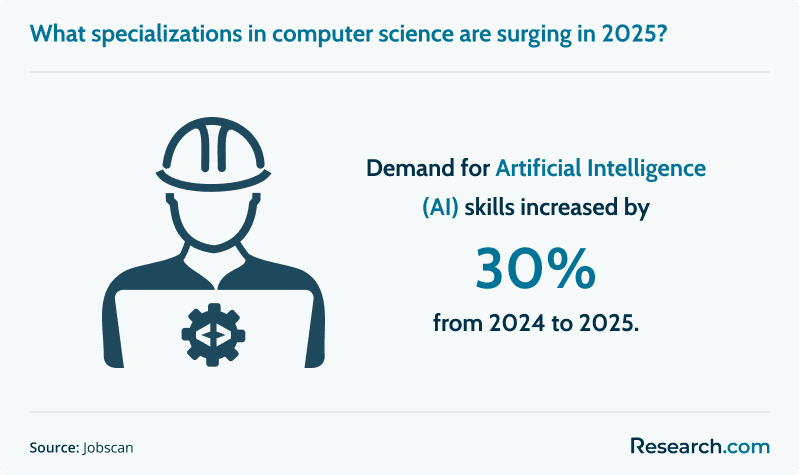
Specializations help students align a general computer science degree with a specific career direction. They are most useful when they include hands-on projects, current tools, and enough depth to support internships or entry-level applications. Students drawn to AI can also compare degree tracks with the shortest online artificial intelligence programs to understand how quickly they can build targeted skills.
| Specialization | Typical topics | Good fit for students who want to... |
| Artificial Intelligence & Machine Learning | Algorithms, neural networks, natural language processing, statistical modeling | Work on intelligent systems, automation, predictive tools, or AI-enabled products |
| Cybersecurity & Network Security | Threat detection, cryptography, secure networks, risk management, ethical hacking labs | Protect systems, analyze attacks, and prepare for security operations or analyst roles |
| Data Science & Analytics | Statistical computing, data visualization, big data tools, data management | Turn raw data into insights for business, healthcare, finance, or public-sector decisions |
| Software Engineering & Development | Application design, testing, Agile methods, code review, software architecture | Build and maintain production-quality software products |
| Human-Computer Interaction & UX Design | User research, prototyping, usability testing, interface design | Blend technical development with user-centered product design |
| Cloud Computing & Systems | Virtualization, distributed systems, AWS, Azure, Google Cloud, cloud architecture | Support scalable infrastructure, cloud migration, DevOps, or platform engineering |
How do you choose an online bachelor’s in computer science program?
The right online computer science program should match your background, schedule, budget, and career target. Accreditation and tuition matter, but they are not enough. You also need to know how the program teaches programming, how students collaborate, whether projects are portfolio-ready, and how the school supports online learners.
Questions to ask before enrolling
- Is the institution accredited? Confirm institutional accreditation through recognized agencies before applying.
- Does the program have ABET accreditation? ABET is not required for every CS job, but it can signal additional program-level quality in some cases.
- How many credits will I need after transfer evaluation? Do not rely on a general transfer estimate. Ask for a degree-specific audit.
- Are courses asynchronous, synchronous, or mixed? A flexible format is only useful if it fits your work and family schedule.
- What tools will I use? Browser-based IDEs can be beginner-friendly, while local development environments using Git, Docker, or Visual Studio Code may better reflect workplace expectations.
- How are group projects handled? Look for structured collaboration through GitHub Classroom, Slack, Trello, peer code reviews, or Agile sprints.
- What career support is available to online students? Ask about internships, resume reviews, mock interviews, employer events, and alumni networking.
- Can I pause or slow down if needed? Accelerated formats can be demanding, so understand withdrawal, retake, and leave policies.
Students comparing online learning formats in other fields will see similar decision points. For example, the fastest online master's in early childhood education programs also require careful attention to practical training, collaboration tools, and field-relevant support.
If you are not ready for a bachelor’s program, an affordable online associate degree in computer science can be a lower-cost way to build fundamentals before transferring into a four-year pathway.
Common mistakes to avoid
| Mistake | Why it can hurt you | Better approach |
| Choosing only the fastest program | You may sacrifice depth, support, or portfolio quality. | Balance speed with curriculum rigor and career outcomes. |
| Looking only at tuition per credit | Fees, transfer-credit loss, and longer timelines can raise total cost. | Compare full estimated cost to graduation. |
| Assuming all credits transfer | Credits may count as electives but not toward major requirements. | Request a written degree audit before committing. |
| Ignoring math preparation | Weak math skills can make algorithms, discrete math, and systems courses harder. | Refresh algebra, discrete math basics, and calculus if required. |
| Skipping portfolio development | A degree alone may not stand out in competitive entry-level hiring. | Build public projects, capstones, GitHub repositories, and technical documentation. |
| Assuming online means easier | Accelerated technical coursework can be more intense because deadlines arrive quickly. | Plan weekly study blocks and reduce course load when needed. |
How do I verify the accreditation and quality standards of an online computer science program?
Start by confirming that the institution is accredited by an agency recognized by the U.S. Department of Education. Then check whether the computer science program itself has additional programmatic accreditation, such as ABET, if that matters for your goals. Also review faculty qualifications, curriculum update frequency, student support services, online lab access, graduation requirements, and career outcomes.
Use rankings and third-party reviews as supporting information, not as your only decision tool. A program can rank well overall but still be a poor fit for your schedule, transfer credits, or career target. Students comparing quality and cost across disciplines can apply the same verification mindset used when reviewing options such as the most affordable biotechnology masters online.
What career paths are available for graduates of an online bachelor’s in computer science program?
An online bachelor’s in computer science can lead to several technical and hybrid roles. The best path depends on your coursework, projects, internships, certifications, and preferred work style. Students in other online programs, such as the fastest online master's in gifted education programs, also use specialization to target specific career settings; computer science students should do the same.
| Career path | What the role involves | Useful preparation |
| Software Developer / Engineer | Design, code, test, maintain, and improve applications or systems. Worldwide, there are approximately 28.7 million software developers. | Data structures, algorithms, software engineering, Git, testing, portfolio projects |
| Information Security or Cybersecurity Analyst | Protect systems, monitor threats, investigate incidents, and reduce security risk. BLS projects 33% job growth through 2030. | Networking, operating systems, security labs, scripting, certifications, threat analysis |
| Database Administrator or Network Architect | Design, manage, secure, and optimize databases or network systems. Both specialties offer average salaries over $120,000 annually. | Databases, SQL, networking, cloud platforms, systems administration |
| Computer and Information Research Scientist | Research advanced computing methods, algorithms, architectures, or emerging technologies. These roles earn median salaries above $130,000. | Advanced math, algorithms, research experience, graduate study for many positions |
| Data Analyst / Data Scientist | Use computing, statistics, and visualization to interpret data and support decisions. The average computer science major's salary typically falls between $120,000 and $130,000, depending on experience and specialization. | Statistics, Python, SQL, machine learning, visualization, data projects |
Computer science work can include writing software, fixing bugs, automating business processes, improving databases, testing security, building internal tools, or supporting cloud infrastructure. Some graduates move into hybrid roles such as UX engineer, technical product manager, technical project manager, or solutions architect.
Specialized skills can also affect earning potential. Career paths involving cybersecurity, AI, cloud architecture, and advanced software engineering may lead to some of the highest-paying computer science jobs, although compensation depends on experience, location, and employer needs.
What is the job market like for graduates of an online bachelor’s in computer science program?
The technology job market remains strong overall, but entry-level hiring is more competitive than it was during the peak of pandemic-era tech expansion. The Bureau of Labor Statistics projects 11% to 14% growth in computer and information technology occupations within a decade. Growth is especially relevant in software development, cybersecurity, systems analysis, cloud infrastructure, and data-related roles.
Technology now drives about 23% of all new STEM jobs, and around 67% of CS graduates land full-time jobs within six months after graduation. At the same time, entry-level postings at large technology firms have dropped by over 50% compared with pre-pandemic levels. This means graduates should expect opportunity, but not automatic placement.
To compete, online CS students should graduate with more than transcripts. Strong candidates often have internships, open-source contributions, GitHub repositories, capstone projects, certifications, hackathon work, or documented freelance and volunteer projects. Students who want a faster path into a specialized security field may also consider a fast-track online cybersecurity bachelor's degree.
What do graduates say about online bachelor’s in computer science programs?
-
: "
"I picked an online program because I could not leave my help desk job. The format ended up fitting my schedule better than I expected. I watched recorded lectures during quiet overnight shifts and worked on programming assignments before clocking out. My capstone used cloud automation tools that my employer already used, so the coursework immediately connected to my job." – Mark
"
-
: "
"Returning to school after almost ten years felt intimidating, especially with two children at home. The online format made it possible. I studied after bedtime, replayed difficult lectures, and used a virtual study group when topics like recursion and data structures got challenging. That support made the program feel less isolating." – Justin
"
-
: "
"I underestimated how much teamwork would matter in an online program. In software engineering, my group used GitHub, Trello, and Slack to build a task manager app in six weeks. We followed Agile sprints and reviewed one another’s code. I later used that project in interviews, and recruiters liked that it reflected real development practices." – Adam
"
Is specializing in fields like game development a strategic career move?
Game development can be a smart specialization for students who want to combine programming, graphics, design, storytelling, physics, and user experience. It is also a competitive field, so students should evaluate the curriculum carefully. A strong pathway should include programming depth, engine experience, collaborative projects, and a portfolio that shows completed work.
Students interested in this direction can compare general CS programs with an online game development degree. A broader computer science degree may offer more flexibility across industries, while a game-focused program may provide more targeted portfolio preparation for studios and interactive media companies.
How Do Online Computer Science Programs Strengthen Professional Networking and Career Support?
Online programs vary widely in career support. Strong programs do not treat online learners as secondary students. They provide virtual career coaching, resume and GitHub reviews, mock technical interviews, internship guidance, alumni communities, employer events, and mentorship opportunities.
Networking is especially important for online students because they may not have the same spontaneous campus interactions as residential students. Look for programs that build community through live coding sessions, student clubs, Discord or Slack groups, hackathons, capstone showcases, and alumni panels. Some students also combine technical education with management preparation through pathways such as the fastest online master's degree engineering management to prepare for future technical leadership roles.
Can Pursuing an Advanced Degree Accelerate My Tech Career?
A master’s degree can help some computer science graduates move into advanced technical, research, AI, data science, cybersecurity, or leadership roles. It is not always necessary for entry-level software work, but it can be valuable when a role requires deeper specialization, advanced mathematics, research capability, or management preparation.
Before applying to graduate school, compare the cost with the likely career benefit. Ask whether your goal could be met through a certification, employer-sponsored training, portfolio work, or a focused graduate certificate. For students interested in AI specialization, the cheapest online masters in artificial intelligence programs may provide a more cost-conscious route to advanced study.
References
- Business Insider. (2025, June). Mira Murati's startup is dangling $500,000 salaries to win the AI arms race. https://www.businessinsider.com/muratis-new-ai-startup-salary-technical-talent-2025-6
- ComputerScience.org. (n.d.). Best online bachelor’s in computer science programs. https://www.computerscience.org/degrees/bachelors/online/
- Financial Times. (2024, March). AI talent wars lead to superstar salaries for top tech staff. https://www.ft.com/content/d48e7cfe-7b04-4cdd-8769-c88c83522118
- Mission: Graduate. (n.d.). College dropout statistics. https://missiongraduatenm.org/college-dropout-statistics/
- Pew Research Center. (2023, May 4). Online learning in higher education. https://www.pewresearch.org/internet/2023/05/04/online-learning-in-higher-education/
- Southern Illinois University. (n.d.). Jobs vs. grads: What’s the outlook for CS students? https://soc.siu.edu/student-resources/jobs-vs-grads.php
- Steppingblocks. (n.d.). What are the highest-paying skills in computer science? https://blog.steppingblocks.com/high-paying-skills-computer-science
- Student Clearinghouse. (2023, November 16). Computer science has highest increase in bachelor’s earners. https://www.studentclearinghouse.org/nscblog/computer-science-has-highest-increase-in-bachelors-earners
Key Insights
- A fast online bachelor’s in computer science is most valuable when it is accredited, transfer-friendly, technically rigorous, and built around real projects—not just convenience.
- Accelerated formats can shorten completion to 1.5 to 3 years for some students, but the workload is demanding and requires disciplined weekly study time.
- Many online bachelor’s in computer science programs cost between $36,000 and $84,000 in tuition, but total cost depends on transfer credits, fees, software, hardware, and time to completion.
- Online CS programs can prepare students for roles in software, cybersecurity, data, cloud systems, healthcare IT, finance, government, retail, and education technology.
- Specializations such as AI, cybersecurity, software engineering, data analytics, cloud computing, and game development are useful when they include hands-on projects and align with a clear career goal.
- Entry-level tech hiring is competitive. Graduates improve their odds by building a portfolio, completing internships or capstones, earning relevant certifications, and practicing technical interviews.
- Do not choose a program based only on speed or tuition. Verify accreditation, transfer-credit rules, course tools, project requirements, career support, and total cost before enrolling.
Other Things You Should Know About Getting an Online Bachelor’s Degree in Computer Science for CURRENT_YEAR
Yes, many accelerated online computer science bachelor’s programs require a capstone project in the final term. Commonly, students complete a software or systems project after finishing about 120 semester credits, with the capstone assessed by faculty and tied to program learning outcomes.
Most of 2027's fastest online Bachelor's in Computer Science programs do not have residency requirements. Students can complete all coursework online, but some programs may require periodic in-person workshops or exams to fulfill graduation criteria. Confirm specifics with each institution.


