
2027 Best Online Master's in Higher Education Programs

Co-Founder and Chief Data Scientist
Did you know postsecondary enrollment climbed by 2.5%—an increase of 476,522 students—in Fall 2023 compared to 2022? Meanwhile, postsecondary education administrators command a median salary of $103,960 per year, with about 15,200 annual openings projected through 2033.
This article examines the advantages of earning a fully online master’s in higher education, offers up‑to‑date career data, and outlines key factors—like program quality, accreditation, and support services—to guide your decision.
What are the benefits of completing an online master's in higher education program?
- Median salary for postsecondary education administrators is $103,960 per year.
- Job outlook projects 3% growth from 2023 to 2033, about as fast as average.
- Career paths include roles in student affairs, institutional research, and academic administration.
What can I expect from an online master's in higher education program?
An online master’s in higher education blends rigorous academic coursework—such as organizational theory, student development, and policy analysis—with experiential learning like internships or capstone projects. You’ll engage in synchronous and asynchronous classes, collaborate with peers in virtual cohorts, and access university services (e.g., academic advising, library resources, and career coaching). Expect to build leadership skills, design data‑driven initiatives, and prepare for roles overseeing student services, faculty affairs, and institutional research.
Where can I work with an online master's in higher education program?
Graduates with an online master’s in higher education often find themselves leading departments and programs at postsecondary institutions, nonprofit organizations, and education‑focused governmental agencies. They may also transition into roles at educational consultancies, training companies, or higher‑ed technology firms.
Top employing industries for postsecondary education administrators (BLS, May 2023):
- Colleges, universities, and professional schools: 133,900 employed
- Junior colleges: 25,120 employed
- Technical and trade schools: 3,980 employed
States with the highest employment levels (May 2023):
- Texas: 14,680 positions
- California: 13,920 positions
- Illinois: 10,590 positions
- Florida: 9,090 positions
- Pennsylvania: 9,070 positions
How much can I make with an online master's in higher education program?
According to the U.S. Bureau of Labor Statistics, postsecondary education administrators earned a median annual wage of $103,960 in May 2024. Earnings vary by employer type, location, and experience. Below are six salary benchmarks from leading job platforms:
- Zippia: $67,252 / year – average for Educational Administrators nationwide
- Salary.com: $56,287 / year – average for Higher Education Administration roles
- ZipRecruiter: $80,932 / year – average for Higher Education Administrator positions
- PayScale: $52,675 / year – average for Education Administrator, Postsecondary
- Glassdoor: $63,980 / year – average reported pay
These figures illustrate the range you can expect as a graduate of an online master’s in higher education, with top roles often exceeding six figures, especially in leadership tracks.
- Best Online Master's in Higher Education Programs for 2027 List of Programs
- How long does it take to complete an online master's in higher education program? Program Duration
- How does an online master's in higher education compare to an on-campus program? Online vs Campus
- What is the average cost of an online master's in higher education program? Program Cost
- What are the financial aid options for students enrolling in an online master's in higher education program? Financial Aid
- What are the prerequisites for enrolling in an online master's in higher education program? Admission Requirements
- What courses are typically in an online master's in higher education program? What courses are typically in an online master's in higher education program?
- What types of specializations are available in an online master's in higher education programs? What types of specializations are available in an online master's in higher education programs?
- How do you choose the best online master's in higher education program? How do you choose the best online master's in higher education program?
- What career paths are available for graduates of an online master's in higher education programs? Career Paths
- What is the job market like for graduates of online master's in higher education programs? Job Outlook
- Is an online master's in higher education program a sound financial investment? Is an online master's in higher education program a sound financial investment?
- What challenges might I face during my online master's in higher education program? What challenges might I face during my online master's in higher education program?
- Could a Related Online Degree Offer Similar Career Benefits? Could a Related Online Degree Offer Similar Career Benefits?
Best Online Master's in Higher Education Programs for 2027
Choosing an online master’s in higher education is usually a career decision, not just an academic one. You may already work in admissions, advising, student affairs, academic support, enrollment management, institutional research, or another campus role and want a credential that can help you move into leadership. Or you may be entering higher education from teaching, nonprofit work, public policy, counseling, or administration and need a practical graduate program that explains how colleges operate.
This guide compares strong online master’s programs in higher education and explains how to evaluate cost, accreditation, curriculum, format, career outcomes, and fit. It also covers admissions requirements, typical courses, specializations, job paths, financial aid, and the trade-offs between online and on-campus study. If you later decide that senior academic leadership or research-intensive roles require a doctorate, you can also compare accredited online doctoral programs after completing your master’s.
Quick answer: What is the best online master’s in higher education?
The best online master’s in higher education is the program that matches your career goal, budget, schedule, and target area of practice. Student affairs professionals may prioritize programs with internships, cohort learning, and advising-focused coursework. Policy-minded students may prefer programs with governance, law, finance, and institutional research. Working professionals should compare total credits, per-credit tuition, accreditation, live class requirements, field experience options, and whether online students receive the same career and faculty support as campus students.
How do we rank schools?
Research.com rankings are built from a structured ranking methodology that evaluates academic quality, value, institutional credibility, and student-relevant outcomes. The goal is not to name a universally perfect program; it is to help prospective students identify reputable options and then compare them against their own career plans.
Our research draws on major education data sources, including the IPEDS database from the National Center for Education Statistics, Peterson's database, including its Distance Learning Licensed Data Set, and the College Scorecard database. These sources help verify institutional details, costs, distance learning availability, and student outcome indicators where available.
At-a-glance comparison of featured online master’s in higher education programs
| Rank | University and program | Cost listed | Typical duration | Credits or units | Accreditation listed |
| 1 | University of Florida — M.Ed. in Student Personnel in Higher Education | ~$550/credit (Florida residents) | 2 years | 46 credits | Southern Association of Colleges and Schools Commission on Colleges (SACSCOC) |
| 2 | University of Southern California — M.Ed. in Postsecondary Administration and Student Affairs | $2,467/unit | 1 year (full-time) or 2 years (part-time) | 30 units | WASC Senior College and University Commission (WSCUC) |
| 3 | University of Michigan — Master of Arts in Higher Education and Master of Public Policy | $1,825/credit | 2 years | 30 credits | Higher Learning Commission (HLC) |
| 4 | University of Missouri — M.Ed. in Educational Leadership & Policy Analysis: Higher Education | $590/credit | ~2 years (8-week courses, full-time or part-time options) | 33 credits | Higher Learning Commission (HLC) |
| 5 | Michigan State University — M.A. in Higher, Adult, and Lifelong Education | $933/credit | ~2 years (self-paced up to 5 years maximum) | 30 credits | Higher Learning Commission (HLC) |
| 6 | Northeastern University — M.Ed. in Higher Education Administration | ~$800/credit (estimated; ~$36,000 total tuition) | 1–2 years (full-time or part-time) | ≈45 quarter credits (equivalent to ~30 semester credits) | New England Commission of Higher Education (NECHE) |
| 7 | University of Nebraska–Lincoln — M.A. in Educational Administration: Higher Education | $365/credit | 2 years (can be completed in ~5 semesters part-time) | 30 credits | Higher Learning Commission (HLC) |
| 8 | Arizona State University — M.Ed. in Higher and Postsecondary Education | $692/credit | ~2 years (full-time can finish in ~18–24 months) | 30 credits | Higher Learning Commission (HLC) |
| 9 | Boston University — Ed.M. in Educational Leadership & Policy Studies: Higher Education Administration | $815/credit | ~18 months (full-time) or 2+ years (part-time) | 36 credits | New England Commission of Higher Education (NECHE) |
| 10 | Colorado State University — M.S. in Student Affairs in Higher Education | $698/credit | 2 years (designed as a part-time cohort program) | 33 credits | Higher Learning Commission (HLC) |
1. University of Florida – M.Ed. in Student Personnel in Higher Education (SPHE)
The University of Florida offers an online SPHE master’s through its College of Education for students preparing for student affairs, student services, and campus support leadership. Founded in 1853 and based in Gainesville, UF is a flagship public research university, and this program is structured for professionals who want a recognized public-university credential with a student personnel focus.
- Program cost: ~$550/credit (Florida residents)
- Program duration: 2 years
- Total credits needed: 46 credits
- Program/School Accreditation: Southern Association of Colleges and Schools Commission on Colleges (SACSCOC)
2. University of Southern California – M.Ed. in Postsecondary Administration and Student Affairs (PASA)
The University of Southern California delivers its online PASA program through the Rossier School of Education. Founded in 1880, USC is a private research university in Los Angeles with a large professional network, making this option especially relevant for students who want a student affairs and postsecondary administration degree tied to a prominent education school and broad alumni base.
- Program cost: $2,467/unit
- Program duration: 1 year (full-time) or 2 years (part-time)
- Total credits needed: 30 units
- Program/School Accreditation: WASC Senior College and University Commission (WSCUC)
3. University of Michigan – Master of Arts in Higher Education and Master of Public Policy (Dual Degree)
The University of Michigan dual degree combines higher education study with public policy training through the Marsal Family School of Education and Gerald R. Ford School of Public Policy. Established in 1817 in Ann Arbor, the university is a major public research institution, and this option is best suited to students interested in policy analysis, governance, institutional strategy, and leadership roles that require a broader public-sector lens.
- Program cost: $1,825/credit
- Program duration: 2 years
- Total credits needed: 30 credits
- Program/School Accreditation: Higher Learning Commission (HLC)
4. University of Missouri – M.Ed. in Educational Leadership & Policy Analysis: Higher Education
The University of Missouri offers an online M.Ed. with a higher education emphasis through its College of Education & Human Development. Founded in 1839 in Columbia, Mizzou is the state’s flagship public research university, and the program’s 8-week course format may appeal to students who want a structured but flexible path through leadership and policy coursework.
- Program cost: $590/credit
- Program duration: ~2 years (8-week courses, full-time or part-time options)
- Total credits needed: 33 credits
- Program/School Accreditation: Higher Learning Commission (HLC)
5. Michigan State University – M.A. in Higher, Adult, and Lifelong Education (HALE)
Michigan State University offers the online HALE M.A. for students interested in higher education, adult learning, and lifelong education. Founded in 1855 in East Lansing, MSU is a land-grant university with a long history in education. The program’s self-paced design can be useful for working professionals who need flexibility while building expertise in administration, learning, and postsecondary systems.
- Program cost: $933/credit
- Program duration: ~2 years (self-paced up to 5 years maximum)
- Total credits needed: 30 credits
- Program/School Accreditation: Higher Learning Commission (HLC)
6. Northeastern University – M.Ed. in Higher Education Administration
Northeastern University offers an online M.Ed. in Higher Education Administration through its College of Professional Studies. Founded in 1898 in Boston, Northeastern is known for experiential and career-connected education, and this program may fit students who want applied projects, professional relevance, and preparation for administrative work across varied postsecondary settings.
- Program cost: ~$800/credit (estimated; ~$36,000 total tuition)
- Program duration: 1–2 years (full-time or part-time)
- Total credits needed: ≈45 quarter credits (equivalent to ~30 semester credits)
- Program/School Accreditation: New England Commission of Higher Education (NECHE)
7. University of Nebraska–Lincoln – M.A. in Educational Administration (Higher Education)
The University of Nebraska–Lincoln offers an online M.A. in Educational Administration with a higher education focus. Chartered in 1869, UNL is Nebraska’s flagship public university and a Big Ten institution. The program is designed for professionals seeking preparation in leadership, administration, governance, and related areas of campus management.
- Program cost: $365/credit
- Program duration: 2 years (can be completed in ~5 semesters part-time)
- Total credits needed: 30 credits
- Program/School Accreditation: Higher Learning Commission (HLC)
8. Arizona State University – M.Ed. in Higher and Postsecondary Education
Arizona State University’s online M.Ed. in Higher and Postsecondary Education is offered through ASU Online and the Mary Lou Fulton Teachers College. Founded in 1885 and centered in Tempe, ASU is a public research university known for large-scale online education. This program is appropriate for students who want preparation in leadership, equity, and contemporary postsecondary challenges in a fully online format.
- Program cost: $692/credit
- Program duration: ~2 years (full-time can finish in ~18–24 months)
- Total credits needed: 30 credits
- Program/School Accreditation: Higher Learning Commission (HLC)
9. Boston University – Ed.M. in Educational Leadership & Policy Studies: Higher Education Administration
Boston University offers an Ed.M. concentration in Higher Education Administration through Wheelock College of Education & Human Development. Founded in 1839, BU is a private research university in Boston. The program is a strong fit for students looking for coursework in leadership, policy, student affairs, counseling-related foundations, and higher education administration in either online or campus formats.
- Program cost: $815/credit
- Program duration: ~18 months (full-time) or 2+ years (part-time)
- Total credits needed: 36 credits
- Program/School Accreditation: New England Commission of Higher Education (NECHE)
10. Colorado State University – M.S. in Student Affairs in Higher Education (SAHE)
Colorado State University offers an M.S. in Student Affairs in Higher Education in online and on-campus formats. Founded in 1870 in Fort Collins, CSU is a public land-grant research university. The online SAHE option is designed as a part-time cohort program, making it especially relevant for students who want a structured student affairs curriculum while continuing to work.
- Program cost: $698/credit
- Program duration: 2 years (designed as a part-time cohort program)
- Total credits needed: 33 credits
- Program/School Accreditation: Higher Learning Commission (HLC)
How long does it take to complete an online master's in higher education program?
Most online master’s programs in higher education require 30–48 credit hours. For many students, that means about 1.5–2 years of full-time study. Some accelerated formats may be completed in 12–15 months when students take heavier course loads or attend year-round, similar to other one year online masters options designed for fast completion.
Part-time students usually need more time, especially if they are working full time in a college, university, nonprofit, or school system. A 2–4 year timeline is common for students taking fewer courses per term. Some universities also set a maximum completion window of 5–7 years, which gives students room to pause or slow down if work or family obligations change.
| Enrollment pace | Typical timeline | Best for | Main trade-off |
| Accelerated full-time | 12–15 months | Students who can prioritize school heavily | Less room for work, internships, or family demands |
| Standard full-time | 1.5–2 years | Students who want steady progress | More intense than part-time study |
| Part-time | 2–4 years | Working professionals and caregivers | Longer time before graduation and potential career advancement |
| Extended flexible pacing | Up to 5–7 years at many institutions | Students with unpredictable schedules | Requires long-term motivation and careful planning |
How does an online master's in higher education compare to an on-campus program?
An online master’s in higher education can provide the same credential value as an on-campus program when the institution is properly accredited, the curriculum is comparable, and online students receive meaningful faculty access and support. The biggest difference is not usually the degree title; it is the learning experience.
Online formats are built for students who need flexibility. Lectures, discussions, advising meetings, and group work may occur through a learning management system, video conferencing, discussion boards, and virtual collaboration tools. On-campus programs, by contrast, provide easier access to in-person events, spontaneous networking, campus offices, and local assistantships. As with an online degree in energy policy, the key is to verify whether the online version uses the same faculty standards, assessment expectations, and accreditation as the campus program.
| Factor | Online master’s in higher education | On-campus master’s in higher education |
| Schedule | Often more flexible, especially for working adults | Usually tied to fixed class times and campus availability |
| Networking | Requires intentional participation in virtual events, cohorts, and professional associations | More natural access to campus offices, classmates, and local events |
| Field experience | May allow projects or internships near the student’s location | Often connected to the institution’s own campus offices |
| Cost considerations | May reduce commuting, relocation, parking, and housing costs | May provide more access to campus assistantships, depending on the school |
| Best fit | Professionals who need to keep working while studying | Students who want an immersive campus-based graduate experience |
If you are still comparing education graduate pathways, Research.com also maintains a broader guide to online master of education degrees, including options beyond higher education administration.
What is the average cost of an online master's in higher education program?
Graduate tuition varies sharply by school type, residency status, credit load, and fee structure. According to the latest NCES report cited in the original data, median graduate tuition and required fees were $12,410 at public institutions and $27,420 at private nonprofit institutions. When living expenses, books, and supplies are included, average total annual costs for master’s students ranged from $20,000 (public, on-campus) to $50,000 (private, on-campus).
Online higher education programs often bill by the credit. The original cost range cited for public schools is $500–$900 per credit hour, while private nonprofit programs commonly fall between $800–$1,200 per credit. Online students may avoid some campus-based expenses, including relocation, commuting, parking, and certain activity fees. Other online graduate credentials, such as online graduate certificate programs in nursing informatics, often show the same basic pricing pattern: institution type and delivery model strongly influence total cost.
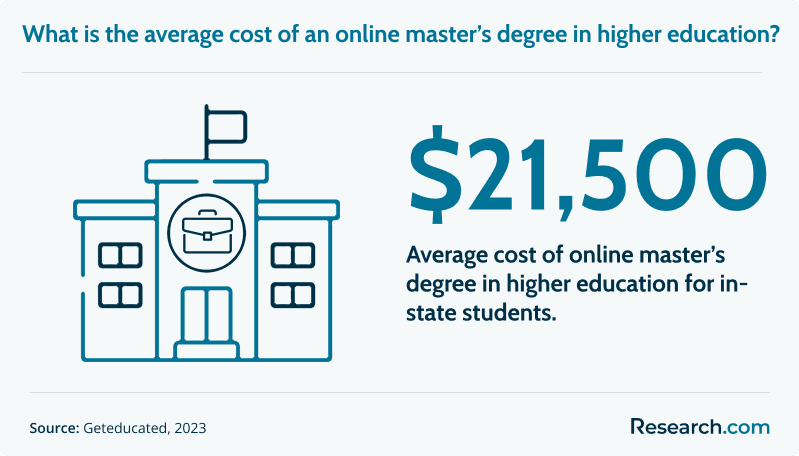
The graphic below reports that in 2023, in-state students paid an average of $21,500 for a fully online master’s in higher education. Use that figure as a starting point, not a guarantee. Your actual cost depends on tuition classification, total credits, required fees, books, technology costs, and whether you receive scholarships, assistantships, employer reimbursement, or military benefits.
What are the financial aid options for students enrolling in an online master's in higher education program?
Online graduate students may qualify for many of the same aid sources as campus students, as long as the school participates in eligible aid programs and the student meets the requirements. Similar aid categories also apply to programs such as nurse education graduate certificate programs online.
- Federal Direct Unsubsidized Loans: These loans are available to eligible graduate students regardless of demonstrated financial need, and interest accrues while the student is enrolled.
- Graduate PLUS Loans: These credit-based federal loans can help cover remaining education costs after other aid, though they generally carry a higher interest rate than Direct Unsubsidized Loans.
- Institutional Scholarships & Fellowships: Universities may offer merit-based, need-based, department-based, or program-specific awards. Availability and competitiveness vary widely.
- Graduate Assistantships: Some students may receive tuition remission, stipends, or both through teaching, research, administrative, or student affairs assistantships, though online students should confirm whether remote assistantships are available.
- Employer Tuition Reimbursement: Colleges, universities, school systems, nonprofits, and public agencies may help employees pay for graduate study when the degree supports their role.
- Veterans’ and Military Benefits: Eligible service members, veterans, and dependents may use Post-9/11 GI Bill, Yellow Ribbon Program, and other VA benefits for approved programs.
- Education Tax Benefits: The Lifetime Learning Credit and student loan interest deduction may reduce federal tax liability for qualifying students and borrowers.
- State Grants and Aid: Some states provide graduate aid, tuition waivers, or resident-specific funding at in-state public institutions.
- Private and Professional Organization Scholarships: Professional associations, including ACPA and NASPA, may offer scholarships or awards for students preparing for higher education administration and student affairs careers.
- Emergency Relief Funds: Many institutions maintain short-term support for students facing unexpected financial hardship.
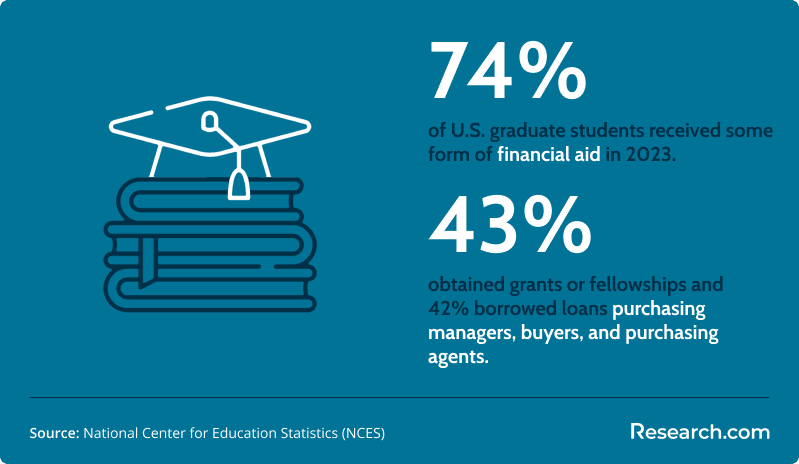
The chart below notes that in 2023, 74% of U.S. graduate students received financial aid, while 43% received grants or fellowships and 42% used loans. Before enrolling, ask each school for a full aid estimate that separates gift aid, loans, assistantships, and out-of-pocket costs.
What are the prerequisites for enrolling in an online master's in higher education program?
Admissions requirements vary, but most online master’s in higher education programs expect applicants to show that they can handle graduate-level reading, writing, research, and professional reflection. Some programs welcome career changers, while others prefer applicants with prior experience in education, student services, advising, administration, residence life, nonprofit work, or related fields. Requirements are more directly related to graduate education than unrelated credentials such as the best online dog training certification, so always review the specific admissions page for each university.
- Bachelor’s degree from an accredited institution, often in education, social sciences, humanities, public administration, or a related field.
- Minimum undergraduate GPA of 2.5–3.0 on a 4.0 scale, with many programs expecting at least 3.0.
- Official transcripts from every postsecondary institution attended.
- Resume or CV showing employment, volunteer work, leadership, or campus-related experience.
- Statement of purpose explaining why you want to study higher education and how the degree supports your goals.
- Two to three recommendation letters from academic, professional, or supervisory references.
- GRE or GMAT scores if required, although some schools waive standardized testing based on GPA, experience, or current admissions policy.
- Professional experience, sometimes preferred and sometimes required, often 1–3 years in an educational setting.
- Reliable computer access, stable internet, and comfort using online learning platforms.
What courses are typically in an online master's in higher education program?
A master’s in higher education usually combines leadership theory, student development, policy, law, finance, assessment, and applied research. Programs differ by emphasis, but most are designed to help students understand how colleges and universities serve students, manage resources, comply with regulations, and make evidence-based decisions.
| Course area | What students study | Why it matters professionally |
| Foundations of Higher Education | History, mission, structure, and purpose of colleges and universities | Helps professionals understand institutional context and governance |
| Student Development Theory | Psychological, social, and identity-based frameworks for student growth | Supports advising, residence life, engagement, and student success work |
| Organizational Theory in Education | Leadership, change management, culture, and decision-making structures | Prepares graduates to work across departments and lead initiatives |
| Research Methods and Data Analysis | Qualitative and quantitative methods, evaluation, and institutional data | Builds skills for assessment, institutional research, and program improvement |
| Assessment and Evaluation | Learning outcomes, program review, rubrics, and evidence-based reporting | Supports accreditation, accountability, and continuous improvement |
| Leadership and Ethics | Ethical decision-making, equity, professional responsibility, and leadership models | Prepares administrators for complex decisions affecting students and staff |
| Higher Education Policy and Law | Regulation, accreditation, compliance, student rights, and institutional obligations | Important for roles involving policy, conduct, Title IX, FERPA, and reporting |
| Financial Management in Higher Education | Budgeting, resource allocation, revenue models, and departmental planning | Useful for directors, deans, and administrators managing programs or teams |
| Capstone or Internship | Applied project, supervised fieldwork, or professional portfolio | Connects coursework to real campus problems and career goals |
The chart below identifies skills universities seek in higher education administrators, including syllabus design (28.4%), K-12 expertise (20.8%), and institutional analytics (14.1%). These areas connect closely to coursework in assessment, policy, analytics, curriculum, and organizational leadership.
What types of specializations are available in an online master's in higher education programs?
Specializations help you align the degree with the part of higher education where you want to work. A student affairs track may be ideal for advising, residence life, conduct, or engagement roles. A policy or institutional research track may be better for students interested in analytics, governance, or executive decision support. Students interested in learning science may also compare related pathways such as educational psychology careers.
| Specialization | Best for students interested in | Possible professional focus |
| Student Affairs & Enrollment Management | Admissions, advising, retention, student engagement, and student support | Academic advising, enrollment services, student success, residence life |
| Academic Program Design & Assessment | Curriculum, learning outcomes, program review, and accreditation | Assessment coordination, academic affairs, curriculum support |
| Diversity, Equity & Inclusion | Inclusive campus climate, access, equity initiatives, and student belonging | DEI programming, student support, multicultural affairs |
| Institutional Research & Data Analytics | Campus data, survey research, reporting, and strategic planning | Institutional research, assessment, decision support |
| Alumni Relations & Fundraising | Donor engagement, campaigns, advancement, and external relations | Development, alumni engagement, advancement operations |
| Community College Leadership | Two-year institutions, access missions, workforce programs, and transfer pathways | Community college administration, student services, program management |
| Distance Learning & Technology Integration | Online learning, digital student support, learning platforms, and virtual programs | Online program coordination, instructional support, student success technology |
| Athletic Program Management | Sports administration, compliance, student-athlete support, and program operations | Athletics administration, compliance support, student-athlete services |
| Legal & Regulatory Compliance | Higher education law, Title IX, FERPA, risk, and reporting requirements | Compliance, student conduct, policy administration |
The chart below shows where many master’s-prepared administrators work: 133,900 in colleges and universities, 25,120 in junior colleges, and 3,980 in technical and trade schools. Those employment settings can help you choose a specialization that fits the type of institution where you want to build your career.
How do you choose the best online master's in higher education program?
Start with your intended role, then evaluate programs against that goal. A lower-cost program is not automatically the best choice if it lacks the specialization, internship access, or professional network you need. A prestigious program is not automatically the best choice if the debt level is too high or the schedule is unrealistic.
- Confirm accreditation first. Verify institutional accreditation and make sure the credential will be recognized by employers, doctoral programs, and financial aid systems.
- Match the curriculum to your target role. Student affairs, institutional research, policy, enrollment management, and academic affairs require overlapping but different skill sets.
- Compare total program cost, not just tuition. Add tuition, fees, books, technology charges, travel requirements, and lost income if you reduce work hours.
- Ask whether online students can access the same services. Look for virtual advising, library access, career coaching, writing support, faculty office hours, and tech support.
- Review live attendance expectations. Some programs are mostly asynchronous; others require scheduled video classes, weekend sessions, or limited campus visits.
- Check fieldwork and internship rules. Ask whether you can complete applied projects at your current workplace or a nearby institution.
- Look for evidence of career alignment. Review alumni roles, employer connections, practicum sites, capstone examples, and career services support.
- Evaluate faculty fit. Faculty expertise should align with your interests in student affairs, policy, governance, finance, equity, data, or online learning.
- Understand transfer credit and time limits. Policies can affect both cost and graduation timeline.
- Talk to current students or recent graduates. Ask about workload, responsiveness, cohort quality, and whether the online experience felt well-supported.
Questions to ask before enrolling
| Question | Why it matters |
| Is the institution regionally accredited or otherwise properly accredited? | Accreditation affects aid eligibility, employer recognition, and doctoral study options. |
| Are online and campus students taught by the same faculty? | This can signal whether the online program is integrated into the academic department. |
| What is the total cost after fees and required materials? | Per-credit tuition does not show the full price of attendance. |
| Can I complete internships or applied projects where I live? | Fieldwork logistics can determine whether the program is practical. |
| How many live sessions are required? | Synchronous classes may be difficult for students in different time zones or work schedules. |
| What roles do graduates typically enter? | Career outcomes should align with your intended professional direction. |
| Are assistantships available to online students? | Assistantships can reduce cost and provide valuable experience, but access varies. |
The following chart notes that education master’s degrees accounted for 151,707 awards in the most recent NCES reporting cited here, second only to business. That volume shows that graduate education remains a major field, but it also means students should choose a program with a clear specialization and career strategy rather than enrolling based on degree title alone.
What career paths are available for graduates of an online master's in higher education programs?
Graduates often move into administrative, student support, policy, advising, assessment, enrollment, and leadership roles. Career growth is usually progressive: many professionals start in coordinator or advisor positions, then move into assistant director, director, dean, vice president, or executive leadership roles over time.
| Career stage | Example role | Typical focus | Salary data cited |
| Entry-level or early career | Academic Advisor | Course planning, degree progress, student support, referrals | Median annual wage: $61,710 |
| Early to mid-career | Assistant Director of Academic Advising | Supervising advisors, building workshops, improving advising systems | Often requires 3–5 years’ experience |
| Mid-career leadership | Director of Student Affairs | Student engagement, retention, conduct, programming, and support services | Postsecondary Education Administrators median wage: $102,610 |
| Senior administration | Associate Vice President of Student Services | Policy, multi-unit leadership, planning, and institutional priorities | Varies by institution size and location |
| Executive student affairs leadership | Vice President for Student Affairs | Strategy, large teams, budgets, student experience, and campus leadership | Varies by institution size and location |
| Academic executive leadership | Provost or Chief Academic Officer | Academic programs, faculty affairs, institutional research, and academic planning | Varies by institution size and location |
| Institution-wide leadership | President or Chancellor | Mission, operations, external relations, fundraising, and overall strategy | Chief Executives median wage: $206,680 |
Students aiming for the highest academic leadership or research-focused roles may eventually compare doctoral options, including the cheapest online PhD programs. A master’s can be a strong step toward leadership, but senior roles often also require substantial experience, institutional credibility, and in some cases a doctorate.
What is the job market like for graduates of online master's in higher education programs?
The U.S. Bureau of Labor Statistics projects employment for postsecondary education administrators to grow 3% from 2023 to 2033, about as fast as the average for all occupations. The same outlook cites about 15,200 openings each year, largely connected to workers leaving the occupation or retiring as well as ongoing institutional needs.
Demand is not evenly distributed across every campus office or region. Colleges and universities continue to need professionals who can support enrollment, retention, compliance, student well-being, online learning, financial planning, data reporting, and equity-focused initiatives. At the same time, hiring can be affected by enrollment shifts, state funding, institutional budgets, and restructuring. Students should evaluate the employment market in their target region and function, not just the national outlook.
For a broader view of earnings across education leadership roles, compare Research.com’s guide to high-paying jobs with a master’s in education. Salary varies by institution type, geography, seniority, department, and whether the role is academic, administrative, student-facing, or executive.
Is an online master's in higher education program a sound financial investment?
An online master’s in higher education can be a worthwhile investment when it helps you qualify for roles you could not reasonably access with your current credentials, when the total cost is manageable, and when the program’s network and curriculum align with your career plan. It is less compelling if you already have the experience required for your next role, if the program does not connect to your specialization, or if the debt would be difficult to repay on likely higher education salaries.
| ROI factor | What to evaluate | Decision signal |
| Total cost | Tuition, fees, books, technology, travel, and interest on loans | Lower debt improves flexibility after graduation |
| Current career level | Whether the degree fills a real credential or skill gap | Stronger value when it unlocks a specific next step |
| Employer support | Tuition reimbursement, schedule flexibility, promotions, or internal mobility | Employer funding can significantly change the cost-benefit calculation |
| Program fit | Specialization, faculty, internship access, and alumni network | Better fit usually matters more than general prestige alone |
| Long-term goal | Director, dean, vice president, policy, research, or doctoral pathway | Career clarity helps prevent overpaying for a poorly matched degree |
If your goal is senior leadership and you expect to continue beyond the master’s level, it may also be useful to compare doctoral timelines through resources such as the fastest EdD program guide. Do not assume that a doctorate is always necessary; match the credential to the job descriptions and leadership expectations in your target area.
What challenges might I face during my online master's in higher education program?
Online graduate study is flexible, but it is not effortless. Students often underestimate the time required for reading, discussion posts, group projects, research papers, and applied assignments. The lack of a daily campus routine can also make it easier to fall behind unless you create a consistent schedule.
- Time management pressure: Working professionals may need to protect weekly study blocks and communicate deadlines to supervisors and family members.
- Limited informal networking: Online students should actively attend virtual events, join professional associations, and build relationships with classmates and faculty.
- Technology problems: Reliable internet, backup access, and comfort with video meetings and learning platforms are essential.
- Group project coordination: Time zones and work schedules can complicate collaboration, so strong communication matters.
- Motivation over time: Part-time programs can last several years, making clear goals and steady progress especially important.
Students comparing online learning across fields may also find useful strategy ideas in Research.com’s guide to an anthropology degree online, especially when evaluating workload, virtual learning design, and program flexibility.
Common mistakes to avoid when choosing an online master’s in higher education
| Mistake | Why it can hurt you | Better approach |
| Choosing based only on ranking | A highly ranked program may not match your schedule, budget, or target role. | Use rankings as a shortlist, then compare curriculum and outcomes. |
| Looking only at per-credit tuition | Fees, books, technology costs, and total credit requirements can change the real price. | Request a full program cost estimate before applying. |
| Ignoring accreditation | Accreditation affects employer recognition, financial aid, and future doctoral options. | Verify accreditation through official institutional and accreditor sources. |
| Assuming online means self-paced | Some online programs require live classes, group work, or cohort schedules. | Ask about synchronous sessions, deadlines, and attendance policies. |
| Skipping career services questions | Graduate students need support for advancement, not just coursework. | Ask about career coaching, alumni connections, internships, and employer relationships. |
| Choosing a specialization too late | Course selection affects your portfolio, internship, and job search. | Identify your target function before enrolling or early in the first term. |
Could a related online degree offer similar career benefits?
A master’s in higher education is best for students who want to work inside colleges, universities, community colleges, postsecondary agencies, or education nonprofits. However, related degrees may be better if your interests are more specialized. For example, public administration may fit policy and government roles, educational leadership may fit K-12 administration, instructional design may fit online learning roles, and library science may fit academic library or information services careers. If library and information work is a stronger match, compare affordable MLIS online programs before committing to a higher education administration degree.
Here's What Graduates Have to Say About Their Online Master's in Higher Education Program
- : "The online format made graduate school possible while I kept my campus job and family schedule intact. I expected convenience, but I was surprised by how connected the cohort felt. I used ideas from class immediately in staff meetings and student support projects. — Reyna"
- : "Recorded lectures helped me study around night shifts, while live discussions kept the program from feeling isolated. The strongest courses connected theory to actual policy and student affairs decisions, which made the work feel relevant instead of abstract. — Cassian"
- : "I did not have to move or pay for campus housing, but I still used career coaching and alumni contacts. My capstone experience connected me with a mentor in enrollment management and helped me plan my next career move. — Zara"
Key Insights
- An online master’s in higher education is best for professionals seeking advancement in student affairs, advising, enrollment, academic affairs, institutional research, compliance, policy, or campus leadership.
- Program fit matters more than prestige alone. Compare specialization, faculty expertise, fieldwork options, support services, and alumni outcomes before focusing on rankings.
- Most programs require 30–48 credit hours and take about 1.5–2 years full time, though accelerated and part-time paths can change the timeline significantly.
- Costs vary widely. NCES data cited here reports median graduate tuition and required fees of $12,410 at public institutions and $27,420 at private nonprofit institutions, while the graphic reports an average of $21,500 for in-state students in fully online master’s programs in higher education in 2023.
- Financial aid can include federal loans, scholarships, fellowships, assistantships, employer reimbursement, military benefits, tax benefits, state aid, private scholarships, and emergency funds.
- The job outlook for postsecondary education administrators is steady, with BLS projecting 3% growth from 2023 to 2033 and about 15,200 openings each year.
- Before enrolling, verify accreditation, ask for a total cost estimate, confirm live attendance requirements, review internship policies, and make sure the curriculum supports your target role.
References:
- Arizona State University Online. M.Ed. in Higher and Postsecondary Education.
- Boston University. Ed.M. in Educational Leadership & Policy Studies: Higher Education Administration.
- Bureau of Labor Statistics. Occupational Outlook for Postsecondary Education Administrators.
- Bureau of Labor Statistics. May 2023 State Employment and Wage Estimates for Postsecondary Education Administrators.
- Bureau of Labor Statistics. Industry and Occupational Employment Projections Overview and Highlights 2023–33.
- Colorado State University Online. M.S. in Student Affairs in Higher Education.
- Glassdoor. Postsecondary Education Administrator Average Salary.
- NCES. Graduate Degree Fields.
- NCES. Press Release: Postsecondary Enrollment Data (July 26, 2023).
- Northeastern University College of Professional Studies. M.Ed. in Higher Education Administration (Online).
- Payscale. Education Administrator, Postsecondary Salary.
- Salary.com. Higher Education Administration Salary.
- University of Florida. M.Ed. in Student Personnel in Higher Education (Online).
- University of Michigan Marsal Family School. M.A. in Higher Education and Master of Public Policy (Dual Degree).
- University of Missouri Online. M.Ed. in Higher Education.
- Michigan State University Online. M.A. in Higher, Adult, and Lifelong Education.
- University of Nebraska–Lincoln Online. M.A. in Educational Administration: Higher Education.
- USC Rossier Admissions. M.Ed. in Postsecondary Administration and Student Affairs.
- ZipRecruiter. Higher Education Administrator Salary.
- Zippia. Educational Administrator Average Salary.
Other Things You Should Know About Online Master's in Higher Education Programs
In 2027, when choosing an online master's in higher education, consider factors such as accreditation, faculty expertise, curriculum relevance, tuition cost, and technology support. Also assess program flexibility, student support services, and networking opportunities to ensure they align with your career goals.
Look for institutional accreditation from a U.S. Department of Education-recognized agency, such as the Higher Learning Commission or regional accreditors. For the strongest quality signal, many employers and doctoral programs also prefer colleges with programmatic accreditation from bodies like CAEP when the curriculum includes educator preparation.


