2027 What Is an Education Specialist (EdS) Degree?

Co-Founder and Chief Data Scientist
Educators often reach a point where classroom experience and a master’s degree are no longer enough for the roles they want next. An Education Specialist (EdS) degree is designed for that stage: it is an advanced graduate credential for professionals who want deeper expertise in school leadership, curriculum, school psychology, special education, counseling, literacy, or instructional improvement without immediately committing to a doctorate.
This guide explains how an EdS degree works, who it is best suited for, what it costs, which specializations and certifications may be available, and how to compare programs based on career goals. It also covers salaries, job outlook, online program options, common mistakes to avoid, and the difference between an EdS and an EdD so educators can decide whether this degree is a smart next step.
Quick Answer: What Is an EdS Degree?
An Education Specialist degree is a post-master’s graduate program for experienced educators who want advanced, practice-focused training. Most EdS programs require 30 to 65 credit hours and can take 1 to 3 years to complete, depending on the school, specialization, and enrollment pace. The degree is commonly used to prepare for roles such as principal, instructional coordinator, school psychologist, special education leader, reading specialist, school counselor, or district-level administrator.
Key Things You Should Know About an Education Specialist (EdS) Degree
- It is usually a post-master’s credential. Most EdS programs expect applicants to already hold a master’s degree and have professional experience in education or a related setting.
- It is more specialized than a master’s degree but usually shorter than a doctorate. The EdS is built for practical advancement, not broad doctoral research.
- Program length varies. Many programs take 1 to 3 years, and some offer accelerated or flexible tracks for working educators.
- Costs can differ widely. Tuition commonly ranges from $10,000 to $30,000 per year, with additional annual expenses for books, technology, supplies, and fees adding $1,000 to $3,000.
- Career outcomes depend on specialization and state requirements. Some EdS paths, such as school psychology, counseling, and administration, may require state licensure, certification, supervised experience, or exams.
- Salaries vary by role and location. Educational Specialist salaries typically range from $57,000 to $92,000 annually, with the average base salary listed at about $64,002 per year as of 2027.
- Demand for specialized educators remains relevant. The U.S. education market is projected to grow at a CAGR of 4.21% through 2030, and schools continue to need professionals who can address learning, leadership, behavioral, and instructional challenges.
- What is an education specialist degree?
- What EdS specializations can you choose?
- What are the admission requirements for an EdS program for 2027?
- How much does an EdS degree cost, and how can students pay for it?
- What certifications are available after an EdS degree?
- What salary can professionals with an EdS degree expect?
- Are affordable online EdS programs worth considering?
- What skills do EdS students and graduates need?
- Is an EdS degree worth the investment?
- How is an EdS different from an EdD?
- How can an EdS support interdisciplinary collaboration?
- How can interdisciplinary study strengthen an EdS career path?
- What jobs can you pursue with an EdS degree?
- What is the job outlook for EdS graduates?
- Can an EdS lead to advanced leadership credentials?
- How do you choose the best EdS program for your goals?
What is an education specialist degree?
An Education Specialist degree, often shortened to EdS, is an advanced graduate degree positioned between a master’s degree and a doctorate. It is usually intended for educators who already have graduate-level preparation and want targeted training in a specific professional area, such as educational leadership, school psychology, curriculum design, special education, reading, instructional technology, or student support.
Unlike many doctoral programs, an EdS is typically not centered on producing original academic research. Instead, it emphasizes applied expertise: improving schools, leading teams, interpreting student data, designing interventions, managing programs, and solving real problems in educational settings. Depending on the institution and specialization, students may complete 30 to 65 credit hours.
Some schools offer accelerated degree programs for educators who want a faster route. These may use condensed terms, online courses, evening classes, or year-round scheduling. Accelerated study can be useful for working professionals, but students should confirm that the shorter format still meets certification, licensure, internship, or practicum requirements in their state.
Who is an EdS degree best for?
An EdS degree is generally a good fit for educators who already know the type of advancement they want and need a credential aligned with that next role. It may suit:
- Teachers preparing for school leadership, department leadership, curriculum, or specialist roles.
- Educators seeking principal, assistant principal, superintendent, or district administrator preparation.
- Professionals who want to specialize in school psychology, counseling, special education, literacy, or instructional coordination.
- School employees who need advanced coursework for licensure, certification, or salary-lane movement.
- Master’s-prepared educators who want advanced practice training but do not need a doctorate right now.
Who should think carefully before enrolling?
An EdS is not the right choice for every educator. It may be less useful if you are unsure about your career direction, need a doctorate for university faculty work, want to conduct extensive research, or are entering education for the first time without the required background. It can also be risky to enroll before checking whether the program satisfies your state’s licensure or certification rules.
| Education Path | Best For | Key Consideration |
| Master’s degree | Educators building graduate-level knowledge or entering specialized education roles | May not be enough for some leadership, psychology, or advanced specialist positions |
| EdS degree | Master’s-prepared educators seeking applied expertise and career advancement | Check licensure, certification, internship, and state approval requirements before enrolling |
| EdD degree | Professionals pursuing doctoral-level leadership, research, policy, or executive education roles | Usually requires more time and research than an EdS |
What EdS specializations can you choose?
EdS programs are usually built around a concentration. Choosing the right specialization matters because it affects coursework, practicum requirements, licensure eligibility, job options, and long-term earnings. A leadership-focused EdS is very different from one in school psychology or reading education.
- Educational Leadership. This track focuses on school administration, supervision, policy, instructional improvement, budgeting, and staff leadership. Graduates often pursue principal, superintendent, assistant principal, or district-level roles.
- School Psychology. This specialization prepares professionals to evaluate students’ learning, behavioral, emotional, and mental health needs. Coursework may include assessment, counseling, intervention planning, consultation, and school-based psychological services.
- Curriculum and Instruction. Students learn to design, evaluate, and improve instructional programs. This path is often appropriate for instructional coordinators, curriculum developers, academic coaches, and teacher leaders.
- Special Education. This concentration prepares educators to support students with disabilities through individualized education plans, inclusive classroom strategies, specialized interventions, and compliance knowledge. In the U.S., there are 2,671 special education schools, representing approximately 2% of all schools.
- Reading and Literacy. This area develops expertise in literacy assessment, reading intervention, comprehension, fluency, and evidence-based literacy instruction. Graduates may work as reading specialists, literacy coaches, or intervention coordinators.
- Early Childhood Education. This specialization centers on learning and development from birth through age 8, with attention to family engagement, early learning environments, developmental milestones, and age-appropriate instruction. One major difference between early childhood education and elementary education is the stronger focus on play-based learning and early developmental stages.
- Higher Education Administration. This option prepares professionals for roles in colleges and universities, including student affairs, academic advising, enrollment services, program management, and institutional leadership.
- Counseling and Student Services. This pathway emphasizes academic, social, emotional, and career support for students. Graduates may work in school counseling or broader student services roles, depending on state requirements and program design.
| If Your Goal Is... | Consider This EdS Specialization | Important Question to Ask |
| Become a principal or district administrator | Educational Leadership | Does the program meet administrator certification requirements in my state? |
| Support student mental health and learning needs | School Psychology | Does the program include the practicum, internship, and credentialing requirements I need? |
| Improve instruction across grades or subjects | Curriculum and Instruction | Does the curriculum include data use, assessment, coaching, and curriculum evaluation? |
| Lead services for students with disabilities | Special Education | Does the program address IEPs, inclusion, compliance, and leadership in special education? |
| Become a literacy specialist or reading coach | Reading and Literacy | Will the degree support reading specialist certification where I plan to work? |
What are the admission requirements for an EdS program for 2027?
Admission standards differ by university and specialization, but EdS programs usually look for evidence that applicants are ready for advanced professional study. Competitive applicants typically have graduate education, field experience, strong recommendations, and a clear reason for pursuing the degree.
- Prior degrees. Most programs require both a bachelor’s degree and a master’s degree from an accredited institution. Education, counseling, psychology, curriculum, leadership, or closely related fields are common backgrounds, though some programs review applicants from other disciplines if their work experience is relevant.
- Minimum GPA. A 3.0 GPA on a 4.0 scale is commonly expected. Some schools set a higher threshold, while others may consider conditional admission for applicants who show strong professional achievement despite a lower GPA.
- Professional experience. Many EdS programs prefer or require at least three years of work in an education setting. Experience may include teaching, administration, school counseling, instructional support, or roles connected to early childhood education career paths.
- Test scores, when required. Some institutions ask for GRE results. A common benchmark may include a combined verbal and quantitative score of at least 290 and a writing score of 4.0 or higher.
- Recommendations. Applicants are often asked for three letters from supervisors, faculty members, or professional colleagues who can evaluate their leadership potential, academic readiness, and effectiveness in education settings.
- Writing sample or statement. Some schools require a research paper, essay, or response to a prompt. This helps admissions teams assess writing, reasoning, and the applicant’s ability to engage with complex education problems.
Application checklist for EdS applicants
- Confirm that the program accepts your prior degree field.
- Ask whether your professional experience meets the program’s requirement.
- Check whether GRE scores are required or optional.
- Review state licensure or certification alignment before applying.
- Prepare a statement that connects your specialization choice to a specific career goal.
- Request recommendations from people who can speak to your leadership, teaching, counseling, or administrative ability.
How much does an EdS degree cost, and how can students pay for it?
Tuition for an EdS program commonly ranges from $10,000 to $30,000 per year. Public universities may charge lower tuition to in-state students, while private institutions may have higher published tuition but sometimes offer institutional aid. Most students should also budget for books, technology, supplies, fees, and other expenses, which can add $1,000 to $3,000 annually.
The total price depends on the number of credits, residency status, online fees, practicum or internship requirements, travel, and whether the student enrolls full time or part time. Because EdS programs often serve working educators, many schools offer part-time scheduling, online courses, payment plans, or employer-friendly formats.
Many online accredited colleges that accept financial aid participate in federal aid programs, but students should always verify eligibility directly with the school and through federal aid channels.
| Cost Factor | Why It Matters | What to Ask Before Enrolling |
| Tuition | Usually the largest expense and may vary by residency or online status | Is tuition charged per credit, per term, or by program? |
| Fees and technology costs | Online, campus, and program-specific fees can increase the total cost | Are there separate online learning, internship, assessment, or graduation fees? |
| Books and supplies | Course materials may add $1,000 to $3,000 annually with other miscellaneous expenses | Are digital materials included, or must students buy them separately? |
| Practicum or internship costs | Some specializations require supervised fieldwork that can affect scheduling and travel | Can I complete field requirements near where I live or work? |
| Time away from work | Full-time study may shorten the timeline but reduce work availability | Can the program be completed while I remain employed? |
Financial aid options for EdS students
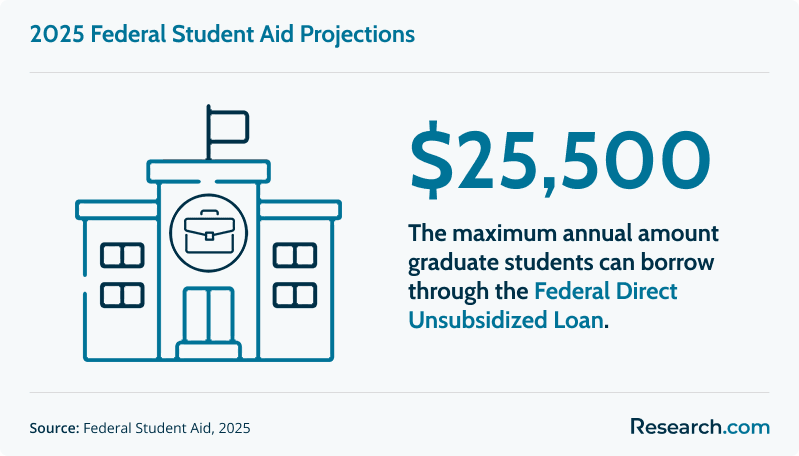
- Federal student loans. Graduate students may be eligible for the Federal Direct Unsubsidized Loan, which permits borrowing up to $20,500 annually. The Grad PLUS Loan may cover remaining eligible education costs not met by other aid, subject to credit approval.
- Scholarships and grants. Universities, professional associations, private foundations, and education organizations may offer funding for graduate study. The Teacher Education Assistance for College and Higher Education Grant may provide up to $4,000 annually for students who commit to teaching in high-need fields in low-income areas.
- Employer tuition assistance. School districts, colleges, and education employers may help pay for advanced degrees when the program aligns with staffing or leadership needs.
- State-based support. Some states offer scholarships, loan forgiveness, or incentive programs for educators who serve shortage areas, high-need schools, or underserved communities.
- Work-study and assistantships. Some graduate students with financial need may qualify for federal work-study or campus-based assistantship opportunities that help offset costs.
Ways to reduce the cost of an EdS degree
- Compare total program cost, not just advertised tuition.
- Ask whether prior graduate credits can transfer into the EdS.
- Look for in-state public options if they meet your professional goals.
- Check whether your district offers salary advancement, tuition reimbursement, or partnership discounts.
- Choose an accredited program that qualifies for federal aid if you plan to use it.
- Avoid borrowing more than you need for tuition, fees, and required expenses.
What certifications are available after an EdS degree?
Certification options after an EdS depend on specialization, state rules, prior credentials, and field experience. In some areas, the EdS coursework may be part of a pathway toward advanced endorsement or licensure. In others, graduates must still pass exams, complete internships, document supervised experience, or apply through a state education agency.
- Reading Specialist Certification. This credential is designed for educators who assess reading needs, deliver literacy interventions, support struggling readers, and help teachers implement effective reading instruction.
- Instructional Leadership Certification. This certification supports educators preparing for school leadership roles. It typically emphasizes curriculum oversight, teacher coaching, instructional improvement, and schoolwide academic planning.
- Educational Leadership Tier II Certification. This advanced leadership credential is intended for professionals pursuing higher-level administrative responsibilities, including district leadership. It may address policy implementation, strategic planning, school improvement, and organizational leadership.
- Special Education Leadership Certification. Educators who pursue this credential prepare to manage special education programs, support compliance, advocate for appropriate services, and lead inclusive practices for students with diverse learning needs.
- Curriculum and Instruction Certification. This certification focuses on curriculum design, standards alignment, assessment, instructional evaluation, and improvement of teaching methods.
- Educational Technology Certification. This path prepares educators to integrate digital tools, learning platforms, assistive technology, and technology-supported instruction. Some educators also pursue online certifications to keep pace with new tools and instructional practices.
| Certification Area | Common Career Use | Important Caution |
| Reading Specialist | Literacy coach, reading interventionist, reading program leader | Requirements differ by state and may include exams or supervised experience |
| Instructional Leadership | Assistant principal, principal, instructional leader | Verify that the program is approved for administrator certification where you plan to work |
| Educational Leadership Tier II | Advanced administrator or district-level leader | May require prior leadership certification or administrative experience |
| Special Education Leadership | Special education coordinator, program director, compliance leader | Check whether prior special education licensure is required |
| Educational Technology | Instructional technology coach, digital learning specialist, technology integration leader | Employer expectations can vary by district and role |
What salary can professionals with an EdS degree expect?
As of 2027, the average base salary for an Educational Specialist in the United States is approximately $64,002 per year. Reported salaries typically range from $57,000 to $92,000, depending on role, experience, location, responsibilities, and employer type. The EdS itself does not guarantee a specific salary; compensation is usually tied to the job title, district salary schedule, contract rules, licensure status, and local labor market.
| Experience Level | Average Salary Per Year |
| 0-1 year | $63,393 |
| 1-3 years | $66,441 |
| 4-6 years | $68,651 |
| 7-9 years | $70,557 |
| 10-14 years | $74,264 |
| 15+ years | $79,539 |
Source: Glassdoor, 2025
Location can strongly affect pay. District salary scales, state and local education funding, cost of living, union agreements, and demand for specialized services all influence compensation. Urban and high-cost regions may offer higher salaries, but housing and transportation costs can reduce the practical value of that increase. Rural areas may pay less but may have different benefits, loan forgiveness opportunities, or leadership openings.
Are affordable online EdS programs worth considering?
Affordable online EdS programs can be a strong option for working educators, especially when the program is accredited, aligned with state requirements, and designed with realistic fieldwork expectations. Online study can reduce commuting costs and make it easier to continue working while earning the degree. However, “online” should not be confused with “automatically easier” or “automatically cheaper.” Students still need to evaluate total cost, faculty access, practicum placement support, licensure alignment, and academic quality.
Educators comparing low-cost pathways may also review related options such as a cheap online teaching degree, but an EdS should be chosen for advanced professional goals rather than price alone. A low tuition rate is only valuable if the program supports the credential, career move, or salary advancement the student needs.
| Online EdS Advantage | Potential Limitation | How to Evaluate It |
| Flexible scheduling for working educators | Requires strong time management and self-direction | Ask whether courses are asynchronous, synchronous, or a mix of both |
| May reduce commuting and relocation costs | Technology and online fees may still apply | Request a full cost breakdown before applying |
| Access to programs outside your local area | Licensure rules may not transfer across states | Confirm state approval for your intended career path |
| Can support continued employment | Fieldwork may require daytime availability | Ask how practicums, internships, or school placements are arranged |
What skills do EdS students and graduates need?
An EdS program develops advanced professional skills, but students also need strong preparation before they enroll. The most successful candidates can connect theory to practice, interpret data, communicate across roles, and lead improvement in real educational settings. Just as a prospective student might ask what is marriage and family therapy to understand the competencies behind that profession, EdS applicants should understand the specialized skill demands of education leadership and student support roles.
Technical skills for Education Specialist roles
- Data analysis and interpretation. EdS professionals often use student performance data, assessment results, behavior records, and program metrics to identify needs and recommend interventions.
- Educational technology fluency. Many roles require confidence with learning management systems, digital assessment tools, instructional software, assistive technology, and data platforms.
- Curriculum development. Specialists may create, revise, or evaluate curriculum based on standards, research, student needs, and instructional goals.
- Instructional leadership. Educators in advanced roles must support teachers, model effective practice, lead professional learning, and improve classroom instruction.
- Assessment and evaluation. Graduates need to design, administer, interpret, and respond to assessments in ways that improve learning and decision-making.
Professional and leadership skills for EdS success
- Communication and collaboration. Education specialists regularly work with teachers, administrators, parents, students, counselors, specialists, and community partners.
- Leadership and judgment. Advanced roles require decision-making, ethical awareness, staff support, and the ability to guide change without losing trust.
- Problem-solving and adaptability. Student needs, policy expectations, technology, and school priorities change often, so specialists must adjust strategies quickly.
- Critical thinking and research use. EdS graduates should be able to evaluate research, recognize weak evidence, and apply findings responsibly.
- Time management and organization. Many students complete the degree while working full time, managing coursework, fieldwork, family responsibilities, and professional obligations at the same time.
Is an EdS degree worth the investment?
An EdS degree can be worth it when it directly supports a specific career outcome, such as administrator certification, specialist licensure, promotion into curriculum leadership, or qualification for a higher salary lane. It is less likely to pay off if the student chooses a program without checking accreditation, state approval, total cost, or employer recognition.
The best way to judge value is to compare the degree’s cost and time commitment with the role you are targeting. For example, an educator pursuing school leadership should confirm that the program meets administrator requirements. A future school psychologist should verify practicum and credentialing standards. A teacher hoping for salary advancement should ask the district whether an EdS changes placement on the pay schedule.
Students comparing education options sometimes look at unrelated low-cost degrees, such as the cheapest English degree online, to understand affordability. That can be useful for price awareness, but the EdS decision should be based on professional fit, licensure relevance, and long-term role alignment.
Choose an EdS if:
- You already hold a master’s degree and want advanced education training.
- Your next job requires or rewards an EdS-level credential.
- You want a practice-focused degree rather than a research-heavy doctorate.
- Your employer, district, or state recognizes the specialization you plan to complete.
- You can manage the cost without taking on debt that outweighs the likely career benefit.
Consider another path if:
- You need a doctoral credential for your long-term goal.
- You are not yet sure which education role you want next.
- The program does not meet your state’s licensure or certification requirements.
- You are choosing a school only because it is cheap or fast.
- Your employer does not recognize the EdS for promotion, pay, or advancement.
How is an EdS different from an EdD?
The EdS and EdD are both advanced education credentials, but they serve different purposes. An EdS is usually more narrowly focused on professional practice in a specific education role. An EdD is a doctoral degree that generally involves applied research, organizational leadership, policy analysis, and broader systems-level problem solving.
The EdS may be the better fit for educators who want to move into a defined specialist or leadership role quickly. The EdD may be more appropriate for professionals who want doctoral-level leadership, research-informed policy work, senior administration, consulting, or academic opportunities. Cost-conscious students who decide they need the doctoral route can compare cheap online EdD programs, but the decision should be based on career requirements rather than degree prestige alone.
| Comparison Point | EdS Degree | EdD Degree |
| Academic level | Post-master’s specialist degree | Doctoral degree |
| Main focus | Applied professional expertise in a defined education area | Applied research, leadership, policy, and systems improvement |
| Typical goal | Specialist, school leadership, curriculum, psychology, counseling, or instructional roles | Executive leadership, research-informed practice, policy, higher education, or district-level influence |
| Research intensity | Usually less research-heavy than doctoral study | Typically includes substantial applied research or dissertation-style work |
| Best for | Educators who want advanced practice credentials without a full doctorate | Professionals who need or want doctoral-level authority and research preparation |
How can an EdS support interdisciplinary collaboration?
Many education problems do not fit neatly into one discipline. Student learning can involve psychology, literacy, technology, family systems, disability services, information access, community resources, and school leadership at the same time. An EdS can help educators coordinate across these areas, especially when programs emphasize data use, intervention planning, collaboration, and systems thinking.
For example, understanding what can you do with a library science degree can help an education specialist see how information literacy, research support, digital resources, and school library services connect to curriculum and student achievement. In the same way, EdS graduates working in counseling, special education, or instructional technology often collaborate with professionals outside their own specialty to build stronger student supports.
How can interdisciplinary study strengthen an EdS career path?
Interdisciplinary study can make an EdS graduate more effective by adding broader tools for analysis and problem-solving. Education leaders increasingly work with data systems, family engagement models, mental health supports, instructional technology, accessibility practices, and community partnerships. Exposure to multiple fields can help specialists design better interventions, communicate with more stakeholders, and adapt to changing school needs.
Educators who want broader academic flexibility may explore options such as an online BA interdisciplinary studies program earlier in their education journey. For EdS-level professionals, the same idea applies in a career context: the more effectively you can connect learning, technology, student services, and organizational leadership, the more value you can bring to schools and districts.
What jobs can you pursue with an EdS degree?
An EdS degree can lead to several advanced education roles, but job eligibility depends on specialization, state credentialing rules, and prior experience. Some positions require specific licenses or endorsements, while others depend more on district hiring standards and professional background.
1. School Counselor
School counselors support students’ academic planning, personal development, social-emotional growth, and career readiness. They may provide individual counseling, group support, crisis response, course planning, and family or teacher consultation. Some professionals begin with an online counseling degree before pursuing advanced school-based credentials.
Median Salary: $60,409 per year.
2. School Psychologist
School psychologists evaluate learning, behavioral, emotional, and developmental concerns. Their work may include psychological assessment, counseling, intervention planning, consultation with teachers and parents, and support for student mental well-being. This path often has specific credentialing and supervised fieldwork requirements.
Median Salary: $92,813 per year.
3. Special Education Teacher
Special education teachers design instruction and supports for students with disabilities. They develop individualized education plans, adapt lessons, collaborate with families and related service providers, and monitor student progress. Educators interested in school-based support roles may also compare related helping professions and ask what can you do with an MFT degree, especially if they are drawn to family, counseling, or student support work.
Median Salary: $61,098 per year.
4. Instructional Coordinator
Instructional coordinators help improve teaching and curriculum across schools or districts. They may analyze achievement data, train teachers, evaluate instructional materials, align curriculum to standards, and recommend teaching strategies. This role is often a strong match for EdS graduates in curriculum and instruction.
Median Salary: $69,627 per year.
5. Teacher-Librarian
Teacher-librarians support literacy, research, digital citizenship, and access to learning resources. Many hold a librarian degree or related preparation in information management and education. In schools, they may collaborate with teachers, guide students in evaluating sources, manage library collections, and support technology-rich learning.
Median Salary: $65,193 per year.
| Role | Good EdS Match | Primary Work Focus | Median Salary |
| School Counselor | Counseling and Student Services | Academic, social, emotional, and career support | $60,409 per year |
| School Psychologist | School Psychology | Assessment, intervention, counseling, and consultation | $92,813 per year |
| Special Education Teacher | Special Education | Instruction and support for students with disabilities | $61,098 per year |
| Instructional Coordinator | Curriculum and Instruction | Curriculum design, teacher training, and instructional improvement | $69,627 per year |
| Teacher-Librarian | Library, literacy, technology, or curriculum-related pathways | Information literacy, reading support, and school library services | $65,193 per year |
What is the job outlook for EdS graduates?
The job outlook for EdS graduates depends on the role they pursue, their location, and their specialization. Leadership, school psychology, special education, curriculum, counseling, and library-related roles are all influenced by district budgets, enrollment patterns, state staffing rules, retirements, and local demand for student support services.
According to the U.S. Bureau of Labor Statistics, employment for education administrators is projected to grow by 3%, supported by ongoing needs for leadership in schools and education systems. EdS graduates may also find opportunities in curriculum development, special education, educational consulting, school improvement, student services, and policy implementation.
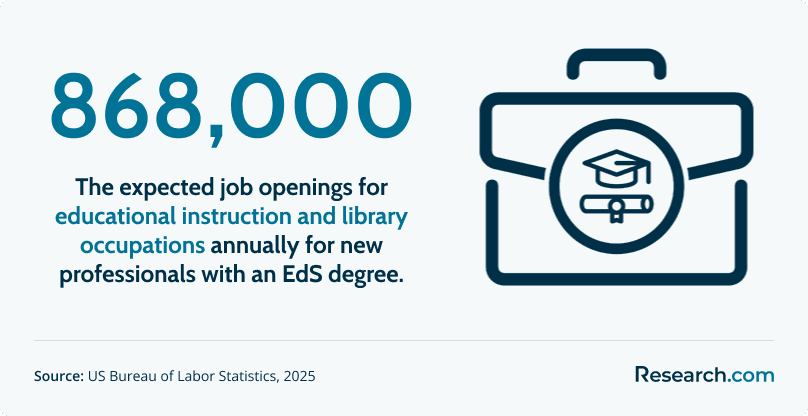
The broader category of educational instruction and library occupations is expected to generate about 868,000 job openings each year, on average, over the decade. Many openings are expected because experienced professionals retire, change occupations, or leave the labor force. For EdS graduates, the strongest opportunities are likely to come when their specialization aligns with documented employer needs and state credentialing requirements.
Current trends affecting EdS careers
- Greater attention to student mental health. Schools continue to need professionals who can support behavioral, emotional, and academic interventions.
- Data-driven decision-making. Educators in leadership and specialist roles are increasingly expected to use assessment and performance data responsibly.
- Instructional technology integration. Digital learning tools, assistive technology, and online platforms have become part of school improvement conversations.
- Special education compliance and inclusion. Districts need trained professionals who understand individualized supports, inclusion practices, and legal responsibilities.
- Credential scrutiny. Employers and states may require specific program approval, licensure pathways, supervised experience, or exams, especially in regulated roles.
Can an EdS lead to advanced leadership credentials?
An EdS can be a stepping stone to higher leadership credentials, especially for educators who choose a specialization in educational leadership, administration, curriculum, or district-level improvement. For some professionals, the EdS is enough to qualify for the leadership role they want. For others, it becomes part of a longer pathway toward doctoral study or executive-level education leadership.
Educators who want to move beyond school-level leadership into broader organizational strategy, research-informed administration, or senior leadership may later compare online doctorate programs in leadership. Before doing so, they should consider whether the next credential is required for their goals or simply appealing as an additional title.
How do you choose the best EdS program for your goals?
The best EdS program is not necessarily the cheapest, fastest, or highest ranked. It is the program that fits your career target, meets credentialing requirements, offers credible academic quality, and works with your schedule and budget. Start with the role you want, then work backward to identify the degree, specialization, fieldwork, and certification requirements needed to get there.
Step-by-step guide to comparing EdS programs
- Define the job you want after graduation. Decide whether your target is school leadership, school psychology, curriculum, special education, counseling, literacy, instructional technology, or higher education administration.
- Check accreditation and state approval. Confirm institutional accreditation and, when relevant, program approval for licensure or certification in the state where you plan to work.
- Compare specialization requirements. Review coursework, field experiences, internship hours, capstone requirements, and exam preparation.
- Calculate the full cost. Include tuition, fees, books, technology, travel, field placement expenses, and the cost of reducing work hours if necessary.
- Ask about transfer credits. Some programs may accept prior graduate credits, which can reduce cost and completion time.
- Evaluate faculty and school partnerships. Strong programs often have faculty with practical education experience and relationships with schools, districts, or agencies.
- Review format and pacing. Online, hybrid, evening, cohort, part-time, and accelerated options can differ significantly. Educators comparing faster doctorate routes may also review structures similar to the fastest EdD program, but EdS students should still verify quality and credential alignment.
- Ask for outcome information. Request data or examples related to certification pass rates, graduate roles, employer partnerships, alumni support, and field placement outcomes when available.
Questions to ask an EdS admissions advisor
- Is this program approved for the license, endorsement, or certification I need?
- Can I complete fieldwork or internships in my local area?
- How many credits are required, and can any of my prior graduate credits transfer?
- What is the total estimated cost, including fees and materials?
- Are courses asynchronous, live online, hybrid, or campus-based?
- Does the program support working educators with evening, weekend, or part-time options?
- What jobs do graduates commonly pursue?
- Does my current district recognize this EdS for salary advancement or promotion?
Common mistakes to avoid when choosing an EdS program
| Mistake | Why It Can Hurt You | Better Approach |
| Choosing a program without checking accreditation | It may affect financial aid, transferability, employer recognition, or credential eligibility | Verify institutional accreditation before applying |
| Assuming every EdS leads to licensure | Some programs are academic only and may not satisfy state requirements | Check state approval and certification alignment in writing |
| Focusing only on tuition | Fees, travel, books, fieldwork, and lost work time can change the real cost | Compare total program cost and likely career benefit |
| Choosing the fastest option without checking requirements | A shorter program may not include required supervised experience or exam preparation | Make sure the timeline does not weaken credential eligibility |
| Ignoring transfer credit policies | You may pay for coursework you do not need to repeat | Ask for a transfer evaluation before enrolling |
| Relying only on rankings or advertising | A highly marketed program may not be the best fit for your state, role, or budget | Prioritize career alignment, outcomes, licensure fit, and affordability |
| Assuming salary increases are guaranteed | Pay depends on employer policies, job changes, contracts, and local salary schedules | Confirm salary-lane or promotion rules with your employer |
What educators say about earning an Education Specialist degree
-
: "
After more than ten years in the classroom, I wanted a role where I could support students in a different way. My EdS in school psychology gave me the advanced preparation I needed while allowing me to keep working full time. — Samantha
"
-
: "
I was ready for leadership but did not want to commit to a doctorate yet. The EdS helped me build practical administrative skills and move into an assistant principal role within a couple of years. — Luis
"
-
: "
The EdS helped me transition from teaching into curriculum work. I wanted a degree focused on real school improvement, and the program gave me tools I now use at the district level. — Brian
"
Key Insights
- An EdS is best for focused advancement. It is most useful for educators who already know their target role and need advanced preparation beyond a master’s degree.
- Specialization drives value. Educational leadership, school psychology, curriculum, special education, literacy, counseling, and higher education administration lead to different requirements and outcomes.
- Licensure alignment is critical. Before enrolling, confirm that the program meets state requirements for certification, endorsement, internship, or supervised practice if your target job requires them.
- Cost should be evaluated against career benefit. Tuition can range from $10,000 to $30,000 per year, and students should include fees, materials, fieldwork costs, and potential work schedule changes in the calculation.
- Online EdS programs can be practical for working educators. They are worth considering when accredited, affordable, flexible, and aligned with state and employer expectations.
- The EdS is not the same as an EdD. Choose the EdS for applied specialist or leadership preparation; consider the EdD if your goals require doctoral-level research, policy, or executive leadership preparation.
- Do not rely on rankings alone. The right program is the one that matches your career goal, state requirements, budget, schedule, and expected return.
References:
- FNF Research. (n.d.). U.S. education market. Retrieved from FNF Research.
- Glassdoor. (n.d.). Education specialist salary. Retrieved from Glassdoor.
- MDR Education. (n.d.). How many schools are in the U.S.? Retrieved from MDR Education.
- U.S. Bureau of Labor Statistics. (n.d.). Education, training, and library occupations. U.S. Department of Labor. Retrieved from BLS.
- U.S. Department of Education. (n.d.). How much money can I borrow in federal student loans? Federal Student Aid. Retrieved from Federal Student Aid.
- ZipRecruiter. (n.d.). Education specialist salary. Retrieved from ZipRecruiter.
- ZipRecruiter. (n.d.). Instructional coordinator salary. Retrieved from ZipRecruiter.
- ZipRecruiter. (n.d.). Librarian salary. Retrieved from ZipRecruiter.
- ZipRecruiter. (n.d.). School counselor salary. Retrieved from ZipRecruiter.
- ZipRecruiter. (n.d.). School psychologist salary. Retrieved from ZipRecruiter.
- ZipRecruiter. (n.d.). Special education teacher salary. Retrieved from ZipRecruiter.
Other Things You Should Know About Education Specialist (EdS) Degree
An EdS can support advanced school-based licensure in some states, such as principal, supervisor, or specialist credentials. State education departments set the rules, and many require an approved EdS program, a valid teaching license, and passing scores on state leadership exams.
In 2027, typical program requirements for an EdS degree include a master’s degree in education or a related field, completion of around 30-45 credit hours, and a capstone project or comprehensive exam. Programs may have specific coursework focusing on leadership, curriculum development, or specialized educational technologies.