
2027 LMFT vs LCSW: Explaining the Difference

Co-Founder and Chief Data Scientist
Choosing between becoming a Licensed Marriage and Family Therapist (LMFT) and a Licensed Clinical Social Worker (LCSW) is not just a question of job title. It affects the graduate degree you choose, the license you pursue, the clients you are trained to serve, the settings where you can work, and the kind of problems you will spend your career helping people solve.
Both LMFTs and LCSWs provide mental health support, and both can offer therapy after meeting state licensing requirements. The difference is in professional focus. LMFTs are trained to understand people through relationships, family systems, and interpersonal patterns. LCSWs are trained to provide clinical care while also addressing social, economic, healthcare, and community factors that affect a client’s well-being.
This guide compares LMFT vs LCSW careers for students, career changers, and helping professionals deciding which graduate path fits their goals. You will learn how the roles differ, what education and licensing usually require, where each professional works, how salary and demand compare, and what questions to ask before committing to either path.
LMFT vs LCSW: Quick Answer
- Both careers require graduate education and supervised clinical experience. In most states, LMFT and LCSW candidates need a relevant master’s degree, post-graduate supervised hours, a licensing exam, and continuing education.
- LMFTs focus primarily on relationships and family systems. They often work with couples, families, and individuals whose concerns involve communication, conflict, life transitions, parenting, intimacy, or relational stress.
- LCSWs combine therapy with social support and advocacy. They may treat mental health concerns while helping clients navigate housing, healthcare access, poverty, unemployment, substance use, child welfare systems, or community resources.
- Pay is broadly comparable, but context matters. The average LMFT salary is $68,730, while the mental health and substance abuse social worker salary is $63,870, according to BLS occupational data cited in this article.
- Demand looks strong for both, but in different ways. Marriage and family therapists are projected to see 16% job growth from 2022 to 2032, while employment of all social workers is projected to increase by 7%, with a much larger number of annual openings.
- What does an LMFT do?
- What does an LCSW do?
- LMFT vs LCSW skills: how the training differs
- Education requirements for LMFTs and LCSWs
- Licensing requirements: LMFT vs LCSW
- Where LMFTs and LCSWs work
- Salary, job outlook, and demand
- Certifications and professional development
- Advanced degree options for clinical growth
- Accelerated psychology degree options
- Long-term growth and career fulfillment
- Best-paying states for LMFTs and social workers
- Forensic psychology training for clinicians
- Combined advanced degrees
- Accreditation and quality standards
- Can you switch from LMFT to LCSW or from LCSW to LMFT?
- Financial considerations for LMFT and LCSW students
- Emerging trends affecting both careers
- LMFT vs LCSW: which path should you choose?
What does an LMFT do?
A Licensed Marriage and Family Therapist is a mental health clinician trained to help individuals, couples, and families understand and change patterns that affect emotional health and relationships. Instead of viewing a client’s concern only as an individual problem, LMFTs often examine how family roles, communication habits, attachment patterns, conflict cycles, cultural expectations, and life transitions shape distress.
The American Association for Marriage and Family Therapy describes marriage and family therapists as professionals who use psychotherapy, or talk therapy, to address concerns within family systems. These concerns can include mental health disorders, marital conflict, parent-child problems, and individual psychological or health-related issues. LMFTs may also use solution-focused strategies to help clients work toward clear, realistic treatment goals.
Common LMFT responsibilities include:
- Clinical assessment and treatment planning: LMFTs evaluate mental, emotional, and behavioral concerns while considering the client’s relationship and family context.
- Individual, couple, and family therapy: They provide therapy for relationship stress, divorce adjustment, parenting challenges, grief, infidelity, communication breakdowns, and family conflict.
- Conflict and communication work: LMFTs help clients identify unhealthy interaction patterns, rebuild trust, establish boundaries, and practice more effective communication.
- Goal-focused intervention: Many LMFTs use structured, time-limited approaches that help clients make measurable changes in how they relate to others.
LMFTs are a smaller but important part of the counseling workforce. The American Counseling Association reported in 2024 that marriage and family therapists accounted for 7% of the counseling workforce in 2022. That made them the fourth largest counselor occupation after Substance Abuse, Behavioral Disorder, and Mental Health Counselors (41%), Educational, Guidance, and Career Counselors and Advisors (37%), and Rehabilitation Counselors (10%).
| LMFT focus area | What it means in practice |
| Relationships and family systems | Understanding how people influence one another within couples, families, and close relationships |
| Therapy delivery | Providing individual, couple, and family counseling using approved clinical methods |
| Common client concerns | Communication problems, relationship conflict, parenting stress, family transitions, grief, and relational trauma |
| Typical fit | Students who want a therapy-centered career focused on interpersonal and family dynamics |
What does an LCSW do?
A Licensed Clinical Social Worker is a master’s-trained social work professional licensed to provide clinical mental health services. LCSWs can offer therapy, diagnose and treat mental health conditions where permitted by state law, and help clients manage practical barriers that contribute to emotional distress.
The National Association of Social Workers explains that social workers help people manage health and social problems such as unemployment, substance abuse, healthcare access, and inadequate housing by connecting them with needed support. Clinical social work builds on that foundation by allowing licensed professionals to provide therapy for people experiencing mental health concerns.
Common LCSW responsibilities include:
- Clinical assessment and treatment: LCSWs assess, diagnose, and treat concerns such as anxiety, depression, trauma, and substance use issues. Many use evidence-based approaches, including cognitive behavioral therapy.
- Case management and resource coordination: They may connect clients with housing, medical care, financial assistance, benefits, school supports, or community programs.
- Crisis response: LCSWs may assist during domestic violence situations, psychiatric crises, disasters, and other emergencies that require coordinated support.
- Advocacy and systems work: They often help clients navigate institutions, reduce barriers to care, and support policy or program improvements that address social inequities.
For students asking what can I do with a social work degree, the LCSW route is one of the most clinically focused options. It can lead to therapy roles, hospital-based work, community mental health positions, substance use treatment, school-related services, child and family services, and private practice where allowed by state law.
BLS data show the scale of the social work field. Child, family, and school social workers made up the largest U.S. social work segment in 2023, with 352,160 professionals. Healthcare social workers followed with 185,020, mental health and substance abuse social workers with 114,680, and other social work roles with 58,460.
| LCSW focus area | What it means in practice |
| Clinical therapy | Providing mental health assessment, diagnosis, and treatment within the scope allowed by state law |
| Social support | Helping clients access resources such as housing, healthcare, public benefits, and community programs |
| Systems navigation | Working across agencies, hospitals, schools, courts, and community organizations |
| Typical fit | Students who want both clinical work and a broader social services or advocacy role |
LMFT vs LCSW skills: how the training differs
LMFTs and LCSWs both need strong clinical judgment, ethical decision-making, cultural humility, communication skills, and the ability to build trust with clients. Both careers require professionals to listen carefully, ask effective questions, document care appropriately, and create treatment or intervention plans based on client needs.
The difference is in emphasis. LMFTs are trained to think systemically about relationships. They examine how a person’s symptoms may be affected by family roles, couple dynamics, attachment patterns, intergenerational experiences, and communication cycles. LCSWs are also trained clinically, but they place additional emphasis on person-in-environment thinking, which considers how poverty, discrimination, healthcare access, disability, housing instability, employment, and public systems affect mental health.
| Skill area | LMFT emphasis | LCSW emphasis |
| Clinical interviewing | Understanding relationship patterns, family history, and interpersonal stress | Understanding mental health symptoms, social needs, safety, and environmental pressures |
| Treatment planning | Creating goals tied to communication, conflict, boundaries, and family functioning | Creating goals that may include therapy, resource access, advocacy, and stabilization |
| Collaboration | Working with couples, family members, schools, physicians, or other care providers when appropriate | Coordinating with hospitals, agencies, schools, courts, insurers, and community organizations |
| Problem-solving | Helping clients shift relational patterns and improve emotional connection | Helping clients address clinical needs while navigating complex support systems |
| Best-fit strengths | Systems thinking, emotional insight, relationship assessment, conflict resolution | Clinical care, advocacy, crisis response, resource coordination, policy awareness |
Workforce need is a major reason students are comparing these paths now. The National Center for Health Workforce Analysis projects a shortage of -50,760 marriage and family therapists by 2037, along with unmet need for -30,520 mental health and substance use disorder social workers and -21,080 child, family, and school social workers. These projections suggest that both relationship-focused clinicians and social work clinicians will remain important parts of the behavioral health workforce.
This chart displays the deficit of mental health and behavioral health workers in the U.S.
Education requirements for LMFTs and LCSWs
Both LMFT and LCSW careers usually require a master’s degree, supervised clinical training, and state licensure. The key difference is the type of graduate program you choose. LMFT candidates typically pursue marriage and family therapy or closely related counseling programs, while LCSW candidates complete a Master of Social Work program that meets social work accreditation standards.
| Step | LMFT path | LCSW path |
| Bachelor’s degree | A counseling, psychology, behavioral science, human development and family studies, or related major can be useful | A social work, psychology, sociology, behavioral science, or related major can be useful |
| Master’s degree | Complete a marriage and family therapy or related counseling program accredited by COAMFTE or CACREP | Complete a Master of Social Work program approved by CSWE |
| Clinical training | Gain supervised experience in settings such as counseling centers, private practices, hospitals, or family service agencies | Gain supervised experience in settings such as hospitals, government agencies, community organizations, mental health clinics, or social service agencies |
| Doctoral study | Optional; may support advanced clinical, teaching, research, supervision, or leadership roles | Optional; may support advanced clinical, administrative, research, policy, teaching, or leadership roles |
Program format also matters. Some universities offer online MFT programs or online social work programs that let students complete didactic coursework remotely while arranging required fieldwork or clinical training in approved in-person settings. This can help working adults, parents, and students who do not live near a campus, but online students still need to confirm that placements, supervision, and curriculum meet the licensing rules in the state where they plan to practice.
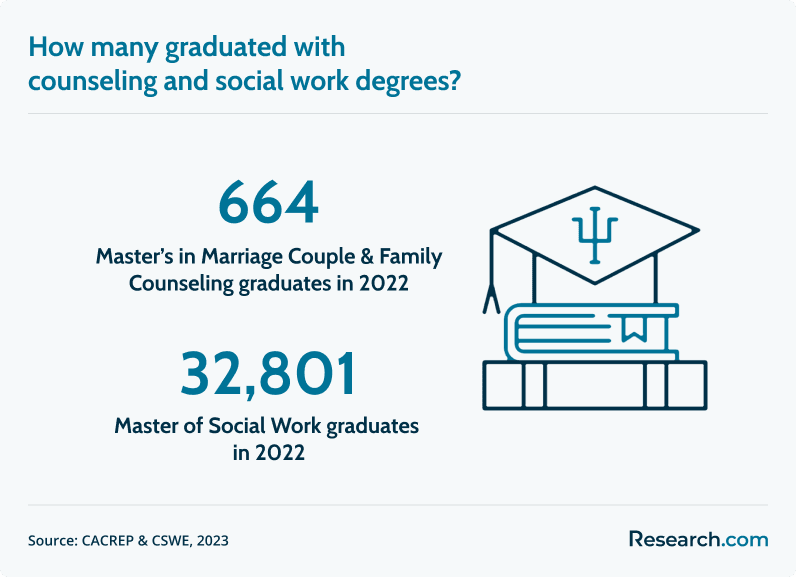
Graduate output differs substantially between the fields. In 2022, CACREP reported 664 graduates in Marriage Couple & Family counseling programs, while CSWE recorded 32,801 graduates with a Master of Social Work degree. Clinical mental health and school counseling produced the highest number of counseling graduates, but LMFTs and LCSWs continue to serve distinct needs in family systems, social work, community care, and behavioral health.
Licensing requirements: LMFT vs LCSW
A master’s degree alone does not make someone an LMFT or LCSW. After graduation, candidates must meet state licensing requirements. Rules differ by state, so students should review the licensing board requirements in the state where they expect to practice before choosing a program. This is especially important for online students and for anyone planning to move after graduation.
In addition to completing a relevant graduate program, such as a counseling program or a masters in social work online, candidates generally complete the following steps:
- Apply to the state licensing board: Candidates submit official graduate transcripts, personal information, application materials, and required fees.
- Complete supervised clinical experience: LMFT and LCSW candidates usually complete a state-defined amount of supervised clinical work, often around 3,000 hours depending on the state.
- Pass the required exam: LMFT candidates commonly take the Association of Marital and Family Therapy Regulatory Boards’ National Marital and Family Therapy Examination. LCSW candidates commonly take the Association of Social Work Boards Clinical Examination.
- Meet state-specific requirements: Some states require jurisprudence exams, ethics exams, background checks, specific coursework, or associate-level licenses before full independent licensure.
- Maintain the license: Licensed professionals must complete continuing education, which may include ethics, cultural competence, law, telehealth, supervision, or new treatment methods.
| Licensing issue | Why it matters | What to verify before enrolling |
| Accreditation | Some states require or strongly prefer specific accreditation for licensure eligibility | Whether the program’s accreditor aligns with your state’s LMFT or LCSW rules |
| Field placement | Clinical hours must usually meet board standards | Who arranges placements, who approves supervisors, and where hours can be completed |
| Exam preparation | Licensure exams are required after education and supervised experience | Whether the curriculum prepares students for the AMFTRB or ASWB exam pathway |
| State mobility | Moving states can create additional requirements | Whether the degree supports licensure in the states where you may work |
| Continuing education | Licensure is not a one-time requirement | How often renewal is required and what topics must be completed |
The safest approach is to compare programs against official licensing board rules before applying. Admissions representatives can explain program design, but the state board determines whether your education and supervised experience qualify you for licensure.
Where LMFTs and LCSWs work
LMFTs and LCSWs can work in overlapping settings, but their day-to-day roles may look different. LMFTs are often concentrated in therapy-focused environments where individuals, couples, and families seek help with relational or emotional concerns. LCSWs may also provide therapy, but they are more likely to work in settings that require case management, discharge planning, crisis intervention, advocacy, or coordination across social systems.
If you are exploring what can you do with a counseling degree, the LMFT route can lead to therapy roles in private practice, family service agencies, outpatient clinics, and healthcare environments. BLS data show that 20,920 LMFTs work in offices of health practitioners and 20,370 work in individual family services.
For LCSWs and related social work roles, BLS data show that 23,620 mental health social workers work in outpatient care centers, 15,780 in individual family service centers, and 14,000 in offices of other practitioners.
| Work setting | LMFT role | LCSW role |
| Private practice | Individual, couple, and family therapy, often with a relationship or systems focus | Individual and group therapy, clinical assessment, and sometimes case coordination |
| Community mental health | Therapy for families, couples, children, and adults experiencing emotional or relational stress | Therapy, crisis services, resource navigation, advocacy, and care coordination |
| Hospitals and healthcare settings | Family support, adjustment counseling, and collaboration with medical teams | Discharge planning, behavioral health care, crisis intervention, and patient advocacy |
| Outpatient care centers | Counseling for clients who do not require inpatient care | Clinical services, substance use support, treatment planning, and referrals |
| Government or public agencies | Family counseling, prevention services, and support for community programs | Child welfare, public health, mental health services, benefits navigation, and policy-related work |
| Psychiatric and substance abuse hospitals | Therapeutic support where family or relationship dynamics are part of treatment | Longer-term support for severe mental health or addiction-related needs |
The best setting depends on what kind of work energizes you. If you want most of your week to involve therapy sessions centered on relationships, LMFT may be the clearer fit. If you want clinical work that also addresses systems, resources, and social barriers, LCSW may offer a broader platform.
This chart shows the highest levels of employment for marriage and family therapists and mental health social workers.
Salary, job outlook, and demand
Salary and job outlook should not be the only reasons to choose LMFT or LCSW, but they are important when evaluating graduate school cost, career stability, and long-term return on investment. Both occupations are tied to rising behavioral health needs, but the labor market differs by state, employer type, and role.
The average LMFT salary is $68,730. The LCSW salary category most closely reflected here, mental health and substance abuse social workers, is $63,870. Substance abuse, behavioral disorder, and mental health counselors earn $60,080, while child, family, and school social workers earn $59,190. In home health care services, marriage and family therapists earn $122,120 and mental health social workers earn $93,400.
Job growth differs in percentage and scale. BLS data show that marriage and family therapists are projected to have 16% job growth from 2022 to 2032, producing around 7,500 annual openings. Employment of all social workers is projected to increase by 7%, with around 67,300 openings.
| Career category | Average salary | Job outlook detail | How to interpret it |
| Marriage and family therapists | $68,730 | 16% job growth from 2022 to 2032; around 7,500 annual openings | Higher projected growth rate, but smaller occupation size |
| Mental health and substance abuse social workers | $63,870 | Included within broader social work demand data | Clinical social work roles can vary widely by setting and state |
| All social workers | Not stated as a single figure here | 7% projected employment increase; around 67,300 openings | Lower growth percentage than LMFT, but many more annual openings overall |
| Child, family, and school social workers | $59,190 | Part of the larger social work workforce | Often tied to schools, agencies, child welfare, and family support systems |
In short, LMFT may show stronger percentage growth, while social work offers a larger and more varied employment base. Students should compare local labor markets, not just national numbers, because salary and hiring conditions can differ sharply across regions and employers.
This chart displays the job outlook for both professions and related positions.
How can certifications and professional development strengthen an LMFT or LCSW career?
Licensure is the baseline credential, not the end of professional learning. After becoming licensed, LMFTs and LCSWs often pursue training in areas such as trauma-informed care, substance use treatment, family systems therapy, cognitive behavioral therapy, telehealth ethics, supervision, crisis intervention, and culturally responsive practice. These options can help clinicians serve more complex client needs and may support advancement into supervision, program leadership, consulting, or teaching roles.
Students and early-career professionals who want a broader view of counseling credentials can review Research.com’s guide on how to become a certified counselor. While counseling, LMFT, and social work credentials are not interchangeable, understanding the credential landscape can help you avoid choosing a program that does not match your intended license.
What advanced degree options can expand clinical practice?
A doctoral or advanced clinical degree is not required for most LMFT or LCSW licensure pathways, but it may be useful for professionals who want to move into advanced clinical leadership, research, assessment-focused roles, higher education, or specialized practice. Before enrolling, clinicians should ask whether the degree changes their legal scope of practice, improves their career options, or simply adds cost without a clear return.
Professionals comparing clinical psychology options may want to review PsyD online programs. A PsyD pathway is different from LMFT or LCSW training, so prospective students should verify licensure outcomes, residency requirements, supervised practice expectations, and state psychology board rules.
Can an accelerated online psychology degree help future LMFTs or LCSWs?
An accelerated psychology degree can be helpful for students who need undergraduate preparation before entering a graduate clinical program. It may build a foundation in human behavior, research methods, development, abnormal psychology, and counseling-related concepts. However, a psychology bachelor’s degree by itself does not qualify someone to practice as an LMFT or LCSW.
Students looking for faster undergraduate options can explore the fastest online psychology degree programs. The key is to confirm that the degree will be accepted by the graduate programs you plan to apply to and that it does not create unnecessary debt before the required master’s-level training.
How do LMFT and LCSW careers compare in long-term growth and fulfillment?
Long-term satisfaction depends on the type of client work you want, the systems you want to engage with, and the professional identity that fits you best. LMFTs often find fulfillment in helping couples and families change patterns that may have lasted for years. LCSWs may find fulfillment in combining therapy with practical support, advocacy, and systems-level problem-solving.
Both careers can lead to private practice, supervision, administration, teaching, specialized clinical work, and consulting. LMFTs may move toward family systems training, couple therapy specialization, or clinical supervision. LCSWs may move toward healthcare leadership, community program management, policy advocacy, school-based services, or integrated behavioral health.
Some professionals also add specialized training outside their original discipline. For example, clinicians interested in behavior analysis may compare the best ABA programs to see whether applied behavior analysis aligns with their client population and career goals.
Best-paying states for LMFTs and social workers
Location can affect salary, job availability, supervision options, licensure portability, and cost of living. A high salary in one state may not automatically mean a better financial outcome if housing, taxes, or commuting costs are also high. Students should compare pay with local expenses, state licensing rules, and the number of relevant employers in the area.
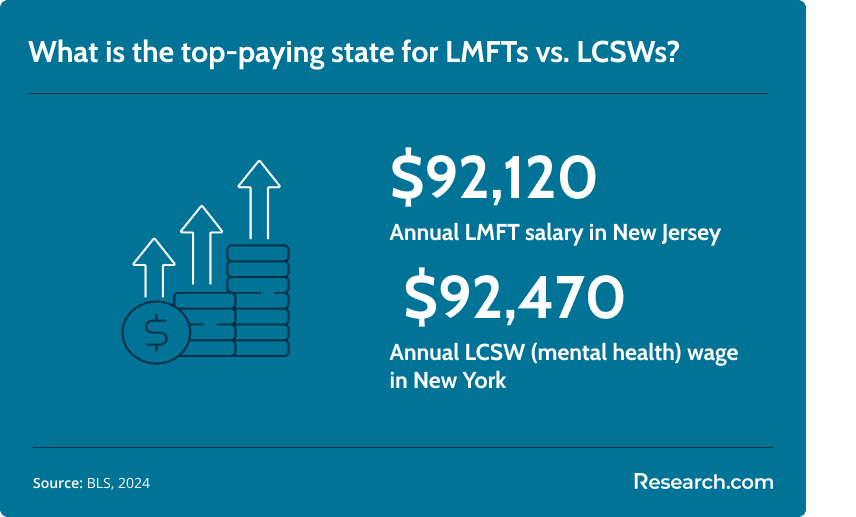
According to BLS data cited here, the highest average annual wages for marriage and family therapists are in the following states:
- New Jersey: $92,120
- Maryland: $87,090
- Utah: $83,980
- Virginia: $76,480
- Alaska: $74,420
For mental health social workers, the top-paying states are:
- New York: $92,470
- California: $81,330
- Connecticut: $77,930
- District of Columbia: $77,600
- New Jersey: $76,690
For child, family, and school social workers, the highest-paying locations listed are:
- District of Columbia: $76,330
- New York: $74,080
- New Jersey: $73,680
- Maryland: $71,870
- Connecticut: $70,200
| Before choosing a state | Why it matters |
| Check licensure rules | Education, exam, supervision, and scope-of-practice requirements vary by state |
| Compare salary with cost of living | Higher pay may be offset by housing, transportation, or insurance costs |
| Look at supervision availability | New graduates need qualified supervisors before full independent practice |
| Review employer mix | Private practices, hospitals, schools, agencies, and government offices may offer different opportunities |
| Consider long-term mobility | If you may relocate, understand whether your license can transfer easily |
How can forensic psychology training support LMFT or LCSW practice?
Forensic psychology training can be useful for clinicians whose work intersects with legal, safety, custody, correctional, or court-related issues. It may strengthen skills in risk assessment, documentation, trauma response, mandated reporting awareness, and collaboration with legal or protective systems. It does not automatically change an LMFT’s or LCSW’s legal scope of practice, so clinicians should choose training that matches their license, competence, and state rules.
Professionals interested in this interdisciplinary area can compare cheap forensic psychology master's programs online to understand available program formats and cost-conscious options.
Can combined advanced degrees broaden clinical expertise?
Combined advanced degrees may appeal to clinicians who want deeper training across assessment, intervention, research, and leadership. The benefit depends on the program’s design and the license it supports. A combined degree can be valuable when it leads to a clear professional outcome, but it can also add time and expense if the credential does not align with your intended practice.
Clinicians considering this route can review dual masters and PsyD programs in clinical psychology. Before applying, compare admissions requirements, supervised clinical expectations, licensure outcomes, and whether the program supports the state where you plan to practice.
What accreditation and quality standards matter for LMFT and LCSW programs?
Accreditation is one of the most important checks before enrolling in an LMFT or LCSW program. It can affect licensure eligibility, field placement approval, transferability, employer recognition, and access to certain professional pathways. Students should not rely only on a school’s marketing language. They should confirm the accreditor, curriculum, placement process, and state alignment directly.
For MFT students, program accreditation through COAMFTE or CACREP may be relevant depending on the state and program type. For social work students, CSWE approval is central for MSW pathways. Students comparing online marriage and family therapy options can review MFT programs online while also checking the licensing board in the state where they plan to practice.
| Program quality question | Why you should ask it |
| Is the program accredited by the expected accrediting body? | Accreditation can affect whether your degree meets licensure requirements |
| Does the curriculum satisfy my state’s coursework rules? | Some states require specific courses in ethics, diagnosis, human development, or law |
| How are clinical placements arranged? | Online and campus students both need approved supervised experience |
| Who qualifies as a supervisor? | Hours may not count if supervision does not meet board standards |
| What support is available for licensure exams? | Exam preparation can affect your timeline after graduation |
| What are total costs beyond tuition? | Fees, books, travel, insurance, exam costs, and lost work hours can change affordability |
Can you switch from LMFT to LCSW or from LCSW to LMFT?
Switching from LMFT to LCSW, or from LCSW to LMFT, is possible, but it is usually not a simple license transfer. The two licenses are built on different graduate degrees, accreditation expectations, exams, and supervised experience requirements. In many cases, a professional who wants to switch must complete another qualifying master’s degree or substantial additional coursework.
Some courses may overlap, but transferability depends on the state board and the receiving program. Prior clinical hours may also fail to count if they were not completed under the correct license category, supervisor type, or practice setting required for the new credential.
A clinician who wants to move into psychology rather than LMFT or LCSW work faces a separate pathway. That usually requires a traditional or online doctorate in psychology and completion of psychology licensure requirements. LMFT or LCSW credentials do not automatically convert into psychologist licensure.
Before switching, compare the cost, time, supervision burden, and actual career benefit. If your goal is simply to work with a different population, a post-licensure certification or supervised specialization may be more efficient than starting a second licensure path.
Financial considerations for LMFT and LCSW students
The financial decision is bigger than tuition. LMFT and LCSW students should account for application fees, books, technology, transportation to field placements, clinical supervision costs where applicable, licensing exam fees, background checks, continuing education, professional liability insurance, and the income they may give up while completing internships or supervised hours.
Because both careers generally require graduate school and post-graduate supervised experience, students should estimate total cost against likely earnings in their state and preferred setting. As a point of comparison with another behavioral health credential pathway, students can review the BCBA certification cost and consider how tuition, supervision, and credentialing expenses differ across helping professions.
| Cost factor | Why it matters | How to reduce risk |
| Tuition and fees | Program sticker price may not reflect the full cost of attendance | Compare total program cost, not just cost per credit |
| Field placement expenses | Travel, scheduling limits, and unpaid hours can affect income | Ask how placements are arranged and whether evening or weekend options exist |
| Supervision costs | Some graduates may need paid supervision after graduation | Ask employers whether supervision is included as a benefit |
| Licensing and exam fees | Credentialing costs continue after graduation | Budget for board applications, exams, renewals, and continuing education |
| Opportunity cost | Graduate school and supervised hours can limit full-time work | Consider part-time, online, employer-supported, or lower-cost accredited options |
| Salary by location | National averages may not match local job offers | Research job postings and employer types in the state where you plan to practice |
Emerging trends affecting LMFT and LCSW careers
Several shifts are changing how LMFTs and LCSWs work. Telehealth has expanded access to therapy and changed client expectations around scheduling and convenience. Integrated behavioral health has increased collaboration between mental health providers, primary care teams, hospitals, schools, and community agencies. Workforce shortages have also intensified attention on retention, supervision, burnout, and access to care.
At the same time, employers increasingly value clinicians who can work with complex cases, document outcomes, collaborate across disciplines, and use technology responsibly. Professionals who serve children, adolescents, and families may seek specialized preparation such as a masters in child psychology online, though they should confirm whether any additional degree changes their credentials or simply supplements their knowledge.
Common mistakes when choosing between LMFT and LCSW
| Mistake | Why it can hurt you | Better approach |
| Choosing based only on salary averages | Pay varies by state, employer, experience, and setting | Compare local job postings, supervision benefits, and cost of living |
| Ignoring accreditation | A nonaligned program may delay or prevent licensure | Verify accreditation and state board approval before applying |
| Assuming all online programs meet licensure rules | Online coursework does not guarantee clinical placement approval in your state | Ask the program and licensing board about state-specific eligibility |
| Confusing counseling, MFT, social work, and psychology licenses | Different licenses require different degrees and exams | Start with the license you want, then choose the degree that leads to it |
| Underestimating supervised hours | Post-graduate supervision can take time and may affect income | Ask employers and alumni how supervision is typically completed |
| Relying only on rankings | A highly ranked program may still be a poor fit for your state, budget, or schedule | Use rankings as one input alongside accreditation, placement support, cost, and outcomes |
LMFT vs LCSW: which path should you choose?
The better choice depends on the kind of work you want to do most often. Both paths can lead to meaningful clinical careers, but they train you to see client problems through different lenses.
- Choose LMFT if you want a therapy-centered career focused on couples, families, communication, relational trauma, family roles, parenting, and interpersonal patterns. This path is a strong fit for students who are drawn to systemic therapy and want their professional identity to center on relationships and family dynamics.
- Choose LCSW if you want a broader clinical and social services role. This path may fit you if you want to provide therapy while also addressing housing, healthcare, poverty, benefits, child welfare, substance use, crisis response, or community systems.
- Consider another route if your primary interest is psychological testing, research-heavy clinical psychology, school counseling, career counseling, or behavior analysis. Those goals may require a different degree and license.
| Question to ask yourself | If your answer is yes, consider... |
| Do I want to spend most of my clinical time helping couples and families change relationship patterns? | LMFT |
| Do I want to combine therapy with advocacy, case management, and resource coordination? | LCSW |
| Do I want the broadest range of social service settings? | LCSW |
| Do I feel most interested in family systems and interpersonal dynamics? | LMFT |
| Do I want to work in hospitals, agencies, community programs, or public systems? | LCSW |
| Do I want private practice as a long-term option? | Either, depending on state law and your clinical focus |
Before deciding, speak with licensed professionals in both fields, review your state licensing board’s requirements, compare accredited programs, and look at job postings in the area where you want to live. The right choice is the one that fits your preferred client population, daily responsibilities, financial situation, and long-term professional identity.
Key Insights
- LMFT and LCSW are both clinical mental health paths, but they are not interchangeable. LMFTs specialize in relationships and family systems, while LCSWs combine clinical care with social work, advocacy, and resource navigation.
- Both routes require serious graduate preparation. Candidates generally need a relevant master’s degree, supervised clinical experience, a licensing exam, state board approval, and continuing education.
- Accreditation should be checked before cost, convenience, or rankings. LMFT students should pay attention to COAMFTE or CACREP alignment where relevant, while LCSW students should confirm CSWE approval for MSW pathways.
- Salary comparisons should be local. The average LMFT salary is $68,730, while mental health and substance abuse social workers earn $63,870, but state, employer, experience, and cost of living can change the real financial picture.
- Demand is strong in different ways. Marriage and family therapists are projected to see 16% job growth from 2022 to 2032, while all social workers are projected to see 7% growth and around 67,300 openings.
- Do not choose based on title alone. Choose LMFT if you want relationship-centered therapy as your core work. Choose LCSW if you want clinical practice plus broader systems, advocacy, and social support responsibilities.
References:
- American Association for Marriage and Family Therapy. (n.d.). About Marriage and Family Therapists. Retrieved February 4, 2025, from https://www.aamft.org/AAMFT/About_AAMFT/About_Marriage_and_Family_Therapists.aspx
- Council for Accreditation of Counseling and Related Educational Programs. (2024). 2023 Vital Statistics Report. https://www.cacrep.org/about-cacrep/cacrep-annual-reports-andvital-statistics-reports/#cacrep-vital-statistics-reports
- Council on Social Work Education. (2023). 2022–2023 Statistics on Social Work Education in the United States. https://www.cswe.org/Research-Statistics/Research-Briefs-andPublications/2022-2023-Annual-Statistics-on-Social-Work-Education
- National Association of Social Workers. (n.d.). About Social Workers. Retrieved February 4, 2025, from https://www.socialworkers.org/News/Facts/Social-Workers
- U.S. Bureau of Labor Statistics. (2024a, April 3). Occupational Employment and Wages, May 2023 - Marriage and Family Therapists. Occupational Outlook Handbook. https://www.bls.gov/oes/2023/may/oes211013.htm
- U.S. Bureau of Labor Statistics. (2024b, April 3). Occupational Employment and Wages, May 2023 - Mental Health and Substance Abuse Social Workers. Occupational Outlook Handbook. https://www.bls.gov/oes/current/oes211023.htm
- U.S. Bureau of Labor Statistics. (2024c, April 3). Occupational Employment and Wages, May 2023 - Child, Family, and School Social Workers. Occupational Outlook Handbook. https://www.bls.gov/oes/current/oes211021.htm
Other Things You Should Know About LMFT vs LCSW
LMFT and LCSW licenses are regulated by each state’s licensing board, not by a single national agency. For example, California uses the Board of Behavioral Sciences, while New York licenses clinical social workers through the Office of the Professions. Requirements, supervision, and renewal rules vary by state.
Yes, educational requirements differ for LMFTs and LCSWs in 2027. LMFTs focus on family systems and require specialized training in marital and family therapy. LCSWs require broader social work training, emphasizing clinical practice, policy, and research. Both require a master's degree, but coursework and fieldwork vary to align with their distinct focuses.
In 2027, LMFTs must pass the Marital and Family Therapy National Exam, while LCSWs need to succeed in the Association of Social Work Boards (ASWB) Clinical Exam. These exams are crucial for obtaining licensure in their respective fields.


