
2027 Is a Master of Arts in Teaching Worth It?

Co-Founder and Chief Data Scientist
A Master of Arts in Teaching (MAT) is a graduate degree for people who want to become classroom teachers, qualify for certification, or strengthen their instructional practice without moving away from direct teaching. It is especially relevant for career changers, bachelor’s degree holders pursuing teacher licensure, and current educators who want stronger preparation in areas such as special education, STEM instruction, classroom management, and digital learning.
This guide explains what an MAT is, how it compares with related education degrees, what it may cost, how long it can take, which jobs it can support, and how to decide whether the investment makes sense for your teaching goals in 2026.
Quick Answer: Is a Master of Arts in Teaching a Good Degree?
An MAT can be a good choice if your main goal is to teach in a K-12 classroom or qualify for teacher certification. It is less ideal if your primary goal is school administration, education policy, or research, where a Master of Education, leadership credential, EdD, or PhD may fit better. Common MAT-aligned careers include high school teacher, middle school teacher, special education teacher, and school or career counselor, with reported median salaries ranging from $61,710 to $65,910 for several of these roles.
What are the main benefits of earning a Master of Arts in Teaching?
- Licensure preparation: Many MAT programs are designed for students who already hold a bachelor’s degree but need the coursework, field experience, and student teaching required for certification.
- Classroom-focused training: The degree emphasizes lesson planning, pedagogy, assessment, differentiated instruction, and subject-area teaching rather than broad education policy.
- Career flexibility: Graduates may pursue roles such as K-12 teacher, special education teacher, instructional coach, or school and career counselor, depending on the program and state requirements.
- Salary potential: MAT graduates in common education roles may earn around $61,000 to more than $100,000 annually, depending on role, location, experience, and specialization.
- Online study options: Accredited online MAT programs can help working adults complete coursework while continuing to work, as long as local practicum and student teaching requirements can be met.
- What is a Master of Arts in Teaching?
- Who benefits from a Master of Arts in Teaching?
- How much does a Master of Arts in Teaching cost?
- How long does it take to complete a Master of Arts in Teaching?
- How does an online Master of Arts in Teaching compare to an on-campus program?
- How much can I make with a Master of Arts in Teaching?
- What jobs can I get with a Master of Arts in Teaching?
- Which industries pay more for Master of Arts in Teaching graduates?
- What should I consider when choosing an MAT program?
- Which affordable online Master of Arts in Teaching programs offer quality education?
- Which states pay more for Master of Arts in Teaching graduates?
- Is a doctorate the next step after earning your MAT?
- What is the job outlook for Master of Arts in Teaching graduates?
- Is a Master of Arts in Teaching worth it?
- What are the certification and licensure requirements for teaching careers?
- How do MAT programs prepare educators for digital and hybrid classrooms?
- Could additional credentials accelerate your career advancement?
- Can MAT graduates move into educational leadership?
- How can interdisciplinary expertise expand your teaching career options?
- How do MAT outcomes compare with related advanced degrees?
- What is the return on investment of a Master of Arts in Teaching?
What is a Master of Arts in Teaching?
A Master of Arts in Teaching is a graduate-level education degree built around classroom instruction. Students typically study teaching methods, learning theory, assessment, classroom management, inclusive education, and subject-specific pedagogy. Many programs also include supervised fieldwork or student teaching because certification pathways usually require verified classroom experience.
The MAT is different from a Master of Education (M.Ed.). An MAT usually prepares people to teach or become stronger teachers. An M.Ed. is often broader and may serve educators interested in curriculum leadership, administration, policy, instructional design, or specialized support roles. The best choice depends on whether you want to spend most of your career teaching students directly or shaping education systems from outside the classroom.
| Degree | Best for | Main focus | Typical career direction |
| Master of Arts in Teaching | Aspiring teachers, career changers, and current classroom educators | Instruction, pedagogy, student teaching, and subject-area preparation | K-12 teaching, special education, instructional coaching, certification pathways |
| Master of Education | Educators seeking broader school or system-level roles | Leadership, curriculum, education policy, assessment, or administration | Curriculum work, school leadership, training, policy, or program coordination |
| Doctorate in Education or PhD | Experienced educators seeking senior leadership, research, or higher education roles | Research, organizational leadership, policy, advanced practice, or scholarship | Administration, university teaching, research, consulting, or executive leadership |
Educators who later want to move into senior academic, research, or leadership positions may compare the MAT with a doctorate in education career path. For many future teachers, however, the MAT is the more direct route because it is centered on classroom readiness.
Who benefits from a Master of Arts in Teaching?
An MAT is most useful for students who want a practical teaching credential or deeper classroom expertise. It is not simply a general graduate degree in education; its value depends heavily on whether the curriculum matches the grade level, subject area, and state licensure requirements you need.
The degree is often a strong fit for these groups:
- Career changers: Professionals with a bachelor’s degree in another field who want to transition into teaching.
- Aspiring licensed teachers: Bachelor’s degree holders who need graduate coursework, student teaching, and exam preparation for certification.
- Current teachers: Educators who want stronger instructional strategies, a potential salary-lane increase, or a new endorsement.
- Future special education or STEM teachers: Students targeting subject areas where districts may have greater hiring needs.
- Working adults who need flexibility: Students who need online or hybrid coursework while completing fieldwork locally. Some may also compare MAT pathways with an online elementary education degree if they are focused on early grades.
An MAT may not be the best match if you already hold full teacher certification and want to leave the classroom for principal, superintendent, policy, or higher education roles. In that case, a leadership-focused master’s, EdD, or PhD may align better.
How much does a Master of Arts in Teaching cost?
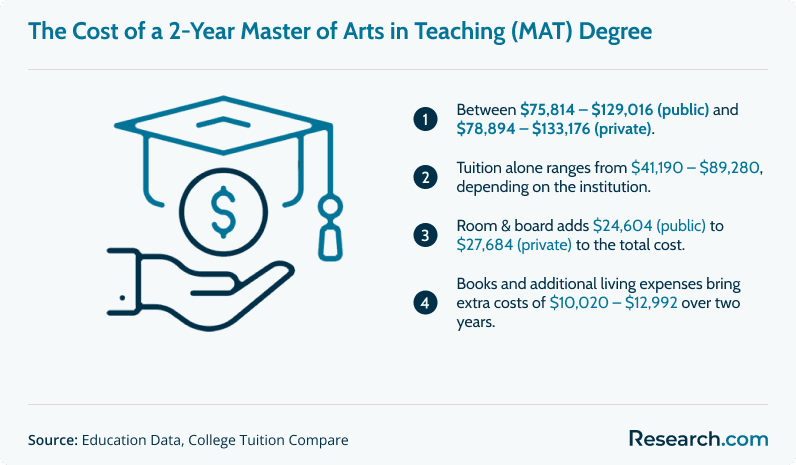
The total cost of an MAT depends on tuition, fees, program length, residency status, delivery format, and whether you must reduce work hours during student teaching. A full-time student in a two-year MAT program could spend between $65,000 and $100,000 when tuition and living expenses are combined.
There is no single national average that applies only to MAT degrees. A useful comparison is the Master of Education, a closely related graduate education degree. Education Data reports average tuition for a Master of Education at $44,640. College Tuition Compare reports average tuition for graduate education programs at $20,595. MAT tuition can fall within this general range, but individual programs may be lower or higher depending on the institution.
Tuition is only one part of the budget. Education Data also reports annual costs that graduate education students should consider, including books, supplies, room, board, and living expenses.
| Cost category | Reported amount | Why it matters when comparing MAT programs |
| Master of Education average tuition | $44,640 | Useful benchmark because MAT and M.Ed. programs are both graduate education pathways. |
| Graduate education program average tuition | $20,595 | Shows that costs can vary widely by school type and pricing model. |
| Books and supplies | $1,220 | May include textbooks, software, assessment tools, and course materials. |
| Room and board | $12,302 (public) – $13,842 (private) | Important for campus-based students and those relocating for a program. |
| Additional living expenses | $3,790 (on-campus) – $5,276 (off-campus) | Can affect affordability as much as tuition, especially during student teaching. |
| Estimated full two-year total | $65,000 to $100,000 | Helps students estimate the broader financial commitment before enrolling. |
Before choosing a program, ask whether student teaching is paid or unpaid, whether transfer credits are accepted, whether scholarships are available, and whether the program qualifies for federal financial aid.
How long does it take to complete a Master of Arts in Teaching?
Most MAT programs take 1 to 2 years, but the timeline depends on course load, start dates, field placement requirements, licensure rules, and whether the student already has prerequisite coursework in the teaching subject.
| Enrollment format | Typical timeline | Best fit |
| Full-time | 12 to 24 months | Students who can prioritize graduate coursework and complete fieldwork on a structured schedule. |
| Accelerated | As little as 12 months | Students with relevant preparation, clear licensure goals, and the ability to handle an intensive pace. |
| Part-time | 2 to 4 years | Working adults, caregivers, and current educators who need a lighter course load. |
| Online or hybrid | Varies by program | Students who need remote coursework but can complete supervised classroom requirements locally. |
The main factor that can extend the timeline is licensure. If your state requires specific exams, student teaching hours, background checks, or additional subject coursework, your completion date may depend on more than just finishing graduate classes.
How does an online Master of Arts in Teaching compare to an on-campus program?
An online MAT can carry the same academic value as an on-campus degree when it is offered by an accredited, reputable institution and includes appropriate field placements. Employers are usually more concerned with accreditation, licensure eligibility, school reputation, and classroom experience than with whether lectures were delivered online or in person.
Research cited in the original article reports that 92% of hiring managers favor online degrees from brick-and-mortar universities, while online-only schools have a lower acceptance rate of 70%. It also notes that HR leaders tend to prefer degrees from institutions established for over 95 years. These findings do not mean every older university is automatically better, but they do show why institutional reputation still matters.
| Factor | Online MAT | On-campus MAT |
| Flexibility | Often better for working adults because coursework may be asynchronous or hybrid. | Usually follows a fixed class schedule and may require regular campus attendance. |
| Field experience | Usually completed in approved schools near the student, if the program permits local placement. | Often arranged through the university’s regional school partnerships. |
| Networking | May rely on virtual cohorts, online discussion, and local mentor teachers. | May provide more face-to-face faculty, peer, and district connections. |
| Employer perception | Strongest when the degree comes from an accredited, established university. | Often familiar to local districts, especially when the university has placement partnerships. |
| Licensure risk | Students must confirm the program meets requirements in their state. | Often aligned with the state where the campus is located, but out-of-state students still need to verify. |
If you are comparing online programs, prioritize accredited options that clearly disclose licensure outcomes, student teaching arrangements, pass-rate support, and state authorization. A useful starting point is a comparison of online teaching credential programs.

How much can I make with a Master of Arts in Teaching?
Earnings after an MAT vary by state, district pay scale, union contracts, subject area, years of experience, and whether the role requires specialized credentials. Based on U.S. Bureau of Labor Statistics data cited in the original article, common MAT-related roles report salaries from $61,000 to over $100,000 annually.
| Role | Median salary | Top reported earnings | Decision note |
| High school teacher | $65,220 | More than $106,380 | Good fit for students with strong subject expertise and interest in adolescents. |
| Middle school teacher | $64,290 | Exceeding $104,410 | Best for educators comfortable teaching early adolescents and adapting instruction across developmental needs. |
| School and career counselor | $61,710 | Over $100,050 | May require a counseling-focused program or additional credentialing beyond a standard teaching MAT. |
| Special education teacher | $65,910 | Exceeding $106,290 | Can offer strong demand and salary potential but requires preparation for individualized instruction and compliance duties. |
Teachers who want to move beyond classroom roles may eventually consider a PhD degree or another advanced credential. That path is not necessary for most K-12 teaching jobs, but it may support careers in leadership, research, higher education, or specialized consulting.
What jobs can I get with a Master of Arts in Teaching?
Most MAT graduates work in schools, but the exact role depends on licensure area, grade level, endorsement, and prior experience. The degree may also support adjacent work in curriculum, coaching, and student support after a teacher gains classroom experience.
| Career path | Employment figure cited | How the MAT can help |
| High school teacher | 1,071,400 employed | Provides subject-specific teaching methods, assessment strategies, and practicum experience. |
| Middle school teacher | 640,000 employed | Builds skills in adolescent learning, classroom management, and differentiated instruction. |
| Special education teacher | 531,600 employed | Supports preparation in individualized education plans, accommodations, and inclusive practices. |
| School and career counselor | 360,800 employed | May be relevant when paired with counseling-specific coursework and required credentials. |
Some graduates later move into instructional coaching, curriculum development, department leadership, or school administration. Those transitions usually require classroom experience and, in many cases, additional certification.
Which industries pay more for Master of Arts in Teaching graduates?
Public and private schools are the most common employers for MAT graduates, but education skills can also be used in support services, government, healthcare-adjacent settings, and higher education. Pay depends on the specific occupation, not just the industry.
| Industry or setting | Salary figures cited | When it may make sense |
| Elementary and secondary schools | Around $74,910 for counselors and $73,890 for high school teachers | Best for educators who want a traditional school setting, district benefits, and a clear teaching ladder. |
| Educational support services | Salaries reaching $92,830 for special education professionals | Useful for educators interested in curriculum support, intervention services, assessment, or specialized consulting. |
| Offices of health practitioners | Up to $108,900 | May fit special education teachers or career counselors working in health-related or therapeutic environments. |
| Colleges, universities, and professional schools | $58,390 - $68,070 | Can suit educators interested in academic advising, career services, or educator preparation support. |
| State and local government, excluding schools | Salaries reaching $99,120 for secondary education experts | May appeal to experienced teachers interested in program oversight, compliance, training, or policy implementation. |
If higher earnings are a priority, compare roles in special education, counseling, and educational support services. Also review whether additional certification is required before assuming an MAT alone will qualify you for the highest-paying jobs.
What should I consider when choosing an MAT program?
The right MAT program is the one that leads to the credential and career outcome you actually need. A low tuition price is not enough if the program does not meet your state’s licensure requirements or cannot place you in a suitable classroom setting.
| Selection factor | What to verify | Why it matters |
| Accreditation | Confirm institutional accreditation and any education-specific approvals required in your state. | Accreditation affects credit transfer, financial aid, employer trust, and licensure eligibility. |
| Licensure alignment | Ask whether the program prepares students for certification in your grade level and subject area. | Teacher certification rules vary by state, and online programs may not meet every state’s requirements. |
| Student teaching placement | Find out who arranges placements, where they occur, and how supervision works. | Field experience is often the most important part of teacher preparation. |
| Program format | Compare online, hybrid, evening, weekend, full-time, and part-time formats. | The best format depends on your work schedule, location, and ability to complete practicum hours. |
| Total cost | Look beyond tuition to fees, books, travel, testing, unpaid fieldwork, and living expenses. | A cheaper sticker price can be misleading if hidden costs are high. |
| Student support | Review advising, licensure exam support, career services, mentor access, and technology help. | Strong support can reduce delays and help you complete certification steps correctly. |
Students exploring education-adjacent careers may also compare MAT programs with options such as an online library science degree, especially if their long-term goal involves information literacy, school libraries, or instructional resources rather than standard classroom teaching.
Which affordable online Master of Arts in Teaching programs offer quality education?
An affordable online MAT should be evaluated by value, not price alone. The strongest options combine reasonable tuition with accreditation, licensure alignment, transparent field placement support, qualified faculty, and strong student services.
When comparing programs, ask these questions before applying:
- Is the university accredited by a recognized accrediting body?
- Does the program lead to teacher certification in my state?
- Will the school help arrange local student teaching or will I need to find my own placement?
- Are online students eligible for the same advising and career support as campus students?
- What are the total costs after tuition, fees, books, testing, and travel?
- Can I complete the program while working, or will student teaching require time away from employment?
For a focused affordability comparison, review Research.com’s guide to affordable online master’s degrees in teaching.
Which states pay more for Master of Arts in Teaching graduates?
Teacher salaries vary significantly by state because of district funding, cost of living, collective bargaining rules, staffing needs, and local pay scales. The states below were identified in the original article using U.S. Bureau of Labor Statistics data for MAT-aligned roles.
| State | Strong salary areas cited | Reported salaries |
| California | High school teachers and special education | High school teachers: $105,540; middle school teachers: $95,860; special education secondary: $105,270 |
| New York | Career counseling and preschool special education | Career counselors: $85,820; preschool special education: $116,500; secondary school special education: $92,890 |
| Washington | Middle school and special education | Middle school teachers: $91,920; special education secondary: $92,720 |
| Massachusetts | Secondary and middle school teaching | Secondary school teachers: $87,000; middle school teachers: $87,930 |
| Oregon | Special education | Special education teachers, all levels: $90,450 |
Higher salaries can come with higher housing, transportation, tax, and childcare costs. If you are considering relocation, compare net income, district benefits, pension rules, union protections, certification reciprocity, and the cost of earning any additional state credentials.
Is a doctorate the next step after earning your MAT?
A doctorate is not the automatic next step after an MAT. It makes sense when your career goals move beyond classroom teaching into senior leadership, advanced research, district administration, professor roles, policy work, or organizational change.
An EdD is usually practice-oriented and may appeal to educators who want leadership roles in schools, districts, nonprofits, or education organizations. A PhD is usually more research-focused and may be better for those interested in scholarship, university faculty roles, or advanced research. Educators comparing accelerated doctoral options can review fast-track online EdD programs to understand possible pathways.
What is the job outlook for Master of Arts in Teaching graduates?
The job outlook for MAT graduates depends on the occupation, location, subject area, and level of specialization. Some traditional teaching roles show limited growth, but annual openings remain because of retirements, transfers, and workforce churn. Students should also monitor in-demand education careers when choosing endorsements or specializations.
| Occupation | Projected change, 2023-2033 | Annual openings or jobs added cited | Interpretation for MAT students |
| High school teachers | Decline by 1% | 64,000 openings per year | Overall employment may shrink slightly, but replacement needs still create openings. |
| Middle school teachers | Decline by 1% | 41,400 annual openings | Job prospects may depend heavily on state, subject area, and district staffing patterns. |
| Special education teachers | Stable growth (0%) | 35,900 openings per year | Specialized preparation can be valuable even when total growth is flat. |
| School and career counselors | Growing at 4% | Adding 16,200 jobs by 2033 | Counseling can be a stronger growth pathway but may require a specific credential. |
The Economic Policy Institute has also discussed an ongoing teacher shortage, even after employment rebounded from pandemic disruptions. For prospective MAT students, the practical takeaway is to research shortages by state, district, grade level, and endorsement rather than assuming demand is identical everywhere.
Is a Master of Arts in Teaching worth it?
An MAT is worth it when it helps you become licensed, enter a teaching role you could not otherwise access, qualify for a higher pay lane, or move into a specialization with better prospects. It is less likely to be worth the cost if you enroll without confirming licensure eligibility, borrow heavily for a low-paying district, or choose a program that does not match your intended grade level or subject.
The financial decision is significant. The cost of returning to college for a teaching degree at the graduate level can reach $65,000 to $100,000 for a two-year MAT when tuition and living costs are included. The original article also notes that monthly expenses for a single person in the U.S. average $1,164.3, excluding rent.
| An MAT may be worth it if... | Consider another path if... |
| You need a structured route to teacher certification. | You already hold certification and mainly want an administrative role. |
| Your target district rewards master’s degrees with salary increases. | Your district does not offer meaningful pay increases for graduate credits. |
| You want to specialize in areas such as special education or counseling. | You are unsure whether you want to teach long term. |
| You can choose an accredited program with reasonable debt. | You would need to borrow heavily without clear repayment options. |
| The program meets licensure rules in the state where you plan to work. | The program cannot confirm state certification alignment. |
Before enrolling, estimate your likely starting salary, expected loan payment, district salary schedule, certification costs, and the opportunity cost of unpaid student teaching. The degree’s value is strongest when the credential, cost, and job market line up.
What are the certification and licensure requirements for teaching careers?
Teacher certification is state-specific. Most pathways include approved coursework, supervised student teaching, background checks, and passing scores on exams such as Praxis or state-specific assessments. Some states also require subject-area tests, performance assessments, or additional reading and special education coursework.
Do not assume an online MAT automatically qualifies you for certification in every state. Before applying, contact the program and your state education agency to confirm requirements. You can also review Research.com’s state-by-state guide to teacher certification requirements.
How do MAT programs prepare educators for digital and hybrid classrooms?
Modern MAT programs increasingly include preparation for online, hybrid, and technology-supported classrooms. This may include learning management systems, digital assessment tools, remote engagement strategies, accessibility practices, adaptive learning tools, and data-informed instruction.
The strongest programs do more than teach software. They help future teachers decide when technology improves learning, when it distracts from instruction, and how to protect student privacy and equity. Educators interested in later leadership roles related to digital learning or school innovation may also compare options such as affordable online EdD programs.
Could additional credentials accelerate your career advancement?
Additional credentials can help when they match a specific role. Examples include special education endorsements, bilingual education, reading specialist credentials, STEM endorsements, instructional technology certificates, counseling credentials, or leadership preparation. The key is to avoid stacking credentials without a career plan.
If your long-term goal involves school improvement, district leadership, nonprofit administration, or organizational change, a leadership doctorate may be relevant. Research.com’s guide to an online doctorate in organizational leadership can help educators compare that broader leadership route with education-specific doctoral programs.
Can MAT graduates move into educational leadership?
Yes, but the MAT alone is usually not enough for formal administrative positions. Classroom experience is valuable, but roles such as assistant principal, principal, or district administrator generally require leadership coursework, administrative certification, and state approval.
A common pathway is to teach after completing the MAT, build a record of instructional effectiveness, then add a leadership credential. Educators considering that route can compare affordable online educational leadership master’s programs to determine whether a leadership degree or certification is the next logical step.
How can interdisciplinary expertise expand your teaching career options?
Teaching increasingly overlaps with technology, data literacy, student support, information science, media literacy, and community partnerships. MAT graduates who develop interdisciplinary skills may qualify for roles that extend beyond a single classroom, including instructional coaching, curriculum development, school library collaboration, educational technology support, and intervention coordination.
For example, educators interested in research skills, information access, and learning resources may compare teaching pathways with library science careers. This can be especially relevant for teachers who want to support literacy, digital citizenship, and student research across grade levels.
How do MAT outcomes compare with related advanced degrees?
MAT outcomes are strongest for people who want teaching credentials and classroom expertise. Related degrees may produce different outcomes because they prepare graduates for different work. A library science degree, for example, may lead toward school library, archives, information management, or research support roles rather than standard classroom teaching. Research.com’s guide to careers and salary outcomes with a master’s in library science can help students compare those options.
| Graduate path | Best use case | Main trade-off |
| MAT | Becoming a licensed teacher or improving direct instruction | Less focused on administration or policy than leadership degrees. |
| M.Ed. | Curriculum, leadership, student services, or broader education roles | May not include initial teacher certification unless designed for that purpose. |
| Library science master’s | Information literacy, school libraries, archives, or research support | May require different certification for school-based library roles. |
| EdD or PhD | Advanced leadership, research, higher education, or policy work | Longer and more specialized than an MAT. |
What is the return on investment of a Master of Arts in Teaching?
The ROI of an MAT should be measured by more than salary. A useful calculation includes total program cost, debt, time away from work, licensure value, salary-lane increases, job stability, pension or benefits, and whether the degree opens roles that were previously unavailable.
Use this practical ROI checklist before enrolling:
- Compare the program’s total cost with your expected first-year teaching salary.
- Ask districts whether a master’s degree changes your pay scale.
- Confirm whether student teaching will reduce your income temporarily.
- Review loan repayment, forgiveness, or employer tuition assistance options if available.
- Check whether the program leads to certification in your state and subject area.
- Compare the MAT with lower-cost or adjacent graduate options, including unrelated affordability benchmarks such as the most affordable online master’s degrees in history, to understand how program costs differ across fields.
Common mistakes to avoid when choosing an MAT program
| Mistake | Why it can hurt you | Better approach |
| Choosing based only on tuition | Low tuition does not guarantee licensure alignment, field placement support, or strong advising. | Compare total cost, accreditation, outcomes, and certification fit together. |
| Assuming every online MAT leads to licensure | State rules vary, and some programs may not meet requirements outside their home state. | Get written confirmation from the school and check with your state education agency. |
| Ignoring student teaching logistics | Fieldwork can affect work schedules, childcare, travel, and income. | Ask who arranges placements and whether they can be completed near you. |
| Relying only on rankings | A highly ranked program may not be the best match for your state, subject, or budget. | Use rankings as one input, then verify licensure, cost, and support. |
| Assuming salary outcomes are guaranteed | Teacher pay depends on district contracts, location, experience, and specialization. | Review local salary schedules before borrowing for the degree. |
Sources
- Bureau of Labor Statistics. School and Career Counselors. BLS school and career counselor data.
- Bureau of Labor Statistics. Special Education Teachers. BLS special education teacher data.
- Bureau of Labor Statistics. Middle School Teachers. BLS middle school teacher data.
- Bureau of Labor Statistics. High School Teachers. BLS high school teacher data.
- College Tuition Compare. Education Major Tuition Costs. College Tuition Compare education tuition data.
- Drexel University. Online Degree vs. Traditional Degree: Which is Right for You? Drexel University Online degree comparison.
- EducationData.org. Average Cost of a Master’s Degree. Education Data Initiative master’s degree cost data.
- EducationData.org. Average Cost of College. Education Data Initiative college cost data.
- Numbeo. Cost of Living in the United States. Numbeo U.S. cost of living data.
Key Insights
- An MAT is primarily a teaching degree. Choose it if your goal is classroom instruction or teacher certification, not if your main goal is administration or policy.
- Cost can be substantial. A two-year MAT may total $65,000 to $100,000 when tuition and living expenses are included, so compare total cost rather than tuition alone.
- Licensure alignment is the most important program filter. An accredited online MAT is useful only if it meets the certification requirements in the state where you plan to teach.
- Salary outcomes depend on role and location. Common MAT-related roles report median salaries from $61,710 to $65,910, while top earners in some roles exceed $100,000.
- Specialization can improve prospects. Special education, counseling, and certain high-paying states or industries may offer stronger financial outcomes than general teaching roles.
- Online MAT programs can be credible when they come from accredited, reputable institutions and provide supervised local field placements.
- The best ROI comes from matching degree cost, state certification rules, district salary schedules, and your long-term commitment to teaching before enrolling.
Other Things You Should Know About Master of Arts in Teaching
Yes, individuals with a bachelor's degree in a non-education field can pursue a Master of Arts in Teaching (MAT) in 2027. Many MAT programs are designed to accommodate diverse academic backgrounds and provide necessary pedagogical training for a teaching career.
Admission requirements typically include a bachelor's degree from an accredited institution, a minimum GPA of 3.0, letters of recommendation, and sometimes GRE scores. Individual programs may have additional criteria, such as previous teaching experience or a personal statement detailing educational goals.
Most MAT graduates must pass a state-approved teacher licensure exam, such as the Praxis series, before earning a public school teaching license. Requirements are set by each state education department, and some states also require a content test, a pedagogy test, and a background check.


