
2027 What Can You Do With an Associate in Cybersecurity?

Co-Founder and Chief Data Scientist
Choosing an associate degree in cybersecurity is often the first major decision for someone who wants to enter the field but does not yet have a technical background, a bachelor’s degree, or years of IT experience. The appeal is clear: cybersecurity work is tied to protecting data, networks, businesses, public services, and personal privacy, and the Bureau of Labor Statistics projects the field to grow 33 percent from 2023 to 2033.
This guide explains what an associate in cybersecurity can realistically do for you, what jobs it may help you pursue, which certifications can strengthen your resume, and when you should consider continuing into a bachelor’s or graduate program. It is written for first-time college students, working adults changing careers, IT support workers who want to move into security, and anyone comparing cybersecurity education options before investing time and money.
Quick answer: Is an associate in cybersecurity worth considering?
An associate in cybersecurity can be a practical starting point if you want structured training in networking, security fundamentals, systems defense, and incident response without immediately committing to a longer degree path. It can help you qualify for entry-level security and IT roles, prepare for industry certifications such as CompTIA Security+, and create a transfer pathway into a bachelor’s degree. It is not a guarantee of a cybersecurity job, and many employers still value experience, labs, internships, certifications, and strong technical portfolios.
| Best fit | May not be the best fit |
| Career changers who need a structured entry point into cybersecurity | Applicants expecting senior cybersecurity roles immediately after graduation |
| Students who want transferable college credits toward a bachelor’s degree | Learners who only want a short certification bootcamp with no general education courses |
| IT support or networking workers who want to add security skills | People who are unwilling to practice hands-on labs outside required coursework |
| Budget-conscious students comparing lower-cost academic pathways | Students who have not checked accreditation, transfer policies, or certification alignment |
Key things to know about an associate in cybersecurity
- The average annual salary for a cybersecurity professional in the U.S. is $132,962, which shows why many students see the field as financially attractive.
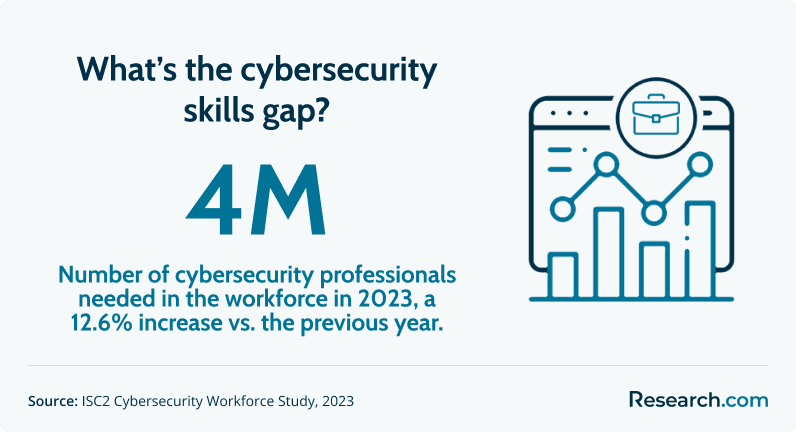
- The cybersecurity workforce need increased by 12.6% in 2023, with roughly four million positions open, reflecting continued demand for qualified security talent.
- Workers with certifications earned a median weekly wage of $1,386 in 2022, while workers without certifications earned $986, showing why credentials can matter in career progression.
- Cybersecurity helps organizations avoid operational disruption and financial loss; the global average cost of a data breach reached $4.88 million in 2024.
- Entry-level candidates are usually evaluated on technical fundamentals, critical thinking, communication, teamwork, and credentials such as CompTIA Security+ because many employers report skills gaps on their teams.
- What cybersecurity associate degree jobs are available in 2027?
- How does an associate in cybersecurity prepare you for work?
- Which cybersecurity certifications pair well with an associate degree?
- Why does cybersecurity matter in the current digital economy?
- How does cybersecurity protect business continuity?
- What ethical responsibilities come with cybersecurity work?
- What should you check before choosing a cybersecurity program?
- Can an accelerated computer science degree help cybersecurity professionals?
- When should you consider an advanced degree for cybersecurity?
- What real-world challenges do cybersecurity workers face?
- How can you move from an associate degree to a bachelor’s degree?
- How do interdisciplinary skills improve cybersecurity careers?
- How does cybersecurity apply to game development?
- What is the ROI of an associate in cybersecurity?
- How does cybersecurity support emerging technologies?
- How can interdisciplinary education expand cybersecurity options?
- How does cybersecurity connect to business strategy and leadership?
- How does cybersecurity affect personal privacy?
- What skills do employers want in entry-level cybersecurity candidates?
- What trends are shaping cybersecurity education?
- What mistakes should students avoid when choosing this path?
What cybersecurity associate degree jobs are available in 2027?
An associate in cybersecurity can prepare graduates for entry-level and early-career roles focused on protecting systems, monitoring threats, supporting investigations, and helping organizations reduce security risk. As of Feb 3, 2025, the average annual pay for a Cyber Security Professional in the United States is $132,962 a year, but individual pay can vary by role, experience, location, employer, industry, clearance requirements, and certifications.
| Career path | Typical focus | How an associate degree helps |
| Cybersecurity Analyst | Reviews alerts, monitors systems, investigates suspicious activity, and supports security controls. | Builds a foundation in networks, threats, access controls, and incident documentation. |
| Network Security Specialist | Helps secure routers, switches, firewalls, wireless networks, and internal infrastructure. | Connects networking fundamentals with defensive security practices. |
| Information Security Technician | Installs security tools, assists with audits, updates systems, and supports user security practices. | Prepares students for hands-on operational security work and basic compliance tasks. |
| Incident Response Analyst | Responds to security events, gathers evidence, identifies causes, and recommends prevention steps. | Introduces log review, threat identification, documentation, and response procedures. |
| Security Consultant | Assesses vulnerabilities, reviews security practices, and recommends improvements. | Provides technical vocabulary and risk-awareness that can grow with experience and certifications. |
Some graduates begin outside pure cybersecurity in IT support, help desk, systems administration, or networking before moving into dedicated security roles. That path can be smart because employers often want proof that candidates understand how systems work before they are trusted to defend them.
Cybersecurity also overlaps with audit, compliance, and risk management. If you are interested in controls, governance, and financial risk, reviewing an internal auditor career path can help you understand adjacent roles that often work with security teams.
Human behavior is also part of cyber risk. Social engineering, phishing, insider risk, and training design all require an understanding of how people make decisions under pressure. Students exploring the behavioral side of security may find it useful to compare this field with other people-centered disciplines, including career options with a master's in sport psychology, while recognizing that this is not a direct cybersecurity credential.
For professionals aiming eventually at risk leadership, budgeting, or executive decision-making, business education can complement technical expertise. A program such as the best MBA in finance online may be relevant for those who want to connect cybersecurity investment with financial strategy and enterprise risk.
How does an associate in cybersecurity prepare you for work?
An associate degree in cybersecurity gives students a structured introduction to the technical, analytical, and ethical skills used in entry-level security work. In 2023, there were roughly four million cybersecurity professionals needed in the workforce, a 12.6% increase from the previous year, which helps explain why many colleges have expanded cybersecurity pathways.
Coursework commonly emphasizes network defense, operating systems, security tools, cryptography concepts, cyber defense methods, risk assessment, and incident response. Strong programs do more than assign readings. They use labs, simulations, packet analysis, vulnerability exercises, and scenario-based projects so students can practice identifying weaknesses and responding to realistic threats.
Employers also look beyond technical vocabulary. Cybersecurity workers must document findings clearly, explain risk to nontechnical staff, escalate urgent issues, protect sensitive information, and make sound decisions under pressure. An associate program can introduce these habits early, especially when assignments require reports, teamwork, and ethical analysis.
| Workforce preparation area | Why it matters | What to look for in a program |
| Hands-on labs | Security work is practical; students need experience with tools and scenarios. | Virtual labs, cyber ranges, firewall configuration, log analysis, and incident exercises. |
| Networking fundamentals | You cannot secure systems well if you do not understand how traffic, devices, and access work. | Courses in TCP/IP, routing, switching, wireless networks, and secure network design. |
| Security operations | Entry-level roles often involve monitoring, ticketing, alerts, and escalation. | Exposure to SIEM concepts, intrusion detection, threat triage, and documentation. |
| Ethics and compliance | Security professionals handle sensitive systems and data. | Assignments covering privacy, authorization, legal boundaries, and responsible disclosure. |
| Career readiness | Students need evidence of skills when applying for their first role. | Resume support, internships, capstone projects, certification preparation, and employer partnerships. |
Cybersecurity professionals also work in education and training environments, especially as organizations teach staff how to avoid phishing, protect student records, and handle sensitive data. Those interested in broader student support and educational settings may compare cybersecurity training roles with programs such as the best online school counseling master's degree programs, though counseling and cybersecurity lead to different professional outcomes.
Which cybersecurity certifications pair well with an associate degree?
An associate degree can help you understand the concepts tested on major cybersecurity certifications, but a degree and a certification serve different purposes. The degree provides academic structure and college credit; certifications validate specific job-related knowledge for employers. According to the U.S. Bureau of Labor Statistics, workers with certifications often earn more than workers without them. In 2022, certified professionals earned a median weekly wage of $1,386, compared to $986 for those without certification.
| Certification | Best use | How it fits with an associate degree |
| CISSP certification | Demonstrating advanced knowledge in security program design, risk management, architecture, and governance. | Better suited after building experience; an associate degree can introduce the concepts but usually is not enough by itself. |
| Certified Ethical Hacker (CEH) | Learning ethical hacking methods, vulnerability identification, and penetration testing concepts. | Useful for students interested in offensive security, testing, and authorized assessment work. |
| CompTIA Security+ | Showing baseline cybersecurity knowledge in threats, network security, cryptography, risk, and controls. | Often one of the most practical early certifications to consider alongside or after an associate program. |
| Cisco Certified CyberOps Associate | Preparing for security operations center work, alert monitoring, detection, and response. | A good match for students targeting analyst or SOC-style roles. |
| Certified Cloud Security Professional (CCSP) | Validating knowledge of cloud security design, operations, architecture, and service orchestration. | More relevant after gaining cloud and security experience, especially for roles involving cloud platforms. |
When choosing certifications, start with the roles you want. A student applying for help desk or junior security analyst roles may benefit from foundational credentials, while someone targeting penetration testing, cloud security, or governance may need a more specialized sequence.
Cybersecurity professionals who want to move into management sometimes combine technical certifications with business credentials. For example, cheap online MBA programs no GMAT may appeal to working professionals who want a management-focused path with flexible admissions requirements.
Public-sector cybersecurity roles can involve budgeting, policy, compliance, and public administration. If that direction interests you, comparing the most affordable MPA options may help you understand how government and nonprofit leadership training can complement security experience.
Why does cybersecurity matter in the current digital economy?
Cybersecurity matters because nearly every organization now depends on digital systems to store data, deliver services, process payments, manage operations, and communicate with customers. When those systems are compromised, the damage can include stolen information, interrupted services, regulatory consequences, reputational harm, and direct financial loss. A data breach had a global average cost of $4.88 million in 2024—up 10% from the previous year.
- Data protection: Security controls help reduce the risk of identity theft, financial fraud, intellectual property theft, and exposure of sensitive records.
- Operational resilience: Secure systems help organizations keep essential services running during attempted attacks or technical failures.
- Customer confidence: People are more likely to trust organizations that treat privacy and security as core responsibilities.
- Legal and regulatory compliance: Many industries must follow rules for storing, transmitting, and protecting personal or confidential information.
- Risk-informed decision-making: Cybersecurity gives leaders a clearer picture of technical risk before they launch products, adopt tools, or expand digital services.
How does cybersecurity protect business continuity?
Cybersecurity supports business continuity by reducing the chance that attacks, breaches, ransomware, system abuse, or unauthorized access will stop normal operations. Security is not only about blocking hackers; it is also about keeping payroll, customer service, logistics, clinical systems, financial platforms, and internal communications available when the organization needs them.
- Reducing breach exposure: Strong authentication, patching, monitoring, and access controls make unauthorized entry more difficult.
- Keeping systems available: Defensive planning helps limit downtime and supports faster recovery when incidents occur.
- Limiting financial damage: Good preparation can reduce recovery costs, lost productivity, legal exposure, and regulatory penalties.
- Supporting compliance: Security policies and controls help organizations meet privacy, reporting, and data protection obligations.
- Improving incident response: Prepared teams know who must act, what systems matter most, and how to communicate during a crisis.
Graduates with an associate in cybersecurity may support this work by monitoring systems, documenting incidents, applying controls, helping with user training, and escalating risks to more experienced analysts or managers.
What ethical responsibilities come with cybersecurity work?
Cybersecurity professionals often have access to sensitive systems, private records, logs, credentials, and technical weaknesses that could be misused. Ethics matters because the same skills used to defend systems can cause harm if they are applied without authorization, transparency, or respect for privacy.
- Authorization: Security testing should be performed only when the professional has permission and a defined scope of work.
- Privacy: Analysts must protect personal and confidential data and avoid accessing information that is not needed for the task.
- Responsible disclosure: Vulnerabilities should be reported through appropriate channels so they can be fixed without creating unnecessary harm.
- Accuracy: Security findings should be documented honestly, without exaggerating risk or hiding serious problems.
- Compliance: Professionals need to understand applicable rules, policies, contracts, and legal obligations before handling sensitive systems or data.
What should you check before choosing a cybersecurity program?
The right cybersecurity program should match your goals, schedule, budget, transfer plans, and preferred learning format. Do not choose based only on the program name. Two schools may both offer an “associate in cybersecurity,” but one may include robust labs, certification preparation, and transfer agreements while another may rely mostly on theory.
| Selection factor | Why it matters | Questions to ask |
| Accreditation | Accreditation affects credit transfer, employer recognition, and financial aid eligibility. | Is the institution accredited by a recognized accreditor? |
| Curriculum | The program should cover networking, systems, security operations, risk, and incident response. | Which courses are required, and how current are the tools and scenarios? |
| Hands-on practice | Employers want applied skills, not just course completion. | Are there labs, virtual environments, projects, or a capstone? |
| Certification alignment | Some courses can help prepare for industry credentials. | Does the curriculum map to certifications such as CompTIA Security+? |
| Transfer pathway | Many students later continue into a bachelor’s degree. | Which credits transfer, and does the school have articulation agreements? |
| Flexibility | Working adults may need online, evening, part-time, or accelerated formats. | Can I complete labs remotely, and are courses offered on a predictable schedule? |
| Career support | First cybersecurity roles can be competitive. | Does the school help with resumes, internships, employer connections, or interview preparation? |
If speed is a priority, compare traditional options with accelerated cyber security degree online programs. An accelerated format can be useful, but only if it still includes enough hands-on practice and support for your experience level.
Can an accelerated computer science degree help cybersecurity professionals?
An accelerated computer science pathway can strengthen cybersecurity preparation by improving programming ability, systems thinking, software architecture knowledge, and problem-solving. These skills are valuable for security engineering, application security, malware analysis, cloud security, automation, and technical leadership.
This option makes the most sense for learners who want deeper technical flexibility beyond security operations. For example, a one year computer science degree may appeal to students who already have college credits, strong motivation, and the ability to handle an intensive course load.
When should you consider an advanced degree for cybersecurity?
An advanced degree is usually not the first requirement for entry-level cybersecurity work, but it can become useful for specialized, research-oriented, management, architecture, policy, or leadership roles. Graduate study can help professionals connect technical decisions with governance, business risk, data strategy, secure systems design, and organizational leadership.
If your long-term goal is to move beyond analyst work into senior technical or strategic roles, programs such as an online MS computer science may help deepen your technical foundation while supporting broader career mobility.
What real-world challenges do cybersecurity workers face?
Cybersecurity work is demanding because threats change quickly, systems are complex, and organizations must balance security with usability, cost, compliance, and business deadlines. Professionals may deal with ransomware, phishing, misconfigured cloud systems, outdated software, weak passwords, third-party risk, and limited staffing.
- Fast-changing threats: Attackers constantly adapt tactics, which requires ongoing learning.
- Alert fatigue: Security teams may receive large volumes of alerts and must decide what matters most.
- Business pressure: Security recommendations must often be explained in terms of cost, risk, and operational impact.
- Compliance complexity: Different industries and jurisdictions may have different security and privacy requirements.
- Skills maintenance: Tools, platforms, and attacker methods change, so learning does not stop after graduation.
Students who want a broad view of school options can compare cyber security schools online to find programs that combine affordability with relevant technical preparation.
How can you move from an associate degree to a bachelor’s degree?
Many students use an associate in cybersecurity as the first step toward a bachelor’s degree. The key is to plan early so you do not lose credits or take courses that do not apply to your next program.
- Identify transfer-friendly schools: Look for bachelor’s programs that clearly accept associate degree credits in cybersecurity, information technology, computer science, or related areas.
- Confirm accreditation and articulation agreements: Ask whether your current school has formal transfer agreements with specific universities.
- Compare course equivalencies: Review which cybersecurity, networking, programming, math, and general education courses will count toward the bachelor’s program.
- Ask about GPA and prerequisite rules: Some programs require minimum grades or specific courses before admission.
- Keep documentation: Save syllabi, lab descriptions, transcripts, and certification records in case the receiving school reviews courses individually.
- Consider format and pace: Online, evening, part-time, and accelerated options may help working students continue without pausing their careers.
When comparing flexible programs, look beyond cybersecurity alone and study how other online degree models handle transfer credits, pacing, and scheduling. For example, a self-paced accounting degree is not a cybersecurity program, but it can help you understand how self-paced online formats differ from term-based study.
How do interdisciplinary skills improve cybersecurity careers?
Cybersecurity does not exist in isolation. Strong professionals often combine security fundamentals with knowledge of data, business, psychology, law, healthcare, engineering, or software development. These combinations can make you more useful in specialized environments where security decisions depend on industry context.
| Interdisciplinary skill | Cybersecurity value | Possible career advantage |
| Data analytics | Helps identify suspicious patterns, prioritize alerts, and evaluate risk trends. | Useful for threat detection, fraud analysis, and security operations. |
| Communication | Turns technical findings into clear recommendations for users and leaders. | Important for consulting, awareness training, and management roles. |
| Business and finance | Connects security investments to risk reduction and organizational goals. | Helpful for governance, risk, compliance, and leadership pathways. |
| Healthcare or science knowledge | Supports security work in regulated environments with sensitive data. | Relevant for health systems, research organizations, and biotech settings. |
| Software development | Improves secure coding, application testing, and automation skills. | Valuable for application security and security engineering. |
Professionals who want to add analytics depth may explore online masters in data science programs as a later step, especially if they want to work with large-scale security data, threat intelligence, or risk modeling.
How does cybersecurity apply to game development?
Cybersecurity is important in game development because studios, publishers, and platforms need to protect source code, player accounts, payment systems, anti-cheat mechanisms, online communities, development pipelines, and intellectual property. Multiplayer games and digital distribution systems can also become targets for account theft, fraud, denial-of-service attacks, and exploitation.
Students interested in the intersection of security and interactive media may compare cybersecurity training with a game design bachelor degree online. The strongest path depends on whether your main goal is to build games, secure gaming platforms, or work in software security more broadly.
What is the ROI of an associate in cybersecurity?
The return on investment for an associate in cybersecurity depends on total cost, how quickly you complete the program, whether credits transfer, whether you earn certifications, and whether you gain practical experience that helps you qualify for entry-level work. The degree can be financially attractive because it may cost less than a longer pathway and can help you enter the workforce sooner, but outcomes are not guaranteed.
| ROI factor | Why it matters | How to evaluate it |
| Tuition and fees | Sticker price is only one part of cost. | Include books, technology fees, lab fees, certification exams, and commuting or online platform costs. |
| Transfer value | Credits that transfer can reduce the cost of a bachelor’s degree later. | Ask receiving schools to confirm transferability before enrolling. |
| Certification preparation | Certifications may improve employability when paired with skills and experience. | Check whether courses align with industry-recognized exams. |
| Hands-on experience | Projects, labs, and internships can make applications stronger. | Review sample assignments, capstones, and employer partnerships. |
| Career support | First roles can be difficult to land without guidance. | Ask about placement support, resume help, interview preparation, and alumni networks. |
Interdisciplinary knowledge can also affect long-term ROI. For example, students interested in security for scientific, healthcare, or research environments may compare cybersecurity with the best online degree in biochemistry to understand how domain expertise can shape career direction.
How does cybersecurity support emerging technologies?
Emerging technologies create new opportunities, but they also increase the number of systems, devices, applications, and data flows that must be protected. Cybersecurity enables adoption by helping organizations manage risk before new technology becomes a liability.
- Internet of Things: Connected devices need secure configuration, access controls, updates, and monitoring. With the IoT cybersecurity market expected to reach $60 billion globally by 2029, securing connected devices is a major priority.
- Cloud computing: Cloud environments require identity management, encryption, monitoring, secure configuration, and shared-responsibility awareness.
- Blockchain systems: Security practices help protect wallets, smart contracts, platforms, and transaction integrity from fraud and exploitation.
- Smart cities: Connected transportation, utilities, public safety, and energy systems require protection because cyber incidents can affect physical services.
- Artificial intelligence: Security teams must think about data protection, model misuse, automated attacks, and secure deployment as AI tools become more common.
Professionals who want to combine security with executive decision-making may also compare technology leadership programs, including AACSB-accredited online MBA programs rankings, when planning long-term advancement.
How can interdisciplinary education expand cybersecurity options?
Cybersecurity professionals often become more valuable when they understand the industry they are protecting. A security analyst in healthcare, finance, education, manufacturing, gaming, or government may face different data types, regulations, systems, and risk priorities.
For example, healthcare security requires an understanding of patient data, clinical workflows, interoperability, and compliance pressures. Students interested in that direction may look at accelerated online masters health informatics programs as a later specialization that connects technical security awareness with healthcare information systems.
How does cybersecurity connect to business strategy and leadership?
Cybersecurity is now a business issue, not only an IT function. Leaders need to understand how cyber risk affects revenue, operations, reputation, compliance, customer trust, insurance, vendor relationships, and product development. Security professionals who can translate technical risk into business language are better positioned for management and advisory roles.
- Risk prioritization: Security teams help leaders decide which risks require immediate investment.
- Governance: Policies, controls, and reporting structures make security accountable across the organization.
- Incident planning: Leadership must know how the organization will respond before a breach occurs.
- Innovation support: Strong security allows companies to adopt new technologies with fewer unmanaged risks.
For professionals who want to combine technical security experience with operations, project management, and organizational leadership, cheap engineering management online masters programs may be worth comparing with cybersecurity-focused graduate options.
How does cybersecurity affect personal privacy?
Cybersecurity protects personal privacy by helping prevent unauthorized access to personal information, financial records, credentials, communications, location data, and other sensitive digital traces. Privacy and security are not identical, but they are closely connected: privacy defines how information should be collected and used, while security helps protect that information from misuse or exposure.
- Personal data protection: Encryption, authentication, access controls, firewalls, and secure password practices help reduce exposure.
- Breach prevention: Data breaches can reveal financial information, social security numbers, health records, and other sensitive details.
- Privacy laws: Regulations such as GDPR in Europe and CCPA in California set expectations for how organizations collect, store, and use personal data.
- Individual responsibility: People can reduce personal risk by using strong unique passwords, enabling two-factor authentication, updating devices, and avoiding phishing traps.
- Security education: Basic cybersecurity knowledge helps individuals recognize scams, protect accounts, and make safer choices online.
What skills do employers want in entry-level cybersecurity candidates?
Employers hiring for entry-level cybersecurity roles usually want a combination of technical fundamentals, troubleshooting ability, communication skills, ethical judgment, and willingness to keep learning. Despite strong demand, 90% of cybersecurity professionals report skills gaps on their teams, according to the 2024 ISC2 Cybersecurity Workforce Study.
| Skill area | What it includes | How to demonstrate it |
| Technical fundamentals | Networking, operating systems, firewalls, encryption concepts, endpoint protection, and basic scripting or programming. | Labs, home lab projects, coursework, certifications, and documented troubleshooting examples. |
| Threat detection | Understanding phishing, malware, suspicious network activity, log review, and common attack patterns. | Security lab writeups, incident response exercises, and practice with detection tools. |
| Critical thinking | Analyzing alerts, separating false positives from real risk, and identifying root causes. | Case studies, capstone projects, and interview examples using clear reasoning. |
| Teamwork | Working with IT, operations, compliance, managers, and end users. | Group projects, internship experience, service desk work, and strong references. |
| Communication | Explaining technical findings in plain language and documenting incidents accurately. | Reports, tickets, presentations, and concise portfolio summaries. |
| Certifications | Credentials such as CompTIA Security+, Certified Ethical Hacker (CEH), and Cisco's CCNA Cyber Ops. | Completed exams, exam preparation progress, and alignment with target job postings. |
What trends are shaping cybersecurity education?
Cybersecurity education is changing because the threat landscape, employer expectations, and technology platforms are changing. Programs increasingly emphasize applied labs, cloud security, AI-aware defense, data analytics, secure software practices, and collaboration with employers. The strongest programs help students practice with realistic scenarios rather than only memorizing terminology.
- More simulation-based learning: Cyber ranges, virtual labs, and incident scenarios help students practice decisions under realistic pressure.
- AI and machine learning content: Students need to understand how AI can support defense and how attackers may misuse automation.
- Cloud security emphasis: As organizations use cloud services, programs need to teach identity, configuration, monitoring, and shared responsibility.
- Competency-based evaluation: Some programs focus more on demonstrated skills, projects, and practical assessments.
- Industry certification alignment: Schools increasingly map courses to recognized certifications to help students show job readiness.
Students interested in the AI side of security may compare cybersecurity pathways with online AI masters programs as part of a longer-term technical plan.
What mistakes should students avoid when choosing this path?
The biggest mistake is assuming that any cybersecurity degree will automatically lead to a cybersecurity job. A good associate program can be valuable, but students still need to choose carefully, build hands-on experience, pursue relevant certifications, and understand what local or remote employers actually require.
| Common mistake | Why it can hurt you | Better approach |
| Choosing without checking accreditation | Credits may not transfer, and financial aid or employer recognition may be affected. | Verify institutional accreditation before applying. |
| Looking only at tuition | Low tuition may not reflect total cost or program quality. | Compare fees, books, labs, certification costs, support services, and transfer value. |
| Ignoring hands-on training | Employers want proof that you can apply concepts. | Prioritize programs with labs, projects, simulations, and internships. |
| Assuming online means easier | Online cybersecurity programs still require technical discipline and practice. | Ask how labs work, how instructors support students, and what technology is required. |
| Waiting until graduation to prepare for jobs | Entry-level applications are stronger with projects, certifications, and networking. | Build a portfolio, practice interviews, earn credentials, and apply for internships early. |
| Relying only on rankings | A highly ranked program may not fit your budget, schedule, or transfer goals. | Use rankings as one data point, then compare outcomes, curriculum, cost, and support. |
Student perspectives on completing an associate in cybersecurity
-
: "
Completing my associate in cybersecurity helped me move toward a better-paying job soon after graduation. The program gave me the core security knowledge I needed, and I did not have to postpone work while waiting to finish a bachelor’s degree. My career is now moving in a direction I care about, and my earnings are improving over time. – Mark
"
-
: "
I picked the associate route because I wanted to enter the workforce quickly. The practical coursework in network security and threat management helped me qualify for my first cybersecurity role. I am still pursuing certifications, but the degree gave me the confidence and foundation to begin. – Jade
"
-
: "
The strongest part of my associate program was the balance of affordability, speed, and practical training. I learned enough to start applying for entry-level roles while keeping the flexibility to work and continue studying. – Leo
"
Key insights
- An associate in cybersecurity is best viewed as a launch point, not a finish line. It can support entry-level roles, certification preparation, and transfer into a bachelor’s degree.
- Demand is strong, with the field projected to grow 33 percent from 2023 to 2033, but employers still expect practical skills, problem-solving ability, and evidence of hands-on experience.
- Certifications can improve credibility. In 2022, certified professionals earned a median weekly wage of $1,386, compared to $986 for those without certification.
- Program quality matters. Before enrolling, check accreditation, labs, certification alignment, career support, transfer policies, and total cost.
- Cybersecurity careers are broad. Graduates may start in analyst, technician, network security, incident response, IT support, or compliance-adjacent roles before advancing.
- The strongest candidates combine technical foundations with communication, ethics, teamwork, and industry context.
- ROI depends on more than salary. Consider tuition, fees, time to completion, credit transfer, certifications, internships, and your ability to turn coursework into demonstrable skills.
References:
- 2024 ISC2 Cybersecurity Workforce Study. (n.d.). https://www.isc2.org/Insights/2024/10/ISC2-2024-Cybersecurity-Workforce-Study
- Cyber Security Professional Salary. (2025, February). ZipRecruiter. Retrieved February 11, 2025, from https://www.ziprecruiter.com/Salaries/Cyber-Security-Professional-Salary
- Information Security Analysts. (2024, August 29). Bureau of Labor Statistics. https://www.bls.gov/ooh/computer-and-information-technology/information-security-analysts.htm
- Koehler, R., Sharma, U., & Nord, P. (2025, January 16). Addressing cybersecurity skills gap in higher education. IBM. Retrieved February 11, 2025, from https://www.ibm.com/new/announcements/addressing-cybersecurity-skills-gap-higher-education
- Staff, C. (2025, January 15). Your Cybersecurity salary guide. Coursera. https://www.coursera.org/articles/cybersecurity-salary
Other Things You Should Know about Associate in Cybersecurity
In 2027, individuals with an associate degree in cybersecurity can pursue entry-level roles such as cybersecurity technician, IT support specialist, and network security associate. These positions focus on monitoring networks, troubleshooting software issues, and implementing basic security measures to protect organizational data.
In 2027, an associate degree in cybersecurity can equip you with skills like network security, ethical hacking, and incident response. Additionally, you'll gain proficiency in cybersecurity tools relevant to protecting digital systems and defending against cyber threats, preparing you for various career opportunities.


