2027 Forensic Analyst Careers: Skills, Education, Salary & Job Outlook

Co-Founder and Chief Data Scientist
Choosing a forensic analyst career means deciding whether you want a science-heavy role where accuracy, documentation, and courtroom-ready communication matter as much as curiosity. The work can be rewarding, but it is not a casual entry into criminal justice. Most roles require a strong foundation in biology, chemistry, forensic science, statistics, or a related technical field, plus supervised practice with evidence handling and laboratory procedures.
This guide is for students, career changers, and early-career professionals who want a realistic view of the path ahead. It explains what forensic analysts do, which skills and credentials matter, how salaries and job growth compare, what the work environment is like, and how to evaluate advancement options. Use it to decide whether this career fits your strengths, tolerance for detailed lab work, and interest in supporting legal investigations through objective scientific evidence.
Key Things You Should Know About Forensic Analyst Career
- The typical earning potential for a forensic analyst is around $67,440 per year, with entry-level salaries usually between $50,000 and $60,000, while experienced professionals can earn significantly more.
- Employment in forensic analysis is expected to grow 13% from 2024 to 2034, which is much faster than average, offering strong job stability and future opportunities.
- A bachelor's degree in forensic science or a related natural science like biology or chemistry is required to start, along with additional on-the-job training.
- Success in this field depends on strong analytical thinking, attention to detail, effective written and verbal communication, solid scientific knowledge, and problem-solving skills, plus technical proficiency with lab equipment and digital forensics tools.
- Career advancement can lead to senior analyst roles, supervisory or laboratory management positions, specialization in areas like DNA or digital forensics, and eventually consulting or leadership roles in crime labs or federal agencies.
What do forensic analysts do?
Forensic analysts examine evidence connected to criminal and civil investigations. Their job is to apply scientific methods to materials such as biological samples, chemical substances, trace evidence, fingerprints, digital files, or other case-related items, then explain what the findings do and do not prove.
The role sits at the intersection of laboratory science, law enforcement, and the court system. A forensic analyst does not “solve” cases alone. Instead, they produce reliable findings that investigators, attorneys, judges, and juries can use to make decisions. That distinction matters: strong forensic work is careful, limited to the evidence, and transparent about uncertainty.
A typical day in the role
A forensic analyst may spend much of the day in a laboratory receiving evidence, documenting chain of custody, preparing samples, running tests, reviewing results, and writing reports. Depending on the specialization, the work may involve microscopy, DNA procedures, toxicology screening, chemical analysis, digital evidence recovery, or comparison methods.
The job also includes communication. Analysts may meet with investigators, clarify results for attorneys, respond to quality reviews, or testify in court. The best professionals are not only technically competent; they can also explain methods, limitations, and conclusions in language that non-scientists can understand.
What are the key responsibilities of forensic analysts?
Forensic analysts are responsible for producing accurate, defensible, and well-documented scientific work. A small error in labeling, documentation, interpretation, or testimony can affect an investigation, so the role demands consistency and discipline.
- Receive, document, preserve, and track physical or digital evidence while maintaining chain of custody.
- Analyze samples, substances, patterns, devices, or records using approved laboratory or investigative procedures.
- Follow strict quality assurance protocols, including instrument checks, contamination controls, peer review, and documentation standards.
- Interpret test results and distinguish between findings that are conclusive, limited, inconclusive, or outside the scope of the evidence.
- Prepare clear written reports that describe methods, observations, results, limitations, and conclusions.
- Communicate with investigators, attorneys, supervisors, and other forensic specialists when findings need clarification.
- Provide expert testimony when required, explaining technical evidence under direct examination and cross-examination.
- Maintain lab readiness by following safety standards, calibration schedules, evidence storage rules, and accreditation-related procedures.
The hardest parts of the job
The most demanding responsibilities often involve pressure rather than technical difficulty alone. Court testimony can be challenging because analysts must defend their methods and conclusions while remaining neutral, precise, and calm. Case backlogs, tight deadlines, and emotionally difficult evidence can also make the work stressful.
The most rewarding parts of the job
The strongest reward is impact. A careful analysis can support a prosecution, identify a suspect, connect evidence to a scene, or help clear someone who was wrongly accused. For people who value scientific objectivity and public service, that combination can make the meticulous work worthwhile.
If you are still comparing academic routes, reviewing college degrees with strong job outlooks can help you choose a major that supports both forensic and adjacent science careers.
What are the key skills for forensic analysts?
Forensic analyst roles require more than an interest in crime investigation. Employers look for people who can work accurately under procedural rules, handle evidence responsibly, and communicate scientific findings without overstating them.
Technical skills
- Evidence handling: Analysts must understand collection, packaging, labeling, storage, transfer, and chain-of-custody procedures.
- Laboratory technique: Depending on the specialty, this may include sample preparation, chemical testing, DNA workflows, microscopy, toxicology methods, or instrument-based analysis.
- Quality control: Forensic work must meet documented standards. Analysts need to follow validation procedures, recognize contamination risks, and maintain complete records.
- Data interpretation: The role requires evaluating results, spotting inconsistencies, and explaining what the evidence can reasonably support.
- Technology use: Many analysts work with specialized lab instruments, case management systems, databases, imaging tools, or digital forensic software.
- Legal and procedural awareness: Analysts need enough understanding of criminal procedure, admissibility, and expert testimony expectations to keep their work legally defensible.
Soft skills
- Attention to detail: Small mistakes can undermine evidence, so precision is essential.
- Critical thinking: Analysts must consider alternative explanations and avoid assumptions that go beyond the evidence.
- Written communication: Reports should be clear, complete, and understandable to legal and investigative audiences.
- Verbal communication: Analysts must explain complex findings during meetings and court testimony.
- Professional composure: The work may involve disturbing material, adversarial questioning, or high-stakes deadlines.
- Integrity: A forensic analyst’s credibility depends on neutrality, transparency, and willingness to acknowledge limitations.
The overlooked skill that separates strong analysts from average ones
One of the most important but underestimated skills is expert witness communication. A technically correct result has limited value if an analyst cannot explain it clearly, accurately, and without exaggeration. In court, the analyst must translate scientific work for judges and juries while also responding to cross-examination.
This skill is not about persuasion at any cost. It is about credibility. Strong forensic analysts define terms, explain methods, state limitations, and avoid overstating certainty. That makes their work more useful and more defensible.
Students building a flexible education plan may also compare accessible online degree options, especially if they need a pathway that balances foundational coursework with work or family responsibilities.
Forensic Analyst Careers: A Step-by-Step Guide to Getting Started
Becoming a forensic analyst usually requires a planned sequence of education, practical exposure, and specialization. The exact route depends on whether you want to work in DNA analysis, toxicology, trace evidence, fingerprints, crime scene work, digital forensics, or another area.
- Choose the right academic foundation. Start with forensic science, biology, chemistry, biochemistry, computer science, criminal justice, or another closely related field aligned with your intended specialty.
- Build lab and research competence early. Prioritize courses and experiences that develop scientific writing, statistics, instrumentation, quality control, and evidence-based reasoning.
- Seek internships or practical placements. Forensic labs, law enforcement agencies, medical examiner offices, and research settings can help you understand real procedures and employer expectations.
- Apply for entry-level forensic or laboratory roles. New graduates may begin as forensic science technicians, laboratory assistants, evidence technicians, crime scene personnel, or specialty trainees.
- Complete employer-based training. Many forensic roles require months of supervised casework before analysts can work independently or testify.
- Pursue relevant certification when it fits your specialty. Certifications can strengthen credibility, especially after you gain qualifying education and experience.
- Specialize or advance. With experience, analysts can move into complex casework, technical review, quality assurance, supervision, training, laboratory leadership, or consulting.
The most common mistake is treating “forensic analyst” as one single job. It is better to identify the type of evidence you want to work with, then choose coursework, internships, and certifications that match that target.
What education, training, or certifications are required?
Most forensic analyst positions require at least a bachelor's degree in forensic science or a closely related field such as biology, chemistry, or biochemistry with forensic electives. For specialized roles, other majors can also make sense. Criminal justice may fit some crime scene or evidence roles, while computer science can be useful for digital forensics.
Course selection matters as much as the degree title. Employers often value biology, chemistry, statistics, genetics, analytical chemistry, instrumental analysis, molecular biology, technical writing, and laboratory quality assurance. For digital roles, coursework in operating systems, networks, cybersecurity, scripting, and data recovery may be more relevant.
Training expectations
Formal residency programs are not typical for this career. Instead, analysts usually receive several months of supervised on-the-job training in forensic laboratories, crime scene units, or evidence sections. During this period, they learn agency procedures, documentation expectations, quality standards, and testimony preparation.
Internships during college can be especially useful because they help applicants show practical interest and familiarity with forensic work. However, internships may be competitive and can require background checks, strong grades, and coursework in relevant sciences.
Certifications
Professional certifications are not always required for entry-level employment, but they can strengthen a candidate’s credibility and support advancement. The Certified Forensic Science Technician (CFST) from the International Association for Identification and the American Board of Criminalistics (ABC) certification are highly valued by many employers.
The best certification depends on your specialty. Before paying for an exam or course, review job postings in your target region and ask whether the credential is recognized by the labs or agencies where you want to work.
Are advanced degrees or niche certifications worth the investment?
Advanced degrees such as a master's or doctoral degree can be useful for specialized laboratory roles, research-focused positions, leadership tracks, or competitive markets. They may also help professionals move into areas such as forensic DNA analysis, toxicology, method development, or laboratory administration.
That said, an advanced degree is not automatically the best next step. Many forensic analyst roles remain accessible with a bachelor's degree, relevant experience, strong lab skills, and appropriate certification. A graduate certificate or targeted professional credential may offer a better return if you already know which specialty you want.
For those comparing doctoral options, programs described as a doctorate degree with no dissertation may be worth reviewing, but applicants should still verify accreditation, employer recognition, curriculum relevance, and total cost before enrolling.
What is the earning potential for forensic analyst?
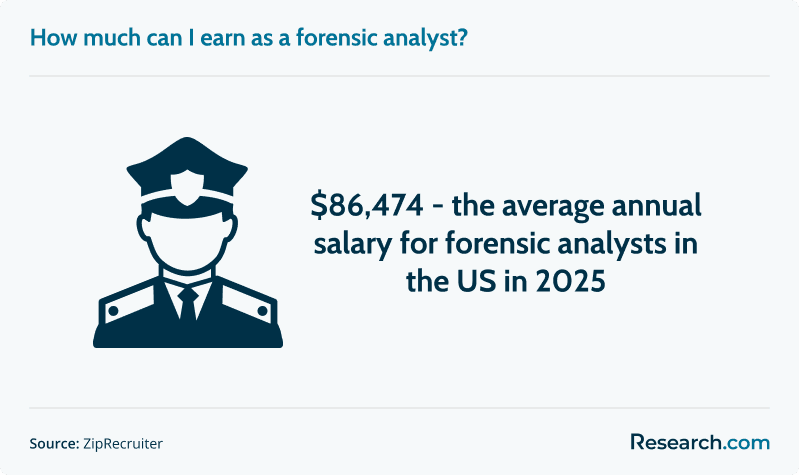
Forensic analyst pay varies by employer, location, specialization, education, certification, and years of experience. A useful benchmark is the median annual wage of $67,440, which reflects the middle of the salary distribution rather than a guaranteed offer.
Entry-level professionals should plan more conservatively. The forensic analyst average starting salary 2025 is around $45,460, while experienced professionals can earn as much as $108,930 per year. That range shows meaningful upside, but higher earnings usually require time, specialized competence, responsibility for complex casework, or work in better-paying agencies and regions.
What affects salary most?
- Employer type: Federal agencies, state agencies, local governments, private laboratories, medical and diagnostic laboratories, and research organizations may pay differently.
- Location: Salaries often reflect regional labor markets, government budgets, and cost of living.
- Specialization: Advanced DNA analysis, toxicology, digital forensics, technical leadership, and quality assurance roles may offer stronger compensation in some settings.
- Experience and testimony readiness: Analysts who can handle complex cases, pass technical review, train others, and testify effectively may qualify for higher-level positions.
- Credentials: Certifications and graduate education can help, but their value depends on employer requirements and the specialty.
When comparing salary offers, look beyond base pay. Public-sector roles may include strong benefits, retirement plans, union protections, overtime rules, or tuition support. Private-sector roles may offer different trade-offs, including faster specialization or consulting opportunities.
What is the job outlook for forensic analysts?
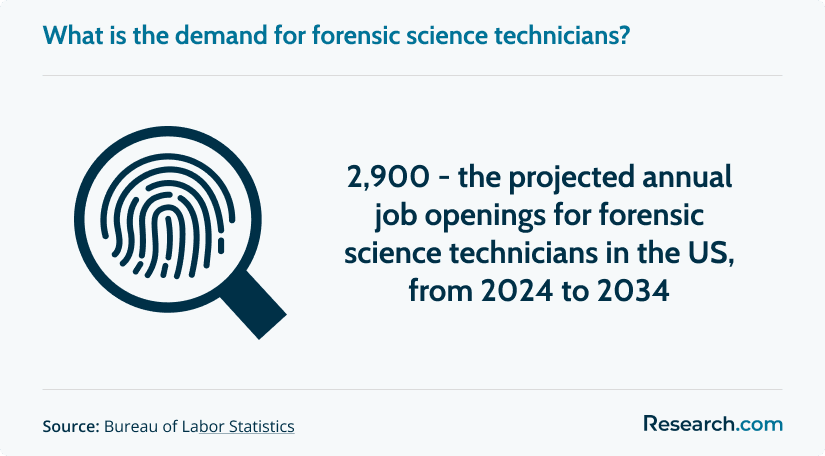
The job outlook for forensic analysts is strong. Forensic analysts are commonly grouped with forensic science technicians, a field projected to grow 13% from 2024 to 2034. That rate is much faster than the average for all occupations.
Growth does not mean every applicant will have an easy time finding a preferred role. Forensic positions can be competitive because the field attracts many students interested in science and criminal justice. Candidates with strong laboratory coursework, internships, technical writing ability, and relevant specialization are usually better positioned.
Key factors shaping demand
- Technology expansion: Digital evidence, advanced DNA methods, improved analytical instruments, and data-driven investigative tools are increasing the need for technically trained analysts.
- Case backlogs: Many laboratories need qualified staff to process evidence efficiently while maintaining quality standards.
- Government demand: Forensic work is closely tied to law enforcement, courts, and public agencies, which creates ongoing need but can also make hiring dependent on budgets.
- Retirements and replacement hiring: As experienced professionals leave the field, agencies need new analysts who can be trained into specialized roles.
- Higher expectations for scientific rigor: Courts and accrediting bodies continue to emphasize documented methods, quality assurance, and defensible conclusions.
Students seeking a cost-conscious route into the field can compare accredited online colleges with no application fee, but they should confirm that any program provides the science coursework and lab preparation required for their target forensic specialty.
What is the typical work environment for forensic analysts?
Forensic analysts most often work in secure laboratories operated by government agencies. These settings are controlled, procedure-driven, and focused on evidence integrity. Most professionals-about 59%-are employed by local government agencies excluding education and hospitals, while another 27% work for state government. A smaller portion work in medical and diagnostic laboratories.
The day-to-day environment depends on the specialty. A DNA analyst may spend more time in a laboratory workflow with contamination controls, while a digital forensic analyst may work at a secured workstation examining devices and files. A crime scene-focused role may involve more field response, evidence collection, and irregular hours.
Schedule and work-life considerations
The forensic analyst work schedule and hours can be more demanding than a standard office job. Many analysts work regular business hours, but urgent cases, court dates, backlogs, and agency staffing needs can require overtime, evening work, weekend shifts, or on-call availability.
Remote or hybrid work is uncommon for core evidence analysis because physical evidence must be handled under strict security and chain-of-custody rules. Some administrative tasks, report drafting, training, or meetings may be completed remotely in limited situations, but most forensic analyst work remains site-based.
Conditions to consider before entering the field
- You may encounter graphic, disturbing, or emotionally difficult case material.
- You may need to work under strict security, documentation, and quality control procedures.
- You may face pressure from deadlines, attorneys, investigators, or court schedules.
- You may spend long periods on repetitive technical tasks that require sustained concentration.
- You may be expected to testify publicly about your work and defend your conclusions.
What are the pros and cons of forensic analyst careers?
Forensic analysis can be a meaningful career for people who value science, public service, and careful problem-solving. It can also be stressful, repetitive, and emotionally demanding. A realistic decision requires weighing both sides.
Pros
- Meaningful public impact: The work can support justice, public safety, and case resolution.
- Strong use of science: Analysts apply biology, chemistry, technology, statistics, and evidence-based reasoning to real investigations.
- Variety by specialization: The field includes DNA, toxicology, trace evidence, fingerprints, digital forensics, firearms, and other paths.
- Stable demand: The criminal justice system has an ongoing need for reliable forensic analysis.
- Professional credibility: Experienced analysts can become respected technical experts and expert witnesses.
Cons
- Emotional exposure: Some cases involve violence, death, abuse, or traumatic evidence.
- High consequence of errors: Mistakes can affect investigations, court outcomes, and public trust.
- Detailed documentation: The work requires extensive records, reviews, and procedural compliance.
- Potentially irregular hours: Overtime, court schedules, and urgent cases can disrupt work-life balance.
- Competitive entry: Popular forensic roles may require strong science preparation, internships, and persistence.
If you want to combine forensic science with another field, reviewing the best colleges for dual degree options may help you think through pairings such as biology and criminal justice, chemistry and data science, or computer science and cybersecurity.
What are the opportunities for advancement for forensic analysts?
Forensic analysts can advance by moving into more complex casework, earning specialty credentials, becoming technical reviewers, leading teams, managing laboratories, or shifting into consulting and research. Advancement usually depends on performance, documented competency, testimony experience, and the needs of the agency or laboratory.
Common promotion paths
- DNA Analyst I / Forensic Biologist I: Entry-level role focused on basic DNA handling and casework (0-2 years).
- DNA Analyst II / Senior Forensic Biologist: Handles complex evidence, trains others, and may testify in court (3-5 years).
- Technical Leader: Oversees technical operations, validates methods, and ensures quality compliance (6-10 years).
- Laboratory Director: Senior management role responsible for all lab operations and strategic planning (10+ years).
Specialization opportunities
- Complex DNA Analysis: Work with mixed, degraded, low-template, or otherwise challenging DNA samples.
- Digital and Multimedia Forensics: Recover and analyze evidence from computers, phones, storage media, networks, images, audio, and video.
- Trace Evidence and Chemical Analysis: Examine materials such as fibers, paint, glass, soil, gunshot residue, or unknown substances.
- Private Forensic Consulting: Provide expert review, testimony, or case support for attorneys, agencies, companies, or private clients.
- Research and Development: Help improve forensic methods, validate technologies, or develop new tools in partnership with laboratories, universities, or industry.
How to position yourself for advancement
- Keep detailed records of training, competencies, casework, testimony, and quality reviews.
- Choose certifications that match your actual specialty rather than collecting unrelated credentials.
- Develop technical writing and court communication skills early.
- Volunteer for validation studies, method updates, audits, or training responsibilities when appropriate.
- Build expertise in a high-need niche instead of staying broadly interested but technically shallow.
The strongest advancement strategy is to become both technically reliable and easy to trust under scrutiny. In forensic work, credibility is career capital.
What other careers should you consider?
If forensic analysis interests you but you are unsure about laboratory work, court testimony, or evidence handling, compare related careers before committing. Many adjacent roles use similar strengths but differ in daily tasks, education requirements, and work settings.
- Crime Scene Investigator (CSI): Focuses on documenting scenes, collecting evidence, photographing locations, and preserving materials for laboratory analysis. This path may involve more fieldwork and irregular hours than lab-based analysis.
- Forensic Toxicologist: Analyzes bodily fluids and tissues to detect drugs, alcohol, chemicals, or toxins. This career is especially suited to students with strong chemistry, pharmacology, and laboratory interests.
- Digital Forensic Analyst: Recovers and examines data from computers, smartphones, networks, cloud accounts, and other digital sources. This route is a better fit for people drawn to cybersecurity, operating systems, and investigative technology.
- Forensic DNA Analyst: Examines genetic material to help identify individuals or interpret biological evidence. It typically requires strong biology, genetics, molecular biology, and quality assurance preparation.
- Forensic Anthropologist: Applies scientific methods to human remains to help determine identity, biological profile, trauma, or circumstances of death. This path often requires advanced graduate study and may be more academic or specialized.
A practical way to choose is to ask what kind of evidence you want to work with every day. If you prefer wet-lab science, DNA or toxicology may fit. If you prefer technology, digital forensics may be stronger. If you want field response and scene documentation, CSI roles may be more appropriate. If you want research and human skeletal analysis, forensic anthropology may be worth exploring.
Here's What Professionals Say About Their Forensic Analyst Careers
- Stefan: "Working as a forensic analyst often means operating behind the scenes, but one case I'll never forget was when my DNA analysis helped exonerate a man wrongly accused for years. The real breakthrough came when the true perpetrator confessed after the evidence pointed straight to him. Being part of delivering justice and helping bring closure to that family was incredibly meaningful to me. It's moments like these that remind me why I remained committed despite all the quiet hours in the lab."
- Mickey: "The emotional strain of processing disturbing evidence can be overwhelming at times. I've had nightmares that felt like I was right there in the crime scenes, powerless to intervene despite my role in uncovering the truth. Although the pay doesn't reflect the challenge, my dedication stems from a deep sense of duty and the satisfaction that comes from public service. Every piece of evidence, from a single fingerprint to complex multi-evidence cases, keeps me focused on contributing in some way."
- Jonathan: "I remember when I identified a foreign DNA profile from a decades-old homicide case that didn't match the initial suspect. The profile matched a man who later confessed, sealing the case after years of uncertainty. That breakthrough filled me with a profound sense of accomplishment and pride in making a real difference through forensic science. Knowing my work can clear innocent lives and provide answers to families drives me every day."
Key Findings
- Forensic analysts use scientific methods to examine evidence and produce findings that can support investigations and court proceedings.
- Most roles require at least a bachelor's degree in forensic science, biology, chemistry, biochemistry, computer science, criminal justice, or another related field aligned with the specialty.
- Important skills include evidence handling, laboratory technique, data interpretation, quality control, technical writing, and expert witness communication.
- The median annual wage is $67,440, with the forensic analyst average starting salary 2025 around $45,460 and experienced professionals earning as much as $108,930 per year.
- The field is projected to grow 13% from 2024 to 2034, but preferred roles can still be competitive.
- Most forensic analysts work in secure government laboratories, with many employed by local or state government agencies.
- The career offers meaningful public impact and intellectual challenge, but it can involve emotional stress, strict documentation, court scrutiny, and irregular hours.
- Advancement often comes through specialization, certification, complex casework, technical leadership, laboratory management, consulting, or research and development.
Other Things You Should Know About Forensic Analyst
In 2027, essential skills for forensic analysts include strong analytical abilities, attention to detail, proficiency in technology and software for crime analysis, effective communication, and critical thinking. Additionally, knowledge in cyber security and understanding of forensic procedures are increasingly important due to digital forensic evidence.
In 2027, forensic analysts are in demand across various industries, including law enforcement, cybersecurity, financial services, and healthcare. These sectors require skilled professionals to analyze digital data, investigate fraud, and ensure compliance with regulations, reflecting the diverse career opportunities available in this field.
References
- Careers in forensic science https://www.justice-ni.gov.uk/articles/careers-forensic-science
- 5 Essential Forensic Scientist Skills & Qualities to Consider https://www.alliant.edu/blog/forensic-scientist-skills
- Forensic Science Technicians : Occupational Outlook Handbook: : U.S. Bureau of Labor Statistics https://www.bls.gov/ooh/life-physical-and-social-science/forensic-science-technicians.htm
- Forensic Scientist Interview Guide: Questions, Dress Code and Research Tips | UK Career Advice https://workbred.co.uk/career/forensic-scientist
- Career Outlook https://forensicscience.ucdavis.edu/career-outlook
- Discover Your Career Options with Top Forensic Medicine Jobs » Forensic Medicine Distance Education Program » College of Medicine » University of Florida https://forensicmedicine.med.ufl.edu/2024/08/26/discover-your-career-options-with-top-forensic-medicine-jobs/
- 6 Forensic Analyst Interview Questions | AARST https://jobs.aarst-nrpp.com/interview-questions/forensic-analyst
- How to become a forensic analyst | edX https://www.edx.org/become/how-to-become-forensic-analyst
- Careers in Forensic Science https://www.aafs.org/careers-forensic-science
- How to Become a Forensic Analyst: Career Path & Guide | Himalayas https://himalayas.app/career-guides/forensic-analyst