2027 Fastest Online CISM Training Bootcamps

Co-Founder and Chief Data Scientist
Choosing a CISM bootcamp is not just about finding the shortest course. It is about deciding whether an intensive online program can help you prepare for the Certified Information Security Manager exam, move toward security leadership, and justify the cost in time and money. For cybersecurity professionals, IT auditors, risk managers, compliance specialists, and experienced technology workers, CISM is most useful when the goal is to manage security programs, advise executives, oversee risk, or align cybersecurity with business priorities.
The timing matters. With 67% of organizations reporting a moderate-to-critical cybersecurity skills gap (World Economic Forum, 2025), employers continue to need professionals who can lead security strategy, not only configure tools. This guide explains the fastest online CISM training bootcamps for 2027, what they include, how much they cost, who should enroll, how to prepare for the exam, and how to compare providers before paying for a program.
Quick Answer: Are Online CISM Bootcamps Worth It?
Online CISM bootcamps can be worth it for professionals who already have IT, cybersecurity, audit, risk, or governance experience and want structured preparation for the CISM exam in a short timeframe. They are less suitable for complete beginners who still need foundational networking, systems, or security knowledge. The best bootcamps cover all four CISM domains, provide realistic practice questions, include instructor support, and clearly state whether exam vouchers, ISACA materials, CPE credits, or retake support are included.
What are the benefits of participating in Online CISM Training Bootcamps?
- A CISM bootcamp can support preparation for roles such as Information Security Manager, Cybersecurity Consultant, or Risk Management Officer in a field projected to grow by 33% from 2023 to 2033, according to the BLS (2023).
- Professionals working at the CISM level can pursue security management roles with a median annual salary of $124,910 as of 2024, reflecting the market value of advanced cybersecurity leadership skills (BLS, 2024).
- Online delivery allows working professionals to study with instructors, practice exams, and review tools without leaving their current job or relocating for training.
What can I expect from Accelerated Online CISM Training Bootcamps?
Accelerated online CISM bootcamps are short, intensive exam-preparation programs built around ISACA’s CISM content areas. Instead of spreading study over several months, these courses condense security governance, risk management, security program management, and incident management into a few days, one week, or a short multi-week format.
Most bootcamps combine live lectures, domain reviews, case discussions, practice questions, and test-taking strategies. You should expect a management-focused curriculum rather than a hands-on technical lab course. The exam emphasizes how security leaders make decisions, prioritize risks, communicate with stakeholders, and align controls with organizational goals.
The pace can be demanding. Learners who have not worked with governance frameworks, audits, compliance programs, incident response plans, or enterprise risk may need additional study before and after class. Strong programs usually provide recordings, instructor office hours, practice exams, and post-course review access so students can revisit difficult topics.
| What to expect | Why it matters | How to prepare |
| Fast-paced domain coverage | The CISM exam tests broad management concepts, not only definitions. | Read the domain outline before class and flag unfamiliar terms. |
| Scenario-based questions | Many questions ask for the best management decision, not the most technical answer. | Practice explaining why one answer is stronger than another. |
| Heavy study load | A short bootcamp does not replace independent review. | Set aside study time after each session and complete mock exams. |
| Instructor-led review | Experienced instructors can clarify how ISACA frames governance and risk. | Ask questions about concepts you have not used in your job. |
Where can I work after completing Accelerated Online CISM Training Bootcamps?
Completing a CISM bootcamp alone does not make you CISM-certified, but it can prepare you to sit for the exam and move toward roles that involve security leadership, risk oversight, governance, and compliance. After passing the exam and meeting ISACA’s experience requirements, CISM can strengthen your profile for management-level cybersecurity positions.
CISM-aligned roles appear across finance, healthcare, government, technology, consulting, retail, manufacturing, and managed security service providers. Employers in these sectors often need professionals who can translate cybersecurity risk into business terms, build security programs, guide audits, and coordinate incident response across departments.
Common paths include Information Security Manager, IT Risk Manager, Security Compliance Officer, Cybersecurity Consultant, Incident Response Manager, and Chief Information Security Officer. These roles usually require more than exam knowledge; employers also look for leadership ability, communication skills, policy experience, and a record of sound risk-based decision-making.
How much can I make with an Online CISM Training Certificate?
A CISM training certificate shows that you completed a course, while the CISM certification requires passing the exam and satisfying ISACA’s work-experience rules. Employers place more weight on the full CISM credential, but bootcamp completion can still demonstrate serious preparation and professional development.
Pay varies by job title, experience, industry, location, education, and scope of responsibility. Current data from Indeed (2025) lists the following annual earnings for roles that may be relevant to professionals pursuing CISM-level work:
- Systems analyst: $79,891
- Network engineer: $95,178
- Security engineer: $108,356
- IT architect: $121,524 per year
- Chief information officer: $118,328
These figures should be treated as role-based salary references, not guaranteed outcomes from completing a bootcamp. The strongest earnings potential usually comes from combining certification with experience in risk management, security governance, compliance, incident management, and cross-functional leadership.
- Fastest Online CISM Training Bootcamps for 2027
- Fastest Path to CISM Certification
- CISM Bootcamp Experience Requirements
- Online CISM Bootcamp Cost
- Skills Covered in CISM Bootcamps
- What Bootcamp Fees Usually Include
- CPE Credits from CISM Training
- How to Choose an Online CISM Bootcamp
- ISACA and Employer Recognition
- Interdisciplinary Skills for Cybersecurity Leaders
- CISM Exam Preparation After a Bootcamp
- Career Opportunities After CISM Training
- Job Outlook and Salary for CISM-Certified Professionals in 2027
- How to Pay for an Online CISM Bootcamp
Fastest Online CISM Training Bootcamps for 2027
How do we rank schools?
Research.com evaluates training options with a practical focus on cost, program structure, learner support, curriculum relevance, and publicly available provider information. Our team applies a transparent, data-informed methodology to help readers compare programs rather than rely only on advertising claims.
For education and training research, we review reliable sources where applicable, including the IPEDS database, Peterson’s, the College Scorecard, and the National Center for Education Statistics (NCES). For certification bootcamps, readers should also verify provider details directly because schedules, inclusions, vouchers, and prices may change.
| Provider | Program Length | Price | Best for |
| Global Knowledge | 3 days | $2,395 | Professionals who want the shortest intensive review option listed |
| Certification Academy | 4 days | $2,495 | Learners seeking structured instruction, labs, and mock exams |
| Training Camp | 4 days | Contact Training Camp for price information | Students who want scenario-based workshops and feedback |
| Learning Tree | 4 days | $3,850 | Learners who want coaching, simulated questions, and an exam voucher |
| InfoSec Institute | 5 days | $4,499 | Students who want extended support, recordings, voucher, and pass guarantee |
| Cyberkraft | 40 hours | Contact Cyberkraft for price information | Learners who want official ISACA materials and extensive practice support |
1. Global Knowledge
Global Knowledge offers a 3-day CISM prep course designed for experienced professionals who want a compressed review of the four CISM domains. The course uses instructor-led teaching, exam-focused examples, and practice questions aligned with ISACA expectations. It is a strong fit for mid-career IT, audit, or security professionals who already understand core cybersecurity concepts and need a fast, guided review.
- Program Length: 3 days
- Price: $2,395
- Accreditation: Aligned with ISACA CISM domains; DoD 8570 approved
2. Certification Academy
Certification Academy provides a 4-day CISM bootcamp that blends instructor instruction, interactive labs, and mock exams. The format is built for learners who want a defined study plan and concentrated exam preparation. It may work especially well for professionals who need accountability and a clear daily structure.
- Program Length: 4 days
- Price: $2,495
- Accreditation: ISACA-aligned curriculum
3. Training Camp
Training Camp runs a 4-day CISM certification bootcamp with domain review, group workshops, and full-length practice exams. Students receive feedback that can help identify weak areas before test day. This option is practical for learners who want more than lectures and prefer applied scenarios during review.
- Program Length: 4 days
- Price: Contact Training Camp for price information
- Accreditation: ISACA-aligned training
4. Learning Tree
Learning Tree offers a 4-day CISM course with instructor guidance, review sessions, group work, simulated exam questions, and an exam voucher. The course is suited to professionals who want a more supported learning environment and a practical plan for reviewing high-value exam topics.
- Program Length: 4 days
- Price: $3,850
- Accreditation: ISACA-aligned certification training
5. InfoSec Institute
InfoSec Institute provides a 5-day CISM bootcamp that includes extended access to recordings, an official Q&A database, an exam voucher, and a pass guarantee. The program uses labs, case studies, and unlimited practice exams to reinforce learning. It is best for learners who want broader support and are willing to pay more for bundled resources.
- Program Length: 5 days
- Price: $4,499
- Accreditation: ISACA Elite+ Accredited Training Organization; DoD 8570 compliant
6. Cyberkraft
Cyberkraft offers a 40-hour CISM bootcamp using official ISACA materials, including the Review Manual and Q&A database. The package includes an exam voucher, ISACA membership, expert coaching, unlimited practice exams, and a first-time-pass guarantee. It is a strong option for learners who want a longer instructional format with official study tools bundled into the program.
- Program Length: 40 hours
- Price: Contact Cyberkraft for price information
- Accreditation: ISACA Premium Accredited Training Organization; meets DoD 8570/8140 Standards
What is the fastest way to become CISM-certified?
The quickest route depends on whether you already meet ISACA’s experience requirements. CISM certification generally requires five years of relevant work experience, including three years in information security management. Many candidates build this background through a bachelor’s degree in information technology, cybersecurity, computer science, or a related discipline, followed by hands-on work in IT security, audit, risk, or governance.
If you already have the required background, the fastest route can take just 4 to 8 weeks. A typical accelerated plan looks like this:
- Choose an intensive online CISM bootcamp that fits your schedule, budget, and preferred learning format.
- Complete the 3–5 day, 40-hour, or short multi-week course and take notes by domain.
- Spend 2–3 weeks reviewing the CISM Review Manual and completing practice exams.
- Schedule the exam once your practice scores and domain confidence are consistent.
- Submit your certification application promptly if you already satisfy the experience requirement.
You can also pass the CISM exam before completing all required experience and then gain the remaining experience within the next 5 years, as allowed by the Information Systems Audit and Control Association (ISACA). This is similar to other credentials that combine coursework, exams, and supervised experience, such as online BCBA certification pathways.
If speed is your main priority, compare bootcamp formats the way students compare accelerated programs in other fields, including the fastest online fashion merchandising degree programs: look at calendar length, weekly workload, included support, and whether the format is realistic for your current responsibilities.
Is prior cybersecurity experience required to join a CISM Bootcamp?
Most providers do not require formal cybersecurity experience before enrollment, but CISM bootcamps are not beginner-level courses. They are designed for learners who can already understand IT operations, risk, controls, governance, compliance, and organizational decision-making.
Experienced IT professionals, auditors, security analysts, risk analysts, systems administrators, network engineers, and compliance staff are usually better positioned to benefit from an accelerated bootcamp. Recent graduates with degrees in Information Technology, Computer Science, Cybersecurity, Information Systems, or Engineering may also enroll, but they should expect a steep learning curve if they lack workplace exposure.
Beginners may get more value from foundational training before attempting CISM. For example, entry-level networking and security learners can review options such as the cheapest online CCNA training bootcamps before moving into management-oriented CISM study.
| Learner profile | Should you take a CISM bootcamp now? | Better next step |
| Security analyst with several years of experience | Yes, if you are preparing for management responsibilities. | Choose an exam-focused bootcamp and schedule review time after class. |
| IT auditor or risk professional | Yes, especially if your work involves controls, governance, or compliance. | Focus on incident management and security program development gaps. |
| Recent graduate | Possibly, but expect advanced material. | Build practical exposure through entry-level security or networking work. |
| Complete technology beginner | Usually no. | Start with foundational IT, networking, and cybersecurity courses. |
Cybersecurity investment priorities also show why strategic credentials matter. Statista (2025) reports that tech leaders worldwide are prioritizing cloud security (34%), data protection (28%), and AI-driven risk management (26%). These areas require professionals who can connect technical risk with executive-level decisions, which is the type of thinking emphasized in CISM preparation.
What is the average cost of Online CISM Training Bootcamps?
Online CISM training bootcamps commonly cost between $2,400 and $4,500, depending on provider, length, instructor access, materials, exam resources, and whether certification-related fees are bundled. A lower price may cover live instruction and basic practice materials, while a higher price may include official ISACA resources, exam vouchers, ISACA membership, recorded sessions, Q&A databases, coaching, or pass guarantees.
Most learners should also budget for CISM certification expenses if they are not included in the course. The CISM exam fee is $575 for ISACA members or $760 for non-members. ISACA membership costs approximately $135 per year, plus local chapter dues. When training and certification costs are combined, the total can be approximately $3,000 to $5,000, depending on the package.
| Cost item | Typical amount stated | What to check before paying |
| Bootcamp tuition | $2,400 to $4,500 | Confirm length, instructor access, recordings, and practice tools. |
| CISM exam fee | $575 for ISACA members or $760 for non-members | Ask whether the bootcamp includes the exam voucher. |
| ISACA membership | Approximately $135 per year, plus local chapter dues | Check whether membership is required or bundled. |
| Total estimated training and certification cost | Approximately $3,000 to $5,000 | Compare bundled value instead of tuition alone. |
If you are comparing security governance options, shortest ISC2 CGRC training programs online may also be worth reviewing, especially if your work is centered on compliance, authorization, governance, and risk frameworks.
Professionals continue to invest in certification because many view it as a career development tool. Pearson VUE 2025 data reports that the top reason for earning a certification is to gain new skills (43%), followed by promotion goals (24%) and resume enhancement (14%). Before enrolling, however, compare the total cost against your current role, employer reimbursement options, and the likelihood that CISM aligns with your next position.
What skills can I learn after completing an Online CISM Training Bootcamp?
CISM bootcamps focus on management-level cybersecurity skills rather than deep technical configuration. The curriculum is built around ISACA’s four CISM domains and teaches candidates how to think like security leaders who manage risk, programs, stakeholders, and incidents.
If your technical base is still developing, you may want to pair CISM preparation with networking or cloud training. For example, the shortest CCNA online training course can help strengthen infrastructure knowledge, while the cheapest online Microsoft Azure dual certification bootcamps may be useful for professionals moving into cloud-heavy environments.
| Skill area | What you learn | Why employers value it |
| Information Security Governance | How to align security strategy, accountability, policies, and frameworks with business objectives. | Organizations need leaders who can connect security work to executive priorities. |
| Risk Management | How to identify, evaluate, respond to, and monitor information security risks. | Risk-based decision-making helps organizations prioritize limited resources. |
| Security Program Development and Management | How to build, maintain, and improve an enterprise security program. | Security programs require structure, ownership, metrics, and ongoing management. |
| Information Security Incident Management | How to plan for, classify, respond to, and recover from security incidents. | Fast, organized response reduces disruption and supports business continuity. |
| Compliance and Policy Development | How to interpret requirements and translate them into policies, controls, and procedures. | Regulated organizations need defensible security practices and audit readiness. |
| Strategic Communication | How to explain security risks, trade-offs, and investments to stakeholders. | Security leaders must influence business, legal, finance, IT, and executive teams. |
| Performance Measurement | How to define and track metrics that show whether a security program is effective. | Metrics help leaders justify budgets and improve security operations. |
For newer IT learners who want operational cybersecurity exposure before CISM, shortest online cyberops training programs can provide a more technical starting point.
What is included in an Online CISM Training Bootcamp fee?
A CISM bootcamp fee may cover only instruction, or it may include a broader exam-preparation package. Because providers bundle resources differently, ask for a written list of inclusions before enrolling.
- Live or recorded instructor-led classes: These sessions explain CISM concepts, clarify exam logic, and give learners a guided path through the domains.
- Official or provider-created study materials: Domain summaries, slides, manuals, and reference guides help students review after class.
- Practice questions and mock exams: Timed question sets help learners identify weak areas and adjust to ISACA-style decision questions.
- Learning management system access: Online portals may store recordings, assignments, quizzes, and progress tracking tools.
- Certificate of completion: This document can support employer reimbursement requests, training records, and possible CPE reporting.
- Exam strategy resources: Some providers include test-taking guidance to help students interpret wording and manage time.
- Instructor or peer support: Discussion boards, office hours, or post-course access can help students resolve difficult topics after the live sessions end.
| Included item | Worth paying extra for? | Decision tip |
| Exam voucher | Often yes | Compare the total package price against paying the exam fee separately. |
| Official ISACA materials | Often yes | Helpful if you want resources closely aligned with exam expectations. |
| Recordings | Yes for working professionals | Valuable if you cannot review everything during live sessions. |
| Pass guarantee | Depends on terms | Read the conditions carefully; guarantees often require attendance and practice scores. |
| CPE certificate | Yes for certified professionals | Useful if you need documented professional education hours. |
Can I earn continuing professional education (CPE) credits from online CISM training bootcamps?
Yes. Many CISM bootcamps provide Continuing Professional Education credits when they are delivered by recognized training organizations and include documented instructional hours. A typical CISM bootcamp may award 20–40 CPE credits, depending on course length, assignments, assessments, and labs.
CPE credits can help with CISM renewal requirements after you become certified, and some may be usable for other IT certifications if the certifying body accepts them. If cloud security leadership is part of your plan, shortest CCSP training online programs may also complement CISM by focusing on cloud security knowledge.
To avoid problems claiming CPEs, choose a provider that clearly states the number of CPE credits, keep your certificate of completion or attendance, and record the training details in your ISACA profile. If you work in digital content security or creative technology environments, programs such as accelerated online animation degree programs may also broaden your understanding of digital media workflows, though they do not replace cybersecurity-specific training.
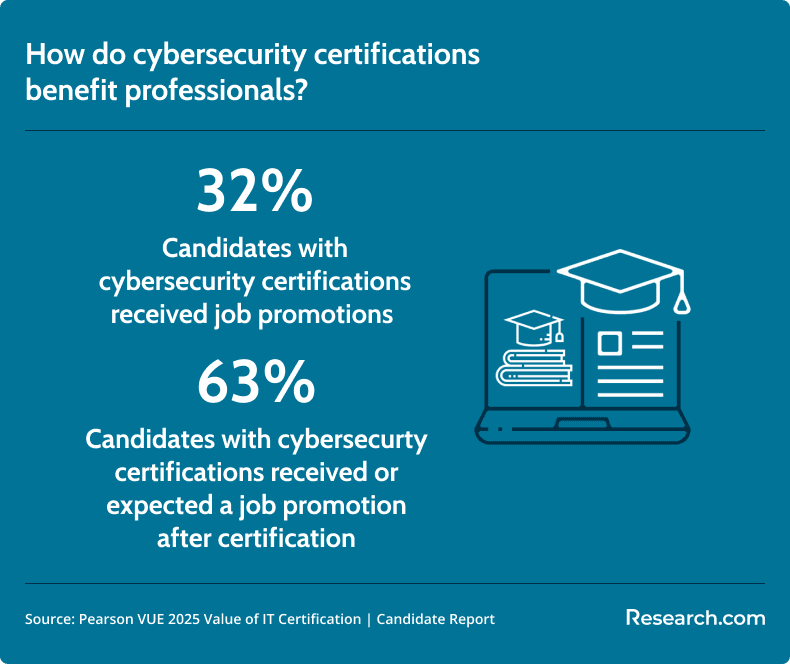
Certification can also support career mobility. Pearson VUE (2025) reports that 32% of candidates received a job promotion after earning certification, while 63% of certified professionals either received or expected a promotion after earning their credential. These outcomes are not guaranteed, but they show why many professionals use certification as part of a broader advancement strategy.
What factors should I consider when selecting an online CISM Bootcamp?
The best CISM bootcamp for you depends on your experience, exam timeline, budget, preferred learning style, and need for bundled resources. Do not choose based only on the shortest duration or the most aggressive pass guarantee. A 3-day course may be ideal for an experienced security manager, while a 40-hour program may be better for someone who needs more guided review.
| Selection factor | What to look for | Red flag |
| ISACA alignment | Clear coverage of all four CISM domains. | Vague curriculum descriptions or outdated exam references. |
| Instructor qualifications | Instructors with security management, governance, audit, risk, or CISM experience. | No instructor biography or unclear teaching credentials. |
| Practice materials | Realistic questions, mock exams, domain scoring, and explanations. | Only slides with no assessment tools. |
| Total cost | Transparent tuition, voucher details, membership details, and retake terms. | Low advertised price with many required add-on fees. |
| Schedule fit | Live sessions, recordings, or flexible access that match your work schedule. | No replay access if you cannot attend every session live. |
| Support after class | Office hours, Q&A, forums, or continued access to materials. | Access ends immediately after the last session. |
| Employer relevance | Training that supports your next role in governance, risk, compliance, or security leadership. | A course focused mostly on technical tools rather than CISM management concepts. |
When comparing programs, use the same disciplined approach you would apply to any specialized online education decision. For example, rankings such as the best online game development degree programs can be useful only when you look beyond the headline and evaluate curriculum fit, outcomes, cost, and student support.
Questions to ask before enrolling
- Does the bootcamp cover all four current CISM domains?
- Are official ISACA materials included, or must I buy them separately?
- Is the CISM exam voucher included in the listed price?
- How many full-length practice exams are provided?
- Will I have access to recordings after the live course?
- How many CPE credits are awarded, and what documentation will I receive?
- What are the exact terms of any pass guarantee?
- Can my employer verify attendance for reimbursement?
Common mistakes to avoid
- Choosing only by speed: The shortest bootcamp may not give you enough review time if you are new to governance or risk.
- Ignoring total cost: Tuition may not include the exam fee, membership, official materials, or retake support.
- Assuming completion equals certification: A course certificate is not the same as the CISM credential.
- Skipping experience requirements: Passing the exam is only one part of becoming certified.
- Relying only on pass guarantees: Read the conditions carefully because many guarantees have strict requirements.
- Underestimating post-bootcamp study: Most learners still need focused review and practice questions after class.
Are Online CISM Training Bootcamps recognized by ISACA and employers?
Online CISM bootcamps are preparation courses, not the certification itself. ISACA does not treat every third-party course as an official endorsement, but reputable providers design their curricula around ISACA’s CISM exam content outline. Some providers are ISACA-accredited training organizations, while others simply align their materials with CISM domains.
Employers generally value credible CISM training when it is paired with exam success, relevant experience, and demonstrated leadership ability. A bootcamp can show initiative and current knowledge, but the CISM credential carries more weight than a completion certificate alone.
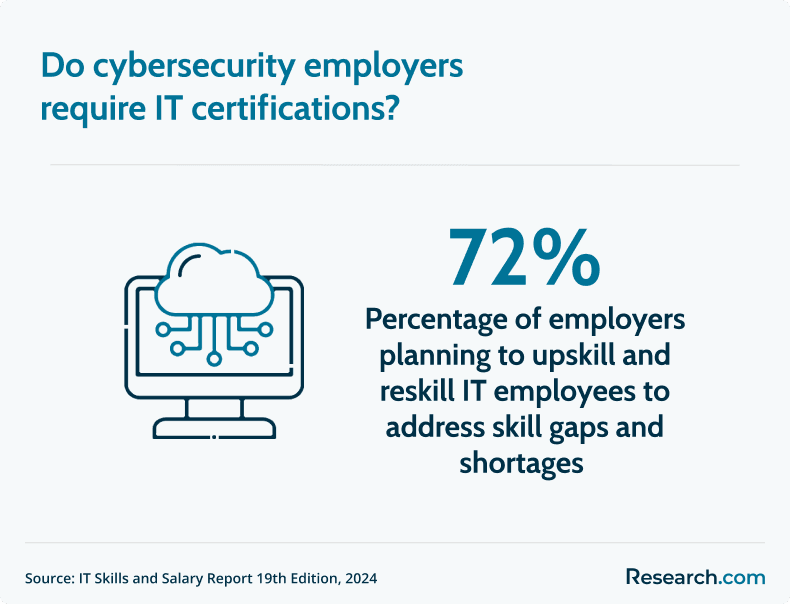
Employer demand for upskilling remains strong. According to Skillsoft (2024), 72% of decision-makers intend to upskill or reskill existing employees to address skill shortages. Certification training such as CISM may be part of that strategy when organizations need stronger cybersecurity governance and risk leadership.
Professionals who work with secure digital products may also benefit from broader design and usability knowledge. For example, an accelerated user experience design degree online can help security leaders better understand user behavior, product workflows, and secure design trade-offs.
How can interdisciplinary studies enrich my cybersecurity leadership skills?
Cybersecurity leaders rarely solve problems with technical knowledge alone. They interpret data, assess uncertainty, communicate risk, manage people, evaluate regulations, and make decisions under pressure. Interdisciplinary study can strengthen these abilities by exposing professionals to different analytical methods and problem-solving frameworks.
Fields that emphasize evidence, systems thinking, and structured analysis can be useful complements to cybersecurity leadership. For example, geology programs online may seem unrelated at first, but their emphasis on data interpretation, uncertainty, modeling, and long-term risk can reinforce skills that also matter in enterprise cyber risk management.
How can I prepare for the CISM exam after finishing the bootcamp?
A bootcamp gives you structure, but passing the CISM exam usually requires additional review. The best post-bootcamp plan combines official materials, targeted practice, timed exams, and a clear test date.
- Register through ISACA: Create or update your ISACA account, pay the exam fee, and choose a Pearson VUE testing option when you are ready.
- Pick a realistic exam date: Many learners benefit from scheduling the test 2–4 weeks after the bootcamp so they have time to review without losing momentum.
- Use the CISM Review Manual: Revisit definitions, frameworks, and management concepts across each domain.
- Complete practice questions daily: Regular quizzes help you understand how ISACA frames best-answer decisions.
- Review wrong answers carefully: Track weak domains and study the reasoning behind each missed question.
- Join a study group or forum: Discussion can expose you to different interpretations of governance, risk, and incident scenarios.
- Take a full timed mock exam: Simulating the test environment helps with pacing, focus, and exam-day confidence.
Security leaders increasingly need to interpret metrics, budgets, risk trends, and operational data. If you want to build stronger analytics skills alongside CISM preparation, the fastest online graduate certificate programs in data analytics may provide useful complementary training.
What career opportunities are available after completing a CISM Bootcamp?
After completing a bootcamp, passing the exam, and meeting certification requirements, CISM can support advancement into roles centered on cybersecurity leadership, governance, compliance, risk, and incident management. These positions usually require experience and judgment, so candidates should connect the credential to real projects, leadership outcomes, and business impact on their resumes.
| Role | Main responsibilities | Why CISM helps |
| Information Security Manager | Oversees policies, risk assessments, controls, compliance, and security program execution. | CISM directly supports governance and program management responsibilities. |
| IT Risk Manager | Identifies, analyzes, mitigates, and reports technology risks that affect operations or compliance. | The certification emphasizes risk-based decision-making. |
| Cybersecurity Consultant | Advises organizations on security maturity, compliance, risk reduction, and program improvement. | CISM helps consultants communicate with both technical and executive stakeholders. |
| Chief Information Security Officer | Leads enterprise cybersecurity strategy, governance, risk, incident response, and executive reporting. | CISM is aligned with strategic security leadership. |
| Security Governance Analyst | Reviews policies, controls, procedures, and standards for alignment with internal and regulatory requirements. | CISM provides a governance framework for evaluating security programs. |
| Security Compliance Manager | Monitors adherence to laws, standards, industry rules, and internal cybersecurity policies. | CISM strengthens knowledge of governance, reporting, and control oversight. |
| Incident Response Manager | Coordinates incident planning, response, communication, recovery, and post-incident improvements. | CISM includes incident management from a business continuity perspective. |
Professionals who combine CISM with analytics training may be well suited for governance and reporting-heavy roles. For example, completing affordable master's in analytics online programs can strengthen your ability to evaluate security performance metrics and communicate risk using data.
CISM-relevant opportunities are not limited to technology companies. Finance, healthcare, manufacturing, retail, consulting, and government employers all need leaders who can protect sensitive information, meet compliance expectations, and reduce cybersecurity risk. Government intelligence agencies, including the CIA, may also employ cybersecurity professionals. Although CISM is not a CIA officer job requirement, it can be useful for specialized cybersecurity, risk, or security management roles.
What is the job outlook and average salary for CISM-certified professionals for 2027?
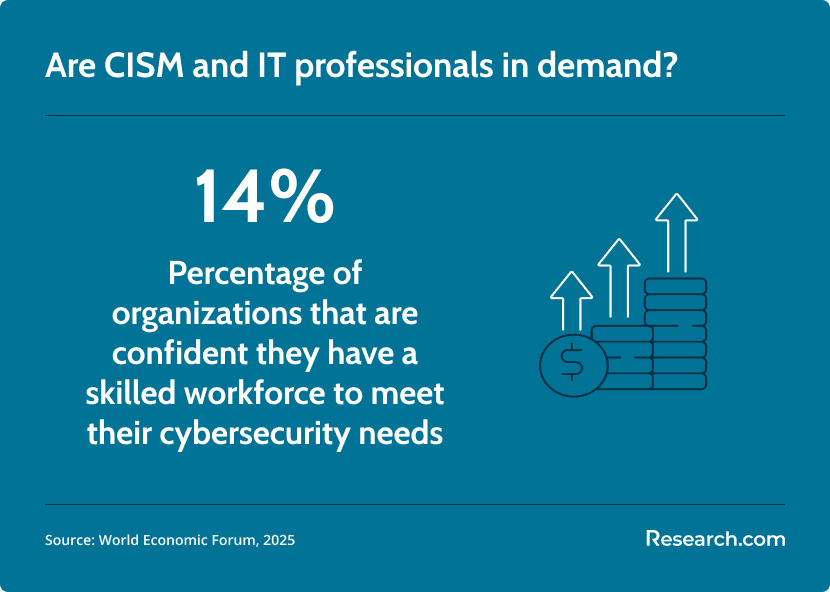
The labor market outlook for cybersecurity professionals remains strong because organizations continue to face expanding threats, stricter compliance expectations, and a shortage of skilled workers. The World Economic Forum (2025) reports demand for 4 million professionals worldwide and states that only 14% of organizations have the skilled workforce they need to meet cybersecurity demands.
In the United States, the U.S. Bureau of Labor Statistics projects employment in information security to grow by 33% from 2023 to 2033. This growth supports demand for both hands-on security specialists and leaders who can manage governance, risk, programs, and incidents.
Salary outcomes depend on job title, location, industry, experience, and leadership scope. CISM can improve credibility for management-oriented security roles, but it does not guarantee a specific salary. Candidates with strong experience, measurable leadership outcomes, and business communication skills tend to be better positioned for senior roles.
If you are earlier in your education journey, compare certification with degree options. Starting with the cheapest cybersecurity degree may make more sense if you still need broad academic preparation before pursuing advanced security management credentials.
How can I finance my online CISM training bootcamp?
CISM bootcamps can be expensive, so financing should be part of your decision before enrollment. Start by checking whether your employer offers tuition reimbursement, professional development funds, certification reimbursement, or paid training time. Many employers are more willing to pay when you can connect CISM training to compliance, risk reduction, audit readiness, leadership development, or business continuity.
| Financing option | Best for | What to confirm |
| Employer reimbursement | Working professionals whose role benefits from CISM knowledge. | Approval process, grade or completion requirements, repayment obligations, and covered expenses. |
| Professional development budget | Employees in IT, cybersecurity, audit, risk, or compliance teams. | Whether the budget covers exam fees, memberships, and materials. |
| Installment plan | Learners who need to spread payments over time. | Total cost, payment deadlines, and refund rules. |
| Personal loan | Students without employer support who can manage repayment risk. | Interest rate, repayment term, and whether the expected career benefit justifies borrowing. |
| Scholarships or discounts | Veterans, career changers, association members, or group enrollees. | Eligibility, deadlines, and documentation requirements. |
When comparing the cost of CISM training with other graduate or technical programs, review total price, career relevance, and time to completion. For a broader benchmark on affordable online education, you can compare cost structures with options such as cheap bioinformatics master's programs online.
Key Insights
- CISM bootcamps are best for experienced IT, cybersecurity, audit, risk, and compliance professionals who want focused preparation for security management roles.
- The fastest listed options run 3 days, 4 days, 5 days, or 40 hours, but the shortest course is not always the best choice for learners who need deeper review.
- Online CISM bootcamps commonly cost $2,400 to $4,500, while total training and certification expenses can reach approximately $3,000 to $5,000 depending on what is included.
- Passing the exam is only part of the process; CISM certification also requires five years of relevant experience, including three years in information security management.
- Strong programs clearly cover all four CISM domains, provide realistic practice exams, disclose voucher and membership details, document CPE credits, and offer post-course support.
- CISM is most valuable when paired with real leadership experience, measurable security outcomes, risk management ability, and strong communication with business stakeholders.
References:
- Pearson VUE. (2025). Value of IT certification survey. https://go.pearsonvue.com/voc
- Statista. (2025). Cybersecurity investment priorities for tech leaders worldwide in 2025. https://www.statista.com/statistics/1550040/tech-leaders-cyber-security-investment-priorities-worldwide/
- U.S. Bureau of Labor Statistics. (2024). Information security analysts. https://www.bls.gov/ooh/computer-and-information-technology/information-security-analysts.htm
- World Economic Forum. (2025). Bridging the cyber skills gap. https://initiatives.weforum.org/bridging-the-cyber-skills-gap/home
Other Things You Need to Know About an Online CISM Training Bootcamps
The 2027 fastest online CISM training bootcamps typically include digital course materials, video lectures, quizzes, practice exams, and forums for peer interaction. Additionally, many programs offer mobile app access, allowing students to study on-the-go, as well as direct support from certified instructors to aid in preparation.
The fastest online CISM training bootcamps in 2027 offer comprehensive coverage of the four CISM domains, hands-on practice tests, and interactive sessions with experts. They prioritize flexibility and accelerated learning, usually taking 1-2 weeks to complete, allowing participants to enhance their cybersecurity management skills efficiently.
To enroll in the fastest online CISM training bootcamps in 2027, candidates typically need to have at least five years of professional information security management experience. Some programs might require a high school diploma or equivalent, along with basic IT knowledge.