
2027 Best Biochemistry Online Degree Programs

Co-Founder and Chief Data Scientist
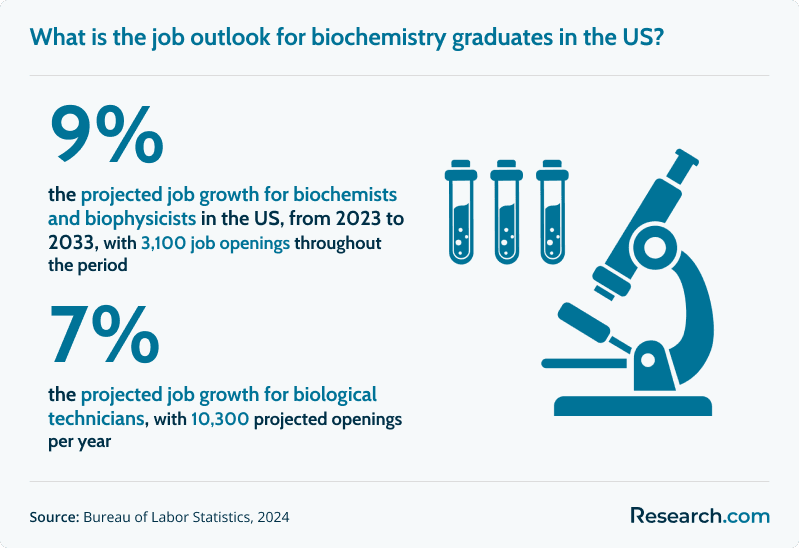
Breaking into biochemistry can feel daunting. The good news is the field is expanding, with jobs for biochemists and biophysicists projected to grow 9% between 2023 and 2033—adding around 3,100 openings. That growth means real opportunity, but also a challenge: choosing the right program to prepare for it.
This guide was created to make that choice easier. Backed by more than 10 years of career-planning expertise, it introduces the best online biochemistry degree programs for 2027. More than a list, it’s a path forward—helping you find a program that fits your life today while opening doors for tomorrow.
What are the benefits of enrolling in the best biochemistry online degree programs?
- A biochemistry degree opens doors to careers like research scientist, laboratory manager, or pharmaceutical developer—roles that advance medicine, technology, and public health.
- As of 2023, biochemists and biophysicists earned an average annual salary of $120,310, with potential to reach over $175,000.
- Earning the degree online provides flexibility, letting you balance studies with work or family while still accessing top-tier education.
What can I expect from the best biochemistry online degree programs?
From the best biochemistry online degree programs, you can expect to engage with a rigorous curriculum that delves into core biochemical principles, including subjects such as organic chemistry, molecular biology, genetics, and cell biology. You will also participate in a variety of learning modalities, from lectures and readings to assignments, discussions, and virtual laboratory simulations designed to provide practical skills, although some programs may have minimal in-person requirements, such as for laboratory work or specific assessments. Top-tier programs will provide access to expert faculty and comprehensive support services to ensure your academic success. These programs are designed to develop your critical thinking and analytical abilities, as well as cultivate a thorough understanding of biochemical concepts, thus preparing you for various professional opportunities.
Where can I work after graduating from the best biochemistry online degree programs?
Career paths for graduates of the best biochemistry online degree programs vary depending on the level of education attained. A bachelor's degree typically leads to entry-level positions such as biological technician, working in laboratory settings, and assisting with research. However, for more advanced roles like biochemist, biophysicist, or research scientist, a PhD is generally required. These roles often involve leading independent research projects, directing research teams, or working in faculty positions at universities. Graduates at all levels can find opportunities in various sectors, including pharmaceutical companies, biotechnology firms, government agencies, and research institutions. Ultimately, your level of education significantly influences the specific roles and responsibilities available to you, with advanced degrees often opening doors to leadership and research-focused positions.
How much can I make with a degree from best biochemistry online programs?
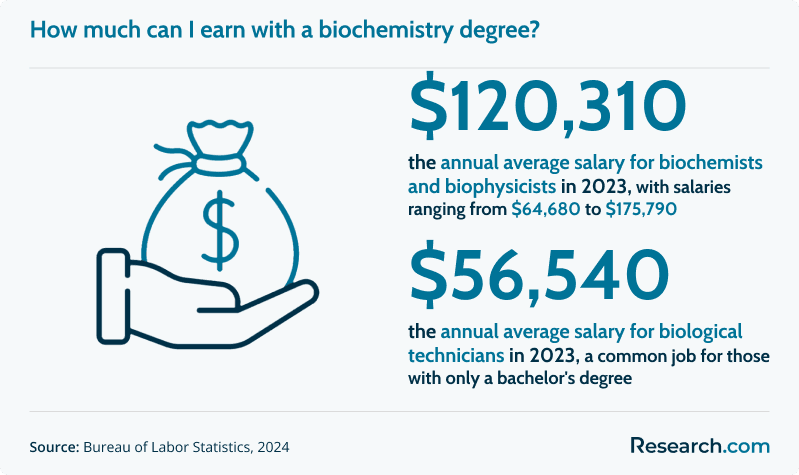
Earning potential with a biochemistry degree varies significantly based on your level of education and the specific career path you choose. As of 2023, the average annual salary for biochemists and biophysicists was $120,310, with salaries ranging from $64,680 to $175,790. However, it's important to remember that these figures represent individuals who typically hold a PhD. For those with a bachelor's degree working as biological technicians, the average annual salary is around $56,540. Furthermore, the industry you work in also plays a significant role. Some of the highest-paying industries for biochemists and biophysicists include the management of companies and enterprises ($153,300), merchant wholesalers ($152,570), and professional, scientific, and technical services ($325,610). While a bachelor's degree can provide a solid starting point, pursuing an advanced degree like a PhD can significantly increase your earning potential in the field of biochemistry
- List of the Best Biochemistry Online Degree Programs for 2027 List of Programs
- How long does it take to complete biochemistry online degree programs? How long does it take to complete biochemistry online degree programs?
- How does a biochemistry online degree program compare to an on-campus program? Online vs. On-Campus
- What is the average cost of biochemistry online degree programs? Average Cost
- What are the financial aid options for students enrolling in biochemistry online degree programs? Financial Aid
- What are the prerequisites for enrolling in biochemistry online degree programs? Requirements
- What courses are typically in biochemistry online degree programs? What courses are typically in biochemistry online degree programs?
- What types of specializations are available in biochemistry online degree programs? What types of specializations are available in biochemistry online degree programs?
- Is accreditation essential for online biochemistry programs? Is accreditation essential for online biochemistry programs?
- How can integrating bioinformatics elevate your biochemistry career? How can integrating bioinformatics elevate your biochemistry career?
- What are the common challenges of online biochemistry degree programs? What are the common challenges of online biochemistry degree programs?
- How do online biochemistry programs foster professional networking and mentorship? How do online biochemistry programs foster professional networking and mentorship?
- Are there affordable yet reputable online biochemistry programs? Are there affordable yet reputable online biochemistry programs?
Best Online Biochemistry Degree Programs for 2026
Choosing an online biochemistry degree is not as simple as searching for “online science programs.” Biochemistry is lab-based, research-focused, and often used as a pathway into biotechnology, medicine, pharmaceuticals, public health, graduate school, or professional healthcare programs. That means the right program must offer more than flexible classes. You need credible accreditation, rigorous chemistry and biology coursework, realistic lab options, strong faculty support, and a curriculum that matches your career goal.
This guide is designed for students comparing online biochemistry, biology, biotechnology, biomedical science, and related life science degrees. You will learn which programs stand out, how online science degrees handle labs, what these programs cost, how long they take, what careers they can lead to, and how to avoid expensive mistakes before enrolling.
Quick answer: What is the best online biochemistry degree?
Fully online biochemistry bachelor’s degrees are uncommon because the field requires laboratory training. For that reason, strong options often include online or mostly online programs in biochemistry, biology, biotechnology, biomedical sciences, human biology, or biohealth sciences. The best choice depends on your goal: Arizona State University is a direct online BS in Biochemistry option, while programs such as University of Maryland Global Campus, University of North Texas, Oregon State University, and University of Arizona may be better fits for students targeting biotechnology, healthcare preparation, biomedical sciences, or broader life science careers.
How we ranked these programs
This ranking was developed through Research.com’s data-informed review process using our ranking methodology. We evaluated program availability, academic structure, online delivery, institutional credibility, affordability, and student outcome indicators using sources such as the IPEDS database from the National Center for Education Statistics, Peterson’s database, including its Distance Learning Licensed Data Set, and the College Scorecard. Because fully online biochemistry degrees are limited, this list also includes closely related online life science programs that can support similar academic or career goals.
| Rank | School | Program | Best fit | Key requirement or note |
| 1 | Arizona State University | BS in Biochemistry | Students who want a direct biochemistry degree | Includes online and in-person lab requirements |
| 2 | Florida International University | BA in Biological Sciences | Students who want a broad online life science foundation | Fully online format |
| 3 | Life University | BS in Biology | Students considering chiropractic, medical, dental, or allied health paths | Uses quarter credits |
| 4 | Logan University | BS in Human Biology | Students preparing for graduate or professional health programs | Can be completed in 3-4 years |
| 5 | National University | BS in Biology | Students interested in genetics, biotechnology, microbiology, or conservation biology | Offers interdisciplinary options |
| 6 | Oregon State University | BS in Biohealth Sciences | Students interested in health, disease, microbiology, and public health contexts | Not intended for students pursuing health-related professional schools |
| 7 | University of Arizona | BS in Biology | Students seeking biomedical or organismal biology emphasis options | Requires two Organic Chemistry labs in person at the main campus |
| 8 | University of Florida | BA in Biology | Students interested in flexible biology applications outside medical or veterinary school preparation | Not designed for professional schools like medical or veterinary programs |
| 9 | University of Maryland Global Campus | BS in Biotechnology | Students targeting applied biotech, bioinformatics, pharmaceutical biotech, or regulatory affairs | Includes workplace-focused learning |
| 10 | University of North Texas | BS in Biomedical Sciences | Transfer students seeking degree completion in biomedical sciences | Requires 60 earned transfer credits from an accredited institution |
1. Arizona State University - BS in Biochemistry
Arizona State University offers a Bachelor of Science in Biochemistry for students who want to study the chemistry of living systems. The program covers core concepts such as thermodynamics, chemical kinetics, equilibrium theory, and biological applications of chemistry. It is a strong option for students interested in medicine, agriculture, research, or graduate study, but applicants should pay close attention to the lab structure because some laboratory work must be completed in person, either on campus or through approved institutions.
- Program Length: 4 years
- Credits Required to Graduate: 120
- Cost per Credit: $580
- Accreditation: Higher Learning Commission (HLC)
2. Florida International University - BA in Biological Sciences
Florida International University offers a fully online Bachelor of Arts in Biological Sciences that gives students a broad education in life science. The program is best for learners who want a flexible online biology degree rather than a narrowly focused biochemistry curriculum. Its coursework supports scientific reasoning, critical thinking, and understanding of major biological systems, making it useful for students interested in science communication, environmental topics, public health-adjacent work, or further study in biology-related fields.
- Program Length: 4 years
- Credits Required to Graduate: 120
- Cost per Credit: $235.57 (in-state); $648.87 (out-of-state)
- Accreditation: Southern Association of Colleges and Schools Commission on Colleges (SACSCOC)
3. Life University - BS in Biology
Life University offers a Bachelor of Science in Biology with a foundation in biological science and an institutional emphasis on the body’s capacity for self-regulation and healing. The program can serve students preparing for chiropractic, medical school, dentistry, allied health, education, research, or business roles connected to the life sciences. It may appeal to students who want a biology degree that connects human biology with broader environmental and health contexts.
- Program Length: 4 years
- Credits Required to Graduate: 188 quarter credits
- Cost per Credit: $301
- Accreditation: Southern Association of Colleges and Schools Commission on Colleges (SACSCOC)
4. Logan University - BS in Human Biology
Logan University offers a Bachelor of Science in Human Biology for students who want preparation for science, health professions, graduate education, or professional programs. The curriculum emphasizes evidence-informed thinking, problem-solving in biological contexts, and clear communication of scientific ideas. It is especially relevant for students who want a human-centered biology degree connected to healthcare and applied science pathways.
- Program Length: 3-4 years
- Credits Required to Graduate: 122
- Cost per Credit: $375
- Accreditation: Higher Learning Commission (HLC)
5. National University - BS in Biology
National University offers a Bachelor of Science in Biology that covers life science topics connected to medical professions, genetics, biotechnology, microbiology, conservation biology, sustainability, disease, and biodiversity. Students can combine biology with physical and earth science coursework or pursue specialized options such as the Biology to Master of Forensic Science Transition program. This is a practical choice for students who want a broad science degree with room to connect biology to multiple career directions.
- Program Length: 4 years
- Credits Required to Graduate: 180 quarter credits
- Cost per Credit: $375
- Accreditation: Western Association of Schools and Colleges (WASC)
6. Oregon State University - BS in Biohealth Sciences
Oregon State University offers a Bachelor of Science in Biohealth Sciences that blends life sciences, physical sciences, social sciences, and public health. The program focuses on human health, disease origins, and research foundations for future medical advances. Courses are developed and taught by faculty in Oregon State’s Department of Microbiology. Students should note that the program is not intended for those pursuing health-related professional schools, so it is best for learners who want biohealth career preparation rather than a pre-professional medical track.
- Program Length: 4 years
- Credits Required to Graduate: 180 quarter credits
- Cost per Credit: $366
- Accreditation: Northwest Commission on Colleges and Universities (NWCCU)
7. University of Arizona - BS in Biology
The University of Arizona offers a Bachelor of Science in Biology for students interested in medicine, health, agriculture, environmental science, conservation, forensic science, public health, or research. The curriculum examines biological systems from molecular components to ecosystems and offers two emphases: Biomedical Sciences or Organismal Biology. The program is primarily online, but students must complete two Organic Chemistry labs through in-person immersion at the main campus, so location and travel planning matter.
- Program Length: 4 years
- Credits Required to Graduate: 120
- Cost per Credit: $525
- Accreditation: Western Association of Schools and Colleges – Senior College and University Commission (WSCUC)
8. University of Florida - BA in Biology
The University of Florida offers a Bachelor of Arts in Biology that gives students a flexible foundation in living systems, from cells to complex organisms. The program allows students to explore areas such as environmental science, biotechnology law, science journalism, education, allied health professions, and bioscience management. It includes access to faculty from 17 different academic departments. Students planning for medical or veterinary school should be cautious, because this program is not designed for those professional school pathways.
- Program Length: 4 years
- Credits Required to Graduate: 120
- Tuition (annual): $6,380 (in-state); $28,658 (out-of-state)
- Accreditation: Southern Association of Colleges and Schools Commission on Colleges (SACSCOC)
9. University of Maryland Global Campus - BS in Biotechnology
The University of Maryland Global Campus offers a 120-credit Bachelor of Science in Biotechnology focused on life science and applied biotechnology. Coursework includes microbiology, bioinformatics, pharmaceutical biotechnology, laboratory management, environmental biotech, eukaryotic cell biology, and regulatory affairs. The program is a strong fit for students who want a career-oriented biotechnology degree connected to healthcare, agriculture, environmental management, biomedical research, or regulated science industries.
- Program Length: 4 years
- Credits Required to Graduate: 120
- Cost per Credit: $324 (in-state); $499 (out-of-state); $250 (military)
- Accreditation: Middle States Commission on Higher Education (MSCHE)
10. University of North Texas - BS in Biomedical Sciences
The University of North Texas offers an online Bachelor of Science in Biomedical Sciences as a degree-completion program. It is built for students who already have 60 earned transfer credits from an accredited institution and want to study applied biology in relation to human health and disease. The curriculum includes biochemistry, anatomy, physiology, and scientific communication. Graduates may use the degree for healthcare graduate preparation or entry into areas such as laboratory research, biotechnology, and pharmaceutical sales.
- Program Length: 4 semesters (full-time); 6 semesters (part-time)
- Credits Required to Graduate: ~60
- Estimated Cost per Credit (varies per semester): $350 (in-state); $2,820 (out-of-state); $250 (military)
- Accreditation: Southern Association of Colleges and Schools Commission on Colleges (SACSCOC)
How Long Does an Online Biochemistry Degree Take?
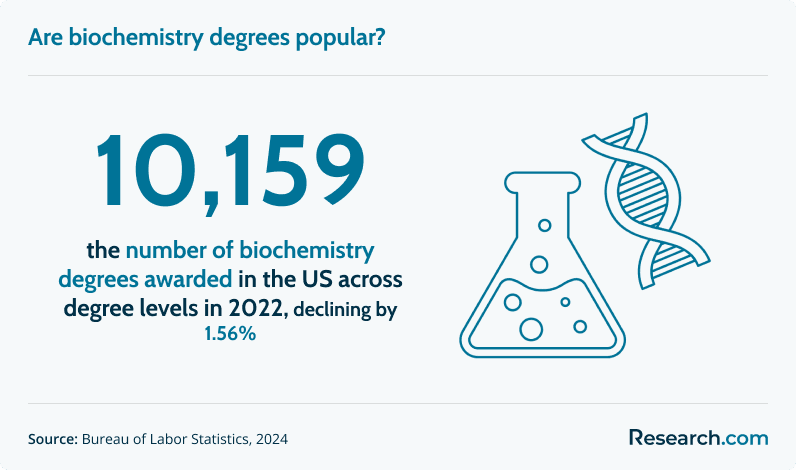
Most bachelor’s-level biochemistry and related life science programs are designed to take 4 years for full-time students. In 2022, bachelor’s degrees represented around 92% of biochemistry degrees awarded, making the undergraduate route the most common entry point into the field. Students who transfer credits, enroll year-round, or choose an accelerated format may finish sooner, while part-time students often take longer.
A master’s degree in biochemistry usually adds about two more years after a bachelor’s degree. A PhD in biochemistry can take four to seven years and normally requires original research, a dissertation, and, for some careers, post-doctoral work. Online options can provide scheduling flexibility, but students should still expect demanding science coursework and lab or research requirements.
In 2022, there were a total of 10,159 biochemistry degrees awarded across levels.
| Degree level | Typical time commitment | Best for | Important consideration |
| Bachelor’s degree | 4 years | Entry-level lab roles, biotech support roles, graduate school preparation, professional school prerequisites | Check whether labs are virtual, local, hybrid, or campus-based |
| Master’s degree | About two additional years | Research associate roles, lab management, specialization, PhD preparation | May require a research project, thesis, or applied capstone |
| PhD | Four to seven years | Independent research, university faculty roles, senior scientist roles | Research fit and advisor availability are more important than convenience alone |
Online vs. On-Campus Biochemistry Programs: Which Format Is Better?
Online and campus-based biochemistry programs often cover similar scientific foundations, including chemistry, biology, molecular processes, genetics, and laboratory methods. The difference is how students access instruction, labs, faculty, and peer interaction. Online programs are useful for working adults, military learners, transfer students, caregivers, and students who do not live near a suitable campus. On-campus programs usually provide easier access to physical laboratories, research groups, faculty offices, and in-person academic communities.
Students considering health-related or public health pathways may also want to compare life science degrees with related options, including Research.com’s guide to accessible bachelor’s programs in public health.
| Factor | Online biochemistry or related science degree | On-campus biochemistry degree |
| Flexibility | Usually better for students balancing work, family, or location limits | Requires scheduled campus attendance |
| Laboratory experience | May use virtual labs, lab kits, local lab partnerships, or short campus immersions | Typically offers regular access to campus laboratories |
| Faculty access | Often through video meetings, discussion boards, email, and online office hours | More face-to-face interaction is available |
| Networking | Depends heavily on online events, cohort design, mentorship, and career services | Often easier through campus research groups, clubs, and seminars |
| Best for | Self-directed students who need flexibility | Students who want frequent in-person labs and campus research involvement |
How Much Do Online Biochemistry Degree Programs Cost?
Costs vary by school, residency status, program level, and whether the degree uses semester credits or quarter credits. Based on the programs listed in this guide, in-state students pay around $380 per credit hour on average, while out-of-state students pay around $720 per credit hour on average. That places estimated total tuition at roughly $45,740 for in-state students and $96,210 for out-of-state students. These estimates reflect only the programs included here, so students should verify tuition, fees, lab costs, technology fees, books, and travel expenses directly with each school.
How to think about ROI
Return on investment depends on the job you pursue, whether you continue to graduate school, how much debt you take on, and whether the program helps you gain marketable lab, data, and research skills. As of 2023, the average annual salary for biochemists and biophysicists was $120,310. Biological technicians, a common bachelor’s-level role, earned an average of $56,540. These figures show why degree level matters: many higher-level biochemistry roles require advanced study.
Students interested in research leadership, lab coordination, or biotech operations may improve their career flexibility by adding management skills. Related education, such as one of Research.com’s guides to project management degree programs, may be useful for learners who want to manage scientific teams, timelines, budgets, or regulated projects.
| Cost factor | Why it matters | Question to ask before enrolling |
| Tuition rate | Per-credit pricing can change total cost dramatically | Is tuition different for in-state, out-of-state, online, or military students? |
| Lab requirements | In-person labs may add travel, housing, or local placement costs | Where are labs completed, and who pays extra costs? |
| Transfer credits | Accepted credits can shorten completion time | How many prior credits will apply to the major and graduation requirements? |
| Fees | Online, technology, course, and lab fees can raise the real price | What is the full cost of attendance, not just tuition? |
| Career outcomes | Lower tuition is not enough if the program lacks support or recognition | What roles do graduates enter, and what support is available for internships or research? |
Financial Aid Options for Online Biochemistry Students
Online students in accredited programs may qualify for many of the same aid options as campus students. The key is to confirm that the institution is eligible for federal aid and that your enrollment status meets aid requirements.
- Scholarships: Look for awards from universities, STEM organizations, science associations, employers, and local foundations.
- Grants: Grants do not need to be repaid and may be available through federal, state, institutional, or STEM-focused sources.
- Federal student aid: Submit the Free Application for Federal Student Aid (FAFSA) to be considered for federal grants, loans, and work-study programs.
- Private loans: Use private loans cautiously and compare interest rates, repayment terms, borrower protections, and total repayment cost.
- Employer tuition assistance: If you already work in healthcare, biotech, pharmaceuticals, education, or a related field, ask whether your employer helps pay for approved degree programs.
Advanced degrees and earning potential
A bachelor’s degree can open entry-level doors, but graduate education can be important for biochemist, biophysicist, and senior research roles. In 2023, some of the top-paying industries for biochemists and biophysicists included professional and commercial equipment and supplies merchant wholesalers ($325,610), management of companies and enterprises ($153,300), and merchant wholesalers, nondurable goods ($152,570). These figures do not guarantee individual earnings, but they show why advanced education and industry choice can affect long-term ROI.
Admission Requirements for Online Biochemistry Degree Programs
Admission requirements differ by institution and degree level, but biochemistry and related online science programs usually expect students to be prepared for college-level math and laboratory science. Before applying, compare both general admission requirements and major-specific prerequisites.
- High school diploma or equivalent: Undergraduate applicants generally need a high school diploma, GED, or accepted equivalent.
- Science and math preparation: Programs often expect background in biology, chemistry, physics, calculus, or related subjects.
- Minimum GPA: Some schools require a minimum cumulative GPA or a minimum grade in prerequisite courses.
- Transfer credits: Degree-completion programs may require previous college credits, such as the University of North Texas program’s requirement for 60 earned transfer credits from an accredited institution.
- Recommendations: Graduate-level programs and some competitive undergraduate pathways may request academic or professional recommendations.
- Standardized tests: Some institutions have test-optional policies, while others may still request SAT, ACT, GRE, or other scores depending on level and program policy.
Common Courses in Online Biochemistry and Related Science Programs
Biochemistry programs combine biology, chemistry, molecular science, quantitative reasoning, and laboratory methods. Related online programs in biology, biotechnology, biomedical sciences, and biohealth sciences may include many of the same courses, though the emphasis can differ.
- Organic chemistry: Students study carbon-containing compounds, reaction mechanisms, molecular structure, and chemical behavior that underpin biological systems.
- Molecular biology: This course examines DNA replication, transcription, translation, gene regulation, and the flow of genetic information inside cells. Students comparing related life science pathways can also review Research.com’s guide to biology degree programs that may be easier to access.
- Genetics: Students learn how traits are inherited, how genes are expressed, how variation occurs, and how genetics connects to disease and populations.
- Cell biology: This subject focuses on cell structure, metabolism, signaling, reproduction, and the organization of living systems.
- Biochemistry: Students examine enzymes, metabolic pathways, bioenergetics, proteins, carbohydrates, lipids, and other molecular processes in living organisms.
- Physical chemistry: This course applies thermodynamics, kinetics, and chemistry principles to molecular and biological systems.
- Bioinformatics: Students use computational tools to analyze biological data, including genomics, proteomics, and metabolomics.
Biochemistry also intersects with healthcare teams and biomedical innovation. In biotechnology and clinical research environments, biochemists may collaborate with physicians, lab professionals, and specialized nurses, including some of the highest-paying nursing careers, depending on the setting and research focus.
Biochemistry Specializations to Consider
Specialization usually becomes more important in graduate school, research placements, internships, or advanced professional roles. Some bachelor’s programs offer tracks or electives, but deeper expertise often develops through master’s, PhD, laboratory, or industry experience.
- Enzymology: Focuses on enzyme structure, catalytic function, kinetics, regulation, and their role in metabolic systems.
- Immunology: Examines immune system function, innate and adaptive immunity, pathogens, immune disorders, and disease mechanisms.
- Metabolomics: Studies metabolites and metabolic pathways using advanced analytical methods to understand cellular processes.
- Structural biology: Investigates the three-dimensional structure of proteins, nucleic acids, and other macromolecules using methods such as X-ray crystallography, NMR spectroscopy, and cryo-electron microscopy.
- Genomics and proteomics: Uses large-scale biological data to study genomes, proteins, gene expression, protein interactions, and molecular networks.
Students interested in the connection between metabolism, diet, and human health may also explore an online nutritional science degree as a complementary pathway. Biochemistry provides useful preparation for understanding nutrient metabolism, absorption, and molecular health processes.
Why Accreditation Matters for Online Biochemistry Programs
Accreditation is one of the first items to verify before applying. Institutional accreditation affects federal financial aid eligibility, transfer credit recognition, graduate school applications, and employer confidence. Students should confirm accreditation through official databases and review whether any program-specific requirements apply to their goals.
Accreditation is especially important if you may later pursue healthcare, laboratory, or regulated professional pathways. If you are comparing science-based healthcare alternatives, Research.com’s guide to radiology technology pathways may help you evaluate a more directly clinical route.
How Bioinformatics Can Strengthen a Biochemistry Career
Biochemistry is increasingly connected to data analysis, computational biology, molecular modeling, and systems-level research. Students who can combine wet-lab knowledge with computational tools may be better prepared for biotech, pharmaceutical, genomics, and research roles. Online programs that include bioinformatics, programming exposure, statistics, or data interpretation can be especially valuable.
Learners who want a deeper computational specialization can compare options such as an online master’s in bioinformatics. This can be a strong next step for students who enjoy biological data, genomics, proteomics, and computational research.
Challenges of Online Biochemistry Degrees
Online science degrees can work well, but they are not effortless. The biggest concerns are lab access, self-discipline, technical readiness, and remote networking. Students should choose programs that clearly explain how labs are completed and how online learners receive academic, career, and technical support.
| Common challenge | Why it matters | What to look for |
| Limited hands-on lab access | Biochemistry careers often require practical lab skills | Local lab partnerships, campus intensives, lab kits, simulations, or internship options |
| Heavy independent workload | Science courses require consistent study and problem-solving | Structured deadlines, tutoring, faculty office hours, and advising |
| Remote networking | Research and biotech opportunities often come through professional relationships | Mentorship, alumni events, research groups, and career services |
| Technology barriers | Virtual labs and data tools require reliable systems | Technical support, digital library access, and current software platforms |
| Financial uncertainty | Lab fees, travel, and materials can increase total cost | Clear cost breakdowns and aid options, including online schools with financial aid access |
Student Support and Technology: What Online Science Students Need
Strong online biochemistry programs invest in learning platforms, technical help, digital libraries, virtual lab tools, academic advising, tutoring, and career guidance. These services matter because students are often completing complex chemistry, biology, and data assignments without daily campus access.
Before enrolling, ask whether support is available during evenings or weekends, how quickly faculty respond, whether tutoring covers advanced science courses, and whether the school provides access to updated simulation tools or scientific databases. Students comparing broader online institutions can also review Research.com’s resource on online universities.
Can You Finish an Online Biochemistry Degree Faster?
Some online programs support faster completion through transfer credits, year-round courses, condensed terms, or degree-completion formats. Acceleration can be helpful for motivated students, but it should not come at the expense of lab quality, prerequisite sequencing, or graduate school preparation.
If speed is a major priority, compare accelerated options carefully and make sure the program still provides rigorous science training. Research.com’s guide to fast online degrees can help students think through time-to-completion trade-offs across fields.
Research, Internships, and Lab Experience in Online Programs
For biochemistry and biotechnology careers, practical experience matters. Strong online programs may provide virtual labs, short campus residencies, local laboratory arrangements, remote research projects, workplace learning, or internship coordination. Students should ask exactly how they will document lab competencies and whether the program helps them find research or applied science opportunities near where they live.
Students considering graduate-level acceleration may also compare options such as a 1 year online master’s degree, especially if the program includes research, capstone, internship, or professional project components.
Is an Online Doctorate in Biochemistry Worth It?
An online or hybrid doctorate in biochemistry may be worthwhile only if it supports your research goals, gives you access to qualified faculty mentors, and provides credible research infrastructure. At the doctoral level, convenience is not enough. The most important questions are whether the program has faculty working in your area of interest, whether you can complete required research, and whether graduates move into roles aligned with your goals.
A doctorate is typically most relevant for students pursuing independent research, senior scientific roles, academic careers, or specialized industry leadership. Students comparing cost-conscious doctoral routes can review Research.com’s guide to affordable online PhD options, while still verifying research fit and program quality before applying.
Emerging Technology in Online Biochemistry Education
Online biochemistry programs increasingly use virtual labs, simulation software, computational chemistry tools, digital microscopy, bioinformatics platforms, and data analysis environments. These tools can strengthen learning, but they should complement—not completely replace—meaningful laboratory or research practice when a student’s career goal requires hands-on experience.
Students exploring technology-heavy academic paths can also compare how different majors integrate digital tools by reviewing Research.com’s guide to choosing a college major.
Future Trends in Online Biochemistry Education
Online biochemistry education is moving toward more interdisciplinary training. Programs are increasingly connecting molecular biology with bioinformatics, computational biology, data science, and remote research collaboration. Virtual simulations, adaptive learning tools, and industry partnerships may also make online science programs more practical for students who cannot relocate.
Working adults should pay close attention to flexibility, affordability, and scheduling. Research.com’s guide to the most affordable online colleges for working adults may help students compare broader cost and format considerations.
Can Certifications Help a Biochemistry Graduate?
Supplemental certifications can help when they verify skills that employers value, such as data analysis, quality control, project management, regulatory knowledge, laboratory safety, programming, or bioinformatics tools. A certification is not a replacement for a science degree, but it may strengthen a resume when it aligns with a specific job target.
Students considering additional credentials can compare options using Research.com’s guide to online certifications with strong earning potential. Choose credentials based on employer recognition, skill relevance, cost, and whether they support your intended role.
How to Choose the Best Online Biochemistry Degree Program
The best online biochemistry program is the one that fits your career goal, budget, learning style, lab needs, and future education plans. A student preparing for medical school, for example, may need a different curriculum than a student targeting biotechnology operations or bioinformatics.
| Selection factor | Why it matters | What to ask the school |
| Accreditation | Protects aid eligibility, transfer options, and academic credibility | Which agency accredits the institution, and is the program accepted by graduate schools or employers in my field? |
| Lab format | Science employers and graduate programs may expect hands-on preparation | Are labs virtual, local, hybrid, or campus-based? |
| Curriculum fit | Course choices affect career and graduate school readiness | Does the program include organic chemistry, biochemistry, genetics, molecular biology, and research methods? |
| Faculty expertise | Faculty interests can affect research options and mentorship | Do faculty members teach and research in areas that match my goals? |
| Student support | Online science students need accessible help | Is tutoring available for chemistry, biology, statistics, and writing? |
| Career preparation | Internships, research, and career services affect outcomes | How does the program help online students find labs, internships, or research projects? |
| Technology and data skills | Bioinformatics and computational tools are increasingly useful | Does the program include coding, databases, modeling, or data analysis? |
Students who want to add computational skills can also explore coding training. Research.com’s guide to the best coding bootcamps may be useful for learners interested in programming for bioinformatics, molecular simulations, or biological data analysis.
Common mistakes to avoid
- Choosing a program before checking accreditation: Always verify institutional accreditation before applying.
- Assuming “online” means no labs: Many science programs still require in-person, local, or intensive lab work.
- Looking only at tuition: Fees, books, lab materials, travel, and lost work time can change the real cost.
- Ignoring graduate school prerequisites: If you plan to apply to medical, dental, veterinary, pharmacy, or graduate programs, confirm that the curriculum meets prerequisite expectations.
- Relying only on rankings: Rankings are a starting point, not a substitute for reviewing curriculum, lab requirements, faculty, cost, and outcomes.
- Assuming salary outcomes are guaranteed: Earnings depend on degree level, location, industry, experience, and specialization.
Career Paths for Online Biochemistry and Life Science Graduates
A biochemistry-related degree can lead to roles in research, biotechnology, pharmaceuticals, healthcare support, environmental science, public health, education, quality control, and graduate or professional school preparation. The exact path depends heavily on degree level and experience.
- Research and development: Bachelor’s graduates may begin as research assistants or biological technicians, while advanced degree holders may move into scientist or senior research roles.
- Academia: Teaching and independent research roles usually require a PhD and often postdoctoral experience.
- Biotechnology and pharmaceuticals: Graduates may work in quality control, manufacturing, laboratory operations, regulatory affairs, product development, or research support.
- Government and public health: Biochemistry training can support roles in regulatory work, public health research, policy support, or laboratory analysis.
- Environmental science: Students interested in biology, chemistry, and ecosystems may also consider environmental careers. Research.com explains how to become an environmental scientist in a separate career guide.
Students who want to move from science into leadership may consider business education later. Research.com’s guide to the fastest online MBA programs can help science graduates compare management-oriented pathways for biotech, pharmaceutical, startup, or healthcare administration roles.
Where biochemists work: employment data
In 2023, the scientific research and development services sector employed the largest number of biochemists and biophysicists: 21,120 individuals, representing approximately 64% of the total 33,180 professionals. This concentration shows why research experience, technical skills, and graduate education can be important for students who want to compete for biochemistry-focused roles.
Networking and Mentorship in Online Biochemistry Programs
Online students should not evaluate coursework alone. Mentorship, networking, and career connections can strongly affect research access and job search results. Look for programs that offer virtual research groups, faculty mentorship, alumni events, employer webinars, discussion forums, career coaching, and student science organizations.
Students who want to strengthen their employability can also compare supplemental credentials, including Research.com’s guide to career certifications with strong salary potential.
Job Market Outlook for Biochemistry Graduates
The job market for biochemistry graduates depends on education level, specialization, research experience, and industry. A bachelor’s degree may support entry-level roles such as biological technician or research assistant, while many biochemist, biophysicist, principal investigator, senior scientist, or professor roles require graduate education.
The projected job growth for biochemists and biophysicists from 2023 to 2033 is around 9%, with approximately 3,100 job openings expected during that period. According to O*NET, approximately 25% of biochemistry and biophysics jobs require a doctoral degree, and an additional 44% require post-doctoral training. This does not mean a bachelor’s degree has no value; it means students should align their degree level with the kind of work they want to do.
For independent research leadership, university faculty positions, principal investigator roles, and many senior research scientist jobs, a PhD is typically expected. A master’s degree can help students qualify for some research associate, lab management, or specialized technical roles and can also serve as preparation for doctoral study.
Are Affordable Online Biochemistry Programs Reputable?
Affordable programs can be reputable if they are properly accredited, academically rigorous, transparent about lab requirements, and supported by strong faculty and student services. Low tuition should not be the only deciding factor. A cheaper program that lacks lab access, career support, or graduate school preparation may cost more in the long run if it delays your goals.
Students comparing lower-cost options can review Research.com’s guide to cheap online colleges that accept FAFSA. Always compare total cost, accreditation, transfer policies, lab format, financial aid, and career support before enrolling.
What Graduates Say About Online Biochemistry Programs
- Herbert: "I grew up in a small town and did not expect to end up in biotechnology. Studying online connected me with faculty and classmates I would never have met locally, and their perspectives challenged me to aim higher. The program helped me build the knowledge and confidence I needed to earn a research role."
- Gerald: "As the first person in my family to attend college, I worried about falling behind. The online format let me manage the pace while still getting help when I needed it. Faculty and classmates were supportive, even from a distance, and I was able to start a science career I once thought was out of reach."
- Kyle: "I had always enjoyed science, but earning my bachelor’s in biochemistry online showed me how much I liked research. The lab work, whether virtual or arranged locally, felt practical and relevant. Learning from professors with real experience helped me move into a lab assistant position that has become a strong career starting point."
Key Insights
- Fully online biochemistry degrees are limited: Many strong options are in related fields such as biology, biotechnology, biomedical sciences, human biology, and biohealth sciences.
- Lab format is the make-or-break factor: Before enrolling, confirm whether labs are virtual, local, hybrid, or campus-based, and ask how they support your career or graduate school plans.
- Degree level affects career options: Bachelor’s graduates can pursue entry-level science roles, but many biochemist, biophysicist, senior research, and academic roles require a master’s, PhD, or postdoctoral training.
- Cost varies widely: Based on programs in this guide, average costs are around $380 per credit hour for in-state students and around $720 per credit hour for out-of-state students, with total tuition estimates ranging from roughly $45,740 to $96,210.
- Accreditation should be verified first: It affects financial aid, transfer credit, graduate school recognition, and employer confidence.
- Bioinformatics and data skills are increasingly valuable: Students who combine biochemistry with computational analysis, statistics, or programming may be better positioned for biotechnology and research roles.
- The best program depends on your goal: Pre-health students, biotech-focused students, research-oriented students, and working adults may need different curricula, lab arrangements, and support services.
References:
- Bureau of Labor Statistics. (2024). Biochemical and biophysicists. Retrieved January 15, 2025, from BLS.
- Bureau of Labor Statistics. (2024). Biological technicians. Retrieved January 15, 2025, from BLS.
- Bureau of Labor Statistics. (2024). Life, physical, and social science occupations. Retrieved January 15, 2025, from BLS.
- Bureau of Labor Statistics. (2024). Occupational employment and wages, May 2023 - 19-0000 life, physical, and social science occupations (major group). Retrieved January 15, 2025, from BLS.
- Bureau of Labor Statistics. (2024). Occupational employment and wages, May 2023 - 19-1021 biochemists and biophysicists. Retrieved January 15, 2025, from BLS.
- Bureau of Labor Statistics. (2024). Occupational employment and wages, May 2023 - 19-4021 biological technicians. Retrieved January 15, 2025, from BLS.
- Data USA. (2024). Biochemistry. Retrieved January 15, 2025, from Data USA.
Other Things You Should Know About the Best Biochemistry Online Degree Programs
Yes, in 2027, some online biochemistry programs offer hybrid options, where students can complete theoretical coursework online while participating in in-person labs at affiliated institutions. This approach provides a more comprehensive learning experience by integrating hands-on laboratory work with the flexibility of online study.
Admission requirements for online biochemistry degree programs in 2027 typically include a high school diploma or equivalent, standardized test scores such as the SAT or ACT, transcripts, and letters of recommendation. Some programs may also require a personal statement or evidence of prior coursework in chemistry or biology. Always check the specific requirements of each program.
Most online biochemistry degree programs accept up to 60 transferable semester credits for a bachelor’s degree, but major-science courses often must be completed at the granting institution. Regional accreditation is usually required, and official transcripts are reviewed before any credits are accepted.


