2027 Easiest Biology Degree Programs

Co-Founder and Chief Data Scientist
Searching for the “easiest biology degree” usually means you are not trying to avoid science—you are trying to find a biology program that fits your schedule, budget, learning style, and career goals without unnecessary obstacles. Biology is a rigorous field because it combines laboratory work, math, chemistry, scientific writing, and data analysis. Still, some programs are more manageable than others because they offer flexible formats, clearer degree pathways, strong advising, online lab options, generous transfer policies, and concentrations that match what students actually want to do after graduation.
This guide explains how to evaluate online and campus-based biology degrees in 2026, what makes a program easier to complete, how long it takes, what it costs, which careers may require graduate study, and how to compare biology programs without relying only on rankings. It is designed for first-time college students, transfer students, working adults, military-affiliated learners, and career changers who want a practical science degree with broad career options.
Quick Answer: What Makes a Biology Degree Program Easier?
The easiest biology degree program is not the one with the least science. It is the one with the best fit. A manageable biology program typically has flexible scheduling, clear graduation requirements, strong academic support, accessible lab options, transparent costs, and a specialization that matches your goals. A Bachelor of Arts in Biology may feel more flexible for students interested in education, policy, communication, or pre-professional paths, while a Bachelor of Science in Biology is usually better for students who want deeper lab training, research preparation, or graduate study in the biological sciences.
Online biology degrees can be especially practical for working adults, parents, transfer students, and military students. However, students planning for medical school, dental school, veterinary school, lab research, or teaching licensure should confirm that online labs, prerequisites, clinical expectations, or student-teaching requirements will be accepted by the schools, employers, or licensing bodies they plan to pursue later.
What are the benefits of an online biology degree program?
- Broader career flexibility: Biology graduates can move toward research, healthcare, biotechnology, environmental work, science education, forensic science, science writing, and other applied science roles. Some careers are available with a bachelor’s degree, while others require graduate or professional education.
- Scheduling flexibility: Online programs can make it easier to complete lectures, assignments, discussions, and some lab activities around work or family responsibilities. This is especially valuable for students who cannot relocate or attend daytime classes.
- Potential cost savings: Online students may reduce commuting, relocation, and housing expenses. Tuition still varies widely, so students should compare total cost, not only the per-credit rate.
- Access to specialized pathways: Many online and hybrid programs offer concentrations or electives in areas such as ecology, biotechnology, microbiology, pre-health, or biology education.
- Career preparation with competitive earning potential: Salary depends heavily on occupation, location, education level, and experience. For example, biochemists and biophysicists earn a median annual salary of $102,270, while medical scientists earn a median annual salary of $95,310.
What can I expect from an online biology degree program?
An online biology degree usually combines asynchronous or scheduled online coursework with virtual labs, lab kits, simulations, local fieldwork, internships, or occasional in-person requirements. The strongest programs clearly explain how students complete laboratory work before they enroll.
- Core science foundation: Students study cell biology, molecular biology, genetics, ecology, evolution, chemistry, physics, statistics, and related scientific methods.
- Laboratory and research skills: Programs may use virtual experiments, home-lab kits, data analysis projects, remote research assignments, or approved local lab experiences to build applied skills.
- Scientific communication: Students learn to read research papers, write lab reports, present evidence, explain findings, and communicate technical ideas to different audiences.
- Career-focused electives: Depending on the school, students may choose coursework in microbiology, biotechnology, environmental biology, pre-health, bioinformatics, education, or ecology.
- Advising and transfer planning: Because biology degrees have sequenced courses, advising matters. Chemistry, biology, and lab prerequisites often must be taken in a specific order.
Where can I work with a biology degree?
A biology degree can lead to work in laboratories, schools, hospitals, universities, government agencies, biotechnology companies, pharmaceutical firms, environmental organizations, public health organizations, and science communication roles. The best job options depend on whether you stop at the bachelor’s level or continue into graduate, professional, or certification-based training.
- Research and laboratory settings: Graduates may work as lab technicians, research assistants, biological science technicians, or quality control associates.
- Healthcare pathways: Biology is a common foundation for medical, dental, veterinary, pharmacy, physician assistant, physical therapy, and other health-related programs.
- Education and outreach: Some graduates teach, work in museums or science centers, develop educational materials, or pursue biology education licensure.
- Environmental and conservation work: Biology graduates may contribute to conservation, field research, environmental consulting, wildlife management, or sustainability-related roles.
- Biotechnology and pharmaceutical work: Employers may value biology graduates who also understand data analysis, laboratory procedures, compliance, and technical documentation.
How much can I make with a biology degree?
Biology salaries vary because the degree can lead to many different careers. A bachelor’s degree may qualify graduates for entry-level laboratory, education, environmental, or technical roles. Higher-paying research, clinical, academic, and leadership roles often require a master’s degree, doctoral degree, professional degree, licensure, or specialized certification.
- Research Scientists: Median salaries often range from $80,000 to $100,000 per year.
- Biotechnologists: Salaries can range from $70,000 to $120,000 or more, depending on the specific role and industry.
- Healthcare Professionals: With further education such as medical school, dental school, or another professional pathway, earning potential can increase significantly.
A biology degree is most valuable when students choose courses, internships, research experiences, and credentials that connect directly to a realistic career plan.
- 2027 list of manageable biology degree programs
- How long does it take to complete a biology degree program?
- How does an online biology degree compare to an on-campus program?
- What is the average cost of a biology degree program?
- What are the financial aid options for students enrolling in a biology degree program?
- What are the prerequisites for enrolling in a biology degree program?
- What courses are typically in a biology degree program?
- What types of specializations are available in biology degree programs?
- What are the highest paying career opportunities with a biology degree?
- Can additional certifications enhance my biology career prospects?
- Should I pursue additional certifications to enhance my biology degree?
- How can I verify accreditation and quality standards for biology degree programs?
- Is an accelerated master’s pathway a strategic next step for biology graduates?
- How does one choose the best biology degree program?
- What career paths are available for graduates of biology degree programs?
- Would a master’s degree boost my biology career?
- What is the job market for graduates with a biology degree?
- How can online biology programs enhance practical skill development?
- What is the difference between a BA and a BS in Biology?
- What are the emerging trends in biology degree programs?
- Is a biology degree a wise financial investment?
- Can accelerated degrees boost my entry into biology careers?
2027 List of the Easiest Biology Degree Programs
How do we rank schools?
Research.com’s biology degree ranking is intended to help students compare programs using transparent information rather than vague claims about which degree is “easy.” Our ranking process draws on institutional and student outcome data from sources such as:
When reviewing the list, focus on fit. The right biology program should match your academic preparation, budget, preferred format, transfer-credit situation, and post-graduation plan.
| Factor | Why it affects degree difficulty | What to ask before enrolling |
| Lab format | Biology requires applied scientific work, and online lab requirements vary by program. | Are labs virtual, in person, home-based, hybrid, or completed locally? |
| Course sequencing | Chemistry, biology, math, and physics prerequisites can delay graduation if taken out of order. | Is there a clear four-year or transfer-friendly course map? |
| Transfer policy | Generous transfer credit can reduce time and cost for students with prior college work. | How many science and general education credits will transfer? |
| Academic support | Tutoring, advising, writing support, and faculty access can make difficult courses more manageable. | Is science tutoring available online and outside business hours? |
| Career alignment | A degree is easier to justify when it supports a clear career or graduate-school plan. | Does the program support pre-health, research, teaching, biotech, or environmental goals? |
1. University of Florida
The University of Florida offers an online Bachelor of Arts in Biology through the College of Liberal Arts and Sciences. The program is built for students who want a flexible biology curriculum with a broad scientific foundation. It covers major biological principles while also supporting preparation for biological science careers, graduate study, or professional programs such as medicine and dentistry. Students take biology, chemistry, and physics coursework, including laboratory components, and may pursue independent research with faculty guidance. The program also emphasizes scientific ethics, critical thinking, and communication in biological science contexts.
- Program Length: Typically 4 years for full-time students.
- Tracks/Concentrations: General Biology.
- Tuition Cost: Approximately $129 per credit hour for in-state students; $553 per credit hour for out-of-state students.
- Required Credits to Graduate: 120 credits.
- Accreditation: Southern Association of Colleges and Schools Commission on Colleges (SACSCOC).
2. Arizona State University
Arizona State University offers a Bachelor of Science in Biology through the New College of Interdisciplinary Arts and Sciences. The program emphasizes experiential learning across biological science topics, from molecular processes to ecosystems. Students complete core coursework with laboratory components and can participate in faculty-guided research, independent projects, scientific presentations, and publication opportunities. The program is offered at the West Valley campus and is eligible for the Western Undergraduate Exchange program, which can reduce tuition for students from Western states. It is also STEM-OPT eligible, allowing eligible international students on F-1 visas to pursue an Optional Practical Training extension.
- Program Length: Typically 4 years for full-time students.
- Tracks/Concentrations: General Biology.
- Tuition Cost: Approximately $10,710 per year for in-state students; $28,800 per year for out-of-state students.
- Required Credits to Graduate: 120 credits.
- Accreditation: Higher Learning Commission (HLC)
3. Florida International University
Florida International University offers a Bachelor of Arts in Biology that gives students a broad grounding in the biological sciences. The program can support careers in biology, education, research, healthcare preparation, and related fields. Coursework includes biology, chemistry, and physics, along with opportunities for laboratory experience, internships, and research participation. Students develop scientific reasoning, communication skills, and inquiry-based problem-solving. FIU’s public research university environment also gives students access to academic resources connected to emerging science fields.
- Program Length: Typically 4 years for full-time students.
- Tracks/Concentrations: General Biology.
- Tuition Cost: Approximately $205.57 per credit hour for in-state students; $618.87 per credit hour for out-of-state students.
- Required Credits to Graduate: 120 credits.
4. American Public University
American Public University offers a Bachelor of Science in Natural Sciences with a concentration in Biology. The online curriculum combines biology, chemistry, physics, and mathematics, making it a flexible option for students interested in biological science, healthcare preparation, or education-related goals. Students complete laboratory experiments at home and build research, analysis, and communication skills. APU may be especially relevant for military-affiliated learners because of its military-friendly structure and tuition option for eligible students.
- Program Length: Typically 4 years for full-time students.
- Tracks/Concentrations: Biology.
- Tuition Cost: $285 per credit hour; $250 per credit hour for military-affiliated students.
- Required Credits to Graduate: 120 credits.
- Accreditation: Higher Learning Commission (HLC).
5. Bellevue University
Bellevue University offers a Bachelor of Science in Biology designed for students seeking a strong understanding of living systems. The program may appeal to pre-medical and health science students, as well as learners interested in secondary science education. Coursework includes biology, chemistry, physics, and laboratory work. On-campus students can use lab facilities and flexible course scheduling, while the curriculum emphasizes scientific inquiry, critical thinking, and communication.
- Program Length: Typically 4 years for full-time students.
- Tracks/Concentrations: General Biology.
- Tuition Cost: $440 per credit hour.
- Required Credits to Graduate: 127 credits.
- Accreditation: Higher Learning Commission (HLC).
6. St. Petersburg College
St. Petersburg College offers a Bachelor of Science in Biology that prepares students for careers and further study in healthcare, conservation, education, research, and related biological science areas. The program includes biology, chemistry, physics, and mathematics, with subplans in Cellular & Molecular Biology and Ecology, Evolution & Organismal Biology. Students complete laboratory and field experiences and may participate in independent research, internships, and Course-based Undergraduate Research Experiences (CUREs). The curriculum is also designed to support students who plan to continue into medicine, dentistry, veterinary medicine, pharmacy, or graduate study.
- Program Length: Typically 4 years for full-time students.
- Tracks/Concentrations: Cellular & Molecular Biology; Ecology, Evolution & Organismal Biology.
- Tuition Cost: Approximately $111.75 per credit hour for in-state students; $386.90 per credit hour for out-of-state students.
- Required Credits to Graduate: 120 credits.
- Accreditation: Southern Association of Colleges and Schools Commission on Colleges (SACSCOC).
7. Columbia College
Columbia College offers a Bachelor of Science in Biology for students preparing for employment or advanced study in medicine, dentistry, pharmacy, veterinary medicine, research, or other science-related fields. The program covers general biology, chemistry, genetics, and cellular biology while building laboratory and scientific reasoning skills. Students may pursue independent research, internships, and Course-based Undergraduate Research Experiences (CUREs). Personalized advising can help students select coursework that strengthens their applications for graduate or professional programs.
- Program Length: Typically 4 years for full-time students.
- Tracks/Concentrations: General Biology.
- Tuition Cost: Approximately $23,498 per year.
- Required Credits to Graduate: 120 credits.
- Accreditation: Higher Learning Commission (HLC).
8. Western Governors University
Western Governors University offers a Bachelor of Science in Science Education (Secondary Biological Science) for students who want to become middle school or high school biology teachers. The online program blends biological science coursework with teacher preparation, including genetics, ecology, microbiology, evolution, instructional planning, classroom management, and educational psychology. WGU’s competency-based model lets students progress by demonstrating mastery. The program also includes a supervised teaching practicum, which is essential for teacher preparation and licensure pathways.
- Program Length: Varies; typically 2.5 to 5 years, depending on the student's pace.
- Tracks/Concentrations: Secondary Biological Science Education.
- Tuition Cost: Approximately $3,575 per 6-month term; flat-rate tuition allows students to complete as many courses as they can per term.
- Required Credits to Graduate: Approximately 122 competency units (equivalent to credits).
- Accreditation: Northwest Commission on Colleges and Universities (NWCCU); National Council for Accreditation of Teacher Education (NCATE).
9. University of New Orleans
The University of New Orleans offers a Bachelor of Science in Biological Sciences with coursework in biology, chemistry, physics, and mathematics. Students can align electives with research, healthcare, environmental science, or advanced study goals. The program includes lab-based learning and research opportunities, including participation in the Louisiana Biomedical Research Network, a 10-week summer research program. UNO is also recognized for affordability, with many students receiving scholarships and grants, and it reports a high employment rate for recent graduates within their field of study.
- Program Length: Typically 4 years for full-time students.
- Tracks/Concentrations: General Biology; Pre-Medical; Ecology and Evolutionary Biology; Molecular Biology.
- Tuition Cost: Approximately $9,072 per year for in-state students; $13,608 per year for out-of-state students.
- Required Credits to Graduate: 120 credits.
- Accreditation: Southern Association of Colleges and Schools Commission on Colleges (SACSCOC).
10. University of Alaska
The University of Alaska Fairbanks offers a Bachelor of Arts in Biological Sciences with a liberal arts focus. The program is flexible enough to support interests in education, science communication, policy, and interdisciplinary study. Students complete biology, chemistry, and mathematics courses and can gain laboratory and field experience in Alaska’s distinctive ecosystems. Undergraduate research, internships, and interdisciplinary coursework help students connect biological concepts with real-world settings.
- Program Length: Typically 4 years for full-time students.
- Tracks/Concentrations: General Biology (liberal arts focus).
- Tuition Cost: Approximately $9,870 per year for in-state students; $27,360 per year for out-of-state students.
- Required Credits to Graduate: 120 credits.
- Accreditation: Northwest Commission on Colleges and Universities (NWCCU).
The Bureau of Labor Statistics (BLS) and education datasets help show how broad the biology field is. As shown in the graph below, General Biology is the most popular major, comprising 64% of students in 2022. Biochemical Sciences follow at 8%, while Physiology, Molecular Biology, and Microbiology each represent 4%. The remaining 15% pursue other specializations. These patterns suggest that many students begin with a broad biology major and specialize later through electives, research, graduate study, or professional training.
How long does it take to complete a biology degree program?
Most bachelor’s-level biology programs are designed around a four-year full-time plan, but the actual timeline depends on credit requirements, transfer credits, lab availability, course sequencing, and whether the student attends full time or part time.
- Bachelor's Degree: Typically 4 years for full-time students.
- Accelerated Programs: Some schools offer 3-year pathways for motivated students.
- Part-Time Study: Completion can extend to 5-7 years, depending on course load.
- Online Programs: Flexible pacing can shorten or lengthen the duration, depending on the student.
| Student situation | Likely timeline issue | How to avoid delays |
| First-time full-time student | Science prerequisites must be taken in order. | Follow the recommended biology, chemistry, math, and lab sequence from the first term. |
| Transfer student | Some lab sciences may not transfer as expected. | Request a formal transfer-credit evaluation before committing. |
| Working adult | Lab requirements may conflict with work schedules. | Choose a program with evening, weekend, virtual, local, or condensed lab options. |
| Pre-health student | Professional schools may require specific prerequisite courses. | Confirm requirements for medical, dental, veterinary, pharmacy, or allied health programs early. |
| Teaching licensure student | Student teaching can add scheduling and placement requirements. | Verify state licensure alignment and practicum expectations before enrollment. |
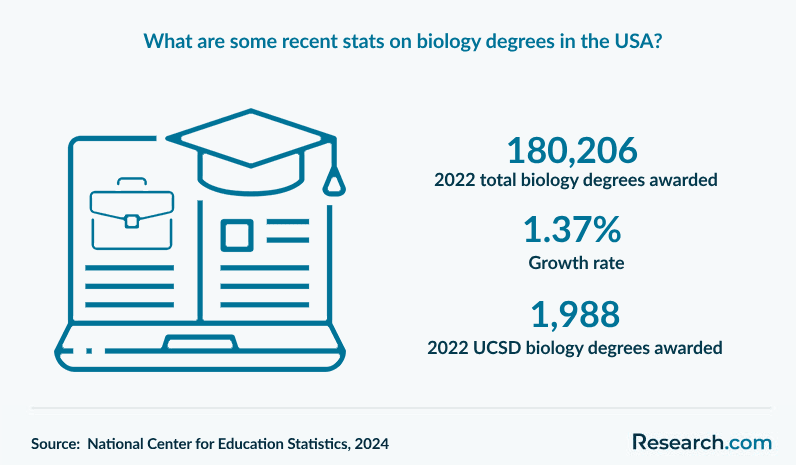
In 2022, a total of 180,206 degrees were awarded in biology, reflecting a growth rate of 1.37% compared to previous years. The highest concentrations of biology degree recipients are found in major cities such as New York, NY, Los Angeles, CA, and San Diego, CA. The University of California-San Diego is noted for awarding the most degrees in biology, with 1,988 degrees conferred in 2022. These patterns are shown in the graphic below.
How does an online biology degree compare to an on-campus program?
Online and campus biology degrees can cover the same core science content, but the learning experience is different. The biggest differences usually involve labs, research access, scheduling, peer interaction, and how easily students can participate in internships or faculty-led projects.
| Comparison point | Online biology degree | On-campus biology degree |
| Best for | Working adults, transfer students, military students, parents, and learners who need geographic flexibility. | Students who want frequent in-person labs, campus research, peer study groups, and direct faculty access. |
| Lab experience | May use virtual labs, simulations, home-lab kits, or local in-person requirements. | Usually offers direct access to campus laboratories, equipment, and supervised lab sections. |
| Research opportunities | May include remote research, data projects, local internships, or occasional campus-based options. | Often easier to access faculty labs, fieldwork, and undergraduate research positions. |
| Schedule | More flexible, especially when courses are asynchronous. | More structured and may require daytime availability. |
| Networking | Requires more intentional effort through online groups, faculty outreach, internships, and professional associations. | Often easier through campus organizations, lab teams, seminars, and in-person events. |
| Potential concern | Some graduate or professional programs may review online labs differently. | Less convenient for students who cannot relocate or attend scheduled classes. |
If you are comparing biology with adjacent science fields, it can also help to ask whether a related major fits your goals better. For example, students focused on sustainability, conservation, or policy may also research whether environmental science is an easy degree compared with biology.
What is the average cost of a biology degree program?
The cost of a biology degree varies by institution type, residency status, program format, credit requirements, lab fees, and whether students need to relocate. Biology can also involve extra expenses for lab materials, technology, textbooks, course fees, fieldwork, and professional school applications for pre-health students.
- Public Universities (In-State): $10,000-$15,000 per year.
- Public Universities (Out-of-State): $20,000-$30,000 per year.
- Private Universities: $30,000-$60,000 per year.
- Online Programs: $5,000-$20,000 per year, depending on the school and program structure.
When comparing programs, calculate the total cost to graduate. A lower tuition rate may not save money if the school accepts fewer transfer credits, charges significant lab fees, or requires extra semesters because key courses are offered infrequently.
What are the financial aid options for students enrolling in a biology degree program?
Biology students may be eligible for federal, state, institutional, private, employer, and military education funding. The most important step is to complete financial aid paperwork early and compare net price, not just published tuition.
- Federal Aid: Pell Grants, Direct Subsidized Loans, and Direct Unsubsidized Loans.
- State Aid: Grants and scholarships provided by state governments.
- Institutional Aid: Merit-based and need-based scholarships offered by universities.
- Private Scholarships: Awards from external organizations and foundations.
- Work-Study Programs: Part-time campus jobs to help offset tuition costs.
- Military Benefits: Educational funding for veterans and active-duty service members.
- Employer Tuition Assistance: Programs that reimburse educational expenses for employees.
Students comparing healthcare-related pathways may also want to understand how costs differ across fields. For example, those considering a future counseling or healthcare-adjacent path can compare biology costs with options such as the cheapest online LPC programs.
What are the prerequisites for enrolling in a biology degree program?
Admission requirements vary by school, but biology applicants should expect programs to review academic readiness in science and math. Transfer students should pay special attention to whether prior biology, chemistry, and lab courses will satisfy major requirements.
- High School Diploma or GED: A fundamental requirement for undergraduate programs.
- High School Coursework: Strong performance in biology, chemistry, and mathematics.
- Standardized Tests: SAT/ACT scores, though for some schools, these are optional.
- GPA Requirements: Typically 2.5-3.0 minimum.
- Application Materials: Personal statements, letters of recommendation, and a completed application form.
- Prerequisite College Courses (for Transfers): Basic science courses if entering as a transfer student.
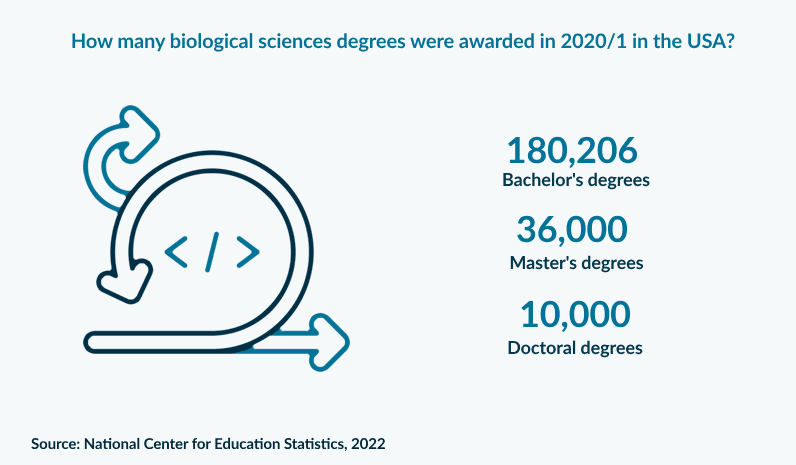
In the 2020/21 academic year, US institutions awarded approximately 180,206 bachelor's degrees in the biological sciences. This field shows promising career prospects, with an unemployment rate of roughly 2.4% for bachelor's degree holders in 2018. Furthermore, about 36,000 master's degrees and 10,000 doctoral degrees were conferred in the biological and biomedical sciences during the same period (National Center for Education Statistics, 2022). These figures, shown in the graphic below, show that biology remains a major pathway into graduate study, health professions, research, and applied science careers.
What courses are typically in a biology degree program?
A biology curriculum builds from foundational science into advanced biological systems, laboratory methods, and elective specialization. Students who want a smoother path should review the course sequence because many upper-level biology classes require general biology, chemistry, organic chemistry, statistics, or physics first.
Core Courses
- General Biology: Introduces biological principles such as cells, organisms, genetics, evolution, and ecosystems.
- Chemistry: Covers general and organic chemistry concepts that support molecular and cellular biology.
- Mathematics: Often includes statistics and calculus, especially for students planning research or graduate school.
- Physics: Provides foundational concepts relevant to biological systems, health professions, and scientific modeling.
Advanced Courses
- Genetics: Examines heredity, DNA, gene expression, and inheritance patterns.
- Microbiology: Focuses on bacteria, viruses, fungi, and other microscopic organisms.
- Ecology: Studies relationships among organisms and their environments.
- Molecular Biology: Explores biological processes at the molecular and cellular level.
Laboratory Courses
- Students practice experimental design, measurement, observation, documentation, and analysis.
- Upper-level labs may focus on molecular biology, microbiology, ecology, genetics, or biochemistry.
Electives
- Elective options may include biochemistry, immunology, developmental biology, marine biology, biotechnology, environmental biology, or bioinformatics.
Students interested in sustainability leadership may eventually combine science training with business or policy preparation. One related option is to explore the best MBA sustainability degrees after building a science foundation.
What types of specializations are available in biology degree programs?
Specializations help students turn a broad biology degree into a more focused academic and career plan. The right specialization depends on whether the student wants laboratory research, healthcare preparation, environmental work, teaching, biotechnology, data-centered biology, or science communication.
| Specialization | Best fit for students interested in | Common next steps |
| Cellular and Molecular Biology | Cells, DNA, gene expression, proteins, and disease mechanisms. | Research labs, graduate school, biotechnology, medical preparation. |
| Ecology and Evolution | Organisms, ecosystems, biodiversity, conservation, and adaptation. | Field research, environmental consulting, conservation, graduate study. |
| Genetics and Developmental Biology | Inheritance, organismal development, genetic disorders, and developmental processes. | Genetics labs, healthcare pathways, graduate research. |
| Organismal Biology and Physiology | Structure, function, behavior, and biological systems across organisms. | Healthcare preparation, teaching, research, animal or plant science. |
| Biochemistry | Chemical processes in living organisms and molecular mechanisms of life. | Biotech, pharmaceutical work, graduate school, health professions. |
| Marine Biology | Ocean life, saltwater environments, marine ecosystems, and aquatic research. | Fieldwork, conservation, environmental agencies, graduate study. |
| Neurobiology | The brain, spinal cord, nerves, cognition, and behavior. | Neuroscience research, healthcare pathways, graduate programs. |
| Biotechnology | Using biological systems to develop technologies for medicine, agriculture, and industry. | Biotech firms, quality control, product development, regulatory roles. |
| Bioinformatics | Biology, computer science, DNA sequence analysis, and biological data. | Data-heavy research, computational biology, genomics, graduate study. |
| Environmental Biology | Human environmental impact, ecosystems, sustainability, and conservation. | Environmental consulting, agencies, policy support, field research. |
| Pre-Health | Medicine, dentistry, veterinary medicine, pharmacy, and allied health. | Professional school prerequisites, clinical experience, entrance exams. |
| Biomedical Sciences | Health, disease, physiology, research, and treatment development. | Medical research, graduate programs, professional healthcare pathways. |
Students interested in molecular life sciences can compare biology with the best online biochemistry degree programs. Those who want faster entry into patient-facing work may also research accelerated medical assistant programs, while students leaning toward population health can compare biology with the cheapest online public health degree programs.
Biology career salaries span a wide range, and advanced education often matters. Biology majors can pursue diverse career paths with varying salaries. Biologist positions range from entry-level Biologist I roles averaging $58,162 to senior Biologist V positions with an average of $128,071. Specialized roles like Marine Biologists command an average of $88,108, while Research Biologists earn around $60,162. In New York, Biological Scientists average $100,306.
Academic positions like Online Biology Professor and Professor of Plant Biology offer attractive salaries of $160,388 and $153,710, respectively. A Biology Content Developer can expect to earn around $133,012. Students interested in teaching may eventually combine biology with education training; for example, they can compare the best 1 year online master's in education programs if they want a faster graduate education route.
What are the highest paying career opportunities with a biology degree?
The highest-paying biology-related careers usually require specialization. Bachelor’s graduates may start in lab, technical, education, environmental, or quality-control roles, while advanced positions in biotechnology, medical research, academia, clinical leadership, and regulatory affairs often require graduate education, professional credentials, or substantial experience.
Students who want to target higher-paying work should look beyond the major title and build a skill stack. Useful additions may include bioinformatics, data analytics, laboratory instrumentation, regulatory documentation, project management, research methods, grant writing, or clinical knowledge. Research.com’s guide to the highest paying jobs with a biology degree can help students compare career paths that may offer stronger earnings potential.
Can Additional Certifications Enhance My Biology Career Prospects?
Certifications can help biology graduates prove specific, job-ready skills that may not be obvious from a broad biology major alone. The most useful credentials depend on the career target. A student interested in public health or wellness may consider a nutrition course online, while a student aiming for lab operations, data analysis, biotechnology, environmental compliance, or clinical research should look for credentials aligned with those employers’ requirements.
Should I pursue additional certifications to enhance my biology degree?
Additional certifications make the most sense when they fill a clear skills gap. They are less useful when students collect credentials without a job target. Before enrolling, identify three to five roles you want, review job postings, and note recurring technical skills, software tools, regulatory knowledge, or lab methods. Flexible certificate programs online can be helpful if they directly support those requirements and do not distract from completing the degree.
How can I verify accreditation and quality standards for biology degree programs?
Accreditation is one of the first things to check because it can affect federal financial aid, credit transfer, graduate admission, employer recognition, and licensure-related pathways. Students should confirm institutional accreditation through official school pages and recognized accreditation directories. For biology, also review lab requirements, faculty qualifications, research opportunities, graduate school placement, student support, and whether the curriculum matches your intended career path.
Students planning a fast graduate route should be especially careful. A shorter program is only useful if it is credible and aligned with future goals. When comparing options such as the quickest masters degree, verify accreditation and academic expectations before prioritizing speed.
Is an Accelerated Master’s Pathway a Strategic Next Step for Biology Graduates?
An accelerated master’s pathway can be valuable for biology graduates who already know they need advanced training for biotechnology, research, healthcare administration, environmental management, teaching, or data-centered science roles. These pathways may shorten the time between undergraduate and graduate credentials, but students should still evaluate faculty expertise, research access, curriculum depth, internship options, and total cost.
A program such as a 1 year masters online may be appropriate for students who need a faster credential, but it should not be chosen only for speed. For research-heavy or professional pathways, depth, mentorship, and hands-on experience often matter as much as the timeline.
How does one choose the best biology degree program?
The best biology degree program is the one that supports your specific next step. A student preparing for medical school, a student who wants to teach high school biology, a student interested in marine ecosystems, and a working adult seeking an online science degree may need very different programs.
- Confirm accreditation: Make sure the institution is accredited and eligible for federal financial aid.
- Match the degree type to your goal: Consider whether a BA or BS better supports your career, graduate-school, or professional-school plan.
- Review lab requirements: Ask exactly how online, hybrid, or campus labs are completed.
- Check transfer credits: Transfer students should request a course-by-course evaluation before enrolling.
- Compare total cost: Include tuition, fees, books, lab materials, technology, travel, and extra terms.
- Look at support services: Prioritize programs with science tutoring, advising, career help, research support, and faculty access.
- Investigate career outcomes: Ask where graduates work, whether students attend graduate school, and what internships or research opportunities are available.
- Verify licensure alignment: Students pursuing teaching, clinical, or professional pathways should confirm state or professional requirements.
| If your goal is... | Look for... | Be cautious about... |
| Medical, dental, veterinary, or pharmacy school | Strong chemistry, physics, biology labs, advising, and prerequisite alignment. | Online labs that may not satisfy every professional school’s expectations. |
| Biotechnology or lab work | BS curriculum, lab training, molecular biology, biochemistry, internships, and data skills. | Programs with limited hands-on or applied laboratory exposure. |
| Environmental or conservation work | Ecology, fieldwork, GIS or data skills, internships, and local ecosystem access. | Programs with little field experience or no environmental electives. |
| Teaching biology | Biology education track, student teaching, and state licensure alignment. | General biology degrees that do not lead to teacher certification. |
| Flexible adult completion | Online courses, transfer-friendly policies, clear advising, and flexible labs. | Hidden in-person requirements or limited course availability. |
Some students ultimately choose a different healthcare route after comparing requirements. For example, registered nurses planning graduate advancement may research the cheapest online MSN programs instead of pursuing a biology graduate pathway.
What career paths are available for graduates of biology degree programs?
Biology graduates can work in science, healthcare preparation, education, environmental services, biotechnology, technical writing, and forensic or regulatory settings. The bachelor’s degree is often a starting point; graduate education, licensure, or certification may be required for advanced practice, independent research, university teaching, or clinical roles.
- Research Scientist: Designs and conducts experiments in academic, government, or industry settings. Advanced research roles commonly require graduate education.
- Healthcare Professional: Biology can prepare students for medical, dental, pharmacy, veterinary, physician assistant, or allied health programs, but additional schooling and licensure are usually required.
- Environmental Scientist: Works on conservation, pollution, climate-related research, resource management, environmental compliance, or biodiversity issues.
- Biotechnologist: Uses biological knowledge in agriculture, pharmaceuticals, diagnostics, medicine, and product development.
- Educator: Teaches science in schools, colleges, museums, or informal learning settings. Students interested in teaching can compare the cheapest online teaching degree programs to understand education pathways.
- Forensic Scientist: Applies biological methods to evidence analysis, including DNA, blood, tissue, or other biological samples.
- Science Writer: Translates scientific information into articles, educational content, reports, books, or public-facing communication.
- Pharmaceutical Sales Representative: Uses biological and pharmacological knowledge to communicate with healthcare professionals about products.
- Biomedical Engineer: Combines biology and engineering to support medical device, prosthetic, and healthcare technology development.
- Genetic Counselor: Genetic counselors help individuals and families understand genetic risks, testing options, and related healthcare decisions.
Students comparing helping professions may also consider how biology differs from mental health, counseling, and social service pathways. For example, Research.com’s guide to the most affordable online masters in mental health counseling programs may be useful for students considering a people-centered graduate career outside laboratory science.
Would a Master’s Degree Boost My Biology Career?
A master’s degree can improve career options when it gives students specialized training that employers or graduate programs value. It may be useful for biotechnology, environmental management, clinical research coordination, bioinformatics, laboratory leadership, education, and preparation for doctoral or professional study. However, the degree should be chosen for a specific outcome, not simply because bachelor’s-level job searches feel competitive.
Before enrolling, compare expected cost, salary potential, program length, research access, employer demand, and whether a master’s is actually required for your target jobs. Students focused on earnings can compare biology-related pathways with broader lists of masters degrees that make the most money.
What is the job market for graduates with a biology degree?
The U.S. job market for biology graduates includes real opportunity, but it is not automatic. Many entry-level roles are competitive, and advanced scientific positions may require graduate study. Students can improve their prospects by gaining lab experience, internships, research exposure, data skills, technical writing ability, and credentials tied to specific jobs.
Employment Statistics
- Current Employment: There are approximately 135,000 biologists employed in the U.S. as of 2024, with this number expected to grow by 4.7% from 2022 to 2032, translating to about 11,900 new positions created due to both growth and retirements.
- Average Salary: The median salary for biology graduates varies by specific roles but is generally around $65,000 per year. Biological scientists earn an average of $67,631, while entry-level positions like microbiologists start at just under $68,000.
Job Outlook
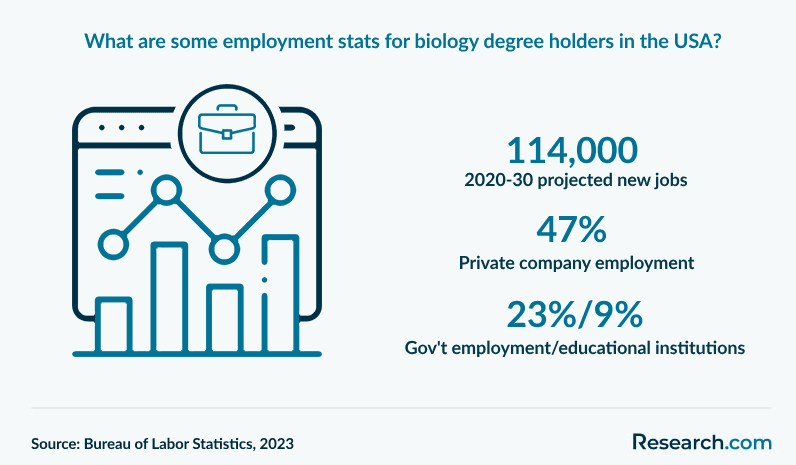
- Growth Projections: The Bureau of Labor Statistics estimates there will be nearly 114,000 new jobs in the life, physical, and social sciences between 2020 and 2030. This growth reflects an increasing demand for professionals in the biotechnology, environmental protection, and healthcare sectors.
- Industry Demand: Job opportunities for biologists are expected to be concentrated in biotechnology and molecular biology, with significant roles emerging in agriculture and environmental protection as senior-level professionals retire.
Employment Types and Sectors
- Sector Distribution: Biologists are more likely to work in private companies (47%) compared to government (23%) or educational institutions (9%). The most common industries include professional services, government agencies, and technology firms.
- Job Roles: Common entry-level positions include laboratory technicians, research assistants, and high school biology teachers. Advanced roles typically require a master’s or doctoral degree, particularly for independent research or university-level teaching.
These statistics are shown in the graphic below.
Challenges in the Job Market
- Underemployment Issues: Despite the growth in job opportunities, approximately 46.8% of biology graduates are reported to be underemployed, often due to competition for research positions and the need for advanced degrees for many roles.
- Job Competition: The job market can be competitive, especially for research positions where funding is limited. Many graduates find it necessary to pursue further education or specialized training to enhance their employability.
The practical takeaway is clear: biology students should not wait until senior year to think about employment. Choose a concentration early, build hands-on experience, learn data and lab tools, join research or internship projects, and document your skills in a portfolio, resume, or LinkedIn profile.
How Can Online Biology Programs Enhance Practical Skill Development?
Online biology programs can develop practical skills when they are intentionally designed around applied learning. Strong programs use virtual laboratory simulations, remote data projects, scientific case studies, home-lab kits, faculty-guided research, and local internship options. These experiences help students practice observation, hypothesis testing, documentation, experimental reasoning, and data interpretation.
Students should ask how each online program verifies lab competency. A good online biology program should explain what equipment or software is used, how experiments are assessed, whether any in-person sessions are required, and how students gain experience relevant to careers or graduate school. Learners comparing flexible academic options more broadly can also review Research.com’s guide to easy online college degrees.
What is the difference between a BA and a BS in Biology?
A Bachelor of Arts in Biology usually offers a broader liberal arts structure with more room for electives, interdisciplinary study, communication, policy, education, or pre-professional coursework. A Bachelor of Science in Biology typically includes more science, math, laboratory, and research-intensive requirements. Neither degree is automatically better. The right choice depends on the student’s goal.
| Degree type | Typical emphasis | Best fit |
| BA in Biology | Broad biology foundation with more flexibility for humanities, social sciences, communication, or interdisciplinary electives. | Students interested in education, science communication, policy, healthcare prerequisites, or flexible career paths. |
| BS in Biology | More technical science coursework, lab work, math, chemistry, and research preparation. | Students aiming for lab-based roles, biotechnology, graduate research, or science-intensive professional pathways. |
Students who want to move quickly from undergraduate science into advanced credentials should still prioritize fit and quality. Shorter graduate or doctoral formats, including short doctoral programs, should be evaluated carefully for accreditation, research expectations, and career relevance.
Here’s What Graduates Have to Say About Their Biology Degrees
-
: "
My biology degree helped me qualify for research opportunities I would not have found otherwise. I now work in a genetics lab and contribute to projects connected to disease treatment. The work is demanding, but it feels meaningful because the science has real-world impact. Jenna
"
-
: "
The online format made it possible for me to study biology while raising a family. I had supportive instructors, and the virtual labs were more engaging than I expected. I now teach high school biology and use what I learned to help students see science as something they can understand. Joel
"
-
: "
I worried that an online biology degree would not feel rigorous, but the program pushed me to improve my data analysis, writing, and scientific reasoning. I now work as an environmental consultant and use those skills to support conservation and compliance projects. Eunice
"
What are the emerging trends in biology degree programs?
Biology education is becoming more interdisciplinary and technology-driven. Programs increasingly integrate bioinformatics, sustainability, data analytics, digital lab simulations, remote research, and applied case studies. Employers and graduate programs are also paying closer attention to practical evidence of skill, such as research participation, internship experience, technical writing, lab documentation, and computational ability.
Online education trends are also affecting access. Some institutions are streamlining admissions, offering more flexible start dates, or reducing application barriers. Students comparing flexible college options can review online college with no application fee resources, but they should still verify accreditation, lab quality, and degree requirements before enrolling.
Is a biology degree a wise financial investment?
A biology degree can be a worthwhile investment when the student has a realistic plan for turning the degree into employment, graduate education, professional school admission, or specialized technical skills. It can be risky when students borrow heavily without understanding entry-level salaries, underemployment risk, graduate-school requirements, or the extra cost of professional preparation.
To evaluate return on investment, compare total program cost, expected debt, transfer-credit value, completion time, internship access, graduate-school placement, and likely entry-level roles. Students who want flexible or faster alternatives can also compare biology with other pathways covered in Research.com’s guide to what degrees can I get online.
Can Accelerated Degrees Boost My Entry into Biology Careers?
Accelerated degrees can help some students enter the workforce faster, especially when they already have transfer credits, a clear career goal, and the discipline to handle compressed science coursework. However, biology is not a field where speed should replace lab competence, prerequisite planning, or academic support. A fast program is only useful if it still prepares students for the roles or graduate programs they want.
Students who want the fastest possible entry into science-related work may compare associate, bachelor’s, and certificate routes. Research.com’s guide to the quickest associates degree may help students explore shorter pathways, but bachelor’s-level biology roles and graduate programs usually require careful long-term planning.
Common Mistakes to Avoid When Choosing a Biology Degree
- Assuming “easy” means low effort: Biology requires science, math, labs, and writing. Look for support and fit, not shortcuts.
- Choosing a program without checking accreditation: Accreditation can affect financial aid, transfer credits, graduate admissions, and employer recognition.
- Ignoring lab requirements: Online biology students should know exactly how labs are completed and whether those labs meet future school or career expectations.
- Focusing only on tuition: Total cost includes fees, books, lab materials, technology, travel, lost transfer credits, and extra semesters.
- Choosing a BA or BS without a career plan: A BA may offer flexibility, while a BS may better support lab and research goals.
- Waiting too long to get experience: Internships, research, fieldwork, and lab assistant roles can matter as much as coursework for entry-level jobs.
- Assuming a bachelor’s degree guarantees a high salary: Earnings vary widely by occupation, location, education level, experience, and specialization.
- Overlooking licensure rules: Teaching, clinical, counseling, and healthcare careers may require state-specific or profession-specific requirements beyond biology coursework.
Questions to Ask Before Enrolling
- Is the institution accredited, and by which accrediting body?
- Is the program a BA, BS, biology education degree, or natural sciences degree with a biology concentration?
- How are labs completed in online, hybrid, or campus formats?
- Will the program meet prerequisites for medical, dental, veterinary, pharmacy, graduate, or teacher licensure pathways?
- How many transfer credits will apply to the major, not just general electives?
- Are science courses offered every term, or only once per year?
- What tutoring, advising, writing, and career services are available to online students?
- Are internships, research projects, fieldwork, or faculty mentorship available?
- What is the total estimated cost to graduate after financial aid?
- What jobs or graduate programs do recent graduates enter?
Key Insights
- There is no truly “easy” biology degree: The most manageable program is the one with the right format, lab structure, advising, cost, and specialization for your goals.
- General Biology remains the dominant pathway: General Biology is the most popular major (64%), followed by Biochemical Sciences (8%). Other specializations account for the remaining 28%.
- Biology is a large and active degree field: In 2022, 180,206 biology degrees were awarded, a 1.37% increase. UC San Diego awarded the most (1,988).
- Employment outcomes vary by specialization and education level: Roughly 135,000 biologists work in the U.S., earning an average of $65,000 annually. Biological scientists average $67,631, and entry-level microbiologists start near $68,000.
- The field has growth areas but also competition: The BLS projects nearly 114,000 new jobs in related fields by 2030, with growth in biotechnology, molecular biology, agriculture, and environmental protection.
- Private-sector work is common: Most biologists (47%) work in private companies. Common entry-level roles include technicians and assistants. Advanced positions typically require graduate degrees.
- Online biology degrees can work, but labs matter: Before enrolling, verify how practical skills are taught and whether online labs will support your future graduate, professional, or career plans.
- ROI depends on planning: A biology degree is strongest when paired with internships, research, technical skills, certifications, graduate study, or a clear professional pathway.
References:
- Brooklyn College. (n.d.). What can you do with a degree in biology? Brooklyn College.
- Bureau of Labor Statistics. (2023). Biochemists and biophysicists. Bureau of Labor Statistics.
- CareerExplorer. (2024). The job market for biologists in the United States. CareerExplorer.
- Data USA. (2022). Biology. Data USA.
- Harvard University. (2022). Careers in biology: Where your degree will take you. Harvard University.
- Indeed. (2025). 2025 biology jobs, employment. Indeed.
- National Center for Education Statistics. (2022). Digest of Education Statistics 2021. National Center for Education Statistics.
- Nexford University. (2024). Top 10 highest paying jobs with a biology degree. Nexford University.
- Peace College. (2021). The best entry-level jobs for biology majors. Peace College.
- Salary.com. (2025). Biologist I salary in the United States. Salary.com.
- Zippia. (2024). Biologist demographics and statistics in the US. Zippia.
- Zippia. (2024). Biological scientist job outlook and growth in the US. Zippia.
Other Things You Should Know About Online Biology Degrees
In 2027, programs emphasizing flexibility and a balanced curriculum include the online Bachelor of Science in Biology from Arizona State University and Oregon State University’s Biology B.A. These programs cater to students seeking accessible learning routes combined with practical experience. Both institutions support diverse learning styles through online platforms and integrated lab work.
Admission requirements typically include a high school diploma or equivalent, a minimum GPA of 2.5, and completed coursework in biology and chemistry. Some programs may also require SAT or ACT scores, with deadlines falling between May and July 2027.
Most biology degrees require 2 to 4 laboratory courses, and many programs add a separate lab fee of about $50 to $300 per course. Introductory labs in general biology, chemistry, and genetics are usually mandatory, even in easier degree tracks.