2027 Best Online Biotechnology Graduate Certificate Programs

Co-Founder and Chief Data Scientist
The global life sciences market is expanding at an 11.75% compound annual growth rate, yet many experienced science professionals feel stalled. You may have the skills for a senior role, but a credential gap on your resume is preventing a promotion. An online biotechnology graduate certificate is the specific key designed to solve this exact problem.
This article, prepared by career planning experts, will explore the best online biotechnology graduate certificate available. We're here to provide the insights you need to make a strategic and confident decision about your future.
What are the benefits of getting an online biotechnology graduate certificate?
- It provides the specific credential needed to qualify for senior and managerial roles in quality assurance, regulatory affairs, and project management.
- You can unlock a higher salary bracket, with the potential to move from a mid-career average of around $57,000 to a senior-level salary of over $70,000.
- The flexible online format allows you to gain these career-advancing skills without having to step away from your current job or personal commitments.
What can I expect from an online biotechnology graduate certificate?
An online biotechnology graduate certificate delivers a focused, post-baccalaureate curriculum designed for experienced professionals. The program provides advanced, graduate-level coursework that builds upon existing knowledge rather than repeating undergraduate material.
The structure is intentionally flexible to accommodate an active career. Coursework emphasizes the practical and technical skills that employers currently seek, allowing professionals to enhance their qualifications without pausing their careers.
Where can I work with an online biotechnology graduate certificate?
This certificate qualifies graduates for senior specialist and leadership positions within innovative sectors such as pharmaceuticals, manufacturing, and research and development. The credential facilitates a move into roles centered on strategic oversight and management.
These roles include positions like quality assurance manager, regulatory affairs specialist, or clinical research project lead. Such positions are vital in both fast-growing startups and established corporations, where a combination of professional experience and advanced training is highly valued.
How much can I make with an online biotechnology graduate certificate?
This credential provides access to higher salary brackets associated with senior-level and specialized roles. While exact earnings are influenced by specialization and experience, the certificate is the qualification that makes a professional eligible for these more lucrative positions.
An individual could see their salary potential increase from a mid-career average of approximately $57,000 to over $70,000 in a senior role. An advanced credential of this nature is often the requirement for breaking through the salary ceilings frequently encountered by those with only a bachelor's degree.
- List of the Best Online Biotechnology Graduate Certificate Programs for 2027 List of Programs
- How long does it take to complete an online biotechnology graduate certificate program? Completion Time
- How does an online biotechnology graduate certificate program compare to an on-campus program? How does an online biotechnology graduate certificate program compare to an on-campus program?
- What is the average cost of an online biotechnology graduate certificate program? Program Cost
- What are the financial aid options for students enrolling in an online biotechnology graduate certificate program? Financial Aid
- What are the prerequisites for enrolling in an online biotechnology graduate certificate program? What are the prerequisites for enrolling in an online biotechnology graduate certificate program?
- What courses are typically in an online biotechnology graduate certificate program? What courses are typically in an online biotechnology graduate certificate program?
- What types of specializations are available in an online biotechnology graduate certificate program? What types of specializations are available in an online biotechnology graduate certificate program?
- How to Choose the Best Online Biotechnology Graduate Certificate Program How to Choose the Best Online Biotechnology Graduate Certificate Program
- What career paths are available for graduates of an online biotechnology graduate certificate program? Career Paths
- What is the job market for graduates with an online biotechnology graduate certificate program? Job Market
- How Do Hiring Managers Evaluate Online Biotechnology Certificates Compared to Related Online Credentials? How Do Hiring Managers Evaluate Online Biotechnology Certificates Compared to Related Online Credentials?
Best Online Biotechnology Graduate Certificate Programs for 2027
An online biotechnology graduate certificate can be a practical way to move into biotech, strengthen a science career, or add regulatory, biomanufacturing, bioinformatics, or project management skills without committing to a full master’s degree. The main decision is not simply which school has the strongest name recognition. You need to know whether the certificate matches your career target, whether the credits can stack into a graduate degree, how much the program will cost, and whether the curriculum teaches skills employers can recognize immediately.
This guide is designed for working professionals, recent science graduates, lab technicians, quality specialists, healthcare professionals, and career changers comparing online biotechnology certificate options. You will find a ranked program list, cost and timeline comparisons, admissions expectations, common course topics, specialization choices, career paths, hiring considerations, and practical steps for choosing a program with a defensible return on investment.
Quick answer: Is an online biotechnology graduate certificate worth it?
An online biotechnology graduate certificate can be worth it if you already have a science, healthcare, engineering, or technical background and need focused graduate-level training for roles in biotech research, regulatory affairs, quality assurance, biomanufacturing, clinical project management, or bioinformatics. Most programs are shorter than a master’s degree, many can be completed while working, and some allow certificate credits to count toward a later graduate degree. It is less likely to be the right choice if you need broad entry-level science preparation, a required professional license, or a credential that guarantees a specific salary outcome.
How to use this ranking
Use the ranking as a starting point, not as the only factor in your decision. The strongest program for one student may be a poor fit for another if the curriculum does not match the intended career path. For example, a student targeting regulatory affairs should evaluate FDA, quality systems, and compliance coursework more heavily than laboratory technique courses, while a student targeting biomanufacturing should look for process development, GMP, quality control, and manufacturing-focused content.
How do we rank schools?
Because graduate education requires a serious financial and time commitment, Research.com evaluates programs using transparent information from established education data sources, including the IPEDS database, Peterson's database, the College Scorecard database, and The National Center for Education Statistics.
These sources help support comparisons of online biotechnology graduate certificate programs across factors such as institutional profile, program availability, and student-relevant data. For a fuller explanation of how Research.com builds rankings, review the Research.com methodology page.
Program comparison at a glance
| Rank | School and program | Best fit | Length | Credits or courses | Published cost |
| 1 | Northeastern University – Graduate Certificate in Biotechnology | Professionals seeking a science-to-biotech transition with stackable graduate credits | 1 year | 12 credits | $1,928 per credit |
| 2 | Worcester Polytechnic Institute – Graduate Certificate in Life Sciences Management / Biotechnology | Students who want technical and business preparation for life sciences leadership | 1 year | 12 credits | $1,610 per credit |
| 3 | Harvard Extension School – Biotechnology Management Graduate Certificate | Professionals interested in biotech commercialization, innovation, and management | Up to 3 years | 4 courses | $3,440 per course |
| 4 | University of California, Santa Cruz – Silicon Valley Extension – Biotechnology Certificate | Students seeking broad scientific preparation across molecular biology and drug development | 1 year | 19 credits | $326 per credit |
| 5 | University of California, Los Angeles Extension – Biotechnology Engineering Certificate | Students focused on biopharmaceutical manufacturing, design, quality, and regulation | 6–18 months | 24 credits | $314 per credit |
| 6 | Case Western Reserve University – Experimental Biotechnology Graduate Certificate | Students who want hands-on technical preparation in molecular biology and biochemistry | 1–2 years | 18 credits | $2,862 per credit |
| 7 | University of Washington – Certificate in Biotechnology Project Management | Professionals managing biotech product development, clinical, technical, or regulatory projects | 8–9 months | 4 courses | $1,560 per course |
| 8 | South Dakota State University – Biotechnology Graduate Certificate | Students interested in agricultural, environmental, industrial, and applied biotechnology | 1 year | 12 credits | $340 in-state; $654 out-of-state per credit |
| 9 | University of Alabama at Birmingham – Certificate in Biotechnology Regulatory Affairs | Students targeting regulatory affairs, quality assurance, and clinical research certification pathways | ~9–12 months | 15 credits | $628 per credit |
| 10 | University of Wisconsin–Madison – Biotech / Life-Sciences Management Certificate | Professionals seeking practical preparation in quality assurance, regulatory affairs, and team-based biotech work | ~1 year | 9 credits | $1,000 per credit |
1. Northeastern University – Graduate Certificate in Biotechnology
Northeastern University offers an online biotechnology certificate for professionals who want to enter or advance in the biotech industry, including students who may not have a traditional science background. The program emphasizes core industry knowledge and is taught by faculty connected to professional practice. A key advantage is that all certificate credits may be applied toward Northeastern’s Master of Science in Biotechnology program, making it a strong option for students who want a shorter credential now and a possible master’s pathway later.
- Program length: 1 year
- Required credits to graduate: 12
- Cost per credit: $1,928
- Accreditation: New England Commission of Higher Education (NECHE)
2. Worcester Polytechnic Institute – Graduate Certificate in Life Sciences Management / Biotechnology
Worcester Polytechnic Institute is a good fit for students who want both scientific and business-oriented training for life sciences roles. The certificate is designed to support technical growth as well as preparation for leadership, management, or laboratory-based responsibilities. Students may also be able to continue into an MS in Biotechnology or Bioscience Management, depending on their prior preparation and goals.
- Program length: 1 year
- Required credits to graduate: 12
- Cost per credit: $1,610
- Accreditation: New England Commission of Higher Education (NECHE)
3. Harvard Extension School – Biotechnology Management Graduate Certificate
Harvard Extension School focuses on the intersection of life sciences, innovation, and business. The program is especially relevant for students interested in how biotechnology products move from research concepts into development, commercialization, and organizational strategy. Credits may also stack toward an ALM in Biotechnology, which can be useful for students who want a certificate first but are considering a graduate degree later.
- Program length: Up to 3 years
- Required courses to complete: 4
- Cost per course: $3,440
- Accreditation: New England Commission of Higher Education (NECHE)
4. University of California, Santa Cruz – Silicon Valley Extension – Biotechnology Certificate
The University of California, Santa Cruz certificate gives students a broad scientific foundation across biotechnology topics, including molecular biology and drug development. It may be a strong choice for students seeking roles in biopharmaceutical companies, academic research settings, or related scientific environments where current laboratory concepts and biotech technologies are important.
- Program length: 1 year
- Required credits to graduate: 19
- Cost per credits: $326
- Accreditation: WASC Senior College and University Commission (WSCUC)
5. University of California, Los Angeles Extension – Biotechnology Engineering Certificate
The University of California, Los Angeles Extension certificate is built around biotechnology engineering and biopharmaceutical manufacturing. Students study areas such as process design, manufacturing, quality systems, and regulatory requirements. The program may appeal to learners who want practical exposure to production environments and regulatory expectations, including European and FDA regulations.
- Program length: 6–18 months
- Required credits to graduate: 24
- Cost per credits: $314
- Accreditation: Western Association of Schools and Colleges Senior College and University Commission (WASC)
6. Case Western Reserve University – Experimental Biotechnology Graduate Certificate
Case Western Reserve University emphasizes applied technical training for students interested in academic, healthcare, pharmaceutical, or laboratory-based biotechnology roles. The curriculum includes hands-on experience and skill development in areas such as biochemistry and molecular biology. A part-time option can make the program more manageable for employed students.
- Program length: 1–2 years
- Required credits to graduate: 18
- Cost per credit: $2,862
- Accreditation: Higher Learning Commission (HLC)
7. University of Washington – Certificate in Biotechnology Project Management
The University of Washington offers a certificate jointly designed and delivered with UC San Diego Extended Studies. The program is focused on biotech product development from beginning to end and is particularly relevant for professionals who coordinate clinical, technical, regulatory, or cross-functional project work.
- Program length: 8–9 months
- Required courses to complete: 4
- Cost per course: $1,560
- Accreditation: Northwest Commission on Colleges and Universities (NWCCU)
8. South Dakota State University – Biotechnology Graduate Certificate
South Dakota State University covers the use of biological and genetic processes in agricultural, environmental, and industrial applications. The program may be a practical option for students who want applied biotechnology knowledge beyond human therapeutics, including work involving microorganisms, plants, and animals.
- Program length: 1 year
- Required credits to graduate: 12
- Cost per credit: $340 (In-State); $654 (Out-of-State)
- Accreditation: Higher Learning Commission (HLC)
9. University of Alabama at Birmingham – Certificate in Biotechnology Regulatory Affairs
The University of Alabama at Birmingham certificate is centered on regulatory affairs and quality systems in biotechnology. The online curriculum is designed for students who want preparation related to quality assurance, regulatory affairs, or clinical research certification exams after completing the program.
- Program length: ~9–12 months
- Required credits to graduate: 15
- Cost per credit: $628
- Accreditation: Southern Association of Colleges and Schools Commission on Colleges (SACSCOC)
10. University of Wisconsin–Madison – Biotech / Life-Sciences Management Certificate
The University of Wisconsin–Madison capstone certificate focuses on workplace-ready skills in biotechnology and life sciences management. The program is especially relevant for students interested in quality assurance, regulatory affairs, team collaboration, and communication with government agencies.
- Program length: ~1 year
- Required credits to graduate: 9
- Cost per credit: $1,000
- Accreditation: Higher Learning Commission (HLC)
How long does it take to complete an online biotechnology graduate certificate program?
Most online biotechnology graduate certificate programs can be completed in 9 to 12 months, although some programs take less time and others allow students up to several years. The best timeline depends on whether you study full time or part time, whether courses are offered asynchronously, and whether the program requires lab work, group projects, or a fixed course sequence.
A shorter certificate can be useful when you need specific skills quickly, such as regulatory documentation, GMP, bioinformatics, project management, or bioprocessing knowledge. However, speed should not be your only criterion. A program that finishes quickly but does not teach the tools used in your target role may have weaker value than a slightly longer option with better career alignment. Students who want broader scientific preparation rather than a narrow graduate certificate may also compare certificate options with an online applied sciences degree.
| Timeline | Who it works for | Trade-off to consider |
| 8–9 months | Working professionals who need a tightly focused credential quickly | Fewer electives may mean less room to explore multiple biotech areas |
| 9 to 12 months | Students who want a standard certificate pace while staying employed | Requires steady weekly commitment alongside work or family obligations |
| 1–2 years | Students who need part-time pacing or more technical depth | Longer completion time may delay career transition plans |
| Up to 3 years | Students balancing demanding jobs or using a certificate as a step toward a degree | Extended pacing can reduce urgency and may require careful course planning |
How does an online biotechnology graduate certificate compare with an on-campus program?
An online biotechnology graduate certificate can carry the same institutional credential as an on-campus certificate when offered by the same accredited school. The major difference is not usually the name of the credential but how you learn, network, complete labs or projects, and manage your schedule. Online programs are often more practical for employed students, while campus programs may be stronger for students who need in-person laboratory access or local networking.
| Factor | Online biotechnology certificate | On-campus biotechnology certificate |
| Schedule | Often better for working adults, especially when courses are asynchronous | Requires attendance at set times and may be harder to combine with full-time work |
| Location | Allows students to enroll without moving or commuting | Best for students who live near campus or can relocate |
| Lab experience | May use simulations, remote assignments, local arrangements, or limited in-person components depending on the program | Usually offers more direct access to campus laboratories and equipment |
| Networking | Built through discussion boards, live sessions, group work, faculty interaction, and online career services | Built through in-person classes, labs, campus events, and local employer connections |
| Career continuity | Often allows students to keep working while studying | May require reduced work hours if class schedules conflict with employment |
| Best for | Professionals who need flexibility and already have access to workplace experience | Students who want campus resources, structured face-to-face learning, or hands-on lab access |
If you are comparing career-change options across fields, it can also help to review how other specialized credentials connect to employment outcomes, such as guides on urban planning jobs. The important lesson is the same across fields: format matters less than whether the program builds the competencies required for the role you want.
What is the average cost of an online biotechnology graduate certificate program?
Online biotechnology graduate certificate programs commonly cost between $2,500 and $7,500 on average, depending on the school, credit requirements, course fees, residency status, technology fees, and whether books, materials, or lab-related costs are included. Published tuition does not always show the full cost, so students should request a complete cost sheet before enrolling.
The financial value of a certificate depends on what it helps you do next. A regulatory affairs certificate may be worthwhile if it qualifies you for compliance-focused positions that were previously out of reach. A bioinformatics-focused certificate may make sense if you already have biology training but need computational skills. A broad certificate with no clear connection to your target role may be less valuable, even if it has a respected university name.
Students evaluating short, career-focused healthcare and science credentials may also compare the cost structure of biotech certificates with other professional pathways, such as MRI technologist programs. In any field, the key is to compare total cost against realistic career outcomes rather than assuming the credential automatically pays for itself.
Cost factors to check before applying
| Cost factor | Why it matters | Question to ask |
| Per-credit or per-course tuition | Programs list prices differently, which can make direct comparisons misleading | What is the total tuition required to finish the certificate? |
| Fees | Technology, registration, student service, or lab-related fees can increase the final bill | Are mandatory fees included in the published cost? |
| Books and materials | Technical courses may require specialized texts, software, or platforms | What should I budget for materials each term? |
| Residency pricing | Some public universities charge different tuition for in-state and out-of-state students | Does my residency status affect online tuition? |
| Stackable credits | Credits that apply to a master’s degree may improve long-term value | Can every certificate credit transfer into a related graduate degree at the same institution? |
What financial aid options are available for online biotechnology graduate certificate students?
Financial aid for graduate certificates varies by school and by program eligibility. Before assuming you can use loans, employer benefits, or veterans’ benefits, confirm whether the certificate is approved for the funding source you plan to use.
- Employer tuition assistance: Many biotech, pharmaceutical, healthcare, laboratory, and manufacturing employers support job-related education. Ask HR whether certificates qualify, whether you need manager approval, and whether repayment rules apply if you leave the organization.
- Federal student loans: Some graduate certificate programs may qualify for federal aid. Students must submit the Free Application for Federal Student Aid (FAFSA) to determine eligibility.
- University payment plans: Payment plans can divide tuition into smaller installments, which may reduce the need to pay the full balance at the start of the term.
- Department or program scholarships: Some universities provide limited scholarship support for certificate students. Check the department page and ask an enrollment advisor directly.
- Veterans' benefits: Veterans, active-duty service members, and eligible dependents may be able to use education benefits such as the GI Bill®, depending on program approval.
Ways to reduce the cost
- Ask whether your employer will pre-approve the certificate as job-related training.
- Choose a program with stackable credits if you may pursue a master’s degree later.
- Compare total program cost instead of per-credit price alone.
- Confirm whether online students pay campus-based fees.
- Check whether the program offers textbooks, software access, or lab resources as part of tuition.
What are the prerequisites for enrolling in an online biotechnology graduate certificate program?
Most online biotechnology graduate certificate programs expect applicants to have a bachelor’s degree from an accredited institution. Many prefer a background in biology, chemistry, biochemistry, engineering, health sciences, or a related field, although some programs are designed to help professionals from adjacent backgrounds enter biotechnology. Admissions committees often consider both academic preparation and professional experience.
- Bachelor's degree: Applicants generally need a bachelor’s degree from an accredited college or university, often in a science or related discipline.
- Relevant professional experience: Work in a laboratory, healthcare, pharmaceutical, regulatory, manufacturing, clinical research, or technical environment may strengthen an application.
- Minimum GPA: Some universities set a minimum undergraduate GPA, typically a 3.0 on a 4.0 scale, though professional achievements may help contextualize an applicant’s record.
- Official transcripts: Schools usually require transcripts from all previously attended undergraduate institutions.
- Resume or CV: A current resume helps programs evaluate your work history, technical skills, leadership experience, and career direction.
Admissions requirements differ by field, but many graduate-level professional programs use a similar mix of academic and practical review. For example, BSN to PhD nursing programs online also evaluate prior education alongside applied experience, although the professional goals and licensure context are different.
Who is a strong candidate?
| Applicant profile | Why the certificate may fit | What to verify first |
| Lab technician or research associate | Can build graduate-level knowledge for advancement into senior technical, QA, or research roles | Whether the curriculum goes beyond skills already learned on the job |
| Chemistry, biology, or biochemistry graduate | Can add industry-specific biotechnology training to a science foundation | Whether the program provides enough applied or career-focused content |
| Healthcare or clinical research professional | Can support movement toward regulatory, clinical project, or biotech operations roles | Whether prerequisites include molecular biology, statistics, or lab science coursework |
| Engineer or manufacturing professional | Can connect process, quality, or production experience to biomanufacturing | Whether the certificate includes GMP, quality systems, and bioprocessing topics |
| Career changer with limited science background | May help with a transition if the program is designed for non-science entrants | Whether foundational science courses are required before graduate coursework |
What courses are typically included in an online biotechnology graduate certificate program?
Coursework varies widely because biotechnology certificates are often specialized. Some programs focus on laboratory science, while others emphasize business, regulatory affairs, manufacturing, project management, or computational biology. Before enrolling, compare the course list with job postings for your target role and look for overlap in required tools, methods, and terminology.
Graduate certificates are usually more targeted than broad degree programs. In that sense, they resemble other advanced professional pathways, such as a DBA in management online, where the goal is to develop specialized knowledge that can be applied in a defined professional setting.
- Advanced molecular biology: Students may study techniques and concepts related to PCR, DNA analysis, gene expression, and next-generation DNA sequencing.
- Bioinformatics: Coursework may introduce computational methods, large biological datasets, and tools such as R for biological data analysis.
- Regulatory affairs: These courses examine approval pathways, FDA expectations, global regulatory frameworks, and documentation used to bring biotech products to market.
- Quality assurance and GMP: Students learn about quality systems, Good Manufacturing Practices, documentation, audits, and compliance in regulated biotechnology environments.
- Drug discovery and development: Courses may cover the development pipeline from early research and preclinical work to clinical trials and product review.
- Bioprocessing: Students study biological product manufacturing, process scale-up, production systems, and process control.
- Project management: Coursework may address timelines, budgets, risk, cross-functional teams, and project coordination in scientific and regulated environments.
Students entering biotech from adjacent healthcare roles may also benefit from reviewing related credential pathways, such as free and low-cost pharmacy technician certification programs, to understand how different science and healthcare credentials prepare students for different levels of responsibility.
What specializations are available in an online biotechnology graduate certificate program?
Specialization is one of the most important factors in choosing a biotechnology certificate. A general biotech certificate may provide broad exposure, but a targeted certificate can be more useful when you already know the role you want. The best specialization is the one that closes a specific skills gap between your current background and your intended job.
| Specialization | Focus | Best for |
| Bioinformatics | Computational analysis of biological data, genomics, software tools, and large datasets | Students with biology or data interests who want to work with genomic or biomedical data |
| Drug discovery and development | Therapeutic development, preclinical research, clinical trials, and product lifecycle concepts | Students interested in pharmaceutical or biopharmaceutical research and development |
| Regulatory affairs | FDA processes, global regulatory expectations, submissions, compliance, and documentation | Professionals who want to work at the intersection of science, policy, quality, and product approval |
| Biomanufacturing and bioprocessing | Large-scale production, process optimization, sterile operations, and quality control | Students targeting manufacturing, process development, or production roles |
| Quality assurance and control | Product safety, quality systems, audits, standards, and compliance documentation | Professionals moving into QA, QC, validation, or regulated operations |
Regulatory and informatics roles often require professionals who can translate technical information across clinical, data, and compliance teams. If that interdisciplinary work interests you, reviewing a clinical informatics job description can help clarify how scientific, data, and healthcare systems skills may overlap in related roles.
How to choose the best online biotechnology graduate certificate program
The best online biotechnology graduate certificate is the one that fits your current background, target role, budget, schedule, and long-term education plans. A well-known school can be helpful, but it should not outweigh curriculum fit, accreditation, career support, and credit-transfer value.
- Start with the job you want: Identify two or three target roles, then compare program courses with job descriptions. Look for direct alignment with skills such as GMP, regulatory submissions, bioinformatics tools, bioprocessing, QA systems, or clinical project coordination.
- Check institutional accreditation: Confirm that the university is regionally accredited. Accreditation is a baseline quality signal and may affect credit transfer, employer reimbursement, and future graduate study.
- Evaluate whether credits are stackable: If you may pursue a master’s degree later, ask whether every certificate credit can apply to a specific graduate program and whether time limits or grade minimums apply.
- Review faculty and industry connections: Look for instructors with current or recent biotech, pharmaceutical, regulatory, manufacturing, or research experience. Guest speakers, employer projects, and career services can also improve practical value.
- Compare total cost, not just tuition: Include fees, books, software, travel for any in-person requirements, and the cost of taking fewer work hours if the program is demanding.
- Ask about outcomes carefully: Request information on common job titles, employers, internships, alumni pathways, and career services. Be cautious if a program implies guaranteed promotion or salary increases.
Accreditation rules vary by discipline. For comparison, public health students often look specifically for programmatic accreditation, such as CEPH-accredited MPH programs online. Biotechnology certificates may not follow the same accreditation model, so students should at minimum verify institutional accreditation and ask employers whether the credential is recognized for the roles they want.
Questions to ask before enrolling
| Question | Why it matters |
| Is the program fully online, or are there in-person labs or residencies? | Some “online” science programs may still require occasional campus or lab participation. |
| Can the credits apply to a master’s degree? | Stackable credits can improve long-term value if you continue studying. |
| What technical tools, software, or lab methods will I learn? | Employers often care about demonstrable skills, not just course titles. |
| Does the program support my target specialization? | A broad biotech certificate may not be enough for regulatory, QA, or bioinformatics roles. |
| Are online students eligible for the same career services as campus students? | Career coaching, resume review, and employer connections can affect job-search value. |
| What is the full program cost? | Fees and materials can change affordability comparisons. |
Common mistakes to avoid
- Choosing only by school name: Prestige cannot compensate for a curriculum that does not match your career goal.
- Ignoring accreditation: Always verify the institution’s accreditation before applying.
- Comparing tuition incorrectly: Per-credit, per-course, and total-program pricing can make programs look cheaper or more expensive than they are.
- Assuming online means self-paced: Many online programs still have weekly deadlines, group work, and fixed course sequences.
- Overlooking prerequisites: Some certificates expect prior science coursework that career changers may not have.
- Expecting guaranteed salary gains: A certificate can strengthen your profile, but outcomes depend on experience, location, employer demand, and job-search strategy.
What career paths are available for graduates of an online biotechnology graduate certificate program?
An online biotechnology graduate certificate can support movement into specialized or more senior roles, especially for students who already have relevant education or work experience. The certificate is not a universal entry ticket into every biotech job, but it can help demonstrate focused knowledge in areas such as regulatory affairs, quality systems, biomanufacturing, project management, or bioinformatics.
| Career path | Typical responsibilities | Why a certificate may help |
| Senior Research Scientist | Design experiments, lead research projects, analyze results, and guide junior team members | Advanced coursework can strengthen scientific depth and research planning skills |
| Quality Assurance Manager | Oversee quality systems, documentation, audits, safety standards, and GMP compliance | QA and GMP coursework can support movement from technical roles into compliance leadership |
| Regulatory Affairs Specialist | Prepare submissions, track regulatory requirements, and communicate with agencies such as the FDA | Regulatory coursework helps build fluency in approval processes and documentation expectations |
| Clinical Project Manager | Coordinate clinical trials, manage schedules and budgets, and work with cross-functional teams | Project management and clinical development coursework can support trial oversight responsibilities |
| Bioinformatics Scientist | Analyze biological datasets, support genomics or proteomics projects, and use computational tools | Bioinformatics coursework can add data-analysis skills to a biology or research background |
1. Senior Research Scientist
A senior research scientist typically moves beyond routine bench work into experiment design, research planning, data interpretation, and mentorship. A certificate may be useful when it adds specialized biotechnology knowledge that complements prior laboratory experience.
2. Quality Assurance Manager
Quality assurance managers help ensure that biotechnology products meet safety, quality, documentation, and compliance standards. Certificates with GMP, validation, quality systems, and regulatory content may be especially relevant for this path.
3. Regulatory Affairs Specialist
Regulatory affairs specialists connect scientific product development with government requirements. They may prepare documentation for drug, device, or biologic review and help organizations understand FDA expectations. This is a more specialized path than many general roles in a health science career.
4. Clinical Project Manager
Clinical project managers coordinate the operational side of clinical trials, including timelines, budgets, teams, vendors, and study milestones. Biotechnology project management certificates can be helpful for professionals moving from research or clinical operations into broader trial oversight.
5. Bioinformatics Scientist
Bioinformatics scientists use computational tools to interpret biological data. This path is most realistic for students who combine biology knowledge with statistics, programming, data analysis, or computational training.
What is the job market for graduates with an online biotechnology graduate certificate?
The biotechnology job market includes research, manufacturing, quality, regulatory, data, clinical, and project-based roles. The strongest opportunities generally go to candidates who combine a relevant degree, hands-on experience, and targeted technical skills. A graduate certificate can improve marketability when it fills a specific gap, but it should be viewed as one part of a broader career profile.
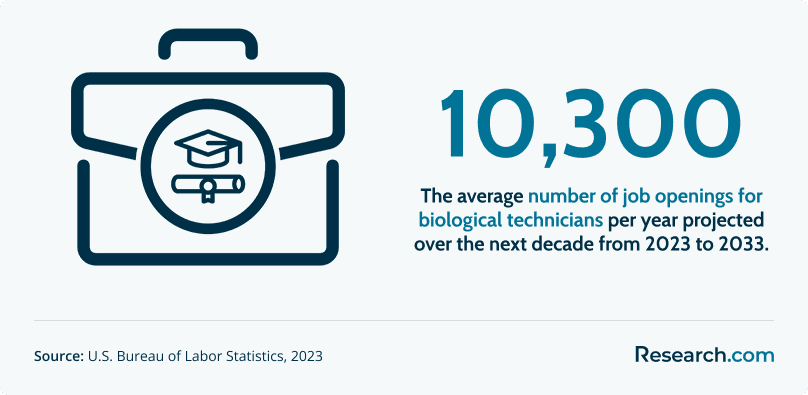
Demand indicators remain positive for related science occupations. Science and engineering occupations are projected to expand by 12.5%, and the U.S. Bureau of Labor Statistics projects employment for biological technicians to grow 7% from 2023 to 2033. These figures suggest continued need for trained science workers, but job outcomes will vary by specialization, location, prior experience, and employer requirements.
Current trends affecting biotechnology certificate graduates
- Bioinformatics and data skills are increasingly valuable: Biotech employers often need professionals who can work with large biological datasets, genomic tools, and computational workflows.
- Regulatory and quality knowledge remains important: Products in biotechnology, biopharmaceuticals, diagnostics, and related fields operate in highly regulated environments, making documentation and compliance skills valuable.
- Biomanufacturing requires process and quality expertise: Students interested in production roles should look for coursework in GMP, process control, scale-up, validation, and quality systems.
- AI and automation are changing workflows: Automation, analytics, and AI-supported tools can affect discovery, documentation, and manufacturing processes. Graduates who can combine science knowledge with technical adaptability may be better positioned.
- Employers still value experience: A certificate is strongest when paired with internships, laboratory work, clinical research exposure, manufacturing experience, or documented project work.
How do hiring managers evaluate online biotechnology certificates compared with related online credentials?
Hiring managers usually evaluate an online biotechnology certificate by asking whether it proves job-relevant skills. The delivery format matters less when the institution is credible, the curriculum is rigorous, and the candidate can explain how the coursework applies to real biotech work. Employers may look for evidence such as completed projects, familiarity with regulatory language, experience with quality systems, data-analysis tools, laboratory methods, or process-development concepts.
Compared with broader online credentials, a biotechnology certificate is most useful when the target job requires industry-specific scientific knowledge. A software engineering credential may be stronger for roles focused mainly on programming, platforms, or systems design; students comparing technical routes can review options such as an affordable online software engineering degree. For biotech data roles, however, candidates may benefit from combining biological knowledge with computational training rather than choosing only one side of the skill set.
How to make your certificate more valuable to employers
- Create a portfolio of class projects, regulatory documents, data analyses, or process maps if permitted by the program.
- Translate coursework into resume bullets that name tools, methods, standards, and deliverables.
- Use the certificate to target a specific role family, such as QA, regulatory affairs, bioprocessing, or bioinformatics.
- Ask faculty or advisors which courses best match current employer expectations.
- Pair the certificate with workplace experience, internships, research projects, or professional networking.
Here’s what graduates say about online biotechnology graduate certificate programs
-
: "After several years as a senior lab technician, I needed a credential that showed I was ready for management responsibilities. Studying online let me keep my job while building the knowledge my employer wanted to see. A few months after finishing, I moved into a team lead role.
— Gela"
-
: "My undergraduate training was in chemistry, but I wanted to shift into biopharma. The certificate helped me connect my existing science background to industry-specific processes and vocabulary. It made the transition feel realistic instead of like starting over.
— Jana"
-
: "Regulatory affairs was the area I wanted, but I could not find a local program that fit. The online format gave me access to specialized coursework and instructors I would not have reached otherwise. The focused training helped me qualify for the role I have now.
— Lea"
Key Insights
- The best online biotechnology graduate certificate depends on your target role. Regulatory affairs, bioinformatics, biomanufacturing, quality assurance, and project management require different course content.
- Most programs are built for speed and flexibility. Many can be completed in 9 to 12 months, but some range from 8–9 months to up to 3 years depending on structure and pacing.
- Cost comparisons require total-program math. Published prices may be per credit or per course, and students should include fees, materials, and any in-person requirements.
- Accreditation matters. Verify institutional accreditation before applying, especially if you want employer reimbursement, credit transfer, or future graduate study options.
- Stackable credits can improve long-term value. If you may pursue a master’s degree later, prioritize certificates that clearly apply credits toward a related graduate program.
- Online can be a strong format for working professionals. The main advantage is career continuity, but students must still manage deadlines, technical coursework, and possible group projects.
- A certificate is not a guarantee of promotion or salary growth. It is most useful when paired with relevant experience, a focused job-search strategy, and demonstrable technical skills.
- Before enrolling, ask hard questions. Confirm total cost, online requirements, course sequencing, faculty expertise, career support, and whether the curriculum directly matches your intended job.
References:
- Bureau of Labor Statistics. (n.d.). Biological technicians. Retrieved from BLS.
- Business Research Insights. (n.d.). Life sciences market. Retrieved from Business Research Insights.
- Data USA. (n.d.). Biotechnology, 261201. Retrieved from Data USA.
- Grand View Research. (n.d.). Biotechnology market. Retrieved from Grand View Research.
- National Center for Education Statistics. (n.d.). Fast facts: Biological and biomedical sciences. Retrieved from NCES.
- ZipRecruiter. (n.d.-a). Biotechnologist salary. Retrieved from ZipRecruiter.
- ZipRecruiter. (n.d.-b). What is the average biotechnologist salary by state. Retrieved from ZipRecruiter.
- Zippia. (n.d.-a). Biotechnologist jobs demographics. Retrieved from Zippia.
- Zippia. (n.d.-b). Biotechnologist jobs skills. Retrieved from Zippia.
Other Things You Need To Know About an Online Biotechnology Graduate Certificate
In 2027, several universities are noted for their excellent online biotechnology graduate certificate programs, including Johns Hopkins University, the University of Maryland Global Campus, and the University of Illinois Urbana-Champaign. These institutions provide flexible and comprehensive curricula, catering to professionals seeking advancement in biotechnology.
In 2027, the best online biotechnology graduate certificate programs typically cover topics such as molecular biology, biostatistics, genetic engineering, bioinformatics, and drug development. These programs are designed to offer foundational and advanced knowledge crucial for careers in biotechnology.
In 2027, admission requirements for online biotechnology graduate certificate programs typically include a bachelor's degree in a related field, a minimum GPA (often 3.0 or higher), and submission of transcripts and letters of recommendation. Some programs may also require a statement of purpose or professional experience in biotechnology.