2027 Fastest Online Geosciences Degree Programs

Co-Founder and Chief Data Scientist
Graduates are missing out on fast-moving job opportunities in environmental consulting, energy, and climate research by delaying a degree in geosciences. With climate-related careers projected to grow by over 6% through 2032, waiting too long could mean falling behind in one of the decade’s most critical scientific fields.
This guide explores the fastest online geosciences degree programs for 2027—designed for those ready to move quickly without compromising quality. Prepared by career planning experts, this guide outlines accredited programs, timelines, and career pathways to help readers gain an edge and act before opportunities pass them by.
What are the benefits of the fastest online geosciences degree programs?
- Qualifies you for roles such as environmental scientist, geologist, hydrologist, or geospatial analyst across sectors like government, energy, and environmental consulting.
- Median annual salary for geoscientists is $87,480, according to the U.S. Bureau of Labor Statistics.
- Online programs allow faster completion, flexible scheduling, and access to specialized tracks, which is ideal for those balancing work or remote living situations.
What can I expect from the fastest online geosciences degree programs?
Fast-track online geosciences programs are designed to build strong foundations in earth systems, environmental analysis, and geographic information systems (GIS). The core curriculum typically includes geology, hydrology, climate science, and data mapping. Most programs also require a capstone project or research paper to showcase applied knowledge.
Some degrees include optional or required internship hours, which can be completed locally or virtually. Online classes are usually delivered through a mix of recorded lectures, interactive labs, and real-time discussions with instructors.
Tuition ranges from $9,000 to $32,000 depending on the school, residency status, and transfer credits. Accelerated formats may allow you to graduate in as little as 18 to 24 months.
Where can I work with an online geosciences degree?
An online geosciences degree opens doors to careers in government, private industry, nonprofits, and education. Graduates often find work as environmental consultants, geologists, GIS analysts, or sustainability specialists. Others enter roles in energy, water resource management, and climate policy.
Many geoscientists work in federal agencies like the U.S. Geological Survey or EPA, while others join research labs, engineering firms, or tech startups. About 22% of geoscientists are employed in architectural and engineering services, according to the U.S. Bureau of Labor Statistics.
The degree also provides transferable skills—like data analysis, communication, and problem-solving—useful in education, policy, or even creative industries. Some graduates even start their own consulting businesses or pursue advanced research.
How much can I make with an online geosciences degree?
Graduates with a geosciences degree earn a solid income. The median annual salary for geoscientists is $87,480, according to the U.S. Bureau of Labor Statistics. Entry-level roles typically start around $50,000 to $60,000, while experienced professionals can earn over $130,000, especially in energy or engineering sectors.
Salaries vary by location and industry. Those working in oil and gas extraction often earn the highest—averaging over $125,000 annually. Government and environmental consulting roles may offer slightly lower pay but often come with strong benefits.
Holding an advanced degree or specialized certifications, such as in GIS or hydrogeology, can significantly boost earning potential over time.
- List of the Fastest Online Geosciences Degree Programs for 2027 List of Programs
- How long does it take to complete the fastest online geosciences degree programs? Program Length
- How do the fastest online geosciences degree programs compare to an on-campus program? How do the fastest online geosciences degree programs compare to an on-campus program?
- What is the average cost of the fastest online geosciences degree programs? Average Cost
- What are the financial aid options for students enrolling in the fastest online geosciences degree programs? Financial Aid
- What are the prerequisites for enrolling in the fastest online geosciences degree programs? What are the prerequisites for enrolling in the fastest online geosciences degree programs?
- What courses are typically in the fastest online geosciences degree programs? What courses are typically in the fastest online geosciences degree programs?
- What types of specializations are available in the fastest online geosciences degree programs? Specializations
- How to Choose the Best Online Geosciences Degree Program How to Choose the Best Online Geosciences Degree Program
- What career paths are available for graduates of the fastest online geosciences degree programs? Career Paths
- How Can I Optimize Your Online Geosciences Learning Experience? How Can I Optimize Your Online Geosciences Learning Experience?
- What is the job market for graduates of the fastest online geosciences degree programs? Job Outlook
- How Can Advanced Certifications Enhance Your Geosciences Career? How Can Advanced Certifications Enhance Your Geosciences Career?
Fastest Online Geosciences Degree Programs for 2027
Choosing an accelerated online geosciences degree is usually a time, cost, and career decision at the same time. You may want to move into environmental science, geology, GIS, climate work, natural resources, or earth science education without pausing your job or waiting four years to finish a traditional campus program. The fastest options can help, but only if the program is accredited, fits your schedule, accepts transfer credits, and teaches the scientific and technical skills employers or graduate schools expect.
This guide explains how fast online geosciences-related degrees work, which programs offer flexible or accelerated formats, what they cost, what courses and specializations to expect, and how to compare online programs with campus-based study. If you are also comparing related paths such as a fast track online geography degree, use this guide to understand where geosciences, environmental science, earth science, geography, and GIS programs overlap.
Quick Answer: What Is the Fastest Way to Earn an Online Geosciences Degree?
The fastest route is usually an accredited online bachelor’s program that accepts a large number of transfer credits, offers accelerated 6- to 8-week courses, has multiple start dates, or uses a competency-based format. Students with prior college credit or an associate degree may finish much faster than first-time college students. Some accelerated online geosciences-related programs can be completed in 18 to 36 months, depending on transfer credits, course load, and program structure.
For most students, the best choice is not simply the shortest program. The better decision is the fastest accredited program that matches your intended career path, whether that is environmental consulting, GIS, earth science education, climate analysis, natural resource management, or graduate study in geology or environmental science.
How We Evaluate Fast Online Geosciences Programs
A fast degree is only useful if it comes from a legitimate institution and provides enough academic preparation for the next step. Research.com reviews programs using publicly available and school-reported information, with attention to accreditation, cost, curriculum relevance, online flexibility, transfer policies, and student outcomes where available.
Our evaluation process is informed by trusted education data sources, including the IPEDS database, Peterson's database, the College Scorecard, and the National Center for Education Statistics. For more detail about how Research.com structures rankings and school evaluations, review our methodology.
Fastest Online Geosciences Degree Programs to Consider
The programs below are geosciences, earth science, environmental science, geography, environmental management, or earth science education degrees delivered online or in highly flexible formats. Because “geosciences” can include several related disciplines, compare each curriculum carefully before applying.
| Rank | School and Program | Best Fit | Required Credits to Graduate | Cost | Accreditation |
| 1 | Southern New Hampshire University – BS in Environmental Science | Working adults who want a broad environmental science degree with biology, chemistry, geology, sustainability, earth systems, and conservation coursework. Six start dates per year can help students begin sooner. | 120 | $330 per credit hour | New England Commission of Higher Education (NECHE) |
| 2 | University of Florida – BA in Geology (Online) | Students interested in earth processes, natural resources, climate science, energy, environmental science, or preparation for graduate study. | 120 | $129.18 per credit hour (in-state); $552.62 (out-of-state) | Southern Association of Colleges and Schools Commission on Colleges (SACSCOC) |
| 3 | Arizona State University – BS in Geography, Meteorology and Climatology Track | Learners focused on atmospheric science, climatology, physical geography, spatial data, and climate-related analysis. Courses are delivered in 7.5-week sessions. | 120 | $561–$661 per credit hour | Higher Learning Commission (HLC) |
| 4 | Oregon State University – BS in Environmental Sciences | Students who want a customizable environmental sciences degree with options such as environmental policy, geospatial science, and climate change. Year-round start dates support flexible pacing. | 180 quarter credits | $350 per credit (undergraduate online) | Northwest Commission on Colleges and Universities (NWCCU) |
| 5 | University of North Dakota – BS in Earth Science | Career changers or future graduate students seeking geology, hydrology, environmental geoscience, research exposure, virtual labs, and simulations. | 120 | $374.76 per credit hour | Higher Learning Commission (HLC) |
| 6 | Western Governors University – BS in Science Education, Secondary Earth Science | Aspiring middle or high school earth science teachers who want a competency-based model with earth science content, pedagogy, and teaching licensure preparation. | Varies by student progress | $3,985 per six-month term | Northwest Commission on Colleges and Universities (NWCCU) |
| 7 | Columbia Southern University – BS in Environmental Management | Students aiming for environmental compliance, pollution control, resource use, environmental health and safety, or corporate sustainability roles in a self-paced format. | 120 | $270 per credit hour | Distance Education Accrediting Commission (DEAC) |
| 8 | American Public University – BS in Environmental Science | Working professionals and military-affiliated students seeking flexible scheduling, multiple start dates, transfer-friendly policies, conservation, sustainability, and environmental policy coursework. | 120 | $285 per credit hour | Higher Learning Commission (HLC) |
| 9 | Franklin University – BS in Environmental & Safety Management | Professionals interested in environmental regulations, hazard control, risk assessment, compliance, and safety management. Transfer credits and condensed courses may support faster completion. | 120 | $398 per credit hour | Higher Learning Commission (HLC) |
| 10 | Eastern Kentucky University – BS in Environmental Studies | Students who want a multidisciplinary degree in natural sciences, geosciences, environmental ethics, ecological systems, environmental policy, and global environmental issues. Courses use an accelerated 8-week format. | 120 | $421 per credit hour | Southern Association of Colleges and Schools Commission on Colleges (SACSCOC) |
How Long Does It Take to Finish an Accelerated Online Geosciences Degree?
The fastest online geosciences degree programs can take 18 to 36 months for students who already have transfer credits, enroll full time, and choose accelerated or self-paced formats. Students starting with no prior college credit should expect a longer timeline, while part-time learners may need up to four years.
Program speed usually depends on four factors:
- Transfer Credits: Prior college coursework, an associate degree, or approved prior learning can reduce the number of credits you still need.
- Course Format: Accelerated 6- to 8-week courses allow students to complete more terms in a year than traditional 16-week semesters.
- Enrollment Load: Full-time students can progress faster, but the workload can be heavy in science-based courses.
- Start Dates and Year-Round Availability: Programs with multiple entry points and summer courses make it easier to avoid long gaps between classes.
Speed also has an opportunity-cost advantage. According to the latest data, the median annual wage for STEM jobs is $101,650, compared to $46,680 for non-STEM roles. Finishing sooner may help students enter the labor market earlier, though salaries are never guaranteed and depend on role, location, experience, technical skills, and employer demand. Students comparing accelerated degrees in other fields, such as fast track social sciences degree online options, should use the same logic: faster is valuable only when the program still supports the career outcome you want.
Online vs. On-Campus Geosciences Degrees: Which Format Makes More Sense?
Online and campus-based geosciences programs can cover similar scientific foundations, but they differ in pace, access to fieldwork, classroom structure, and student support. The right option depends on whether you need maximum flexibility or more in-person lab and field experiences. This kind of format comparison is similar to professional pathway decisions in other fields, such as understanding LCPC vs LCSW differences before choosing a counseling route.
| Comparison Point | Fast Online Geosciences Degree | On-Campus Geosciences Degree |
| Schedule | Often built around flexible access, accelerated terms, self-paced work, or multiple start dates. | Usually follows a fixed academic calendar with scheduled classes and in-person attendance. |
| Time to Completion | Can be faster for students with transfer credits or those who can handle accelerated coursework. | Typically follows a traditional four-year structure for full-time bachelor’s students. |
| Labs and Fieldwork | May use virtual labs, simulations, local field assignments, or independent projects. | Usually provides easier access to campus labs, research sites, equipment, and faculty-led field trips. |
| Best For | Working adults, career changers, military-affiliated students, and learners who cannot relocate. | Students who want frequent hands-on lab work, structured peer interaction, and campus research opportunities. |
| Main Risk | Some programs may have limited field immersion, so students should ask how practical skills are taught. | Less schedule flexibility and higher living or commuting costs may be barriers for some students. |
When an Online Program Is the Better Choice
Choose an online program if you need to keep working, have transfer credits, want a faster calendar, or are focused on areas that translate well to digital learning, such as environmental policy, GIS, data analysis, climate systems, or environmental management.
When a Campus Program May Be Better
Consider a campus program if your goal requires extensive field geology, lab-heavy research, close faculty mentorship, or preparation for graduate programs that strongly value in-person field training.
How Much Do Fast Online Geosciences Degree Programs Cost?
The average cost of the fastest online geosciences degree programs typically ranges from $270 to $660 per credit hour, depending on the institution, residency rules, and pricing model. Public universities may charge lower tuition for in-state students, while some online programs use flat tuition rates that can help out-of-state learners budget more predictably.
For a 120-credit bachelor’s degree, total tuition can fall between $32,000 and $60,000 before transfer credits, financial aid, employer assistance, or prior learning credit. As with many flexible career-focused programs, including online ultrasound tech school options, the advertised tuition is only part of the cost picture.
Students should also ask about technology fees, online course fees, books, lab kits, GIS software access, proctoring fees, and graduation fees. Online learning may reduce commuting and housing costs, but science courses can still involve materials or technology expenses.
Competency-based programs such as Western Governors University use a term-based model instead of a traditional per-credit structure. At WGU, tuition is listed as $3,985 per six-month term. This type of pricing can lower total cost for students who complete courses quickly, but it can become less economical if progress slows.
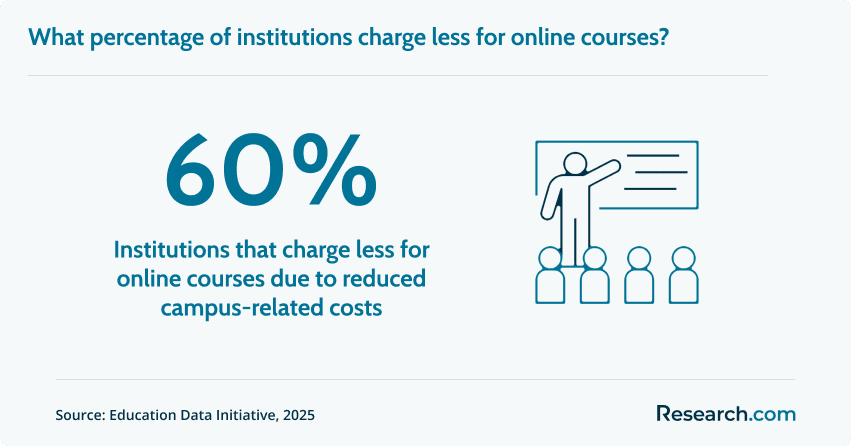
According to the Education Data Initiative, 60% of institutions that charge less for online courses do so because of reduced campus-related costs. That does not mean every online program is cheaper, so compare the full cost of attendance rather than tuition alone.
| Cost Factor | Why It Matters | Question to Ask |
| Per-credit tuition | This is the largest direct academic cost in most programs. | Is the rate different for in-state and out-of-state online students? |
| Transfer credit acceptance | Accepted credits can reduce both time and total tuition. | How many credits can I transfer into the program? |
| Term-based tuition | Can reward faster progress, especially in competency-based programs. | What happens to my total cost if I need more terms? |
| Lab and technology fees | Science courses may require software, kits, or virtual lab platforms. | Are lab kits, GIS tools, or proctoring fees included in tuition? |
| Residency pricing | Some public universities charge different rates by residency status. | Do online students pay resident, nonresident, or flat-rate tuition? |
Financial Aid Options for Online Geosciences Students
Students in accredited online geosciences-related programs may be able to use many of the same funding sources available to campus students. The most important first step is confirming that the school and program are eligible for federal financial aid. Cost-control strategies matter in geosciences just as they do in other advanced or career-focused programs, including the cheapest PsyD programs.
Federal Aid
Submitting the Free Application for Federal Student Aid (FAFSA) can determine eligibility for Pell Grants, Federal Supplemental Educational Opportunity Grants (FSEOG), and Direct Subsidized or Unsubsidized Loans. Grants do not need to be repaid, while loans do. Borrow only what you need, especially if you plan to attend graduate school later.
Scholarships and Grants
Students should check institutional scholarships for online learners and external awards from geoscience, environmental, teaching, and STEM organizations. The Geological Society of America and the National Association of Geoscience Teachers are examples of organizations connected to earth science education and geoscience communities.
Employer, Military, and State Support
- State Aid: Some states provide need-based grants or online tuition benefits for eligible residents.
- Work-Study: Eligible students may qualify for work-study roles, including remote options when available.
- Employer Assistance: Employers may reimburse tuition when the degree supports compliance, safety, environmental, GIS, or technical roles.
- Military Benefits: Active duty service members and veterans may be able to use the GI Bill or military tuition assistance.
- Payment Plans: Monthly payment plans can reduce the need for large upfront payments, but they do not reduce the total price.
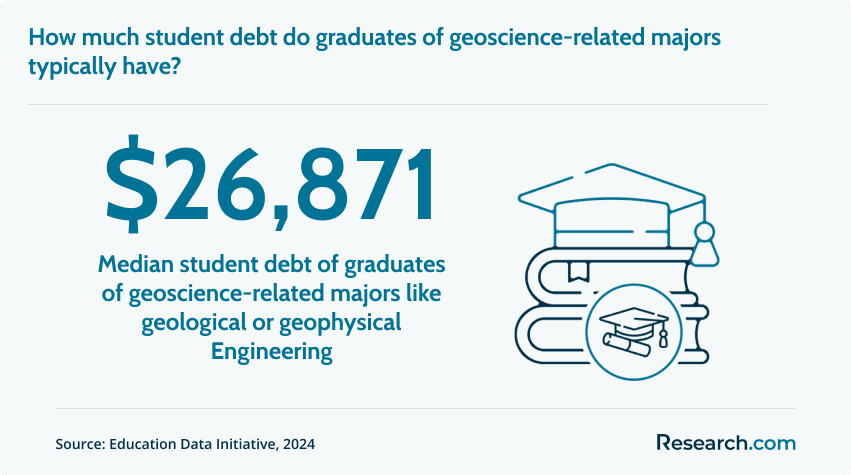
Debt should be part of the decision. According to a recent report, graduates of geoscience-related majors such as Geological or Geophysical Engineering carry a median student debt of $26,871. Before enrolling, estimate your total borrowing, likely monthly payment, and realistic entry-level job options.
Admission Requirements for Fast Online Geosciences Degree Programs
Most online bachelor’s programs in geosciences-related fields require a high school diploma or GED, official transcripts, and evidence that the student is ready for college-level math and science. Admissions standards vary by school, but many programs are designed for first-time students, transfer students, and adults returning to college. This accessibility is similar to many career-oriented online degrees, including the cheapest online LPC programs.
Typical Prerequisites
- A minimum GPA, often around 2.0 to 2.5
- Official high school transcripts and transcripts from any college previously attended
- High school or college coursework in math and science, such as algebra, geometry, biology, and chemistry
- SAT or ACT scores in some cases, although many schools have made these optional
- Reliable computer and internet access for online coursework, virtual labs, exams, and research assignments
Transfer Student Considerations
Transfer students should request a preliminary credit evaluation before committing to a program. A school that accepts more general education, science, or elective credits may save you more time and money than a school with a slightly lower tuition rate but stricter transfer rules.
Common Courses in Online Geosciences Degree Programs
Fast online geosciences programs usually combine earth science, environmental science, geography, data analysis, and applied research. The exact mix depends on whether the degree is in geology, earth science, environmental science, geography, environmental management, or education.
| Course Area | What Students Usually Learn | Why It Matters |
| Introduction to Geology | Earth materials, plate tectonics, minerals, rocks, and surface processes. | Builds the foundation for understanding how the planet changes over time. |
| Earth Systems Science | Connections among the atmosphere, hydrosphere, biosphere, and geosphere. | Helps students understand complex environmental interactions and how earth systems function. |
| Environmental Science | Human impacts, sustainability, pollution, environmental policy, and conservation. | Prepares students for environmental protection, consulting, and compliance roles. |
| Physical Geography | Landforms, weather patterns, climate zones, and spatial relationships. | Supports work in planning, environmental analysis, and climate-related fields. |
| Geographic Information Systems (GIS) | Mapping, spatial data collection, geospatial analysis, and digital cartography. | GIS is one of the most practical technical skill areas for geosciences graduates. |
| Hydrology or Oceanography | Water systems, groundwater, surface water, ocean currents, and ecosystem effects. | Relevant for water resources, environmental consulting, and climate resilience work. |
| Statistics or Data Analysis | Quantitative methods for interpreting scientific and environmental data. | Improves employability in roles that require evidence-based analysis. |
| Field Methods or Virtual Lab Courses | Observation techniques, data collection, lab simulations, and applied projects. | Helps online students develop practical skills even when campus fieldwork is limited. |
Programs that emphasize applied assignments, portfolio projects, or technical tools can be especially useful for students seeking career-ready training. That same career-focused lens is useful when comparing accelerated degrees in other fields, such as fast track online bachelor's in sociology programs.
Specializations in Fast Online Geosciences Programs
Specializations help students align a broad geosciences-related degree with a specific career direction. This matters because a student preparing for GIS work needs a different course mix than someone preparing to teach earth science or work in environmental compliance. The same principle applies in other science careers; for example, students researching how to become a forensic scientist often look for a concentration that matches the laboratory or investigative work they want to do.
| Specialization | Focus | Potential Career Alignment |
| Environmental Science | Sustainability, pollution control, conservation, and human impacts on natural systems. | Environmental scientist, environmental specialist, consultant, compliance assistant. |
| Geographic Information Systems (GIS) | Mapping, spatial analysis, remote sensing, and digital cartography. | GIS technician, GIS analyst, planning assistant, geospatial data specialist. |
| Climate and Meteorology | Weather systems, atmospheric processes, climate science, and climate data. | Climate analyst, meteorological assistant, research support roles. |
| Geology | Earth structure, rocks, minerals, plate tectonics, landforms, and resource systems. | Geoscience technician, field technician, graduate study preparation. |
| Earth Science Education | Earth science content, teaching methods, classroom assessment, and licensure preparation. | Middle or high school science educator, depending on state licensure requirements. |
| Natural Resource Management | Conservation, land use, resource policy, and sustainable management practices. | Natural resource technician, conservation roles, government or nonprofit work. |
Employer settings vary by specialization. According to the U.S. Bureau of Labor Statistics, the largest employers of geoscientists include architectural, engineering, and related services (33%), management and technical consulting services (15%), and mining, quarrying, and oil and gas extraction (15%). Federal and state governments each employ about 9% of geoscientists. These figures show why students should choose electives based on the industry they hope to enter.
How to Choose the Best Online Geosciences Degree Program
The best program is the one that gets you to a credible credential without wasting time, money, or credits. Do not choose based on speed alone. Use the checklist below to compare programs before applying.
1. Verify Accreditation First
Choose a college or university with recognized accreditation. Accreditation affects federal financial aid eligibility, transfer credit, graduate school admission, and employer confidence. If a program is intended to lead to teacher licensure, confirm that it meets the requirements in the state where you plan to teach.
2. Match the Curriculum to Your Career Goal
Review the required courses, electives, lab structure, and specialization options. A student aiming for GIS should prioritize mapping and spatial analysis. A future environmental consultant should look for environmental regulations, field methods, data analysis, and sustainability coursework.
3. Ask How Online Labs and Fieldwork Work
Geosciences is an applied field. Ask whether the program uses virtual labs, mailed lab kits, local fieldwork, simulations, internships, or independent projects. If you plan to attend graduate school in geology, limited field training may be a drawback.
4. Calculate Total Cost After Transfer Credits
Compare tuition, fees, materials, and expected remaining credits. A program with a higher per-credit cost can still be cheaper if it accepts more transfer credits. This same total-cost approach is useful when comparing other accelerated STEM options, such as fast track electrical engineering online degree programs.
5. Evaluate Student Support
Fast programs require strong advising. Look for academic advising, tutoring, career services, library access, technical support, and faculty availability. Online students should not have to navigate registration, transfer credits, or lab requirements alone.
Who Should Choose a Fast Online Geosciences Degree?
A fast online geosciences degree can be a strong fit if you already have college credits, need to keep working, want to change careers, or are targeting roles where online coursework and applied projects can build relevant skills. It may also work well for military-affiliated students, adult learners, and students in rural areas without convenient access to campus programs.
Consider This Path If You:
- Need schedule flexibility because of work, family, or location.
- Have transfer credits that can shorten the degree.
- Want a career connected to environmental science, GIS, climate, natural resources, or earth science education.
- Can manage compressed courses without falling behind.
- Are comfortable learning technical material through online labs, data tools, simulations, and independent projects.
Consider a Different Path If You:
- Need extensive in-person field geology or laboratory research.
- Prefer a highly structured classroom schedule.
- Plan to enter a graduate program that expects substantial field camp or campus-based research experience.
- Are unsure about science-heavy coursework and need more in-person academic support.
Career Paths for Graduates of Online Geosciences Programs
Graduates can pursue roles in environmental protection, earth science, resource management, geospatial analysis, education, consulting, and government. Some positions may require additional experience, graduate education, licensure, or specialized technical training.
| Career Path | Typical Work | Helpful Preparation |
| Environmental Scientist or Specialist | Investigates environmental problems, supports policy or compliance work, and helps develop solutions. | Environmental science, statistics, field methods, regulations, and report writing. |
| Geoscientist | Studies physical aspects of the Earth in environmental, energy, mining, research, or consulting settings. | Geology, field methods, data analysis, and often graduate-level study for advanced roles. |
| GIS Technician or Analyst | Uses geographic information systems to map, organize, and interpret spatial data. | GIS software, spatial analysis, remote sensing, and database skills. |
| Hydrologist | Works with water resources, groundwater, surface water, and water-quality issues. | Hydrology, chemistry, statistics, environmental science, and data modeling. |
| Environmental Consultant | Advises organizations on environmental risks, regulations, sustainability, and site assessments. | Environmental regulations, fieldwork, technical writing, and client communication. |
| Science Educator | Teaches earth science or environmental science, usually at the middle or high school level. | Earth science education coursework and state-specific teaching licensure preparation. |
| Climate Analyst or Meteorological Assistant | Supports climate, weather, or atmospheric data analysis for research or forecasting teams. | Climatology, meteorology, statistics, GIS, and data visualization. |
How to Succeed in an Online Geosciences Program
Online geosciences students need more than good study habits. They also need comfort with scientific software, data interpretation, virtual labs, and independent problem-solving. Create a weekly schedule that accounts for readings, lab activities, discussion boards, exams, and longer projects. Accelerated courses can move quickly, so waiting until the weekend to begin assignments can create unnecessary pressure.
Use every available support resource: faculty office hours, tutoring, library databases, GIS tutorials, writing centers, discussion forums, and career advising. If you are balancing school with work, compare programs that explicitly support adult and remote learners. Research.com’s guide to the most affordable online universities for working adults can help you identify schools designed around flexibility and cost control.
Job Market Outlook for Geosciences Graduates
The geosciences job market is shaped by environmental regulation, infrastructure planning, climate resilience, natural resources, energy transitions, and demand for geospatial data. As organizations respond to environmental risks and energy transitions, graduates with environmental analysis, GIS, climate, and data skills may find opportunities across public and private sectors.
Between December 2024 and January 2025, employment shifted unevenly across geoscience-related fields. Petroleum, mining, and geological engineering lost 13,456 jobs. Atmospheric and space sciences lost 5,642 jobs. Environmental sciences and geosciences added 9,324 new jobs during the same period. These changes suggest that students should pay close attention to specialization and technical skill development rather than assuming all geoscience sectors are growing at the same pace.
According to the U.S. Bureau of Labor Statistics, employment for geoscientists is projected to grow 5% from 2022 to 2032, about as fast as the average for all occupations. Students interested in leadership, management, or sustainability strategy may later consider graduate options, including the shortest environmental management online MBA programs.
To improve employability, prioritize GIS, environmental data analysis, technical writing, field methods, regulatory knowledge, and internships or applied projects. Employers often value graduates who can explain scientific findings clearly to nontechnical audiences.
What Graduates Say About Accelerated Online Geosciences Programs
- : "The accelerated online format made it possible for me to move into a new field while keeping my full-time job. I could study climate systems and geological mapping on a schedule that worked for me. — Sydney"
- : "The pace was quick, but the program still covered the skills I needed. Virtual labs and applied assignments helped me build confidence before I started working as a field technician. — Janice"
- : "I stayed motivated because the courses connected theory to real environmental work, including impact assessments and data-driven decision-making. — Yuri"
Can Certifications Strengthen a Geosciences Career?
Certifications and graduate certificates can help graduates show focused expertise in areas such as GIS, remote sensing, environmental policy, sustainability, data analysis, or compliance. They are especially useful when your bachelor’s degree is broad and you want to move toward a more technical or specialized role.
Before paying for an additional credential, check whether employers in your target role request it and whether the credential teaches software or applied skills you can show in a portfolio. Students looking for shorter, focused post-bachelor’s training can compare affordable graduate certificate programs as a lower-cost alternative to a full graduate degree.
Common Mistakes to Avoid
- Choosing speed over accreditation: A fast program can create problems if credits do not transfer, financial aid is unavailable, or employers question the credential.
- Looking only at tuition: Fees, lab materials, technology requirements, and transfer-credit limits can change the real cost.
- Assuming online means easier: Accelerated science courses can be demanding, especially when labs, data analysis, and technical writing are involved.
- Ignoring fieldwork requirements: Some careers and graduate programs value hands-on field experience. Ask how the online program addresses this.
- Skipping career alignment: Environmental science, geology, GIS, and earth science education are related but not interchangeable.
- Assuming licensure is automatic: Teaching-focused programs may support licensure, but requirements vary by state.
- Relying only on rankings: Rankings can narrow your search, but your best program depends on transfer credits, cost, specialization, support, and career goals.
Questions to Ask Before Enrolling
- Is the institution accredited, and is the program eligible for federal financial aid?
- How many of my previous credits will transfer into the degree?
- Are courses accelerated, self-paced, competency-based, or semester-based?
- How are labs, field methods, GIS training, and applied projects delivered online?
- Does the curriculum match my goal: environmental science, geology, GIS, climate, resource management, or teaching?
- What are the total costs, including tuition, fees, books, software, and lab materials?
- What career services, internships, advising, and tutoring are available to online students?
- If the program involves teacher preparation, does it meet licensure requirements in my state?
- What graduate programs or employers have accepted graduates from this program?
- What happens if I need to slow down from full-time to part-time enrollment?
References
- American Institute of Professional Geologists. (2025, January 9). AGI press release - Geoscience employment trends. American Institute of Professional Geologists.
- Education Data Initiative. (2024). Average cost of online college. Education Data Initiative.
- Education Data Initiative. (2024). Student loan debt by major. Education Data Initiative.
- U.S. Bureau of Labor Statistics. (2024). Geoscientists: Occupational outlook handbook. U.S. Bureau of Labor Statistics.
- U.S. Bureau of Labor Statistics. (2024). STEM employment projections. U.S. Bureau of Labor Statistics.
Key Insights
- The fastest online geosciences degrees are usually accelerated, transfer-friendly, self-paced, or competency-based, but speed should not outweigh accreditation and curriculum quality.
- Students with transfer credits may finish in 18 to 36 months, while first-time or part-time students may need longer.
- Costs commonly range from $270 to $660 per credit hour, but total price depends heavily on transfer credits, fees, residency rules, and pacing.
- Online programs work best for flexible learners targeting environmental science, GIS, climate, compliance, natural resources, or earth science education.
- Campus programs may be stronger for students who need extensive in-person field geology, lab research, or faculty-led fieldwork.
- GIS, data analysis, environmental regulations, technical writing, and applied projects can make a geosciences graduate more competitive.
- Before enrolling, confirm accreditation, financial aid eligibility, transfer policies, lab delivery, fieldwork expectations, and whether the program fits your exact career goal.
Other Things You Should Know About the Fastest Online Geosciences Degree Programs
In 2027, enrolling in an online geosciences degree program typically requires a high school diploma or equivalent. Some programs may also require prerequisite coursework in science or mathematics and submission of transcripts. English proficiency may be necessary for non-native speakers.
The fastest online geosciences degree programs in 2027 prioritize accelerated coursework, offering flexible schedules with condensed semesters. Many programs integrate virtual labs and utilize cutting-edge technology for remote fieldwork experiences. They typically offer interdisciplinary courses, allowing for specialization, and support increased interactivity with faculty for a robust academic experience.
Geoscience is a broader field that includes geology as one of its main branches. While geology focuses specifically on Earth's structure, rocks, and processes, geoscience also covers related areas like meteorology, oceanography, and environmental science.
In short, all geologists are geoscientists, but not all geoscientists are geologists. Geoscience degrees offer a wider interdisciplinary view, making them suitable for diverse earth and environmental careers.