2027 Best Online Master’s in Biotechnology Degree Programs

Co-Founder and Chief Data Scientist
Choosing an online master’s in biotechnology is a high-stakes decision because the degree sits at the intersection of science, regulation, data, manufacturing, and business. The right program can help a working professional move into biopharmaceutical development, quality assurance, regulatory affairs, bioinformatics, research support, or biotech management. The wrong program can leave a student with high tuition costs, limited lab exposure, weak employer recognition, or coursework that does not match their career goal.
This guide is designed for prospective graduate students comparing online biotechnology master’s programs for 2027. It explains what the degree covers, how online programs compare with campus-based options, what the listed programs cost, how long completion usually takes, what admissions requirements to expect, which specializations matter, and how to judge return on investment. It also includes a ranking-style program list, practical selection criteria, common mistakes to avoid, and career considerations for students who want a decision-ready view before applying.
Quick answer: Is an online master’s in biotechnology worth it?
An online master’s in biotechnology can be worth it for students who already have a science, engineering, healthcare, or technical background and want to move into more specialized biotech roles without leaving the workforce. The strongest fit is usually for learners targeting regulated industries such as pharmaceuticals, biomanufacturing, biomedical research, bioinformatics, clinical development, or biotechnology management. Students should compare accreditation, curriculum depth, lab or applied project access, faculty expertise, employer partnerships, total tuition, and whether the program’s specialization matches their intended role.
What are the benefits of getting a degree in biotechnology?
A biotechnology degree develops scientific and technical fluency across biology, chemistry, genetics, molecular systems, data analysis, and applied laboratory methods. At the graduate level, the degree can also build stronger judgment in research design, compliance, product development, quality systems, and commercialization. For many students, the main value is not simply learning more science; it is gaining a credential and skill set that can support movement into more specialized, better-defined roles in industries addressing disease treatment, food systems, environmental challenges, and biomanufacturing.
What can I expect from a master’s in biotechnology degree?
A master’s in biotechnology usually combines advanced life science coursework with applied training in areas such as molecular biology, biochemistry, bioinformatics, bioprocessing, pharmaceutical development, quality systems, regulatory affairs, and research methods. Many online programs are designed for working adults, so coursework may be asynchronous or delivered through evening sessions, virtual labs, remote projects, capstones, or short in-person intensives.
Students should expect a mix of scientific theory and workplace-focused assignments. Depending on the program, the experience may emphasize research, product development, compliance, management, computational biology, or biomanufacturing. Before enrolling, students should check whether the degree is thesis-based, capstone-based, non-thesis, or project-based because that structure can strongly affect preparation for doctoral study, industry roles, or management advancement.
Where can I work with a master’s in biotechnology degree?
Graduates may work in pharmaceutical companies, biotechnology firms, contract research organizations, biomanufacturing facilities, medical research institutes, universities, diagnostic companies, agricultural biotechnology organizations, regulatory teams, and healthcare-adjacent technology companies. Common job functions include research support, process development, quality assurance, regulatory documentation, product development, data analysis, laboratory management, and technical project coordination.
| Work setting | Common focus | Roles that may fit |
| Pharmaceutical and biotech companies | Drug discovery, product development, manufacturing, compliance | Research scientist, regulatory affairs specialist, quality assurance specialist, biotech manufacturing associate |
| Research institutes and universities | Experimental design, grant-supported studies, translational research | Research scientist, laboratory manager, bioinformatics specialist |
| Clinical and diagnostic organizations | Testing platforms, biomarkers, clinical data, laboratory quality | Quality specialist, bioinformatics analyst, technical project coordinator |
| Biomanufacturing and process development | Scale-up, process validation, production efficiency, documentation | Manufacturing associate, process development specialist, quality systems professional |
| Biotech business and management teams | Commercial strategy, operations, product lifecycle, regulatory planning | Biotechnology manager, product development associate, regulatory project specialist |
How much can I make with a master’s in biotechnology degree?
Compensation varies widely by role, location, employer, experience, and specialization. Entry-level positions may start around $60,000 to $80,000 per year, mid-level professionals can earn between $80,000 and $120,000, and senior-level positions often reach $120,000 or more. These figures should be treated as broad planning ranges rather than guaranteed outcomes. Roles tied to drug development, gene therapy, engineering, analytics, and regulated product development may offer stronger compensation when the graduate also has relevant experience and technical skills.
- Best online master’s in biotechnology programs for 2027
- How long online biotechnology master’s programs usually take
- Online vs. on-campus biotechnology master’s programs
- Average cost of an online master’s in biotechnology
- Financial aid options for online biotechnology graduate students
- Admissions prerequisites for online biotechnology master’s programs
- Courses commonly included in the curriculum
- Why accreditation matters and how to review coursework
- Common biotechnology specializations
- Professional development in online biotechnology programs
- Research collaboration in online biotechnology study
- How to choose the right program
- When accelerated online programs make sense
- Career paths after graduation
- Mentorship and networking
- Industry partnerships and applied training
- Return on investment
- Biotechnology and high-paying medical career paths, including ROI and industry partnerships
- Regulatory and ethical training
- Entrepreneurial opportunities
- Biotechnology plus healthcare administration
- How an accelerated associate degree may fit earlier career planning
- Student support services for online learners
- Accelerated pathways that may complement biotechnology study
- Whether an online doctoral degree should come next
- Job market outlook for biotechnology graduates
- Challenges of studying biotechnology online and how to solve them
- Certifications that can strengthen the degree
- Interdisciplinary skills that improve career flexibility
- Emerging technologies shaping biotechnology education, plus online learning challenges and job market context
List of the Best Online Master’s in Biotechnology Degree for 2027
The programs below were selected to help students compare online master’s options in biotechnology using practical decision factors such as accreditation, curriculum design, credit requirements, tuition per credit, completion length, and applied learning opportunities. A ranking should be a starting point rather than the only reason to apply. Students should also compare admissions fit, schedule format, specialization options, employer recognition, and whether the program prepares them for their intended career path.
Research.com evaluates programs using available institutional and education data sources, including federal databases and licensed education datasets. Prospective students should always verify tuition, delivery format, program availability, and admissions requirements directly with the school because graduate program details can change.
How do we rank schools?
Research.com uses a ranking process built around available institutional data, program information, and education datasets. The goal is to give prospective students a clearer comparison point when reviewing online biotechnology master’s programs. The ranking process considers sources such as:
- Integrated Postsecondary Education Data System (IPEDS database)
- Peterson’s database, including their Distance Learning Licensed Data Set
- College Scorecard database
- National Center for Education Statistics
| Rank | School | Program length | Credits | Cost per credit | Accreditation |
| 1 | Johns Hopkins University | 3 years | 40 credits | $1,317 | Middle States Commission on Higher Education |
| 2 | Purdue University | 2 years | 30 credits | $1,000 | Higher Learning Commission |
| 3 | Harvard Extension School | 2 years | 48 credits | $835 | New England Commission of Higher Education |
| 4 | Northeastern University | 2 years | 34 credits | $1,861 | New England Commission of Higher Education |
| 5 | Worcester Polytechnic Institute | 2 years | 30 credits | $1,610 | New England Commission of Higher Education |
| 6 | University of Maryland Global Campus | 2 years | 36 credits | $534 | Middle States Commission on Higher Education |
| 7 | Columbia University in the City of New York | 1 year | 30 credits | $1,733 | New England Commission of Higher Education |
| 8 | University of Pennsylvania | 1 year | 30 credits | $897 | Middle States Commission on Higher Education |
| 9 | University of Wisconsin-Madison | 2 years | 31 credits | $875 | Higher Learning Commission |
| 10 | Florida Institute of Technology | 2 years | 30 credits | $875 | Higher Learning Commission |
1. Johns Hopkins University
The online Master of Science in Biotechnology at Johns Hopkins University is structured for students who want a flexible graduate program combining life sciences, applied technology, and industry-oriented electives. The curriculum allows students to shape their plan around interests such as biodefense, regulatory affairs, or drug discovery, making it useful for learners who want a recognized science-focused credential with room for specialization.
- Program Length: 3 years
- Tracks/concentrations: Biotechnology
- Cost per credit: $1,317
- Required credits to graduate: 40 credits
- Accreditation: Middle States Commission on Higher Education
2. Purdue University
Purdue University offers an online Master of Science in Biotechnology Innovation & Regulatory Science that is especially relevant for professionals interested in biotechnology development, regulatory systems, quality assurance, and organizational leadership. The program includes an applied research project, giving students a way to connect graduate coursework to a workplace challenge or innovation-focused initiative.
- Program Length: 2 years
- Tracks/concentrations: Biotechnology
- Cost per credit: $1,000
- Required credits to graduate: 30 credits
- Accreditation: Higher Learning Commission
3. Harvard Extension School
Harvard Extension School offers an online Master of Liberal Arts in Biotechnology with coursework that covers biotechnology principles, research, innovation, and the regulatory environment connected to drug development. The program may appeal to students who want academic rigor, advising support, and a broad view of the biotechnology sector rather than training limited to one narrow technical function.
- Program Length: 2 years
- Tracks/concentrations: Biotechnology
- Cost per credit: $835
- Required credits to graduate: 48 credits
- Accreditation: New England Commission of Higher Education
4. Northeastern University
Northeastern University offers an online Master of Science in Biotechnology that lets students choose electives aligned with fields such as bioinformatics, clinical trials, and biostatistics. The program’s emphasis on experiential learning, including opportunities such as co-op experiences or internships, can be valuable for students who want industry exposure while completing graduate coursework.
- Program Length: 2 years
- Tracks/concentrations: Biotechnology
- Cost per credit: $1,861
- Required credits to graduate: 34 credits
- Accreditation: New England Commission of Higher Education
5. Worcester Polytechnic Institute
Worcester Polytechnic Institute offers an online Master of Science in Biotechnology built around practical skill development for professionals in the field. The program is non-thesis, which can make it a better match for students focused on applied industry roles than for those primarily preparing for research-intensive doctoral study.
- Program Length: 2 years
- Tracks/concentrations: Biotechnology
- Cost per credit: $1,610
- Required credits to graduate: 30 credits
- Accreditation: New England Commission of Higher Education
6. University of Maryland Global Campus
The online Master of Science in Biotechnology Management at University of Maryland Global Campus is designed for students who want to pair biotechnology knowledge with management, commercialization, and regulatory decision-making. Its capstone project asks students to apply program concepts to real-world biotechnology problems, making the degree especially relevant for professionals seeking leadership or operational roles.
- Program Length: 2 years
- Tracks/concentrations: Biotechnology
- Cost per credit: $534
- Required credits to graduate: 36 credits
- Accreditation: Middle States Commission on Higher Education
7. Columbia University in the City of New York
The MA in Biotechnology at Columbia University emphasizes advanced scientific preparation through topics such as molecular biology, biochemistry, and bioinformatics. Its 1 year structure may appeal to students seeking a faster graduate route, although applicants should carefully evaluate workload intensity and whether the format fits their schedule.
- Program Length: 1 year
- Tracks/concentrations: Biotechnology
- Cost per credit: $1,733
- Required credits to graduate: 30 credits
- Accreditation: New England Commission of Higher Education
8. University of Pennsylvania
The University of Pennsylvania Master of Biotechnology Program is built for students interested in the scientific and engineering dimensions of biotechnology and pharmaceuticals. The program includes three specialized tracks, including Molecular Biology and Biopharmaceutical/Engineering Biotechnology, giving students options to focus on research-oriented or product-development-oriented training.
- Program Length: 1 year
- Tracks/concentrations: Biotechnology
- Cost per credit: $897
- Required credits to graduate: 30 credits
- Accreditation: Middle States Commission on Higher Education
9. University of Wisconsin-Madison
The fully online Master of Science in Applied Biotechnology at University of Wisconsin-Madison is aimed at professionals who want applied training across biotechnology operations, compliance, management, and research and development. Students can pursue tracks in Quality Assurance and Compliance, Business Management, and Research and Development, and the capstone project gives them a structured way to connect graduate learning to a workplace biotechnology challenge.
- Program Length: 2 years
- Tracks/concentrations: Biotechnology
- Cost per credit: $875
- Required credits to graduate: 31 credits
- Accreditation: Higher Learning Commission
10. Florida Institute of Technology
The Master of Science in Biotechnology at Florida Institute of Technology focuses on connecting scientific principles with practical biotechnology applications. The program may be a fit for students interested in pharmaceuticals, healthcare, research, and applied projects that reflect workplace problems in biotechnology.
- Program Length: 2 years
- Tracks/concentrations: Biotechnology
- Cost per credit: $875
- Required credits to graduate: 30 credits
- Accreditation: Higher Learning Commission
What graduates say about online biotechnology master’s programs
-
: "
“The online format made graduate school possible while I was still working full time. I could plan coursework around my job and family responsibilities, which would have been much harder in a traditional campus schedule.” - Mabel
"
-
: "
“The coursework was demanding, but it reflected the pace of the field. I also valued the chance to connect with classmates and professionals outside my local area because those relationships helped me think more clearly about career options.” - Charles
"
-
: "
“Faculty access and student services mattered more than I expected. Having professors who answered questions, along with tutoring and career support, helped me stay on track throughout the program.” - Leonora
"
Key Findings
- The typical completion time for an online Master's in Biotechnology degree program is one to two years.
- The average cost of an online master's degree in biotechnology typically ranges from $45,000 to $60,000 in total tuition.
- This estimate reflects the specialized nature of biotechnology programs, which often require around 30 credits.
- The median salary of a biomedical engineer is $100,730.
- Biomedical engineer as a profession has a projected growth of 5% by 2032.
How long does it take to complete an online master’s in biotechnology degree program?
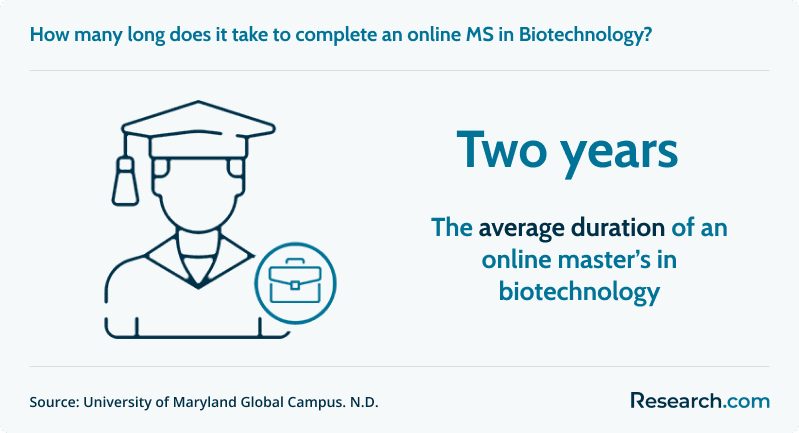
Most online master’s in biotechnology programs take one to two years, though pacing depends on credit load, course sequencing, part-time or full-time enrollment, transfer policies, work obligations, and whether the program includes a thesis, capstone, practicum, or lab requirement. A 1 year option can reduce time away from career advancement, but it may require a heavier course load. A 2 year format may be more manageable for students working full time.
Students comparing timelines should evaluate course frequency, whether summer courses are available, and whether prerequisites can delay enrollment. The same planning logic applies across technical graduate programs, including an AI degree online, where pacing depends heavily on sequencing and workload.
How does an online master’s in biotechnology degree program compare to an on-campus program?
Online and campus-based biotechnology master’s programs can cover similar academic content, but the learning experience differs. Online programs generally offer stronger schedule flexibility and may reduce relocation, commuting, and housing costs. Campus programs may provide easier access to physical labs, in-person faculty interaction, research groups, and local employer networks. The better option depends on whether the student needs flexibility, hands-on lab access, research mentorship, or a specific campus-based professional network.
| Factor | Online master’s in biotechnology | On-campus master’s in biotechnology |
| Best for | Working adults, students who cannot relocate, professionals needing flexible scheduling | Students who want direct lab access, in-person research, and campus networking |
| Lab experience | May use virtual labs, local placements, short residencies, simulations, or capstones | Usually easier access to university laboratories and research facilities |
| Networking | Virtual events, online cohorts, alumni platforms, remote mentoring | In-person faculty meetings, research groups, seminars, and campus recruiting |
| Cost considerations | Can reduce commuting, housing, and relocation expenses | May involve higher living or campus-related costs depending on location |
| Main risk | Insufficient applied training if the program has weak lab or project design | Less flexibility for students balancing work and family obligations |
Affordability varies by institution. Just as students may compare the cheapest data science masters options before selecting a data-focused graduate degree, biotechnology students should compare total tuition, fees, residency costs, and technology requirements rather than relying on tuition per credit alone.
What is the average cost of an online master’s in biotechnology degree program?
The average cost of an online master's degree in biotechnology typically ranges from $45,000 to $60,000 in total tuition. This reflects the specialized nature of many biotechnology programs, which often require around 30 credits or about ten courses. Some graduate programs charge between $1,500 to $2,000 per credit, which can push the total cost above $50,000. Johns Hopkins University, for example, has reported average tuition fees around $52,000 for its online master's program in biotechnology.
Cost comparisons should include more than tuition. Students should also review graduate fees, lab fees, software subscriptions, textbooks, travel for residencies, graduation fees, and lost income if they reduce work hours. This is different from lower-cost undergraduate completion pathways, where students may research items such as RN to BSN online cost to estimate affordability.
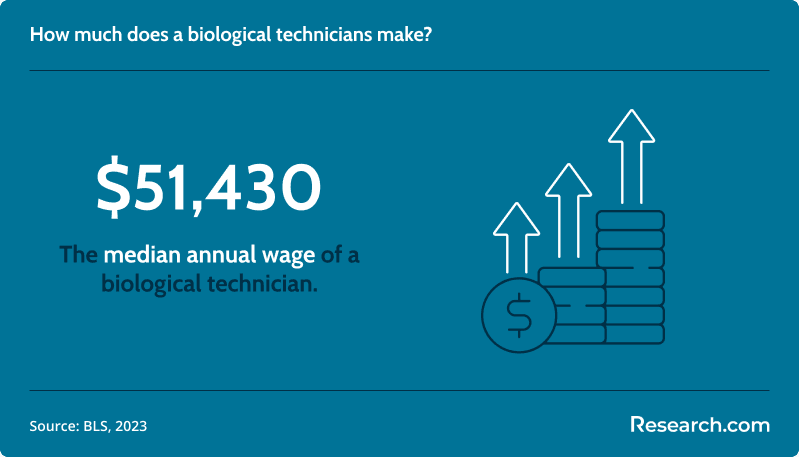
Biological technicians earned a median annual wage of $51,430 in May 2023, with wages ranging from less than $36,970 to over $80,330. The median wage was highest in scientific research and development services, with a median annual wage of $69,250.
What are the financial aid options for students enrolling in an online master’s in biotechnology degree program?
Students should build a funding plan before applying because biotechnology graduate tuition can be substantial. The same cost-checking approach used for programs such as the cost of masters in library science applies here: compare direct tuition, indirect expenses, aid eligibility, employer support, and debt repayment risk.
- Federal student loans: Eligible graduate students may use loans through the Federal Direct Loan Program. Federal loan terms are often more predictable than private loan terms.
- Private student loans: Private lenders may help cover tuition, fees, and living costs, but rates and repayment protections differ by lender. Students should compare offers carefully.
- Scholarships and grants: Universities, professional organizations, employers, and foundations may offer aid based on merit, need, field of study, or career goals.
- Employer tuition reimbursement: Biotech, pharmaceutical, healthcare, and research employers may help pay for graduate education when the degree aligns with job responsibilities.
- Online learning scholarships: Some institutions and organizations provide awards specifically for distance learners or working adults.
What are the prerequisites for enrolling in an online master’s in biotechnology degree program?
Admissions requirements vary by institution, but most online biotechnology master’s programs expect applicants to show readiness for graduate-level science. Students without a strong background in biology, chemistry, genetics, or engineering may need prerequisite coursework before beginning the core curriculum.
- Bachelor's Degree: Applicants usually need a bachelor’s degree from an accredited institution, often in biological sciences, biotechnology, engineering, chemistry, or a related field. Some programs may consider applicants from adjacent health or science fields, including pathways such as accelerated speech pathology programs online, when prerequisite science preparation is sufficient.
- Minimum GPA: Many programs require a minimum undergraduate GPA of 3.0 on a 4.0 scale. Some schools may review lower GPAs conditionally.
- Relevant Experience: Work experience in biotechnology, research, healthcare, laboratory operations, manufacturing, or related technical fields can strengthen an application.
- Letters of Recommendation: Programs commonly request academic or professional recommendations that speak to scientific ability, discipline, and graduate potential.
- Personal Statement: Applicants are often asked to explain their background, career goals, and reasons for pursuing biotechnology at the graduate level.
What courses are typically in an online master’s in biotechnology degree program?
Curricula vary by school and specialization, but most biotechnology master’s programs cover advanced science, applied tools, and industry practices. Students should compare course descriptions rather than relying only on program titles because two biotechnology degrees can prepare students for very different outcomes.
| Course area | What students usually study | Why it matters |
| Biotechnology Fundamentals | Core principles, applications, terminology, and major industry sectors | Builds the shared foundation for advanced coursework |
| Molecular Biology | DNA, RNA, proteins, gene expression, and molecular techniques | Supports research, diagnostics, and product development roles |
| Biochemistry | Chemical processes in living systems | Helps students understand mechanisms behind therapeutics and biological products |
| Genetics | Heredity, variation, genomic tools, and genetic analysis | Useful for genomics, personalized medicine, and research careers |
| Bioinformatics | Computational methods for analyzing biological datasets | Increasingly important as biotech work becomes more data-driven |
| Bioprocess Engineering | Design and operation of biological production systems | Relevant for manufacturing, scale-up, and process development |
| Immunology | Immune system function and disease connections | Important for vaccines, biologics, diagnostics, and therapeutics |
| Pharmaceutical Biotechnology | Development and production of pharmaceutical products | Connects science coursework to regulated product development |
What is the importance of accreditation in online master’s in biotechnology degree programs?
Accreditation is one of the first items students should verify. Institutional accreditation indicates that a college or university has been reviewed by a recognized accreditor and meets established standards for academic quality, governance, student services, and financial practices. For online graduate students, accreditation also affects federal financial aid eligibility, transfer credit recognition, employer confidence, and the credibility of the degree.
Students should confirm accreditation through recognized agencies or national databases rather than relying only on marketing language. Programmatic accreditation may also matter in certain technical areas, but institutional accreditation is the baseline requirement. Some accredited programs also offer compressed formats, including options similar to one year online master’s degree programs, but speed should never replace quality, academic fit, or employer relevance.
What types of specializations are available in an online master’s in biotechnology degree program?
Specializations help students align graduate study with a specific sector. Choosing the wrong concentration can make the degree less useful, so applicants should work backward from target jobs, required skills, and preferred industries. As with affordable online education degrees, the best choice depends on goals, not simply program popularity.
- Agricultural Biotechnology: Focuses on biotechnology applications in crop improvement, animal health, food production, and food safety.
- Biomedical Engineering: Combines engineering and biology to support medical devices, diagnostics, and therapeutic technologies.
- Bioinformatics: Uses computational tools to interpret biological data, including DNA sequences and protein structures.
- Environmental Biotechnology: Applies biotechnology to pollution control, waste management, renewable energy, and sustainability challenges.
- Medical Biotechnology: Centers on biotechnology in medical research, drug discovery, diagnostics, gene therapy, and treatment development. Students exploring shorter healthcare routes may also compare 2-year medical degrees before committing to a graduate pathway.
How do online master’s programs in biotechnology support professional development?
Strong online biotechnology programs do more than post lectures. They provide career advising, resume support, alumni connections, virtual recruiting events, faculty mentoring, and opportunities to discuss industry pathways with professionals already working in biotech. These services matter because many students enroll to change roles, not simply earn another credential.
Students should ask whether the program offers internship support, employer panels, portfolio-building projects, and access to alumni in their target sector. For a broader look at roles in the field, students can review Research.com’s guide to biotech careers.
How do online biotechnology programs foster practical research collaborations?
Because biotechnology is an applied science, the strongest online programs create ways for students to work on realistic research or industry problems. This may include virtual labs, remote research projects, employer-sponsored assignments, capstones, faculty-supervised data analysis, or partnerships with local laboratories. Students already working in a relevant organization may also be able to connect course projects to workplace challenges.
Data-heavy research is especially important as biotechnology becomes more computational. Students interested in genomics, sequence analysis, or computational biology may also compare a bioinformatics degree online to determine whether a biotechnology degree or a more specialized data-focused program is the better fit.
How to choose the best online master’s in biotechnology degree program
The best online biotechnology master’s program is the one that matches your career goal, academic background, schedule, and budget. Accreditation should come first; choosing a non-accredited program can create problems with aid, transfer credit, employer recognition, and future education. This is similar to why a student considering legal support training may prefer a paralegal certificate online aba-approved over a credential with weaker recognition.
| Selection factor | What to ask | Why it matters |
| Accreditation | Is the institution regionally accredited or otherwise properly accredited by a recognized body? | Protects degree credibility and financial aid eligibility |
| Curriculum | Does the coursework match research, regulatory, management, bioinformatics, or manufacturing goals? | Biotechnology programs can have very different career orientations |
| Faculty | Do instructors have relevant academic, research, or industry experience? | Faculty background affects mentorship, course relevance, and project quality |
| Applied learning | Are there labs, simulations, residencies, capstones, internships, or workplace projects? | Applied practice is essential in science-based fields |
| Flexibility | Are courses asynchronous, synchronous, cohort-based, part-time, or accelerated? | The delivery model must fit work and life obligations |
| Total cost | What is the full price after fees, materials, travel, and lost work time? | Tuition per credit does not show the full financial impact |
| Career support | Does the school help with networking, internships, employer connections, and job search preparation? | Career services can affect how well the degree translates into opportunity |
Hands-on learning matters in biotechnology just as it does in other applied fields, including programs discussed in guides to the easiest project management degree programs online. Students should ask admissions counselors direct questions about lab access, project expectations, and employer partnerships before applying.
Are accelerated online master’s in biotechnology programs a smart choice?
Accelerated online biotechnology master’s programs can be a smart choice for students who already have the academic foundation, time availability, and discipline to handle compressed graduate coursework. They are less ideal for students who need extensive prerequisite science preparation, want deep research immersion, or cannot commit to an intensive schedule. When comparing accelerated options, students should review workload, course sequencing, faculty access, applied project quality, and whether the shorter timeline reduces internship or research opportunities.
Students looking broadly at faster graduate routes can compare biotechnology options with quick master degree programs, but they should avoid choosing speed over academic fit and career relevance.
What career paths are available for graduates of an online master’s in biotechnology degree program?
Graduates can pursue roles across biotechnology, pharmaceuticals, research, diagnostics, quality systems, manufacturing, and data-driven biology. The field has broad applications, as reflected in the federal discussion of diverse applications of biotechnology. The right role depends on prior experience, specialization, lab skills, regulatory knowledge, and technical tools.
- Research Scientist: Designs experiments, analyzes findings, develops new processes or products, and may specialize in molecular biology, genetics, microbiology, or related areas.
- Quality Assurance Specialist: Helps ensure that biotechnology products and processes meet quality standards, documentation rules, and regulatory expectations.
- Regulatory Affairs Specialist: Prepares and manages documentation for regulated biotechnology products and helps teams comply with agencies such as the FDA.
- Biotech Manufacturing Associate: Supports biopharmaceutical or biotechnology production processes, monitors procedures, and helps maintain compliance and efficiency.
- Bioinformatics Specialist: Uses computational methods to analyze biological information, including genetic sequence data and large research datasets.
Biological technicians are in high demand, with employment projected to grow 7% from 2023 to 2033, faster than the average for all occupations. This growth will lead to about 10,300 job openings annually over the next decade, primarily due to the need to replace workers who retire or transfer to other fields.
How can mentorship and networking enhance your online master’s in biotechnology degree?
Mentorship can help online students translate coursework into career strategy. A strong mentor can advise on specialization choices, research interests, internships, employer expectations, technical tools, and whether additional credentials are useful. Networking also matters because many biotechnology roles are shaped by project experience, referrals, research collaboration, and familiarity with regulated industry workflows.
Students should look for programs with active alumni communities, faculty office hours, employer events, peer groups, and structured mentoring. Learners who want to broaden healthcare-adjacent skills can also evaluate complementary options such as medical billing and coding courses, though these should be chosen only when they support a specific career plan.
How do industry partnerships enhance practical training in online biotechnology programs?
Industry partnerships can make online biotechnology programs more practical by connecting students to employer-informed projects, internships, guest lectures, case studies, mentorship, and current regulatory or manufacturing practices. These partnerships can be especially useful for students who need applied experience but cannot relocate to a campus-based research hub.
Before enrolling, students should ask whether industry relationships are formal, how many online students can participate, and whether opportunities are competitive or guaranteed. Students seeking programs with streamlined admissions processes may also review free application online colleges, but admissions convenience should not outweigh program quality.
What is the return on investment for an online master’s in biotechnology degree?
ROI depends on total program cost, current salary, target role, time to completion, employer tuition support, debt level, and whether the degree leads to a realistic career step. A biotechnology master’s can improve ROI when it helps a student qualify for a higher-level role, shift into a specialized area, or gain access to regulated industry work. It can produce weaker ROI when the student pays high tuition without gaining in-demand skills, applied experience, or a clear career direction.
| ROI question | What to check before enrolling |
| Will this degree qualify me for my target role? | Review job postings and compare required skills with the curriculum. |
| Can I reduce out-of-pocket cost? | Ask about employer reimbursement, scholarships, assistantships, and federal aid. |
| Does the program provide applied experience? | Look for capstones, labs, internships, simulations, or workplace-based projects. |
| Is the specialization valuable in my region or industry? | Compare local and remote job openings in regulatory affairs, QA, bioinformatics, manufacturing, or research. |
| Will the schedule let me keep working? | Maintaining income can significantly affect the real cost of graduate school. |
Students considering broader degree value questions may also compare career-focused graduate pathways, including interesting online degrees, but salary potential should always be weighed against cost, fit, and labor market evidence.
Can an online master’s in biotechnology degree lead to the highest paying job in the medical field?
An online master’s in biotechnology can support movement toward high-paying healthcare and medical-adjacent roles, especially in biopharmaceuticals, biomedical engineering, regulatory strategy, quality leadership, and biotech management. However, it does not automatically lead to the highest-paying roles. Compensation depends on experience, technical depth, leadership responsibility, location, employer type, and whether the role requires additional credentials or licensure.
Students comparing biotechnology with other lucrative healthcare paths can review Research.com’s guide to the highest paying job in the medical field. The key is to identify which jobs require a biotechnology master’s, which require a clinical degree, and which are better reached through engineering, medicine, pharmacy, data science, or business training.
How does an online master’s in biotechnology degree address regulatory and ethical challenges?
Biotechnology operates in heavily regulated and ethically sensitive environments. Strong programs teach students how regulation, documentation, safety, data integrity, research ethics, biosecurity, clinical development, and product approval processes affect daily work. Coursework may include case studies, simulated compliance assignments, risk analysis, quality systems, and discussions of responsible innovation.
Students should make sure the curriculum includes regulatory affairs or bioethics if they plan to work with therapeutics, diagnostics, clinical trials, biomanufacturing, or public-facing biotechnology products. Short healthcare workforce pathways such as the fastest medical assistant program can illustrate how regulated healthcare training differs by level, but biotechnology graduate students need deeper preparation in scientific and product-level compliance.
Can an online master’s in biotechnology degree lead to entrepreneurial opportunities?
Yes, but entrepreneurship in biotechnology is more complex than launching many other businesses because products may require scientific validation, intellectual property planning, regulatory strategy, funding, manufacturing capacity, and clinical or technical evidence. A master’s can help students understand product development and market needs, but founders often also need business, legal, regulatory, and investor support.
Students interested in biotech ventures should look for programs with commercialization coursework, capstones tied to market problems, faculty with industry experience, incubator access, and alumni founders. They may also want to compare graduate options through a broader value lens, such as Research.com’s guide to what masters degrees are worth it.
Can combining biotechnology with healthcare administration elevate career trajectories?
Combining biotechnology training with healthcare administration can be useful for professionals who want to manage research operations, clinical innovation programs, regulatory projects, product implementation, or healthcare technology teams. The combination is strongest when a student’s goal involves both scientific understanding and organizational decision-making.
Students who want a more management-focused healthcare route may compare biotechnology programs with the quickest healthcare administration degree online. Biotechnology is usually the better fit for science-driven product and research roles, while healthcare administration is often stronger for operations, policy, and healthcare organization leadership.
How can an accelerated associate degree complement your biotechnology career trajectory?
An accelerated associate degree is not a replacement for a graduate biotechnology program, but it may help early-career students build foundational lab, healthcare, or technical skills before moving into bachelor’s and master’s study. It can also help career changers test interest in science or healthcare before investing in a more expensive graduate pathway.
Students at the beginning of their education can explore ways to get an associates degree fast, but they should remember that most biotechnology master’s programs require a bachelor’s degree and sufficient science preparation.
How do student support services enhance your online learning experience in biotechnology?
Online biotechnology students need more than recorded lectures. Strong support services include academic advising, technical help, online library access, tutoring, writing support, career counseling, disability services, faculty access, and clear orientation to lab software or learning platforms. These supports are especially important for working adults who may be returning to school after several years away.
Students should ask whether support is available outside standard business hours and whether online learners receive the same services as campus students. Those still exploring academic direction may also review easy college classes to take online, though graduate biotechnology study itself should not be considered an easy route.
Can accelerated pathways complement an online master’s in biotechnology degree?
Accelerated pathways in related fields can complement biotechnology when they fill a specific gap. For example, additional training in pharmacy, healthcare, data analytics, quality systems, or regulatory affairs may support specialized career goals. However, stacking credentials without a clear plan can increase cost without improving employability.
A student interested in clinical product development might compare a biotechnology master’s with an accelerated PharmD degree, but the two pathways lead to different professional outcomes. The best choice depends on whether the student wants scientific, clinical, regulatory, or patient-centered responsibilities.
Is pursuing an online doctoral degree the right next step for your biotechnology career?
An online doctoral degree may make sense for biotechnology professionals seeking advanced research leadership, academic roles, senior technical authority, or specialized expertise beyond the master’s level. It may not be necessary for students whose goals are quality assurance, regulatory documentation, manufacturing operations, or management roles that value experience as much as academic credentials.
Before pursuing doctoral study, students should compare research expectations, dissertation requirements, faculty alignment, time commitment, funding, and whether a doctorate is actually required for their target jobs. Those considering faster doctoral routes can review accelerated doctoral programs online, but they should be cautious about programs that sacrifice research depth for speed.
What is the job market for graduates with an online master’s in biotechnology degree?
The biotechnology industry is a significant economic driver, generating approximately $183 billion in revenue in 2024. With over 431,600 people employed in U.S. biotechnology firms, the sector is poised for continued growth, particularly as innovation accelerates in areas like personalized medicine, gene therapy, and biopharmaceuticals.
Graduates of master’s in biotechnology programs can pursue roles in research, quality assurance, regulatory affairs, product development, and related functions. Some students also compare biotechnology with business-oriented graduate paths such as online masters human resources, but the better choice depends on whether the student wants a science-driven or people-operations-driven career.
For example, a biomedical engineer designs medical devices and equipment to enhance patient care. With a median salary of $100,730 and a projected growth of 5% by 2032, this career offers both financial stability and the opportunity to make a significant impact on healthcare.
What are the potential challenges and solutions when studying biotechnology online?
Online biotechnology study can work well, but it has real challenges. Students should evaluate these issues before enrolling rather than assuming every online science program offers the same level of preparation.
| Challenge | Why it matters | How to reduce the risk |
| Limited hands-on lab access | Biotechnology careers often require practical familiarity with lab methods and workflows. | Choose programs with hybrid labs, residencies, virtual simulations, local lab partnerships, or workplace-based projects. |
| Less real-time interaction | Networking and collaboration are important in science careers. | Look for live sessions, group projects, faculty office hours, and active cohort communities. |
| High self-management demands | Flexible coursework can lead to procrastination if students lack structure. | Create a weekly study schedule and track assignments with calendars or task tools. |
| Technology learning curve | Programs may use specialized analysis software, virtual labs, or collaboration tools. | Complete orientation, test software early, and ask about technical support availability. |
| Research access limitations | Some students need research experience for doctoral study or research-heavy roles. | Ask faculty about remote research, data-based projects, local collaborations, and capstone options. |
| Variable program quality | Not every online program provides equal academic rigor or employer recognition. | Verify accreditation, review curriculum, speak with alumni, and compare outcomes with related guides such as genetics masters programs. |
How can additional certifications complement an online master’s in biotechnology degree?
Certifications can strengthen a biotechnology master’s when they signal a specific skill that employers recognize. Useful areas may include regulatory affairs, quality assurance, bioinformatics, project management, clinical research, data analysis, or specialized laboratory methods. The value depends on whether the certification is respected in the target industry and whether it adds something the master’s curriculum does not already provide.
Students comparing credential options can review broader examples of certifications online, but they should prioritize biotechnology-relevant credentials over general certificates that do not connect to job requirements.
How can interdisciplinary skills enhance your online master’s in biotechnology degree?
Biotechnology employers often value professionals who can connect science with data, regulation, manufacturing, business, communication, and project execution. Interdisciplinary skills are especially useful in roles that require translating research into products, managing cross-functional teams, or explaining technical findings to non-scientists.
Students with weak preparation in one area may consider additional coursework before or during graduate study. For some learners, an accelerated bachelor's degree online in a related field may provide the foundation needed before entering a master’s program, though this depends on prior education.
Emerging Technologies Shaping Biotechnology Education
Biotechnology education is changing as programs incorporate digital tools, data platforms, and simulation-based learning. These technologies do not fully replace physical laboratory training, but they can expand access and help online students practice analysis, collaboration, and experimental reasoning. Students comparing affordability and technology access may also review low cost accredited online colleges, especially if they need a program designed for adult learners.
Virtual and augmented reality
VR and AR tools can simulate laboratory environments, molecular structures, and experimental procedures. They are most useful when paired with real assignments and faculty feedback rather than used as passive demonstrations.
AI and machine learning
AI and machine learning are increasingly relevant in drug discovery, genetic analysis, image interpretation, and biological data modeling. Biotechnology students benefit when programs teach not only how to use tools, but also how to evaluate results, limitations, bias, and reproducibility.
Cloud-based laboratories
Cloud-based lab platforms can let students run simulations, access datasets, or complete experiments remotely. These tools are valuable for online learning, but students should still ask whether employers in their target roles expect in-person lab experience.
Bioinformatics and data analysis tools
As genomic and biological datasets expand, students may need experience with tools such as BLAST, Python, and R. Programs with strong bioinformatics training can be especially useful for students targeting computational biology, genomics, or data-heavy research roles.
Collaborative online platforms
Digital collaboration tools help online students complete group projects, share research progress, and work across time zones. This mirrors many professional biotechnology environments where scientists, regulatory teams, data analysts, and business leaders collaborate across sites.
3D printing in biotechnology
3D printing is used in areas such as tissue engineering, drug delivery, and medical device development. Students interested in biomedical innovation should ask whether a program introduces this technology through coursework, projects, or research examples.
Common mistakes to avoid when choosing an online biotechnology master’s
- Choosing based only on school name: Reputation matters, but curriculum fit, applied training, and specialization alignment matter just as much.
- Ignoring accreditation: Always verify institutional accreditation before applying or paying a deposit.
- Looking only at tuition per credit: Total cost includes fees, materials, travel, software, and possible changes to work hours.
- Assuming online means no lab expectations: Some programs require residencies, local lab work, or intensive projects.
- Skipping job-posting research: Compare target job descriptions with the program’s courses and skills outcomes.
- Assuming salary increases are guaranteed: A master’s can improve qualifications, but outcomes depend on experience, location, role, and employer demand.
- Overlooking support services: Online students need reliable advising, technical help, faculty access, and career support.
Questions to ask before applying
- Is the institution accredited by a recognized accrediting body?
- Does the program focus more on research, management, bioinformatics, regulatory affairs, or biomanufacturing?
- Are labs, simulations, residencies, capstones, internships, or workplace projects required?
- Can online students access the same faculty, library, career, and advising services as campus students?
- What is the total cost after tuition, fees, software, books, and travel?
- Can I complete the degree while working full time?
- What roles do graduates typically pursue?
- Does the program’s schedule allow part-time, full-time, or accelerated completion?
- Are prerequisites required before beginning graduate coursework?
- Will the specialization help me qualify for the jobs I actually want?
References:
- Bureau of Labor Statistics (2021). Occupational Outlook Handbook. Retrieved from https://www.bls.gov/ooh/
- Bureau of Labor Statistics (2021). Occupational Employment and Wage Statistics. Retrieved from https://www.bls.gov/oes/
- Grand View Research, Inc. (2021). Biotechnology Market Size, Share & Trends Analysis Report By Technology (DNA Sequencing, Nanobiotechnology), By Application (Health, Bioinformatics), By Region, And Segment Forecasts, 2021 2028. Retrieved from https://www.grandviewresearch.com/industry-analysis/biotechnology-market
- IBIS World (2021). Biotechnology in the US Employment Statistics 20052027. Retrieved from https://www.ibisworld.com/industry-statistics/employment/biotechnology-united-states/
Key Insights
- An online master’s in biotechnology is best for students who want advanced science or biotech management training without leaving the workforce.
- The strongest programs combine accredited graduate coursework with applied projects, lab exposure, industry relevance, and career support.
- Most online programs take one to two years, but faster options require careful review because compressed schedules can reduce flexibility.
- Total tuition often matters more than cost per credit; students should calculate fees, materials, travel, software, and lost work time.
- Specialization choice is critical. Bioinformatics, regulatory affairs, quality assurance, biomanufacturing, research, and management tracks lead to different roles.
- Online study can be effective, but students must confirm how the program handles lab skills, research collaboration, faculty access, and networking.
- ROI is strongest when the degree directly supports a realistic job target, complements prior experience, and adds skills employers actively request.
Other Things You Should Know About the Best Online Biotechnology Degree Programs
Students should consider accreditation, curriculum relevance, faculty expertise, alumni outcomes, and flexibility when choosing online Master's in Biotechnology programs. Programs that rank highly in October 2027 often offer strong industry connections, cutting-edge research opportunities, and comprehensive student support services.
In October 2027, the top online Master’s programs in Biotechnology offer flexible schedules, comprehensive curricula covering molecular biology and bioinformatics, experienced faculty, and cutting-edge research opportunities. These programs also emphasize industry partnerships, providing students with networking opportunities and potential career advancements.