2027 Fastest Online Physics Degree Programs

Co-Founder and Chief Data Scientist
Some people study physics to understand the universe. Others do it to build things, model systems, or solve problems no one else can. These students tend to ask precise questions and look for practical, structured ways to find answers. For those who want to start a career in this field quickly, online physics degree programs provide an accelerated, remote-first option that doesn’t compromise academic rigor.
In this guide, I’ll walk you through what to expect from online physics degrees that prioritize speed and momentum. We’ll explore how long these programs take, how much they cost, and which backgrounds best support fast academic progress. I’ll also cover common prerequisites, transfer credit options, and the types of careers available after graduation.
Whether your goal is teaching, data science, or advanced study, this guide will help you chart the fastest path into the field.
What are the benefits of getting an online physics degree?
- Online physics degree graduates work in government, energy, semiconductors, aerospace, healthcare, finance, and tech, contributing to research, systems design, data analysis, and emerging technologies in high-demand fields.
- Graduates earn median salaries of $100,590 to $166,290 in areas such as research, computing, and data science, depending on their role and specialization.
- Modular coursework and asynchronous lectures allow students to balance their studies with work or personal commitments, making the format ideal for adult learners and career changers.
What can I expect from an online physics degree?
Online physics degree programs follow a curriculum comparable to their on-campus counterparts, typically requiring 120 credits for graduation. These programs cover core areas such as classical mechanics, electromagnetism, thermodynamics, and quantum physics. Most courses are delivered asynchronously, allowing students to manage their schedules while maintaining access to instructor support through virtual office hours or scheduled discussions.
Laboratory components are adapted for remote learning through mailed experiment kits, household-material exercises, and simulation-based modules. These formats are designed to meet departmental learning outcomes without requiring relocation or on-campus attendance. Some universities also include virtual TA sessions or video demonstrations to enhance the hands-on experience.
Programs in accelerated formats are generally structured in 7–10 week terms, with multiple start dates each year. This pacing supports faster progression, especially when paired with generous transfer policies and credit-for-prior-learning options. Online learners also have access to professional tools and platforms used in modern physics education, including simulation software and data analysis environments.
Graduates earn the same accredited degrees as those who study on campus, but often reach completion sooner thanks to flexible formats and credit-efficient pathways.
Where can I work with an online physics degree?
An online physics degree opens doors across sectors that rely on complex systems, advanced modeling, and data-driven decision making. While some graduates enter traditional research settings, many find roles in applied industries where scientific training translates into measurable impact.
Here are the main sectors that actively recruit physics graduates:
- Government and National Research: Federal agencies, defense labs, and space organizations such as NASA and the Department of Energy employ physicists in research, modeling, and instrumentation design.
- Energy and Sustainability: Clean energy firms, fusion startups, and national laboratories seek physics graduates for materials development, power systems analysis, and environmental monitoring.
- Semiconductors and Manufacturing: With CHIPS Act funding accelerating domestic production, semiconductor companies and advanced manufacturers are expanding R&D teams that include physicists with expertise in device physics and metrology.
- Aerospace and Defense: Contractors and suppliers working with the U.S. Air Force and NASA use physics-trained professionals for simulation, guidance systems, and space systems testing.
- Healthcare and Medical Technology: Medical device companies and radiation clinics rely on physicists to support imaging systems, quality control, and applied safety technologies.
- Technology, Finance, and Data Science: Physicists are increasingly employed in tech companies, hedge funds, and AI startups, where their skills in modeling, simulation, and quantitative analysis support forecasting and operational optimization.
This broad sector access shows how physics degrees align with industries that prioritize precision and technical depth.
How much can I make with an online physics degree?
Graduates with an online physics degree enter a high-earning job market, with salaries shaped by industry, role, and technical specialization. Physics backgrounds are valued for their versatility, and many roles pay well above the national average, especially in fields that combine scientific expertise with computational skills.
Below are examples of median salaries across sectors that frequently employ physics graduates:
- Research and Development: Physicists in government or private-sector research earn a median salary of $166,290, supported by demand in experimental modeling and applied science (Bureau of Labor Statistics, 2024).
- Aerospace and Defense: Aerospace engineers earn a median of $134,830, with physics graduates contributing to simulation, guidance systems, and spaceflight design (BLS, 2024).
- Computing and AI: Computer and information research scientists earn around $140,910, often working in algorithm development, cybersecurity, or quantum computing (BLS, 2024).
- Energy and Nuclear Applications: Nuclear engineers report a median income of $127,520, with roles in fusion, reactor design, and energy systems analysis (BLS, 2024).
- Data Science and Analytics: Physicists in data science earn a median of $112,590, applying modeling techniques to finance, logistics, and software development (BLS, 2024).
- Healthcare and Medical Technology: Medical scientists earn $100,590, while radiation therapists average $101,990, both representing career paths tied to imaging and treatment systems (BLS, 2024).
Online graduates who move quickly into specialized tracks or combine physics with coding, simulation, or industry certifications often reach these salary levels earlier in their careers.
- List of the Fastest Online Physics Degree Programs for 2027 List of Programs
- How long does it take to complete a fast-track online physics degree program? Program Length
- How does an online physics degree program compare to on-campus programs? How does an online physics degree program compare to on-campus programs?
- What is the average cost of accelerated online physics degree programs? Average Cost
- What are the financial aid options for students enrolling in online physics degree programs? Financial Aid
- What are the prerequisites for enrolling in fast-track online physics degree programs? Requirements
- What courses are typically in online physics degree programs? Courses
- What types of specializations are available in online physics degree programs? What types of specializations are available in online physics degree programs?
- How to choose the best accelerated online physics degree programs? Program Criteria
- What career paths are available for graduates of an online physics degree? What career paths are available for graduates of an online physics degree?
- Is an accelerated online physics degree right for working professionals? Is an accelerated online physics degree right for working professionals?
- What is the job market for graduates of an online physics degree? Job Outlook
- What challenges should students anticipate in accelerated online physics degree programs? What challenges should students anticipate in accelerated online physics degree programs?
- How Do Industry Partnerships and Research Opportunities Enhance Online Physics Degrees? How Do Industry Partnerships and Research Opportunities Enhance Online Physics Degrees?
- How can you verify the accreditation and quality of online physics degree programs? How can you verify the accreditation and quality of online physics degree programs?
Best Online Physics Degree Programs for 2027
An online physics degree can be a practical option if you want strong training in mathematics, scientific modeling, data analysis, engineering-adjacent problem-solving, or physics education without relocating for every course. The challenge is that physics is lab-intensive, so “online physics degree” does not always mean the same thing from one school to another. Some programs are fully online, while others use hybrid lectures, remote simulations, summer labs, transfer-friendly pathways, or accelerated BS/MS options.
This guide is for students comparing online, hybrid, and accelerated physics programs and trying to answer a direct question: which option fits my schedule, budget, academic preparation, and career plans? You will learn how these programs work, how long they take, what they cost, how online labs compare with campus labs, what careers may follow, and which questions to ask before enrolling.
Quick answer: Are online physics degrees worth considering?
Yes, an online or hybrid physics degree can be worth considering if the institution is properly accredited, the curriculum includes advanced mathematics and laboratory experience, and the format matches your career goal. A fully online pathway may work well for students pursuing applied technical roles, data-focused careers, graduate preparation, or teaching advancement. Students who want intensive experimental research, medical physics preparation, or laboratory-heavy graduate study should examine lab access, research opportunities, and faculty mentorship very carefully before choosing an online format.
| Student goal | Best-fit physics program type | What to verify before applying |
| Finish a bachelor’s degree faster | Accelerated or transfer-friendly online BS pathway | Maximum accepted transfer credits, residency rules, lab requirements, and term length |
| Prepare for graduate physics or research | Hybrid or campus-connected BS with research access | Upper-division lab options, faculty research, capstone expectations, and graduate placement support |
| Move into data, engineering, or technical roles | Applied physics, computational physics, or engineering physics track | Programming, modeling, statistics, project work, internships, and employer partnerships |
| Advance as a teacher | Physics education or online MS in physics with teaching emphasis | State licensure alignment, supervised teaching requirements, and course approval by your school district or state |
How we evaluated schools
Online physics programs should be judged by more than convenience. We used Research.com’s methodology to assess whether schools offer credible academic quality, flexible delivery, transparent pricing, regional accreditation, meaningful transfer policies, career-relevant concentrations, and options that may help students complete their degrees efficiently.
The program information in this guide is based on reliable higher education sources, including the U.S. Department of Education’s College Scorecard, the National Center for Education Statistics (NCES), Peterson’s Distance Learning database, and the Integrated Postsecondary Education Data System (IPEDS). Because tuition, course availability, and delivery format can change, students should confirm current details directly with each university before applying.
1. University of Maryland–Baltimore County
University of Maryland–Baltimore County is a strong option for students who want a physics pathway that can continue into graduate study. Its combined BS/MS structure lets eligible students use graduate-level credits toward both degrees, which can shorten the overall timeline for students who already know they want advanced training. The academic strengths include optics, quantum information, condensed matter, astrophysics, research planning, and faculty-guided preparation for graduate work.
- Program Length: 4 years (BS), up to 2 additional years for BS/MS
- Tracks/concentrations: Astrophysics, condensed matter, optics and quantum, materials physics
- Cost per Credit: $382 in-state, $1,103 out-of-state
- Required Credits to Graduate: 120 (BS), additional 21 (MS)
- Accreditation: Middle States Commission on Higher Education (MSCHE)
2. Northeastern University
Northeastern University may appeal to students who want online flexibility for early coursework while still benefiting from in-person laboratory work and co-op experience. Its physics curriculum emphasizes both theoretical and experimental foundations, and the school’s cooperative education model can help students connect academic study with paid professional experience. This structure is best for learners who can accommodate some campus-based or placement-based requirements.
- Program Length: 4 years (BS)
- Tracks/concentrations: Physics, applied physics, interdisciplinary combined majors
- Cost per Credit: $541 (undergraduate online, lab components $781)
- Required Credits to Graduate: 120
- Accreditation: New England Commission of Higher Education (NECHE)
3. Illinois Institute of Technology
Illinois Institute of Technology is suited to students seeking a research-oriented physics education with links to major scientific facilities. The program has traditionally been campus-based, but selected online components and an accelerated BS/MS option may help qualified students begin graduate coursework sooner. Its strengths include particle and accelerator physics, condensed matter, superconductivity, biophysics, and computational biophysics, supported by connections with Argonne National Laboratory and FermiLab.
- Program Length: 4 years (BS); accelerated BS/MS option available
- Tracks/concentrations: Particle and accelerator physics, condensed matter, superconductivity, biophysics, computational biophysics
- Cost per Credit: $1,550
- Required Credits to Graduate: 120 (BS); additional credits for MS
- Accreditation: Higher Learning Commission (HLC)
4. Rochester Institute of Technology
Rochester Institute of Technology combines physics theory, computation, applied laboratory work, and co-op learning. Students may use asynchronous online coursework, on-campus lab intensives, summer terms, and transfer credits to manage their pace. The program is particularly relevant for students interested in optics, photonics, space science, computational physics, or applied technical careers.
- Program Length: 4 years
- Tracks/concentrations: Astrophysics and space science, condensed matter, optics and photonics, applied physics, computational physics
- Cost per Credit: $1,560
- Required Credits to Graduate: 120
- Accreditation: MSCHE
5. University of Colorado Boulder
University of Colorado Boulder is not a fully online Bachelor of Science in Physics option, but it does offer flexible learning through CU Online for some lecture-based coursework. Students should expect on-campus labs, summer sessions, or other in-person requirements. The school’s BAM pathway can also help eligible students move from bachelor’s to master’s study more efficiently.
- Program Length: 4 years (BS), BAM option available
- Tracks/concentrations: Multiple plans: theoretical, applied/interdisciplinary, teacher licensure, engineering physics
- Cost per Credit: Varies by in-state/resident rates via CU Online
- Required Credits to Graduate: 120 for BS, additional for BAM
- Accreditation: HLC
6. Arizona State University
Arizona State University Online offers one of the clearest fully online physics pathways for undergraduate students. Its Bachelor of Science in Physics uses 43 courses in 7.5-week modules, and the curriculum includes simulation-based labs designed to approximate upper-division experimental environments. Students may also bring in up to 90 credits, making ASU a practical option for transfer students trying to reduce time to completion.
- Program Length: Typically 2.5–4 years depending on transfer credits and course load
- Tracks/concentrations: Bachelor of Science in Physics; Bachelor of Arts in Physics
- Cost per Credit: $561–$1,343 per credit hour
- Required Credits to Graduate: 120 credit hours
- Accreditation: HLC
7. University of Illinois Springfield
University of Illinois Springfield offers a flexible route through its Astronomy/Physics thematic option. Students can complete some lecture-based and astronomy coursework online at the e-tuition rate, while lab and observational components require planned on-campus participation. This pathway is most useful for students who want a lower-cost hybrid option and can schedule occasional in-person requirements.
- Program Length: Varies based on transfer credits and course load
- Tracks/concentrations: Astronomy/Physics thematic option
- Cost per Credit: $424–$455 (e-tuition rate)
- Required Credits to Graduate: Approximately 120
- Accreditation: HLC
8. University of Massachusetts Lowell
University of Massachusetts Lowell is best viewed as a flexible physics program rather than a fully online one. Students may complete selected general education and lecture components online, but laboratory work remains tied to campus facilities. The curriculum supports physics, engineering physics, and nuclear-related study, making it relevant for students considering technical, energy, engineering, or research-connected roles.
- Program Length: Typically 4 years
- Tracks/concentrations: Physics, Engineering Physics, Nuclear option
- Cost per Credit: $660 in-state, $1,445 out-of-state
- Required Credits to Graduate: 120
- Accreditation: NECHE
9. Missouri University of Science and Technology
Missouri University of Science and Technology offers a Bachelor of Science in Physics with strong on-campus laboratory expectations and flexibility for online general education or elective coursework. Students interested in research areas such as ultrafast lasers, condensed matter, and dark energy may benefit from the school’s undergraduate research environment while using online options where available to manage scheduling.
- Program Length: 4 years full-time
- Tracks/concentrations: General Physics; electives in Materials Physics and Engineering Physics
- Cost per Credit: Approximately $758 for Missouri residents (based on full-time tuition plateau)
- Required Credits to Graduate: 120
- Accreditation: HLC
10. Texas A&M University–Commerce
Texas A&M University–Commerce offers a fully online Master of Science in Physics for students who already hold an undergraduate background and want graduate-level physics training without leaving work. The program is especially relevant for professionals in teaching or applied physics settings who need advanced coursework, flexible scheduling, and a structure that can be completed while maintaining employment.
- Program Length: Typically 1.5–2 years full-time
- Tracks/concentrations: Applied Physics (online); Teaching Emphasis (online)
- Cost per Credit: $160 in-state; $580 out-of-state
- Required Credits to Graduate: 36
- Accreditation: HLC
How long does it take to complete a fast-track online physics degree program?
Most bachelor’s-level online physics degrees require 120 semester credits or 180 quarter credits. The actual completion time depends on how many credits you transfer, whether the school uses accelerated terms, how many courses you can manage at once, and whether lab or residency requirements create scheduling limits.
| Fast-track route | How it works | Potential completion timeline |
| Accelerated format | Courses run in shorter 7–10 week sessions, often with year-round enrollment. | Students carrying a heavy full-time load may finish in approximately 30–36 months. |
| Competency-based model | Students advance after showing mastery of required material instead of waiting for a traditional term to end. | Well-prepared learners may complete the degree in 24 months or less. |
| Transfer-friendly pathway | Prior college courses, exams, military training, or other accepted credits reduce the number of courses left to complete. | Students who can transfer up to 90 credits may finish in 18–24 months. |
A faster schedule is not automatically better in physics. Students should confirm that an accelerated program still includes calculus-based physics, upper-division theory, meaningful lab work, and enough time to master problem-solving. If you are still comparing science fields, it may also help to review schools with strong biological science degree programs before committing to physics.
How does an online physics degree program compare to on-campus programs?
Online and campus-based physics programs can cover the same core subjects, but the learning experience is different. The largest distinction is laboratory access. Physics is not only a theory-based subject; students also need practice collecting data, interpreting uncertainty, using instruments, and connecting experiments to mathematical models.
| Comparison point | Online or hybrid physics degree | On-campus physics degree |
| Course delivery | Recorded lectures, interactive modules, virtual meetings, discussion boards, and self-paced study tools are common. | Students attend scheduled lectures, recitations, office hours, and peer study sessions in person. |
| Laboratory experience | Programs may use mailed kits, simulations, remote-controlled labs, or short campus intensives. | Students usually work directly with equipment such as optics benches, spectroscopy tools, electronics, and measurement systems. |
| Flexibility | Best for students balancing work, family, military service, or geographic limits. | Best for students who want daily access to faculty, research labs, student groups, and campus facilities. |
| Cost considerations | Students may avoid relocation, commuting, and some campus-based expenses, though online fees can apply. | Students may pay for housing, transportation, campus fees, and location-based living costs. |
| Networking and research | Requires intentional outreach, virtual advising, online research projects, and planned internships. | Offers easier access to lab groups, faculty mentorship, seminars, and informal peer collaboration. |
Online learning has become common across higher education. According to the National Center for Education Statistics, 61% of undergraduates take at least one online course (NCES, 2024) during their academic careers. Still, students should not assume every online physics program offers the same lab depth or graduate-school preparation.
Students who want to pair technical reasoning with product, interface, or digital design work may also compare physics with online user experience design degree programs. Those considering healthcare leadership instead of physics may find a better fit in a fast online MSN in healthcare quality and patient safety program.
The following visual summarizes the share of students in different institution types and formats who studied exclusively online.
What is the average cost of accelerated online physics degree programs?
The cost of an accelerated online physics degree depends on public versus private status, residency rules, transfer credits, lab fees, technology fees, and whether the school charges a flat online rate. The lowest advertised tuition is not always the lowest total cost, especially if a program requires travel for labs, summer sessions, or campus intensives.
| Cost factor | Typical benchmark or range | Why it matters |
| Public universities at in-state rates | Average around $337 per credit, placing a 120-credit degree near $40,000. | Usually the strongest value if you qualify for resident pricing. |
| Private nonprofit institutions | Average about $516 per credit, with total tuition reaching approximately $62,000. | May offer strong support or specialized options, but students should compare net price carefully. |
| General online tuition range | Online tuition across institution types often falls between $200 and $1,000 per credit, with many public programs near $341. | The range is wide, so program-by-program comparison is essential. |
| Additional fees | Technology and course-specific fees add $16 to $50 per credit, depending on the institution. | Fees can meaningfully raise the real cost of attendance. |
| Online versus in-person pricing | About 16% of colleges charge more for online courses than in-person, though research shows online credits are often 10% to 15% less expensive overall. | Students should compare total cost, not just the delivery format. |
| Published versus net price | The average published tuition for public four-year in-state institutions is $11,610 annually. | Grants, scholarships, and institutional aid can reduce what students actually pay. |
If cost is your main concern, compare total degree cost after transfer credits, expected fees, financial aid, and travel requirements. Research.com’s guide to the most affordable online physics degree programs can help you identify lower-cost options, but you should still evaluate course quality, lab structure, and accreditation.
Students exploring a healthcare route instead of physics can also compare accelerated clinical pathways such as a fast-track online MSN women’s health nurse practitioner program.
The chart below compares average college costs by institution type and delivery format.
What are the financial aid options for students enrolling in online physics degree programs?
Online physics students at accredited institutions can often use the same major financial aid sources available to campus-based students. The key is to confirm that the school participates in federal aid programs, that the degree is eligible, and that your enrollment intensity meets aid requirements.
| Aid option | What it may provide | What to check |
| Federal grants | The FAFSA can help eligible students access Pell Grants of up to $7,395 for the 2025–26 award year. | Grant eligibility depends on financial need, enrollment status, and federal rules. |
| Federal Work-Study | Eligible students can earn wages through part-time work while enrolled. | Online students should ask whether remote or local work-study options are available. |
| Federal student loans | Direct Subsidized and Unsubsidized Loans are available to undergraduates at a fixed interest rate of 6.53% for loans disbursed between July 1, 2024, and June 30, 2025. | Borrow only after estimating total debt and expected repayment. |
| State and institutional aid | States and colleges may offer grants, merit awards, or STEM scholarships. | Some programs limit aid by residency, GPA, major, or enrollment status. |
| STEM-specific scholarships | Programs such as National Science Foundation S-STEM and APS undergraduate scholarships can support physics and related STEM students. | Application deadlines and academic criteria can be strict. |
| Employer tuition assistance | Employers may offer up to $5,250 annually in tax-free tuition reimbursement under IRS guidelines. | Ask whether the employer requires minimum grades, continued employment, or program approval. |
| Military and veterans benefits | The Post-9/11 GI Bill covers tuition for online programs at the in-state rate and includes a textbook stipend of up to $1,000 per year. | Confirm benefit eligibility and how online housing allowances apply. |
| Aid estimator tools | The Federal Student Aid Estimator can help students preview possible aid before submitting the FAFSA. | Use estimates for planning, not as guaranteed awards. |
What are the prerequisites for enrolling in fast-track online physics degree programs?
Physics is mathematically demanding, so admissions requirements are only the starting point. Students who enter without enough preparation in algebra, trigonometry, calculus, or introductory physics may struggle in accelerated courses. Before applying, review both general admissions standards and course placement expectations.
- High school completion: Undergraduate applicants need a high school diploma or GED.
- Mathematics background: Algebra and trigonometry are commonly expected. Some schools prefer Calculus I and II, and additional exposure to vector calculus or differential equations can be useful.
- Physics preparation: High school physics or introductory college physics can make the transition easier.
- Minimum GPA: Many programs look for a GPA of 2.0 to 2.5 or higher, especially for STEM applicants.
- Basic skills testing: Students pursuing teacher licensure may need to pass a state-required skills exam before fieldwork.
- English proficiency: International or non-native English-speaking applicants may need TOEFL or IELTS scores.
- Technology access: A reliable computer, stable internet connection, and required software access are essential for online labs, simulations, and exams.
- Credit residency: Many institutions require students to complete at least 25% to 30% of total credits through the degree-granting school.
Students who want a STEM-adjacent career in defense, public service, or strategic operations may also compare physics with accelerated online military studies degree programs. If your long-term goal is educational leadership rather than physics specialization, Research.com’s guide on how to become a school principal may be more relevant.
What courses are typically in online physics degree programs?
Accredited online physics programs should build from calculus-based fundamentals to upper-division theory, computation, and lab or project-based work. Accelerated terms may shorten the calendar, but they should not remove essential content.
| Common course area | What students study | Why it matters |
| Classical mechanics | Motion, forces, energy, momentum, and planetary motion. | Forms the foundation for advanced theoretical physics and engineering applications. |
| Electromagnetism | Electric and magnetic fields, wave behavior, and Maxwell’s equations, often across two courses. | Essential for optics, electronics, photonics, and many applied physics roles. |
| Quantum Mechanics I and II | Wave functions, operators, atomic structure, perturbation theory, and spin systems. | Important for materials science, condensed matter, quantum technology, and graduate physics. |
| Statistical and thermal physics | Entropy, partition functions, ensemble theory, and thermodynamic systems. | Connects microscopic models to macroscopic physical behavior. |
| Mathematical methods | Differential equations, linear algebra, vector calculus, and other problem-solving tools. | Provides the mathematical language needed for upper-level physics. |
| Modern physics | Special relativity, nuclear physics, and introductory particle physics. | Introduces students to major twentieth- and twenty-first-century physics concepts. |
| Computational or lab practicum | Remote simulations, coding tools, mailed kits, or structured experimental activities. | Builds modeling, measurement, data analysis, and technical communication skills. |
| Capstone research or project | A faculty-guided investigation, design project, or applied research assignment. | Helps students demonstrate readiness for jobs, teaching, or graduate study. |
Some physics students also apply analytical and laboratory skills in related areas. If you are interested in evidence analysis, instrumentation, or applied lab work, compare physics outcomes with careers connected to a forensic science degree.
What types of specializations are available in online physics degree programs?
Specializations help students focus a physics degree toward a clearer career or graduate-school direction. Many concentrations use 12–18 credits of electives and may lead to a capstone, research project, practicum, or teaching-related requirement.
- Astrophysics and planetary science: Covers stellar evolution, exoplanet detection, observational methods, and remote telescope use.
- Computational physics: Emphasizes numerical modeling, data analysis, simulation, and programming for complex physical systems.
- Physics education: Combines physics content with pedagogy and state-aligned teacher preparation requirements.
- Materials and condensed-matter physics: Focuses on superconductivity, nanotechnology, energy applications, and material behavior.
- Biophysics: Connects molecular structure, imaging, quantitative biology, and research methods relevant to life science and health-related fields.
- Applied or engineering physics: Integrates optics, electronics, mechanics, instrumentation, and product-oriented problem-solving.
Students who enjoy modeling, mapping, spatial data, and applied analysis may also want to review the role of a GIS analyst, including factors that influence GIS salary outcomes.
How to choose the best accelerated online physics degree programs
The best program is not simply the fastest or cheapest. A strong online physics degree should protect academic quality while giving you enough flexibility to complete the program realistically. Use the checklist below before enrolling.
| Selection factor | What to look for | Red flag |
| Accreditation | Confirm regional accreditation recognized by the U.S. Department of Education. Applied or engineering-oriented tracks may also have ABET accreditation. | The school is unclear about accreditation or lists an unfamiliar accreditor without verification. |
| Physics curriculum | Compare courses with APS and American Association of Physics Teachers expectations for undergraduate preparation. | The program lacks upper-division mechanics, electromagnetism, quantum mechanics, or lab work. |
| Lab delivery | Ask whether labs use simulations, mailed kits, remote equipment, campus intensives, or local partnerships. | The school cannot explain how students build experimental and measurement skills. |
| Transfer and acceleration | Review prior learning credit, exam credit, military credit, and maximum transfer limits. | The program advertises fast completion but accepts few transfer credits or has strict course sequencing. |
| Student outcomes | Use College Navigator, IPEDS, and College Scorecard to examine retention, graduation, debt, and earnings data. | The school makes salary promises without transparent outcome data. |
| Total cost | Calculate tuition, fees, textbooks, lab travel, technology costs, and lost income from reduced work hours. | The school promotes low tuition but hides required fees or in-person expenses. |
| Support services | Look for online tutoring, faculty advising, career services, research guidance, and technical support. | Online students receive fewer resources than campus students. |
Working adults should pay special attention to asynchronous access, evening support, predictable course rotations, and employer tuition assistance. If affordability and flexibility are your top concerns, compare physics programs with Research.com’s guide to the most affordable online universities for working adults.
What career paths are available for graduates of an online physics degree?
Physics graduates often move into roles that require quantitative reasoning, modeling, coding, experimental thinking, technical writing, and complex problem-solving. Some positions require graduate education, licensure, or specialized training, so students should match their coursework and internships to their intended career path early.
| Career path | Typical work | Additional preparation to consider |
| Physicist or research scientist | Designs experiments, develops models, analyzes data, and contributes to research in universities, national labs, or private R&D. | Graduate study, research experience, programming, and publications may be important. |
| Astronomer or astrophysicist | Studies celestial data, telescope observations, star formation, black holes, cosmic radiation, or planetary systems. | Graduate education and strong computational skills are commonly needed. |
| Medical physicist | Supports imaging systems, radiation treatment planning, calibration, quality assurance, and patient safety. | Graduate training, clinical preparation, and field-specific certification may be required. |
| Data scientist or machine learning engineer | Uses mathematical models, coding, and statistical analysis to solve problems in technology, biotech, logistics, or other industries. | Programming, statistics, machine learning projects, and a portfolio are valuable. |
| Quantitative analyst | Builds models for financial risk, forecasting, trading strategies, or financial technology products. | Advanced mathematics, programming, finance knowledge, and internships can help. |
| Optics or photonics engineer | Develops lasers, sensors, imaging systems, and optical technologies for communications, defense, or aerospace. | Applied lab experience, electronics, optics coursework, and engineering collaboration are useful. |
| Acoustics or geophysics consultant | Applies wave, sound, or seismic modeling to energy, environmental science, architecture, or infrastructure problems. | Field methods, modeling tools, and domain-specific electives can strengthen preparation. |
| Physics teacher or lecturer | Teaches physics in secondary or postsecondary settings. | Teacher licensure, education coursework, or graduate credentials may be required. Students can start by reviewing what degree is needed to become a science teacher. |
| Patent examiner or technical writer | Evaluates technical claims, explains scientific concepts, or prepares documentation for legal, academic, or public audiences. | Writing samples, legal or regulatory familiarity, and technical breadth are helpful. |
Is an accelerated online physics degree right for working professionals?
An accelerated online physics degree can work well for employed students who already have strong math preparation and can protect regular study time. Asynchronous courses, shorter terms, and transfer credit can make the degree more manageable, but compressed physics courses require consistent problem practice. Working professionals should ask whether exams are proctored, whether labs require specific time windows, and whether courses are offered often enough to avoid delays.
This pathway is usually strongest for professionals in technical operations, education, military systems, data analysis, engineering support, energy, manufacturing, or research-adjacent roles. It may be less suitable for students whose schedules change weekly and who cannot commit to intensive problem sets, lab reports, and coding or simulation assignments.
What is the job market for graduates of an online physics degree?
The labor market for physics graduates is broad because physics training can apply to research, engineering, education, computing, finance, geoscience, medical technology, and data-heavy industries. However, the best opportunities often depend on complementary skills such as programming, statistics, instrumentation, technical writing, or graduate-level specialization.
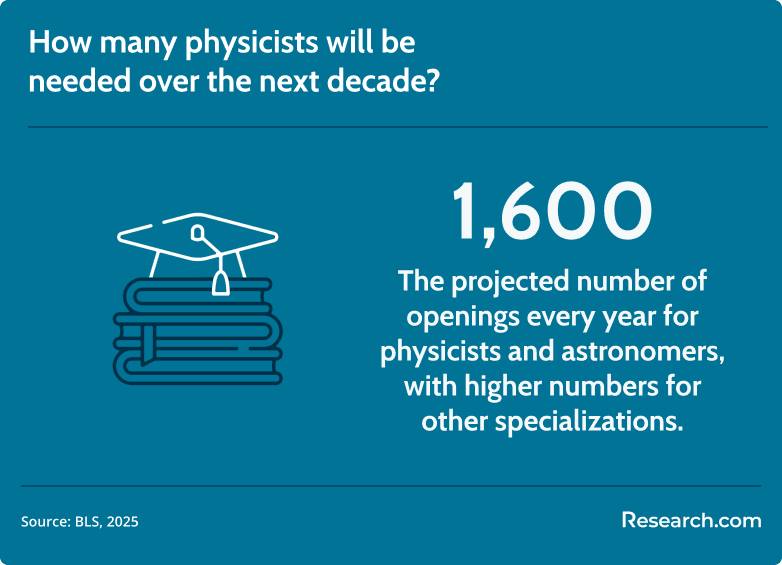
- Physicists and Astronomers: Projected 7% growth from 2023 to 2033, with about 1,600 job openings each year.
- Data Scientists: Expected to grow 36% over the same period, making it one of the fastest-growing occupations.
- Financial Analysts: Projected 9% growth, with approximately 30,700 job openings per year.
- Geoscientists: Anticipated 5% growth, with about 2,200 openings annually, often in environmental and energy sectors.
- Engineering Roles: Occupations in architecture and engineering are projected to grow faster than average, with 195,000 annual openings and a median wage of $97,310.
- Biophysicists and Biochemists: Forecasted 9% growth as demand rises for interdisciplinary scientific expertise.
The strongest candidates usually combine physics knowledge with internships, research, applied projects, coding, data analysis, or teaching credentials. Students should not rely on the degree title alone; they should build evidence of skill through capstones, portfolios, lab reports, and employer-facing projects.
The chart below shows growth projections for data-related occupations during the next decade.
What challenges should students anticipate in accelerated online physics degree programs?
Accelerated online physics programs can be demanding. The main challenge is pace: students may need to absorb advanced mathematics, complete problem sets, write lab reports, and study for exams within shortened terms. Students who fall behind early can struggle to catch up.
- Limited hands-on access: Remote simulations can be valuable, but students interested in laboratory research should confirm opportunities for physical instrumentation experience.
- Heavy math load: Calculus, differential equations, linear algebra, and computational work can be challenging in compressed courses.
- Time-management pressure: Online physics requires consistent weekly study rather than occasional cramming.
- Less informal networking: Students must be proactive about office hours, faculty contact, internships, and peer study groups.
- Technology dependence: Remote labs, simulations, proctored exams, and collaboration tools require reliable hardware and internet access.
- Graduate-school alignment: Students planning a research doctorate should verify that online labs, research experiences, and recommendations will support competitive applications.
If speed is your main priority and you are still deciding among majors, compare physics with broader lists of the fastest bachelor’s degree options online.
Common mistakes to avoid when choosing an online physics degree
- Assuming every “online” physics degree is fully online: Many programs require campus labs, summer sessions, or hybrid components.
- Choosing based only on tuition: Fees, lab travel, transfer limits, and delayed graduation can raise the total cost.
- Ignoring accreditation: Accreditation affects financial aid, transfer credits, employer recognition, and graduate school eligibility.
- Underestimating lab requirements: Ask exactly how experimental skills are taught and assessed.
- Skipping transfer evaluations: A program that accepts more prior credits may be faster and cheaper than one with lower tuition.
- Assuming salary outcomes are guaranteed: Career results depend on skills, location, internships, graduate education, and labor market conditions.
- Overlooking licensure rules: Students pursuing teaching must verify state-specific requirements before enrolling.
- Relying only on rankings: Rankings are a starting point, not a substitute for checking curriculum fit, cost, and student support.
When physics may not be the right online degree
Physics is a strong choice for students who enjoy mathematical modeling, abstract problem-solving, and scientific reasoning. It is not the best fit for every STEM-interested student. If your goal is healthcare practice, digital product design, school administration, military leadership, or a faster general bachelor’s degree, another path may align better with your timeline and career needs.
| If your goal is... | Consider this Research.com guide | Why it may fit better |
| Healthcare quality or clinical leadership | Fastest online MSN in patient safety and healthcare quality | More directly connected to nursing leadership and healthcare outcomes than physics. |
| Women’s health clinical practice | Fast-track online MSN women’s health nurse practitioner programs | Designed for nursing professionals pursuing advanced clinical roles. |
| Digital interface and product design | Best online UX design degree programs | Focuses on users, interfaces, research, prototyping, and digital product development. |
| Military, defense, or strategy-focused study | Fastest online military studies degree programs | May be better aligned with leadership, security, and defense-related career paths. |
| School leadership | How to become a school principal | Explains administrative credentials, experience expectations, and education leadership pathways. |
| A broad accelerated degree search | Fastest online bachelor’s degree programs | Useful if your priority is completion speed more than a specific physics curriculum. |
Here’s what graduates have to say about fast-track online physics study
- Kenny: "My schedule changed constantly, including periods overseas, so I needed a degree format that could keep me moving without forcing me to pause my career. The online physics structure helped me stay organized, finish the program, and move into a leadership role connected to military defense systems."
- Soojin: "I had worked as a technician for years, but the degree helped me connect hands-on experience with deeper theory. After finishing, I moved into an engineering role and now help lead research and development work on clean energy devices."
- Dan: "I was already teaching and wanted stronger physics credentials without leaving the classroom. The online format helped me continue working while completing coursework that supported my licensure goals. I now teach advanced physics, coach robotics, and mentor students in STEM competitions."
How do industry partnerships and research opportunities enhance online physics degrees?
Industry partnerships, research projects, internships, and capstones can make an online physics degree more career-relevant. These experiences help students apply theory to real problems, build evidence of skill, and connect with faculty or employers. For online students, these opportunities are especially important because they can offset the reduced informal access to campus labs and professional networks.
Ask each program whether online students can join research groups, complete remote or local internships, attend seminars, work with external partners, or receive faculty recommendations for graduate school. Students who already hold a bachelor’s degree and want a faster graduate credential may also compare physics pathways with one-year master’s programs online.
How can you verify the accreditation and quality of online physics degree programs?
Accreditation is one of the most important checks before enrolling. Start by confirming that the institution is accredited by an agency recognized by the U.S. Department of Education. Then review whether the physics, applied physics, engineering physics, or teacher preparation pathway has any relevant program-level approvals. Accreditation can affect federal aid, credit transfer, graduate school eligibility, employer recognition, and licensure preparation.
- Search the school in official accreditation databases and verify the accreditor listed by the institution.
- Confirm that the degree level, campus, and online delivery format are included under the institution’s accredited offerings.
- Ask whether any engineering-focused pathway has ABET recognition when that matters for your career goal.
- Review College Scorecard, IPEDS, and College Navigator data for graduation, retention, debt, and earnings indicators.
- Request a written transfer-credit evaluation before committing, especially if you plan to accelerate completion.
- Ask how online labs are completed, assessed, and documented on transcripts or course descriptions.
Students who need a lower-cost institution should still verify quality and aid eligibility. Research.com’s guide to cheap online colleges that accept FAFSA can help with affordability research, but accreditation and program fit should remain central.
Questions to ask before enrolling
- Is the physics degree fully online, mostly online, or hybrid?
- How are laboratory courses completed, and are any campus visits required?
- How many transfer credits will the program accept, and which physics or math courses must be repeated?
- Are courses offered every term, or could sequencing delay graduation?
- Does the program prepare students for graduate physics, teaching, applied technical work, or another specific outcome?
- What tutoring, advising, research, and career services are available to online students?
- What is the total estimated cost after tuition, fees, books, lab materials, and travel?
- Can employer tuition assistance, military benefits, scholarships, or federal aid be applied?
- Will the program meet licensure requirements if you plan to teach?
- Can the school provide outcome data for physics graduates rather than broad institutional averages?
Key Insights
- Online physics degrees vary widely. Some are fully online, while others require campus labs, summer sessions, or hybrid coursework.
- The fastest path is usually a transfer-friendly program, especially for students who can apply up to 90 credits toward the 120-credit bachelor’s requirement.
- Accreditation, lab quality, and upper-division coursework matter more than speed alone.
- Physics can lead to research, teaching, engineering-adjacent, data science, finance, geoscience, optics, and technical writing paths, but many advanced roles require additional preparation.
- Students should compare total cost, not just tuition. Fees, lab travel, transfer limits, and course sequencing can change the real price and timeline.
- Working adults can succeed in accelerated online physics programs if they have strong math readiness, reliable study time, and access to support.
- Before enrolling, ask for written details about accreditation, transfer credits, lab delivery, course rotation, financial aid, and career outcomes.
References:
- American Association of Physics Teachers. (2024). Self-Study Guidelines for Undergraduate Physics. https://www.aapt.org/resources/upload/guide_undergrad.pdf
- American Physical Society. (2024). Careers in Physics. https://www.aps.org/careers/
- American Physical Society. (2024). Guidelines for Undergraduate Physics Programs. https://www.aps.org/learning-center/statistics/top-educators-all-institutions
- American Physical Society. (2024). Remote introductory physics laboratory course. https://meetings.aps.org/Meeting/MAR24/Session/J00.120
- Bureau of Labor Statistics. (2024). Aerospace Engineers. https://www.bls.gov/ooh/architecture-and-engineering/aerospace-engineers.htm
- Bureau of Labor Statistics. (2024). Computer and Information Research Scientists. https://www.bls.gov/ooh/computer-and-information-technology/computer-and-information-research-scientists.htm
- Bureau of Labor Statistics. (2024). Data Scientists. https://www.bls.gov/ooh/math/data-scientists.htm
- Bureau of Labor Statistics. (2024). Medical Scientists. https://www.bls.gov/ooh/life-physical-and-social-science/medical-scientists.htm
- Bureau of Labor Statistics. (2024). Nuclear Engineers. https://www.bls.gov/ooh/architecture-and-engineering/nuclear-engineers.htm
- Bureau of Labor Statistics. (2024). Physicists. https://www.bls.gov/ooh/life-physical-and-social-science/physicists-and-astronomers.htm
- Bureau of Labor Statistics. (2024). Radiation Therapists. https://www.bls.gov/ooh/healthcare/radiation-therapists.htm
- College Board. (2024). Trends in College Pricing and Student Aid 2024. https://research.collegeboard.org/media/pdf/Trends-in-College-Pricing-and-Student-Aid-2024-ADA.pdf
- Hanson, M. (2025). Average Cost of College 2025. Education Data Initiative. https://educationdata.org/average-cost-of-college
- Indeed. (2025). Physics Jobs in Data Science. https://www.indeed.com/q-data-scientist-physics-jobs.html
- National Aeronautics and Space Administration. (2024). Careers at NASA. https://www.nasa.gov/careers
- National Center for Education Statistics. (2024). Fast facts: Distance education. https://nces.ed.gov/fastfacts/display.asp?id=80
- O*NET OnLine. (2025). Physics Teachers, Postsecondary. https://www.onetonline.org/link/summary/25-1054.00
- U.S. Department of Energy. (2024). Workforce and Education. https://www.energy.gov/workforce
Other Things You Should Know About Fast-Track Online Physics Degree Programs
Yes. Many accelerated online physics programs require proctored midterms or finals, either through a live online service or an approved testing center. Schools often use services such as ProctorU, Honorlock, or campus-approved proctors to verify identity and maintain exam security.
In 2027, online physics degree programs often accept transfer credits from accredited institutions. Typically, up to 90 credits can be transferred, though this varies by school and specific program requirements, potentially expediting completion of your degree.
In 2027, online physics students can fulfill laboratory requirements through virtual labs, simulations, and sometimes short on-campus residencies. Virtual labs replicate physical experiments in a digital environment, allowing students to conduct experiments remotely. Some programs offer week-long on-campus intensives where students can access lab equipment in person.