2027 What Can You Do With a Bioinformatics Master’s Degree?

Co-Founder and Chief Data Scientist
Bioinformatics is one of the fastest-growing fields in science and technology. Bioinformatics scientists earn between $91,530 and $123,338 annually, depending on role and experience, and the profession is expected to grow 17%—far above the U.S. average of 0.3%.
With demand rising in biotech, healthcare, and data-driven research, this article breaks down the career opportunities, industries, skills, salaries, and practical insights you need to decide whether pursuing a bioinformatics master’s degree in 2025 is the right path for you.
Key Things You Should Know About Bioinformatics Master's Degree
- Job growth for bioinformatics scientists is projected at 17%, far faster than the U.S. average.
- Top employers include biotech, pharma, and hospitals, seeking skills like Python, next-generation sequencing, and data analysis.
- Salaries range from $91,530 to $123,338, depending on experience and role.
- What can you do with a bioinformatics master's degree in 2027? Degree Overview
- What jobs can you get with a bioinformatics master’s? Potential Jobs
- What industries actually hire bioinformatics graduates? Top Industries
- How much do bioinformatics master’s grads make in 2027? Salary
- Do you really need a master’s for bioinformatics jobs, or will a bachelor’s do? Master's vs. Bachelor's
- Is a bioinformatics master’s worth it compared to alternatives? Is It Worth It?
- What skills, tools, and languages do employers expect? Core Skills
- How do you break into bioinformatics without experience? How do you break into bioinformatics without experience?
- Can you work remotely in bioinformatics, and where are the jobs located? Can you work remotely in bioinformatics, and where are the jobs located?
- How can complementary tech skills accelerate my bioinformatics career? How can complementary tech skills accelerate my bioinformatics career?
- What’s the difference between bioinformatics and computational biology—and which fits my goals? What’s the difference between bioinformatics and computational biology—and which fits my goals?
What can you do with a bioinformatics master's degree in 2027?
A master’s degree in bioinformatics prepares you to work where biology, computing, statistics, and healthcare data meet. This matters more in 2027 because genomics, drug discovery, precision medicine, public health research, and biotechnology product development increasingly depend on people who can turn large biological datasets into usable answers.
This guide is for students comparing graduate programs, bachelor’s degree holders deciding whether to continue into a master’s, working professionals moving from biology or tech into bioinformatics, and applicants who want a clearer view of salaries, job options, skills, remote work, and alternatives such as data science or computational biology.
Quick answer: What can you do with this degree?
With a bioinformatics master’s degree, you can pursue roles such as bioinformatics scientist, bioinformatician, data analyst, genomics analyst, computational biology specialist, research scientist, bioinformatics manager, or director-level roles after significant experience. The strongest opportunities are usually in biotechnology, pharmaceuticals, healthcare systems, academic research, government labs, agriculture technology, and software or AI companies building tools for life science data.
The degree is most valuable if you want to work with genomic data, next-generation sequencing, biological databases, machine learning models, or computational tools used in medicine and research. It is less useful if your goal is a general tech job that does not require biological expertise; in that case, a data science, computer science, or software engineering route may offer broader options.
What jobs can you get with a bioinformatics master’s?
A bioinformatics master’s can qualify you for technical, research, and leadership-track roles that require both biological knowledge and computational skill. Employers typically look for candidates who can write code, analyze biological datasets, communicate with scientists, and understand the research or clinical context behind the data.
According to ZipRecruiter 2025, the following roles are among the higher-paying career paths commonly associated with advanced bioinformatics training:
- Bioinformatics Scientist: Builds analytical methods, develops algorithms, and interprets genomic, molecular, or biomedical datasets for research or applied product development.
- Senior Scientist Immunology: Uses computational approaches to investigate immune system behavior and support therapy, vaccine, or drug discovery work.
- Director of Bioinformatics: Leads bioinformatics strategy, supervises teams, and oversees large genomics or biomedical data initiatives across an organization.
- Bioinformatician: Processes biological data, maintains analytical pipelines, supports lab or clinical teams, and helps translate data into research findings.
- Bioinformatics Manager: Coordinates staff, timelines, budgets, workflows, and technical deliverables for bioinformatics projects.
| Role | Best fit for | Typical work focus |
| Bioinformatics Scientist | Graduates who want a research-heavy technical role | Algorithm development, genomic analysis, computational workflows, scientific interpretation |
| Bioinformatician | New or mid-career professionals building practical experience | Data cleaning, sequence analysis, pipeline support, reporting for research teams |
| Senior Scientist Immunology | Professionals with strong biology and domain-specific research knowledge | Immune data analysis, therapeutic research, translational science support |
| Bioinformatics Manager | Experienced professionals who want to lead projects and people | Project planning, team coordination, stakeholder communication, resource management |
| Director of Bioinformatics | Senior leaders with deep technical and organizational experience | Department strategy, platform decisions, team leadership, executive-level planning |
These titles show why the degree can lead to more than one career direction. Some graduates stay close to the bench and collaborate with scientists; others move toward software, analytics, product development, or technical leadership. If you want a broader view of undergraduate and graduate pathways, see Research.com’s guide on bioinformatics degree career options.
What industries actually hire bioinformatics graduates?
Bioinformatics is not limited to one type of employer. Any organization that collects, stores, models, or interprets complex biological data may need these skills. The best industry fit depends on whether you want to focus on healthcare applications, laboratory research, software tools, public-sector science, or commercial biotechnology products.
- Biotechnology and pharmaceuticals: Employers use bioinformatics for drug discovery, target identification, vaccine development, biomarker research, and therapy design.
- Hospitals and healthcare systems: Roles may support precision medicine, genetic testing, diagnostics, clinical genomics, and patient-centered data interpretation.
- Academic research: Universities and research institutes hire bioinformatics professionals for genomics, molecular biology, evolutionary biology, and disease research projects.
- Government laboratories: Public agencies may use bioinformatics in public health surveillance, environmental research, biomedical policy work, and population-level studies.
- Agriculture and food technology: Bioinformatics supports crop genetics, food safety research, sustainability, livestock science, and plant disease analysis.
- Software and AI companies: Technology firms hire bioinformatics talent to build platforms, databases, visualization tools, machine learning models, and workflow automation systems for life science users.
| Industry | Why bioinformatics matters there | Who may enjoy this path |
| Biotech and pharmaceuticals | Large biological datasets guide product pipelines and research decisions. | People interested in drug development, commercial science, and applied research. |
| Healthcare systems | Genomic and diagnostic data can inform treatment planning and clinical decision-making. | Professionals who want their work connected to patient care. |
| Academic research | Computational analysis helps answer biological questions and support publications. | Students who enjoy discovery, experimentation, and grant-funded research. |
| Government labs | Bioinformatics can support public health, policy, environmental, and biomedical research. | Those seeking mission-driven science and public-sector stability. |
| Agriculture and food technology | Genomic tools help improve crops, sustainability, safety, and agricultural productivity. | Graduates interested in biology beyond human medicine. |
| Software and AI firms | Life science organizations need scalable tools for analysis, automation, and collaboration. | Professionals who prefer product, engineering, or platform development work. |
Because bioinformatics overlaps with biotechnology, students comparing adjacent career paths may also find it useful to review jobs for graduates with a master’s in biotechnology.
How much do bioinformatics master’s grads make in 2027?
Bioinformatics salaries depend heavily on job title, employer type, location, experience, technical depth, and whether the role is research-focused, clinical, software-oriented, or managerial. Reported figures also vary by source, so it is better to treat salary data as a range rather than a guarantee.
Entry-level roles are commonly described as starting around $60,000 per year. Mid-level positions such as bioinformaticians and data analysts are reported between $91,530 and $115,825 by sources including Zippia and Salary.com. SalaryExpert reports a higher global average of $123,338, while senior or specialized leadership roles can reach as high as $212,000 per year. Glassdoor reports a range of $61,000 to $109,000, which shows how much compensation can differ across employers and experience levels.
| Salary figure mentioned | How to interpret it |
| $60,000 | A commonly cited starting point for entry-level positions, depending on market and employer. |
| $91,530 to $115,825 | A reported mid-level range for roles such as bioinformaticians and data analysts from sources including Zippia and Salary.com. |
| $123,338 | SalaryExpert’s reported global average, reflecting strong demand in research and biotechnology markets. |
| $61,000 to $109,000 | Glassdoor’s reported range, useful for understanding early- to mid-career variation. |
| $212,000 | A possible upper-end figure for senior, specialized, or leadership positions. |
Private-sector biotechnology and pharmaceutical companies often pay more than some academic research organizations or government labs, though compensation is only one part of the decision. Benefits, publication opportunities, job stability, visa sponsorship, remote flexibility, equity, and promotion paths can also affect the real value of an offer. If speed and total program cost are major concerns, compare options such as fast online bioinformatics master’s programs.
The image below uses ZipRecruiter’s reported average bioinformatic salary of $96,169.
Do you really need a master’s for bioinformatics jobs, or will a bachelor’s do?
You do not always need a master’s degree to enter bioinformatics, but graduate training can make it easier to qualify for specialized, research-intensive, and leadership-track jobs. Workforce data cited in the original source shows that 42.7% of bioinformatics scientists hold a bachelor’s degree, 30.5% hold a master’s degree, and 24.4% hold a doctorate.
A bachelor’s degree may be enough for assistant, technician, junior analyst, or entry-level programming roles, especially if you already have strong Python, statistics, biology, and database skills. Candidates coming from biology may need to build computing skills, while candidates from computer science may need to strengthen genetics, molecular biology, and laboratory context. For people who need a faster entry point into technical training, Research.com’s guide to accessible IT certifications and programs may help identify ways to build foundational skills.
A master’s degree becomes more important when the job involves independent research, next-generation sequencing analysis, genomics pipeline design, machine learning, drug discovery support, or cross-functional leadership. A PhD may be preferred for principal investigator roles, advanced research scientist positions, or academic research careers.
| Education level | When it may be enough | Limitations to consider |
| Bachelor’s degree | Entry-level analyst, lab-adjacent data support, junior programming, or research assistant roles. | May limit access to senior research, leadership, and specialized genomics positions. |
| Master’s degree | Bioinformatician, bioinformatics scientist, genomics analyst, applied research, and industry roles. | Still may not be enough for some principal scientist or tenure-track academic paths. |
| Doctorate | Advanced research leadership, academic research, principal scientist, and highly specialized scientific roles. | Requires a longer time commitment and may be more research-focused than some industry roles require. |
If you are comparing nearby graduate options, it may help to evaluate whether a master’s in biotechnology is worth it, because biotechnology and bioinformatics careers often intersect but do not prepare students for exactly the same work.
The chart below shows the degree levels completed by bioinformatics scientists as reported by Zippia.
Is a bioinformatics master’s worth it compared to alternatives?
A bioinformatics master’s can be worth it when your goal is to apply computing and statistics to biological or medical problems. It is not the best fit for every student interested in data. Your decision should depend on whether you want a biology-centered career or a broader analytics career that can move across finance, retail, software, government, and other sectors.
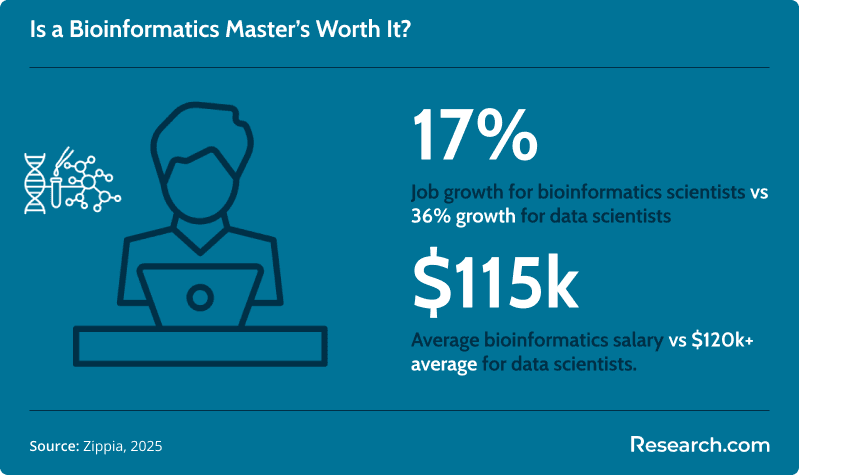
Bioinformatics has average salaries around $115,000 in the cited comparison, while data science averages above $120,000 and has projected job growth of +36%. Bioinformatics also shows strong growth at 17%, which is above the U.S. average but below the cited data science projection. These figures make bioinformatics attractive, but they also show why some students consider a broader data science path.
Computational biology is close to bioinformatics, but it often leans more toward modeling, theory, and biological questions. Bioinformatics is usually more tool-, data-, and pipeline-focused. Students who want to design workflows for sequencing analysis, build biological databases, or support drug discovery teams may prefer bioinformatics. Students who want to model biological systems or pursue academic research may find computational biology more aligned.
| Path | Best for | Trade-off |
| Bioinformatics master’s | Students who want to work with genomics, sequencing, biological data pipelines, and healthcare or biotech applications. | More specialized than general data science, which can be a strength or a limitation depending on your goals. |
| Data science master’s | Students who want the widest range of analytics roles across many industries. | May not provide enough biology, genetics, or laboratory context for life science employers. |
| Computational biology | Students drawn to biological modeling, theory, and research questions. | May be less focused on production pipelines, software platforms, and industry data operations. |
| Biotechnology master’s | Students interested in bioprocessing, product development, laboratory science, or biotech management. | May include less programming and statistical computing than a bioinformatics curriculum. |
Students considering several science-and-technology routes can also compare accelerated online biotechnology master’s programs. If you are interested in tech-adjacent roles that combine analytics with product experience, Research.com’s guide to online UX design courses may also be useful, though it serves a different career goal than bioinformatics.
The image below compares job growth and salary for bioinformatics scientists and data scientists.
What skills, tools, and languages do employers expect?
Employers usually care about proof that you can work with real biological data, not just that you completed graduate coursework. The strongest candidates can code, analyze data, explain statistical choices, understand genomic methods, and communicate results to scientists, clinicians, or product teams.
Zippia’s 2025 data highlights several commonly requested skills:
- Python: A core programming language for scripting, analysis, automation, workflow development, and data processing.
- Next-Generation Sequencing (NGS): A central method in genomics work, especially in precision medicine, disease research, and molecular biology.
- Data Analysis: The ability to clean, organize, interpret, visualize, and explain large biological datasets.
- NGS Technology: Practical understanding of sequencing methods and their technical limits, which helps connect computational output to laboratory realities.
- Java: A useful language for scalable applications, software tools, and some enterprise bioinformatics systems.
| Skill area | Why it matters | How to show it to employers |
| Programming | Bioinformatics work often requires scripts, pipelines, automation, and reproducible analysis. | Publish code samples, maintain a GitHub profile, and document project workflows clearly. |
| Statistics and data analysis | Biological data can be noisy, complex, and high-dimensional. | Include projects that explain methods, assumptions, visualizations, and conclusions. |
| Genomics and NGS | Many jobs involve sequencing data, variant analysis, transcriptomics, or related workflows. | Build portfolio projects using public datasets and describe each step of the analysis. |
| Biology domain knowledge | Technical results are only useful if interpreted within a biological context. | Connect your analysis to a research question, clinical use case, or experimental design. |
| Communication | Bioinformatics professionals often serve as translators between wet-lab, clinical, and technical teams. | Practice concise reports, slide decks, and plain-language explanations of technical findings. |
Students weighing adjacent science degrees should compare how much programming and data analysis each curriculum provides. For example, a biochemistry program can build strong laboratory and molecular science foundations, while bioinformatics usually adds deeper computational training. Research.com’s guide to fast online biochemistry degree options can help you compare related academic paths.
The chart below summarizes skills commonly reported on bioinformatics professional resumes.
How do you break into bioinformatics without experience?
You can enter bioinformatics without a formal bioinformatics job history, but you need evidence that you can do the work. Hiring managers often look for projects, research exposure, code samples, and domain understanding, especially when an applicant is switching from biology, statistics, computer science, healthcare, or another related field.
- Choose a starting lane. Decide whether you are closer to biology, programming, statistics, or clinical data. Your strongest background should guide your first job search.
- Build missing fundamentals. Biology-focused applicants should strengthen Python, statistics, and reproducible workflows. Tech-focused applicants should study genetics, molecular biology, genomics, and sequencing concepts.
- Complete portfolio projects. Use public biological datasets to show that you can ask a question, clean data, run an analysis, explain results, and document the process.
- Seek research exposure. University labs, hospital research units, biotech internships, and independent projects can help you gain practical experience.
- Contribute to open-source tools. Even small contributions can show coding ability, initiative, and familiarity with collaborative development.
- Use certificates strategically. Short programs can help fill a skill gap, but they work best when paired with visible projects and a clear career target.
- Apply for realistic entry points. Look for junior bioinformatician, research data analyst, sequencing analyst, computational research assistant, or genomics data roles before targeting senior scientist positions.
Portfolio work is especially useful because it turns abstract skills into evidence. A strong project should include the research question, dataset source, tools used, code, quality-control steps, results, limitations, and a short explanation for nontechnical readers. Students exploring salary expectations and career planning can also review Research.com’s page on bioinformatics master’s careers and salary considerations.
Common mistakes when trying to enter bioinformatics
| Mistake | Why it hurts your chances | Better approach |
| Listing tools without projects | Employers cannot tell whether you can apply the tools to real data. | Show completed analyses with code, documentation, and conclusions. |
| Ignoring biology context | Bioinformatics is not just generic data analysis with biological labels. | Explain what the results mean biologically and why the question matters. |
| Choosing a program only by tuition | A low price may not compensate for weak coursework, poor advising, or limited research opportunities. | Compare curriculum, faculty, datasets, career support, and alumni outcomes alongside cost. |
| Assuming every online program fits every goal | Some programs may be stronger for research, while others emphasize applied industry skills. | Match the program’s projects, electives, and faculty expertise to your intended role. |
| Relying only on rankings | Rankings rarely capture whether a program fits your technical gaps and career plans. | Ask detailed questions about tools, capstones, internships, and employer connections. |
Can you work remotely in bioinformatics, and where are the jobs located?
Many bioinformatics tasks can be done remotely or in a hybrid format because the work often involves coding, cloud platforms, databases, statistical analysis, and written reporting. Remote work is more likely when a role centers on sequencing data analysis, software development, machine learning workflows, data visualization, or pipeline maintenance.
Not every role is remote-friendly. Jobs that require daily coordination with wet-lab teams, clinical operations, regulated health data, physical instruments, or trial sites may require regular on-site work. Some employers also restrict remote access because of data security, compliance, or collaboration needs.
In the United States, major hubs include Boston, San Francisco, and New York, where biotechnology and pharmaceutical employers are concentrated. Internationally, the UK, Germany, Switzerland, Singapore, and China are identified as active hiring regions because of investment in genomics and biotechnology.
Current trends affecting bioinformatics careers
- AI and machine learning are becoming more common: Employers increasingly value professionals who can evaluate models responsibly, not just run automated tools.
- Cloud-based workflows are expanding collaboration: Large datasets often require secure, scalable computing environments and reproducible pipelines.
- Precision medicine continues to shape demand: Genomic analysis is increasingly connected to diagnostics, treatment selection, and disease risk interpretation.
- Employers want practical evidence: A degree helps, but projects, internships, publications, and code repositories can make applicants more competitive.
- Cross-functional communication matters: Bioinformatics professionals often work between scientists, clinicians, engineers, and business leaders.
How can complementary tech skills accelerate my bioinformatics career?
Additional technical training can make a bioinformatics graduate more competitive, especially for roles involving production pipelines, platform development, cloud systems, automation, and scalable data infrastructure. Software engineering skills are particularly useful when your work must be reliable, documented, reusable, and shared across teams.
Useful complementary areas include software design, databases, version control, cloud computing, workflow orchestration, APIs, data visualization, machine learning operations, and cybersecurity basics for sensitive biomedical data. Professionals who want deeper engineering preparation can compare affordable online software engineering degree options as a way to strengthen the computing side of a bioinformatics profile.
| Complementary skill | Career advantage |
| Software engineering | Helps you build maintainable tools instead of one-time scripts. |
| Cloud computing | Supports work with large datasets and distributed research teams. |
| Machine learning | Useful for prediction, classification, pattern discovery, and model-based research. |
| Database design | Important for storing, querying, and managing biological datasets efficiently. |
| Data visualization | Improves communication with researchers, clinicians, managers, and nontechnical stakeholders. |
What’s the difference between bioinformatics and computational biology—and which fits my goals?
Bioinformatics and computational biology overlap, but they are not identical. Bioinformatics is generally more focused on data systems, algorithms, software tools, pipelines, databases, and the practical analysis of biological information. It is often the better fit for students who want to work in industry, healthcare data, genomics platforms, or applied research teams.
Computational biology usually places more emphasis on modeling biological processes, testing hypotheses, simulating systems, and answering theoretical or research-driven biological questions. It may be a better fit for students who are considering academic research, doctoral study, or roles centered on biological theory and quantitative modeling.
| Question to ask yourself | If your answer is yes, consider bioinformatics | If your answer is yes, consider computational biology |
| Do you want to build tools and pipelines? | Yes, this is a core bioinformatics strength. | Possibly, but it may not be the central focus. |
| Do you want to model biological systems? | Useful, but often secondary to applied data analysis. | Yes, this is often a primary focus. |
| Do you want to work in biotech or pharma data teams? | Often a strong fit. | Can fit, especially in research-heavy roles. |
| Do you want to pursue academic research? | Possible, especially with further study. | Often a natural match. |
| Do you want a role close to software and data infrastructure? | Usually yes. | Less directly, depending on the program and role. |
The simplest distinction is this: bioinformatics often emphasizes making biological data usable, while computational biology often emphasizes using computation to understand biological systems. Many jobs combine both, so review course requirements, faculty projects, capstone options, and employer outcomes before choosing a program label.
Here's What Graduates Have to Say About Their Bioinformatics Master's Degree Program
- : "The online format let me continue working while I built practical skills in Python and next-generation sequencing. I was able to apply new techniques directly to my lab work, which made the program feel immediately useful. It helped me see career options I had not seriously considered before. — Eliana"
- : "What stood out was the mix of theory and applied analysis. Collaborating online with classmates from different locations on real genetic datasets was demanding, but it made the material feel relevant. The experience changed how I think about my long-term career. — Tobias"
- : "Flexibility mattered most for me. I could study from anywhere while still receiving detailed instruction and feedback. The program strengthened my confidence in statistics, cloud-based genomics, and data interpretation. Without an online option, earning the degree would not have been realistic. — Mireille"
How to choose a bioinformatics master’s program
The best bioinformatics master’s program is not necessarily the highest-ranked or most expensive one. It is the program that closes your specific skill gaps, fits your schedule, supports your target career, and gives you enough hands-on practice with real biological data.
- Check accreditation and institutional legitimacy. Make sure the school is properly recognized before you invest time or money.
- Read the curriculum closely. Look for coursework in programming, statistics, genomics, databases, machine learning, and reproducible research.
- Evaluate applied learning. Capstones, thesis options, internships, research assistantships, and public-data projects can be more valuable than lecture-only coursework.
- Compare faculty expertise. Faculty research areas should match your interests, such as cancer genomics, clinical informatics, plant genomics, drug discovery, or computational biology.
- Ask about tools and datasets. A strong program should expose students to current workflows, coding practices, and biological data types.
- Review career support. Look for employer connections, alumni outcomes, resume support, internship pipelines, and networking opportunities.
- Calculate total cost. Include tuition, fees, software, technology requirements, travel, lost work hours, and the time needed to complete the degree.
- Confirm online expectations. If you choose an online program, ask whether courses are live or asynchronous, how group projects work, and whether research opportunities are available remotely.
Questions to ask before enrolling
- Which programming languages and tools are used in required courses?
- Does the program include a thesis, capstone, internship, or research project?
- Are students allowed to work with real genomic or biomedical datasets?
- What career paths do recent graduates pursue?
- How much support is available for students without a biology background?
- How much support is available for students without a programming background?
- Can online students access faculty research, career services, and technical support?
- What is the total cost after fees, books, technology, and possible travel?
- Are courses designed for working adults, full-time students, or both?
- How does the program help students build a portfolio?
Key Insights
- A bioinformatics master’s is strongest for students who want to apply computing, statistics, and biology to genomics, healthcare, drug discovery, and biotechnology problems.
- You can enter some bioinformatics roles with a bachelor’s degree, but the cited workforce distribution shows substantial graduate education in the field: 42.7% hold a bachelor’s, 30.5% hold a master’s, and 24.4% hold a doctorate.
- Reported pay varies widely. Figures cited in this article include entry-level roles around $60,000, mid-level ranges from $91,530 to $115,825, a SalaryExpert global average of $123,338, Glassdoor’s $61,000 to $109,000 range, and senior compensation reaching as high as $212,000.
- Bioinformatics can be worth it compared with alternatives if you want a biology-centered analytics career. Data science may offer broader industry mobility, while computational biology may better fit research and modeling goals.
- Employers value practical evidence. Python, NGS, data analysis, NGS Technology, and Java appear as important skills in the cited 2025 data, but projects, code, research experience, and communication ability often determine competitiveness.
- Remote and hybrid work are realistic in many data-heavy bioinformatics roles, but positions tied closely to wet labs, clinical workflows, or regulated environments may require on-site work.
- Do not choose a program based only on rankings or tuition. Compare accreditation, curriculum depth, hands-on projects, faculty expertise, employer connections, online support, and total cost before enrolling.
References:
- Bureau of Labor Statistics. Biochemists and Biophysicists.
- Bureau of Labor Statistics. Biomedical Engineers.
- Bureau of Labor Statistics. Computer and Information Research Scientists.
- Bureau of Labor Statistics. Data Scientists.
- Bureau of Labor Statistics. Mathematicians and Statisticians.
- Bureau of Labor Statistics. Medical Scientists.
- Bureau of Labor Statistics. Microbiologists.
- Data USA. Bioinformatics Profile.
- Glassdoor. Bioinformatics Scientist Salaries.
- O*NET OnLine. Bioinformatics Scientists Summary (19-1029.01).
- Payscale. Bioinformatics Scientist Salary.
- Salary.com. Bioinformatics Scientist Salary.
- SalaryExpert. Bioinformatics Scientist Salary in the United States.
- ZipRecruiter. Bioinformatic Salary.
- ZipRecruiter. Bioinformatics Scientist Salary.
- Zippia. Bioinformatics Scientist Jobs.
- Zippia. Bioinformatics Scientist Salaries.
Other Things You Should Know About a Bioinformatics Master's Degree
No, a background in coding is not essential but it is highly beneficial. Bioinformatics relies on programming for data analysis and algorithm development. Many programs will teach the necessary coding skills, but having a foundational understanding can ease the transition and enhance learning.
Graduates with a bioinformatics master’s degree are commonly hired by pharmaceutical companies, biotechnology firms, hospitals, and academic research institutions. They work in roles such as data scientists, bioinformatics analysts, or research associates, leveraging their expertise to analyze biological data and contribute to scientific discoveries.
Employers often expect competence with DNA/RNA extraction, PCR, gel electrophoresis, and next-generation sequencing workflows. For genomics analyst roles, familiarity with Linux, Python or R, and tools such as BLAST, Bowtie, or GATK is commonly required, along with basic quality-control and data-management practices.