
2027 Fastest Online Biotechnology Graduate Certificate Programs

Co-Founder and Chief Data Scientist
As a specialist in career and education planning, I frequently assist individuals aiming for rapid entry or advancement into stable, in-demand fields within the life sciences industry. The pursuit of the fastest online biotechnology graduate certificate is a popular and practical goal.
The digital landscape is filled with programs making bold claims about completion times, making it difficult to discern credible, accredited options from those that are merely well-marketed. The critical task is to evaluate a program's true value and rigor beyond its advertised speed.
My purpose is to provide expert clarity, helping you identify a genuinely accelerated program that upholds academic standards and meets your career objectives.
What are the benefits of getting a qualification from the fastest online biotechnology graduate certificate programs?
- Accelerated Career Entry: A graduate certificate can quickly qualify you for essential, lab-based, or technical roles such as Research Associate, Quality Control Analyst, or Bioinformatics Technician in various life science settings.
- Competitive salaries: Entry-level Research Associates earn around $66,500, while Senior Research Associates earn $85,400 or move into specialized fields like bioinformatics to earn over $102,000 annually.
- Flexible Learning: The accelerated online format provides the convenience of earning a credential on a condensed timeline, allowing you to balance education with current personal or work commitments.
What can I expect from the fastest online biotechnology graduate certificate programs?
- Applied Strategic Knowledge: Emphasis is placed on real-world biotechnology scenarios, focusing on areas like molecular biology, genetic engineering, bioinformatics, and compliance with regulatory standards from agencies like the FDA.
- Structured Curriculum: Delivery typically combines recorded lectures, live online seminars, and practical skills assignments. Some programs may require an in-person lab component or a capstone project to ensure hands-on competence.
- Condensed Timeline: Programs are designed to be completed quickly, often in 9-12 months, through intensive, focused modules.
Where can I work with an online biotechnology graduate certificate?
- Pharmaceutical and Biopharmaceutical Companies: Secure roles in research and development (R&D), quality assurance/quality control (QA/QC), and manufacturing departments, assisting in the drug discovery and production pipeline.
- Research Institutions and Universities: Work in academic or private research labs, supporting projects in genetics, cell biology, and molecular diagnostics.
- Government Agencies: Provide technical expertise in agencies like the National Institutes of Health (NIH), the Centers for Disease Control and Prevention (CDC), or the Food and Drug Administration (FDA).
- Diagnostic Laboratories: Assist with developing and running diagnostic tests for diseases, utilizing molecular biology techniques.
- Agricultural and Environmental Sectors: Work for companies that use biotechnology for crop improvement, biofuel production, or environmental remediation.
How much can I earn with an online biotechnology graduate certificate?
- Entry-Level Roles: Graduates with a new certificate typically earn between $60,000 and $75,000 annually in roles such as a Research Associate or Quality Control (QC) Analyst.
- Experienced and Lead Roles: With several years of experience and a proven skill set, professionals in senior or lead roles, like a Scientist I or Senior Research Associate, can earn $75,000-$95,000.
- Specialized Roles: Professionals who specialize in high-demand fields like bioinformatics, computational biology, or regulatory affairs can command higher salaries, often ranging from approximately $90,000 to >$110,000 annually.
- Fastest Online Biotechnology Graduate Certificate Programs for 2027 List of Programs
- Can an online biotechnology graduate certificate drive long-term career advancement? Can an online biotechnology graduate certificate drive long-term career advancement?
- What is the average cost of an online biotechnology graduate certificate? Average Cost
- What are the financial aid options for an online biotechnology graduate certificate? Financial Aid
- What are the prerequisites for enrolling in an online biotechnology program? What are the prerequisites for enrolling in an online biotechnology program?
- What courses are typically in an online biotechnology program? What courses are typically in an online biotechnology program?
- How can I verify the accreditation and quality of an online biotechnology program? How can I verify the accreditation and quality of an online biotechnology program?
- What types of specializations are available for biotechnology graduate certificate holders? Specializations
- How do you choose the best among the fastest online biotechnology programs? How do you choose the best among the fastest online biotechnology programs?
- What career paths are available for graduates of online biotechnology programs? Career Paths
- How much can I earn with an online biotechnology graduate certificate? Salaries
- What is the job market like for graduates of an online biotechnology graduate certificate program? Job Market
- What are some current and future trends in biotechnology? What are some current and future trends in biotechnology?
Fastest Online Biotechnology Graduate Certificate Programs for 2027
Choosing a fast online biotechnology graduate certificate is usually about one practical question: how quickly can you build credible biotech skills without leaving work or committing to a full master’s degree? These programs can help professionals move into biomanufacturing, bioinformatics, regulatory affairs, project management, quality control, research support, or graduate study, but the best choice depends on your science background, schedule, budget, and career target.
This guide compares fast online and hybrid biotechnology certificate options, explains how to evaluate program quality, and helps you decide whether a certificate is the right credential for your next step. If you are also comparing related science pathways, an accelerated online biochemistry degree may be useful when you want broader undergraduate-level preparation rather than a shorter graduate certificate.
Quick answer: What is the fastest online biotechnology graduate certificate?
The fastest option listed here is Alvin Community College’s Biotechnology Certificate, which can launch a career in just 15 weeks, although the program details also list a 1 year program length. Among graduate-level university certificates, the University of Washington’s online Certificate in Biotechnology Project Management stands out for speed, with an 8-9 month completion timeline. Several other programs can be completed in about 1 year, including options from California State University, Los Angeles; California State University, East Bay; Northeastern University; and the University of Wisconsin-Madison.
Before enrolling, confirm three things directly with the school: whether the certificate is fully online or hybrid, whether you meet the science prerequisites, and whether credits can transfer into a related master’s program if you later decide to continue.
How Research.com evaluates these programs
Because certificate programs require time, tuition, and career planning, our rankings are built to help readers compare options using transparent education data and program-level details. Our methodology considers information from recognized sources, including the IPEDS database, Peterson's database and its Distance Learning Licensed Data Set, the College Scorecard database, and the National Center for Education Statistics.
Rankings should be a starting point, not the only factor in your decision. A program that ranks highly may still be the wrong fit if it does not match your target role, required schedule, lab expectations, or financial aid needs.
Fast comparison of featured biotechnology certificate programs
| School or provider | Best fit | Program length | Credits or courses | Tuition listed |
| California State University, East Bay | Students seeking hands-on lab-oriented biotechnology preparation | Approximately 1 year | 20 units | Not specified |
| California State University, Los Angeles | Science graduates who want biotech coursework plus an industry internship | 1 year | 18 units | $2,340.00/semester (0 to 6 credits) |
| Harvard University Extension School | Professionals interested in biotechnology management and stackable graduate coursework | 1 to 2 years (3-year time frame) | 4 courses | $13,760 total |
| University of Washington | Working professionals focused on biotech project management | 8-9 months | Four required courses | $6,240 |
| Kansas State University | Students interested in genetics, genomics, and customizable electives | Typically requires completion of 15 credit hours; duration varies by student pace | 15 credit hours | Not specified |
| Northeastern University | Career changers without a science background who want a pathway to an MS | 1 year | 12 credits | $23,136 total |
| UCLA Extension | Professionals seeking biotechnology engineering, manufacturing, and regulatory training | Typically 2 quarters (full-time) to 1.5 years (part-time) | 18 quarter units | $6300.00 |
| University of Massachusetts Lowell | Students interested in biomedical engineering and biotechnology coursework | Flexible; part-time students typically complete in 2–3 semesters | 12 credits | $610/credit |
| University of Wisconsin-Madison | Professionals seeking online applied biotechnology with data science skills | 1 year | 12 credits | $875/credit |
| Alvin Community College | Students seeking fast workforce-oriented biotechnology training | 1 year | 12 credits | Resident In-District: $282; Resident Out-of-District: $333; Non-Resident: $386. |
1. California State University, East Bay
The online biotechnology graduate certificate at California State University, East Bay is built for students who want a compact, skills-focused route into biotechnology. The two-semester format emphasizes scientific foundations and applied laboratory methods aligned with the Bay Area biotechnology sector.
Students study core biotechnology concepts, including molecular biology, bioprocessing, and bioinformatics. The program is also designed to support learners who do not already have a biotechnology background, making it a practical option for students who need structured preparation before moving into research, pharmaceutical, or technical laboratory environments.
A major feature is the program’s practical training requirement. Students complete over 90 hours of lab-focused work in areas such as PCR and sequencing, bioinformatics, mammalian cell culture, and functional genomics. To finish successfully, students must maintain a B average and pass a comprehensive, two-day, seven-section exit exam.
- Program Length: Approximately 1 year
- Tracks/Concentrations: General Biotechnology
- Tuition Cost: Not specified
- Required Credits to Graduate: 20 units
- Accreditation: WASC Senior College and University Commission (WSCUC)
2. California State University, Los Angeles
California State University, Los Angeles offers an online biotechnology graduate certificate that combines modern bioscience concepts with direct exposure to industry practices. The curriculum is taught by both academic and industrial experts, which can be valuable for students who want applied knowledge rather than purely theoretical coursework.
Students complete laboratory skills training during the academic year and then participate in a focused summer industry internship after completing the academic portion. The internship component is a key differentiator for students who want direct experience with local partner bioscience companies.
Applicants need a baccalaureate degree in a biological or related science, such as biochemistry, medical technology, or microbiology. The certificate has been approved as a Gainful Employment Program by the Department of Education, which means eligible students may apply for Federal Financial Aid.
- Program Length: 1 year
- Tracks/Concentrations: General Biotechnology
- Tuition Cost: $2,340.00/semester (0 to 6 credits)
- Required Credits to Graduate: 18 units
- Accreditation: WASC Senior College and University Commission (WSCUC)
3. Harvard University Extension School (Hybrid)
Harvard University offers an online/hybrid biotechnology management graduate certificate for students who want to connect life science knowledge with business decision-making. This option is best suited to professionals who are interested in management, product strategy, R&D leadership, licensing, or commercialization rather than a lab-only role.
Coursework covers timely biotechnology topics such as biomedical product development and monoclonal antibodies while also building business knowledge in leadership, marketing, and finance. Students also examine experimental design, scientific data analysis, R&D management, licensing, and mergers and acquisitions.
The certificate requires courses selected from designated groups in biotechnology, management, an elective area, and an application of skills. It is also stackable, allowing completed coursework to count toward a master’s degree in biotechnology.
- Program Length: 1 to 2 years (3-year time frame)
- Tracks/Concentrations: Bioinformatics, Biotechnology Management, etc.
- Tuition Cost: $13,760 total
- Required Credits to Graduate: 4 courses
- Accreditation: New England Commission of Higher Education (NECHE)
4. University of Washington
The online Certificate in Biotechnology Project Management is offered jointly by the University of Washington and UC San Diego Extended Studies. It is designed for professionals who need to manage biotechnology product development in regulated clinical and commercial environments.
This is one of the fastest graduate-level options in the list. The program can be completed in approximately eight to nine months and uses online real-time meetings on weekends and evenings, making it better suited for working adults who can commit to scheduled live sessions.
The curriculum follows the biotechnology development process from clinical and regulatory perspectives. Students learn how to initiate, plan, and execute projects, then complete a capstone that simulates a clinical development cycle. The capstone also produces a detailed project plan for a professional portfolio using tools such as Smartsheet.
The program is approved by the Project Management Institute, and the coursework can be used to fulfill the educational requirements for the Project Management Professional (PMP) certification.
- Program Length: 8-9 months
- Tracks/Concentrations: Biotechnology project management
- Tuition Cost: $6,240
- Required Credits to Graduate: Four required courses
- Accreditation: Northwest Commission on Colleges and Universities (NWCCU)
5. Kansas State University
Kansas State University offers a Genetics, Genomics and Biotechnology Graduate Certificate for students who want advanced coursework in genomics, biotechnology, and related research applications. It is especially useful for learners who want flexibility across scientific subfields instead of a narrowly defined certificate pathway.
The required curriculum includes an introduction to integrative genome analysis and a foundational biotechnology course. Students usually complete a lab course such as molecular genetics or a two-part recombinant DNA lab, although those already working in relevant research may qualify for an exemption.
Electives allow students to shape the certificate around career or research interests. Options span agronomy, applied plant breeding, applied animal biotechnology, immunology, general virology, bioinformatics applications, population genetics, biochemistry, horticulture, and other related areas.
- Program Length: Typically requires completion of 15 credit hours; duration varies by student pace
- Tracks/Concentrations: Single certificate focused on Genetics, Genomics and Biotechnology
- Tuition Cost: Not specified
- Required Credits to Graduate: 15 credit hours
- Accreditation: Higher Learning Commission (HLC)
6. Northeastern University
Northeastern University offers an online biotechnology graduate certificate designed for students who do not have a science background. This makes it a strong option for career changers who want structured entry into the biotechnology field before deciding whether to pursue a full graduate degree.
The certificate is delivered fully online and offers flexible full-time and part-time study options. Students can complete the program within one year while learning core concepts through applied examples and real-world case studies.
Coursework introduces molecular cell biology, protein principles, cell culture applications, data analysis, laboratory techniques, and the role of patents in the biotechnology industry. A major advantage is that all certificate credits can be applied directly toward Northeastern's MS in Biotechnology program.
- Program Length: 1 year
- Tracks/Concentrations: General Biotechnology
- Tuition Cost: $23,136 total
- Required Credits to Graduate: 12 credits
- Accreditation: Higher Learning Commission (HLC)
7. UCLA Extension
The University of California-Los Angeles (UCLA Extension) offers a fully online Biotechnology Engineering Certificate for professionals who want training in biotech design, manufacturing, quality, process development, and regulatory affairs. It is particularly relevant for learners who work, or want to work, near the engineering and production side of biotechnology.
The curriculum covers engineering processes used in drug development and introduces students to European and FDA regulatory rules. Courses are taught by active industry practitioners and subject matter experts, which can help students connect technical content to real workplace expectations.
Students complete required courses in biotechnology engineering fundamentals, biopharmaceutical manufacturing, process development, and regulatory affairs. They also choose two electives, with options such as Six Sigma Green Belt and specialized medical device engineering topics.
- Program Length: Typically 2 quarters (full-time) to 1.5 years (part-time)
- Tracks/Concentrations: No distinct tracks; students select 2 electives from offered biotech-related topics
- Tuition Cost: $6300.00
- Required Credits to Graduate: 18 quarter units (6 courses total: 4 core + 2 electives)
- Accreditation: Western Association of Schools and Colleges Senior College and University Commission (WSCUC)
8. University of Massachusetts Lowell
The Biomedical Engineering and Biotechnology Graduate Certificate at UMass Lowell brings together coursework from multiple academic areas. It is designed for students with a baccalaureate degree who want a compact graduate credential in biomedical engineering and biotechnology.
The program includes two required courses and two electives. Required coursework includes an introductory biomedical engineering and biotechnology course plus either cardiovascular physiology or clinical pathophysiology.
Electives allow students to focus on topics such as molecular and cellular biology, applied math for life scientists, occupational biomechanics, and medical device design. The application process requires an official undergraduate transcript and does not require GRE scores. All certificate courses can also be applied toward the course requirements of the related master's degree program.
- Program Length: Flexible; part-time students typically complete in 2–3 semesters
- Tracks/Concentrations: No formal tracks; electives allow customization in areas like molecular biology, medical devices, and applied math
- Tuition Cost: $610/credit
- Required Credits to Graduate: 12 credits (4 courses)
- Accreditation: New England Commission of Higher Education (NECHE)
9. University of Wisconsin-Madison
The University of Wisconsin-Madison offers an online biotechnology graduate certificate through a collaborative program from several Universities of Wisconsin. Its strongest value is the combination of life sciences and data science, making it useful for professionals who want computational skills alongside biotechnology knowledge.
Students learn to process large-scale genomics and molecular datasets and build skills in applied statistics, machine learning, and data visualization. The program also includes Python and R programming, UNIX-shell scripting, GitHub version control, and data-processing pipelines.
Courses are fully online and asynchronous, with no required meeting times. Students may finish within three semesters, though they can take longer depending on work and personal commitments. The certificate is offered through the Master of Science in Applied Biotechnology program, giving students a clear option for continued graduate study.
- Program Length: 1 year
- Tracks/Concentrations: Biomanufacturing and Molecular Biology
- Tuition Cost: $875/credit
- Required Credits to Graduate: 12 credits
- Accreditation: Higher Learning Commission (HLC)
10. Alvin Community College
The Alvin Community College Biotechnology Certificate is a workforce-oriented option that can launch a career in just 15 weeks. It focuses on practical preparation for biomanufacturing and medical device manufacturing.
The program uses a hybrid format, combining online coursework with hands-on laboratory training. Students study quality assurance, quality control, and current Good Manufacturing Practices, with instruction from professionals who bring workplace experience into the classroom.
ACC’s connections with the local biotechnology industry may support networking and job placement opportunities. Because the program is described as both a 15-week career launch option and as having a 1 year program length, students should confirm the exact schedule, credential type, and completion timeline before enrolling.
- Program Length: 1 year
- Tracks/Concentrations: General Biotechnology
- Tuition Cost: Resident In-District: $282; Resident Out-of-District: $333; Non-Resident: $386.
- Required Credits to Graduate: 12 credits
- Accreditation: Association of Colleges and Schools Commission on Colleges (SACSCOC)
The programs above are certificate options. If you want a broader bachelor’s-level foundation before specializing, compare top ranked biological science degree programs as well.
Can an online biotechnology graduate certificate support long-term career growth?
Yes, an online biotechnology graduate certificate can support career growth when it fills a specific skills gap, helps you enter a regulated life sciences role, or gives you credits that can later count toward a master’s degree. It is most valuable when paired with relevant experience in a lab, manufacturing setting, clinical research environment, data role, or technical business function.
A certificate alone does not guarantee promotion or a salary increase. Its value depends on how well the curriculum matches the role you want. For example, a project management certificate may help a scientist or operations professional move toward program coordination, while a genomics-focused certificate may be more useful for research, bioinformatics, or agricultural biotechnology roles.
Professionals who want to move from science into healthcare operations may also compare adjacent graduate pathways. For example, evaluating whether is a master’s in healthcare administration a good career can help clarify whether your long-term goal is scientific specialization, business leadership, or healthcare administration.
| If your goal is... | A biotechnology certificate may help if... | Consider another path if... |
| Enter the biotech workforce quickly | You already have science coursework or want targeted lab/manufacturing skills | You need a full bachelor’s degree to meet entry-level job requirements |
| Move into management | The certificate includes project management, regulatory affairs, finance, or commercialization | You need broad leadership training better served by an MBA, MHA, or master’s degree |
| Work in bioinformatics | The curriculum includes Python, R, statistics, genomics, and data visualization | You lack basic programming or quantitative preparation and need foundational coursework first |
| Prepare for a master’s degree | The school allows certificate credits to stack into a related graduate program | Credits do not transfer or you plan to change institutions |
What is the average cost of an online biotechnology graduate certificate?
Online biotechnology graduate certificate costs vary widely because programs differ in credit requirements, institution type, lab components, and whether courses are offered through a university extension division or a graduate school. Many programs require 12-18 credit hours, but some use courses, quarter units, or nontraditional certificate formats instead.
- Public Universities: Public university certificates are often less expensive than private alternatives, with total program costs often ranging from $10,000 to $25,000 for the entire certificate.
- Private Universities: Private and for-profit institutions usually charge more, with total program costs that can range from $20,000 to over $40,000.
- Additional Fees: Students should ask about technology fees, application fees, digital textbooks, online lab material fees, required software, and any travel or on-campus lab requirements.
Do not compare tuition using only the advertised per-credit price. A lower per-credit rate can still result in a higher total cost if the program requires more credits, and a higher-cost certificate may be more worthwhile if it includes an internship, stackable credits, or strong employer connections. This is similar to the ROI analysis students use when comparing top online technology management degrees.
What financial aid options are available for an online biotechnology graduate certificate?
Financial aid depends on the school, certificate structure, accreditation status, and whether the program is eligible for federal aid. Before applying, ask the financial aid office whether the specific certificate—not just the institution—qualifies for aid.
- Federal Student Aid: Some graduate certificates at accredited universities are eligible for federal financial aid. Students typically begin by completing the Free Application for Federal Student Aid (FAFSA).
- Employer Tuition Assistance: Biotech, pharmaceutical, clinical research, healthcare, and manufacturing employers may reimburse part of the cost when the program improves job-related skills.
- Private Loans and Payment Plans: Some schools offer installment plans. Private student loans may also be available, but borrowers should compare rates, repayment terms, and total cost carefully.
Students in fast programs need to plan funding early because short timelines can mean tuition deadlines arrive quickly. The same type of planning is common among students comparing accelerated health informatics master's programs online.
What prerequisites do online biotechnology certificate programs usually require?
Admission requirements vary by program. Some certificates are designed for science graduates, while others are built for career changers or working professionals from adjacent fields. Always confirm prerequisites before assuming you qualify.
- Bachelor's Degree: Most graduate certificate programs require a bachelor's degree from an accredited institution. Many prefer or require a science background such as biology, chemistry, biochemistry, microbiology, medical technology, or a related field.
- Minimum GPA: Many graduate programs expect a minimum undergraduate GPA, often a 3.0 on a 4.0 scale.
- Prerequisite Coursework: Common prerequisites may include general biology, general chemistry, organic chemistry, mathematics, or other foundational science courses.
- Professional Experience: Some programs prefer applicants with relevant experience in a laboratory, clinical, research, manufacturing, or life sciences setting, even when experience is not mandatory.
Prerequisites matter because fast programs move quickly. If you are missing basic science or quantitative preparation, a slower or more foundational option may lead to better results. This is similar to the admissions logic in top online master's degree in mathematics programs, where advanced coursework assumes strong preparation before enrollment.
What courses are typically included in an online biotechnology program?
Biotechnology certificate curricula usually combine scientific theory, technical methods, data analysis, manufacturing principles, and regulatory awareness. The exact mix depends on whether the program focuses on general biotechnology, engineering, genomics, project management, bioinformatics, or biomanufacturing. Several topics also overlap with the broader biologist career path.
- Molecular Biology: Students examine genes, proteins, and molecular mechanisms used in genetic engineering, disease research, diagnostics, and therapeutic development.
- Cell Biology: Coursework explores cellular processes that support drug discovery, cell-based therapies, and biological testing.
- Bioinformatics: Students learn to use computational tools to interpret biological datasets such as genomic, proteomic, and transcriptomic data.
- Bioprocess Technology: This area focuses on using cells or biological components to produce pharmaceuticals, enzymes, biofuels, and related products at scale.
- Regulatory Affairs and Ethics: Students study legal, ethical, and compliance requirements affecting biotech products, including rules and guidance associated with the Food and Drug Administration (FDA).
| Course area | Why it matters | Roles it may support |
| Molecular biology | Builds the scientific base for understanding genes, proteins, and disease mechanisms | Research associate, lab technician, biotech scientist support roles |
| Bioinformatics | Connects biology with data analysis, programming, and genomics | Bioinformatics specialist, computational biology assistant, genomics analyst |
| Bioprocessing | Prepares students for production, scale-up, and manufacturing environments | Biomanufacturing specialist, process technician, production associate |
| Regulatory affairs | Explains how biotech products meet approval, documentation, and compliance standards | Regulatory affairs associate, quality specialist, compliance coordinator |
| Project management | Supports planning, timelines, documentation, and cross-functional coordination | Project coordinator, clinical development associate, biotech project manager |
Biological technicians held about 83,100 jobs in 2023. Most of these professionals work in research-focused sectors, with scientific research and development services accounting for 31% of positions. State colleges, universities, and professional schools employed 15%, the federal government employed 10%, pharmaceutical and medicine manufacturing employed 9%, and hospitals accounted for 8%.
Most biological technicians work in laboratories or offices, although some positions require fieldwork to collect samples. Field-based roles may involve hiking in difficult terrain and exposure to extreme weather. The work environment can therefore range from controlled laboratory settings to outdoor research conditions, depending on the employer and role.
How can you verify the accreditation and quality of an online biotechnology program?
Start by confirming institutional accreditation through a recognized accrediting body. Accreditation affects employer recognition, federal financial aid eligibility, and whether credits may transfer into a graduate degree. Then evaluate program-level quality by reviewing curriculum depth, faculty qualifications, lab or applied project requirements, employer partnerships, internship access, and student support for online learners.
Quality is not the same as prestige. A lower-cost public program with strong applied training may be a better choice than a more expensive program that lacks career alignment. Students comparing value across technical programs often use similar criteria when researching cheap engineering universities.
Questions to ask before enrolling
- Is the certificate fully online, hybrid, or online with required live sessions?
- Does the program require lab work, internships, weekend meetings, or campus visits?
- Is the institution accredited by the agency listed in the program materials?
- Can certificate credits transfer into a related master’s degree?
- What jobs have recent graduates pursued after completing the certificate?
- Does the curriculum include current tools used in biotechnology, such as bioinformatics platforms, statistical software, project management tools, or quality systems?
- Are faculty members active in biotechnology research, industry, regulation, or manufacturing?
- What is the total cost after fees, materials, software, and any required travel?
What specializations are available in biotechnology graduate certificate programs?
Some biotechnology certificates provide broad preparation, while others focus on a specific industry function. The right specialization should match the job you want next, not just the topic that sounds most interesting.
- Biomanufacturing and Quality Control: This path focuses on producing biologics at scale, maintaining safety and quality, and following current Good Manufacturing Practices (cGMP).
- Drug Discovery and Development: Students focus on the research pipeline, including target identification, compound screening, preclinical work, and clinical trial support.
- Bioinformatics and Computational Biology: This area combines biology, data science, and computational tools used in genomics, proteomics, and personalized medicine. Many careers in biology increasingly reward skills in data interpretation and computational analysis.
- Regulatory Affairs: This specialization prepares students to work with documentation, compliance requirements, product approvals, and regulatory strategy.
- Agricultural Biotechnology: This area applies biotechnology to crops, pest resistance, plant improvement, food systems, and agricultural productivity.
How should you choose among the fastest online biotechnology programs?
The best fast certificate is the one that gets you to your next career step with the least wasted time, cost, and uncertainty. Speed matters, but it should not override accreditation, curriculum fit, transferability, or access to applied learning.
| Selection factor | What to look for | Why it matters |
| Accreditation | Recognized institutional accreditation and clear program eligibility details | Supports financial aid, employer recognition, and possible credit transfer |
| Career fit | Courses aligned with biomanufacturing, bioinformatics, regulatory affairs, research, or management | Prevents paying for coursework that does not support your target role |
| Format | Fully asynchronous, live online, hybrid, evening/weekend, or lab-based requirements | Affects whether you can complete the program while working |
| Applied experience | Labs, internships, capstones, simulations, portfolios, or industry projects | Helps translate coursework into job-ready evidence |
| Stackability | Credits that apply to a master’s degree at the same institution | Reduces duplicated coursework if you continue graduate study |
| Total cost | Tuition, fees, materials, software, travel, and time away from work | Gives a more accurate view of return on investment |
Common mistakes to avoid
- Choosing only by speed: The shortest program is not always the strongest option if it lacks applied training or does not match your target role.
- Ignoring accreditation: Accreditation can affect financial aid, transfer credits, and employer confidence.
- Looking only at tuition: Fees, materials, lab requirements, and travel can change the real cost.
- Assuming every online program is fully online: Some programs are hybrid or require live sessions, labs, internships, or scheduled meetings.
- Overlooking prerequisites: Fast graduate-level courses can be difficult if you lack biology, chemistry, math, or programming preparation.
- Assuming salary outcomes are guaranteed: Pay depends on role, employer, location, experience, and specialization.
- Relying only on rankings: Rankings help narrow options, but your best program depends on your background, goals, and constraints.
What career paths are available after an online biotechnology certificate?
A biotechnology certificate can support technical, analytical, regulatory, manufacturing, research, and business-facing roles. The most realistic opportunities depend on your prior degree and work history. Some roles require only a bachelor’s degree plus relevant skills, while others may expect graduate study or significant experience.
- Bioinformatics Specialist: Analyzes biological datasets using computational tools for genomics, drug discovery, and personalized medicine.
- Biomanufacturing: Supports production of biologics, vaccines, and biotech products through fermentation, purification, quality systems, and process monitoring.
- Clinical Research: Works as a clinical research associate or coordinator supporting the design, management, and monitoring of drug or medical device trials.
- Environmental and Agricultural Biotechnology: Applies biotechnology methods to environmental problems, plant systems, agricultural productivity, or related research.
- Intellectual Property and Patent Analysis: Supports patent attorneys or firms by evaluating technical details, novelty, and scientific claims in biotechnology inventions.
- Quality Assurance/Quality Control (QA/QC): Tests materials, monitors processes, reviews documentation, and supports safety, purity, and efficacy standards.
- Regulatory Affairs: Prepares documentation, tracks requirements, and helps ensure biotech products and processes comply with applicable regulations.
- Research and Development: Works in academic, government, or industry labs on drug, therapy, diagnostic, or technology development.
- Sales and Technical Support: Explains product capabilities, supports customers, and helps users apply biotechnology tools or services correctly.
- Technology Transfer: Helps move discoveries from research settings toward manufacturing, commercialization, or broader implementation.
As shown in the graphic below, the 2024 median pay for biological technicians was $52,000 per year, or $25.00 per hour. The typical entry-level education for this occupation is a bachelor's degree, and generally, no prior work experience or on-the-job training is required. As of 2023, there were 83,100 jobs in the field. The data shows a positive trend for this profession, with a projected job outlook of 7% growth from 2023 to 2033, which is faster than the average for all occupations. This increase is expected to add approximately 5,500 new jobs to the economy over that decade.
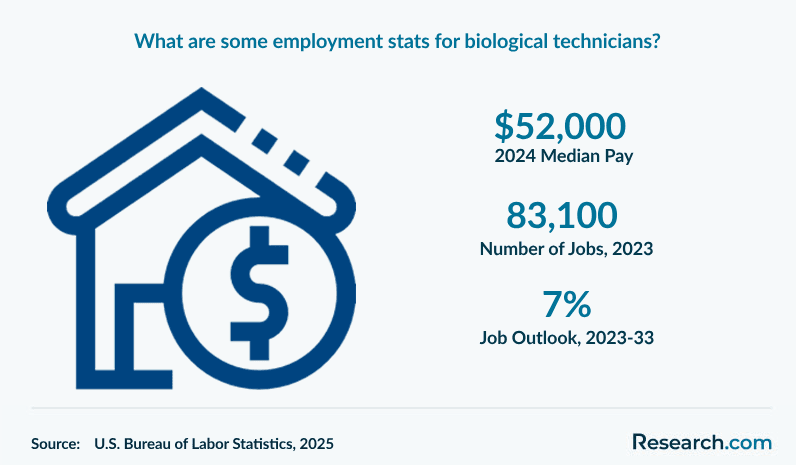
This labor-market data suggests that biological technician roles can be accessible to candidates with relevant bachelor’s-level preparation. A biotechnology certificate may help strengthen a candidate’s technical profile, but employers still evaluate hands-on experience, lab skills, documentation habits, and familiarity with regulated environments.
How much can you earn with an online biotechnology graduate certificate?
Earnings after a biotechnology certificate vary by job title, location, employer type, prior education, and experience. A certificate can improve your skill set, but it does not create a fixed salary outcome. For a broader overview of pay by role, compare related biotechnology salary information.
- Entry-Level Roles: Graduates entering the field with a new certificate can typically expect to earn between $60,000 and $75,000 annually in positions such as Research Associate or Quality Control (QC) Analyst.
- Experienced and Lead Roles: Professionals who move into senior or lead roles, such as Scientist I or Senior Research Associate, can earn salaries in the range of $75,000 to $95,000.
- Specialized Roles: Professionals with high-demand expertise in bioinformatics, computational biology, or regulatory affairs can earn higher salaries, often ranging from approximately $90,000 to over $110,000 annually.
2025 salary data from sources such as ZipRecruiter and PayScale show broad variation by role and location. These figures are not limited only to occupations requiring biotechnology graduate certificates; they include multiple degree levels and related biotechnology fields. Lower salaries appear for positions such as microbiology technologist ($38,627) and an entry-level biotech management role ($48,396).
Several positions fall in the mid-$50,000s to mid-$60,000s range, including research associate, biotechnology ($56,684), biotechnology research ($58,746), and biotechnologist ($63,909). More advanced roles show higher earnings, including senior research associate at $85,304 and process engineer at $75,727.
Location can strongly influence biotechnology pay. Several California cities, including San Francisco and Santa Clara, show salaries above $107,000 annually. The highest figure provided is Green River, WY, with an average salary of $113,457. This means career planning should include geography, not just job title or credential level.
The salary pattern is clear: higher pay is more likely when a certificate is combined with specialized expertise, experience, leadership responsibility, and a strong employment market. Students should use salary data as a planning tool, not as a promise of earnings.
What is the job market like for online biotechnology certificate graduates?
The biotechnology job market is shaped by research investment, pharmaceutical and medicine manufacturing, diagnostics, clinical trials, data-driven drug discovery, and regulated biomanufacturing. A certificate can help job seekers signal current skills, especially when the curriculum includes practical training or industry-aligned projects.
- Projected Growth: The U.S. Bureau of Labor Statistics projects that employment for biological technicians will grow by 5% from 2023 to 2033, a rate that is faster than the average for all occupations.
- High Demand: Growth is connected to research and development in biotechnology and medical sciences, including personalized medicine, genetic engineering, and biopharmaceutical production. Students seeking deeper graduate preparation may also compare an online Masters in Biotechnology.
- Annual Openings: On average, about 12,100 job openings for life, physical, and social science technicians are projected each year over the next decade, many due to workers retiring or transferring to other occupations.
- Global Market Expansion: Growth in the global biotechnology market supports long-term demand for skilled professionals across research, development, manufacturing, and commercialization.
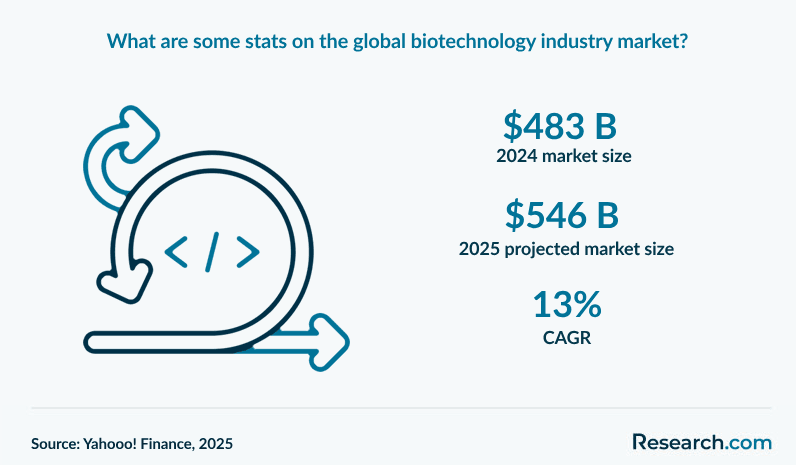
The global biotechnology industry market size is projected to grow from USD 483.0 billion in 2024 to USD 546.0 billion by 2025, driven by a compound annual growth rate (CAGR) of about 13.0%, as shown in the graphic below. Growth is being influenced by innovation, investment, and increased attention to advanced therapies.
Important market forces include biologic drugs such as monoclonal antibodies, gene therapies for complex diseases, and personalized medicine based on an individual’s genetic profile. Artificial intelligence and machine learning are also expected to accelerate drug discovery, improve clinical trial design, and increase efficiency in biomanufacturing.
In 2024, the industry saw major developments, including approval of CRISPR-based, microbiome-based, and cell and gene therapies. The sector is also moving toward greener biomanufacturing practices such as single-use and continuous bioprocessing to reduce costs and environmental impact.
What current and future biotechnology trends should students watch?
Biotechnology is changing quickly, and students should choose programs that teach skills employers are likely to value beyond the next hiring cycle. The strongest certificates are adapting to data science, automation, regulatory complexity, and advanced therapeutics.
- Personalized and Precision Medicine: Treatments are increasingly being designed around a person’s genetic profile, increasing demand for genomics and bioinformatics knowledge.
- CRISPR and Gene Editing: Gene editing continues to influence research and therapy development, especially for genetic diseases.
- AI and Machine Learning in Drug Discovery: Artificial intelligence is being used to analyze large datasets, identify possible drug candidates, improve trial planning, and support biology-data science hybrid roles.
- Synthetic Biology: Researchers are designing and building biological parts, systems, and processes for applications that include therapeutics, materials, and biofuels.
- Sustainable Biotechnology: Biotechnology is being applied to environmental challenges through biofuels, biodegradable plastics, and bioremediation.
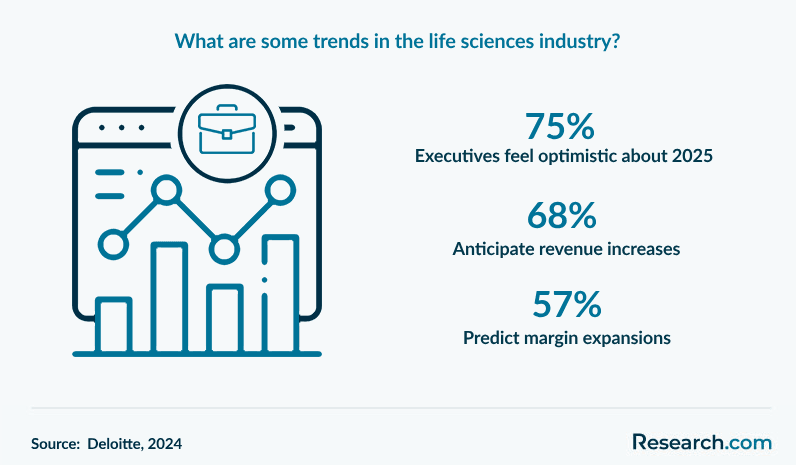
Deloitte (2024) reports a strongly positive 2025 outlook for the life sciences industry, with 75% of executives feeling optimistic. Financial expectations are also favorable, with 68% anticipating revenue increases and 57% predicting margin expansions. About 60% of leaders are both monitoring and planning to increase investments in generative AI.
Companies are also preparing for volatility by adapting operations and market strategies. Building resilient supply chains is a top priority for 37% of leaders, while nearly 60% are focused on optimizing operating models to manage costs and risk. Customer expectations are changing as well, with 36% of executives rating customer experience improvement as very important.
These trends point toward a biotech workforce that needs more than lab technique alone. Data literacy, quality systems, regulatory awareness, automation, and cross-functional communication are becoming more important. If you are debating whether to continue beyond a certificate, consider the long-term question: is it worth it to get a Masters in Biotech?
Key Insights
- The fastest listed option is not always the best graduate-level fit. Alvin Community College is described as a 15-week career launch option, while the University of Washington offers one of the fastest graduate-level timelines at 8-9 months.
- Program focus matters more than the word “biotechnology.” A bioinformatics certificate, a biomanufacturing certificate, and a biotechnology project management certificate can lead to very different jobs.
- Online does not always mean asynchronous. Some programs are fully online with no required meeting times, while others are hybrid or require live evening and weekend sessions.
- Stackable credits can improve ROI. Programs from Harvard University Extension School, Northeastern University, UMass Lowell, and the University of Wisconsin-Madison include pathways that may support continued graduate study.
- Cost comparisons should include more than tuition. Fees, materials, software, lab requirements, and travel can affect the real price of a certificate.
- Salary outcomes vary widely. Pay depends on geography, experience, specialization, employer type, and job function. A certificate strengthens your profile, but it does not guarantee a specific salary.
- Accreditation and applied training are essential checks. Before enrolling, verify accreditation, delivery format, prerequisites, transfer policies, and whether the curriculum produces practical evidence such as labs, internships, capstones, or portfolio work.
References:
- 6figr. (2025, July 14). Biotechnology salary in US. 6figr.
- Lyons, P., Konersmann, T., Gupta, L., & Gosalia, D. (2024, December 10). 2025 life sciences outlook. Deloitte.
- Nexford University. (2025, July 1). Top 10 highest paying jobs in biotechnology 2025 (including salaries). Nexford University Insights. Nexford University.
- PayScale. (2025). Certificate (Cert), Biotechnology degree salary. PayScale.
- U.S. Bureau of Labor Statistics. (2024, September 4). Biological technicians. U.S. Bureau of Labor Statistics.
- U.S. Bureau of Labor Statistics. (2024, September 4). Biological technicians. In Occupational outlook handbook. U.S. Bureau of Labor Statistics. https://www.bls.gov/ooh/life-physical-and-social-science/biological-technicians.htm
- ZipRecruiter. (2025, July 14). What is the average biotechnology certificate salary by state. ZipRecruiter.
- ZipRecruiter. (2025, July 15). Biotechnology salary. ZipRecruiter.
Other Things You Should Know About the Fastest Online Biotechnology Graduate Certificate Programs
The fastest online biotechnology graduate certificate programs in 2027 typically require around 12 to 15 credit hours. These condensed programs focus on providing essential biotechnology skills and knowledge swiftly, enabling students to complete their certificates in about six months to a year.
Yes, some credits can transfer into a related master’s program, but only if the receiving university approves them. Many schools cap transfer at 6 to 9 graduate credits and require a minimum grade of B or better. Accreditation and course match are the usual deciding factors.


