2027 Most Affordable Online Master's in Mathematics Degree Programs

Co-Founder and Chief Data Scientist
An online master’s in mathematics can be a practical next step if you already have strong quantitative training and want to move into higher-level work in data science, statistics, actuarial analysis, operations research, education, government research, or doctoral study. The decision is not simply whether the degree is “good.” The better question is whether a specific program gives you the right mix of advanced mathematics, applied skills, flexibility, accreditation, cost control, and career alignment.
This guide explains what online master’s in mathematics programs usually include, how long they take, what they cost at featured institutions, how online study compares with campus-based study, and which career paths may fit different goals. It also highlights common mistakes to avoid, questions to ask schools, and the job-market factors that matter most in 2026.
Quick answer: Is an online master’s in mathematics worth it?
An online master’s in mathematics can be worth it for students who want advanced quantitative roles, need a graduate credential for teaching or career advancement, or plan to strengthen preparation for doctoral study. The strongest fit is usually for students who already have a background in mathematics, statistics, engineering, computer science, or a closely related field and who can choose a program aligned with a specific outcome, such as data science, statistics, applied mathematics, actuarial work, or mathematics education.
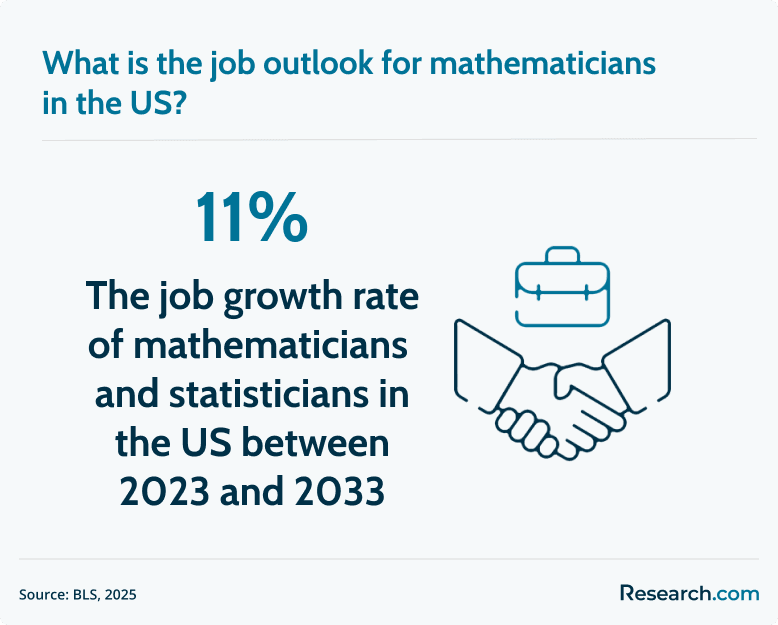
The labor market is favorable for several math-intensive careers. Employment for mathematicians and statisticians in the US is projected to grow by 11% from 2023 to 2033, while actuaries and data scientists are projected to grow by 22% and 36%, respectively, over the same period [US Bureau of Labor Statistics (BLS), 2025]. In 2024, mathematicians in the US earned a median annual wage of $121,680 (US BLS, 2025).
Key benefits of earning a master’s in mathematics online
- Career flexibility: Graduates may pursue roles such as mathematician, statistician, data scientist, actuary, operations research analyst, educator, or research professional, depending on coursework, experience, and specialization.
- Strong earning potential: The 2024 median annual wage for mathematicians employed in the US was $121,680 (US BLS, 2025), and several related roles also report strong median wages.
- Study without relocating: Online delivery can help working adults, teachers, military learners, caregivers, and career changers complete graduate coursework while staying in their current community.
- Access to advanced coursework: Online programs often cover graduate-level topics such as real analysis, abstract algebra, statistics, applied mathematics, numerical methods, and research or capstone work.
- Potential pathway to doctoral study or teaching: Some programs are designed for students preparing for PhD programs, dual-credit instruction, high school teaching advancement, or community college teaching.
What can I expect from online master’s in mathematics degree programs?
An online master’s in mathematics is an advanced graduate program focused on mathematical theory, quantitative reasoning, proof-based thinking, modeling, and applied problem-solving. Unlike a short professional certificate, a master’s program usually requires sustained work in abstract and applied topics, often with a capstone, research project, comprehensive exam, directed reading course, thesis, or non-thesis culminating requirement.
Students should expect demanding coursework. Common subjects include real analysis, abstract algebra, statistics, applied mathematics, numerical methods, differential equations, probability, topology, geometry, or mathematics education. Programs vary in emphasis: some are designed for teachers, some prepare students for doctoral work, and others support careers in analytics, research, government, or industry.
Online courses may be asynchronous, synchronous, or a mix of both. Asynchronous courses let students complete lectures and assignments on a weekly schedule, while synchronous courses require live virtual meetings. Even in flexible programs, graduate mathematics requires consistent study time, comfort with symbolic reasoning, and the discipline to work through proofs, computational problems, and research readings without the structure of daily campus attendance.
Typical online master’s in mathematics experience
| Program feature | What it usually means for students | Why it matters |
| Advanced mathematics core | Courses may include real analysis, abstract algebra, statistics, or applied mathematics. | The core determines whether the degree supports teaching, research, analytics, or doctoral preparation. |
| Online course delivery | Students use a learning platform for lectures, assignments, discussions, exams, and faculty communication. | Online format helps with flexibility, but students must manage deadlines independently. |
| Capstone, research, exam, or thesis option | Many programs require a final academic milestone to demonstrate graduate-level mastery. | The culminating requirement can affect workload, timeline, and doctoral preparation. |
| Specialization options | Some schools offer tracks such as applied mathematics, statistics, algebra, analysis, mathematics education, or related areas. | Specialization should match the role or academic path the student wants after graduation. |
| Faculty and student support | Students may access virtual office hours, advising, tutoring, library resources, and career services. | Support services are especially important in proof-heavy and computational courses. |
Where can I work with an online master’s in mathematics degree?
Graduates with advanced mathematics training can work in government, education, technology, finance, insurance, research, consulting, manufacturing, healthcare analytics, and scientific organizations. The best-fit workplace depends heavily on specialization. A student focused on statistics may target research, healthcare, or government roles; a student focused on applied mathematics may fit scientific computing or engineering-adjacent work; a student focused on education may pursue teaching or instructional leadership pathways.
In 2023, around 2,500 mathematicians were employed in the US. According to the US BLS (2025), the largest shares of these professionals worked in the following industries:
- Federal Government: 49%
- Professional, Scientific, and Technical Services: 17%
- Colleges, Universities, and Professional Schools (State): 17%
- Aerospace Product and Parts Manufacturing: 4%
- Miscellaneous Manufacturing: 3%
In the same year, 32,400 statisticians were employed across the country. The largest employer groups were:
- Federal Government: 16%
- Research and Development in the Physical, Engineering, and Life Sciences: 16%
- Healthcare and Social Assistance: 7%
- Computer Systems Design and Related Services: 6%
- Colleges, Universities, and Professional Schools (State): 6%
Data science is a much larger employment category. In 2023, 202,900 data scientists were employed in the US, with the largest shares working in these industries:
- Computer Systems Design and Related Services: 11%
- Insurance Carriers and Related Activities: 10%
- Management of Companies and Enterprises: 9%
- Management, Scientific, and Technical Consulting Services: 6%
- Scientific Research and Development Services: 5%
How much can I make with an online master’s in mathematics degree?
Salary depends on role, industry, location, experience, technical skills, security clearance requirements, and whether the position is research-focused, teaching-focused, or industry-focused. A master’s degree can strengthen eligibility for some roles, but it does not guarantee a specific salary.
According to 2025 data from the US BLS, the 2024 median annual wages for selected mathematics-related careers were:
| Career path | 2024 median annual wage | How a mathematics master’s may help |
| Mathematician | $121,680 | Builds advanced theory, modeling, and research preparation. |
| Statistician | $103,300 | Supports statistical modeling, inference, analysis, and research roles. |
| Data Scientist | $112,590 | Strengthens quantitative modeling and analytical foundations, especially when paired with programming and data tools. |
| Actuary | $125,770 | Provides a strong math background, though actuarial exams and industry-specific preparation remain important. |
| Operations Research Analyst | $91,290 | Supports optimization, decision modeling, simulation, and analytical problem-solving. |
The highest-value programs are usually those that help students translate mathematical training into a concrete career direction. For data-focused roles, that may mean programming and statistical modeling. For actuarial roles, that may mean exam preparation and risk modeling. For teaching, that may mean pedagogy, curriculum, and credential requirements.
- List of Online Master's in Mathematics Degree Programs for 2027 Program length and pacing
- How long does it take to complete an online master’s in mathematics degree program?
- How does an online master’s in mathematics degree program compare to an on-campus program?
- What is the average cost of an online master’s in mathematics degree program?
- What are the financial aid options for students enrolling in an online master’s in mathematics degree program?
- What are the prerequisites for enrolling in an online master’s in mathematics degree program?
- What courses are typically in an online master’s in mathematics degree program?
- What accreditation and quality standards should you look for in an online master’s in mathematics degree program?
- What technology and support services boost success in online master’s in mathematics programs?
- How does the affordability of online master’s in mathematics compare to other advanced degree programs?
- How do online master’s in mathematics programs facilitate effective networking opportunities?
- What types of specializations are available in online master’s in mathematics degree programs?
- How do you choose the best online master’s in mathematics degree program?
- What career paths are available to graduates of online master’s in mathematics degree programs?
- What is the job market like for graduates of online master’s in mathematics degree programs? Key insights
List of Online Master's in Mathematics Degree Programs for 2027
The programs below are examples of online or online-accessible master’s options in mathematics, mathematics teaching, or mathematics education. Use them as a starting point rather than as a final ranking. A strong program for one student may be a poor fit for another if the curriculum, residency pricing, teaching focus, research expectations, or specialization options do not match the student’s goals.
The list was developed using the Research.com methodology. The Research.com team collected and reviewed recent information from the IPEDS database, Peterson's database, the College Scorecard database, and the National Center for Education Statistics.
Featured program comparison
| School | Program focus | Program length | Credits | Listed cost | Accreditation |
| Sam Houston State University | Mathematics; non-thesis option with teaching and doctoral-preparation relevance | 2 years | 36 credits | $636.60 (Resident); $1,041.60 (Non-resident) per credit for 2026–2027 | Southern Association of Colleges and Schools Commission on Colleges (SACSCOC) |
| Emporia State University | Mathematics with options including applied mathematics, statistics, algebra, and analysis | 2 years | 32 to 34 credits | $184.73 (Resident); $277.10 (Non-resident) per credit for 2024 | Higher Learning Commission (HLC) |
| Indiana University-East | Master of arts for teachers in mathematics | 2 years | 30 credits | $342.42 (Resident); $814.53 (Non-resident) per credit for 2024–2025 | HLC |
| University of North Alabama | MS in mathematics for teaching, professional advancement, and PhD preparation | 2 years | 30 credits | $495 per credit | Southern Association of Colleges and Schools Commission on Colleges (SACSCOC) |
| Western Governors University | Mathematics education programs for aspiring educators | More or less 2 years | Contact the university for information on credit requirements. | $4,125 per term | Northwest Commission on Colleges and Universities (NWCCU) |
1. Sam Houston State University
Sam Houston State University offers a master’s in mathematics in both online and campus formats. The program is a non-thesis option intended for students who want advanced preparation for teaching mathematics at the high school or community college level, as well as students considering doctoral work in mathematics education. Requirements include core mathematics courses, electives, a directed reading and research course, an oral comprehensive examination, and a 12-hour minor in an approved field.
- Program Length: 2 years
- Areas of Specialization: Contact the university for more information on areas of specialization.
- Cost per Credit (2026–2027): $636.60 (Resident); $1,041.60 (Non-resident)
- Required Credits to Graduate: 36 credits
- Accreditation: Southern Association of Colleges and Schools Commission on Colleges (SACSCOC)
2. Emporia State University
Emporia State University offers online and on-campus master’s in mathematics options through the School of Science and Mathematics. Students can pursue areas such as applied mathematics, statistics, algebra, and analysis. The university also offers scholarships to a limited number of graduate students in online and on-campus formats based on academic performance in the program.
- Program Length: 2 years
- Areas of Specialization: Applied Mathematics, Statistics, Algebra, Analysis
- Cost per Credit (2024): $184.73 (Resident); $277.10 (Non-resident)
- Required Credits to Graduate: 32 to 34 credits
- Accreditation: Higher Learning Commission (HLC)
3. Indiana University-East
Indiana University-East provides an online master of arts for teachers (MAT) in mathematics. The program combines graduate mathematics coursework with education-focused study and is built for educators who want preparation for dual-credit high school instruction or community college teaching. The education side may include instruction and curriculum, assessment, and research, while the mathematics side may include algebra, analysis applications, topology, geometry, differential equations, probability, and statistics.
- Program Length: 2 years
- Areas of Specialization: Algebra, Analysis, Topology and Geometry, Differential Equations and Applications, and Probability and Statistics
- Cost per Credit (2024–2025): $342.42 (Resident); $814.53 (Non-resident)
- Required Credits to Graduate: 30 credits
- Accreditation: HLC
4. University of North Alabama
The University of North Alabama offers an online MS in mathematics. The program is intended for students seeking advancement in teaching, related professional fields, or preparation for PhD-level study. Coursework includes topics such as foundations of advanced mathematics, advanced calculus, and group theory.
- Program Length: 2 years
- Areas of Specialization: Contact the university for more information on areas of specialization.
- Cost per Credit: $495
- Required Credits to Graduate: 30 credits
- Accreditation: Southern Association of Colleges and Schools Commission on Colleges (SACSCOC)
5. Western Governors University
Western Governors University offers four online master’s programs connected to mathematics and education. Depending on the chosen option, these programs are designed for educators who want to strengthen mathematics instruction for learners from K-6 through secondary school.
- Program Length: More or less 2 years
- Areas of Specialization: Secondary Mathematics; Teaching Secondary Mathematics; K-6 Mathematics; Middle Grades Mathematics
- Cost per Term: $4,125
- Required Credits to Graduate: Contact the university for information on credit requirements.
- Accreditation: Northwest Commission on Colleges and Universities (NWCCU)
How long does it take to complete an online master’s in mathematics degree program?
Most online master’s in mathematics programs can be completed in about 1.5 to 2 years by full-time students. Part-time students commonly need 2.5 to 3 years, especially if they are teaching, working full time, or balancing family obligations. Many programs require 30 to 36 credit hours, although the exact requirement varies by school.
Program length is shaped by credit load, course availability, capstone or exam requirements, thesis versus non-thesis structure, and whether courses are offered every term. Some universities also offer accelerated options that may be completed in 1 to 1.5 years, but faster completion usually requires a heavier workload and careful planning.
Timeline by enrollment style
| Enrollment approach | Common completion time | Best for | Main trade-off |
| Full-time | 1.5 to 2 years | Students who can prioritize graduate study and take multiple courses per term. | Higher weekly workload and less flexibility for demanding jobs. |
| Part-time | 2.5 to 3 years | Working professionals, teachers, caregivers, and students who need a manageable pace. | Longer time to graduation and possibly more exposure to tuition or fee changes. |
| Accelerated | 1 to 1.5 years | Students with strong preparation, clear goals, and enough time for intensive study. | Less room for schedule disruptions, weaker fit for students who need academic ramp-up time. |
How does an online master’s in mathematics degree program compare to an on-campus program?
Online and on-campus master’s in mathematics programs may share the same faculty, academic standards, and degree title, but the student experience can be very different. The better option depends on how you learn, how much schedule flexibility you need, and whether you benefit more from campus-based interaction or independent online study.
| Factor | Online master’s in mathematics | On-campus master’s in mathematics |
| Schedule | Often more flexible, especially when courses are asynchronous. | Usually follows set class times and campus attendance expectations. |
| Faculty access | May rely on email, discussion boards, video meetings, and virtual office hours. | Provides easier access to in-person office hours and informal academic conversations. |
| Peer interaction | Requires intentional participation in virtual groups, discussions, and projects. | Offers more spontaneous collaboration before and after class. |
| Campus resources | Usually includes digital libraries, advising, learning platforms, and remote support. | May provide more direct access to labs, campus events, tutoring centers, and research groups. |
| Relocation and commuting | Can reduce the need to move or commute. | May require living near campus or traveling regularly. |
The flexibility advantage is similar to why working professionals in other fields compare online options, such as affordable online MSN in care coordination programs, when they need graduate education that fits around employment.
What is the average cost of an online master’s in mathematics degree program?
The cost of an online master’s in mathematics varies by institution, residency status, credit requirement, fee structure, and whether the school charges by credit, term, or another pricing model. Public universities may offer lower rates to residents, while non-resident students may pay more. Private and competency-based models can use different tuition structures.
When comparing programs, do not look only at the advertised tuition rate. Ask for the full estimated cost of attendance, including tuition, university fees, technology fees, textbooks, software, exam or graduation fees, and any required campus visits. Online programs can reduce commuting and relocation expenses, but students still need reliable internet access, appropriate technology, and a quiet study environment.
A cost comparison should also include academic value. A lower-cost program may be a strong choice if it has the right accreditation, courses, faculty access, and student support. A higher-priced program may be worth considering only if it offers a clear advantage for your goals, such as specialized coursework, stronger teaching preparation, or better alignment with doctoral study.
Students comparing graduate costs across fields may also review resources such as affordable online master's in clinical nurse leadership programs to see how program pricing, fees, and professional outcomes are evaluated in other disciplines.
Cost factors to verify before enrolling
- Residency pricing: Confirm whether online students pay resident, non-resident, or separate online tuition rates.
- Total credits: A lower per-credit rate may not be cheaper if the program requires more credits.
- Term-based tuition: If tuition is charged per term, ask how pacing affects total cost.
- Required technology: Check whether specialized software, hardware, proctoring tools, or calculators are required.
- Transfer credits: Ask whether graduate transfer credits are accepted and how they affect cost and completion time.
- Employer support: If you work in education, government, finance, technology, or defense-related settings, ask whether your employer offers tuition assistance.
The chart below visualizes the cost per credit for featured online master’s in mathematics programs in the US based on the tuition data provided by the listed academic institutions.
What are the financial aid options for students enrolling in an online master’s in mathematics degree program?
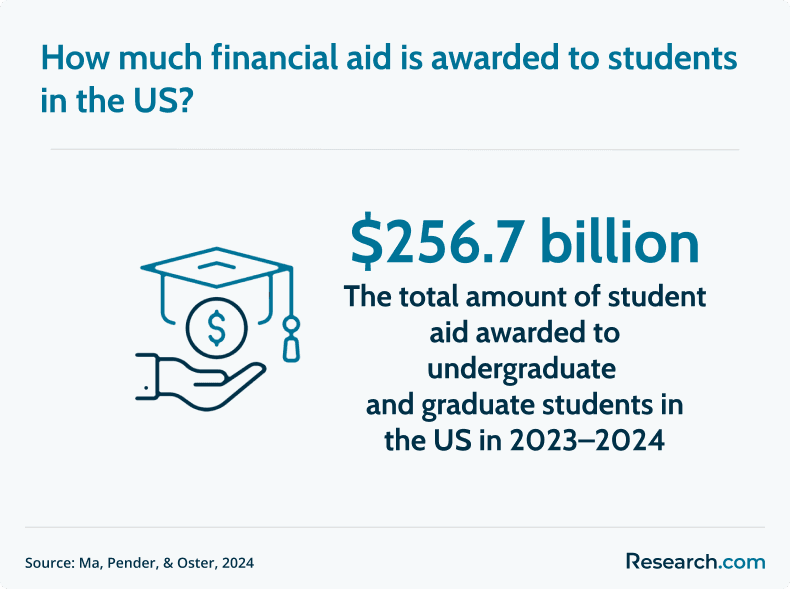
Graduate students in mathematics may be able to use a combination of scholarships, fellowships, assistantships, employer tuition assistance, payment plans, and federal aid options for eligible programs. Aid rules vary by institution, enrollment status, citizenship status, academic progress, and program structure, so students should confirm eligibility directly with the school’s financial aid office.
- National Defense Science & Engineering Graduate (NDSEG) Fellowship: This fellowship is funded by the US Department of Defense and supports US citizens pursuing graduate study in science and engineering fields. It covers full tuition and provides a $43,200 annual stipend as well as travel allowances.
- SBB Research Group STEM Scholarship: This scholarship provides $2,500 for students pursuing STEM degrees. Applicants must have a minimum GPA of 3.5 and submit a 500-word essay explaining key STEM experiences and how they plan to use STEM principles to benefit the world.
- Women in Finance Scholarship: This scholarship supports women in graduate finance study. Eligible applicants must be enrolled full-time in a master’s or PhD program in finance, have fewer than 10 years of total work experience, and fewer than 5 years of work experience in finance. Students comparing debt-sensitive options in quantitative business fields may also find it useful to review resources on the cheapest online finance degree.
Practical ways to reduce graduate math program costs
- Ask whether online students qualify for department scholarships or graduate awards.
- Compare total program cost, not just the per-credit rate.
- Check whether your employer reimburses graduate coursework tied to analytics, teaching, technology, finance, or research responsibilities.
- Consider part-time enrollment if it allows you to keep employer benefits and avoid borrowing more than necessary.
- Ask whether prior graduate coursework can transfer into the program.
- Confirm whether financial aid requires a minimum number of credits per term.
What are the prerequisites for enrolling in an online master’s in mathematics degree program?
Admission requirements vary, but most online master’s in mathematics programs expect applicants to show readiness for graduate-level proof, analysis, algebra, statistics, and applied problem-solving. A student without sufficient undergraduate preparation may need prerequisite coursework before full admission.
- Bachelor’s degree in mathematics or a related field: Many programs prefer applicants with a degree in mathematics, statistics, engineering, computer science, or a closely related quantitative discipline. Similar discipline-specific preparation is common in other graduate fields, including options such as an affordable online master's in health systems management.
- Undergraduate coursework in core mathematics: Applicants may be expected to have completed calculus, linear algebra, differential equations, and real analysis, depending on the program’s rigor and focus.
- Minimum GPA requirement: Many schools use a minimum undergraduate GPA, often around 3.0 on a 4.0 scale, as one indicator of academic preparation.
Other materials you may need
- Official transcripts from all previously attended colleges or universities.
- Letters of recommendation from faculty or professional supervisors who can evaluate quantitative ability.
- A statement of purpose explaining academic interests and career goals.
- A resume or curriculum vitae, especially for applicants with teaching, analytics, research, or technical experience.
- Proof of English language proficiency when required by the institution.
- GRE scores if the school requires or recommends them.
What courses are typically in an online master’s in mathematics degree program?
Curriculum design depends on whether the degree emphasizes pure mathematics, applied mathematics, statistics, teaching, or doctoral preparation. Students should review course descriptions carefully because two programs with similar degree names can prepare students for very different outcomes.
- Real Analysis: This course develops a rigorous understanding of calculus through topics such as sequences, limits, continuity, and integration. It is central for students who need stronger proof-writing and theoretical reasoning.
- Abstract Algebra: Students study structures such as groups, rings, and fields. The course supports deeper work in number theory, symmetry, algebraic systems, and advanced mathematical problem-solving.
- Numerical Methods: This course focuses on computational approaches for solving mathematical problems, including root-finding, numerical integration, and differential equation techniques. It is especially relevant for scientific computing, engineering-adjacent work, and applied modeling.
Mathematics also supports fields that may not seem math-heavy at first glance. For example, students sometimes ask, “Is math required for psychology major?” The answer is that psychology typically requires less advanced mathematics than a graduate math program, but statistics and quantitative reasoning remain important for research and data interpretation.
Course selection by career goal
| If your goal is... | Prioritize courses in... | Also build skills in... |
| Data science or analytics | Statistics, probability, numerical methods, optimization, applied mathematics | Programming, databases, machine learning concepts, data visualization |
| Actuarial or risk analysis | Probability, statistics, financial mathematics, modeling | Exam preparation, insurance or finance knowledge, spreadsheet and programming tools |
| Teaching or dual-credit instruction | Advanced mathematics content, mathematics education, curriculum, assessment | State credential rules, instructional technology, classroom assessment |
| Doctoral study | Real analysis, abstract algebra, topology, advanced proof-based courses | Research reading, faculty mentorship, thesis or research projects |
| Operations research | Optimization, modeling, numerical methods, applied mathematics | Simulation, decision analytics, programming, business operations knowledge |
What accreditation and quality standards should you look for in an online master’s in mathematics degree program?
Accreditation is one of the first quality checks students should complete. At minimum, confirm that the institution is accredited by a recognized accrediting body. Institutional accreditation can affect federal financial aid eligibility, transferability of credits, employer recognition, and admission to future graduate or doctoral programs.
Quality also depends on factors beyond accreditation. Review faculty credentials, graduate course depth, student support, online learning design, outcomes transparency, and whether the program’s purpose matches your goal. A mathematics education program, for example, may be excellent for teachers but less appropriate for a student seeking a research-heavy PhD pathway in pure mathematics.
Students comparing advanced online degrees across fields may notice similar quality checks in resources such as the cheapest Ed.D. online program, where accreditation, completion time, and program purpose also affect value.
Accreditation checklist
- Is the institution accredited by a recognized accreditor?
- Does the school clearly state its accreditation status on its official website?
- Will the degree meet employer, doctoral admission, or teaching requirements for your goal?
- If you plan to teach, does the program meet your state or employer’s credential expectations?
- Are online students eligible for the same academic records and degree title as other students?
What technology and support services boost success in online master’s in mathematics programs?
Online mathematics study works best when the school provides more than recorded lectures. Students need dependable learning technology, access to faculty, digital library resources, math-friendly collaboration tools, and academic support that can handle advanced quantitative coursework.
Useful support services may include technical help desks, online tutoring, graduate advising, virtual office hours, writing support for proof-based and research assignments, career coaching, and access to research databases. Students who are transitioning into teaching may also benefit from mentoring, classroom-focused assignments, and peer communities. Similar considerations apply to education-focused graduate pathways, including online master's programs for teachers.
Technology and support questions to ask
- Are lectures live, recorded, or both?
- How do students submit mathematical notation, proofs, and computational assignments?
- Does the program provide access to statistical or mathematical software?
- How quickly do faculty typically respond to questions?
- Are tutoring and advising available to online graduate students?
- Does the library provide remote access to journals, databases, and research materials?
How does the affordability of online master’s in mathematics compare to other advanced degree programs?
Online master’s in mathematics programs can be cost-effective when they have moderate credit requirements, reasonable tuition, and a clear connection to career advancement. However, affordability is not the same as low tuition. A program is financially sensible only if it supports the outcome you want and does not require unnecessary credits, fees, or time away from work.
Compared with longer advanced degrees, some master’s programs require a shorter time commitment. Doctoral programs, for example, may involve additional years of study and a different set of academic expectations. Students reviewing graduate education broadly may compare cost structures with resources such as the cheapest online doctor of education programs.
When a lower-cost math master’s may be the better choice
- You already know the curriculum fits your target role.
- The institution has appropriate accreditation.
- The program offers courses in your intended specialization.
- You can finish without excessive borrowing.
- The online format lets you keep working while studying.
When paying more may be defensible
- The program offers a specialization that lower-cost options do not.
- Faculty expertise closely matches your research or doctoral goals.
- The school has strong support for teachers, statisticians, data professionals, or another specific pathway.
- The program structure helps you finish faster without sacrificing academic quality.
How do online master’s in mathematics programs facilitate effective networking opportunities?
Online students need to be intentional about networking because they do not benefit from the same informal hallway conversations, campus seminars, and in-person study groups as residential students. Strong online programs address this through virtual office hours, group projects, alumni events, career webinars, discussion boards, research collaborations, and faculty mentorship.
Networking matters because many mathematics-related careers depend on more than coursework. Students may need recommendation letters, referrals, research experience, teaching references, or project examples. Interdisciplinary comparison can also be useful; for example, students exploring policy, analytics, or public-sector pathways may review programs such as the cheapest political science degree online accredited options to understand how online programs build community and professional connections in different fields.
How to build a professional network as an online math graduate student
- Attend live sessions even when recordings are available.
- Use faculty office hours before you are struggling.
- Join study groups for proof-heavy or computational courses.
- Ask about alumni working in data science, teaching, government, insurance, or research.
- Present capstone or project work when the program offers virtual showcases.
- Build a portfolio of applied work if you are targeting analytics or data science roles.
What types of specializations are available in online master’s in mathematics degree programs?
Specializations help students connect the degree to a specific career or academic goal. Choosing the right concentration is often more important than choosing the most familiar school name. A student aiming for teaching should not choose the same curriculum as a student planning for operations research or doctoral work in pure mathematics.
- Applied Mathematics: This area uses mathematical tools to model and solve practical problems in science, industry, engineering, and technology. Students interested in modeling, systems, signal processing, or technical problem-solving may also want to explore related engineering career paths.
- Statistics: A statistics track emphasizes probability, inference, regression, experimental design, and data interpretation. It can support careers in government research, healthcare analytics, business intelligence, and data science.
- Mathematics Education: This specialization is designed for educators who want deeper content knowledge and stronger instructional practice for secondary, dual-credit, or postsecondary teaching contexts.
How to choose a specialization
| Specialization | Good fit for | May be less ideal if... |
| Applied Mathematics | Students interested in modeling, optimization, computation, scientific applications, or engineering-adjacent roles. | You prefer abstract theory with little applied or computational work. |
| Statistics | Students targeting analytics, research, policy analysis, healthcare data, business intelligence, or data science. | You do not want to work with data, statistical software, or probability-based reasoning. |
| Mathematics Education | Teachers and aspiring instructors seeking advanced mathematics content and pedagogy. | You are seeking a research-heavy pure mathematics pathway or non-teaching industry role. |
| Algebra or Analysis | Students preparing for doctoral study or deeper theoretical work. | You need a career-focused analytics curriculum with programming and applied projects. |
How do you choose the best online master’s in mathematics degree program?
The best online master’s in mathematics is the one that fits your academic background, career target, budget, learning style, and credential needs. A well-known school is not automatically the best choice if the program lacks the courses or support services you need.
- Accreditation: Verify institutional accreditation before applying. This matters for degree recognition, financial aid eligibility, transfer credit, and future study. The same principle applies across graduate programs, including specialized healthcare options such as affordable nurse midwifery MSN degree programs online.
- Curriculum and specializations: Review the full degree plan, not just the program title. Make sure the required and elective courses support your intended path.
- Faculty expertise and support services: Look for faculty with relevant academic or professional interests, plus advising, tutoring, library access, and career services that are available to online students.
Step-by-step program selection process
- Define your target outcome. Decide whether you want teaching advancement, doctoral preparation, data science, actuarial work, statistics, operations research, or another path.
- Check admission fit. Compare your undergraduate coursework against prerequisite expectations in calculus, linear algebra, differential equations, and real analysis.
- Verify accreditation. Confirm that the institution is properly accredited and that the credential will be recognized for your goal.
- Map the curriculum to your goal. Identify required courses, electives, capstone requirements, thesis options, and specialization availability.
- Calculate full cost. Include tuition, fees, technology, software, books, and any required visits or exam costs.
- Evaluate online support. Ask about advising, tutoring, faculty access, tech support, career services, and library resources.
- Ask about outcomes. Request information about graduate pathways, teaching placements, doctoral admissions, or employment support if available.
- Compare workload with your schedule. Make sure the program pace is realistic if you work full time or have other obligations.
Common mistakes to avoid
| Mistake | Why it can hurt you | Better approach |
| Choosing only by tuition | The cheapest option may lack the specialization, support, or structure you need. | Compare total value: cost, curriculum, accreditation, support, and career fit. |
| Ignoring accreditation | Accreditation can affect aid eligibility, employer recognition, transfer credits, and future study. | Verify institutional accreditation before applying. |
| Assuming every online program fits every career | A teaching-focused program may not prepare you for data science or doctoral research. | Match the curriculum to a defined outcome. |
| Underestimating proof-based coursework | Graduate mathematics can be difficult even for strong undergraduate students. | Review prerequisites and refresh weak areas before starting. |
| Overlooking licensure or teaching rules | Education-focused degrees may not automatically meet state certification requirements. | Confirm requirements with the school, employer, and state education agency. |
| Relying only on rankings | Rankings may not reflect your specialization, cost, or schedule needs. | Use rankings as one input, then evaluate fit directly. |
What career paths are available to graduates of online master’s in mathematics degree programs?
Graduates can pursue several quantitative and education-focused roles, but career options depend on specialization, work experience, software skills, licensure where applicable, and industry knowledge. A mathematics master’s is strongest when paired with evidence of applied ability, such as research, teaching experience, coding projects, statistical analysis, actuarial exam progress, or modeling work.
- Mathematician: Mathematicians use advanced mathematical theory and modeling to solve complex problems in research, government, academia, and scientific settings.
- Statistician: Statisticians design studies, analyze data, interpret trends, and support evidence-based decisions in areas such as healthcare, public policy, business, and research.
- Data Scientist: Data scientists combine mathematics, statistics, programming, and domain knowledge to analyze large datasets and guide decisions. Students interested in this route may also compare adjacent pathways such as how to become a machine learning engineer.
- Actuary: Actuaries apply mathematics, statistics, and financial theory to evaluate risk and uncertainty, commonly in insurance, pensions, and financial services.
- Operations Research Analyst: Operations research analysts use optimization, modeling, and quantitative analysis to improve systems, logistics, staffing, costs, and organizational decisions.
Students aiming to teach should check state and employer requirements carefully. Research.com’s guide on What certification do you need to teach math? explains that requirements vary by state and often include a teaching license and completion of a teacher preparation program in addition to mathematics coursework.
The chart below visualizes the 2024 median annual wages for mathematics-related roles based on 2025 data from the US BLS.
What is the job market like for graduates of online master’s in mathematics degree programs?
The job market is especially strong for graduates who can combine mathematical reasoning with applied technical skills. Employers increasingly need professionals who can model uncertainty, analyze data, optimize systems, communicate quantitative findings, and use software tools responsibly. AI and automation are changing many analytical jobs, but they also increase the need for professionals who understand the mathematics behind models, can evaluate outputs, and can explain limitations.
US BLS projections point to strong growth in several math-intensive occupations. Employment for data scientists is projected to grow by 36% from 2023 to 2033, with about 20,800 job openings each year. Actuaries are projected to grow by 22%, with about 2,200 openings annually (US BLS, 2025).
Operations research analysts are projected to grow by 23%, with about 11,300 job openings per year. Statisticians are projected to grow by 12%, contributing to the broader 11% projected growth for mathematicians and statisticians combined, equal to about 2,500 openings annually (US BLS, 2025).
For teaching-focused students, a mathematics master’s can also support education pathways. If you are weighing whether teaching aligns with your goals, Research.com’s guide on reasons to become a teacher can help you think through the professional and personal motivations behind that decision.
Current trends affecting mathematics master’s graduates
- AI is raising expectations for technical judgment: Employers need people who can understand models, question outputs, and explain mathematical assumptions rather than simply run tools.
- Programming is increasingly important: For analytics, data science, operations research, and applied mathematics roles, graduate math training is stronger when paired with coding and software experience.
- Teaching pathways are becoming more specialized: Students pursuing dual-credit, secondary, or community college instruction should verify credential expectations before enrolling.
- Interdisciplinary roles are expanding: Mathematics graduates may work in healthcare analytics, insurance, consulting, scientific research, government, technology, and education.
- Proof and theory still matter: Even in applied careers, rigorous reasoning helps graduates evaluate models, uncertainty, and data-driven claims.
Key Insights
- An online master’s in mathematics is most valuable when it is tied to a clear goal, such as statistics, data science, actuarial work, operations research, teaching, or doctoral preparation.
- Labor-market projections are strong for several math-heavy roles: data scientists are projected to grow by 36%, actuaries by 22%, operations research analysts by 23%, and mathematicians and statisticians by 11% from 2023 to 2033 (US BLS, 2025).
- Salary potential is strong but not guaranteed. In 2024, median annual wages were $121,680 for mathematicians, $103,300 for statisticians, $112,590 for data scientists, $125,770 for actuaries, and $91,290 for operations research analysts.
- Most programs take about 1.5 to 2 years full time or 2.5 to 3 years part time, with many requiring 30 to 36 credit hours.
- Accreditation, prerequisites, course depth, faculty support, and total cost matter more than program title alone.
- Students planning to teach must confirm certification, licensure, or dual-credit requirements rather than assuming the degree automatically qualifies them.
- For analytics and industry roles, pair advanced mathematics with programming, statistics, modeling, communication, and domain knowledge.
- The best program is not necessarily the cheapest or the most famous. It is the program that fits your preparation, budget, schedule, and intended career path.
References
- Ma, J., Pender, M., & Oster, M. (2024). Trends in College Pricing and Student Aid 2024. College Board. https://research.collegeboard.org/media/pdf/Trends-in-College-Pricing-and-Student-Aid-2024-ADA.pdf
- National Center for Education Statistics. (2024, May). Graduate Degree Fields. Condition of Education. US Department of Education, Institute of Education Sciences. https://nces.ed.gov/programs/coe/indicator/ctb/graduate-degree-fields#suggested-citation
- US Bureau of Labor Statistics. (2025, April 18). Actuaries. Occupational Outlook Handbook. https://www.bls.gov/ooh/math/actuaries.htm
- US Bureau of Labor Statistics. (2025, April 18). Data Scientists. Occupational Outlook Handbook. https://www.bls.gov/ooh/math/data-scientists.htm
- US Bureau of Labor Statistics. (2025, April 18). Mathematicians and Statisticians. Occupational Outlook Handbook. https://www.bls.gov/ooh/math/mathematicians-and-statisticians.htm
- US Bureau of Labor Statistics. (2025, April 18). Operations Research Analysts. Occupational Outlook Handbook. https://www.bls.gov/ooh/math/operations-research-analysts.htm
Other Things You Need to Know about Online Master's in Mathematics Degree Programs
Many low-cost online mathematics master’s programs end with either a thesis or a capstone, but not both. Thesis options often require 30 to 36 credits plus faculty approval, while capstone tracks usually replace the thesis with a final project or portfolio reviewed by the department.
The average cost for the most affordable online Master's in Mathematics degree programs in 2027 typically ranges from $5,000 to $15,000. This range can vary based on the institution, program length, and additional fees such as technology or graduation fees.
Applicants usually need a bachelor's degree in mathematics or a related field, a minimum GPA of 3.0, and submission of GRE scores. Some programs may also require letters of recommendation and a statement of purpose for the 2027 intake.