2027 Types of Engineering Branches: Salaries & Job Outlooks

Co-Founder and Chief Data Scientist
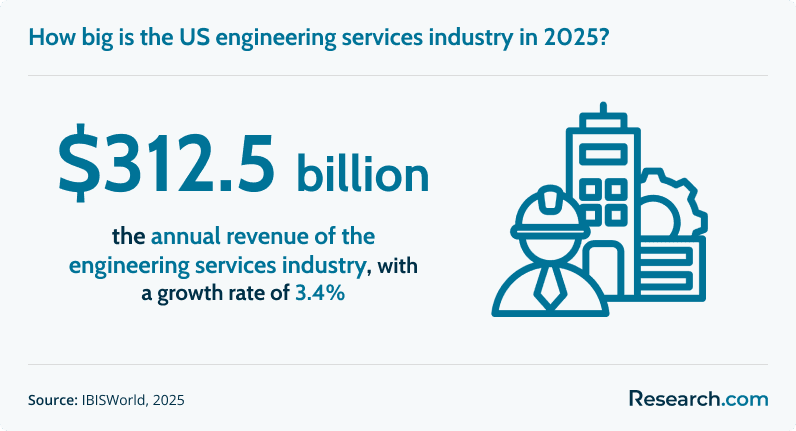
Choosing an engineering branch is not just a college-major decision; it shapes the industries you can enter, the problems you will solve, the credentials you may need, and the salary range you can realistically pursue. The US engineering services industry is projected to reach $312.5 billion in revenue by 2025, with growth of 3.4%, but demand is not evenly distributed across every specialization. This guide explains the main types of engineering, compares career options, and shows how to evaluate salary, job outlook, education requirements, licensing, and long-term fit before committing to a path.
Quick Answer: What Are the Main Engineering Branches?
The major engineering branches are civil, mechanical, electrical, chemical, and industrial engineering. Many students also consider computer, aerospace, biomedical, environmental, materials, petroleum, nuclear, marine, and cybersecurity-related engineering roles. The best branch depends on your strengths, interests, preferred work setting, tolerance for regulation or licensure, and career goals. In 2023, some of the highest median salaries were reported for computer hardware engineers ($138,080), petroleum engineers ($135,690), and aerospace engineers ($130,720), while industrial engineers and bioengineers and biomedical engineers had some of the strongest projected growth at 12% from 2023 to 2033.
Key Things You Should Know About the Types of Engineering Branches
- Engineering remains a sizable and resilient career category. The US engineering services industry is projected to produce $312.5 billion in revenue by 2025, growing at 3.4%, which reflects continuing demand for technical expertise in infrastructure, manufacturing, energy, healthcare, and technology.
- Pay differs significantly by discipline. Median 2023 wages were highest among computer hardware engineers ($138,080), petroleum engineers ($135,690), and aerospace engineers ($130,720), but salaries still depend heavily on employer, region, experience, and industry.
- Growth is stronger in some branches than others. Industrial engineers and bioengineers and biomedical engineers are projected to grow 12% from 2023 to 2033, while mechanical engineers are projected to grow 11%. Nuclear engineering, by contrast, is more limited, with stagnation or slight decline.
- Most engineering roles start with a bachelor’s degree, but some paths require more. A bachelor’s degree is the common entry point, while research, senior design, management, and specialized technical roles may require a master’s degree or PhD. Median in-state public tuition for engineering programs is around $8,935, while private tuition can reach $46,170.
- Engineering can lead beyond design and technical production. Engineers may move into operations, consulting, product leadership, teaching, entrepreneurship, technology strategy, sustainability, artificial intelligence, and cybersecurity with the right combination of experience and additional training.
- What is an engineer?
- What are the types of engineering branches?
- What are the major engineering careers for 2027?
- Who should become an engineer?
- Which engineering fields pay the most?
- What are the fastest-growing and most in-demand engineering jobs?
- What degrees do you need to become an engineer?
- Do you need a license to be an engineer?
- What skills do you need to succeed in engineering?
- What career paths are available for graduates with engineering degrees?
- How do you choose the right engineering career?
- How can an online AI degree support engineering work?
- Can affordable online master’s programs improve engineering competitiveness?
- How can interdisciplinary certifications help engineers?
- Is further education necessary for engineering advancement?
- Can an online game design degree support engineering innovation?
- What technologies are changing engineering careers?
- How do specialized credentials affect engineering outcomes?
- Should engineers add cybersecurity skills?
What is an engineer?
An engineer is a professional who uses math, science, technology, and design principles to create, test, improve, and maintain products, structures, systems, and processes. Engineers may design bridges, develop aircraft components, improve manufacturing workflows, build medical devices, protect water systems, create computer hardware, or improve energy production methods.
What engineers actually do
Engineering work usually begins with a defined problem: a system is too slow, a structure must withstand higher loads, a product must be safer, or a process needs to waste less material. Engineers analyze constraints, model possible solutions, test designs, document results, and refine the final product or process. Their work is often collaborative and may involve scientists, architects, technicians, software developers, business leaders, public agencies, and clients.
Engineering is broader than technical design
Some engineers spend most of their time designing, modeling, testing, or troubleshooting. Others manage construction projects, oversee safety compliance, coordinate manufacturing, advise clients, teach, or lead product and technology teams. Engineers who want to move into senior technology leadership may eventually explore how to become a chief technology officer, especially if their background includes software, systems, hardware, data, or product development.
Across all branches, engineers are expected to combine precision with practical judgment. A design that works on paper still has to meet safety standards, budget limits, user needs, regulatory requirements, and real-world operating conditions.
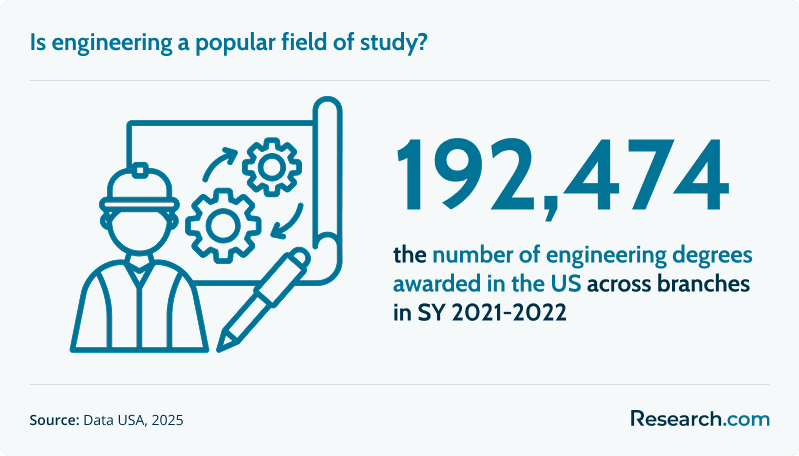
In 2022, there were around 192,474 engineering degrees awarded in the US across branches.
What are the types of engineering branches?
The five traditional engineering branches are civil, mechanical, electrical, chemical, and industrial engineering. These broad areas are the foundation for many modern specializations, including computer, aerospace, biomedical, environmental, materials, marine, nuclear, petroleum, and cybersecurity-focused engineering roles.
| Engineering branch | Primary focus | Best fit for students who like |
| Civil engineering | Infrastructure, buildings, transportation systems, water systems, and public works | Construction, communities, public safety, structural design, and large physical projects |
| Mechanical engineering | Machines, engines, thermal systems, manufacturing equipment, robotics, and mechanical design | Moving parts, product design, vehicles, energy systems, and hands-on problem-solving |
| Electrical engineering | Power systems, electronics, circuits, communications, controls, and electromagnetism | Electricity, devices, renewable energy grids, telecommunications, and automation |
| Chemical engineering | Chemical processes, pharmaceuticals, fuels, food production, materials, and process design | Chemistry, biology, manufacturing, energy, sustainability, and lab-to-industry applications |
| Industrial engineering | Efficiency, systems optimization, logistics, quality control, supply chains, and workflows | Data, operations, process improvement, business systems, and measurable productivity gains |
| Computer engineering | Computer hardware, embedded systems, software-hardware integration, chips, and computing systems | Computers, circuits, coding, artificial intelligence, and device-level technology |
Civil Engineering
Civil engineering centers on the built environment. Civil engineers plan, design, inspect, and maintain roads, bridges, airports, buildings, dams, utility systems, and water infrastructure. This branch is often closely connected to public safety, environmental impact, and government regulation.
Mechanical Engineering
Mechanical engineering is one of the broadest branches. Mechanical engineers work with machines, engines, HVAC systems, manufacturing equipment, robotics, vehicles, tools, and energy systems. Because mechanical systems exist in many industries, this branch can offer flexibility for students who want several possible career directions.
Electrical Engineering
Electrical engineering deals with electricity, electronics, power distribution, controls, communications, and electromagnetic systems. Electrical engineers may work on power grids, consumer electronics, renewable energy systems, sensors, semiconductors, telecommunications networks, or advanced control systems.
Chemical Engineering
Chemical engineers apply chemistry, physics, biology, and mathematics to large-scale production processes. Their work can involve pharmaceuticals, fuels, chemicals, food, water treatment, biotechnology, and sustainable materials. The branch is a strong fit for students who enjoy science but want to apply it to industrial or commercial systems.
Industrial Engineering
Industrial engineering focuses on making systems work better. Industrial engineers improve production lines, supply chains, quality systems, hospital operations, logistics networks, and business processes. Compared with some branches, this field often combines engineering, data analysis, management, and operations strategy.
Computer Engineering
Computer engineering combines electrical engineering and computer science. Computer engineers design hardware, embedded systems, microprocessors, circuit boards, and integrated computing systems. Students comparing software-heavy and hardware-heavy paths may also want to review how data science and computer science degree programs differ.
Specialized Engineering Fields
Specialized engineering fields build on the core branches. Aerospace engineering applies mechanical, electrical, materials, and systems principles to aircraft and spacecraft. Biomedical engineering combines engineering with medicine and biology. Environmental engineering blends civil, chemical, and ecological knowledge. Renewable energy engineering may involve electrical, mechanical, environmental, and materials expertise.
The boundaries between branches are increasingly porous. A medical device project may need biomedical, mechanical, electrical, software, and materials expertise. A smart infrastructure project may require civil engineering, sensors, data analytics, cybersecurity, and environmental planning. For students, this means the “right” branch is often the one that gives you a strong foundation while leaving room to specialize later.
What are the major engineering careers for 2027?
Engineering careers vary by branch, work environment, licensing expectations, and industry. The engineering careers listed below include major roles, their typical focus, 2023 median salaries, and projected job growth from 2023 to 2033 where provided in the source material.
Engineering careers by branch, salary, and growth
| Career | Branch or category | 2023 median salary | Projected growth, 2023 to 2033 |
| Civil Engineers | Civil engineering | $95,890 | 6% |
| Environmental Engineers | Civil/environmental engineering | $100,090 | 7% |
| Mechanical Engineers | Mechanical engineering | $99,510 | 11% |
| Aerospace Engineers | Aerospace/mechanical engineering | $130,720 | 6% |
| Electrical and Electronics Engineers | Electrical engineering | $109,010 | 9% |
| Computer Hardware Engineers | Computer/electrical engineering | $138,080 | 7% |
| Chemical Engineers | Chemical engineering | $112,100 | 10% |
| Materials Engineers | Materials engineering | $104,100 | 7% |
| Industrial Engineers | Industrial engineering | $99,380 | 12% |
| Health and Safety Engineers | Industrial/safety engineering | $103,690 | 5% |
| Bioengineers and Biomedical Engineers | Biomedical engineering | $100,730 | 12% |
| Petroleum Engineers | Petroleum engineering | $135,690 | 2% |
| Mining and Geological Engineers | Mining/geological engineering | $100,640 | 2% |
| Marine Engineers and Naval Architects | Marine engineering/naval architecture | $100,270 | 8% |
Civil Engineering Careers
Civil engineering roles support the infrastructure people use every day. These engineers may work for government agencies, construction firms, consulting companies, utilities, transportation organizations, or environmental firms.
- Civil Engineers: Civil engineers plan, design, supervise, and evaluate infrastructure projects such as roads, bridges, buildings, airports, and water systems. Their 2023 median salary was $95,890, and projected job growth from 2023 to 2033 is 6%.
- Environmental Engineers: Environmental engineers develop solutions related to pollution control, waste management, water quality, environmental compliance, and sustainable development. Their 2023 median salary was $100,090, with projected growth of 7%.
Mechanical Engineering Careers
Mechanical engineering careers are common in transportation, manufacturing, aerospace, energy, robotics, building systems, and product development. The branch is broad, which can make it useful for students who want options after graduation.
- Mechanical Engineers: Mechanical engineers design, test, improve, and maintain mechanical devices and systems, including engines, manufacturing equipment, tools, HVAC systems, and automated machinery. Their 2023 median salary was $99,510, with projected job growth of 11%.
- Aerospace Engineers: Aerospace engineers work on aircraft, spacecraft, satellites, missiles, defense systems, and related components. Their work may involve aerodynamics, propulsion, materials, control systems, and safety testing. Their 2023 median salary was $130,720, with projected growth of 6%.
Electrical and Electronics Engineering Careers
Electrical and electronics engineers work at the intersection of power, devices, communication, control, and computing. Their roles can support renewable energy, telecommunications, consumer electronics, defense, transportation, manufacturing, and semiconductor systems.
- Electrical and Electronics Engineers: These engineers develop, test, and maintain electrical equipment, electronic components, communication systems, power systems, and control technologies. Their 2023 median salary was $109,010, and projected growth is 9%.
- Computer Hardware Engineers: Computer hardware engineers design and test processors, circuit boards, memory devices, routers, and other computer components. Their 2023 median salary was $138,080, with projected growth of 7%.
Chemical and Material Engineering Careers
Chemical and materials engineers help transform scientific knowledge into practical products and industrial processes. Their work can support energy, pharmaceuticals, manufacturing, electronics, construction, sustainability, and biomedical applications.
- Chemical Engineers: Chemical engineers design and improve processes used to produce chemicals, fuels, pharmaceuticals, foods, and other materials. Their 2023 median salary was $112,100, with projected growth of 10%.
- Materials Engineers: Materials engineers study metals, polymers, ceramics, composites, and other materials to determine how they perform in specific applications. Their 2023 median salary was $104,100, with projected growth of 7%.
Industrial Engineering Careers
Industrial engineers improve systems rather than individual components. Their work is common in manufacturing, logistics, healthcare, quality assurance, operations, transportation, and supply chain management.
- Industrial Engineers: Industrial engineers analyze processes, reduce inefficiencies, improve quality, streamline supply chains, and help organizations use people, equipment, materials, and data more effectively. Their 2023 median salary was $99,380, with projected growth of 12%.
- Health and Safety Engineers: Health and safety engineers design systems and procedures that reduce workplace hazards, prevent accidents, and improve safety compliance in industries such as construction, manufacturing, and energy. Their 2023 median salary was $103,690, with projected growth of 5%.
Specialized Engineering Careers
Specialized roles often require deeper technical preparation, industry-specific experience, or interdisciplinary skills. These careers can be rewarding, but students should pay close attention to industry cycles, graduate education expectations, and geographic concentration of jobs.
- Bioengineers and Biomedical Engineers: These engineers develop medical devices, prosthetics, diagnostic tools, biomaterials, and health-related technologies. Their 2023 median salary was $100,730, with projected growth of 12%.
- Petroleum Engineers: Petroleum engineers design methods for extracting oil and natural gas and improving production efficiency. Their 2023 median salary was $135,690, with projected growth of 2%.
- Mining and Geological Engineers: Mining and geological engineers design mines, extraction systems, and safety procedures for natural resource operations while considering environmental and operational risks. Their 2023 median salary was $100,640, with projected growth of 2%.
- Marine Engineers and Naval Architects: These professionals design, build, test, and maintain ships, submarines, offshore structures, and marine systems. Their 2023 median salary was $100,270, with projected growth of 8%.
- Cybersecurity Engineer: A cybersecurity engineer designs and implements protections for networks, systems, devices, and data. As of 2025, they can earn more than $120,000 annually. Engineers interested in digital investigation and security incidents may also explore how to become a computer forensics investigator.
The most popular types of engineering occupations by workforce population in 2023 are civil engineers (341,800) and industrial engineers (336,600).
Expanding Career Paths in Engineering
Engineering graduates do not all stay in design, testing, or production roles. Some move into technical leadership, product management, consulting, sales engineering, patent work, public policy, operations, or teaching. Engineers who want to teach may work at community colleges, technical institutes, public institutions, or accredited nonprofit online universities, depending on their credentials and professional background.
Because the engineering services industry is projected to generate $312.5 billion in revenue by 2025, growing at 3.4%, engineering remains a broad employment category. Still, students should avoid assuming that every engineering branch offers the same number of openings, the same geographic flexibility, or the same advancement path.
Who should become an engineer?
Engineering is a strong fit for people who like solving practical problems, applying math and science, working with constraints, and improving how things function. It is not the right choice simply because it “pays well.” The coursework is demanding, projects can be detailed, and many roles require patience with testing, documentation, safety standards, and failure before a design works.
| You may be a strong fit if... | You may want to reconsider if... |
| You enjoy breaking complex problems into smaller, testable pieces. | You dislike math, physics, technical details, or quantitative reasoning. |
| You are comfortable learning tools, formulas, software, and design methods. | You want a career with little ongoing technical learning. |
| You like creating solutions that must work under real-world constraints. | You prefer work with few rules, standards, safety checks, or documentation requirements. |
| You can collaborate with people from different technical and nontechnical backgrounds. | You want to work entirely alone and avoid communicating results to others. |
| You are willing to invest in education, internships, labs, projects, and possibly licensure. | You want the fastest possible route into a career without substantial training. |
- You like applied problem-solving: Engineers are often asked to improve safety, performance, cost, efficiency, reliability, or sustainability. If you enjoy designing practical solutions, the field may fit your strengths.
- You can handle math and science: Engineering students need comfort with quantitative reasoning, physics, modeling, and analysis, even though the exact tools vary by discipline.
- You work well with deadlines and specifications: Engineering projects often have fixed requirements, budgets, regulations, and timelines.
- You want a career with strong earning potential: In 2023, the median salary for engineers was $105,022, and some specializations exceeded $130,000 annually. These figures do not guarantee individual outcomes, but they show why engineering is often viewed as a financially competitive field.
- You are prepared to manage education costs: Students concerned about affordability can compare public, transfer, online, and financial-aid-friendly options, including low-cost online colleges that accept FAFSA.
The best engineering students are not necessarily the ones who already know everything technical. They are usually persistent, curious, detail-oriented, and willing to test ideas until they work.
Which engineering fields pay the most?
Engineering salaries depend on specialization, employer, experience, region, degree level, and industry. Data from engineering occupation sources show that several branches tend to command especially high median wages, but students should weigh pay against job growth, volatility, licensure requirements, and personal fit.
| High-paying engineering field | 2023 median salary | Why it may pay more |
| Computer Hardware Engineers | $138,080 | Advanced computing, semiconductor, device, and systems expertise can be difficult to replace. |
| Petroleum Engineers | $135,690 | Oil and gas extraction requires specialized knowledge and may involve complex field conditions. |
| Aerospace Engineers | $130,720 | Aircraft, spacecraft, and defense systems require high precision, safety standards, and technical depth. |
| Nuclear Engineers | $125,460 | Nuclear energy and radiation applications require specialized training and strict safety knowledge. |
| Chemical Engineers | $112,100 | Process design for chemicals, pharmaceuticals, fuels, and materials requires strong applied science skills. |
For many students, the highest-paying branch is not automatically the best choice. Petroleum engineering may offer high pay but has lower projected growth than some other fields. Computer hardware engineering may be lucrative but requires strong interest in computing systems and electronics. Aerospace engineering can be compelling for students interested in aviation, space, or defense, but opportunities may be concentrated in specific employers and regions.
What are the fastest-growing and most in-demand engineering jobs?
From 2023 to 2033, the strongest projected growth among the listed engineering roles belongs to industrial engineers and bioengineers and biomedical engineers, both at 12%. Mechanical engineers follow at 11%, while chemical engineers are projected at 10%, electrical and electronics engineers at 9%, and marine engineers and naval architects at 8%.
| Engineering role | Projected growth, 2023 to 2033 | What may support demand |
| Industrial Engineers | 12% | Organizations continue to need process improvement, supply chain efficiency, quality systems, and operations analytics. |
| Bioengineers and Biomedical Engineers | 12% | Medical devices, biotechnology, prosthetics, diagnostics, and healthcare technology create interdisciplinary needs. |
| Mechanical Engineers | 11% | Automation, robotics, manufacturing, energy systems, and product design keep the branch broadly relevant. |
| Chemical Engineers | 10% | Sustainable materials, pharmaceuticals, fuels, and advanced manufacturing rely on process engineering expertise. |
| Electrical and Electronics Engineers | 9% | Renewable energy, electronics, communications, controls, and connected systems require electrical expertise. |
| Marine Engineers and Naval Architects | 8% | Shipbuilding, maritime transportation, offshore structures, and defense applications support specialized demand. |
Demand also depends on how engineering work connects with data, software, mapping, automation, and infrastructure planning. For example, students interested in urban planning, environmental analysis, and infrastructure may benefit from understanding how to become a geographic information systems specialist, since geospatial tools are increasingly useful in engineering-adjacent work.
When comparing “in-demand” fields, look beyond the percentage. A fast-growing niche may still have fewer total roles than a slower-growing but larger discipline. Civil engineers and industrial engineers had the largest workforce populations among the listed fields in 2023, which can matter for geographic flexibility and entry-level hiring.
What degrees do you need to become an engineer?
Most engineering careers begin with a bachelor’s degree in an engineering discipline. The exact major matters because civil, mechanical, electrical, chemical, computer, and industrial engineering programs build different technical foundations. Students who know they want public infrastructure, for example, should not choose a loosely related technology major without checking licensure and employer expectations.
| Education level | When it makes sense | Typical role in an engineering career |
| Bachelor’s degree | You want entry-level engineering roles and a broad technical foundation. | Common minimum credential for many engineering positions. |
| Master’s degree | You want specialization, management preparation, higher-level technical work, or career switching within engineering. | Can support advancement, research-oriented roles, or leadership pathways. |
| PhD | You want academic research, advanced R&D, or highly specialized technical work. | Most relevant for research, university teaching, and deep technical specialization. |
| Certificates and short credentials | You already have a degree and need targeted skills in software, AI, cybersecurity, project management, quality, or a specific technical tool. | Can strengthen a résumé but usually does not replace an engineering degree for engineering-design roles. |
Program format also matters. Campus programs may provide easier access to labs, research groups, machine shops, and in-person recruiting. Online programs can help working adults, transfer students, and career changers who need flexibility. Students comparing cost and format can review options for an affordable online engineering degree, but they should confirm lab requirements, accreditation, transfer policies, and whether the program supports their intended branch.
Some fields, including biomedical and environmental engineering, may benefit from graduate-level study or specialized credentials depending on the employer. A PhD is usually not necessary for most entry-level engineering jobs, but it can be important for academic careers or advanced research roles.
Do you need a license to be an engineer?
Licensure depends on the type of engineering work, the employer, and whether the engineer’s decisions affect the public. Engineers who sign off on public infrastructure, building systems, public safety work, or certain consulting deliverables often need a Professional Engineer (PE) license. The usual pathway includes an accredited engineering degree, the Fundamentals of Engineering (FE) exam, supervised experience under a licensed PE, and the Principles and Practice of Engineering (PE) exam.
Not every engineering role requires a PE license. Many engineers in private manufacturing, software, electronics, hardware, research, product design, and internal corporate roles work without licensure. However, a PE can still be valuable for civil, environmental, structural, consulting, public-sector, and leadership paths where formal authority and public accountability matter.
Questions to ask before choosing a program if licensure may matter
- Is the engineering program accredited in the discipline I plan to enter?
- Will the degree meet the education requirements for the FE exam in the state where I want to work?
- Does the program clearly identify licensure-related outcomes for online and campus students?
- How does the school support internships, co-ops, labs, and supervised engineering experience?
- If I transfer credits, will they count toward the engineering major and licensure preparation?
What skills do you need to succeed in engineering?
Engineering success depends on technical competence, judgment, communication, and the ability to learn new tools as industries change. Employers typically look for evidence that graduates can solve real problems, not just complete coursework.
- Math and analytical reasoning: Engineers use mathematics, physics, statistics, modeling, and computational methods to evaluate designs and predict performance.
- Problem-solving under constraints: Engineering problems usually include limits such as cost, safety, materials, regulations, environmental impact, time, and user needs.
- Communication: Engineers must explain trade-offs, document decisions, write reports, present results, and collaborate with people who may not share the same technical background.
- Discipline-specific tools: Depending on the field, this may include CAD software, simulation tools, programming languages, lab methods, manufacturing systems, data analytics platforms, or testing equipment.
- Project management: Engineers who want to lead teams need budgeting, scheduling, risk management, scope control, and stakeholder communication skills. A project management degree can complement technical training for professionals moving toward program, operations, or engineering management roles.
What career paths are available for graduates with engineering degrees?
An engineering degree can lead to technical, managerial, consulting, research, or interdisciplinary careers. The path you choose should match your preferred type of problem, work setting, and appetite for specialization.
| Career path | What engineers do | When this path makes sense |
| Core engineering practice | Design, test, build, maintain, and improve systems in a specific engineering discipline. | You want to apply your major directly in infrastructure, machines, electronics, chemicals, systems, or products. |
| Research and development | Create new technologies, materials, devices, products, or processes. | You enjoy experimentation, advanced technical work, and uncertain problems. |
| Consulting | Advise clients, evaluate designs, solve technical problems, and support projects across organizations. | You want varied work and may pursue licensure or specialized expertise. |
| Engineering management | Lead teams, budgets, schedules, technical strategy, and project delivery. | You want to move from individual technical work into leadership. |
| Teaching and academia | Teach engineering or technical subjects and, in some settings, conduct research. | You enjoy mentoring, curriculum, and academic or technical training environments. |
| Interdisciplinary technology roles | Combine engineering with AI, data science, cybersecurity, health technology, simulation, or product design. | You want to work where engineering overlaps with digital transformation. |
- Core Engineering Roles: Graduates may work as civil, mechanical, electrical, chemical, computer, industrial, environmental, biomedical, aerospace, or materials engineers.
- Research and Development: R&D roles focus on experimentation, prototyping, testing, and improving emerging technologies or materials.
- Consulting and Advisory Roles: Consultants help organizations solve technical, operational, regulatory, or safety-related problems, often after gaining experience.
- Management and Leadership: Experienced engineers may manage technical teams, facilities, product lines, or complex projects. Those comparing graduate options can look into the most affordable online master’s degrees in engineering.
- Academia and Teaching: Engineers with advanced training may teach at technical schools, community colleges, universities, or professional training programs.
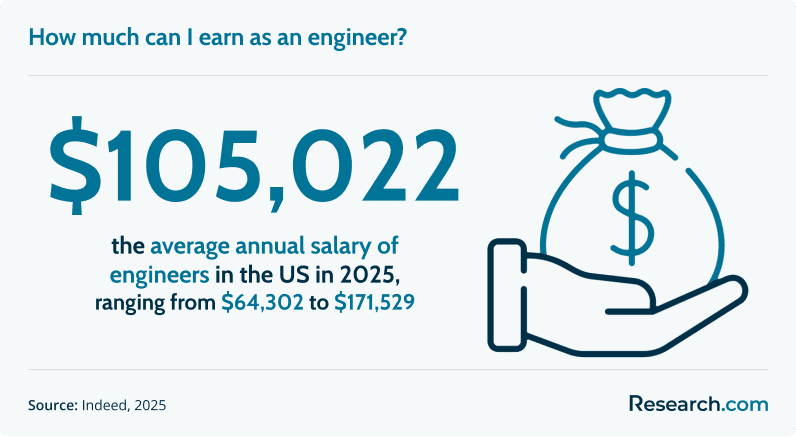
Overall, engineers in the US, regardless of branch and occupation, earn six-figure salaries. The average annual salary for engineers in 2025 is $105,022.
How do you choose the right engineering career?
The right engineering branch is the one that fits your strengths, your preferred problems, your desired work environment, and your tolerance for education, licensing, and industry cycles. A branch with high pay may still be a poor fit if you dislike the daily work. A branch with moderate pay may be ideal if it offers the problems, stability, and mission that keep you engaged.
Step-by-step process for choosing an engineering branch
- Start with the problems you want to solve. Infrastructure points toward civil or environmental engineering. Machines and robotics point toward mechanical engineering. Electronics and power point toward electrical engineering. Medical technology points toward biomedical engineering. Operations and efficiency point toward industrial engineering.
- Match your academic strengths to the discipline. Students who enjoy chemistry may prefer chemical engineering, while those who like circuits and computing may prefer electrical or computer engineering.
- Compare salary and growth together. Industrial engineers and bioengineers and biomedical engineers are projected to grow 12% from 2023 to 2033, while computer hardware engineers and petroleum engineers are among the higher-paid roles based on 2023 median salaries.
- Check licensure expectations early. Civil, environmental, structural, and public-facing engineering roles may require a PE license, so program choice and accreditation can matter.
- Test the field before committing fully. Use internships, co-ops, student design teams, research projects, job shadowing, and entry-level technical work to learn what the branch feels like in practice.
- Plan for advancement. Engineers interested in leadership, operations, or business strategy may eventually compare options such as an online engineering management degree.
Common mistakes when choosing an engineering path
| Mistake | Why it can hurt you | Better approach |
| Choosing only by salary | High pay does not guarantee job satisfaction, stability, or strong entry-level fit. | Compare salary with daily work, growth, locations, and required skills. |
| Ignoring accreditation and licensure | Some programs may not support PE licensure or discipline-specific expectations. | Confirm accreditation and state requirements before enrolling. |
| Assuming every online program works for every branch | Engineering often requires labs, design projects, and hands-on work. | Review lab formats, campus requirements, and employer recognition. |
| Looking only at tuition | Fees, books, equipment, travel, delayed graduation, and lost transfer credits can raise total cost. | Compare total cost, transfer policies, financial aid, and time to completion. |
| Relying only on rankings | A highly ranked school may not be affordable, flexible, or strong in your target branch. | Use rankings as one input, then verify outcomes, curriculum, accreditation, and support. |
| Skipping internships or projects | Without applied experience, it is harder to choose a branch and compete for jobs. | Prioritize co-ops, labs, design teams, research, and employer-sponsored projects. |
How can an online AI degree support engineering work?
Artificial intelligence can help engineers work with prediction, automation, optimization, simulation, computer vision, controls, and data-heavy decision-making. An online AI program may be useful for engineers who already have a technical foundation and want to apply machine learning or intelligent systems to manufacturing, robotics, energy, product design, infrastructure, or quality control. Cost-conscious professionals can compare an affordable master’s in AI if they want graduate-level training without leaving the workforce.
Can affordable online master’s programs offer a competitive edge in engineering?
Online master’s programs can help working engineers build specialized skills while continuing to earn professional experience. The value depends on fit: curriculum, accreditation, faculty expertise, project work, employer recognition, and cost all matter. Engineers moving toward analytics-heavy roles may compare options such as the cheapest online master’s in data science programs, especially if their current work involves modeling, forecasting, quality improvement, automation, or operations data.
How can interdisciplinary certifications drive engineering success?
Interdisciplinary credentials can help engineers move into sectors where technical systems overlap with healthcare, data, sustainability, operations, or compliance. The strongest credentials are those that solve a real gap in your target role. For example, engineers interested in health technology, clinical systems, or medical data environments may examine programs such as the cheapest online nursing informatics programs to understand how healthcare information systems connect with technical work.
Is further education essential for advancing your engineering career?
Further education is not always mandatory, but it can be important when you want to specialize, enter management, change fields, teach, or work with emerging technology. Engineers should choose additional education based on a specific career goal rather than collecting credentials without direction. For professionals moving toward software-intensive engineering, automation, or digital systems, a computer science accelerated degree may help fill technical gaps.
What engineers say about choosing a branch
- I began on a pre-med track, then realized I was more excited about building medical devices than becoming a physician. I now work with prosthetics, and watching people regain mobility makes the difficult coursework feel worthwhile. If healthcare and problem-solving both appeal to you, biomedical engineering can combine those interests. Linda
- I wanted to create structures that communities would use for decades. When I see a bridge I helped design carrying traffic every day, the work feels meaningful. It is not always glamorous, but public impact keeps me invested. Engineering school was demanding, yet I would choose it again. Glen
- I did not initially picture myself as an engineer, but I loved chemistry and wanted to use it outside the classroom. Today I work on biofuels in sustainable energy. The problems are difficult, but it is rewarding to know the work contributes to future solutions. Ahmed
Can a game design degree online Expand Engineering Innovation?
Game design can support engineering when projects require simulation, user interaction, virtual environments, training tools, visualization, or human-machine interfaces. Engineers working on prototypes, digital twins, immersive training, or interactive systems may benefit from skills taught in a game design degree online. This path is most useful when paired with a clear engineering application rather than pursued as a general add-on.
What emerging technologies are shaping engineering career trajectories?
Engineering careers are being influenced by artificial intelligence, connected devices, automation, renewable energy integration, digital modeling, cybersecurity, and healthcare technology. These changes do not replace the need for engineering fundamentals; they increase the value of engineers who can combine discipline-specific knowledge with software, data, security, and systems thinking. Students interested in healthcare technology can also review the health informatics career guide to see how data and technical systems affect clinical environments.
How do specialized certifications influence engineering career outcomes?
Specialized credentials can strengthen an engineering career when they align with a role, industry, or promotion target. A certification or advanced degree may validate expertise in areas such as quality, safety, cybersecurity, project management, biotechnology, data analytics, or systems engineering. Engineers considering biotechnology-related advancement can compare outcomes discussed in master’s in biotechnology salary and career paths. The key is to choose credentials that employers in your target field actually value.
Should Engineers Integrate Cybersecurity Into Their Skill Set?
Cybersecurity is increasingly relevant because engineered systems are often connected, automated, sensor-driven, or data-dependent. Engineers working with infrastructure, manufacturing, robotics, energy, transportation, medical devices, or embedded systems may need to understand how security risks affect design and operations. Professionals who want deeper preparation can compare programs such as the cheapest online master’s in cyber security, especially if they plan to work on critical systems or secure product design.
Key Insights
- Engineering is not one career path; it is a family of disciplines with different work settings, salary ranges, licensure rules, and growth outlooks.
- The core branches are civil, mechanical, electrical, chemical, and industrial engineering, but many modern careers blend these foundations with computing, healthcare, sustainability, AI, cybersecurity, and data.
- In 2023, computer hardware engineers ($138,080), petroleum engineers ($135,690), and aerospace engineers ($130,720) were among the highest-paid listed engineering roles.
- Industrial engineers and bioengineers and biomedical engineers are projected to grow 12% from 2023 to 2033, making them important options for students who want stronger growth prospects.
- Engineering remains a popular field of study, with 192,474 degrees awarded across various branches in the 2021–2022 academic year.
- The US engineering services industry is projected to generate $312.5 billion in revenue in 2025, growing at 3.4%, but students should still compare demand by branch rather than treating all engineering fields as equal.
- Industrial engineers alone are expected to have 25,200 annual job openings, signaling strong demand.
- Engineering salaries vary widely, with an average annual salary of $105,022 in 2025, but individual results depend on branch, employer, location, credentials, and experience.
- Civil, industrial, and mechanical engineering had the largest workforce populations in 2023, with over 290,000 professionals in each field.
- The cost of engineering education can vary sharply: median in-state public tuition was $8,935, while private out-of-state tuition was $46,170 in 2022. Students should compare total cost, transfer credit, aid, accreditation, and time to completion before enrolling.
References:
- Bureau of Labor Statistics. (2024). Aerospace engineers. Retrieved March 13, 2025, from BLS.
- Bureau of Labor Statistics. (2024). Architecture and engineering occupations. Retrieved March 13, 2025, from BLS.
- Bureau of Labor Statistics. (2024). Bioengineers and biomedical engineers. Retrieved March 13, 2025, from BLS.
- Bureau of Labor Statistics. (2024). Chemical engineers. Retrieved March 13, 2025, from BLS.
- Bureau of Labor Statistics. (2024). Civil engineers. Retrieved March 13, 2025, from BLS.
- Bureau of Labor Statistics. (2024). Computer hardware engineers. Retrieved March 13, 2025, from BLS.
- Bureau of Labor Statistics. (2024). Electrical and electronics engineers. Retrieved March 13, 2025, from BLS.
- Bureau of Labor Statistics. (2024). Environmental engineers. Retrieved March 13, 2025, from BLS.
- Bureau of Labor Statistics. (2024). Health and safety engineers. Retrieved March 13, 2025, from BLS.
- Bureau of Labor Statistics. (2024). Industrial engineers. Retrieved March 13, 2025, from BLS.
- Bureau of Labor Statistics. (2024). Marine engineers and naval architects. Retrieved March 13, 2025, from BLS.
- Bureau of Labor Statistics. (2024). Materials engineers. Retrieved March 13, 2025, from BLS.
- Bureau of Labor Statistics. (2024). Mechanical engineers. Retrieved March 13, 2025, from BLS.
- Bureau of Labor Statistics. (2024). Mining and geological engineers. Retrieved March 13, 2025, from BLS.
- Bureau of Labor Statistics. (2024). Nuclear engineers. Retrieved March 13, 2025, from BLS.
- Bureau of Labor Statistics. (2024). Petroleum engineers. Retrieved March 13, 2025, from BLS.
- Data USA. (2025). Engineering. Retrieved March 13, 2025, from Data USA.
- Posada, J. (2025, February). Engineering services in the US - Market research report (2015-2030). IBISWorld. Retrieved March 13, 2025, from IBISWorld.
- Indeed. (2025). Engineer salary in United States. Retrieved March 13, 2025, from Indeed.
Other Things You Should Know About the Type of Engineering Branches
Most engineers who want licensure must pass the Fundamentals of Engineering (FE) exam first, then the Principles and Practice of Engineering (PE) exam after about four years of qualifying experience. Both are administered by the National Council of Examiners for Engineering and Surveying, or NCEES.
The job outlook for civil engineers in 2027 is robust, with a projected growth rate of 7% according to the Bureau of Labor Statistics. This growth is driven by the need for infrastructure upgrades and development, indicating steady demand in the field.