2027 What is Geotechnical Engineering: Degrees and Courses to Launch Your Career

Co-Founder and Chief Data Scientist
Every road, bridge, and skyscraper relies on the expertise of geotechnical engineers who ensure structures are built on a safe and stable foundation. This field is a core part of solving major societal challenges, such as restoring and improving urban infrastructure. This engineering discipline moves beyond abstract calculations to deliver tangible safety and security.
In fact, as of early 2025, a senior geotechnical engineer in the U.S. can earn up to $200,000 per year, depending on industry, experience, and location. This guide will provide a complete overview of this vital profession. We’ll explore what is geotechnical engineering, what the day-to-day work involves, and how you can build a stable and rewarding career from the ground up.
Key Things You Should Know About Geotechnical Engineering
- Closely related to environmental engineering, geotechnical engineering analyzes how earth materials like soil and rock will interact with structures.
- Its primary role is to ensure public safety by preventing the failure of foundations, roadways, and other critical infrastructure.
- Earning a Professional Engineer (PE) license is a non-negotiable step for career progression into senior and leadership positions.
- The career offers excellent financial stability, with a median salary for civil engineers of $99,590 and a job growth rate of 6%, which is faster than average.
- What is geotechnical engineering and what do geotechnical engineers do? Overview
- What are some major specializations in geotechnical engineering? Specializations
- What are the educational requirements to become a geotechnical engineer? Education Requirements
- What skills do you need in geotechnical engineering aside from a degree? Core Skills
- What does a typical geotechnical engineering career path look like? Career Paths
- What is the earning potential for a geotechnical engineer? Earning Potential
- Who is a good fit for a geotechnical engineering career? Who is a good fit for a geotechnical engineering career?
- Which industries rely most heavily on geotechnical engineering? Top Industries
- How is the field of geotechnical engineering evolving? How is the field of geotechnical engineering evolving?
- How do I start exploring geotechnical engineering? How do I start exploring geotechnical engineering?
What is geotechnical engineering and why does it matter?
Geotechnical engineering is the civil engineering specialty that determines whether the ground beneath a project can safely support what people plan to build on it. Before a bridge, tower, highway, dam, tunnel, airport runway, or subdivision moves forward, geotechnical engineers study the soil, rock, groundwater, slopes, and subsurface risks that could affect safety, cost, and long-term performance.
This guide is for students considering civil engineering, early-career engineers comparing specialties, and career changers who want to understand what geotechnical engineers actually do. You will learn how the field works, what education and licensure usually require, which skills matter beyond the degree, how career progression typically unfolds, what salary and job outlook data suggest, and how to decide whether this path fits your strengths.
Geotechnical engineering matters because many construction failures begin below the surface. Weak soil, unstable slopes, shifting groundwater, liquefaction, settlement, and poor foundation choices can turn an otherwise strong design into a dangerous project. Geotechnical engineers reduce those risks by turning site data into practical design recommendations.
Students often compare career paths by reviewing prerequisites and expectations early. For example, understanding pre OT requirements helps future occupational therapy students plan their coursework; in the same way, learning what geotechnical engineering involves helps aspiring engineers choose the right math, science, fieldwork, and design preparation.
Quick answer: What do geotechnical engineers do?
Geotechnical engineers investigate ground conditions and advise project teams on how to build safely on, in, or with earth materials. Their work typically includes site research, drilling oversight, soil and rock sampling, laboratory testing, slope and foundation analysis, groundwater assessment, risk evaluation, and preparation of a geotechnical report used by structural engineers, architects, contractors, owners, and public agencies.
| Core question | Direct answer |
| What field is it part of? | Geotechnical engineering is a branch of civil engineering focused on soil, rock, groundwater, and earth structures. |
| What is the main purpose? | Its purpose is to determine how subsurface conditions affect construction safety, design, cost, and durability. |
| What is the main deliverable? | The key deliverable is usually a geotechnical report with findings, design assumptions, and engineering recommendations. |
| Who uses the work? | Structural engineers, civil engineers, architects, developers, construction managers, public agencies, and contractors rely on geotechnical guidance. |
| Is it mostly office work or fieldwork? | It is usually a mix of both: field investigations, laboratory coordination, engineering analysis, client communication, and report writing. |
What a geotechnical report usually covers
The geotechnical report is the central work product in many projects. It converts subsurface data into design guidance that other professionals can use. A strong report does not simply list soil layers; it explains what the ground conditions mean for the project.
- Site background and geologic context: Engineers review maps, historical use, nearby construction, surface conditions, and known hazards to identify likely subsurface concerns.
- Field exploration plan: They determine where borings, test pits, sampling locations, and in-situ tests should be placed so the investigation addresses the project’s real risks.
- Soil, rock, and groundwater data: Field teams collect samples and measurements that show strength, density, moisture, permeability, stratigraphy, and groundwater conditions.
- Laboratory testing: Samples are tested to evaluate engineering behavior, including how materials may compress, drain, shear, swell, or support loads.
- Engineering interpretation: The engineer analyzes the data, identifies uncertainties, and evaluates how the ground may respond during and after construction.
- Design recommendations: The report may address foundation type, bearing capacity, settlement, excavation support, retaining walls, pavement sections, slope stability, drainage, earthwork, compaction, and construction monitoring.
Major geotechnical engineering specializations
Geotechnical engineering becomes more specialized as projects grow more complex. Some engineers remain broad consultants who support many project types, while others develop deep expertise in seismic hazards, tunnels, forensic investigations, environmental containment, dams, ports, offshore foundations, or transportation infrastructure.
Specialization matters because the risks are different across project types. A building foundation may center on settlement and bearing capacity, while a tunnel may require groundwater control and ground-support sequencing. A landfill project may demand environmental protection and liner design, while a seismic project may focus on liquefaction and earthquake-resistant foundations.
Students comparing engineering fields often look at technical focus and earnings together. Reviewing a guide on computer engineering salary, for instance, can help clarify how a technology career differs from infrastructure-focused engineering. In geotechnical engineering, the better question is not only “Which specialty pays more?” but also “Which risks, work settings, and project types do I want to solve?”
| Specialization | What it focuses on | Good fit for engineers who like |
| Earthquake engineering | Designing foundations and earth structures to perform under seismic forces, including liquefaction, ground shaking, and lateral spreading risks. | Hazard analysis, advanced modeling, public safety, and resilient infrastructure. |
| Tunneling and underground construction | Planning and supporting tunnels, subways, utility corridors, water conveyance systems, and underground storage projects. | Complex construction sequencing, ground support, groundwater control, and multidisciplinary teamwork. |
| Forensic geotechnical engineering | Investigating foundation distress, slope failures, dam issues, retaining wall problems, and other soil- or rock-related failures. | Root-cause analysis, technical writing, expert review, claims support, and failure prevention. |
| Geoenvironmental engineering | Managing the interaction between earth materials and environmental protection, including landfill systems, contaminated soil, groundwater, and waste containment. | Sustainability, environmental risk, remediation, regulation, and protective design. |
Earthquake engineering
Earthquake-focused geotechnical engineers assess how seismic forces may affect soils, foundations, slopes, retaining systems, and lifeline infrastructure. Their work can include evaluating liquefaction potential, estimating ground motion effects, and recommending design measures that help structures remain safe during and after earthquakes.
Tunneling and underground construction
Tunneling specialists help design and build infrastructure below the surface, where unknown ground behavior can create major cost and safety risks. They evaluate soil and rock conditions, groundwater pressures, excavation methods, support systems, settlement impacts, and monitoring plans for underground work.
Forensic geotechnical engineering
Forensic geotechnical engineers investigate what went wrong when foundations settle unexpectedly, slopes fail, dams experience distress, pavements collapse, or retaining structures move. Their findings may support repairs, insurance reviews, litigation, safety improvements, or updated design practices.
Geoenvironmental engineering
Geoenvironmental engineers combine geotechnical design with environmental protection. They may work on landfill liners and covers, contaminated site remediation, groundwater barriers, hazardous waste containment, and designs that prevent pollutants from moving through soil and groundwater.
Education requirements to become a geotechnical engineer
The standard path into geotechnical engineering begins with civil engineering education and continues through supervised experience and professional licensure. The exact sequence can vary by employer and state licensing board, but the broad pathway is well established.
The most important early decision is choosing an undergraduate engineering program that supports licensure. A bachelor's degree in civil engineering or a closely related engineering field from a program accredited by the Accreditation Board for Engineering and Technology (ABET) is the typical foundation. ABET-accredited engineering degrees are especially important because licensure rules in all 50 states depend on meeting recognized education standards.
Graduate study is common in geotechnical engineering because the field relies heavily on soil mechanics, foundation engineering, numerical modeling, slope stability, earthquake engineering, and advanced laboratory or field methods. A master's degree is not always required for every entry-level job, but it is often preferred for technical consulting, advanced design, research-oriented roles, and long-term specialization. Comparing graduate models across disciplines can be useful; for example, learning what is an MFA program shows how professional and terminal degrees differ by field, purpose, and expected outcomes.
| Stage | Typical requirement | Why it matters |
| Undergraduate preparation | Bachelor's degree in civil engineering or a related engineering field, ideally from an ABET-accredited program. | Builds the math, mechanics, materials, hydrology, structural, and civil engineering base needed for geotechnical work and licensure. |
| Entry-level credential | Engineer-in-Training path after completing education and passing the required early exam sequence. | Allows new engineers to gain supervised professional experience under a licensed Professional Engineer. |
| Graduate specialization | Master's study in geotechnical engineering or a closely related civil engineering specialty. | Strengthens technical depth and may improve access to consulting, design, research, and advanced project roles. |
| Professional licensure | Professional Engineer (PE) license after exams and qualifying work experience under a licensed PE. | Often required for signing engineering documents, leading projects, taking responsible charge, and advancing into senior roles. |
Can you enter geotechnical engineering from geology or another science?
Yes, but career changers should expect to fill engineering prerequisites. A background in geology, physics, environmental science, or another earth science can be useful because geotechnical work depends on understanding earth materials. However, engineering programs and licensing pathways usually require specific coursework in mechanics, design, mathematics, and civil engineering fundamentals.
If your previous degree is related but not engineering, the practical next step is to speak with graduate civil engineering departments and state licensing boards before enrolling. Ask which prerequisite courses are required, whether your prior credits count, and whether the path will support eventual PE licensure. For some learners, an accelerated online geosciences degree may help formalize earth science preparation before moving toward engineering-focused graduate study.
The chart below shows the educational attainment of geotechnical engineers in the United States.
Skills geotechnical engineers need beyond the degree
A degree gives you the technical foundation, but day-to-day success depends on how well you gather evidence, judge uncertainty, communicate risk, and translate subsurface conditions into usable recommendations. Geotechnical engineers work at the intersection of field data, design assumptions, client constraints, construction realities, and public safety.
The field rewards people who can move between detail and judgment. You may spend one day reviewing boring logs and lab results, another day walking a muddy site with a drilling crew, and another explaining foundation options to a project manager who needs a clear decision. Like a STEM designated MBA, which emphasizes quantitative decision-making and applied leadership, geotechnical engineering requires both technical analysis and practical communication.
| Skill | How it shows up in the job | How to build it |
| Technical analysis | Interpreting boring logs, lab data, groundwater observations, settlement estimates, slope stability results, and foundation behavior. | Take advanced soil mechanics and foundation courses, practice with real case studies, and seek field-to-office project exposure. |
| Technical writing | Preparing geotechnical reports that clearly explain assumptions, limitations, risks, and recommendations. | Ask supervisors for report feedback, study strong report examples, and practice writing concise conclusions supported by data. |
| Field judgment | Recognizing when site conditions differ from expectations and knowing when additional investigation may be needed. | Spend time on drilling sites, observe sampling methods, and learn how field notes connect to final design recommendations. |
| Project management | Coordinating budgets, drilling schedules, lab testing, deliverables, clients, and construction timelines. | Learn scheduling, scope control, risk communication, and team coordination. Traditional project methods have a low success rate, and some studies show only 13% of such projects fully succeed. |
| Software and digital tools | Using modeling, mapping, data management, and visualization tools to evaluate subsurface and site conditions. | Build experience with geotechnical software, CAD coordination, data tools, and Geographic Information Systems. Exploring the fastest online geographic information systems degree can be useful for students who want stronger mapping and spatial analysis skills. |
| Communication with non-specialists | Explaining soil risks, foundation trade-offs, construction limitations, and uncertainty to owners, architects, contractors, and agencies. | Practice translating technical findings into plain language without overstating certainty or hiding limitations. |
Common mistake: treating geotechnical work as only calculations
Calculations are important, but geotechnical engineering is not a purely desk-based math role. The best engineers understand how samples were collected, where data may be uncertain, how construction methods affect performance, and how to communicate design assumptions clearly. A technically correct analysis can still fail the project if the recommendation is unclear, impractical, or disconnected from field conditions.
Typical geotechnical engineering career path
Geotechnical engineering has a structured career ladder because public safety, responsible charge, and licensure matter. Most engineers begin in supervised entry-level roles, build field and design experience, earn professional credentials, and then move into project leadership, technical specialization, or management.
| Career stage | Typical role focus | What you are proving |
| Student or intern | Assisting with field observations, lab coordination, data entry, calculations, and basic report support. | You can learn safely, follow procedures, document observations, and connect classroom concepts to real projects. |
| Engineer-in-Training | Working under a licensed Professional Engineer on site investigations, lab review, analysis, and draft recommendations. | You can handle increasing technical responsibility while staying within supervision requirements. |
| Early-career geotechnical engineer | Preparing analyses, sections of reports, construction observations, and client-ready technical materials. | You can produce reliable work, recognize uncertainty, and communicate findings clearly. |
| Licensed Professional Engineer | Taking responsibility for engineering recommendations, leading projects, reviewing work, and coordinating with clients. | You can exercise independent professional judgment and meet licensure responsibilities. |
| Project manager or senior engineer | Managing scope, schedule, budgets, teams, client relationships, complex technical decisions, and risk communication. | You can lead both the technical and business sides of geotechnical projects. |
| Principal, technical specialist, or practice leader | Leading major projects, mentoring engineers, providing expert review, developing clients, or specializing in high-risk areas. | You can guide strategy, manage high-consequence decisions, and shape the technical direction of a practice. |
The first major professional milestone is usually becoming an Engineer-in-Training and gaining supervised experience. During the initial phase, which typically lasts about four years, early-career engineers work under a licensed Professional Engineer while learning how investigation, analysis, design, and construction support fit together.
The PE license is the major turning point. After meeting experience requirements and passing the Principles and Practice of Engineering exam, engineers can qualify for roles that involve greater responsibility. For many employers, licensure is closely tied to project leadership, signing or sealing work where permitted, client trust, and promotion into senior positions.
Geotechnical engineer salary and job outlook
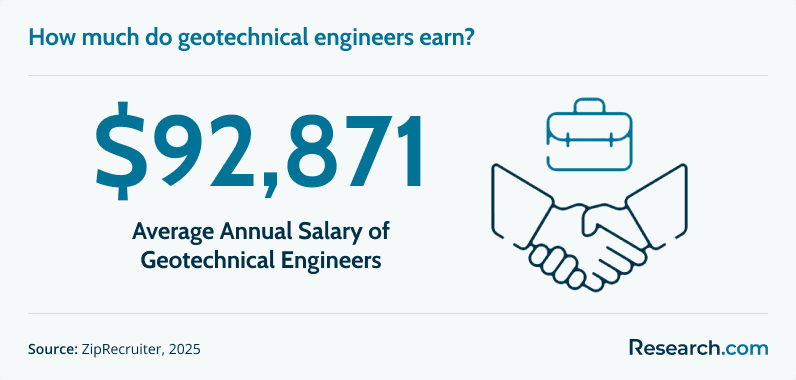
Geotechnical engineering can offer strong earning potential, particularly for engineers who gain licensure, develop specialized technical expertise, and move into project leadership. Salary varies by location, employer type, industry, credentials, and experience, so individual outcomes are not guaranteed.
The average annual salary for an entry-level geotechnical engineer in the U.S. is approximately $74,101. For civil engineers, the broader occupational category that includes geotechnical engineering, the median annual wage was $99,590 in May 2024. Across all architecture and engineering occupations, the median annual wage was $97,310.
The labor market outlook is also favorable for civil engineers. Employment for civil engineers is projected to grow 6% from 2023 to 2033, which is faster than the average for all occupations. Geotechnical engineers may benefit from ongoing needs in transportation, energy, public works, private development, hazard mitigation, and infrastructure maintenance.
| Salary or outlook point | Reported figure | How to interpret it |
| Entry-level geotechnical engineer average annual salary | Approximately $74,101 | A useful starting benchmark, but offers can vary by region, employer, degree level, and internship experience. |
| Civil engineers median annual wage | $99,590 in May 2024 | This broader category includes geotechnical engineers and provides a reliable occupational comparison point. |
| Architecture and engineering occupations median annual wage | $97,310 | Shows how civil engineering pay compares with the wider architecture and engineering labor market. |
| Civil engineers employment growth projection | 6% from 2023 to 2033 | Indicates positive demand, but job availability still depends on geography, infrastructure spending, and construction cycles. |
What can increase earning potential?
- PE licensure: Licensure can open the door to higher-responsibility work and leadership roles.
- Graduate specialization: Advanced study may strengthen opportunities in consulting, seismic design, underground construction, dams, offshore work, or forensic engineering.
- Field and construction experience: Engineers who understand how designs are built often make stronger recommendations and manage risk better.
- Client-facing skills: Clear communication, reliable delivery, and practical judgment can support advancement into project management or principal-level roles.
- Location and sector: Pay can differ across public agencies, private consulting firms, energy companies, transportation organizations, and high-cost metro areas.
Who is a good fit for geotechnical engineering?
Geotechnical engineering is a strong fit for people who like applied science, problem-solving, field conditions, technical writing, and infrastructure. It suits students who want their work to produce visible, practical results: safer buildings, stable slopes, durable roads, resilient bridges, and better-performing public works.
The work is collaborative rather than isolated. Geotechnical engineers must coordinate with clients, architects, structural engineers, civil designers, drilling crews, contractors, regulators, and public agencies. Because 37% of project failures are due to a lack of clear goals and vision, the ability to define the problem and communicate expectations is not a soft extra; it is part of successful engineering practice.
| You may enjoy geotechnical engineering if... | You may prefer another path if... |
| You want a mix of fieldwork, analysis, design, and report writing. | You want a career that is almost entirely indoors or entirely theoretical. |
| You like solving messy real-world problems where the data may be incomplete. | You prefer problems with clean inputs, fixed answers, and minimal uncertainty. |
| You are interested in soil, rock, groundwater, foundations, slopes, and construction. | You are mainly interested in pure research on earth history or fossils. |
| You can communicate technical risk to non-specialists. | You dislike writing reports, explaining trade-offs, or coordinating with multiple stakeholders. |
| You want a profession connected to public safety and infrastructure performance. | You want work with less responsibility for safety-critical decisions. |
If you are drawn to earth science but not sure whether you want engineering design, compare geotechnical engineering with geology, environmental science, and paleontology. For example, reading about how do I start a career in paleontology can help you separate interest in earth history and discovery from interest in applied design and construction risk.
Industries that rely on geotechnical engineering
Any industry that builds on land, under land, near water, or with earth materials may need geotechnical engineering. The field is especially important when failure would threaten safety, disrupt transportation, damage public infrastructure, or create major financial loss.
| Industry | How geotechnical engineers contribute |
| Transportation infrastructure | Support highways, railways, airports, ports, bridges, embankments, pavements, retaining walls, and slope stabilization projects. |
| Commercial and residential development | Evaluate foundation conditions, settlement risk, earthwork needs, retaining systems, drainage, and construction feasibility for buildings and subdivisions. |
| Energy | Assist with power plants, wind turbine foundations, pipelines, substations, transmission corridors, and other energy-related infrastructure. |
| Government and public works | Work on dams, levees, bridges, tunnels, public buildings, water systems, flood protection, and infrastructure maintenance. |
| Environmental and waste management | Design or evaluate landfill systems, containment barriers, remediation projects, and groundwater protection measures. |
| Mining and natural resources | Assess slopes, tailings facilities, ground stability, haul roads, waste rock areas, and site reclamation conditions. |
Large infrastructure projects are highly multidisciplinary. A geotechnical engineer may work alongside structural engineers, transportation planners, hydrologists, environmental scientists, construction managers, surveyors, and operations specialists. Understanding how other engineering professionals are trained, such as through the shortest online industrial engineering master's degree, can help students see how different engineering roles contribute to the same project ecosystem.
How geotechnical engineering is changing
Geotechnical engineering still depends on fundamentals such as soil mechanics, rock behavior, groundwater flow, and field investigation. What is changing is how engineers collect, model, monitor, and communicate subsurface information.
- More digital site investigation: Drones, remote sensing, digital field logs, and improved mapping tools can help engineers understand terrain, access constraints, and surface conditions more efficiently.
- Better monitoring: Sensors and instrumentation allow teams to track settlement, pore pressure, slope movement, vibration, and other performance indicators during and after construction.
- Advanced modeling: Three-dimensional models and numerical tools can improve visualization of subsurface conditions, though they still depend on sound judgment and reliable data.
- Climate resilience: Engineers are increasingly asked to account for flooding, erosion, sea-level rise, extreme weather, changing groundwater conditions, and long-term infrastructure durability.
- More collaborative delivery: Complex projects require adaptable communication among owners, designers, contractors, and regulators. Agile projects have a significantly higher success rate, at 42%, compared with older, more rigid approaches in the cited project management research.
- Stronger emphasis on uncertainty: Because subsurface conditions cannot be known perfectly, the field is placing more value on risk-based recommendations, monitoring plans, and clear communication of limitations.
Technology does not replace geotechnical judgment. It gives engineers better ways to see patterns, test assumptions, and communicate risk. The strongest professionals will be those who understand both the science of earth materials and the limits of the tools used to model them.
How to start exploring geotechnical engineering
You do not need to commit to a full engineering career before you start exploring. The best early steps are low-risk: take the right courses, talk to people in the field, observe engineering work when possible, and compare related careers honestly.
- Build the academic base early. Prioritize physics, calculus, chemistry, statistics, computer skills, and writing. Geotechnical engineering is technical, but report writing and communication matter from the first job.
- Learn what civil engineers do. Review civil engineering departments, student chapters, public works agencies, and professional organizations such as ASCE to see how geotechnical work fits into broader infrastructure design.
- Look for field exposure. Internships, job shadowing, construction site visits, lab tours, and university open houses can show you whether you enjoy the practical side of the work.
- Ask about accreditation before choosing a degree. If professional licensure is your goal, verify whether the undergraduate engineering program is ABET-accredited and whether it supports the PE pathway.
- Compare similar outdoor and science careers. If your main interest is being outside, geotechnical engineering is only one option. Exploring how to become a park ranger can help you decide whether you prefer engineering design, conservation, public education, land management, or environmental protection.
- Talk to current students and working engineers. Ask what they actually do during field seasons, report deadlines, construction support assignments, and project closeouts.
Questions to ask before choosing a geotechnical engineering program
| Question | Why it matters |
| Is the undergraduate engineering program ABET-accredited? | This is a critical factor for future PE licensure eligibility. |
| Does the civil engineering department offer geotechnical electives? | Courses in soil mechanics, foundation design, slope stability, earthquake engineering, and ground improvement can strengthen preparation. |
| Are there geotechnical labs or field-based courses? | Hands-on soil and rock testing helps connect theory to professional practice. |
| Do students get internships with consulting firms, agencies, or contractors? | Field and project exposure can improve career clarity and entry-level job readiness. |
| Does the program support FE and PE exam preparation? | Licensure is often central to advancement in civil and geotechnical engineering. |
| Are faculty active in geotechnical research or industry projects? | Faculty connections can influence research opportunities, recommendation letters, and specialized mentorship. |
The following chart highlights some U.S. cities with the highest average annual salaries for geotechnical engineers, providing a financial perspective on where your skills might be most in demand.
Common mistakes to avoid when planning a geotechnical engineering career
| Mistake | Better approach |
| Choosing a program without checking ABET accreditation. | Confirm accreditation before enrolling if PE licensure may be part of your career plan. |
| Assuming a master's degree automatically replaces licensure. | Understand that graduate education and PE licensure serve different purposes; many senior roles value both. |
| Ignoring fieldwork until after graduation. | Seek internships, site visits, lab work, or construction observation opportunities early. |
| Focusing only on salary. | Compare work environment, travel expectations, field conditions, licensure support, mentorship, and project types. |
| Underestimating writing and communication. | Develop technical writing skills because reports, recommendations, and risk explanations are central to the job. |
| Assuming software can solve uncertainty. | Use modeling tools carefully and learn how assumptions, sampling limits, and field variability affect results. |
| Choosing a specialty too early without exposure. | Try coursework, internships, and project experiences before committing to seismic, tunneling, forensic, environmental, or other advanced niches. |
Graduate perspectives on geotechnical engineering degrees
- Anne: "The most valuable part of my degree was learning to connect soil behavior with real design decisions. Soil mechanics and foundation design were demanding courses, but they showed me how much safety depends on what happens below the surface."
- Jann: "I appreciated that the program combined outdoor investigation with laboratory testing. Collecting samples in the field and then studying their properties in the lab made the engineering concepts feel concrete and useful."
- Karen: "The courses that focused on earthquakes and landslides helped me understand how geotechnical engineers protect communities. The work is challenging, but applying engineering principles to reduce risk is deeply meaningful."
Key Insights
- Geotechnical engineering is the civil engineering field that evaluates ground risk. Its purpose is to determine how soil, rock, groundwater, and slopes affect safe design and construction.
- The geotechnical report is the main decision tool. It turns field and lab data into recommendations for foundations, earthwork, slopes, drainage, excavation, and construction risk.
- ABET-accredited undergraduate education is a critical first step. Students who want PE licensure should verify accreditation before choosing a program.
- A master's degree can strengthen specialization. Graduate study is especially useful for advanced consulting, seismic work, tunneling, research, and complex foundation design.
- Licensure changes career options. The PE license is often necessary for senior responsibility, project leadership, and responsible engineering decision-making.
- The work requires more than calculations. Field judgment, technical writing, communication, project management, and software skills all matter.
- Salary and outlook are positive but not guaranteed. Entry-level geotechnical engineers earn approximately $74,101 on average, civil engineers had a median annual wage of $99,590 in May 2024, and civil engineer employment is projected to grow 6% from 2023 to 2033.
- The field is evolving through digital tools and resilience needs. Drones, sensors, advanced modeling, climate adaptation, and real-time monitoring are changing how geotechnical engineers work.
- The best way to decide is through exposure. Take relevant math and science courses, visit engineering programs, ask about ABET accreditation, pursue internships, and compare related earth science and outdoor careers before committing.
References:
- Agile Genesis. (2024). Agile vs. Waterfall: Comparing success rates in project management. Retrieved September 18, 2025, from Agile Genesis project management comparison
- Park University. (2024, October 16). From agile to waterfall: A breakdown of project management methodologies. Retrieved September 18, 2025, from Park University project management methodologies overview
- Pile Buck. (2024, July 29). Analyzing geotechnical reports: A comprehensive guide for contractors and engineers. Retrieved September 18, 2025, from Pile Buck guide to geotechnical reports
- Salary.com. (2025, August 1). Geotechnical engineer salary. Retrieved September 18, 2025, from Salary.com geotechnical engineer salary data
- Sharma, N. (2025, February 5). Project management statistics & trends you need to know. ProofHub. Retrieved September 18, 2025, from ProofHub project management statistics
- Taylor-Chadwick, H. (2023, October 9). 20+ agile statistics: All about agile adoption. Runn. Retrieved September 18, 2025, from Runn agile statistics overview
- U.S. Bureau of Labor Statistics. (2025, April 18). Architecture and engineering occupations. Occupational Outlook Handbook. Retrieved September 18, 2025, from BLS architecture and engineering occupations overview
- U.S. Bureau of Labor Statistics. (2025, August 28). Civil engineers. Occupational Outlook Handbook. Retrieved September 18, 2025, from BLS civil engineers wage and outlook data
- U.S. National Academy of Engineering. (2008, February 15). 21 century's grand engineering challenges unveiled. Retrieved September 18, 2025, from National Academy of Engineering grand challenges announcement
Other Things You Should Know About Geotechnical Engineering
In 2027, foundational courses such as soil mechanics, foundation engineering, and geology are essential. Advanced studies should include earthquake engineering, site investigation, and environmental geotechnics. These courses ensure a comprehensive understanding of geotechnical principles and prepare graduates for the complexities of modern geotechnical engineering projects.
Most geotechnical engineers pursue the Professional Engineer (PE) license. In the United States, that usually requires a ABET-accredited bachelor’s degree, passing the FE exam, about four years of supervised experience, and then the PE exam administered through NCEES and state licensing boards.