
2027 Best Online Environmental Health and Safety Programs

Co-Founder and Chief Data Scientist
Choosing an online environmental health and safety degree is usually a practical decision: you want a credential that can lead to safety, compliance, environmental management, or risk-related work without leaving your job or relocating. The challenge is knowing which programs are credible, what they cost, how online learning works for a hands-on field, and whether the degree fits your career goals.
This guide explains what online environmental health and safety programs teach, how long they take, what they may cost, which schools appear in our reviewed list, and what career paths graduates commonly pursue. It also covers accreditation, online versus campus trade-offs, financial aid, technology, sustainability, and the questions to ask before enrolling.
Quick Answer: Is an Online Environmental Health and Safety Degree Worth Considering?
An online environmental health and safety degree can be a strong fit for working adults, transfer students, and career changers who want to build skills in workplace safety, environmental compliance, risk assessment, industrial hygiene, and regulatory practice. Graduates may qualify for roles in manufacturing, construction, consulting, healthcare, government, and corporate safety departments. The degree is most useful when the program is accredited, includes applied coursework, offers career support, and aligns with your target role.
What are the main benefits of earning an online environmental health and safety degree?
- Graduates may work in manufacturing and construction, where organizations need professionals who can support compliance, identify hazards, and manage safety risks. Others move into environmental consulting, where they help organizations follow regulations and improve environmental practices.
- Environmental Health and Safety Associates earn an average annual salary of $85,000, with reported salaries ranging from $64,000 to $114,000.
- An online environmental health and safety degree can help students develop the technical knowledge needed to protect workers, communities, property, and natural systems from preventable harm.
What can I expect from an online environmental health and safety degree?
An online environmental health and safety degree focuses on how to recognize, evaluate, prevent, and manage hazards that affect people and the environment. Coursework typically covers environmental regulations, workplace safety, hazardous materials, industrial hygiene, pollution control, emergency planning, risk assessment, and environmental technology.
Although the format is online, the subject matter is applied. Students often analyze case studies, complete projects, use simulations, review regulatory requirements, and learn how organizations build safety and compliance systems. Some programs may also include fieldwork, practicums, or applied projects, so students should check whether any in-person requirements apply before enrolling.
The degree can support career paths such as safety specialist, environmental compliance officer, risk analyst, safety consultant, industrial hygienist, or environmental scientist or specialist. It is especially relevant for students who want a career that combines science, regulation, communication, and problem-solving.
Where can I work with an online environmental health and safety degree?
Environmental health and safety graduates work in settings where organizations must manage occupational hazards, environmental exposure, regulatory compliance, emergency preparation, or waste and materials handling. Common employers include manufacturers, construction firms, environmental consulting companies, government agencies, healthcare organizations, energy companies, transportation firms, agriculture-related businesses, and waste management organizations.
In manufacturing and construction, EHS professionals may inspect worksites, evaluate procedures, recommend controls, support training, manage documentation, and help prevent injuries or environmental violations. In environmental consulting, they may advise clients on compliance, pollution prevention, environmental impact, sustainable operations, or remediation planning.
| Work Setting | Common EHS Responsibilities | Who This Path May Fit |
| Manufacturing | Workplace inspections, machine safety, chemical handling, training, incident prevention | Students who want operational, site-based safety work |
| Construction | Hazard identification, fall protection support, equipment safety, safety planning | Learners comfortable with changing job sites and field conditions |
| Environmental consulting | Regulatory guidance, environmental assessments, client reports, sustainability support | Students who enjoy analysis, documentation, and client-facing work |
| Government agencies | Inspections, enforcement support, public health protection, environmental monitoring | Graduates interested in public service and regulatory systems |
| Healthcare and laboratories | Exposure control, hazardous materials procedures, emergency planning, compliance documentation | Students interested in health, safety, and controlled environments |
How much can I make with an online environmental health and safety degree?
Salary depends on job title, employer, location, industry, experience, certifications, and whether the role is entry-level or senior. As one salary reference point, Environmental Health and Safety Associates in the US earn an average salary of $85,000 per year, with reported salaries ranging from $64,000 to $114,000 annually.
Some EHS roles may also include bonuses, commissions, or profit sharing, but those forms of compensation vary by employer and should not be assumed. When comparing programs, students should evaluate likely career outcomes, local labor demand, tuition, debt, transfer credit options, and whether the curriculum supports certifications or advancement in their target field.
- 2027 reviewed online environmental health and safety programs
- Program length and completion timeline
- Online versus on-campus EHS degrees
- Typical online environmental health and safety program cost
- Financial aid options for online EHS students
- Admission requirements and prerequisites
- Common courses in online EHS programs
- Available concentrations and specialization options
- How to choose an online EHS program
- Entry-level opportunities after graduation
- Return on investment for an online EHS degree
- Post-graduation career support
- Career paths for environmental health and safety graduates
- Job market outlook for EHS-related roles
- Student engagement and mentorship in online EHS programs
- Healthcare-related pathways for EHS students
- Accreditation and program quality in online EHS degreesJob outlook considerations
- Technology in environmental health and safety education
- Interdisciplinary career opportunitiesTechnology skills in EHS
- Global standards and cross-cultural competencies
- Sustainability in environmental health and safety educationTechnology and sustainabilityLabor market context
2027 List of the Best Online Environmental Health and Safety Programs
How do we rank schools?
Research.com evaluates online environmental health and safety programs to help students compare options before making a major education investment. Our rankings are informed by a structured research approach designed to review institutions using available education data and program-level information.
To support consistency and credibility, our research process draws on established sources, including:
- The Integrated Postsecondary Education Data System (IPEDS) database
- Peterson's databases, including the Distance Learning Licensed Data Set
- The College Scorecard database
- National Center for Education Statistics (NCES)
1. University of Maryland Global Campus
The online Bachelor of Science in Environmental Management at the University of Maryland Global Campus includes study in environmental regulations, risk assessment, hazardous materials management, industrial hygiene, and emergency planning.
- Program Length: Four years
- Tracks/concentrations: Environmental Health and Safety
- Cost per Credit: $324 (in-state); $499 (out-of-state)
- Required Credits to Graduate: 120
- Accreditation: Middle States Commission on Higher Education
2. Oakland University
Oakland University offers an Environmental Health and Safety program that combines basic sciences, engineering concepts, behavioral sciences, environmental health, occupational safety, and industrial hygiene principles. The program is designed around the professional task of identifying, assessing, and controlling hazards that may affect people, property, or the environment.
- Program Length: Four years
- Tracks/concentrations: Environmental Health, Occupational Safety, Industrial Hygiene Principles
- Cost per Credit: $587.75 (in-state); $853.25 (out-of-state)
- Required Credits to Graduate: 120
- Accreditation: American Board of Engineering and Technology
3. Missouri Southern State University
Missouri Southern State University provides several academic options for students interested in environmental and safety education, including two bachelor's degree programs, a minor, and five career certificate options. Students in the environmental health and safety degree complete science-based coursework such as general chemistry, environmental physics, and elementary college physics.
- Program Length: Four years
- Tracks/concentrations: Environmental Health and Safety
- Cost per Credit: $300
- Required Credits to Graduate: 120
- Accreditation: National Environmental Health Science and Protection Accreditation Council
4. North Carolina A&T State University
The Environmental Health and Safety program at North Carolina A&T State University emphasizes the recognition and management of occupational hazards tied to mechanical systems, material handling, electrical systems, and chemical processes. Students take core coursework in safety, industrial hygiene, fire safety, manufacturing safety, construction safety, math, and science.
- Program Length: Four years
- Tracks/concentrations: Environmental Regulations, Waste Management, Pollution Prevention, Sustainable Practices
- Cost per Credit: $120 (in-state); $581 (out-of-state)
- Required Credits to Graduate: 120
- Accreditation: Applied and Natural Sciences Accreditation Commission
5. Arkansas State University
The online BS in Occupational and Environmental Safety and Health from Arkansas State University prepares students to develop and apply strategies that help organizations follow occupational safety, health, and environmental rules.
- Program Length: Four years
- Tracks/concentrations: Environmental and Public Health Risks, Toxicology
- Cost per Credit: $276
- Required Credits to Graduate: 120
- Accreditation: Higher Learning Commission
How to Use This Program List
A ranking list should be a starting point, not the only factor in your decision. Before applying, compare each program against your career target, budget, transfer credits, preferred pace, accreditation needs, and access to faculty or career support.
| Decision Factor | Why It Matters | Question to Ask |
| Accreditation | It affects credibility, transfer options, employer recognition, and sometimes certification preparation. | Is the institution accredited, and does the program hold any relevant programmatic accreditation? |
| Curriculum | EHS roles require applied knowledge in safety, compliance, environmental science, and hazard control. | Does the coursework match the roles I want after graduation? |
| Cost | Tuition can vary widely, especially for in-state and out-of-state students. | What is the full cost after fees, books, transfer credits, and aid? |
| Online format | Some students need asynchronous classes, while others benefit from scheduled interaction. | Are classes self-paced, synchronous, asynchronous, or a mix? |
| Applied experience | Hands-on exposure can strengthen job readiness. | Are there labs, simulations, field assignments, practicums, or capstone projects? |
Key Findings About Online Environmental Health and Safety Programs
- An online undergraduate environmental health and safety degree commonly takes four years to complete.
- For a 120-credit environmental health and safety program, the total cost of attendance can range from $14,400 to $72,000.
- Students may be able to use federal grants and loans, specialized scholarships, employer tuition support, and other aid options to reduce out-of-pocket costs.
- Graduates may pursue roles such as Safety Specialist, Environmental Compliance Officer, Environmental Scientist or Specialist, Industrial Hygienist, Risk Management Analyst, or Safety Consultant.
- The anticipated job growth for environmental scientists and specialists suggests a 4% increase from 2024 to 2034.
How long does it take to complete an online environmental health and safety program?
An online bachelor's degree in environmental health and safety usually requires four years of full-time study and about 120 credits. Your actual timeline can be shorter or longer depending on transfer credit, course availability, enrollment intensity, and whether the program offers accelerated terms.
- Course load: Students who enroll part-time often need more than four years, while those who take heavier course loads may finish sooner if the program permits it.
- Transfer credits: Previously completed college coursework may reduce the number of credits you still need, especially if the credits apply to general education or major requirements.
- Program pace: Some online programs use flexible or accelerated course formats that allow motivated students to complete requirements more quickly, though the workload can be demanding.
How does an online environmental health and safety degree compare to an on-campus program?
The best format depends on how you learn, how much flexibility you need, and whether your target program provides enough applied training online. Online EHS degrees are often attractive to working adults, but campus programs may provide more immediate access to labs, equipment, faculty, and peer networking.
| Factor | Online EHS Degree | On-Campus EHS Degree |
| Schedule | Often better for students balancing work, caregiving, military service, or travel limitations. | Usually follows fixed class times and campus-based academic calendars. |
| Learning environment | Requires self-direction, strong planning, and comfort with digital platforms. | Provides regular in-person contact with faculty and classmates. |
| Hands-on learning | May use virtual labs, simulations, local assignments, or limited field requirements. | May offer easier access to physical labs, equipment, and site-based activities. |
| Cost considerations | May reduce commuting or relocation costs; tuition depends on the school and residency rules. | May involve housing, transportation, parking, campus fees, and schedule constraints. |
| Networking | Can include online forums, group projects, webinars, and virtual career events. | Often provides informal networking through campus organizations, labs, and faculty interaction. |
What is the average cost of an online environmental health and safety program?
The cost of online environmental health and safety programs varies by institution, residency status, transfer credit, fees, and tuition model. Students comparing EHS programs may also review related options such as affordable online public health degrees if their interests lean toward population health, environmental exposure, or community health.
- University type: Public institutions are often less expensive than private institutions, though this is not true in every case.
- Residency rules: In-state students may pay lower tuition at public universities, while out-of-state rates can be substantially higher.
- Tuition structure: Some schools charge by credit, while others may use flat-rate tuition or term-based pricing.
Per-credit tuition among the programs listed ranges from $120 to $600. For a 120-credit program, that equals an estimated total program cost of $14,400 to $72,000 before considering fees, books, transfer credits, or financial aid. The table below summarizes the listed per-credit rates.
| School | Cost per Credit |
| University of Maryland Global Campus | $324 (in-state); $499 (out-of-state) |
| Oakland University | $587.75 (in-state); $853.25 (out-of-state) |
| Missouri Southern State University | $300 |
| North Carolina A&T State University | $120 (in-state); $581 (out-of-state) |
| Arkansas State University | $276 |
What are the financial aid options for students enrolling in an online environmental health and safety program?
Online EHS students may qualify for the same major types of financial aid available to other eligible degree-seeking students. If you are also comparing adjacent fields, resources on affordable human services online degrees can help you understand how online degree costs and aid options may differ across health and service-related programs.
- Federal Pell Grant: A need-based federal grant for undergraduate students with exceptional financial need.
- Federal Direct Subsidized Loans: Need-based loans where the government pays interest while eligible students are enrolled at least half-time and during certain periods.
- Federal Direct Unsubsidized Loans: Federal loans available to undergraduate and graduate students regardless of financial need, with the borrower responsible for interest.
- Environmental and safety scholarships: Professional organizations such as the American Society of Safety Professionals and the Board of Certified Safety Professionals offer scholarship opportunities for students in safety-related fields.
- Institutional and general scholarships: Colleges may award scholarships based on merit, need, major, transfer status, military background, or other criteria.
- GI Bill: Eligible veterans and dependents may be able to use education benefits toward approved programs.
- Employer assistance: Some employers reimburse tuition or provide education benefits when the degree supports the employee’s current or future role.
What are the prerequisites for enrolling in an online environmental health and safety program?
Admission requirements differ by school and degree level, but online environmental health and safety programs generally look for academic readiness, interest in safety or environmental issues, and the ability to succeed in a technology-based learning environment.
Admission Requirements
Bachelor’s-level online EHS programs often use admission criteria similar to campus programs. Depending on the school, applicants may need to submit:
- Educational background: Undergraduate applicants typically need a high school diploma, while graduate applicants generally need a bachelor’s degree. Some programs may prefer or require prior coursework in math or science.
- GPA and transcripts: Schools commonly request official transcripts and may set a minimum GPA for admission or transfer consideration.
- Letters of recommendation: Some programs ask for recommendations from teachers, employers, supervisors, or other professionals who can speak to your preparation.
- Personal statement or essay: Applicants may need to explain their interest in environmental health and safety, career goals, and reasons for choosing the program.
- Coursework expectations: Admitted students must complete required general education, core, and elective credits to earn the degree.
- Assignments and examinations: Online students should expect projects, exams, papers, problem sets, and other assessments that demonstrate mastery of course concepts.
- Fieldwork or practicum: Some programs may require applied experience in an environmental health and safety setting, so students should confirm location and scheduling expectations early.
Skills and Technical Readiness
Students comparing EHS with related programs such as affordable online healthcare administration should note that environmental health and safety degrees often require a stronger mix of science, compliance, and technical hazard-control skills.
- Analytical thinking: EHS students must be able to evaluate risks, interpret information, and connect evidence to practical decisions.
- Problem-solving skills: The field requires solutions that work in real workplaces, not just theoretical answers.
- Communication skills: Safety and compliance professionals must explain technical information clearly to workers, managers, regulators, and clients.
- Technical knowledge: Students should be prepared to study regulations, safety protocols, monitoring methods, exposure controls, risk assessment, and emergency procedures.
- Attention to detail: Small oversights can affect compliance, worker safety, environmental protection, and documentation quality.
- Collaboration and interpersonal skills: EHS work often involves teams, supervisors, employees, contractors, public agencies, and outside consultants.
What courses are typically in an online environmental health and safety program?
Online environmental health and safety programs usually combine science, regulation, safety management, and applied risk-control coursework. Course titles vary by institution, but students commonly encounter subjects such as:
- Introduction to Environmental Health and Safety: A foundational course covering hazard recognition, risk assessment, compliance concepts, and core environmental and occupational health principles.
- Environmental Science: Study of ecosystems, pollution, toxicology, sustainability, and the scientific basis for understanding environmental risks.
- Occupational Health and Safety: A course focused on workplace hazards, safety regulations, industrial hygiene, ergonomics, and occupational health management.
- Environmental Risk Assessment: Training in how to identify, evaluate, and manage risks linked to contaminants, exposures, and environmental conditions.
- Environmental Regulations and Compliance: Review of laws and requirements related to air quality, water pollution control, hazardous materials, and waste management.
- Industrial Hygiene: Study of exposure recognition, evaluation, and control, including ventilation, personal protective equipment, chemical safety, and workplace health hazards.
What types of specializations are available in online environmental health and safety programs?
Many online EHS degrees are broad rather than highly specialized, but students can still shape their education through concentrations, electives, certificates, or capstone topics. The right specialization depends on whether you want to focus more on workplace safety, environmental compliance, industrial hygiene, sustainability, or public health-related risk.
Concentration Tracks
Some schools offer formal tracks that let students focus part of the degree on a specific area, such as:
- Environmental Health: Focuses on environmental regulation, pollution control, environmental impact, and health-related environmental risks.
- Sustainability: Examines sustainable practices, resource use, pollution prevention, and environmental health considerations across industries.
Elective-Based Focus Areas
Even without a formal concentration, students can often use electives to build expertise. For example, a learner might choose more courses in industrial hygiene, environmental risk assessment, environmental management, or compliance. Students considering policy-oriented roles may also compare EHS programs with options such as affordable online master's public administration programs.
| If You Want To... | Look For Courses In... | Potential Career Direction |
| Work on workplace exposure and employee health | Industrial hygiene, toxicology, ventilation, ergonomics | Industrial hygienist or safety specialist |
| Support regulatory compliance | Environmental law, hazardous materials, auditing, reporting | Environmental compliance officer |
| Advise organizations on environmental impact | Environmental science, risk assessment, pollution control | Environmental consultant or specialist |
| Integrate sustainability into operations | Sustainability, waste reduction, environmental management | Sustainability-focused EHS role |
How to choose the best online environmental health and safety programs?
The best online environmental health and safety program is the one that matches your career goal, budget, schedule, and required level of applied preparation. Do not choose by tuition or ranking alone. Review accreditation, curriculum depth, faculty expertise, student support, and how well the program prepares you for the roles you want.
- Accreditation: Confirm that the institution is accredited and check whether the program has relevant recognition, such as accreditation from the National Environmental Health Science and Protection Accreditation Council.
- Program reputation: Look at faculty backgrounds, employer connections, student outcomes, alumni feedback, and the program’s standing in safety or environmental fields.
- Curriculum fit: Make sure required courses cover the areas you need, such as occupational safety, environmental compliance, industrial hygiene, risk assessment, and emergency planning.
- Online student support: Review access to academic advising, online tutoring, digital libraries, research databases, technical help, career services, and faculty communication.
- Applied learning: Ask whether the program uses simulations, virtual labs, local field assignments, capstones, internships, or practicums.
- Transfer and completion policies: Find out how many credits you can transfer and whether transfer credits apply to major requirements or only electives.
Common Mistakes to Avoid When Choosing an Online EHS Program
- Choosing without checking accreditation: Accreditation affects credibility and may influence transfer options, employer confidence, or later academic plans.
- Looking only at tuition: Fees, books, residency rules, transfer credits, and lost work time can change the real cost.
- Assuming online means fully self-paced: Some programs have weekly deadlines, live sessions, group work, labs, or scheduled exams.
- Ignoring hands-on requirements: EHS is applied. Ask how the program teaches inspections, exposure assessment, compliance documentation, and hazard control.
- Relying only on rankings: Rankings are useful, but your best option depends on your goals, location, finances, and learning style.
- Assuming salary outcomes are guaranteed: Pay varies by role, employer, location, experience, industry, and credentials.
What Entry-Level Opportunities Are Available to Graduates?
Graduates of online environmental health and safety programs may qualify for entry-level roles that involve inspections, documentation, training support, hazard identification, incident reporting, environmental monitoring, or compliance assistance. Students who want to compare adjacent environmental careers can also review entry level jobs with environmental science degree to understand how EHS roles differ from broader environmental science positions.
| Entry-Level Role | Typical Focus | Good Fit For Students Who... |
| Safety technician | Inspections, safety observations, documentation, training support | Want practical workplace safety experience |
| Environmental compliance assistant | Permits, reports, audits, environmental records | Enjoy regulation, writing, and detail-oriented work |
| EHS coordinator | Program support, incident tracking, employee communication | Want a broad role across safety and environmental functions |
| Environmental consultant assistant | Research, field support, client documentation, compliance projects | Prefer project-based work with multiple clients or industries |
What is the Return on Investment for an Online Environmental Health and Safety Degree?
The return on investment for an online environmental health and safety degree depends on total program cost, time to completion, financial aid, transfer credits, current earnings, career goals, and the type of role you pursue after graduation. A lower-cost program is not automatically the best value if it lacks the coursework, support, or credibility needed for your target career.
Students should compare total cost against likely career mobility, not just starting salary. For some learners, an EHS bachelor's degree may be enough to move into safety or compliance roles. Others may eventually consider graduate study, including options such as an online master's degree in health science, if they want broader health science training or leadership opportunities.
How to Evaluate ROI Before Enrolling
- Calculate the full program cost, including tuition, fees, books, software, travel for any required in-person work, and lost income if you reduce work hours.
- Ask how many transfer credits the school will accept and whether those credits shorten your time to graduation.
- Compare the curriculum with job postings for your target roles.
- Review career services, employer partnerships, internship support, and alumni networks.
- Consider whether the degree helps you qualify for internal promotion, a new role, or a longer-term career pathway.
What post-graduation career support is available through online EHS programs?
Strong online EHS programs provide more than coursework. Career support may include resume reviews, interview preparation, alumni mentoring, virtual career fairs, employer webinars, job boards, internship guidance, and advising on certifications or graduate education.
Some students also build complementary administrative or technical skills to broaden their options. For example, learners exploring healthcare-adjacent paths may compare EHS training with medical billing and coding classes online, though these fields lead to different day-to-day work.
What career paths are available for graduates of online environmental health and safety programs?
Online environmental health and safety graduates can pursue roles across compliance, workplace safety, risk management, environmental protection, consulting, and industrial hygiene. Job titles and qualifications vary by employer, so students should review postings in their target region before choosing electives or certifications.
- Safety Specialist: Supports workplace safety programs by identifying hazards, conducting inspections, reviewing procedures, helping with training, and promoting compliance in settings such as manufacturing, construction, healthcare, and government.
- Environmental Compliance Officer: Helps organizations follow rules related to air quality, water quality, waste disposal, hazardous materials, and environmental reporting. Employers may include consulting firms, manufacturers, and public agencies.
- Industrial Hygienist: Evaluates occupational health hazards such as chemicals, noise, ergonomic risks, and other exposures, then recommends controls to reduce harm. Students interested in technical systems and process improvement may also compare related options such as the cheapest online industrial engineering degree programs.
- Environmental Scientist or Specialist: Applies scientific methods to environmental concerns, which may include impact assessments, pollution control, remediation, monitoring, or research in consulting, government, or research settings.
- Risk Management Analyst: Identifies and evaluates organizational risks, which may include environmental, operational, financial, or safety-related risks. Students comparing communication-heavy risk roles may also examine affordable online public relations degree programs, though those degrees serve different career goals.
- Safety Consultant: Advises organizations on safety procedures, regulatory compliance, training, inspections, and hazard reduction. Consultants may work independently or for consulting firms.
The chart below summarizes the average annual salary information associated with each occupation.
What is the job market for graduates of online environmental health and safety programs?
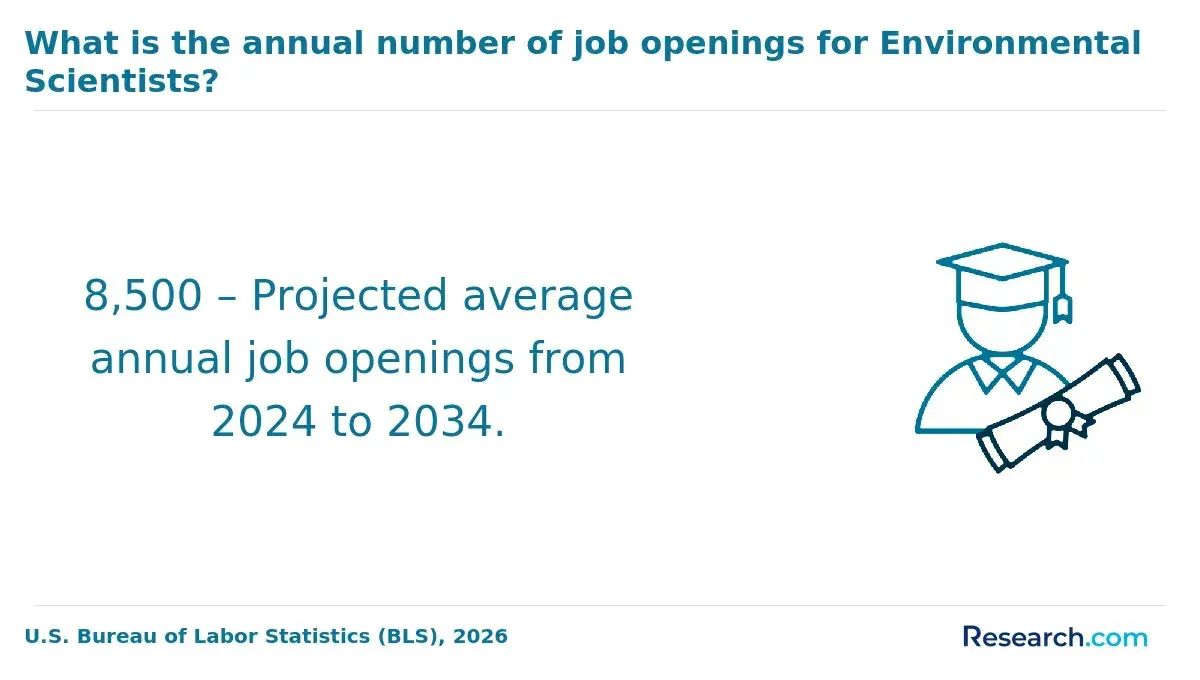
The employment outlook for environmental scientists and specialists indicates projected growth of 4% from 2024 to 2034, which is described as slightly faster than the average for all occupations.
This outlook corresponds to an average of about 6,900 job openings per year over the decade and an estimated total of 85,300 jobs by 2032. Demand is expected to be supported by continued public concern about environmental hazards and the need for professionals who can analyze environmental issues and help protect community health.
How Do Online EHS Programs Enhance Student Engagement and Mentorship?
Online EHS programs can support student engagement through live virtual sessions, recorded lectures, discussion boards, group projects, faculty office hours, and structured mentoring. These features matter because environmental health and safety work requires judgment, communication, and applied decision-making—not just memorizing regulations.
Students should ask whether faculty have industry experience, how quickly instructors respond to questions, whether alumni mentors are available, and whether the program hosts virtual networking or career events. Learners comparing health-related leadership pathways may also review options such as an accelerated healthcare administration degree online, especially if their long-term goals involve health systems management rather than EHS practice.
How Can Online EHS Programs Leverage Collaborative Healthcare Pathways?
Environmental health and safety overlaps with healthcare in areas such as exposure control, hazardous materials management, emergency planning, laboratory safety, infection prevention support, and facility compliance. Online EHS programs that include public health, healthcare safety, toxicology, or risk communication can help students understand how environmental and occupational hazards affect patients, staff, and communities.
Some students may use EHS coursework as part of a broader health-focused career plan. For example, those exploring advanced clinical or pharmaceutical pathways may also research an accelerated doctor of pharmacy degree, though that route involves a different professional scope and education pathway.
Understanding Accreditation and Program Quality in Online EHS Degrees
Accreditation is one of the most important quality checks for an online environmental health and safety degree. It signals that an institution or program has been reviewed against recognized standards. It can also affect transfer credit, graduate school admission, employer confidence, and eligibility for certain credentials or education benefits.
When reviewing programs, confirm institutional accreditation first. Then check whether the program has relevant programmatic accreditation or recognition, such as ABET-related accreditation where applicable, NEHSPAC-related accreditation for environmental health science and protection programs, or another field-relevant quality marker. Accreditation alone does not guarantee a job, but lack of recognized accreditation can create avoidable barriers.
Program quality also depends on curriculum depth, faculty experience, applied learning, advising, career support, and access to academic resources. A credible EHS program should prepare students to discuss regulations, identify hazards, document findings, communicate with stakeholders, and recommend practical controls.
Students still exploring academic options can compare EHS with other college majors to see whether environmental science, public health, engineering, occupational safety, healthcare administration, or policy may better fit their long-term goals.
The Role of Technology in Environmental Health and Safety Education
Technology has changed how online environmental health and safety programs teach applied skills. Digital tools can help students practice inspections, analyze data, model hazards, and understand compliance scenarios without always being physically present in a campus lab.
Virtual Labs and Simulations
Virtual labs and simulations can place students in realistic scenarios involving hazardous waste management, workplace inspections, exposure evaluation, emergency response, or environmental monitoring. These tools do not fully replace all field experience, but they can help students apply concepts before entering professional settings.
Data Analytics and Software Training Online
EHS professionals increasingly work with data from inspections, incident reports, monitoring systems, audits, and compliance documents. Programs that introduce students to data analysis, reporting, and digital record systems can strengthen job readiness. This skill area also connects with programs such as a health informatics degree online, where data management and analysis are central to health-related decision-making.
Geographic Information Systems (GIS)
GIS can be useful for mapping hazards, evaluating environmental exposure patterns, planning site assessments, and understanding the location-based impact of industrial activity. Students interested in environmental analysis should look for programs that introduce GIS or related mapping technologies.
How Do Online EHS Programs Enhance Interdisciplinary Career Opportunities?
Environmental health and safety sits between science, operations, public health, compliance, management, and communication. Online programs that include interdisciplinary coursework can help graduates work across departments and explain technical issues to nontechnical audiences.
This broader preparation may be useful in organizations where safety and health concerns overlap, including hospitals, laboratories, pharmaceutical facilities, manufacturing plants, public agencies, and consulting firms. Students interested in health-related career comparisons may also explore the highest paying jobs in medical field, while keeping in mind that EHS roles and clinical medical roles usually require different preparation.
How Do Online EHS Programs Address Global Standards and Cross-Cultural Competencies?
Many organizations operate across regions, suppliers, contractors, or international standards. Online environmental health and safety programs can prepare students for this reality by introducing global compliance frameworks, comparative regulatory examples, ISO environmental management concepts, and case studies from different cultural and operational contexts.
Cross-cultural competence matters because safety and environmental communication must be understood by diverse workers, managers, clients, and communities. Programs that use collaborative projects, global case studies, and applied communication assignments can help students practice adapting EHS recommendations to different audiences. Students comparing accelerated workforce training models may also look at fastest medical assistant programs, though medical assisting and EHS are separate pathways.
The Role of Sustainability in Environmental Health and Safety Education
Sustainability is now closely connected to environmental health and safety because organizations are expected to reduce environmental impact while protecting workers and communities. EHS professionals may contribute to waste reduction, pollution prevention, sustainable construction practices, resource efficiency, and safer materials management.
Online EHS programs may introduce sustainability through coursework in environmental policy, waste management, renewable energy, pollution control, and environmental stewardship. The goal is not only to understand sustainability concepts but to apply them in operational decisions, compliance plans, and risk-reduction strategies.
Students who want a broader science foundation may compare EHS programs with the cheapest online environmental science degree options. Environmental science programs may emphasize ecosystems, research, and environmental systems more heavily, while EHS programs are typically more focused on safety, compliance, and applied hazard management.
Questions to Ask Before Enrolling in an Online EHS Degree
- Is the institution regionally or nationally accredited, and does the EHS program have relevant program-level accreditation?
- Does the curriculum cover occupational safety, environmental compliance, industrial hygiene, risk assessment, hazardous materials, and emergency planning?
- Are there any in-person labs, field experiences, internships, practicums, or site visits?
- How many transfer credits will the school accept, and how will they apply to the degree?
- What is the complete cost after tuition, fees, books, software, and required travel?
- What career services are available to online students and alumni?
- Do faculty have professional experience in environmental health, safety, compliance, or industrial hygiene?
- Will the program help prepare me for the job titles I am seeing in current postings?
- Are classes asynchronous, synchronous, self-paced, or term-based?
- What student support is available if I need tutoring, advising, technical help, or mentorship?
References
- Glassdoor. (2026). Salary: Environmental Health Safety Associate in United States 2024. Glassdoor.
- Indeed. (2026). Advisor, F. S. Safety Management Group. Indeed.
- Indeed. (2026). Environmental compliance specialist salary in United States. Indeed.
- Indeed. (2026). Environmental specialist salary in United States. Indeed.
- Indeed. (2026). Industrial hygienist salary in United States. Indeed.
- Indeed. (2026). Risk manager salary in United States. Indeed.
- Indeed. (2026). Safety consultant salary in United States. Indeed.
- U.S. Bureau of Labor Statistics. (2025). Environmental Scientists and Specialists: Occupational Outlook Handbook. BLS.
Key Insights
- An online environmental health and safety degree is best for students who want flexible training in workplace safety, environmental compliance, risk assessment, hazardous materials, and industrial hygiene.
- Program quality matters more than format. A strong online EHS degree should be accredited, applied, career-relevant, and supported by responsive faculty and student services.
- Most bachelor’s programs require about four years and 120 credits, but transfer credits, part-time enrollment, and accelerated formats can change the timeline.
- Listed per-credit tuition ranges from $120 to $600, making total cost, residency status, fees, transfer policy, and aid essential parts of the decision.
- Graduates may pursue roles in manufacturing, construction, consulting, healthcare, government, and corporate safety departments, but salary and advancement depend on experience, industry, location, employer, and credentials.
- Do not enroll until you confirm accreditation, applied learning requirements, online format, career support, and whether the curriculum matches the EHS jobs you want.
Other Things You Should Know About Online Environmental Health and Safety Programs
In 2027, top accredited online Environmental Health and Safety programs include the Master of Science in Environmental Health and Safety from Columbia Southern University and Purdue University Global's Bachelor of Science in Environmental Policy and Management. Both offer comprehensive curricula and are recognized for their academic excellence.
Many online Environmental Health and Safety programs require a capstone, internship, or field experience, but not full laboratory residency. Some bachelor’s programs require 120 credit hours total, with 3 to 6 credits tied to practicum or applied work. Program handbooks and accreditation standards define these requirements.


