2027 Best Online Electrical Engineering Degrees for Electronics Engineering Careers

Co-Founder and Chief Data Scientist
Choosing an online electrical engineering degree is a high-stakes decision because electronics careers demand rigorous math, lab experience, and employer-recognized credentials. The U.S. Bureau of Labor Statistics reports 9% projected job growth for electrical and electronics engineers from 2023 to 2033, faster than the average for all occupations.
This guide is for students, transfer applicants, and working adults comparing online programs. You will learn how these degrees work, what they cost, how accreditation matters, and which program features best support electronics engineering careers.
Key Things You Should Know
- For electronics engineering careers, prioritize an ABET-accredited bachelor's program; many employers and professional engineering licensure pathways treat ABET accreditation as the clearest signal of engineering-program quality.
- Online electrical engineering degrees usually require about 120 to 128 credits, including calculus, physics, circuits, electronics, signals, embedded systems, labs, and a capstone design project.
- The BLS reported 2024 median annual pay of $118,780 for electrical and electronics engineers, but outcomes vary by industry, location, experience, clearance eligibility, internships, and hands-on project evidence.
What is an online electrical engineering degree and how does it prepare you for electronics careers?
An online electrical engineering degree is a bachelor's program that teaches students how to design, analyze, test, and improve electrical systems. For electronics careers, the most relevant parts of the degree focus on circuits, semiconductor devices, digital logic, microcontrollers, control systems, signal processing, communications, and hardware-software integration.
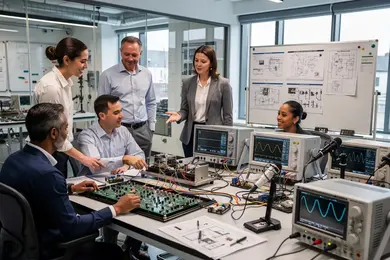
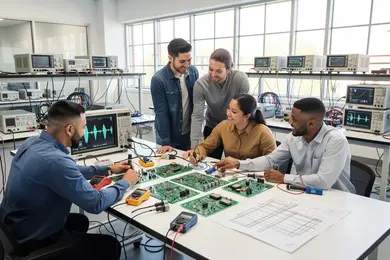
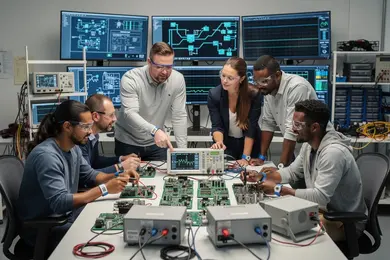
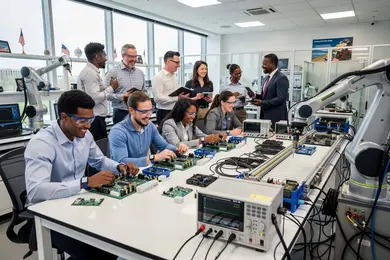
The word online describes the delivery format, not a lighter version of the degree. In a strong program, students still complete advanced mathematics, engineering science, design projects, lab work, and team-based problem solving. Labs may be completed through mailed electronics kits, simulation software, remote-access equipment, short campus residencies, approved local facilities, or a combination of these formats.
Electrical engineering is broader than electronics engineering. Electrical engineering can include power systems, energy conversion, electromagnetics, controls, communications, and computer engineering topics. Electronics engineering is more focused on devices, circuits, sensors, embedded hardware, test systems, and the electronic components inside larger products.
A student who wants to work with printed circuit boards, robotics hardware, aerospace electronics, medical devices, RF systems, or consumer electronics should look for an online electrical engineering curriculum with substantial electronics, digital systems, and lab-based design content.
If you are still comparing engineering fields, an engineering online degree can be a useful starting point for seeing how electrical engineering compares with other engineering options in cost, flexibility, and career alignment.
The degree is usually best for students who want a rigorous hardware-oriented career path and are prepared for calculus-based problem solving. It may not be the best fit for someone who mainly wants coding roles, IT support, product management, or quick entry into the workforce without a four-year engineering sequence.
Those goals may be better served by computer science, information technology, engineering technology, or shorter technical certificates.
How do online electrical engineering programs compare to campus-based programs for electronics engineering?
Online and campus-based electrical engineering programs can lead to similar career paths when the online program has the same academic standards, faculty oversight, lab expectations, and accreditation status as the campus option. The major differences are not usually in the subject matter; they are in scheduling, lab delivery, networking, cost structure, and how easily students can access hands-on experiences.
The table below compares the decision points that matter most for students preparing for electronics engineering work. Use it to identify which format fits your learning style, schedule, and need for in-person hardware access:
| Comparison point | Online electrical engineering degree | Campus-based electrical engineering degree | What it means for electronics careers |
| Flexibility | Often designed for working adults, military students, transfer students, or students outside commuting range | Usually follows a fixed weekly class and lab schedule | Online can be stronger if you need to keep working while building engineering credentials |
| Labs | May use simulation tools, mailed lab kits, remote labs, or limited residencies | Usually offers direct access to campus laboratories and equipment | Electronics-focused students should confirm how circuit-building, instrumentation, and troubleshooting are assessed |
| Peer networking | Depends heavily on virtual teams, discussion boards, online office hours, and project groups | More spontaneous interaction through labs, student clubs, and faculty offices | Online students may need to be more intentional about internships, IEEE student involvement, and portfolio building |
| Employer perception | Strongest when the degree is ABET-accredited and does not signal a lower academic standard | Familiar to many employers and recruiters | Accreditation, projects, internships, and technical interview performance usually matter more than delivery format alone |
| Cost structure | May reduce relocation and commuting costs, but technology fees and out-of-state tuition can still apply | May include housing, transportation, and campus fees | Total cost should include equipment, software, lab kits, books, fees, and lost work time |
Online study makes the most sense for disciplined students who can manage weekly technical work without the structure of campus attendance. Campus study may be better for students who want frequent in-person lab access, undergraduate research, residential student engineering teams, or a more traditional recruiting environment.
A common mistake is assuming that all online engineering degrees are equally practical. For electronics roles, the best online programs show exactly how students complete hands-on circuit labs, design reviews, measurements, debugging, and capstone projects. If that information is vague, ask admissions and faculty for examples before applying.
Which accredited online electrical engineering schools offer the strongest pathways into electronics roles?
The strongest online electrical engineering pathways into electronics roles usually share three traits: ABET accreditation, a curriculum with real electronics and embedded-systems depth, and career support that connects students with internships, senior design projects, or employer-relevant portfolios. Rankings can be useful, but they should not replace verification of program quality.
The schools below are examples of institutions students commonly review when searching for accredited online or distance-friendly electrical engineering bachelor's options.
Program names, delivery formats, residency requirements, and accreditation records can change, so verify details directly with the school and the ABET database before enrolling:
| School to evaluate | Online pathway to review | Why it may fit electronics-focused students | Questions to verify |
| Arizona State University | Online electrical engineering bachelor's pathway | Broad engineering curriculum with relevance to circuits, electronics, communications, and systems design | Confirm current ABET listing, lab format, capstone expectations, and available electronics electives |
| University of North Dakota | Distance or online bachelor's in electrical engineering | Known for serving remote engineering students while maintaining traditional engineering requirements | Ask about required campus visits, lab kits, transfer-credit review, and student access to faculty |
| Stony Brook University | Online electrical engineering degree-completion pathway | Can be attractive for transfer students who have already completed lower-division math and science | Check transfer prerequisites, course sequencing, ABET status, and whether the online track matches your timeline |
| Florida International University | Online electrical engineering bachelor's pathway | May suit students seeking a large public-university environment with online delivery | Verify engineering accreditation, lab delivery, senior design structure, and internship support for online students |
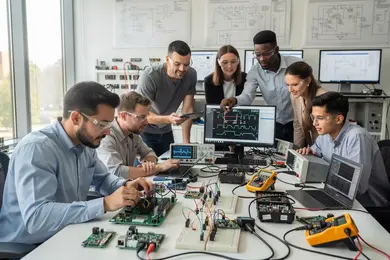
When comparing schools, look beyond the brand name. Electronics employers often want evidence that you can use oscilloscopes, interpret datasheets, design circuits, test prototypes, work with firmware, document results, and troubleshoot ambiguous hardware problems.
Use the following checklist when you speak with admissions, academic advising, or the engineering department. These questions help separate a strong electronics pathway from a program that is simply convenient:
- Ask whether the exact online degree, not only the campus department, appears in the current ABET accreditation record.
- Request examples of required electronics labs, including the equipment, software, lab kits, or remote instrumentation students use.
- Confirm whether electives include analog electronics, digital systems, embedded systems, RF, communications, sensors, microelectronics, power electronics, or control systems.
- Ask how online students complete senior design and whether the project can be hardware-based.
- Review internship support, employer events, faculty office hours, tutoring, and technical-career advising available to online students.
What electrical and electronics coursework can you expect in an online electrical engineering curriculum?
An online electrical engineering curriculum is usually built in layers. Students start with math and physics, move into engineering fundamentals, then specialize through electronics-heavy courses, labs, electives, and a capstone design sequence. The curriculum is demanding because electronics engineering requires both theory and practical judgment.
The table below summarizes common course areas and why they matter for electronics careers. Exact course titles vary by school, but the underlying competencies are similar across rigorous programs:
| Curriculum area | Common topics | Why it matters for electronics careers |
| Mathematics | Calculus, differential equations, linear algebra, probability, numerical methods | Supports circuit analysis, control theory, signals, communications, and modeling |
| Science foundation | Calculus-based physics, electromagnetism, materials concepts | Helps students understand fields, devices, energy transfer, and physical constraints |
| Core electrical engineering | Circuit analysis, electronics, digital logic, electromagnetics, signals and systems | Forms the technical base for designing and evaluating electronic systems |
| Electronics specialization | Analog circuits, semiconductor devices, microcontrollers, embedded systems, instrumentation | Builds the hardware skills most directly tied to electronics engineering roles |
| Design and lab work | Measurements, simulation, prototyping, debugging, documentation, team design | Shows employers that students can apply theory to real devices and constraints |
| Professional practice | Engineering ethics, technical communication, project management, safety | Prepares students to work on regulated, safety-sensitive, and team-based projects |
Software also matters, even for hardware-focused students. Many electronics engineers use SPICE-based circuit simulation, MATLAB or Python for analysis, C or C++ for embedded work, hardware description languages for digital design, and computer-aided design tools for schematics and printed circuit boards.
If your interests lean less toward building electronic hardware and more toward organizing technical knowledge, research systems, archives, or information access, an online library science degree may be a better fit than a full engineering curriculum.
The main curriculum red flag is a program that has limited lab detail. Simulation is valuable, but electronics employers also value measurement, tolerance analysis, soldering or prototyping familiarity, instrumentation, and debugging habits. Before enrolling, ask how the program evaluates hands-on work and whether you will graduate with projects you can explain in a technical interview.
What admission requirements and prerequisites do online electrical engineering bachelor's programs typically have?
Admissions requirements for online electrical engineering bachelor's programs vary by institution, but most schools expect evidence that students can handle calculus-based technical coursework. First-year applicants, transfer students, and degree-completion students may face different requirements.
Most applicants should be prepared for the following requirements. These items matter because weak preparation in math or science can delay progress and increase the total cost of the degree:
- High school diploma, GED, or equivalent credential for first-year admission.
- Prior coursework in algebra, trigonometry, pre-calculus, chemistry, and physics, with calculus readiness strongly preferred.
- Official transcripts from high school and any colleges previously attended.
- Minimum GPA requirements that may be higher for direct admission into engineering than for general university admission.
- Placement testing or prerequisite checks for calculus, physics, and introductory engineering courses.
- Transfer-credit evaluation for students entering with community college, military, AP, IB, or prior university credits.
- English proficiency documentation for applicants whose prior education does not meet the school's language requirements.
Transfer students should pay special attention to course equivalency. A general physics course may not satisfy a calculus-based engineering physics requirement, and a technology-focused circuits class may not replace an engineering circuits course. Losing credits at transfer is one of the most expensive mistakes students make.
Some students discover during admissions that they prefer adjacent technical fields with different prerequisites. For example, a student interested in research tools, digital repositories, or information management may compare an MLIS degree online rather than starting a math-heavy engineering bachelor's degree.
If you are not calculus-ready, that does not automatically rule out electrical engineering. It does mean you should plan a realistic ramp-up through pre-calculus, calculus, and physics before taking core engineering courses. A slower start can be worthwhile if it prevents repeated withdrawals, failed prerequisites, or loss of financial aid eligibility.
How long do online electrical engineering degrees take and what do they cost?
Most online electrical engineering bachelor's degrees require about four years of full-time study for first-time students. Transfer students with the right calculus, physics, general education, and introductory engineering credits may finish faster, while part-time working adults often need five to six years depending on course load and sequencing.
Cost depends on tuition, residency status, fees, transfer credits, lab equipment, software, books, and whether the student must reduce work hours.
The College Board's 2024 pricing data reported average published tuition and fees of $11,610 for in-state students at public four-year institutions, $30,780 for out-of-state students at public four-year institutions, and $43,350 at private nonprofit four-year institutions. For online students, this means residency and transfer policy can matter as much as the posted program name.
The table below summarizes the biggest cost drivers. Use it to estimate the full investment rather than comparing tuition alone:
| Cost factor | What to check | Why it affects total cost |
| Tuition model | Per-credit rate, flat-rate tuition, online tuition, residency rules | A lower per-credit price may not be cheaper if more credits are required after transfer review |
| Transfer credits | Accepted math, science, engineering, and general education credits | Accepted credits can shorten the degree, while rejected credits can add semesters |
| Engineering fees | Program fees, technology fees, lab fees, proctoring fees | Engineering courses can include costs beyond standard tuition |
| Lab materials | Kits, instruments, components, software, shipping, campus visits | Electronics courses may require physical tools or specialized access |
| Time cost | Work schedule changes, childcare, commuting for residencies | Lost income can be a major hidden cost for working adults |
Students can reduce cost by completing transferable general education, calculus, and physics courses at a community college before enrolling, but only if the target engineering school confirms equivalency in writing. It is also wise to ask whether scholarships, employer tuition assistance, military benefits, Pell Grants, federal loans, or state aid apply to the online format.
The trade-off between affordable and accelerated programs is important. A cheaper program that offers required courses only once per year can become expensive if it delays graduation. An accelerated program can be worthwhile for prepared students, but it can be risky if it compresses calculus, physics, circuits, and labs into a workload that is unrealistic alongside employment.
What electronics engineering jobs can you get with an online electrical engineering degree?
An online electrical engineering degree can support many electronics-related careers, especially when the program is accredited and the student graduates with strong projects, internships, or lab experience.
The first job title may not always be "electronics engineer," but the degree can open doors into hardware design, test engineering, embedded systems, manufacturing, aerospace, defense, telecommunications, energy technology, and medical devices.
The table below outlines common roles connected to electronics-focused electrical engineering preparation. Job titles vary by employer, so compare responsibilities rather than relying only on title names:
| Career path | Typical responsibilities | Helpful preparation |
| Electronics engineer | Designs, tests, and improves electronic circuits, devices, and subsystems | Analog and digital electronics, lab measurement, PCB concepts, troubleshooting |
| Electrical design engineer | Creates electrical schematics, specifications, models, and design documentation | Circuit analysis, CAD tools, standards awareness, capstone design |
| Test engineer | Develops test procedures, analyzes failures, validates products, and documents results | Instrumentation, statistics, scripting, lab methods, communication skills |
| Embedded systems engineer | Works on hardware-software interfaces in devices, sensors, controllers, or connected products | Microcontrollers, C or C++, digital logic, real-time systems, debugging |
| RF or communications engineer | Works with wireless systems, antennas, signal transmission, or communication hardware | Signals, electromagnetics, communications, spectrum concepts, lab tools |
| Controls engineer | Designs and tunes systems that monitor and control machines, processes, or devices | Control systems, sensors, programming, modeling, industrial systems |
AI and automation are changing electronics work, but they are not eliminating the need for engineers who understand physical systems. AI-assisted design, simulation, automated testing, and generative coding tools can speed up parts of the workflow, but engineers still need to define requirements, validate outputs, manage safety constraints, interpret measurements, and make design trade-offs.
Students who like technical problem solving but prefer analytics, modeling, or software-heavy work may want to compare hardware engineering with data-focused paths. If cost is the first filter, researching what is the cheapest data science course in the US? can help clarify whether a shorter data pathway is a better investment than a full electrical engineering degree.
To become more competitive for electronics roles, build evidence before graduation. Employers often respond well to a portfolio that includes a senior design project, circuit simulations, test reports, embedded code, PCB layouts, lab notebooks, and clear explanations of design decisions.
What is the salary outlook for electronics engineers with an online electrical engineering degree?
The salary outlook for electronics engineers is strong compared with many bachelor's-level fields, but it should be interpreted carefully. The BLS reported 2024 median annual pay of $118,780 for electrical and electronics engineers. This figure describes the occupation nationally; it does not promise a specific outcome for an online graduate, a new entrant, or a student in a particular region.
Salary varies because electronics roles span different industries and responsibility levels. Defense, semiconductor, aerospace, telecommunications, energy, medical-device, and advanced manufacturing employers may value different combinations of clearance eligibility, design experience, software skills, lab experience, and graduate education.
The table below shows how career stage can influence compensation expectations without treating salary as guaranteed. Use it to understand what employers may be paying for at each level:
| Career stage | Common role focus | What tends to influence pay |
| Entry level | Testing, documentation, junior design tasks, lab support, troubleshooting | Internships, ABET degree, projects, tool familiarity, ability to learn quickly |
| Early career | Subsystem design, validation, embedded hardware, production support | Successful product experience, cross-functional teamwork, stronger technical judgment |
| Mid-career | Lead design work, customer requirements, architecture decisions, mentoring | Specialized domain knowledge, project ownership, reliability and compliance experience |
| Advanced roles | Systems architecture, principal engineering, technical management, R&D leadership | Deep expertise, patents or publications, graduate study, leadership, business impact |
Location also matters. Electronics work clusters around regions with aerospace, defense, semiconductor, automotive, robotics, telecommunications, and advanced manufacturing employers. Remote work exists in some engineering functions, but hardware roles often require access to labs, prototypes, manufacturing sites, or secure facilities.
For return on investment, compare expected debt with realistic entry-level opportunities, not just national median pay. A lower-cost ABET-accredited program with strong transfer credit, internships, and hands-on projects can be a better value than a more expensive option with weak career support.
How is ABET accreditation and program quality verified for online electrical engineering degrees?
ABET accreditation is one of the most important quality checks for an online electrical engineering degree. ABET's Engineering Accreditation Commission evaluates whether engineering programs meet recognized standards for curriculum, faculty, facilities, continuous improvement, student outcomes, and institutional support.
For electronics careers, ABET matters because it helps employers, graduate schools, and licensing boards recognize that the program follows an engineering standard rather than a loosely related technical curriculum. It can also matter for students who may later pursue the Fundamentals of Engineering exam, Professional Engineer licensure, certain government roles, or graduate engineering study.
Do not rely only on a school's marketing page. Accreditation can apply to a specific program name, degree level, campus, or delivery pathway. The safest approach is to verify the exact program before applying:
- Search the ABET accredited-program database by institution name and program name.
- Confirm the degree title, such as Bachelor of Science in Electrical Engineering, matches the program you plan to enter.
- Check whether the online or distance pathway is included under the same accredited program record or clearly recognized by the institution.
- Ask the engineering department to explain any residency, lab, or modality differences between online and campus students.
- Save written confirmation from the school if accreditation status, transfer status, or licensure preparation affects your decision.
Program quality also includes factors beyond accreditation. A strong program should have qualified engineering faculty, sequenced courses, accessible advising, meaningful labs, technical tutoring, capstone design, career services, and transparent graduation requirements. If the program cannot explain how online students complete labs and team design work, treat that as a red flag.
Licensure rules vary by state. Not every electronics engineer needs a Professional Engineer license, especially in private-sector product development, embedded systems, or electronics design. However, students interested in public infrastructure, power systems, consulting, or regulated engineering services should check their state licensing board before choosing a program.
How can you choose the best online electrical engineering program for your electronics career goals?
The best online electrical engineering program is the one that fits your electronics career goal, academic preparation, schedule, budget, and need for hands-on learning. A well-known school is not automatically the best choice, and the cheapest program is not automatically the best value.
Start by defining the kind of electronics work you want. A student interested in embedded medical devices should evaluate different electives and projects than a student interested in RF communications, semiconductor testing, robotics, power electronics, or aerospace systems.
Use the following steps to compare programs in a practical order. This approach helps you avoid choosing based only on rankings, tuition, or convenience:
- Verify ABET accreditation for the exact electrical engineering bachelor's program you plan to complete.
- Map the curriculum against your target electronics role, looking for circuits, electronics, embedded systems, signals, digital design, controls, RF, or relevant electives.
- Ask how labs work online, including equipment, simulations, remote access, kits, residencies, and grading expectations.
- Request a transfer-credit evaluation before committing, especially for calculus, physics, programming, and engineering courses.
- Compare total cost, including tuition, fees, lab kits, software, books, travel, and lost income.
- Review course scheduling to see whether required classes are available often enough for your graduation timeline.
- Ask about internships, career coaching, employer relationships, undergraduate research, IEEE activities, and project portfolio support for online students.
- Check whether the program supports your long-term plans, such as graduate school, FE exam preparation, defense work, or a specific technical specialization.
Common mistakes include choosing a non-ABET program without understanding the trade-off, assuming online means easier, ignoring lab quality, underestimating calculus preparation, and focusing on tuition while overlooking delayed graduation. Another mistake is choosing a general electrical engineering program without enough electronics depth for the specific role you want.
If you are deciding between engineering and another professional field, compare the workload honestly. Electrical engineering is a strong path for students who want to design and test physical systems, but it is not the only respected online degree option for technical or research-oriented careers.
Your final shortlist should include no more than five programs. For each one, collect the degree plan, accreditation confirmation, cost estimate, transfer evaluation, lab explanation, course rotation, and career-support details. The strongest choice will usually be the program that gives you credible engineering training, manageable cost, and concrete evidence of electronics readiness by graduation.
Other Things You Should Know About Electrical Engineering
Yes. Many electronics engineering roles are open to candidates with a bachelor's degree in electrical engineering, electronics engineering, or a closely related engineering field. A master's degree may help for specialized research, semiconductor design, advanced communications, or leadership roles, but it is not always required for entry-level work.
In 2027, many online electrical engineering programs provide virtual labs or offer kits as part of the course package. However, students may still need basic tools like a multimeter or breadboard for practical experiments, depending on the program requirements and personal learning preferences.
Yes. ABET accreditation is the main quality standard employers and licensing boards look for in electrical engineering degrees. For electronics-focused careers, an ABET-accredited bachelor’s program also supports eligibility for the FE exam, which many states require before the PE license.
Strengthen algebra, trigonometry, pre-calculus, physics fundamentals, basic programming, and disciplined study habits. If possible, also practice simple electronics projects using breadboards, microcontrollers, sensors, and measurement tools so early coursework feels less abstract.
References
- Electrical and Electronics Engineers: Salary, career path, job outlook, education and more - RaiseMe https://www.raise.me/careers/architecture-and-engineering/electrical-and-electronics-engineers/
- 6 Best Online Electrical Engineering Degree Programs for Future Engineers https://www.myprivatetutor.com/blog/best-online-electrical-engineering-degree-programs
- What Can You Do with an Electrical Engineering Degree | HAN https://www.hanuniversity.com/en/programs/bachelor/electrical-and-electronic-engineering/fulltime/careers/
- ABET-Accredited Bachelor’s in Electronics Engineering Technology https://www.uagrantham.edu/blog/abet-accredited-electronics-engineering-technology-degree/
- Inside the Best Online Bachelor's in Electrical Engineering Degrees https://www.onlinecolleges.me/engineering-degrees/bachelors/electrical-engineering/
- Best Online Electrical Engineering Degrees 2025 https://www.onlineu.com/degrees/electrical-engineering