
2027 Best Online Dual FNP/PMHNP Degree Programs

Co-Founder and Chief Data Scientist
More than 158 million Americans live in areas with a severe shortage of mental health professionals. This national crisis creates a difficult professional crossroads for experienced RNs like you. You feel the pull to treat the whole person, caught between the urgent needs of primary care and mental health. While this can feel overwhelming, it is a calling to pursue a more integrated and impactful future.
This guide was created by career planning experts with over a decade of experience. It is a strategic roadmap for visionary nurses ready to explore online dual FNP/PMHNP degree programs and become leaders in the future of healthcare.
What are the benefits of getting an online dual FNP/PMHNP degree?
- This certification prepares you for unique leadership roles in integrated care, allowing you to treat complex patients in settings like VA hospitals and community health centers.
- Graduates can expect a strong earning potential, with salaries typically ranging from $110,500 to $140,000, a figure that grows with experience.
- The best online dual FNP/PMHNP degree programs offer the flexibility to manage a demanding graduate education while maintaining your current nursing career.
What can I expect from an online dual FNP/PMHNP degree program?
You should prepare for a rigorous academic and clinical marathon. A dual FNP/PMHNP program is a demanding three- to four-year commitment designed for experienced nurses who are ready for a significant professional challenge.
You will learn to diagnose and treat conditions across the entire lifespan from a primary care perspective. At the same time, you will develop a completely different set of diagnostic and therapeutic skills for psychiatric-mental health.
This means perfecting your abilities in complex diagnostics, which nearly 80% of NPs perform, and patient counseling, a skill used by almost 85% of NPs. You'll be expected to apply these skills at a high level in two different specialties, which is what makes the program so challenging and the graduates so valuable.
Where can I work with an online dual FNP/PMHNP degree?
Graduates with this dual certification are uniquely qualified for roles where physical and mental health collide. While you can work in any setting open to an FNP or a PMHNP, your true value is in environments that demand a fully integrated approach to patient care.
Here are some of the key places you can make an impact:
- Federally Qualified Health Centers (FQHCs): These centers serve complex, underserved populations where providing both primary and mental healthcare in one place is essential.
- Veterans Affairs (VA) Hospitals: You will be equipped to treat the high comorbidity of physical conditions and mental health challenges common in the veteran community.
- Rural Health Clinics: In areas with provider shortages, you become a critical resource who can manage a vast range of patient needs.
- Specialty Outpatient Clinics: Fields like oncology or cardiology need providers who can manage the mental health of patients dealing with serious physical illness.
- Private Group Practice: This path allows you to build a highly specialized practice focused on a specific population with integrated care needs.
How much can I make with an online dual FNP/PMHNP degree?
With a dual FNP/PMHNP certification, your annual salary can start in the $110,500 to $140,000 range, but strategic career choices can push that figure significantly higher.
- Geographic Location: In high-demand urban centers, salaries can reach $145,000, while rural shortage areas may offer competitive packages with loan repayment incentives.
- Work Setting: An entrepreneurial NP running a private practice can earn upwards of $150,000, compared to hospital-based roles that often start closer to the national average.
- Years of Experience: While new graduates typically start around $115,000, practitioners with a decade of expertise in integrated care can command salaries exceeding $135,000.
- Leadership Roles: The greatest earning potential is in leadership, where directing an integrated care program or consulting can push your salary well over $160,000.
- List of the Best Online Dual FNP/PMHNP Degree Programs for 2027 List of Programs
- How long does it take to complete an online dual FNP/PMHNP degree program? Completion Time
- How does an online dual FNP/PMHNP degree program compare to an on-campus program? How does an online dual FNP/PMHNP degree program compare to an on-campus program?
- What is the average cost of an online dual FNP/PMHNP degree program? Program Cost
- What are the financial aid options for students enrolling in an online dual FNP/PMHNP degree program? Financial Aid
- What are the prerequisites for enrolling in an online dual FNP/PMHNP program? What are the prerequisites for enrolling in an online dual FNP/PMHNP program?
- What courses are typically offered in an online dual FNP/PMHNP degree program? What courses are typically offered in an online dual FNP/PMHNP degree program?
- What types of specializations are available in an online dual FNP/PMHNP program? Specializations
- How to Choose the Best Online Dual FNP/PMHNP Degree Program How to Choose the Best Online Dual FNP/PMHNP Degree Program
- What career paths are available for graduates of an online dual FNP/PMHNP degree program? Career Paths
- What is the job market for graduates of an online dual FNP/PMHNP program? Job Market
Best Online Dual FNP/PMHNP Degree Programs for 2027
Choosing an online dual FNP/PMHNP program is a major decision because it affects your licensure path, clinical training, certification eligibility, schedule, and total cost. These programs are built for registered nurses who want to qualify for advanced practice in both family primary care and psychiatric-mental health care, giving them a broader scope than a single-track nurse practitioner program.
This guide explains how online dual FNP/PMHNP programs work, how long they take, what they cost, what to compare before applying, and which career paths they may support. It is designed for BSN-prepared registered nurses who want a practical way to compare programs rather than a simple list of schools.
Quick Answer: What Is the Best Online Dual FNP/PMHNP Program?
The best online dual FNP/PMHNP program is the one that is properly accredited, prepares graduates for both FNP and PMHNP certification exams, provides enough supervised clinical experience in both specialties, and offers realistic clinical placement support in the student’s state. Cost, completion time, campus visit requirements, and board pass outcomes should also factor into the decision.
Based on the programs reviewed here, tuition ranges from $25,440 to $76,307, and completion timelines range from approximately 2 years to 5 years. All listed programs report Commission on Collegiate Nursing Education (CCNE) accreditation.
How to Use This Ranking
A ranking should be a starting point, not the only reason to choose a school. Before applying, confirm whether the program accepts students in your state, whether its clinical hour structure supports certification in both specialties, and whether the school helps arrange preceptors or expects you to find them independently.
How do we rank schools?
Because graduate nursing education can require a substantial financial and time commitment, Research.com uses a data-informed ranking process intended to help students compare programs with clearer context. The ranking considers information from sources such as the IPEDS database, Peterson's database, the College Scorecard database, and The National Center for Education Statistics.
These sources help provide a consistent foundation for evaluating online dual FNP/PMHNP degree programs. To learn more about how Research.com evaluates schools and programs, visit the methodology page.
| School | Program | Length | Credits | Total Tuition | Accreditation |
| Rockhurst University | MSN Dual Track FNP PMHNP | Approximately 4 years | 66 | $57,300 plus fees | Commission on Collegiate Nursing Education (CCNE) |
| University of San Francisco | Dual Degree MPH DNP FNP or PMHNP | 5 years | 45 | $76,275 | Commission on Collegiate Nursing Education (CCNE) |
| University of Tennessee Health Science Center | DNP Dual Concentration FNP PMHNP | 4 years | 73 | $49,421 in-state; $53,728 out-of-state | Commission on Collegiate Nursing Education (CCNE) |
| Rocky Mountain University of Health Professions | MSN Dual Track FNP PMHNP | Approximately 2 years | 77 | $76,307 | Commission on Collegiate Nursing Education (CCNE) |
| University of Alabama | MSN Dual Concentration FNP PMHNP | 2-3 years | 53 | $25,440 | Commission on Collegiate Nursing Education (CCNE) |
| Louisiana State University Health Sciences Center | DNP Dual Concentration FNP PMHNP | 4 years | 119 | $61,701.50 | Commission on Collegiate Nursing Education (CCNE) |
| Saginaw Valley State University | DNP Dual Concentration FNP PMHNP | Approximately 2 years | 91 | $72,800 | Commission on Collegiate Nursing Education (CCNE) |
| Samford University | MSN Dual FNP/PMHNP | Approximately 2 years | 54 | $52,920 | Commission on Collegiate Nursing Education (CCNE) |
1. Rockhurst University - MSN Dual Track FNP PMHNP
Rockhurst University offers an MSN dual-track option for nurses who want preparation in both family practice and psychiatric-mental health care. The program emphasizes whole-person care and includes a clinical placement team that supports online students in identifying sites and preceptors.
- Program Length: Approximately 4 years
- Required Credits to Graduate: 66
- Total Tuition: $57,300 plus fees
- Accreditation: Commission on Collegiate Nursing Education (CCNE)
2. University of San Francisco - Dual Degree MPH DNP FNP or PMHNP
The University of San Francisco offers a hybrid dual-degree pathway that combines a Master of Public Health with a Doctor of Nursing Practice. The program is designed for nurses who want advanced clinical preparation along with population health, leadership, and systems-focused training.
- Program Length: 5 years
- Required Credits to Graduate: 45
- Total Tuition: $76,275
- Accreditation: Commission on Collegiate Nursing Education (CCNE)
3. University of Tennessee Health Science Center - DNP Dual Concentration FNP PMHNP
The University of Tennessee Health Science Center offers a DNP dual concentration intended to prepare graduates for both FNP and PMHNP national certification examinations. Its structure is suited to students who want doctoral-level preparation while building competence across two advanced practice specialties.
- Program Length: 4 years
- Required Credits to Graduate: 73
- Total Tuition: $49,421 in-state; $53,728 out-of-state
- Accreditation: Commission on Collegiate Nursing Education (CCNE)
4. Rocky Mountain University of Health Professions - MSN Dual Track FNP PMHNP
Rocky Mountain University of Health Professions offers a dual certification track focused on treating physical and behavioral health needs together. Coursework is primarily online, with periodic campus-based learning experiences, and students complete clinical training in their own communities.
- Program Length: Approximately 2 years
- Required Credits to Graduate: 77
- Total Tuition: $76,307
- Accreditation: Commission on Collegiate Nursing Education (CCNE)
5. University of Alabama - MSN Dual Concentration FNP PMHNP
The University of Alabama offers an MSN dual concentration designed for nurses who want to address both primary care and mental health needs, including in rural communities and areas facing health disparities. The program uses a primarily online format with required clinical experiences.
- Program Length: 2-3 years
- Required Credits to Graduate: 53
- Total Tuition: $25,440
- Accreditation: Commission on Collegiate Nursing Education (CCNE)
6. Louisiana State University Health Sciences Center - DNP Dual Concentration FNP PMHNP
Louisiana State University Health Sciences Center offers a DNP pathway that combines two population-focused concentrations. The program includes substantial practicum requirements so students can develop competencies aligned with dual national board certification eligibility.
- Program Length: 4 years
- Required Credits to Graduate: 119
- Total Tuition: $61,701.50
- Accreditation: Commission on Collegiate Nursing Education (CCNE)
7. Saginaw Valley State University - DNP Dual Concentration FNP PMHNP
Saginaw Valley State University offers a DNP dual concentration for nurses seeking advanced practice preparation and leadership development. The curriculum is designed to support integrated patient care and broader contributions to healthcare delivery.
- Program Length: Approximately 2 years
- Required Credits to Graduate: 91
- Total Tuition: $72,800
- Accreditation: Commission on Collegiate Nursing Education (CCNE)
8. Samford University - MSN Dual FNP/PMHNP
Samford University offers an online MSN dual FNP/PMHNP option for registered nurses who want to provide both family-focused primary care and psychiatric-mental health services. Courses are delivered mostly online and asynchronously, while clinical training is completed in students’ local communities across the country.
- Program Length: Approximately 2 years
- Required Credits to Graduate: 54
- Total Tuition: $52,920
- Accreditation: Commission on Collegiate Nursing Education (CCNE)
How long does it take to complete an online dual FNP/PMHNP degree program?
Most online dual FNP/PMHNP degree programs take three to four years to complete, although the programs listed here range from approximately 2 years to 5 years. The timeline depends on the degree level, required credits, whether the program is full-time or part-time, and how clinical hours are scheduled.
Clinical training is one of the biggest factors affecting completion time. Many programs require between 900 and 1,200 hours of supervised clinical practice because students must build competency in two advanced practice areas rather than one. Some programs list 900 to 1,200+ hours, depending on degree level and state or certification expectations.
| Program Factor | How It Can Affect Time to Graduation |
| MSN vs. DNP format | DNP pathways may take longer because they typically include doctoral coursework, leadership preparation, and a scholarly project. |
| Clinical placement availability | Delays in finding approved FNP or PMHNP preceptors can extend the program timeline. |
| Full-time or part-time enrollment | Part-time study may be more manageable for working nurses but usually increases total completion time. |
| Campus visit requirements | Hybrid programs or programs with intensives may require travel planning that affects scheduling. |
| State authorization and site approval | Students may need approved clinical sites in their state before progressing through practicum courses. |
How does an online dual FNP/PMHNP degree program compare to an on-campus program?
Accredited online and on-campus dual FNP/PMHNP programs are expected to meet rigorous academic and clinical standards. The main differences are not usually about whether the degree is “valid,” but about scheduling flexibility, access to faculty, clinical placement logistics, travel requirements, and learning preferences.
| Comparison Point | Online Dual FNP/PMHNP Program | On-Campus Dual FNP/PMHNP Program |
| Best fit | Working RNs who need flexibility and want to complete coursework around shifts and family responsibilities. | Students who prefer structured schedules, face-to-face instruction, and regular campus interaction. |
| Clinical training | Often completed near the student’s community, but placement support varies widely by school. | May use existing local partnerships with hospitals, clinics, and behavioral health providers. |
| Flexibility | Usually stronger, especially when courses are asynchronous. | More limited because class times and campus attendance are typically fixed. |
| Networking | Depends on virtual engagement, clinical sites, and optional residencies or intensives. | Often easier to build in-person relationships with faculty and classmates. |
| Main risk | Assuming the school will find all clinical placements without confirming the policy in writing. | Underestimating commuting, relocation, or reduced work-hour demands. |
Online Dual FNP/PMHNP Degree Programs
Online programs are often the stronger option for nurses who cannot pause their careers or relocate for graduate school. The biggest advantage is flexibility, but the most important evaluation point is clinical placement support. If a school provides meaningful preceptor assistance, it can reduce one of the most stressful parts of nurse practitioner training.
On-Campus Dual FNP/PMHNP Degree Programs
Campus-based programs may be a better fit for students who want predictable in-person learning, immediate access to faculty, and a stronger local academic community. Some schools also have established clinical relationships nearby, which may make placement easier. The trade-off is less flexibility and, in some cases, the need to move or reduce work hours.
For many working registered nurses, the ability to keep earning income while completing graduate coursework is a major advantage of online study. Students who are especially concerned about clinical logistics may also compare the best online FNP programs that provide preceptors to see how placement support differs across online NP options.
What is the average cost of an online dual FNP/PMHNP degree program?
The average total tuition for a dual FNP/PMHNP program is approximately $59,000. Some programs may cost as little as $45,000, while others can exceed $80,000. The listed tuition may not include every required expense, so students should ask each school for a full cost breakdown before enrolling.
Common additional costs include university fees, technology fees, textbooks, background checks, drug screenings, immunization tracking, travel for campus intensives, clinical compliance costs, and board certification exam expenses. Students comparing dual options should also review whether pursuing two specialties in one program costs less than earning one certification now and returning later for a post-graduate certificate.
| Cost Item | Why It Matters |
| Tuition | This is the largest published cost, but it may not reflect the full amount you will pay. |
| Fees | Online, clinical, technology, and university fees can add substantially to the final bill. |
| Clinical expenses | Students may pay for compliance documentation, screenings, travel, or housing for clinical experiences. |
| Certification exams | Dual-track students should budget for certification-related costs in both specialties. |
| Lost work hours | Clinical rotations can reduce how much a student is able to work, especially near the end of the program. |
Dual NP study can be efficient for nurses who are certain they want both credentials. Students still comparing graduate pathways may find it useful to review broader online dual master degree programs to understand how combined degrees vary by field, structure, and return on investment.
What are the financial aid options for students enrolling in an online dual FNP/PMHNP degree program?
Students in online dual FNP/PMHNP programs may combine federal aid, employer benefits, scholarships, institutional support, and service-based repayment programs. The best funding plan usually starts before admission, because some scholarships and employer reimbursement programs require preapproval.
- Federal Aid: Complete the Free Application for Federal Student Aid (FAFSA) to determine eligibility for federal graduate student loans and other aid options.
- Employer Tuition Assistance: Hospitals and healthcare systems may reimburse part of graduate tuition for nurses who meet employment and grade requirements.
- Professional Organization Scholarships: Organizations such as the American Association of Nurse Practitioners may offer scholarships for NP students, often ranging from $2,500 to $5,000.
- NURSE Corps Loan Repayment Program: This federal program may help repay a significant share of student debt in exchange for a two-year service commitment in a Critical Shortage Facility.
- University-Specific Grants: Schools may offer institutional grants, scholarships, or discounts based on financial need, academic merit, employment partnerships, or other criteria.
Some nurses also compare different advanced nursing routes before committing to a dual clinical track. For example, online DNP programs without clinicals may appeal to nurses seeking doctoral leadership preparation, but students must confirm whether any program meets their own licensure, certification, and career requirements.
What are the prerequisites for enrolling in an online dual FNP/PMHNP program?
Admission to an online dual FNP/PMHNP program is usually selective because students must be prepared for a demanding clinical and academic workload. Programs generally look for applicants with a strong nursing foundation, active licensure, prior clinical experience, and a clear reason for pursuing two advanced practice specialties.
- Active RN License: Applicants are generally expected to hold a current, unencumbered registered nurse license.
- Bachelor of Science in Nursing (BSN): Many programs require a BSN from a CCNE- or ACEN-accredited nursing program.
- Minimum GPA: Most programs require a cumulative undergraduate GPA of 3.0 or higher on a 4.0 scale.
- Clinical Experience: Applicants are commonly expected to have one to two years of full-time registered nursing experience.
- Broad Clinical Background: Experience across varied patient populations can strengthen an application because dual NP study requires adaptability.
- Personal Statement: Applicants should be ready to explain why they want both FNP and PMHNP preparation and how the dual credential aligns with their long-term goals.
Nurses who are earlier in their educational pathway may first compare bridge options such as RN to FNP programs. A dual FNP/PMHNP program is typically better suited to nurses who already have a solid clinical base and are prepared for intensive graduate study.
| Application Question | Why You Should Ask It |
| Does the program accept students from my state? | State authorization and clinical placement rules can affect whether you can enroll and complete requirements. |
| Does the curriculum support both FNP and PMHNP certification eligibility? | You need clear alignment with both certification pathways before investing time and money. |
| How are clinical sites approved? | Site approval delays can slow progression through the program. |
| What happens if I cannot find a preceptor? | The answer reveals how much practical support the school actually provides. |
| Are campus visits required? | Residencies or intensives may add travel costs and scheduling challenges. |
What courses are typically offered in an online dual FNP/PMHNP degree program?
An online dual FNP/PMHNP curriculum combines advanced nursing core courses with specialized family practice and psychiatric-mental health content. The goal is to prepare students to evaluate both physical and mental health concerns, make appropriate diagnoses, prescribe within their scope, and coordinate care across settings.
- Advanced Practice Core: These courses commonly include advanced pharmacology, advanced pathophysiology, and advanced health assessment.
- FNP-Specific Coursework: Students study primary care across the lifespan, including health promotion, disease prevention, and management of acute and chronic conditions.
- PMHNP-Specific Coursework: This portion focuses on psychiatric assessment, psychopharmacology, mental health diagnostic reasoning, and psychotherapy approaches.
- Integrated Care Seminar: Strong dual programs often include coursework or projects that help students apply both FNP and PMHNP skills to complex patient cases.
- Clinical Practicum: Students should expect 900 to 1,200+ hours of supervised clinical training across family practice and psychiatric-mental health settings.
This curriculum is broader than a single-specialty pathway such as many MSN to FNP online programs, because students must develop competence in both primary care and behavioral health.
What types of specializations are available in an online dual FNP/PMHNP program?
Dual FNP/PMHNP programs prepare nurses for integrated practice rather than a single narrow specialty. Within that broad preparation, students may focus clinical experiences, capstone work, or career planning around populations with overlapping physical and mental health needs.
- Geriatric Populations: Nurses may focus on older adults who have dementia, depression, anxiety, or complex chronic medical conditions.
- Patients with Chronic Pain: This area emphasizes the connection between long-term pain, medication management, mood disorders, function, and quality of life.
- Substance Use Disorders: Dual preparation can support care for patients with addiction and co-occurring medical or psychiatric conditions.
- Psycho-Oncology: This focus supports patients and families managing the mental health effects of cancer diagnosis, treatment, and survivorship.
- Veterans' Health: Nurses may work with veterans experiencing PTSD, traumatic brain injury, chronic pain, and other physical health concerns.
Dual certification can be a meaningful distinction. With nearly 88% of NPs holding only one certification, nurses who qualify in both FNP and PMHNP may be positioned for roles that require a broader integrated-care skill set.
Some nurses compare one year PMHNP programs online when they want a faster psychiatric-mental health credential. A dual FNP/PMHNP pathway may take longer, but it can provide a wider clinical foundation for nurses who want to manage both physical and behavioral health needs.
How to Choose the Best Online Dual FNP/PMHNP Degree Program
The best online dual FNP/PMHNP program should match your licensure goals, learning style, clinical placement needs, state requirements, and budget. Do not choose based on tuition or speed alone. A program that is inexpensive but weak on clinical support can become stressful, delayed, or more costly than expected.
- Verify National Accreditation: Confirm that the nursing program is accredited by CCNE or ACEN before applying.
- Confirm Certification Alignment: Ask whether the program prepares graduates to sit for both FNP and PMHNP board certification examinations.
- Investigate Clinical Placement Support: Request a clear explanation of how the school helps students secure FNP and PMHNP sites and preceptors.
- Review Board Certification Pass Rates: Ask for first-time pass-rate data for both specialties, when available.
- Study the Curriculum: Look for integrated coursework that teaches students how to combine primary care and psychiatric-mental health decision-making.
- Evaluate Faculty Expertise: Strong programs should include faculty with relevant advanced practice, doctoral, and clinical experience.
- Ask About Graduate Outcomes: Request information about employment settings, alumni roles, and typical career paths for dual-track graduates.
- Check State Rules: Make sure the program is authorized for your location and can support clinical placement where you plan to practice.
| Common Mistake | Better Approach |
| Choosing the cheapest program without reviewing fees | Compare full estimated cost, including fees, travel, clinical compliance, and exam expenses. |
| Assuming every online program works in every state | Confirm state authorization, clinical approval rules, and licensure compatibility before applying. |
| Ignoring preceptor support | Ask whether the school places students, assists students, or leaves placement fully to the student. |
| Focusing only on program length | Balance speed with clinical quality, certification preparation, workload, and your ability to keep working. |
| Relying only on rankings | Use rankings as one tool, then verify accreditation, outcomes, cost, and fit. |
| Assuming salary outcomes are guaranteed | Review local job markets, scope-of-practice rules, employer needs, and your own experience level. |
What career paths are available for graduates of an online dual FNP/PMHNP degree program?
Graduates of online dual FNP/PMHNP programs may qualify for roles that combine primary care and psychiatric-mental health services, depending on certification, state practice authority, employer requirements, and experience. The strongest opportunities often appear in settings where patients need coordinated care for chronic illness, behavioral health concerns, medication management, and social complexity.
1. Integrated Care Director
An integrated care director helps build or manage programs that connect primary care and mental health services within a clinic, hospital, or health system. This role may involve care model design, staff coordination, quality improvement, and clinical leadership.
Median Salary: $135,000 per year.
2. Rural Health Specialist
A rural health specialist may serve communities with limited access to both primary care and psychiatric providers. Dual preparation can be especially useful when patients need evaluation and ongoing management for both physical and behavioral health concerns.
Median Salary: $125,000 per year.
3. Specialty Clinic Consultant
A specialty clinic consultant may work in settings such as oncology or cardiology, where serious physical illness often affects mental health, adherence, coping, and quality of life. Dual-trained NPs can help bridge medical treatment and behavioral support.
Median Salary: $130,000 per year.
4. VA Patient Care Coordinator
A VA patient care coordinator may support veterans with overlapping psychiatric, neurological, and chronic physical health needs, including PTSD, TBI, and long-term medical conditions. The role often requires coordination across multiple services and providers.
Median Salary: $128,000 per year.
5. Private Practice Owner
A private practice owner may build a focused practice around a population such as older adults, patients with substance use disorders, or people managing both chronic illness and mental health conditions. Scope-of-practice laws, payer rules, and business planning strongly affect this pathway.
Median Salary: $140,000 per year.
Some dual-certified nurses later explore additional scope expansion, including learning how to go from FNP to acute care NP. That route may appeal to nurses interested in higher-acuity hospital, cardiology, ICU, or specialty inpatient settings.
These careers show why integrated training can be valuable, but outcomes vary. Location, state practice authority, employer demand, experience, certification status, and specialty focus all influence the roles available to a graduate.
What is the job market for graduates of an online dual FNP/PMHNP program?
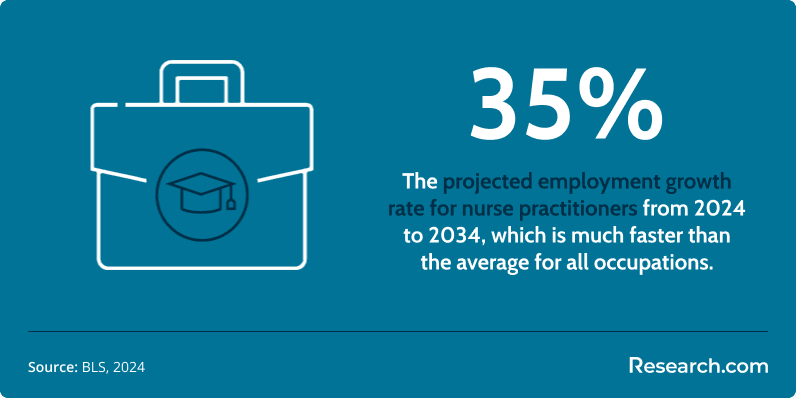
The job market for dual FNP/PMHNP graduates is supported by demand for both primary care and mental health services. The U.S. Bureau of Labor Statistics projects a 35% growth rate for nurse practitioners over the next decade, with an average of 32,700 new job openings each year.
Dual FNP/PMHNP graduates may be especially useful in care models that aim to reduce fragmentation between medical and behavioral health services. At the same time, students should avoid assuming that dual certification automatically guarantees a specific job title or salary. Employers may prioritize prior RN experience, NP clinical hours, state scope-of-practice rules, and experience with specific patient populations.
The growth of psychiatric-mental health NP pathways, including accelerated online MSN PMHNP programs, reflects the need for mental health expertise. A dual FNP/PMHNP pathway adds primary care preparation to that mental health focus, which can broaden practice options in clinics, rural health settings, specialty care, and integrated care programs.
Current Trends Affecting Dual FNP/PMHNP Students
- Integrated care models: More healthcare organizations are trying to coordinate behavioral health and primary care rather than treating them separately.
- Clinical placement pressure: NP students may face competition for qualified preceptors, making school placement support increasingly important.
- State-by-state practice variation: Scope-of-practice rules affect how independently NPs can practice, prescribe, and manage patients.
- Employer focus on readiness: Employers often look beyond the degree title and ask whether graduates have strong assessment, prescribing, documentation, and interprofessional collaboration skills.
- Technology in care delivery: Telehealth and digital care tools can expand access, but students should still ensure their clinical training includes direct, supervised patient care appropriate for certification.
Here’s What Graduates Have to Say about Their Online Dual FNP/PMHNP Degree Program
- Luna: "Working in a rural community showed me how often physical and mental health needs arrive in the same appointment. There is not always another specialist nearby. This degree helped me become a more complete provider for my patients because I can address diabetes and depression together instead of separating the care into different visits. The online format made that possible without leaving the community I serve."
- Jordan: "After years in the ICU, I kept seeing how disconnected medical and psychiatric care could be. The dual program gave me the clinical language, assessment skills, and confidence to connect those pieces. I could study after long shifts, apply concepts immediately, and eventually move into work on integrated care protocols for my health system."
- Hazel: "Oncology has always been my focus, and I saw how much emotional distress patients and families carried during treatment. Dual FNP/PMHNP training helped me build a career in psycho-oncology, where I support both the medical and mental health sides of care. Online study also gave me room to shape my projects around that specialty from the beginning."
Key Insights
- An online dual FNP/PMHNP program is best for registered nurses who want advanced practice preparation in both family primary care and psychiatric-mental health care.
- Program timelines vary widely, from approximately 2 years to 5 years in the programs reviewed, with many students needing three to four years because of extensive clinical requirements.
- Tuition varies substantially. The programs listed range from $25,440 to $76,307, while the average total tuition for a dual FNP/PMHNP program is approximately $59,000.
- Accreditation, certification eligibility, state authorization, and clinical placement support are more important than rankings alone.
- Clinical placement is often the biggest practical challenge in online NP education. Ask specific questions about whether the school secures sites, assists students, or expects students to find preceptors independently.
- Dual certification can support careers in integrated care, rural health, specialty clinics, veterans’ care, and private practice, but job titles and salaries depend on location, experience, employer needs, certification, and state scope-of-practice rules.
- The U.S. Bureau of Labor Statistics projects a 35% growth rate for nurse practitioners over the next decade, with an average of 32,700 new job openings each year, but students should still evaluate local demand before enrolling.
- The strongest program choice is the one that fits your state, budget, work schedule, clinical goals, and long-term practice plans.
References:
- American Association of Colleges of Nursing. (n.d.). Scholarships and financial aid. Retrieved from AACN Nursing.
- American Association of Nurse Practitioners. (2022). National nurse practitioner practice report. Retrieved from AANP.
- APEA. (2024). 2025 PMHNP career outlook: High need, high demand. Retrieved from APEA.
- Maryville University. (2023). Why dual certifications are growing. Retrieved from Maryville Online.
- National Center for Health Workforce Analysis. (2023). Advanced practice registered nurse workforce summary. Retrieved from NC Health Workforce.
- National Organization of Nurse Practitioner Faculties. (2021). Nurse practitioner policy report. Retrieved from NONPF.
- Zippia. (2024). Psychiatric nurse practitioner trends. Retrieved from Zippia.
- ZipRecruiter. (2024). Most popular types of temp dual psychiatric nurse practitioner jobs. Retrieved from ZipRecruiter.
Other Things You Should Know About Online Dual FNP/PMHNP Degree Programs
The strongest programs hold CCNE or ACEN accreditation for the nursing degree. In addition, the FNP track should prepare students for ANCC or AANPCB certification, and the PMHNP track should prepare students for ANCC certification after graduation and clinical eligibility.
Admission requirements typically include a Bachelor of Science in Nursing (BSN), a current RN license, at least one year of clinical experience, and a minimum GPA of 3.0. Some programs may also require GRE scores or recommendation letters for the 2027 intake.


