
2027 Benefits and Challenges of Becoming a Family Nurse Practitioner (FNP): What You Need to Know

Co-Founder and Chief Data Scientist
Across the United States, healthcare systems continue to face provider shortages, leaving patients waiting longer for care and struggling to access essential services. Family nurse practitioners (FNPs) play a critical role in bridging this gap, offering comprehensive, patient-centered care across all age groups. As demand grows, more FNPs are needed to improve access and strengthen communities’ healthcare outcomes.
However, while the path to becoming an FNP is rewarding, it also comes with unique challenges. Understanding both the benefits and obstacles is key to deciding if this career path is the right fit for you. This article explores the opportunities and hurdles of becoming a family nurse practitioner, helping you gain a clear picture of what to expect in today’s healthcare landscape.
What are the benefits of becoming a family nurse practitioner?
- High Earning Potential: FNPs enjoy competitive salaries compared to many other nursing roles.
- Strong Job Growth: The demand for FNPs continues to rise, offering stability and career opportunities.
- Broad Patient Impact: FNPs can care for patients across all ages, building lasting relationships and improving community health.
- Greater Autonomy: In many states, FNPs have the authority to diagnose, prescribe, and manage patient care independently.
What can you do as a family nurse practitioner?
As a family nurse practitioner, you have a wide scope of practice that allows you to deliver primary and preventive care across the entire lifespan. You can perform physical exams, order and interpret diagnostic tests, diagnose illnesses, and create treatment plans. FNPs are also authorized to prescribe medications, manage chronic conditions like diabetes or hypertension, and provide health education to promote wellness and disease prevention.
Beyond clinical tasks, FNPs often serve as advocates for patients, helping them navigate complex healthcare systems and access needed resources. Depending on your state’s regulations, you may practice independently or in collaboration with physicians, giving you flexibility in the type of setting you choose—such as clinics, hospitals, private practices, or community health centers. This blend of autonomy, versatility, and patient-centered care makes the FNP role essential in today’s healthcare landscape.
Where can you work as a family nurse practitioner?
As an FNP, you have the flexibility to work in a wide range of healthcare settings. Many FNPs provide care in primary care clinics, community health centers, or private practices, where they serve as the first point of contact for patients of all ages. Hospitals also employ FNPs in outpatient departments, urgent care, and specialty units, depending on the needs of the facility.
Beyond traditional healthcare settings, FNPs can work in schools, retail health clinics, telehealth platforms, and even corporate wellness programs. Some choose to focus on underserved or rural areas, where access to care is limited and their impact can be especially significant. This wide variety of work environments allows FNPs to tailor their careers to their interests while addressing critical gaps in healthcare delivery.
How much can you earn as a family nurse practitioner?
The earning potential for a family nurse practitioner is one of the key advantages of this career path. According to the U.S. Bureau of Labor Statistics (BLS), nurse practitioners—including FNPs—earn a mean annual wage of $132,000 as of 2024. Median annual wage, meanwhile, is $129,210.
Salaries can vary based on factors such as location, years of experience, and the type of healthcare setting. For example, FNPs working in outpatient care centers or hospitals often earn more than those in educational or community health settings.
In addition to competitive pay, many FNPs receive benefits such as health insurance, retirement plans, paid time off, and continuing education support. This combination of strong compensation and job security makes the role especially appealing for those looking to advance their nursing careers.
- What are the advantages of becoming a family nurse practitioner for 2027? Benefits
- What are the challenges and disadvantages of becoming a family nurse practitioner for 2027? Challenges
- What is the job outlook for family nurse practitioners? Job Outlook
- How long does it take to become a family nurse practitioner? Completion Time
- How much does it cost to become a family nurse practitioner? Program Cost
- What financial aid options are available for those studying to become a family nurse practitioner? Financial Aid
- What skills will I get to develop by becoming a family nurse practitioner? What skills will I get to develop by becoming a family nurse practitioner?
- How do I know FNP is the right specialization for me? How do I know FNP is the right specialization for me?
- What career advancement opportunities are available to family nurse practitioners? What career advancement opportunities are available to family nurse practitioners?
- Is becoming a family nurse practitioner worth it? Is becoming a family nurse practitioner worth it?
- How can online learning accelerate my transition to an FNP role? How can online learning accelerate my transition to an FNP role?
- What factors should I consider when choosing an FNP graduate program? What factors should I consider when choosing an FNP graduate program?
Becoming a family nurse practitioner is a major career decision for registered nurses who want more clinical authority, broader patient responsibility, and a stronger role in primary care. The FNP path can lead to higher earnings, more autonomy, and long-term career flexibility, but it also requires graduate education, clinical training, certification, and ongoing professional accountability.
This guide explains the real advantages and trade-offs of becoming an FNP in 2027. You will learn how the role compares with other nursing paths, what the job outlook looks like, how long training can take, what costs to plan for, how to evaluate FNP programs, and how to decide whether this specialization fits your goals.
Is becoming a family nurse practitioner worth considering in 2027?
Quick answer: Becoming a family nurse practitioner can be a strong choice for nurses who want to provide primary care across the lifespan, take on advanced clinical responsibilities, and work in settings such as clinics, hospitals, community health centers, schools, telehealth, and private practices. The role is especially appealing because nurse practitioners are projected to see substantial employment growth, and FNPs can serve patients of all ages.
However, the path is not easy. You will need a graduate nursing degree, supervised clinical hours, national certification, state licensure, and continuing education. The decision is strongest when the expected career benefits outweigh the time, tuition, debt, workload, and regulatory limits in your state.
| Best reasons to become an FNP | Important trade-offs to consider |
| Broader clinical role than an RN, including assessment, diagnosis, treatment planning, and prescribing where permitted by state law. | Graduate school requires a major investment of time, tuition, clinical hours, and exam preparation. |
| Ability to care for infants, children, adults, and older adults instead of focusing on one narrow population. | Patient volume, documentation, insurance rules, and administrative requirements can create heavy workloads. |
| Strong demand for primary care providers, especially in rural and underserved areas. | State practice authority varies, so independence may be limited depending on where you work. |
| More career flexibility across primary care, community health, urgent care, occupational health, telehealth, and leadership roles. | Certification maintenance, continuing education, and liability responsibilities continue throughout your career. |
If you are still learning what this role involves, start with our guide on what a family nurse practitioner does.
The image below shows nurse practitioner employment in 2024. The employment number is projected to grow to 448,800 by 2034, which illustrates why job demand is one of the clearest advantages of entering this field.
Main advantages of becoming a family nurse practitioner
- Higher earning potential than many RN roles: FNPs take on advanced clinical responsibilities, and compensation often reflects that higher level of training and accountability.
- Strong employment outlook: Demand is being shaped by primary care needs, physician shortages, chronic disease management, and access gaps in underserved communities.
- Flexible work settings: FNPs may work in physician offices, hospitals, community clinics, retail clinics, schools, telehealth companies, correctional health, occupational health, and corporate wellness programs.
- Wide patient scope: FNPs are trained to care for patients across the lifespan, making the specialty useful for nurses who do not want to limit themselves to one age group.
- Greater clinical autonomy: In many states, FNPs can assess patients, diagnose conditions, prescribe medications, and manage treatment plans with significant independence.
- Long-term patient relationships: Because FNPs often work in primary care, they may care for multiple members of the same family over time.
- Work-life options: Depending on the employer, FNPs may pursue traditional clinic hours, shift-based schedules, telehealth roles, part-time work, or administrative positions.
- Community impact: FNPs can help expand access to preventive care, chronic disease management, and health education in areas with limited provider availability.
- Leadership potential: The role can lead to clinical leadership, quality improvement, policy advocacy, education, and advanced administrative positions.
- Room for continued growth: FNPs can pursue additional certifications, a DNP, academic roles, research work, or specialized practice areas.
What are the disadvantages of becoming a family nurse practitioner in 2027?
The FNP career path can be rewarding, but it is not a simple promotion from RN practice. It changes your scope of responsibility, legal accountability, educational expectations, and daily workload. Nurses considering this path should weigh the drawbacks before applying to graduate school.
| Challenge | Why it matters | How to reduce the risk |
| Graduate education requirement | FNPs typically need an MSN or DNP, and the process can take several years. | Compare MSN, DNP, part-time, online, and bridge options before committing. |
| Tuition and possible debt | Advanced nursing programs can be expensive, especially when fees, travel, books, and reduced work hours are included. | Apply for aid early, ask employers about tuition support, and compare total program cost rather than tuition alone. |
| Clinical and administrative workload | FNPs may manage full patient schedules, documentation, test results, referrals, messages, and follow-up care. | Ask potential employers about patient volume, documentation support, scheduling expectations, and onboarding. |
| Emotional pressure | Primary care involves complex chronic conditions, family concerns, serious diagnoses, and end-of-life conversations. | Seek mentorship, build support systems, and look for organizations with reasonable caseloads and wellness resources. |
| State practice limits | Some states require physician collaboration or supervision, which can affect autonomy and job options. | Check your state board of nursing rules before choosing a program or relocating. |
| Ongoing certification and education | Certification renewal and continuing education require time and money after graduation. | Plan for renewal costs, track continuing education hours, and choose employers that support professional development. |
If you already have an associate degree in nursing and want to move directly toward graduate education, compare ADN to MSN bridge programs carefully. These pathways can shorten the route for some RNs, but admission standards, clinical expectations, and total costs vary by school.
The main disadvantage is not simply that FNP school is difficult. The bigger issue is whether the time, cost, liability, and workload match the kind of practice you actually want.
What is the job outlook for family nurse practitioners?
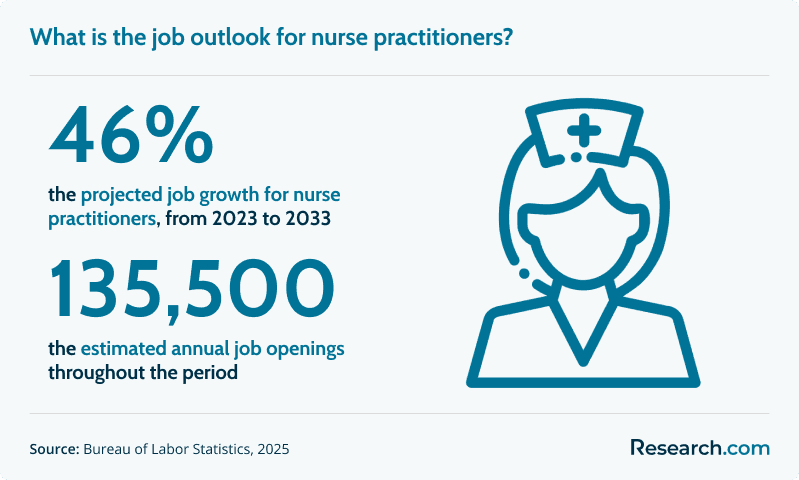
The job outlook for family nurse practitioners is strong because FNPs are part of the broader nurse practitioner workforce, which is expected to grow much faster than the average for all occupations. The U.S. Bureau of Labor Statistics projects a 46% increase in nurse practitioner jobs from 2023 to 2033, compared with a 4% average employment growth rate for all occupations.
That projection equals approximately 427,900 total nurse practitioner positions by 2033, with more than 135,500 new roles added since 2023. Because FNPs are commonly prepared for primary care, they are well positioned for roles in clinics, community health, rural care, telehealth, and chronic disease management.
Why demand for FNPs remains strong
- Primary care access gaps: Physician shortages and uneven provider distribution create demand for advanced practice clinicians.
- Aging population: Older adults often need ongoing management for chronic and complex health conditions.
- Chronic disease burden: FNPs frequently support long-term care plans, medication management, prevention, and patient education.
- Telehealth growth: Virtual care has expanded opportunities for NPs in triage, follow-up visits, chronic care management, and access-focused care models.
- Retirements in the workforce: As experienced providers leave practice, employers may need additional advanced practice clinicians to maintain capacity.
Workforce shortages affect many public-serving professions. For comparison, states also monitor teacher shortages and publish data on the states with high demand for teachers, showing how shortages can influence hiring, mobility, and credential planning across fields.
Recognition and career stability
- Nurse practitioner roles, including FNP positions, are frequently listed among the fastest-growing jobs in the United States.
- The role has also been described as the number one job in America because of its combination of projected growth, pay potential, and broad healthcare need.
How long does it take to become a family nurse practitioner?
The timeline depends on your current nursing credential, whether you study full time or part time, and whether you choose an MSN or DNP pathway. For registered nurses who already hold a bachelor of science in nursing, an MSN with an FNP focus usually takes 2-3 years of full-time study. A DNP route may take 3-4 years of graduate education.
RNs who hold an associate degree generally need to complete a BSN or enter a bridge pathway before becoming eligible for many graduate FNP programs. An RN-to-BSN bridge can add 2-3 years, depending on transfer credits, enrollment pace, and program format. If cost is your main concern, compare affordable RN to BSN programs before choosing a school.
From entry-level nursing preparation to FNP licensure, the full process often takes 6-8 years. That estimate includes nursing education, RN licensure, graduate coursework, clinical training, national certification, and state advanced practice approval.
| Starting point | Common next step | Typical time mentioned | Decision tip |
| RN with BSN | MSN-FNP program | 2-3 years full time | Good fit if you want the most direct graduate route into FNP practice. |
| RN with BSN | DNP-FNP program | 3-4 years | Consider this if you want doctoral-level preparation, leadership training, or a future academic or executive pathway. |
| RN with associate degree | RN-to-BSN or ADN-to-MSN bridge | May add 2-3 years before or during graduate preparation | Compare bridge structure, transfer credit rules, and whether the program includes FNP preparation. |
| Entry-level nursing student | RN preparation, BSN or bridge education, then graduate FNP training | Often 6-8 years total | Plan early for prerequisites, licensure, work experience, and clinical placement requirements. |
Coursework is only part of the timeline. FNP candidates must also complete supervised clinical hours and pass a national certification exam before practicing as advanced practice providers.
How much does it cost to become a family nurse practitioner?
The cost of becoming an FNP varies widely by school type, residency status, program length, credit requirements, fees, and how much you reduce work hours while enrolled. Tuition is only one part of the budget.
- MSN-to-DNP programs can cost between $54,206 for in-state students and $94,379 for out-of-state students.
- MSN programs can range from $370 to $946 per credit hour, depending on the institution.
- Lower-cost MSN options may range from $17,775 to $37,800.
- Additional expenses may include clinical placement fees, online learning fees, campus intensive travel, lodging, books, supplies, certification review materials, liability insurance, background checks, immunizations, and technology costs.
Some students also need to account for lost income if they move from full-time work to part-time employment during clinical rotations. Online coursework may help working nurses manage school more easily, but FNP clinical hours must still be completed in person. If speed and flexibility matter, review shorter FNP program options and confirm that the format still meets certification and licensure expectations.
| Cost factor | Why it affects your budget | Question to ask before enrolling |
| Tuition per credit | FNP programs often charge by credit hour, and total credits vary. | What is the full tuition cost for the entire program, not just one term? |
| Clinical placement | Some schools assist with placement; others expect students to secure preceptors. | Does the program guarantee, arrange, or only support clinical placement? |
| Online fees | Distance-learning fees can raise the real cost of an online program. | Are technology, simulation, or platform fees included in the posted tuition? |
| Travel requirements | Some online programs require campus visits or intensives. | How many in-person visits are required, and where are they held? |
| Certification preparation | Graduates usually need review resources and exam fees. | Does the school include board exam preparation in tuition? |
| Reduced work hours | Clinical rotations may make full-time employment difficult. | Can I realistically maintain my income while completing clinical requirements? |
The chart below shows the industries that pay nurse practitioners the highest salaries. When evaluating the return on investment of an FNP degree, compare total program cost with likely employment settings, local demand, and salary opportunities. Higher-paying industries may shorten the time needed to recover education costs, but no salary outcome is guaranteed.
What financial aid options are available for future family nurse practitioners?
FNP students may be eligible for scholarships, grants, employer support, federal loan programs, repayment incentives, assistantships, and service-based awards. Because many opportunities have deadlines and service requirements, financial planning should begin before you submit applications.
| Funding option | How it can help | What to check carefully |
| Federal aid and FAFSA | Submitting the FAFSA can determine eligibility for federal aid and some state or institutional aid. | Graduate aid rules, annual borrowing limits, interest rates, and school participation. |
| Nurse Corps Scholarship Program | May cover tuition, fees, and provide a living stipend in exchange for service in critical shortage facilities. | Service obligations, eligible sites, and consequences for not completing the commitment. |
| National Health Service Corps Scholarship | Supports students who commit to serving underserved areas. | Approved disciplines, practice sites, service length, and geographic flexibility. |
| Nurse Corps Loan Repayment Program | Can repay up to 60% of qualifying loans for two years of service and up to 85% with an optional third year. | Eligible debt, facility requirements, application competitiveness, and tax implications. |
| Public Service Loan Forgiveness | Can forgive remaining federal student loan balances after 120 qualifying payments while working full time for an eligible government or nonprofit employer. | Loan type, repayment plan, employer certification, and payment tracking. |
| State loan repayment programs | Many states offer repayment support for clinicians serving rural or underserved communities. | Amounts, practice locations, renewal rules, and required service terms. |
| Private scholarships | Scholarships from groups such as AANP Scholarships, Tylenol Future Care Scholarship, FNSNA, Nurse Practitioner Healthcare Foundation, and Uniform Advantage/AACN Graduate Nursing Scholarship may reduce borrowing. | Eligibility, deadlines, essay requirements, membership requirements, and award renewability. |
| Employer tuition assistance | Hospitals and health systems may help employees pay for graduate education or repay loans. | Work commitments, repayment clauses, grade requirements, and eligible schools. |
| Military HPSP | The Health Professions Scholarship Program can cover education costs in exchange for military service. | Branch requirements, service commitment, practice role, and deployment expectations. |
| Assistantships and fellowships | Graduate assistantships, work-study roles, or post-graduate NP residencies may provide income, stipends, tuition support, or structured transition-to-practice training. | Availability, workload, competitiveness, and whether the role fits your academic schedule. |
Students trying to limit debt should also compare affordable online FNP programs. Online coursework can make it easier to keep working, but you should still confirm clinical placement support, accreditation, certification pass preparation, and state authorization.
What skills do family nurse practitioners develop?
FNP education develops advanced clinical judgment, patient communication, leadership ability, and systems-level thinking. The goal is not only to perform more tasks than an RN, but to evaluate patients, make evidence-based decisions, coordinate care, and manage treatment over time.
- Advanced assessment: FNPs learn to complete focused and comprehensive exams, collect histories, recognize red flags, and evaluate patient concerns across age groups.
- Diagnosis and clinical reasoning: Training emphasizes differential diagnosis, diagnostic testing, lab interpretation, and evidence-based decision-making.
- Treatment planning and prescribing: FNPs develop skills in medication management, treatment selection, follow-up care, and patient safety.
- Chronic disease management: Primary care often includes ongoing management of conditions that require monitoring, education, and medication adjustments.
- Preventive care and health promotion: FNPs counsel patients on screenings, immunizations, lifestyle changes, risk reduction, and wellness planning.
- Patient and family education: The role requires explaining diagnoses, treatment options, warning signs, and self-care strategies in language patients can understand.
- Interprofessional collaboration: FNPs coordinate with physicians, nurses, pharmacists, behavioral health clinicians, specialists, social workers, and community agencies.
- Leadership and advocacy: Many FNPs contribute to quality improvement, policy discussions, team supervision, and access-to-care initiatives.
- Cultural responsiveness: FNPs must adapt care plans to patient values, language needs, health literacy, social conditions, and community context.
- Time management: Efficient charting, prioritization, follow-up, and care coordination are essential in busy clinical environments.
Some FNPs later pursue population-specific credentials. For example, nurses who want to focus more deeply on pediatric primary care may explore CPNP-PC certification.
The chart below shows the industries that employ the largest number of nurse practitioners in the United States. The skills you use most often can vary significantly by setting; a telehealth FNP, urgent care FNP, school-based FNP, and rural primary care FNP may have very different day-to-day responsibilities.
How do I know whether FNP is the right specialization for me?
FNP is usually best for nurses who want broad primary care preparation rather than a narrow specialty. It is a strong match if you enjoy seeing patients across the lifespan, managing both acute and chronic concerns, providing prevention-focused care, and building long-term patient relationships.
It may not be the best fit if you want to work exclusively with one population or in one high-acuity specialty. Nurses drawn primarily to pediatrics, women’s health, psychiatric-mental health, neonatal care, or acute adult-gerontology practice should compare those tracks before committing to an FNP program.
| You may be a good fit for FNP if... | You may prefer another NP specialty if... |
| You want to care for children, adults, and older adults. | You want to work only with one age group or clinical population. |
| You like prevention, primary care, health education, and chronic disease management. | You prefer intensive care, inpatient specialty care, surgery-related care, or emergency-only work. |
| You value long-term relationships with patients and families. | You prefer shorter, episode-based patient interactions. |
| You want flexible employment options across clinics, community health, telehealth, and wellness settings. | You already know you want a tightly specialized practice environment. |
| You are comfortable with advanced responsibility and independent decision-making where state law allows. | You prefer a role with less diagnostic, prescribing, or legal accountability. |
Self-check questions before choosing FNP
- Do I want a specialty that allows me to care for patients from infancy through older adulthood?
- Am I interested in both preventive visits and long-term chronic disease management?
- Do I enjoy educating patients and families, not just completing procedures or tasks?
- Am I ready for more responsibility in diagnosis, treatment planning, prescribing, and follow-up?
- Would I be comfortable working in primary care, community health, telehealth, or rural care?
- Can I handle the time, cost, and emotional demands of graduate-level nursing education?
- Do I want a role that can help improve access to care in underserved communities?
- Do I enjoy problem-solving when symptoms are unclear or patients have multiple health concerns?
If you are deciding between family practice and adult-gerontology, compare the differences between FNP and AGNP before selecting a graduate track.
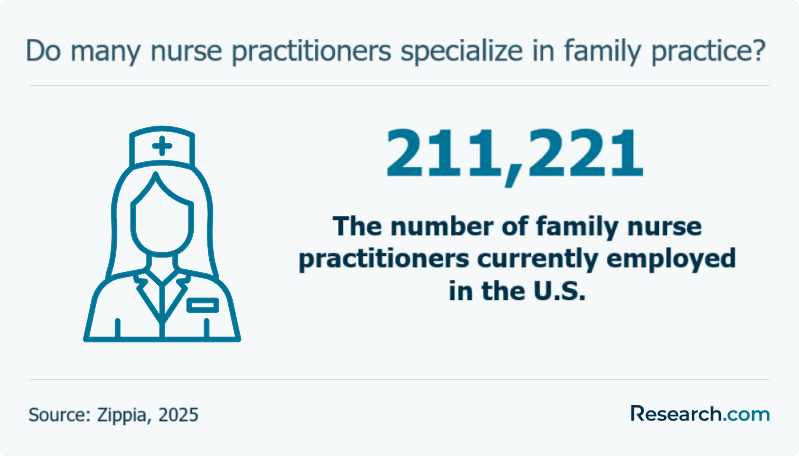
The image below shows how many family nurse practitioners are employed in the country. When compared with broader BLS nurse practitioner employment data, it suggests that family practice represents a substantial share of the NP workforce.
What career advancement opportunities are available to family nurse practitioners?
FNPs can advance in several directions because their training is broad. Some remain in patient care and move into more complex or higher-responsibility clinical roles. Others transition into leadership, education, research, policy, or administration.
| Advancement path | What it can lead to | When it makes sense |
| Clinical specialization | Additional focus in areas such as pediatrics, geriatrics, emergency care, or psychiatric-mental health. | Choose this if you enjoy patient care but want a more targeted clinical niche. |
| DNP education | Doctoral-level practice, quality improvement, systems leadership, and advanced clinical expertise. | Consider this if you want higher-level practice leadership or doctoral preparation. |
| Academic teaching | Nursing faculty, clinical instructor, simulation educator, or preceptor leadership roles. | Good fit if you enjoy mentoring nurses and shaping future clinicians. |
| Clinical leadership | Nurse manager, lead provider, clinical director, or care model leadership roles. | Appropriate if you want to guide teams and improve care delivery. |
| Healthcare administration | Operations, quality, compliance, population health, or executive healthcare leadership. | Best for FNPs who want to move beyond direct patient care into organizational decision-making. |
| Independent or entrepreneurial practice | Potential practice ownership or independent service delivery in states that allow it. | Works best for FNPs with business skills, regulatory knowledge, and a clear patient market. |
FNPs interested in management may benefit from additional administrative training. Programs such as online CAHME-accredited MHA programs can pair clinical experience with healthcare leadership, finance, operations, and policy coursework.
Is becoming a family nurse practitioner worth it?
Becoming an FNP is worth it for many nurses, but only when the role aligns with their long-term goals. The strongest candidates are RNs who want advanced clinical authority, primary care responsibility, patient relationships across the lifespan, and multiple career options. The projected job growth and broad demand for nurse practitioners make the pathway attractive, especially for nurses who want to move into provider-level practice.
The decision is less clear if you are unsure about graduate school, uncomfortable with diagnostic responsibility, unwilling to manage documentation-heavy patient care, or located in a state where practice restrictions do not match your expectations. Cost also matters. A program with high tuition and weak clinical placement support can reduce the value of the degree.
When the FNP path is likely worth it
- You want to move from bedside nursing into advanced practice.
- You enjoy primary care, prevention, patient education, and long-term follow-up.
- You want a specialty that keeps multiple work settings open.
- You have researched your state’s practice authority rules.
- You understand the full cost of graduate school and have a realistic repayment plan.
- You are prepared for certification, licensure, continuing education, and professional liability.
When another path may be better
- You prefer hospital-based acute care over primary care.
- You want to focus only on one population, such as pediatrics or psychiatric-mental health.
- You do not want prescribing, diagnosis, or provider-level accountability.
- You need the fastest or least expensive advancement route and are not committed to advanced practice.
- Your preferred state or employer limits FNP autonomy in ways that would frustrate your career goals.
If compensation differences by specialty are part of your decision, reviewing comparisons such as gerontology nurse practitioner salary by state can help you evaluate whether another NP track may better match your financial and professional goals.
How can online learning help registered nurses move toward an FNP role?
Online learning can make the FNP pathway more accessible for working RNs by allowing didactic coursework to fit around shifts, family responsibilities, and local employment. Many programs use online lectures, discussion platforms, virtual simulations, case-based assignments, and telehealth-related training to support advanced practice preparation.
Online programs do not eliminate in-person requirements. FNP students still need supervised clinical experiences with real patients, and those placements must satisfy program, certification, and state licensure expectations. Before enrolling, ask whether the school helps arrange preceptors, whether clinical sites are available in your state, and whether the program is authorized to enroll students where you live.
RNs who still need a bachelor’s degree may look at online RN to BSN bridge programs as a step toward graduate FNP admission. Choose carefully: the easiest admission process is not always the best long-term option if accreditation, transfer credit, clinical preparation, or graduate school acceptance is weak.
What should I look for when choosing an FNP graduate program?
The right FNP program should prepare you for certification, licensure, safe practice, and employment in your intended state and setting. Do not choose based only on tuition, convenience, or rankings. The most important factors are accreditation, clinical placement quality, certification preparation, state authorization, faculty support, and total cost.
| Program factor | Why it matters | Questions to ask |
| Accreditation | Accreditation can affect certification eligibility, licensure, financial aid, transferability, and employer acceptance. | Is the nursing program accredited by a recognized nursing accreditor? |
| State authorization | Online programs may not be approved to enroll or place students in every state. | Can this program legally enroll students in my state and support clinical placement there? |
| Clinical placement support | Weak placement support can delay graduation or force students to find preceptors alone. | Does the school secure placements, provide a placement team, or require students to find their own sites? |
| Certification preparation | Graduates need to pass a national certification exam to move into practice. | What board exam preparation is included, and how does the curriculum align with certification requirements? |
| Faculty access | Graduate nursing students need mentorship, feedback, and clinical guidance. | How often can students meet with faculty, advisors, and clinical coordinators? |
| Schedule format | Full-time, part-time, synchronous, and asynchronous formats affect work-life balance. | Are classes live, self-paced, hybrid, or cohort-based? |
| Total cost | Fees, travel, books, exams, and lost income can change affordability. | What is the estimated total cost from enrollment to graduation? |
| Student outcomes | Graduation, certification, and employment support reveal program strength. | What support is available for board preparation, job search, and transition to practice? |
Nurses considering doctoral-level preparation may also compare DNP programs with accessible admissions pathways. Admission accessibility should not be the only measure, though. A program still needs strong accreditation, rigorous clinical preparation, and credible outcomes.
Common mistakes to avoid before becoming an FNP
- Choosing a program without checking accreditation: Accreditation can affect certification, licensure, employer recognition, and financial aid eligibility.
- Assuming online means fully remote: FNP programs may offer online coursework, but clinical training is face-to-face.
- Ignoring state practice rules: Practice authority, prescribing rules, and collaboration requirements vary by state.
- Looking only at tuition: Fees, travel, books, clinical placement costs, exam preparation, and reduced work hours can significantly change the real price.
- Assuming the school will find clinical sites: Some programs provide placement support, while others expect students to secure preceptors.
- Relying only on rankings: A highly visible school is not always the best match for your state, schedule, budget, or clinical needs.
- Overlooking certification requirements: Make sure the curriculum aligns with the FNP certification exam you plan to take.
- Expecting guaranteed salary outcomes: Pay varies by location, employer, experience, industry, and scope of practice.
- Underestimating burnout risk: Provider-level responsibility, documentation, and patient volume can be demanding.
Current trends affecting family nurse practitioners
- Telehealth is now part of primary care delivery: FNPs increasingly need comfort with virtual assessment, remote monitoring, patient messaging, and digital documentation.
- Employer expectations are rising: Many employers want FNPs who can manage complex patients, document efficiently, collaborate across teams, and support quality metrics.
- Access-to-care gaps continue to shape hiring: Rural, community, and underserved settings remain important employment areas for primary care-focused NPs.
- Technology is changing workflow: Electronic health records, clinical decision support, AI-assisted documentation, and patient portals can improve efficiency, but they also require digital judgment and privacy awareness.
- Cost and ROI matter more: As graduate education costs remain a concern, students are paying closer attention to tuition, debt, employer benefits, and program outcomes.
Here is what family nurse practitioners say about the career
- Zoe: "My biggest obstacle while preparing for the FNP role was managing graduate coursework while continuing to work as a registered nurse. The schedule was demanding, but online classes and support from classmates helped me stay on track. The most rewarding part now is being able to care for whole families, from children to older adults, and to see patients trust me as a long-term primary care provider."
- Lily: "The cost of becoming an FNP worried me before I started. I had to research scholarships, federal aid, and repayment options so I could make the numbers work. After finishing the program, the career stability and stronger income potential made the effort feel worthwhile. I can support my family while doing work that directly improves patients’ lives."
- Fiona: "When I began the transition into advanced practice, I questioned whether I was ready for the responsibility of diagnosing and managing patients. Mentorship and clinical training helped me build confidence over time. Today, I value the autonomy of the FNP role, while still appreciating collaboration with physicians and other clinicians when patients need team-based care."
Key Insights
- Becoming an FNP can be a strong career move for RNs who want advanced clinical authority, primary care responsibility, and flexibility across healthcare settings.
- The U.S. Bureau of Labor Statistics projects 46% growth for nurse practitioners from 2023 to 2033, far above the 4% average for all occupations.
- The FNP path is demanding: most candidates need graduate education, clinical hours, certification, state licensure, and continuing education.
- Program cost varies widely, with MSN programs ranging from $370 to $946 per credit hour and some affordable MSN options ranging from $17,775 to $37,800.
- Online FNP programs can help working nurses manage coursework, but clinical requirements must still be completed in person.
- Before enrolling, verify accreditation, state authorization, clinical placement support, certification preparation, total cost, and practice authority rules in your state.
- FNP is best for nurses who want to care for patients across the lifespan. If you prefer a narrower population or acute specialty, compare other NP tracks first.
- The career can be worth it when the expected benefits—autonomy, demand, compensation potential, and patient impact—outweigh the cost, workload, and regulatory limits.
References:
- American Association of Nurse Practitioners. (2022, April 7). Nurse Practitioner, No. 1 Ranked Health Care Job, Reports Increase in Numbers. AANP.
- AMN Healthcare. (2025, February 6). Nurse Practitioner Trends to Watch in 2025. AMN Healthcare.
- Purdue Global. (2023, December 5). Nurse Practitioner (NP) Job Outlook: The Demand for NPs Continues to Climb. Purdue Global.
- United States Bureau of Labor Statistics. (2023, April 25). Occupational Employment and Wage Statistics | 29-1171 Nurse Practitioners. BLS.
- United States Bureau of Labor Statistics. (2025). Occupational Employment and Wage Statistics Query System. BLS.
- United States Bureau of Labor Statistics. (2025, April 18). Occupational Outlook Handbook | Nurse Anesthetists, Nurse Midwives, and Nurse Practitioners. BLS.
- WifiTalents. (2025, June 1). Nurse Practitioner Statistics. WifiTalents.
- Zippia. (2025, January 8). Family nurse practitioner demographics and statistics in the US. Zippia.
Other Things You Should Know About the Benefits and Challenges of Becoming a Family Nurse Practitioner
Most family nurse practitioner programs require at least 500 supervised clinical hours, and many universities require 600 to 1,000 hours before graduation. These hours must be completed in approved primary care settings under licensed preceptors, which is essential for meeting NP certification and state licensure expectations.
In 2027, Family Nurse Practitioners must complete at least 75 contact hours of continuing education every five years, including 25 hours in pharmacology, to maintain their certification, as mandated by the American Association of Nurse Practitioners (AANP).





