2027 How to Become a Nurse Informaticist: Salary & Career Paths

Co-Founder and Chief Data Scientist
Becoming a nurse informaticist is a practical next step for registered nurses who want to influence patient care through better data, safer workflows, and smarter health technology rather than through traditional bedside practice alone. Hospitals, health systems, vendors, payers, and government healthcare organizations rely on these professionals to make electronic health records, clinical software, analytics tools, and reporting systems work for real clinicians and patients.
This guide explains what nurse informaticists do, what education and licensing are typically expected in 2026, which certifications can strengthen your resume, how much professionals in the field report earning, and how to decide whether this career path is worth the time and cost. It is written for nurses considering a career shift, BSN or MSN students comparing specialties, and experienced clinicians who want to move into technology, leadership, quality improvement, or data-focused roles.
Quick answer: How do you become a nurse informaticist?
Most nurse informaticists begin as licensed registered nurses, build clinical experience, and then add informatics training through an MSN, graduate certificate, certification, or employer-based health IT project experience. A BSN is often the minimum foundation, but advanced education and recognized credentials can improve access to leadership, analytics, system implementation, and EHR optimization roles. According to a 2022 HIMSS survey, 60% of nurse informaticists reported earning more than $100,000 annually, up from 33% in 2014.
Key things to know before choosing nursing informatics
- The role is clinical and technical. Nurse informaticists work with EHRs, clinical applications, reporting platforms, workflow tools, and data systems. You do not need to become a software engineer, but you must be comfortable learning how systems work and how clinicians use them.
- Bedside or clinical experience matters. Employers value nurses who understand real patient care workflows. That clinical credibility helps informaticists translate frontline problems into usable technology solutions.
- Graduate education can open more doors. Many informatics leadership, project management, and strategy roles favor nurses with an MSN, DNP, PhD, or informatics-focused graduate certificate.
- Certification can help distinguish you. Credentials such as RN-BC, CPHIMS, and CAHIMS may strengthen your profile, especially when paired with measurable project experience.
- The best path depends on your starting point. A working RN without a BSN may need a different education plan than a BSN-prepared nurse already involved in EHR training, quality reporting, or clinical systems projects.
- What does a nurse informaticist do?
- What degree do you need to become a nurse informaticist in 2026?
- Do nurse informaticists need an RN license?
- Which certifications are useful for nurse informaticists?
- What skills do nurse informaticists need?
- What does the nurse informaticist career path look like?
- What is the job outlook for nurse informaticists?
- What are affordable education pathways for nursing informatics?See job outlook context
- How should you choose a nursing informatics program?
- Can clinical specializations strengthen an informatics career?
- What trends are changing nursing informatics?
- How can advanced education change your career options?
- Where do nurse informaticists work?
- How much do nurse informaticists make?
- What challenges should nurse informaticists expect?
What does a nurse informaticist do?
A nurse informaticist connects nursing practice with information systems. The job is not just “IT for nurses.” It involves understanding clinical care, identifying workflow problems, improving how health data is captured and used, and making sure technology supports safe, efficient, and compliant care. Research on health information systems support high-quality patient care highlights why these systems affect areas such as patient identification, regulatory compliance, workflow design, and care quality.
In practice, nurse informaticists often serve as translators between clinicians, IT teams, vendors, administrators, quality leaders, and compliance stakeholders. Their work may affect one unit, an entire hospital, a multi-site health system, or a national healthcare technology product.
Common responsibilities of nurse informaticists
- System planning and design: They help shape EHR templates, documentation tools, clinical decision support, order sets, dashboards, and other systems so they fit actual clinical practice.
- Implementation support: They participate in system go-lives, testing, configuration, user training, troubleshooting, and adoption planning.
- Workflow optimization: After launch, they analyze user feedback, system performance, documentation burden, and care processes to improve usability and efficiency.
- Quality reporting and analytics: They gather, validate, interpret, and present healthcare data for quality improvement, compliance, safety initiatives, and leadership decision-making.
- Clinical-technical communication: They explain clinical needs to technical teams and explain system changes to nurses, physicians, and other care team members.
- Policy and compliance support: They help ensure technology workflows align with privacy, documentation, reporting, and organizational standards.
| Work area | What the nurse informaticist may do | Why it matters |
| EHR optimization | Improve templates, alerts, order sets, and documentation workflows | Reduces friction for clinicians and supports more accurate records |
| Clinical analytics | Review data trends, create reports, and support quality initiatives | Helps leaders make decisions using reliable healthcare data |
| Implementation projects | Test systems, train users, support go-live, and resolve workflow issues | Improves adoption and reduces disruption during technology changes |
| Vendor or product work | Advise on clinical usability, product configuration, and customer needs | Helps technology products reflect real clinical environments |
| Leadership strategy | Guide informatics priorities, staffing, governance, and digital transformation | Aligns nursing practice with organizational technology goals |
What degree do you need to become a nurse informaticist in 2026?
There is no single degree that every nurse informaticist must hold, but most pathways begin with nursing education and RN licensure. From there, nurses typically add informatics knowledge through a BSN, MSN, post-graduate certificate, doctorate, certification, or practical project experience. About 40% of nurse informaticists reported a BSN as their highest degree before moving into specialized roles, while 63% earned a master’s degree or higher.
If you are comparing programs, focus less on the title alone and more on whether the curriculum includes health informatics, data management, EHR systems, workflow redesign, project leadership, privacy, quality improvement, and applied practicum experiences. Nurses looking for accessible informatics-focused options may also compare online nursing informatics programs with more flexible admissions pathways.
| Education option | Best fit | What it can help you do | Important caution |
| BSN | RNs who need the standard bachelor’s foundation for many informatics roles | Builds clinical reasoning, leadership basics, evidence-based practice, and initial exposure to healthcare technology | A BSN alone may not be enough for competitive informatics leadership roles |
| MSN in Nursing Informatics | BSN-prepared nurses who want a direct route into informatics specialization | Develops skills in data, system design, implementation, analytics, leadership, and digital health projects | Program quality and practicum relevance vary, so compare outcomes and employer connections |
| General MSN plus informatics coursework | Nurses who want broader leadership training with an informatics focus | Supports movement into management, education, quality, or informatics roles | You may need additional informatics certificates or project experience |
| Graduate certificate in health or nursing informatics | Nurses who already have a graduate degree or want focused training without another full degree | Adds targeted informatics knowledge and may support career transition | Not all certificates carry the same employer recognition |
| DNP or PhD | Nurses aiming for executive, academic, research, policy, or high-level systems roles | Prepares graduates for applied innovation, research, evidence translation, or organizational leadership | Doctoral study is a major time and cost commitment and should match your long-term goals |
Do nurse informaticists need an RN license?
In most cases, yes. Nurse informaticists are generally expected to be licensed nurses because the role depends on clinical judgment, patient care knowledge, documentation standards, and nursing workflow expertise. The RN license signals that the professional understands clinical responsibility, patient safety, ethics, and the realities of care delivery.
Direct care experience is especially valuable. A nurse who has documented assessments during a busy shift, used medication administration technology, handled admissions and discharges, or worked through alarm fatigue can identify problems that may not be obvious to non-clinical IT staff.
The clinical backgrounds of nurse informaticists are diverse. In 2022, 35% came from medical/surgical nursing and about 33% had critical care experience. Around 17% brought emergency or trauma care experience, while nearly 15% had an administrative background. Those experiences help informaticists design systems for different care settings, from high-acuity units to outpatient operations and administrative reporting.
Nursing informatics also sits near broader health technology career paths. Some nurses compare it with high-paying technology careers, but the distinguishing feature is clinical expertise. A nurse informaticist is not simply leaving nursing for IT; the nurse is applying nursing knowledge inside technology-driven healthcare operations.
Which certifications are useful for nurse informaticists?
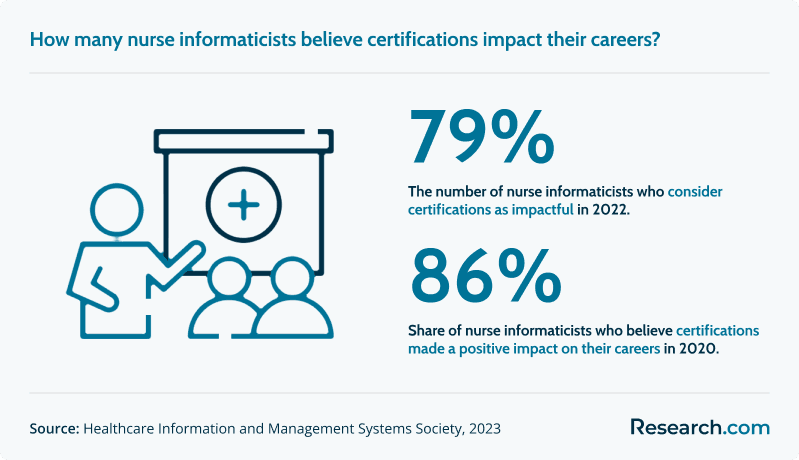
Certification is not always mandatory, but it can help demonstrate commitment and specialized competence. It is most useful when paired with hands-on experience in EHR optimization, implementation, training, quality reporting, analytics, governance, or project leadership. In 2022, 79% of nurse informaticists considered certifications impactful for their careers.
| Credential or training option | Who it is most useful for | What it signals to employers |
| ANCC Informatics Nursing Certification, RN-BC | Licensed nurses with informatics experience who want a nursing-specific credential | Competence in informatics practice, data use, system support, and clinical technology improvement |
| Certified Professional in Healthcare Information and Management Systems, CPHIMS | Experienced healthcare IT or informatics professionals moving toward leadership or strategy roles | Knowledge of healthcare information systems, management, governance, and organizational strategy |
| Certified Associate in Healthcare Information and Management Systems, CAHIMS | Professionals newer to healthcare IT who want a foundational credential | Baseline understanding of healthcare information systems and informatics concepts |
| Clinical Informatics Board Certification | Eligible APRNs and physicians working in clinical informatics | Advanced clinical informatics knowledge, leadership, standards, analytics, and patient-centered system design |
| University health informatics certificates | Nurses who want structured education without committing to a full degree | Focused academic preparation in data, systems, workflow, privacy, and digital health |
Nurses who enjoy systems leadership may also compare informatics credentials with broader technology management careers, including the information systems manager career path. The overlap can be useful, but nurse informaticists should keep their clinical value visible rather than positioning themselves as generic IT workers.
What skills do nurse informaticists need?
Nursing informatics requires more than comfort with computers. Strong candidates combine clinical credibility, analytical thinking, project discipline, communication, and the ability to help people adapt to change. Nurses comparing leadership-oriented degrees may also find it useful to review how healthcare management and healthcare administration programs differ, especially if they want roles that blend operations, technology, and strategy.
Core skills to build
- Clinical workflow knowledge: You need to understand how nurses and interdisciplinary teams actually deliver care, document, communicate, and make decisions.
- Health IT literacy: Familiarity with EHRs, clinical decision support, health information exchanges, reporting tools, and privacy safeguards is essential.
- Data analysis: Nurse informaticists must know how to interpret healthcare data, identify patterns, validate information, and communicate findings clearly.
- Workflow mapping and process improvement: The role often involves identifying bottlenecks, redesigning processes, and measuring whether changes work.
- Project management: Implementation work requires timelines, stakeholder coordination, testing plans, training schedules, risk management, and follow-up.
- Change management: Even a well-designed tool can fail if clinicians do not understand, trust, or adopt it.
- Communication: Nurse informaticists must explain technical concepts to clinicians and clinical priorities to IT staff without losing accuracy.
- Problem-solving: System issues often have multiple causes, including workflow design, configuration, training, policy, staffing, and user behavior.
- Regulatory awareness: Knowledge of HIPAA, the Cures Act, documentation standards, and privacy expectations helps protect patients and organizations.
- Leadership and advocacy: Informaticists often speak up for safer workflows, better usability, and technology decisions that support care teams.
| If you are strong in... | You may fit well in... | Skill to strengthen next |
| Bedside nursing and staff education | EHR training, super-user support, implementation readiness | Project management and adult learning design |
| Quality improvement and reporting | Clinical analytics, dashboard development, regulatory reporting | Data validation and visualization |
| Leadership and operations | Informatics management, governance, workflow redesign | Technology strategy and stakeholder management |
| Technical troubleshooting | Application support, system testing, vendor collaboration | Clinical safety analysis and change communication |
What does the nurse informaticist career path look like?
Many nurse informaticists start as bedside or direct-care nurses, become involved in EHR training or quality projects, and then move into formal informatics roles. Advancement usually depends on a mix of education, certification, project results, leadership exposure, and the ability to manage complex stakeholder relationships. Nurses planning graduate study often compare cost-conscious options such as affordable online BSN-to-MSN programs before committing to a pathway.
| Career stage | Typical role | What to focus on |
| Clinical foundation | Staff nurse, charge nurse, specialty nurse | Build strong documentation habits, workflow insight, and credibility with care teams |
| Early informatics exposure | Super user, EHR trainer, quality project participant, unit technology champion | Volunteer for system testing, training, audits, and improvement projects |
| Entry informatics role | Nurse informaticist, nursing informatics specialist, clinical systems analyst | Develop skills in implementation, optimization, data use, and stakeholder communication |
| Mid-level informatics role | Clinical informatics specialist, informatics analyst, project lead | Lead multi-department work, document measurable outcomes, and build project management skills |
| Leadership role | Informatics manager, director of clinical informatics | Manage teams, budgets, governance, vendor relationships, and system-wide initiatives |
| Executive role | Chief Nursing Informatics Officer, CNIO | Shape enterprise informatics strategy and represent nursing in digital transformation decisions |
Career growth can be substantial for nurses who combine advanced education with visible project leadership. Survey data shows that 60% of nurse informaticists earn over $100,000 annually, but salary growth is not automatic. The strongest candidates can point to concrete outcomes, such as reduced documentation burden, improved reporting accuracy, smoother go-lives, higher user adoption, or better workflow standardization.
What is the job outlook for nurse informaticists?
The outlook for nursing informatics is supported by healthcare’s continued reliance on digital records, quality reporting, analytics, interoperability, cybersecurity, telehealth, and data-driven operations. Nurse informaticists are also reporting strong satisfaction: 53% said they were highly satisfied and 43% were somewhat satisfied with their current positions.
Healthcare organizations increasingly recognize what an informatics nurse can do for clinical and operational improvement. Their value is especially clear when health systems need to improve workflows, prepare for system changes, train clinicians, meet reporting demands, and make better use of patient data.
Retention also appears steady. More than 50% of nurse informaticists indicated that they had no plans to change jobs within the next three years. That does not mean every role is easy or every market is equally strong, but it does suggest that many professionals see long-term value in the specialty.
What are affordable education pathways for nursing informatics?
The most affordable route depends on your current license, degree level, employer benefits, and career goal. A nurse with an ADN may need to complete a BSN first, while a BSN-prepared nurse may be able to move directly into a graduate certificate or MSN in informatics. Working nurses who want to reduce cost should compare tuition, fees, transfer credit, employer reimbursement, clinical or practicum requirements, and whether courses can be completed part time.
For RNs who still need a bachelor’s degree, low-cost online RN-to-BSN programs can be a practical first step. This option may strengthen leadership and evidence-based practice skills while keeping the nurse employed during school.
| Starting point | Lower-cost pathway to consider | Why it may make sense |
| ADN-prepared RN | Online RN-to-BSN, then informatics certificate or MSN | Builds the bachelor’s foundation many employers expect before graduate-level specialization |
| BSN-prepared RN | MSN in nursing informatics or graduate certificate | Creates a direct path toward informatics roles while preserving clinical identity |
| MSN-prepared nurse in another specialty | Post-graduate informatics certificate | Adds informatics expertise without repeating a full graduate degree |
| Experienced nurse leader | DNP with informatics, systems leadership, or quality focus | May support executive, strategy, policy, or enterprise-level roles |
How should you choose a nursing informatics program?
A good nursing informatics program should prepare you to solve real healthcare technology problems, not just complete theory courses. Before enrolling, verify accreditation, compare total cost, examine practicum expectations, and ask how the program supports working nurses. If admissions accessibility is a concern, resources on nursing schools that are easier to get into can help you understand selectivity, but admission ease should never replace program quality.
Questions to ask before enrolling
- Is the nursing program properly accredited and recognized by employers in my state or region?
- Does the curriculum include EHRs, analytics, workflow redesign, privacy, implementation, project management, and quality improvement?
- Will I complete a practicum or applied project in a real healthcare or health technology setting?
- Can working nurses complete the program part time or asynchronously?
- What are the total costs, including fees, technology requirements, travel, books, and certification exam preparation?
- Does the school help students find practicum sites or informatics mentors?
- Do graduates move into informatics roles, leadership positions, or related health IT jobs?
- Will credits transfer into a future MSN, DNP, or certificate if I continue studying?
Online vs. campus nursing informatics programs
| Format | Advantages | Trade-offs | Best for |
| Online | Flexible scheduling, easier for working nurses, broader school options | Requires self-direction and careful practicum planning | RNs balancing employment, family, and school |
| Campus-based | In-person networking, structured schedule, direct faculty access | Less flexible and may require commuting or relocation | Students who prefer face-to-face learning and local healthcare connections |
| Hybrid | Combines online coursework with limited campus or practicum experiences | May still require travel on specific dates | Nurses who want flexibility but also value in-person support |
Can clinical specializations strengthen an informatics career?
Yes, but only if the specialization supports your target role. A nurse with deep emergency, critical care, perioperative, population health, women’s health, or primary care experience may bring valuable context to informatics projects in those areas. However, adding a clinical specialization is not automatically better than gaining direct informatics experience.
For example, nurses who want to remain close to advanced clinical care may compare informatics with options such as affordable online family nurse practitioner programs or accelerated online women’s health nurse practitioner MSN programs. Those paths can deepen clinical authority, while informatics-focused education develops system, data, and workflow expertise. The right choice depends on whether you want your future work centered on patient care delivery, clinical specialization, technology leadership, or a combination of these areas.
What trends are changing nursing informatics?
Nursing informatics is evolving as healthcare organizations adopt more data-intensive and connected systems. The most important trend is not technology for its own sake; it is the expectation that technology must improve care, reduce burden, support compliance, and produce trustworthy information.
Trends nurse informaticists should watch
- Artificial intelligence and predictive analytics: Healthcare organizations are exploring AI-supported decision tools, risk prediction, documentation assistance, and operational analytics. Nurse informaticists help evaluate whether these tools are safe, usable, equitable, and clinically appropriate.
- Cybersecurity and privacy pressure: As health data becomes more connected, informaticists need stronger awareness of access controls, privacy rules, and safe data-sharing practices.
- Telehealth and remote monitoring: More care is delivered through digital channels, which creates new documentation, workflow, triage, and data integration challenges.
- Interoperability and data sharing: Organizations need systems that communicate across settings while maintaining data integrity and patient privacy.
- Clinician burnout and documentation burden: Informatics teams are increasingly expected to reduce unnecessary clicks, duplicate charting, alert fatigue, and inefficient workflows.
- Credential-based hiring: Degrees, certificates, and certifications can help candidates demonstrate informatics readiness, but employers still look for practical project experience.
Nurses comparing future-focused education may also consider whether an advanced practice path, systems leadership route, or informatics degree best fits their goals. For those seeking doctoral-level preparation, fast-track online DNP programs may be relevant when the goal is executive leadership, quality improvement, or systems-level change.
How can advanced education change your career options?
Advanced education can shift a nurse informaticist from user support or implementation work into leadership, strategy, governance, research, policy, or executive decision-making. An MSN in informatics may prepare a nurse to lead EHR optimization or analytics projects. A DNP may strengthen applied systems leadership. A PhD may support research, academic work, or evidence generation in informatics.
The best advanced degree is the one that matches the work you want to do. If you want to manage projects and support clinical systems, an MSN or certificate may be enough. If you want executive responsibility, organizational transformation, or academic research, doctoral preparation may be more appropriate. Avoid choosing the highest degree by default; choose the credential that produces the strongest career return for your goals, time, and budget.
Where do nurse informaticists work?
Nurse informaticists work across healthcare delivery, technology, insurance, government, education, and consulting environments. The largest share—62%—work primarily in hospitals and health systems, where they support EHRs, clinical workflows, reporting, quality improvement, and implementation projects.
Other settings include vendor or payer organizations, where about 13% of nurse informaticists help build, configure, support, or improve health technology products and services. Nearly 8% work in government or military healthcare systems, often on large-scale health IT initiatives. Less than 5% work in academic institutions or ambulatory care settings, where responsibilities may involve education, research, outpatient workflow design, or innovation. Some responsibilities overlap with broader healthcare technology roles, including the skills described in clinical technologist career requirements.
| Work setting | Common focus | Good fit for nurses who enjoy... |
| Hospitals and health systems | EHR optimization, workflow redesign, reporting, implementation, training | Improving clinical practice at scale |
| Vendors and payers | Product support, configuration, analytics, customer workflow consulting | Working across organizations and influencing technology products |
| Government or military healthcare | Large-scale systems, compliance, reporting, standardization | Structured environments and broad public-service impact |
| Academic institutions | Teaching, research, curriculum design, informatics scholarship | Education, research, and mentoring |
| Ambulatory care | Outpatient workflows, telehealth, population health reporting | Primary care operations and longitudinal care improvement |
Nurse informaticists are distributed across the United States, as shown below:
How much do nurse informaticists make?
Nurse informaticist pay varies by education, experience, employer type, geography, role scope, leadership responsibility, and certification. The strongest salary gains are generally associated with advanced responsibility, not simply holding a degree. A nurse who leads enterprise implementations, manages teams, or owns high-impact analytics work may have a different earning profile than someone in an early support role.
- Base salary growth: Around 60% of nurse informaticists reported a base annual salary of $100,000 or more. That share rose from 33% in 2014 to 60% in 2022. Some readers may compare this range with technology compensation, such as computer engineer salary information, but nurse informatics compensation reflects a different mix of clinical, operational, and technical responsibility.
- Education level: Higher degrees are associated with higher salary potential. Among nurse informaticists with a PhD or equivalent degree, 25% earn over $176,000 annually, compared with 8%-12% of those with lower degrees.
- Experience: Time in the field matters. For example, 42% of nurse informaticists with 16+ years of experience earn over $150,000, while only 6% of those with fewer than 5 years in the field reach that level. Some nurses also compare senior informatics pay with technology areas such as high-paying cybersecurity jobs, but career requirements and labor markets differ.
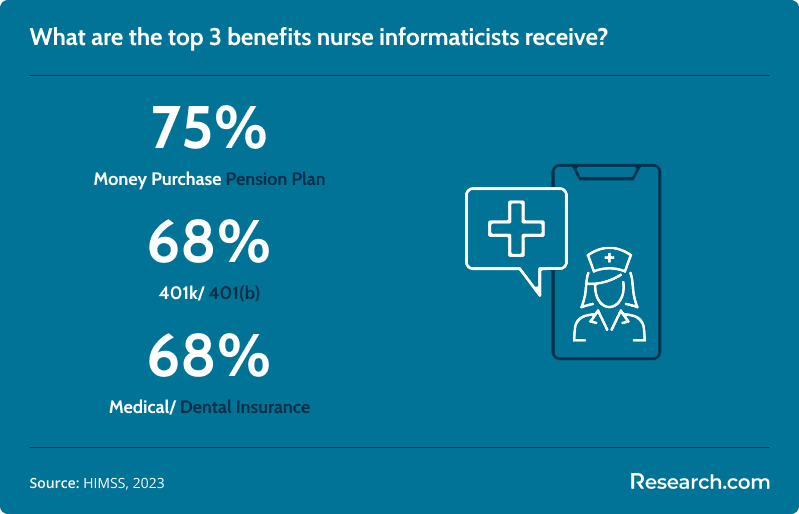
- Benefits: Compensation is not limited to salary. Seventy-five percent have access to a Money Purchase Pension Plan, while 68% receive 401(k)/403(b) contributions and are covered by medical and dental insurance.
How to evaluate salary potential before changing careers
- Look at job postings for your region and note whether roles require BSN, MSN, certification, EHR vendor experience, analytics skills, or leadership experience.
- Compare base pay with benefits, remote work flexibility, call expectations, travel, and project workload.
- Ask whether the role is implementation-heavy, support-heavy, analytics-heavy, or leadership-heavy because responsibilities affect compensation.
- Track your project outcomes so you can show measurable value during interviews and salary negotiations.
What challenges should nurse informaticists expect?
Nursing informatics can be rewarding, but it is not a low-pressure escape from clinical practice. Informaticists often manage competing priorities from bedside staff, IT teams, executives, vendors, compliance leaders, and patients. They may also face unclear career ladders, uneven mentorship, and heavy workloads during system implementations.
- Limited advancement opportunities: In a HIMSS survey, 48% of respondents identified lack of career growth and promotion opportunities as a major barrier.
- Work-life balance: Major go-lives, upgrades, outages, and reporting deadlines can create demanding schedules.
- Insufficient mentorship: About 33% of nurse informaticists cited lack of coaches, mentors, or sponsors as a meaningful obstacle.
- Education and certification costs: Graduate programs, certificates, exams, conferences, and continuing education can be expensive.
- Pay equity concerns: Professionals continue to advocate for fair pay across genders, roles, and organizational levels.
- Access to training: Keeping up with healthcare technology requires continuous learning, but training resources are not always easy to obtain.
- Limited visibility: Some informaticists struggle to be included in high-profile projects that would showcase their strategic value.
- Diversity gaps in leadership: Lack of representation in management can affect inclusion, sponsorship, and advancement.
- Gender and racial stereotypes: Bias can still shape how professionals are perceived, promoted, and supported.
These challenges are not unique to nursing informatics. Professionals in emerging or interdisciplinary fields often face similar career navigation issues, whether they are evaluating biotechnology career opportunities or comparing specialized science paths such as forensic science specialties. The practical response is the same: build visible skills, document outcomes, seek mentors, and choose employers that value your specialty.
Common mistakes to avoid when pursuing nursing informatics
| Mistake | Why it can hurt you | Better approach |
| Choosing a program without checking accreditation | It may affect employer recognition, transfer options, and future education plans | Verify institutional and nursing program accreditation before applying |
| Focusing only on tuition | Fees, books, travel, lost work time, and practicum costs can change the real price | Compare total cost of attendance and employer reimbursement options |
| Assuming an online program is automatically flexible | Some programs have synchronous meetings, campus visits, or fixed practicum schedules | Ask about weekly time expectations and required live sessions |
| Getting a degree without project experience | Employers want evidence that you can solve real workflow and technology problems | Join EHR, quality, analytics, training, or implementation projects while studying |
| Ignoring certification timing | Some credentials require experience, and taking them too early may not be possible or useful | Map certification requirements to your experience level and job goals |
| Leaving clinical identity out of your resume | Your nursing background is a major differentiator from non-clinical IT candidates | Show how your clinical insight improved system design, adoption, safety, or reporting |
What do graduates say about becoming a nurse informaticist?
-
: "
Moving into nursing informatics helped me keep patient care at the center of my work while using technology to improve how nurses document, communicate, and make decisions. Seeing workflow changes improve safety and efficiency has been the most rewarding part. Alicia
"
-
: "
After a decade at the bedside, I wanted a role that still used my clinical judgment. Now I work on EHR optimization projects that support large groups of providers, and I feel like I am contributing to healthcare’s future in a different way. Marcus
"
-
: "
Nursing informatics expanded my career into data, systems integration, and organizational decision-making. I expected the work to be technical, but I did not realize how strategic and collaborative it would be. Jasmine
"
References
- American Nursing Informatics Association. Examining trends within the nursing informatics workforce. Published May 11, 2024. American Nursing Informatics Association. Retrieved April 28, 2025.
- Garcia, A. Nurses month industry perspectives: Nurse informaticists make a difference. Published May 2, 2023. Healthcare Information and Management Systems Society. Retrieved April 28, 2025.
- HIMSS. 2023 nursing informatics workforce survey. Published March 2023. Healthcare Information and Management Systems Society. Retrieved April 24, 2025.
- HIMSS. Unlocking healthcare's future: The invaluable role of clinical informatics. Published 2024. Healthcare Information and Management Systems Society. Retrieved April 24, 2025.
- U.S. Bureau of Labor Statistics. Health information technologists and medical registrars: Summary. Published April 18, 2025. U.S. Bureau of Labor Statistics. Retrieved April 28, 2025.
Key Insights
- Nursing informatics is best suited for licensed nurses who want to improve care through data, systems, workflow design, implementation, analytics, and technology adoption.
- A BSN can be a starting point, but many informatics professionals advance through an MSN, graduate certificate, DNP, PhD, certification, or significant project experience.
- RN licensure and clinical experience remain central because nurse informaticists solve technology problems inside real patient care environments.
- Salary potential is strong but not guaranteed. In the 2022 HIMSS survey, 60% of nurse informaticists reported earning more than $100,000 annually, with higher earnings linked to education, experience, leadership, and role scope.
- Before enrolling in a program, compare accreditation, total cost, practicum quality, curriculum depth, flexibility, transfer policies, and graduate outcomes.
- The strongest career strategy is to combine education with visible project results: EHR improvements, workflow redesign, quality reporting, analytics, training, implementation support, or measurable usability gains.
- The main risks are choosing an expensive or weakly aligned program, relying on credentials without experience, ignoring mentorship, and underestimating the change-management demands of the role.
Other Things You Should Know About Becoming a Nurse Informaticist
The most recognized credential is the American Nurses Credentialing Center’s Informatics Nursing Certification (RN-BC). It requires an active RN license, a bachelor’s degree or higher, at least 2,000 practice hours in informatics within the last 3 years, and 30 hours of continuing education in informatics.
To become a nurse informaticist by 2027, you typically need a Bachelor of Science in Nursing (BSN) and a Master's in Health Informatics or a related field. Nursing licensure and experience in clinical settings are essential for advancing into this specialized role.
In 2027, essential skills for a nurse informaticist include data analysis, nursing practice knowledge, proficiency in electronic health records (EHR) systems, and communication abilities. Being adept at healthcare technology and having strong analytical thinking are also crucial for success in this field.