2027 Most Affordable Online Forensic Science Degree Programs

Co-Founder and Chief Data Scientist
Choosing an online nursing informatics program is not just about finding a school that will admit you. It is about selecting a credential that matches your nursing background, schedule, budget, certification goals, and long-term career plan in a healthcare system that increasingly depends on electronic records, analytics, telehealth, cybersecurity, and clinical decision-support tools.
Electronic health record adoption has already reshaped healthcare delivery. As of 2021, the National Coordinator for Health Information Technology reported that 96% of hospitals and 78% of office-based physicians used EHR systems. That shift has created a need for nurses who understand both bedside workflows and digital health systems. Nursing informatics online programs are designed for that intersection.
This guide explains what online nursing informatics programs include, which programs may be easier to enter, how much they cost, what admission requirements to expect, how online study compares with campus-based learning, and what career outcomes may be realistic. It is written for RNs, BSN-prepared nurses, MSN graduates, and career changers who want a practical way to evaluate whether nursing informatics is the right next step.
Quick Answer: What is the easiest path into nursing informatics online?
The easiest route usually depends on your current nursing credential. BSN-prepared RNs often pursue an online MSN in nursing informatics, while MSN-prepared nurses may choose a graduate certificate or DNP pathway. Some programs listed below consider applicants with GPAs below 3.0, offer provisional admission, waive the GRE or GMAT, or provide flexible online formats that support working nurses.
For most applicants, the best program is not simply the one with the lowest admission threshold. A strong choice should be accredited, clinically relevant, affordable, compatible with your work schedule, and aligned with future certification or leadership goals.
What are the benefits of getting an online nursing informatics degree?
- Broader career options: Graduates may qualify for roles such as nurse informaticist, clinical informatics specialist, EHR analyst, health IT consultant, chief nursing informatics officer, or telehealth systems coordinator.
- Competitive nursing income potential: In 2023, registered nurses earned an average annual salary of $94,480, while nurse practitioners earned more than $125,000.
- Career-friendly format: Online programs often use virtual coursework, remote collaboration tools, applied projects, and flexible scheduling so nurses can keep working while building informatics expertise.
- Preparation for technology-driven healthcare: Students learn how data, EHRs, interoperability, cybersecurity, analytics, and workflow redesign affect patient care and organizational performance.
What can I expect from an online nursing informatics program?
An online nursing informatics program combines advanced nursing knowledge with health information systems, data management, technology implementation, quality improvement, and leadership. Most programs are designed for licensed nurses who want to move into roles that improve how healthcare organizations collect, secure, analyze, and use clinical data.
Although formats differ by school, students can usually expect the following components:
- Informatics-focused coursework: Common topics include electronic health records, health information systems, clinical decision support, interoperability, healthcare analytics, workflow design, and technology evaluation.
- Graduate-level nursing preparation: Nursing informatics is commonly offered through MSN, DNP, post-master’s certificate, or BSN-DNP pathways. These programs often include leadership, research, evidence-based practice, policy, and systems improvement content.
- Applied learning experiences: Many programs require a practicum, capstone, residency, thesis, or informatics project where students solve a real healthcare technology or data problem.
- Flexible online delivery: Courses may be asynchronous, synchronous, or hybrid. Working nurses should check whether live sessions, campus visits, or set practicum hours are required.
- Certification-oriented preparation: Some programs help students build competencies relevant to credentials such as the American Nurses Credentialing Center Informatics Nursing Certification.
Where can I work with an online nursing informatics degree?
Nurse informaticists are usually licensed nurses with specialized training in healthcare technology and data systems. Because they understand clinical practice as well as digital workflows, they can work across care delivery, administration, software development, consulting, policy, research, and education.
| Work Setting | How Nurse Informaticists Contribute |
| Hospitals and healthcare systems | Support EHR implementation, improve clinical workflows, train users, analyze documentation practices, and lead informatics initiatives. |
| Academic institutions | Teach nursing informatics concepts, support simulation and digital learning tools, or conduct research on healthcare technology. |
| Government agencies | Manage public health data systems, support compliance efforts, contribute to surveillance initiatives, and inform health policy work. |
| Healthcare technology companies | Work with product teams to design, test, improve, and support clinical software used by nurses and other providers. |
| Consulting firms | Advise healthcare organizations during system selection, digital transformation, workflow redesign, and data governance projects. |
| Analytics and reporting teams | Analyze trends, support quality reporting, evaluate system performance, and help organizations use data for better care decisions. |
| Telehealth and remote care organizations | Help design, implement, and optimize virtual care platforms with attention to access, usability, workflow, and data security. |
The most suitable workplace depends on your strengths. Nurses who enjoy teaching may prefer training and education roles. Nurses who like systems and operations may fit EHR optimization or project management. Nurses with strong quantitative skills may move toward analytics, reporting, or quality improvement.
How much can I make with an online nursing informatics degree?
Salary outcomes vary widely because nursing informatics roles may sit under nursing, IT, analytics, quality, leadership, education, or healthcare administration job families. Your pay may depend on your degree level, years of nursing experience, employer type, geographic region, cost of living, leadership responsibilities, certifications, and technical skill set.
Data from the U.S. Bureau of Labor Statistics show that registered nurses earn $94,480 annually, with percentiles ranging from $63,720 to $132,680. Nurse practitioners earn an average income of $128,490, with percentiles ranging between $94,530 and $168,030.
The Healthcare Information and Management Systems Society reported in 2023 that around 60% of nurse informaticists earned more than $100,000 in 2022, representing a 49% increase from 2020. The same report connects higher compensation with the advanced expertise needed to manage digital health systems and informatics responsibilities.
Education level also affects earning potential. HIMSS reported that 52% of nurses with a BSN earn between $76,000 and $125,000 annually. Among those with doctoral degrees in nursing or nurse practitioner credentials, 25% earn more than $176,000 per year. By contrast, 57% of nurses with ADN or LPN/LVN preparation make $100,000 or less annually.
| Salary Factor | Why It Matters |
| Degree level | Graduate and doctoral credentials may qualify nurses for leadership, advanced practice, education, or executive roles. |
| Informatics experience | Hands-on work with EHRs, analytics, implementation, training, and workflow redesign can strengthen advancement prospects. |
| Employer type | Hospitals, health systems, vendors, consulting firms, universities, and government agencies may use different pay structures. |
| Location | Regional wage levels and cost of living can significantly affect compensation. |
| Certifications | Relevant credentials may demonstrate specialized knowledge, although they do not guarantee a specific salary. |
The most realistic approach is to compare program cost against local job postings, your current salary, likely advancement opportunities, and the credential requirements for the roles you want.
- Easiest Nursing Informatics Online Programs for 2027
- How long does it take to complete an online nursing informatics program?
- How does an online nursing informatics program compare to an on-campus program?
- What is the average cost of an online nursing informatics program?
- What are the financial aid options for students enrolling in an online nursing informatics program?
- What are the prerequisites for enrolling in an online nursing informatics program?
- How does accreditation impact online nursing informatics programs?
- How do online nursing informatics programs support professional development and practical experience?
- How are emerging healthcare technologies integrated into online nursing informatics programs?
- How does nursing informatics impact geriatric care and related careers?
- Are entry-level MSN programs online a viable option for non-nurses?
- What challenges do students encounter in online nursing informatics programs?
- What factors influence salary and career growth in nursing informatics?
- What courses are typically in an online nursing informatics program?
- What technology infrastructure and student support services are offered in online nursing informatics programs?
- What types of specializations are available in online nursing informatics programs?
- Can accelerated BSN programs pave the way to a successful nursing informatics career?
- How to choose the best online nursing informatics program?
- What career paths are available for graduates of online nursing informatics programs?
- Is the online nursing informatics degree worth the investment?
- How do online nursing informatics programs ensure data security and regulatory compliance?
- What is the job market for graduates with an online nursing informatics degree?
Easiest Nursing Informatics Online Programs for 2027
How do we rank schools?
Research.com developed this ranking to help prospective students compare online nursing informatics programs with accessible admission pathways, flexible delivery, relevant curriculum, and recognized institutional or programmatic quality indicators. The ranking was built using Research.com’s published methodology and data from established sources, including the Integrated Postsecondary Education Data System, Peterson’s database and its Distance Learning Licensed Data Set, College Scorecard, and the National Center for Education Statistics.
Use this list as a starting point, not a final decision. Before applying, verify current tuition, practicum expectations, admission rules, accreditation status, state authorization, and whether the program supports your preferred certification or career path.
| School | Credential or Program Type | Credits | Cost per Credit | Notable Admission Feature |
| Northeastern State University | Online MSN in Nursing Informatics | 32 | $322.65 (in-state), $323.65 (out-of-state) | GPA of 2.5 or 3.0 in a nursing major, depending on the pathway |
| Millersville University | Graduate Certificate in Nursing Informatics | 18 | $605 | No GMAT or GRE required |
| Ferris State University | Fully online Nursing Informatics program | 37 | $770 | Provisional admission may be available after nine graduate semester hours with a 3.0 GPA |
| Grand Canyon University | Online MSN in Nursing Health Informatics | 40 | $590 | Applicants with a GPA below 2.8 may submit a GMAT score of 500 or GRE score of 300 |
| Jacksonville University | RN-MSN with informatics coursework | 52–55 | $750 | Applicants with a GPA of 3.0 or below are encouraged to apply |
1. Northeastern State University
Northeastern State University offers an online MSN in Nursing Informatics for registered nurses who want to move into healthcare technology leadership. The curriculum covers advanced nursing practice, cultural competence, nursing theory, research, evidence-based care, and emerging informatics issues. Students complete either a professional nursing project or a research-oriented thesis through the capstone requirement. Applicants must earn a C or higher in prerequisite courses and meet a GPA requirement of 2.5 or 3.0 in a nursing major. Nurses who want a shorter credential can also consider the school’s nursing informatics and health informatics certificates.
- Program Length: Two years
- Tracks/Concentrations:
- Nursing Informatics
- Nursing Education
- Administrative Leadership in Nursing
- Cost per Credit: $322.65 (in-state), $323.65 (out-of-state)
- Required Credits to Graduate: 32
- Accreditation: Accreditation Commission for Education in Nursing (ACEN)
2. Millersville University
Millersville University provides an online Graduate Certificate in Nursing Informatics for nurses who want focused graduate training without committing to a full degree. The six-course curriculum includes Nursing Informatics and Healthcare Technology, Healthcare Project Management, Healthcare Data Science and Data Analytics, and a practicum. The certificate is designed for roles such as chief nursing informatics officer and telehealth clinical coordinator. Applicants do not need to submit a GMAT or GRE score. The school generally expects an MSN GPA of at least 3.0, although provisional admission may be possible for candidates who show strong potential for graduate-level work.
- Program Length: One year
- Tracks/Concentrations: Nursing Informatics
- Cost per Credit: $605
- Required Credits to Graduate: 18
- Accreditation: National League for Nursing Commission for Nursing Education Accreditation (NLN CNEA)
3. Ferris State University
Ferris State University offers a fully online Nursing Informatics program that prepares nurses to manage, improve, and support healthcare information technology. The program focuses on how patient data is stored, shared, protected, and used across clinical environments. Its online structure gives students 24/7 access to coursework and creates opportunities to collaborate with peers from varied nursing backgrounds. Applicants must have a BSN and a 3.0 GPA. Candidates who do not meet the standard GPA requirement may be considered provisionally if they complete nine graduate semester hours with a 3.0 GPA.
- Program Length: Two years
- Tracks/Concentrations:
- Nursing Informatics
- Nursing Education
- Nursing Administration
- Cost per Credit: $770
- Required Credits to Graduate: 37
- Accreditation: CCNE
4. Grand Canyon University
Grand Canyon University offers an online MSN in Nursing Health Informatics through an interactive learning platform that supports remote coursework, instructor engagement, and peer collaboration. The program includes a capstone and a 16-week practicum in which students identify a healthcare problem, implement an evidence-based solution, evaluate outcomes, and present their findings. The practicum project brings together nursing knowledge, leadership, critical thinking, technology, and data analysis. Applicants with a GPA of 2.8 or higher are eligible. Applicants below that threshold may submit a GMAT score of 500 or a GRE score of 300.
- Program Length: One to two years
- Tracks/Concentrations: Health Informatics
- Cost per Credit: $590
- Required Credits to Graduate: 40
- Accreditation: CCNE, Commission on Accreditation for Health Informatics and Information Management Education (CAHIIM)
5. Jacksonville University
Jacksonville University offers an RN-MSN pathway that allows registered nurses to progress through BSN and MSN coursework within one flexible program. The curriculum includes 12 credit hours in informatics, BSN-level work such as Evidence-Based Nursing, and MSN courses in Nursing Theory and Research and Information Systems and Technology for Enhanced Healthcare. Courses are fully online, run in 7-week terms, and begin throughout the year. Students benefit from smaller class sizes and academic advising that helps them plan their progression. Applicants with a GPA of 3.0 or below are encouraged to apply.
- Program Length: Two to three years
- Tracks/Concentrations:
- Nursing Informatics
- Clinical Nurse Educator
- Leadership in Healthcare Systems
- Healthcare Quality and Safety
- Cost per Credit: $750
- Required Credits to Graduate: 52–55
- Accreditation: CCNE
6. Nova Southeastern University Florida
Nova Southeastern University Florida offers an online BSN-DNP program for nurses pursuing advanced roles as practitioners, educators, executives, or researchers. The pathway combines MSN and DNP coursework, allowing students to earn dual degrees while developing expertise for complex healthcare environments. The program includes more than 500 clinical hours in both the MSN and DNP phases, totaling 1,000 hours of hands-on experience. NSU Florida considers applicants with a minimum GPA of 3.0 for BSN graduates or 2.75 for applicants who have 24 months of active, independent nursing practice.
- Program Length: Two to three years
- Tracks/Concentrations:
- Nursing Informatics
- Nursing Education
- Family NP
- Adult-Gerontology Acute Care NP
- Psychiatric Mental Health NP
- Executive Nurse Leader
- Cost per Credit: $835
- Required Credits to Graduate: 69
- Accreditation: CCNE
7. Waynesburg University
Waynesburg University offers an online MSN in Nursing Informatics for nurses who want to improve patient care through healthcare technology and leadership. The program covers health policy, evidence-based practice, organizational systems, health data management, system development, decision support, and electronic healthcare information. Students complete nursing informatics and capstone practicums, including 200 practicum hours that are eligible for ANCC Informatics Nursing Certification. A 3.0 GPA is typically expected, but applicants with lower GPAs may be reviewed based on professional experience and evidence of graduate study potential.
- Program Length: One to two years
- Tracks/Concentrations:
- Nursing Informatics
- Nursing Education
- Nursing Administration
- Dual Administration/Education
- Dual MSN/MBA
- Cost per Credit: $705
- Required Credits to Graduate: 30
- Accreditation: Commission on Collegiate Nursing Education (CCNE)
8. University of South Alabama
The University of South Alabama offers an online MSN to DNP program for advanced nursing practice roles. Graduates prepare for high-level responsibilities in direct care, population health, healthcare system administration, and health policy. The coursework is delivered entirely online, with no required on-campus attendance. Instead of a thesis or dissertation, students complete a major synthesis project focused on healthcare quality and outcomes. The residency requirement can be completed near the student’s location with an approved mentor. Applicants need a 3.0 GPA and at least two years of nursing experience.
- Program Length: Two to three years
- Tracks/Concentrations:
- Nursing Informatics
- Executive Nurse Administrator
- Family NP
- Public Health Administration
- Cost per Credit: $594
- Required Credits to Graduate: 36
- Accreditation: CCNE
9. University of Utah
The University of Utah offers an interdisciplinary Nursing Informatics curriculum that combines informatics education with leadership development and systems thinking. Courses address systems analysis, programming, clinical decision support, and interoperability standards. Many informatics courses are offered with the Biomedical Informatics Department, giving students exposure to interdisciplinary perspectives. Students also complete hands-on work in advanced clinical settings. Applicants must meet a minimum GPA requirement of 3.0.
- Program Length: One to two years
- Tracks/Concentrations: Nursing Informatics
- Cost per Credit: $931.50
- Required Credits to Graduate: 41
- Accreditation: CCNE
10. University of Minnesota Online
The University of Minnesota Online offers a DNP nursing informatics specialty for nurses who want to lead information system selection, implementation, and optimization in nursing and interprofessional care. The program also emphasizes patient access to health information. Students may choose a three-year or four-year plan, with most coursework online. Each semester includes a one-week on-campus session for core and specialty coursework, enhancement programming, and advisor meetings. Students also complete 1,000 practicum hours at university-arranged designated sites. Applicants must have a 3.0 GPA.
- Program Length: Three to four years
- Tracks/Concentrations: Nursing Informatics
- Cost per Credit: $1,100
- Required Credits to Graduate: 65
- Accreditation: CCNE
What graduates say they valued in online nursing informatics programs
- “The online format helped me continue working while managing family responsibilities. I could organize coursework around my schedule, and the national mix of classmates gave me perspectives I would not have gained locally. The best part was using what I learned right away in my nursing role.” - Ericka
- “The program fit the reality of shift work. I could join discussions, complete assignments, and study when my schedule allowed. The courses helped me connect my clinical interests with practical informatics skills, and that made me more confident about the next stage of my career.” - Logan
- “Online study gave me the flexibility I needed, but I still felt connected through discussion boards and group activities. The platform was easy to use, and I could apply course concepts to my job as I learned them. That made the program feel directly useful.” - Vanessa
Key Findings
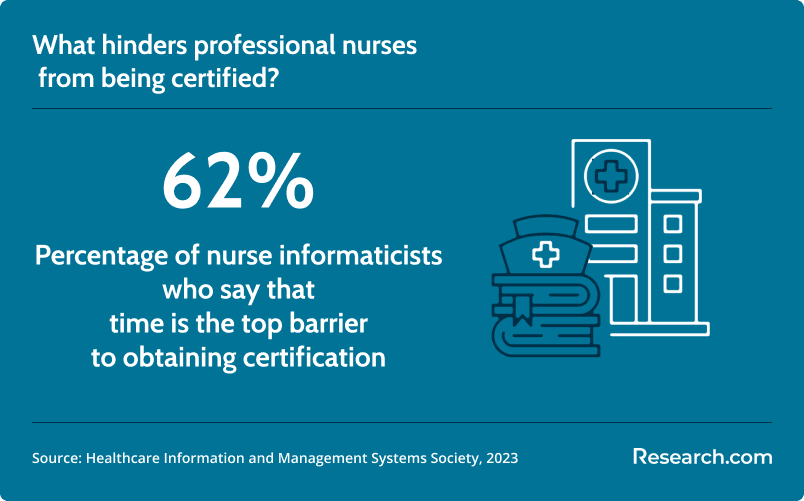
- 62% of nurse informaticists cited time constraints as the biggest obstacle to earning certifications.
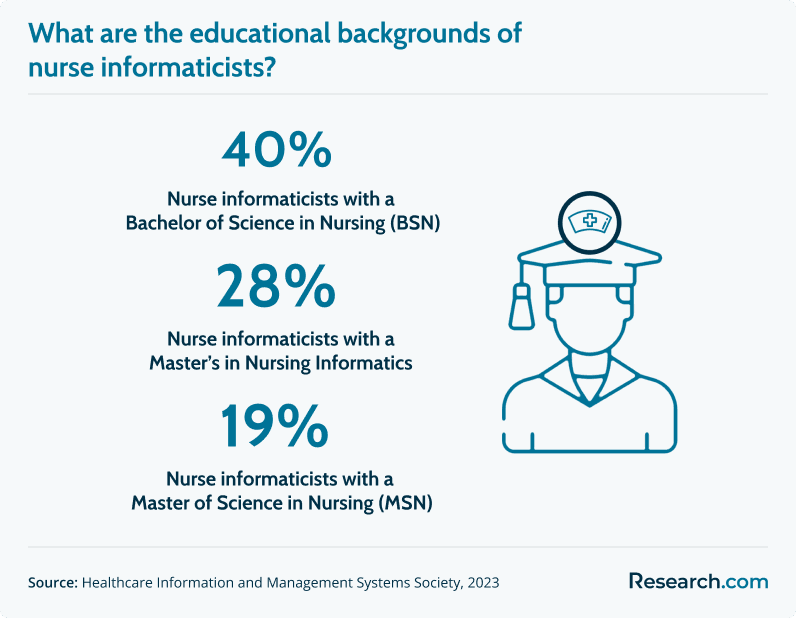
- 40% of nurse informaticists hold a BSN, 28% have earned a master’s degree in nursing informatics, and 19% possess an MSN.
- A 3.0 GPA is commonly required, although some online nursing informatics programs may consider applicants with GPAs as low as 2.5.
- Nurse informaticists reported major responsibilities such as systems implementation (41%), system optimization (35%), and project management (30%).
- 53% of nurse informaticists said their expertise is most valued in training, supporting and redesigning nursing practices, applying data to improve clinical care (42%), and system design (38%).
How long does it take to complete an online nursing informatics program?
Program length depends on the credential, enrollment pace, transfer credits, practicum requirements, and whether you enter through a bridge pathway. A graduate certificate may take six months to a year, while an MSN in nursing informatics often takes 18 months to three years. DNP programs can extend to three or four years.
Full-time students commonly finish faster, often within two or two and a half years for many master’s pathways. Part-time students may need longer, sometimes three to seven years depending on course load and program limits. Students comparing advanced nursing options may also want to review the easiest nurse practitioner specialty programs to get into to understand how admission requirements and timelines differ across specialties.
Bridge formats can change the timeline. RN-MSN and BSN-DNP pathways may help experienced nurses move through multiple credential levels more efficiently than separate programs. This is different from a fast track medical assistant program, but the idea is similar: prior healthcare preparation can shorten the route to a more advanced role. Nurses comparing streamlined graduate options may also find it useful to examine the easiest nurse practitioner program to get into.
Certification preparation may add time after graduation. The ANCC certification was pursued by 23% of professionals in 2022, but 62% of professionals cited time constraints as the top barrier to certification. Planning matters. If certification is part of your goal, ask each school how practicum hours, coursework, and faculty guidance support that path.
Working nurses should build a realistic academic calendar before enrolling. If your schedule is unpredictable, the easiest MSN online program may not be the shortest one; it may be the one with flexible pacing, strong advising, and reasonable practicum expectations.
| Program Type | Typical Time Frame | Best For |
| Graduate certificate | Six months to a year | MSN-prepared nurses or professionals who want focused informatics training |
| MSN in nursing informatics | 18 months to three years | BSN-prepared RNs seeking informatics roles or leadership preparation |
| DNP with informatics focus | Three or four years | Nurses pursuing advanced leadership, systems-level practice, or doctoral preparation |
| RN-MSN or BSN-DNP bridge | Varies by prior education and program structure | Nurses who want an integrated route to a higher credential |
How does an online nursing informatics program compare to an on-campus program?
The American Nurses Association defines nursing informatics as the integration of nursing science, computer science, and information science to improve how data, information, knowledge, and wisdom are managed and communicated in nursing practice. Because the field is technology-centered, many nursing informatics courses translate well to online learning. However, online and on-campus formats differ in scheduling, interaction, practicum coordination, and networking.
| Factor | Online Nursing Informatics Program | On-Campus Nursing Informatics Program |
| Flexibility | Often better for working nurses because coursework may be asynchronous or hybrid. | May require attendance at set class times and campus-based activities. |
| Learning environment | Uses learning platforms, discussion boards, virtual simulations, online labs, and remote collaboration tools. | Provides direct in-person access to faculty, peers, labs, and campus resources. |
| Practicum placement | May allow local placements, but students may need to help identify approved sites or preceptors. | May have established relationships with nearby healthcare facilities. |
| Networking | Relies on virtual events, online communities, faculty outreach, and professional associations. | Offers more spontaneous in-person networking through campus events and local healthcare partnerships. |
| Cost considerations | May reduce commuting, relocation, housing, and campus-related expenses, though technology and distance-learning fees may apply. | May involve higher costs for travel, parking, housing, meals, or campus fees. |
An online program may be the better fit if you need to keep working, live far from a campus, or already have access to a healthcare workplace where you can complete applied projects. A campus program may be preferable if you learn best through face-to-face interaction or want more local networking.
Students exploring other healthcare routes may also compare nursing informatics with the easiest physician assistant schools to get into, especially if they are still deciding between nursing leadership, direct clinical practice, and broader medical careers.
What is the average cost of an online nursing informatics program?
Online nursing informatics program costs vary by school type, credit requirement, residency status, degree level, and fees. Students can expect to pay between $10,000 and $60,000 annually for nursing informatics online programs. Certificate programs are often less expensive because they require fewer credits, while DNP pathways usually cost more because they take longer and include extensive practicum requirements.
The National Center for Education Statistics reported that in 2022-23, students living off-campus paid around $15,708 to $27,756 yearly at four-year public institutions. At private nonprofit institutions, average cost of attendance was around $46,280 to $57,519.
Graduate school costs are typically around $12,000 at public institutions and $30,000 at private nonprofit institutions. Shorter certificate programs may cost around $8,000 to $15,000.
Students looking for lower-cost nursing progression routes may also compare informatics programs with bridge options such as the cheapest RN to BSN program online. For RNs who do not yet have a BSN, an affordable RN-to-BSN program may be a practical first step before graduate informatics study.
| Cost Item | Why You Should Check It |
| Tuition per credit | This is the main cost driver, especially in programs requiring 30 or more graduate credits. |
| Program fees | Online, technology, simulation, clinical coordination, or graduation fees can increase total cost. |
| Books and software | Healthcare data, statistics, and informatics courses may require specialized platforms or subscriptions. |
| Practicum expenses | Students may need background checks, immunizations, travel, liability insurance, or placement-related documentation. |
| Residency requirements | Even mostly online programs may require brief campus visits, which can add travel and lodging costs. |
| Lost work time | Part-time study may protect income, while full-time study may shorten the path but reduce work availability. |
When evaluating return on investment, compare the full cost of attendance with the roles you are likely to pursue, not just the highest salary you see online. Salary growth is possible, but it is not guaranteed.
What are the financial aid options for students enrolling in an online nursing informatics program?
Financing is a major concern for many nurses returning to school. The Education Data Initiative reports that around 42.8 million students carry federal loan debt, so students should compare funding sources carefully before borrowing.
- Scholarships, fellowships, and grants: Funding may be available through organizations such as the National League for Nursing’s Edmund J. Y. Pajarillo Health Informatics and Innovation Scholarship, the Foundation of National Student Nurses’ Association, Inc., and the U.S. Department of Health and Human Services. Availability, eligibility, and award amounts vary.
- State financial aid: Some states support students preparing for high-need healthcare roles. Eligibility may depend on residency, financial need, degree level, or service commitments.
- University financial aid: Schools may offer institutional scholarships, grants, assistantships, work-study opportunities, or loans. Ask whether online students qualify for the same aid as campus students.
- Employer tuition support: Hospitals and health systems may provide tuition reimbursement or professional development funds, especially if the degree supports organizational technology goals.
- Alternative stepping-stone programs: Some students first build healthcare technology knowledge through lower-cost credentials, including affordable online medical billing and coding schools. This is not a substitute for nursing informatics graduate preparation, but it may help some learners explore health data and coding concepts before committing to a larger degree.
Questions to ask before accepting financial aid
- Will online enrollment change my eligibility for institutional scholarships?
- Does tuition reimbursement require me to stay with my employer for a set period?
- Are there service obligations tied to any grants or scholarships?
- What is the total debt I would need to take on, including fees and living expenses?
- Does the program’s expected career value justify the cost for my specific goals?
What are the prerequisites for enrolling in an online nursing informatics program?
Admission requirements vary by school and credential level, but most online nursing informatics programs expect applicants to have nursing education, an active license, professional experience, and evidence of readiness for graduate study.
| Requirement | What It Usually Means |
| Nursing degree | Many MSN programs require a BSN. DNP pathways may require a master’s degree, depending on the entry point. |
| Active RN license | Applicants usually need a valid, active Registered Nurse license for advanced nursing coursework and practicum eligibility. |
| Official transcripts | Schools review prior coursework, degree completion, prerequisite grades, and cumulative GPA. |
| NursingCAS | Some programs use NursingCAS to collect applications, transcripts, recommendations, and supporting materials. |
| GPA | A 3.0 GPA is common, although some programs may consider applicants with GPAs as low as 2.5. |
| Testing | Many programs no longer require GRE or GMAT scores, but some may accept scores to strengthen an application. |
| Clinical experience | Many programs prefer or require at least two years of nursing experience. |
| Resume or CV | Applicants should document nursing experience, leadership, technology exposure, quality projects, and professional achievements. |
| Writing sample or statement | Programs may ask applicants to explain career goals, informatics interests, and readiness for graduate study. |
| Recommendations | At least two letters are often required from academic or professional references. |
| Prerequisite coursework | Some programs require science, biology, math, or statistics coursework; transition courses may be available in certain pathways. |
Some schools also require interviews, immunization documentation, background checks, or medical clearance when practicum placements are part of the curriculum. Applicants should confirm state authorization and clinical placement rules before applying, especially if they live outside the school’s home state.
HIMSS data show that nurse informaticists enter the field from multiple educational backgrounds: 40% hold a BSN, 28% have earned a master’s degree in nursing informatics, and 19% possess an MSN. This means there is no single route, but applicants should choose the pathway that fits their current credential and target role.
How does accreditation impact online nursing informatics programs?
Accreditation is one of the first things to verify before applying. It signals that a program or institution has been reviewed against recognized academic and professional standards. For nursing informatics students, relevant nursing accreditors may include the Commission on Collegiate Nursing Education (CCNE), the Accreditation Commission for Education in Nursing (ACEN), or the National League for Nursing Commission for Nursing Education Accreditation (NLN CNEA), depending on the program.
Accreditation can affect access to federal financial aid, employer recognition, transfer options, graduate admission, and eligibility for some certifications or advanced credentials. It is especially important for nurses who may later pursue advanced practice, teaching, leadership, or doctoral study. Students comparing degree costs should also review how much is nursing school to understand how accreditation, tuition, and total educational investment connect.
How to verify accreditation
- Check the school’s official program page for institutional and nursing accreditation statements.
- Confirm the accreditor directly on the accrediting organization’s website.
- Ask whether the specific nursing informatics track is included under the accredited nursing program.
- Verify whether online students receive the same accredited credential as campus students.
- Ask if the program meets requirements for your certification, licensure, or employer reimbursement plans.
How do online nursing informatics programs support professional development and practical experience?
Strong programs do more than deliver recorded lectures. They help students apply informatics concepts in healthcare settings through practicums, capstones, mentorship, portfolio-building, and career guidance. Applied experiences may involve EHR workflow analysis, training plans, data dashboards, quality improvement projects, system implementation support, or usability assessments.
Professional development support may include faculty mentoring, career advising, virtual networking, resume review, practicum coordination, and introductions to healthcare technology roles. Nurses who are thinking broadly about long-term career fit may also review least stressful nursing specialties to compare informatics with other nursing pathways.
How are emerging healthcare technologies integrated into online nursing informatics programs?
Online nursing informatics programs increasingly address the technologies shaping clinical work: artificial intelligence, cybersecurity, telehealth, interoperability, clinical decision support, patient portals, analytics, and large-scale health data management. These topics matter because nurse informaticists are often asked to evaluate tools, support safe implementation, train clinicians, and reduce workflow problems caused by poorly designed systems.
Programs may use virtual simulations, case studies, data projects, software demonstrations, and capstone work to help students practice real-world decision-making. Nurses who want doctoral preparation with a shorter timeline can also compare technology-focused DNP options, including the shortest DNP program online.
How does nursing informatics impact geriatric care and related careers?
Geriatric care depends heavily on accurate information, coordinated communication, medication safety, monitoring tools, and interdisciplinary collaboration. Nursing informatics can support older adults by improving care coordination, strengthening clinical decision support, making patient records easier to use, and helping teams identify risks through data.
Informatics skills can be useful in long-term care, home health, population health, chronic disease management, and gerontology-focused programs. Professionals interested in aging services may compare informatics roles with related career outcomes, including master's in gerontology salary.
Are entry-level MSN programs online a viable option for non-nurses?
Direct-entry MSN programs can be an option for people who already hold a non-nursing bachelor’s degree and want to enter nursing. These programs typically combine foundational nursing preparation with graduate-level coursework. Students who eventually want nursing informatics should understand that they must first build clinical nursing competence and meet licensure requirements before moving into informatics roles.
Admissions commonly require a completed bachelor’s degree, science prerequisites, strong academic performance, and evidence of readiness for intensive nursing study. For applicants without a nursing background, entry-level MSN programs online can provide more detail on how these pathways work.
What challenges do students encounter in online nursing informatics programs?
Online nursing informatics study can be flexible, but it is not easy. Students must handle graduate-level nursing content, technical concepts, applied projects, and practicum expectations while often continuing to work as nurses.
| Common Challenge | Better Strategy |
| Underestimating time demands | Map weekly coursework, discussion deadlines, project milestones, and practicum hours before the term begins. |
| Choosing a program without checking practicum rules | Ask who finds placements, whether local sites are allowed, and what documentation is required. |
| Assuming online means self-paced | Confirm whether courses are asynchronous, synchronous, cohort-based, or deadline-driven. |
| Ignoring technical requirements | Check software, browser, hardware, webcam, security, and internet expectations before enrolling. |
| Limited networking | Join professional associations, attend virtual events, contact faculty, and build connections through group projects. |
| Weak preparation in statistics or data tools | Refresh quantitative skills early and use tutoring or academic support before major analytics assignments. |
Students considering faster advanced nursing options may also review nurse practitioner 1 year programs, but speed should never replace accreditation, clinical quality, or realistic workload planning.
What factors influence salary and career growth in nursing informatics?
Nursing informatics career growth is shaped by a combination of clinical credibility, technical capability, leadership experience, and organizational need. A degree can open doors, but advancement usually depends on how well you can solve real healthcare problems using data and technology.
- Education level: MSN, DNP, certificate, and doctoral preparation may qualify graduates for different levels of responsibility.
- Technical fluency: Experience with EHR systems, interoperability, data analytics, dashboards, workflow tools, and cybersecurity concepts can strengthen job competitiveness.
- Project experience: Employers value nurses who have participated in implementations, optimizations, upgrades, training rollouts, or quality improvement projects.
- Certifications: Relevant informatics or healthcare IT credentials can help demonstrate specialized knowledge.
- Leadership scope: Managing teams, budgets, vendors, training programs, or enterprise-wide initiatives may support promotion into higher-paying roles.
- Location and employer: Pay varies across regions and organizations. Comparing related healthcare salary patterns, such as PMHNP pay by state, can help students understand how geography influences nursing compensation.
What courses are typically in an online nursing informatics program?
Online nursing informatics curricula usually blend advanced nursing practice with health information technology, systems improvement, analytics, ethics, policy, and leadership. Course titles vary, but the core learning goals are similar: help nurses improve patient care by making health data and technology more useful, secure, and clinically meaningful.
- Health Information Systems: Students study technologies used in healthcare, including EHRs and health information management systems, and examine how these tools affect care delivery and administration.
- Data Management and Analytics: Coursework introduces methods for organizing, interpreting, and using healthcare data to support quality, safety, operations, and decision-making.
- Leadership Development: Students build skills for leading teams, managing change, resolving conflict, and guiding technology adoption in clinical settings.
- Policy, Ethics, and Quality in Professional Nursing Practice: This area connects healthcare policy, privacy, ethical decision-making, quality improvement, and professional nursing responsibilities.
- Critical Thinking for Patient Safety and Quality: Students learn to identify risks, evaluate evidence, and apply systematic approaches to reduce errors and improve outcomes.
- Practicum and Capstone: Applied requirements allow students to complete field-based projects, conduct research, or implement solutions to current healthcare technology problems.
HIMSS reported that nurse informaticists commonly work in systems implementation (41%), system optimization (35%), and project management (30%). Programs that include applied projects in these areas may better prepare students for the realities of the field.
Students who still need to build a nursing foundation before graduate informatics work may compare cheap ABSN programs as a possible first step into nursing practice.
This chart shows the five most common responsibilities reported by nurse informaticists.
What technology infrastructure and student support services are offered in online nursing informatics programs?
The quality of the online learning environment matters because informatics students depend heavily on digital platforms. Before enrolling, confirm that the program offers stable learning technology, responsive support, secure access, and enough academic guidance to help you succeed in a technical graduate program.
- Learning management system: Courses should be easy to navigate, with clear assignment instructions, deadlines, discussion tools, and grade tracking.
- Technical support: Many programs provide 24/7 help desks or extended support hours for platform, login, software, and connectivity issues.
- Virtual labs or simulations: These tools can help students practice informatics decision-making without needing constant campus access.
- Academic advising: Advisors should help students plan course sequences, practicum timing, and graduation requirements.
- Career support: Resume review, interview preparation, job boards, mentorship, and networking events can help students transition into informatics roles.
- Secure digital access: Programs should teach and model appropriate data security practices when students work with health information concepts or simulation data.
Nurses comparing online graduate support services across specialties may also review affordable PMHNP programs online to see how costs and support structures vary in advanced nursing education.
What types of specializations are available in online nursing informatics programs?
Nursing informatics is often a concentration within a broader graduate nursing degree, but students may also tailor electives, practicums, or capstone projects toward specific informatics subfields. The right specialization depends on whether you want to work closer to clinical workflows, patient-facing technology, population health, analytics, education, consulting, or system leadership.
| Specialization Area | Focus | Good Fit For |
| Clinical Informatics | EHR optimization, clinical decision support, documentation workflows, and bedside technology use. | Nurses who want to improve frontline clinical practice and provider usability. |
| Consumer Health Informatics | Patient portals, mobile health tools, personal health records, and patient access to information. | Nurses interested in patient engagement, education, access, and digital self-management tools. |
| Public Health Informatics | Population-level data, surveillance, reporting, emergency response, and public health systems. | Nurses drawn to government, community health, epidemiology support, or policy-oriented data work. |
| Healthcare IT Project Management | Planning, implementation, timelines, budgets, vendor coordination, and change management. | Nurses who like operations, leadership, communication, and cross-functional problem-solving. |
| Health Data Analytics | Data quality, dashboards, trend analysis, reporting, and performance improvement. | Nurses with strong quantitative interests and attention to data-driven decision-making. |
Students may also choose coursework that supports credentials such as the Nursing Informatics Certification (NI-BC), Certified Associate in Healthcare Information and Management Systems (CAHIMS), or Certified Professional in Healthcare Information and Management Systems (CPHIMS).
Credentialing can matter because 53% of nurse informaticists identified their expertise as most valued in training, supporting and redesigning nursing practices, applying data to improve clinical care (42%), and system design (38%). Certifications do not guarantee advancement, but they may strengthen credibility when combined with practical experience.
This chart highlights the areas where nurse informaticists report that their expertise is most valued.
Can accelerated BSN programs pave the way to a successful nursing informatics career?
Accelerated BSN programs can be a practical route for people with a non-nursing bachelor’s degree who want to become nurses and later specialize in informatics. These programs focus first on clinical nursing competence, licensure preparation, and patient care fundamentals. That foundation is important because nurse informaticists need to understand how technology affects real clinical workflows.
After gaining RN experience, graduates may pursue MSN, certificate, or DNP-level informatics study. Students who are still at the entry point of nursing can compare ABSN online programs to understand how accelerated clinical preparation may lead to future graduate options.
How to choose the best online nursing informatics program?
The best online nursing informatics program is the one that fits your current credential, career target, budget, state, schedule, and learning style. Rankings can help you build a shortlist, but your final choice should be based on practical fit.
| Selection Factor | What to Look For | Why It Matters |
| Accreditation | CCNE, ACEN, NLN CNEA, institutional accreditation, or relevant programmatic recognition. | Affects credibility, aid eligibility, transfer options, and future credential pathways. |
| Admission fit | GPA thresholds, RN license requirements, experience expectations, testing policies, and provisional admission options. | Helps you avoid spending money applying to programs that do not match your profile. |
| Curriculum | EHRs, analytics, cybersecurity, interoperability, clinical decision support, leadership, and quality improvement. | Ensures the program prepares you for current informatics responsibilities. |
| Practicum support | Clear placement process, approved site rules, preceptor expectations, and local placement options. | Practicum barriers can delay graduation. |
| Faculty expertise | Instructors with nursing informatics, clinical technology, analytics, or healthcare leadership experience. | Faculty with field experience can connect theory to workplace realities. |
| Graduate outcomes | Certification support, alumni roles, employer partnerships, and career services. | Helps you assess whether the program supports your goals after graduation. |
| Total cost | Tuition, fees, books, software, travel, residency, and lost work time. | The cheapest tuition is not always the lowest total cost. |
| Student support | Advising, tutoring, technical support, library access, writing help, and career coaching. | Online students need reliable support to stay on track. |
Cost comparisons should be program-specific. While unrelated fields such as the cheapest online master's in human resources may show how online graduate pricing varies, nursing students must focus on nursing accreditation, clinical requirements, and informatics career value.
Common mistakes to avoid when choosing a program
- Choosing only by tuition without checking fees, practicum costs, and travel requirements.
- Assuming every online program is available in your state.
- Enrolling without confirming accreditation and certification alignment.
- Ignoring whether the school helps with practicum placement.
- Picking the fastest program even if the workload is unrealistic with your nursing schedule.
- Relying only on rankings instead of comparing curriculum, outcomes, and support services.
- Assuming a degree automatically guarantees a salary increase or leadership promotion.
What career paths are available for graduates of online nursing informatics programs?
Graduates can pursue roles that combine clinical knowledge, data, systems improvement, technology training, and leadership. Job titles differ by organization, and some roles may require prior informatics experience in addition to a degree.
| Career Path | Typical Responsibilities | Best Fit For |
| Nursing Informatics Specialist | Connect nursing practice with technology, support EHR use, improve workflows, and help clinicians use data effectively. | RNs who want to remain close to nursing practice while working with systems. |
| Clinical Informatics Specialist | Optimize technology in clinical settings, support EHR implementation, and collaborate with clinicians and IT teams. | Nurses who enjoy interdisciplinary work and workflow problem-solving. |
| Health IT Project Manager | Coordinate technology projects, manage timelines, support implementation, and communicate across departments. | Nurses with leadership, organization, and change-management strengths. |
| Healthcare IT Consultant | Advise organizations on system selection, process improvement, regulatory alignment, and digital transformation. | Experienced informatics professionals who want variety and client-facing work. |
| Chief Information Officer (CIO) | Lead technology strategy, oversee IT teams, align systems with organizational goals, and support quality and safety initiatives. | Professionals with significant leadership, technology, and healthcare operations experience. |
| Medical Systems Trainer | Create and deliver training for EHRs, e-prescribing tools, documentation systems, and clinical software. | Nurses who enjoy teaching and helping clinicians adopt technology. |
| Healthcare Policy Analyst | Analyze technology-related policies, data trends, access issues, and regulatory impacts on healthcare delivery. | Nurses interested in policy, research, compliance, and systems-level change. |
Some nurses also use informatics preparation as part of a larger DNP or leadership plan. If you are comparing advanced nursing credentials, reviewing how much do DNPs make can help you understand how doctoral nursing roles may differ financially from MSN-level or certificate-based pathways.
This chart compares wages for nurse informaticists and related occupations.
Is the online nursing informatics degree worth the investment?
An online nursing informatics degree can be worth it for nurses who want to move into EHR optimization, health IT leadership, analytics, project management, telehealth, clinical systems training, or healthcare data roles. It may be less worthwhile if you do not enjoy technology, process improvement, documentation systems, data, or cross-department collaboration.
| Choose Nursing Informatics If... | Consider Another Path If... |
| You want to improve healthcare systems without leaving nursing completely. | You prefer direct bedside care and do not want a systems or technology-focused role. |
| You enjoy workflow redesign, training, data, EHRs, and problem-solving. | You dislike documentation systems, analytics, or troubleshooting technology adoption issues. |
| Your employer has informatics, quality, analytics, or health IT advancement opportunities. | Your local job market has few informatics openings and you are not willing to relocate or work remotely. |
| You can manage graduate coursework while maintaining your professional responsibilities. | The cost requires heavy borrowing without a clear career plan. |
| You want a credential that supports future certification or leadership roles. | You need a faster undergraduate nursing completion pathway first. |
For some RNs, the better first investment may be completing a BSN through a streamlined option such as a 6 month RN to BSN program, then pursuing graduate informatics study after gaining more clinical and systems experience.
How do online nursing informatics programs ensure data security and regulatory compliance?
Data security is central to nursing informatics because graduates may work with systems that contain sensitive patient information. Programs typically address privacy, cybersecurity, risk management, access controls, ethical data use, and regulatory compliance through coursework, case studies, simulations, and applied projects.
Students should learn how to evaluate system risks, protect patient information, support secure workflows, and understand the responsibilities of healthcare organizations that manage clinical data. Nurses who are still building their academic foundation may explore the easiest RN to BSN online program before moving into graduate-level informatics and security-focused study.
What is the job market for graduates with an online nursing informatics degree?
The job market for nursing informatics graduates is supported by healthcare’s ongoing reliance on electronic records, data analytics, virtual care, quality reporting, and secure information exchange. Graduates may work in hospitals, healthcare systems, technology vendors, consulting firms, government agencies, insurance organizations, research settings, and pharmaceutical firms.
BLS data project that employment for nurse practitioners will grow by 46% from 2023 to 2033, while registered nurse employment will grow by 6%. This corresponds to around 29,000 to 194,500 annual job openings.
Related roles also show growth. Nursing educator jobs are projected to grow by 18%, with 8,900 annual job openings. Health information technologists and medical registrars are projected to grow by 16%, with 3,200 annual job openings. Medical and health services managers are projected to grow by 29%, translating to 61,400 annual openings.
Technology-adjacent careers also remain relevant. The job outlook for software and web developers, programmers, and testers shows a 15% growth rate and 163,000 annual openings. Nurse informaticists are not software developers by default, but understanding healthcare technology can help them collaborate effectively with technical teams.
Overall, nursing informatics can be a strong option for nurses who want to influence how care is delivered through better systems, safer data practices, smarter workflows, and more effective use of technology.
Key Insights
- Online nursing informatics programs are best suited for nurses who want to combine clinical experience with technology, data, workflow improvement, and leadership.
- The easiest program to enter is not always the best investment. Prioritize accreditation, practicum support, curriculum relevance, total cost, and alignment with your career goal.
- Admission requirements often include a nursing degree, active RN license, transcripts, professional experience, recommendations, and a GPA near 3.0, though some programs consider applicants with lower GPAs.
- Program length varies widely: certificates may take six months to a year, MSN programs often take 18 months to three years, and DNP options may take three or four years.
- Salary potential is influenced by education, experience, location, employer, certifications, and leadership scope. Existing data show strong salaries in nursing and informatics-related roles, but no degree guarantees a specific income.
- Students should ask detailed questions about state authorization, practicum placement, certification preparation, online support, technology requirements, and total cost before applying.
- Nursing informatics is likely to remain relevant as healthcare organizations continue using EHRs, analytics, telehealth, cybersecurity practices, and digital decision-support tools to improve care delivery.
References:
- Healthcare Information and Management Systems Society. (2023, March). 2023 Nursing Informatics Workforce Survey. https://www.himss.org/sites/hde/files/media/file/2023/04/05/2022-nursing-informatics-workforce-survey.pdf
- National Coordinator for Health Information Technology. (2021). National Trends in Hospital and Physician Adoption of Electronic Health Records. https://www.healthit.gov/data/quickstats/national-trends-hospital-and-physician-adoption-electronic-health-records
- U.S. Bureau of Labor Statistics. (2024a, April 3). Occupational employment and wages, May 2023 - Nurse practitioners. Occupational Employment and Wage Statistics. https://www.bls.gov/oes/current/oes291171.htm
- U.S. Bureau of Labor Statistics. (2024b, April 3). Occupational employment and wages, May 2023 - Registered nurses. Occupational Employment and Wage Statistics. https://www.bls.gov/oes/current/oes291141.htm
- U.S. Bureau of Labor Statistics. (2024, August 29). Occupational projections, 2023–33, and worker characteristics, 2023 (Numbers in thousands). Employment Projections. https://www.bls.gov/emp/tables/occupational-projections-and-characteristics.htm
Other Things You Should Know About Online Nursing Informatics Programs
In 2027, some of the most affordable online forensic science degree programs include those offered by Columbia College, St. Leo University, and American InterContinental University, which provide comprehensive curricula at competitive tuition rates.
In 2027, some of the most affordable online forensic science degree programs include offerings from Eastern New Mexico University, University of Central Florida, and American Public University. These programs provide budget-friendly tuition rates while maintaining educational quality, making them popular choices for prospective forensic science students.
In 2027, students pursuing affordable online forensic science degree programs can explore numerous financial aid options, including federal grants, scholarships offered by professional organizations such as the American Academy of Forensic Sciences, and school-specific scholarships. Consulting with a school's financial aid office can uncover additional resources.
When selecting an affordable online forensic science degree program in 2027, consider factors such as program accreditation, course flexibility, faculty expertise, and the availability of resources like virtual labs. Ensure the program aligns with your career goals and offers value without compromising on educational quality.