
2027 Best Online Nursing Programs in Illinois – Accredited RN to BSN Programs

Co-Founder and Chief Data Scientist
Choosing a nursing school in Illinois is not only a personal education decision; it is also connected to a statewide workforce need. Illinois reported that approximately 55% of the Registered Nurses (RNs) workforce is 55 years and older, which means new nurses and advancing nurses will be important for maintaining access to care and reducing shortages (Illinois Nursing Workforce Center, 2024).
Online nursing programs can help more students enter or advance in the profession because they are often built for adults balancing work, family, clinical requirements, and licensing preparation. Whether you are comparing ADN, BSN, RN to BSN, LPN to BSN, MSN, or DNP options, the right choice depends on your current credential, your budget, your timeline, and your long-term role in healthcare.
This guide explains how nursing education works in Illinois, how online programs fit into state licensure, what costs and timelines to expect, and how to compare schools before enrolling. It is designed for first-time nursing students, licensed practical nurses, working RNs, and career changers who want a practical path toward a nursing career.
Best Online Nursing Schools in Illinois Table of Contents
- How to become a nurse in Illinois
- Typical cost of nursing schools in Illinois
- How long it takes to become a nurse in Illinois
- Whether you can become a nurse in Illinois with an online degree
- Online Nursing Programs in Illinois for 2027
- Is Illinois a good state for nursing?
- What you can do with a nursing degree in Illinois
- How online RN to BSN programs in Illinois help working nurses advance
- Online BSN options for non-nurses in Illinois
- LPN to BSN pathways for Illinois nurses
- Renewing and maintaining an Illinois nursing license
- Fast LPN to RN transition options in Illinois
- When medical assistant programs in Illinois may make sense
- Illinois nursing licensing requirements
- How an online DNP can support nursing leadership in Illinois
- Technology trends in Illinois nursing education
- Starting as an LVN or LPN in Illinois
- Using LPN experience to move forward in nursing
- Steps to become a nurse practitioner in Illinois
- Medical billing and coding in Illinois healthcare
- Career pathways for nurse midwives in Illinois
Quick Answer: What is the best online nursing path in Illinois?
The best online nursing path in Illinois depends on where you are starting. If you are already an RN, an online RN to BSN program is often the most direct way to earn a bachelor’s degree while continuing to work. If you are not yet licensed, you may be able to complete some nursing coursework online, but you should expect in-person clinical training and must meet Illinois licensure rules before practicing.
Before choosing a school, confirm three things: the program is properly accredited, the curriculum prepares you for the appropriate licensure or advancement goal, and the clinical or practicum requirements can be completed where you live or work.
How to become a nurse in Illinois?
Illinois employed 129,340 RNs in 2024 (Illinois Board of Higher Education, 2024). To join this workforce, students typically complete an approved nursing program, apply for licensure, pass the required national exam, and satisfy Illinois-specific requirements. The state’s nursing rules are outlined in the Illinois administrative code for nursing.
Step 1: Choose the right nursing education pathway
Most new registered nurses complete either an Associate Degree in Nursing (ADN) or a Bachelor of Science in Nursing (BSN). An ADN is commonly chosen by students who want a shorter route to RN eligibility, while a BSN can be a better fit for students who want broader preparation for leadership, public health, graduate study, or competitive hospital roles.
Step 2: Complete an approved nursing program
Illinois nursing students may study through campus-based, hybrid, or online-supported programs. However, nursing is not fully virtual for pre-licensure students because clinical training must be completed in approved healthcare settings. Working RNs pursuing bridge programs, such as RN to BSN, often have more fully online coursework because they already hold licensure and clinical experience.
Step 3: Apply for RN licensure by examination
After finishing the required nursing education, applicants apply through the Illinois Department of Financial and Professional Regulation (IDFPR). The process generally includes submitting proof of graduation, completing a fingerprint-based background check, paying required fees, and applying for licensure by examination before registering for the NCLEX-RN.
Step 4: Pass the NCLEX-RN and complete licensing instructions
Illinois RN candidates must pass the NCLEX-RN. Official results are typically available within seven to 10 days. After passing, candidates follow the instructions in the official results letter to complete the license application process through IDFPR.
What is the typical cost of nursing schools in Illinois?
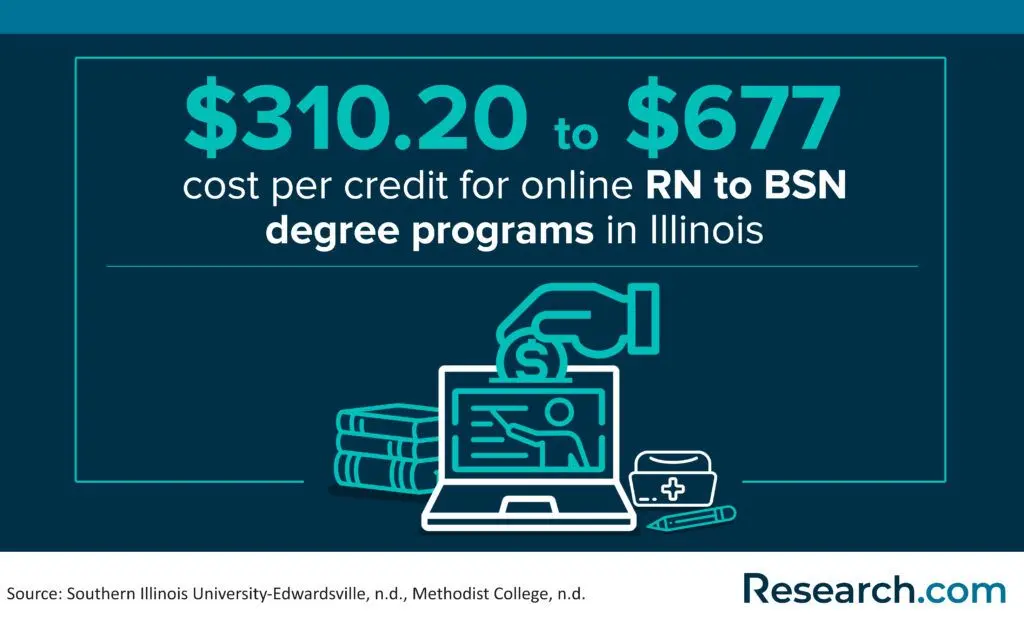
The cost of nursing school in Illinois varies widely by institution, degree level, residency status, delivery format, and the number of credits you must complete. For online RN to BSN programs in Illinois, published tuition can range from $310.20 per credit at Southern Illinois University-Edwardsville (n.d.) to $677 per credit at Methodist College (n.d.).
Students should compare total program cost, not only advertised tuition. Fees, books, technology requirements, clinical expenses, uniforms, immunizations, background checks, exam fees, and travel to clinical sites can change the final price. Illinois students should also review scholarship opportunities, including support from the Illinois Department of Public Health Nursing Education Scholarship Program.
| Cost factor | Why it matters | Question to ask before enrolling |
| Tuition per credit | This is the most visible cost but may not reflect the full price of the degree. | How many credits will I personally need after transfer review? |
| Program fees | Online, lab, simulation, technology, and clinical fees can add to the total. | Are fees included in the advertised tuition estimate? |
| Clinical expenses | Pre-licensure and advanced programs may require travel, health screenings, or site-specific costs. | Where can I complete clinical hours, and who arranges placement? |
| Transfer credits | Generous transfer policies can reduce time and cost, especially for RN to BSN students. | Will my ADN, diploma, or prior college credits be accepted? |
| Financial aid | Scholarships, employer tuition benefits, and federal aid can affect affordability. | What aid is available for my program type and enrollment status? |
How long does it take to become a nurse in Illinois?
Your timeline depends on your starting point and your target credential. Illinois Nursing Workforce Center (2024) data show that practicing nurses in Illinois hold a range of educational credentials, with many educated at the baccalaureate or graduate level, though the exact mix varies across the workforce.
For a high school graduate, an ADN commonly takes two years, while a BSN usually takes four years. A student who starts as an LPN may complete about one year of education and training before pursuing practical nursing licensure and later moving into an RN bridge pathway. After graduation, students also need time to apply for examination, register for and take the NCLEX-RN, receive results, and complete licensure steps.
| Starting point | Common pathway | Typical education timeline stated | Best fit |
| High school graduate seeking RN licensure | ADN | Two years | Students who want a shorter route to RN eligibility |
| High school graduate seeking broader preparation | BSN | Four years | Students interested in leadership, specialty units, or future graduate study |
| Student seeking a faster entry into nursing support care | LPN program | About one year | Students who want earlier hands-on patient care experience |
| Licensed RN with an ADN or diploma | Online RN to BSN | Varies by program and transfer credits | Working nurses who want a bachelor’s degree without leaving employment |
Can you become a nurse in Illinois with an online degree?
Yes, but the answer depends on the program type. Illinois produced 6,351 newly licensed RNs in 2025 (Illinois Department of Financial and Professional Regulation, 2026), and several accredited online nursing programs in Illinois support students pursuing ADN, BSN, and RN to BSN pathways. However, pre-licensure nursing students should expect required in-person clinical training even when lectures or theory courses are online.
For RN licensure, the program must prepare graduates for the NCLEX-RN and meet Illinois requirements. When comparing online nursing degrees, look for accreditation from recognized organizations such as the Accreditation Commission for Education in Nursing (ACEN), the Commission on Collegiate Nursing Education (CCNE), or the Higher Learning Commission (HLC).
Students should also review the curriculum, clinical placement rules, faculty access, student support, NCLEX preparation, and state authorization policies. Speaking with current students or recent graduates can help you understand whether the program is manageable for working adults and whether support services are responsive.
Online Nursing Programs in Illinois for 2027
Illinois offers several online options for licensed nurses who want to complete a BSN. Some students prioritize affordability and may compare the most affordable online RN to BSN programs, while others focus on reputation, student support, transfer credit policies, or graduate-school preparation. The programs below include online RN to BSN options from Illinois institutions and can help students compare online BSN programs by length, cost, credits, and accreditation.
| School | Program length | Cost information | Credits required | Accreditation |
| University of Illinois Chicago | 12 months | $475 per credit | 120 | CCNE |
| Eastern Illinois University | 14 months | $8,685 tuition | 120 | CCNE |
| Southern Illinois University-Edwardsville | One to two years | $310.20 per credit | 120 | CCNE |
| Governors State University | 18 to 24 months | $329 per credit | 120 | ACEN |
| Western Illinois University | 18 to 24 months | $317.18 per credit | 125 | CCNE |
1. University of Illinois Chicago
The University of Illinois Chicago RN to BSN program is designed for registered nurses who want to complete bachelor’s-level nursing coursework online. The curriculum emphasizes health, healthcare systems, policy, research, and education. Students do not need prerequisite courses before starting and may complete nursing core and general education requirements as part of the degree plan.
- Program Length: 12 months
- Cost per Credit: $475
- Tracks/concentrations: Nursing, Administration, Research, Consulting, Teaching
- Required Credits to Graduate: 120
- Accreditation: CCNE
2. Eastern Illinois University
The Eastern Illinois University online RN to BSN program builds on prior RN education and clinical practice. Coursework strengthens students’ understanding of nursing theory, professional values, research, and evidence-based care. The program includes five start dates each year, which can be useful for nurses who do not want to wait for a single annual admission cycle.
- Program Length: 14 months
- Cost of Tuition: $8,685
- Tracks/concentrations: Nursing, Administration, Research, Consulting, Teaching
- Required Credits to Graduate: 120
- Accreditation: CCNE
3. Southern Illinois University-Edwardsville
The Southern Illinois University-Edwardsville accelerated RN to BS option serves graduates of associate degree and diploma nursing programs. The fully online format is intended for working RNs, and rolling admission allows students to apply throughout the year instead of waiting for a fixed start window.
- Program Length: One to two years
- Cost per Credit: $310.20
- Tracks/concentrations: Nursing, Administration, Research, Consulting, Teaching
- Required Credits to Graduate: 120
- Accreditation: CCNE
4. Governors State University
The Governors State University RN to BSN program focuses on evidence-based care, health across the lifespan, and professional preparation for a range of nursing responsibilities. Its online structure is built for working nurses, and the program can be completed in just three terms depending on the student’s plan.
- Program Length: 18 to 24 months
- Cost per Credit: $329
- Tracks/concentrations: Nursing, Administration, Research, Consulting, Teaching
- Required Credits to Graduate: 120
- Accreditation: ACEN
5. Western Illinois University
The Western Illinois University RN to BSN program allows students to complete the curriculum online. The program uses computer simulators to support interactive learning, and students with an approved associate degree in nursing may receive 30 advanced placement credits toward the RN to BSN pathway.
- Program Length: 18 to 24 months
- Cost per Credit: $317.18
- Tracks/concentrations: Nursing, Administration, Research, Consulting, Teaching
- Required Credits to Graduate: 125
- Accreditation: CCNE
Is Illinois good for nursing?
Illinois can be a strong state for nursing students and licensed nurses because it has a large healthcare system, multiple nursing education options, and employment settings that range from major hospitals to clinics, schools, long-term care facilities, and community-based care. Students can find certificates, diplomas, associate degrees, bachelor’s degrees, graduate programs, and online DNP programs.
According to the 2024 Illinois Registered Nurse Workforce Survey, demand for RNs remains strong across acute care, long-term care, and community-based care settings. The state’s aging RN workforce also means that replacement needs may remain an important part of the labor market.
Illinois may be especially attractive if you want access to urban healthcare systems, rural and underserved care opportunities, specialty practice environments, or graduate nursing pathways. However, “good for nursing” still depends on your own priorities: tuition, commute or clinical placement options, work schedule, licensure goals, and desired specialty.
What can I do with a nursing degree in Illinois?
A nursing degree in Illinois can lead to roles in hospitals, clinics, residential care facilities, physician offices, schools, community health agencies, long-term care facilities, and specialized care environments. The profession is expected to see a promising 5% employment growth from 2024 to 2034, resulting in approximately 189,100 job openings annually. These opportunities are projected across multiple care settings (US BLS, 2024).
Nurses who continue into graduate education, such as an online Master of Science in Nursing, may also pursue advanced clinical, education, leadership, or administrative responsibilities, depending on licensure and certification requirements.
| Mean Yearly Pay (in USD) | 82220 |
| Mean Hourly Pay (in USD) | 39.53 |
| Job Growth Rate | 6% |
| Career direction | Typical education or credential | Why it may fit |
| Registered nurse | ADN or BSN plus RN licensure | Direct patient care in hospitals, clinics, and other healthcare settings |
| BSN-prepared nurse | BSN or RN to BSN | Broader preparation for leadership, public health, and competitive clinical roles |
| Nurse manager or supervisor | BSN, experience, and sometimes graduate education | Team leadership, scheduling, quality improvement, and unit operations |
| Advanced practice nurse | Graduate nursing degree and required certification | Specialized clinical practice, depending on state and national requirements |
| Nurse educator | Advanced education is often expected | Teaching, training, curriculum work, and clinical education support |
How can online RN to BSN programs in Illinois support career advancement for working nurses?
Online RN to BSN programs are built for licensed nurses who want to add bachelor’s-level preparation without pausing their careers. They do not replace RN licensure; instead, they build on it by strengthening skills in leadership, evidence-based practice, population health, research, communication, and systems-based care.
- Stronger clinical reasoning: BSN coursework often expands assessment, care coordination, quality improvement, and evidence-based decision-making.
- Leadership preparation: Students may study supervision, team communication, healthcare policy, conflict resolution, and organizational practice.
- Graduate-school readiness: A BSN can support future applications to MSN, DNP, nurse practitioner, nurse educator, or leadership programs.
- More competitive qualifications: Some employers prefer or require BSN preparation for certain units, leadership tracks, research roles, or public health positions.
- Work-compatible structure: Online delivery can make it easier for RNs to continue earning income while completing degree requirements.
What are the best online BSN programs for non-nurses in Illinois?
Non-nurses need to be careful when searching for online BSN programs. A pre-licensure BSN cannot be completed entirely online because students must complete supervised clinical experiences. Some programs deliver theory courses online while arranging in-person skills labs, simulations, or clinical rotations.
Career changers should verify the program type
Some accelerated BSN options are designed for students who already hold a bachelor’s degree in another field. These programs may allow students to use prior college credits and complete nursing preparation in as little as 12–18 months, depending on program structure and eligibility.
The curriculum must prepare students for RN licensure
A strong pre-licensure BSN should cover nursing fundamentals, anatomy, pharmacology, patient care, leadership, and clinical judgment. It should also prepare students to sit for the NCLEX-RN after completing all program and state requirements.
Clinical placement is a deciding factor
Online coursework is only one part of the experience. Ask whether the school arranges clinical placements, whether you must find your own sites, and whether placements are available in your area of Illinois.
Use non-nurse BSN resources carefully
Students comparing pathways can start with Research.com’s guide to online BSN programs for non-nurses, but they should still confirm Illinois eligibility, clinical requirements, accreditation, and licensure alignment directly with each school.
LPN to BSN Pathways: Expanding Opportunities for Nurses in Illinois
An LPN to BSN pathway can help Illinois licensed practical nurses move toward RN-level practice and bachelor’s-level preparation. These programs recognize that LPNs already have patient care experience, but they still require students to complete RN-level coursework, clinical requirements, and licensure steps.
Online LPN to BSN programs may be appealing because they can reduce time on campus and give working nurses more control over study schedules. However, students should not assume that every requirement is online. Clinical components, labs, exams, or practicums may require in-person attendance.
| Pathway | Best for | Main advantage | Important caution |
| LPN to RN | LPNs who want to become RNs as efficiently as possible | Can be a more direct bridge to RN eligibility | May not result in a BSN unless followed by another program |
| LPN to BSN | LPNs who want RN preparation and a bachelor’s degree | Combines career mobility with BSN-level education | Usually requires a larger time and cost commitment |
| LPN to RN to BSN | LPNs who want a staged approach | Allows students to progress step by step | May involve multiple admissions processes |
When choosing a program, confirm accreditation, NCLEX-RN preparation, transfer credit policies, clinical placement support, tuition, and whether the schedule works with your current job. You can compare broader options through Research.com’s overview of online LPN to BSN programs.
How do I renew and maintain my nursing license in Illinois?
Illinois nurses must keep their licenses active by following IDFPR renewal rules, submitting renewal materials on time, paying required fees, and completing state-required continuing education. Renewal is not just an administrative task; it protects your ability to practice legally and helps ensure your knowledge stays current.
Because renewal requirements can change, nurses should verify deadlines and continuing education rules directly before each renewal cycle. For a focused overview, review Research.com’s guide to Illinois nursing license requirements.
How Can LPNs Transition to RN Quickly in Illinois?
LPNs who want to become RNs often look for bridge programs that give credit for prior nursing education and experience. These pathways can reduce repeated coursework while adding the RN-level theory, clinical judgment, and supervised practice needed for licensure eligibility.
A 2 semester LPN to RN program online may be worth exploring if you need a faster option, but review the details carefully. Confirm whether “online” applies only to didactic coursework, where clinical hours occur, whether the program meets Illinois requirements, and what graduates must do before taking the NCLEX-RN.
Should I Consider Medical Assistant Programs in Illinois?
Medical assisting can be a practical alternative for students who want to enter healthcare faster but are not ready for the length, cost, or licensing process associated with nursing. Medical assistants often combine administrative and clinical support duties in clinics, physician offices, and other outpatient settings.
This route may fit students who want patient interaction, front-office skills, and a shorter training pathway. It may not be the best choice if your primary goal is independent nursing practice, RN licensure, or advanced clinical roles. Students considering this option can compare medical assistant programs in Illinois before deciding between allied health and nursing.
What are the licensing requirements for nurses in Illinois?
To practice nursing in Illinois, applicants must meet IDFPR requirements. These commonly include graduating from an approved nursing program, passing the appropriate NCLEX exam, completing a criminal background check, and submitting required documentation and fees.
Online students should be especially careful. A program can be accredited and still require verification that it meets Illinois licensure expectations. Before enrolling, ask the school whether Illinois students are eligible, whether graduates qualify for the appropriate exam, and whether the program has any restrictions related to clinical placement or state authorization.
If your goal is advanced clinical practice, you may eventually need graduate education and certification. Research.com’s guide to the best nurse practitioner programs in Illinois can help you compare options for that next stage.
Shape a Rewarding Healthcare Career From Nursing Schools in Illinois
Illinois nursing schools offer several ways to enter or move up in the profession, from practical nursing and ADN programs to BSN completion, RN to MSN, and doctoral pathways. The right route depends on whether you are starting fresh, changing careers, already licensed, or preparing for leadership or advanced practice.
Students who want the long-term benefits of a nursing degree should choose a program based on more than convenience. Accreditation, licensure alignment, clinical placement, support services, cost, transfer credits, and graduate outcomes all matter. Working RNs who want to continue beyond the BSN can also compare online RN to MSN programs as part of a longer career plan.
How Can Advanced Certifications Enhance Your Nursing Career in Illinois?
Advanced nursing certifications can help experienced nurses demonstrate specialized knowledge in areas such as critical care, emergency nursing, oncology, pediatrics, and other focused practice areas. These credentials may support movement into specialty units, leadership tracks, or higher-responsibility roles, depending on employer expectations and clinical background.
Certifications do not replace required licensure or degree requirements. They work best when matched to your current role, patient population, and long-term goals. If you are still at the entry stage, start with the basic pathway explained in Research.com’s guide on how to become an RN in Illinois.
How Can Pursuing a DNP Online Enhance Your Nursing Career in Illinois?
An online Doctor of Nursing Practice can help experienced nurses prepare for advanced clinical leadership, evidence-based practice, policy work, systems improvement, and high-level patient care roles. The online format may be especially useful for nurses who cannot relocate or stop working while completing doctoral coursework.
Before enrolling, compare program accreditation, practicum requirements, faculty expertise, specialization options, and total cost. If affordability is a priority, Research.com’s guide to the best DNP programs online can help you start your review.
How Do Technological Innovations Impact Nursing Education in Illinois?
Nursing education increasingly uses simulation, telehealth training, digital records, virtual case studies, and technology-supported clinical decision-making. These tools help students practice assessment, prioritization, communication, and safety skills before or alongside direct patient care.
Technology should improve learning, not replace essential clinical preparation. When comparing accredited nursing schools in Illinois, ask how simulation is used, whether students train with electronic health record systems, how online courses are supported, and how faculty evaluate clinical readiness.
Can Starting as an LVN Provide a Strategic Career Advantage in Illinois?
The term LVN is used in some states, while Illinois commonly refers to licensed practical nurses as LPNs. Starting in a practical nursing role can still offer a useful career foundation because it gives students hands-on patient care exposure, workplace experience, and a clearer view of nursing before committing to a longer degree path.
This route can be strategic if you want to enter healthcare sooner and later bridge into RN or BSN study. It may be less efficient if you already know you want to become an RN as quickly as possible. For a state-specific overview, see Research.com’s guide on how to become an LVN nurse in Illinois.
How Can Gaining LPN Experience Propel Your Nursing Career in Illinois?
LPN experience can strengthen clinical confidence, communication skills, time management, and understanding of healthcare workflows. Those skills can be valuable when applying to bridge programs or transitioning into RN-level responsibilities.
However, experience alone does not replace education or licensure requirements. LPNs who want to advance should document their clinical experience, compare bridge programs, review transfer credit rules, and understand the admissions requirements for RN or BSN pathways. To start, review Research.com’s guide on how to become an LPN in Illinois.
What Steps Should You Take to Advance as a Nurse Practitioner in Illinois?
Becoming a nurse practitioner requires deliberate planning. Nurses typically need RN experience, graduate-level nursing education, advanced clinical training, and the appropriate certification for their population focus or specialty. Illinois-specific requirements should be verified before selecting a program.
Prospective nurse practitioners should compare program accreditation, clinical hour expectations, placement support, certification exam alignment, and whether the curriculum fits their intended practice area. For detailed steps, read Research.com’s guide on how to become a nurse practitioner in Illinois.
What is the role of medical billing and coding in Illinois’ healthcare landscape?
Medical billing and coding supports healthcare delivery by translating clinical documentation into standardized codes used for claims, records, reimbursement, and compliance. These professionals do not provide direct nursing care, but their work affects the accuracy and efficiency of healthcare operations.
This pathway may appeal to people who want to work in healthcare with a stronger administrative, technical, or records-focused role. It can also complement clinical experience for professionals interested in revenue cycle management or healthcare administration. Learn more in Research.com’s guide on how to become a medical biller and coder in Illinois.
What are the Career Pathways for Nurse Midwives in Illinois?
Nurse midwifery is an advanced practice nursing path focused on reproductive health, pregnancy, birth, postpartum care, and related patient education. Prospective nurse midwives need advanced nursing education, supervised clinical preparation, and certification from the appropriate professional body.
Students interested in this field should seek programs with strong clinical placements in prenatal, perinatal, postnatal, routine, and higher-risk care settings. For a step-by-step overview, see Research.com’s guide on how to become a nurse midwife in Illinois.
Common Mistakes to Avoid When Choosing an Online Nursing Program in Illinois
- Assuming online means fully remote: Pre-licensure nursing programs still require hands-on clinical training, and some programs require labs or campus visits.
- Checking tuition but not total cost: Fees, clinical expenses, supplies, testing, travel, and lost work time can change affordability.
- Ignoring accreditation: Accreditation affects licensure eligibility, transfer options, graduate admission, and employer confidence.
- Not verifying Illinois eligibility: Out-of-state online programs may not automatically meet Illinois requirements.
- Overlooking clinical placement support: A program that leaves students to find their own sites can create delays.
- Choosing only by speed: A faster program is not better if it lacks support, proper approval, or manageable pacing.
- Assuming salary outcomes are guaranteed: Pay depends on role, employer, location, experience, shift, specialty, and credential level.
Questions to Ask Before Enrolling
- Is the nursing program accredited by ACEN, CCNE, HLC, or another recognized accreditor relevant to my pathway?
- Does the program meet Illinois licensure requirements for my intended credential?
- What percentage of the program is online, and what must be completed in person?
- Who arranges clinical placements, and where can Illinois students complete them?
- How many of my prior credits will transfer?
- What is the total estimated cost after tuition, fees, books, clinical requirements, and exam expenses?
- What academic support, advising, tutoring, and NCLEX preparation are included?
- Can I complete the program while working full time, or is part-time study more realistic?
- What graduate programs or career pathways does this degree prepare me for?
Key Insights
- Illinois needs new and advancing nurses: With approximately 55% of the RN workforce age 55 years and older, nursing education is directly tied to the state’s workforce stability.
- Online nursing is most flexible for licensed nurses: RN to BSN and other bridge programs often work well online, while pre-licensure students still need in-person clinical training.
- Licensure should guide your school choice: Illinois RN candidates must complete an approved nursing program, apply through IDFPR, pass the NCLEX-RN, and complete licensing steps.
- Costs vary widely: Online RN to BSN tuition in Illinois ranges from $310.20 per credit to $677 per credit, so students should compare total program cost instead of tuition alone.
- Timeline depends on your starting point: ADN programs usually take two years, BSN programs four years, and LPN programs about one year, with additional time for exam and licensure processing.
- Accreditation is nonnegotiable: Look for recognized accreditation and confirm that the program aligns with Illinois requirements before enrolling.
- The best program is the one that fits your goal: A first-time student, an LPN, a working RN, and a future nurse practitioner need different pathways, timelines, and decision criteria.
Related Articles for Nearby States
- 2027 Best Online Nursing Programs in Indiana – Accredited RN to BSN Programs
- 2027 Best Online Nursing Programs in Wisconsin – Accredited RN to BSN Programs
- 2027 Best Online Nursing Programs in Iowa – Accredited RN to BSN Programs
- 2027 Best Online Nursing Programs in Missouri – Accredited RN to BSN Programs
- 2027 Best Online Nursing Programs in Kentucky – Accredited RN to BSN Programs
- 2027 Best Online Nursing Programs in Michigan – Accredited RN to BSN Programs
- 2027 Best Online Nursing Programs in Minnesota – Accredited RN to BSN Programs
- 2027 Best Online Nursing Programs in Ohio – Accredited RN to BSN Programs
- 2027 Best Online Nursing Programs in Tennessee – Accredited RN to BSN Programs
- 2027 Best Online Nursing Programs in Arkansas – Accredited RN to BSN Programs
References:
- AACN. (2025). 2024-2025 Enrollment and Graduations in Baccalaureate and Graduate Programs. https://www.aacnnursing.org
- Carson-Newman. (2025). By the Numbers: Nursing Statistics 2025. https://onlinenursing.cn.edu/news/nursing-by-the-numbers
- NurseJournal. (2025). The Top 20 Highest-Paying Nursing Specialties. https://nursejournal.org/articles/best-nursing-specialities-for-the-future/https://onlinenursing.cn.edu/news/nursing-by-the-numbers
- U.S. Bureau of Labor Statistics. (2025). Occupational Outlook Handbook: Registered Nurses. https://www.bls.gov/ooh/healthcare/registered-nurses.htm
- U.S. Bureau of Labor Statistics. (2025). Registered Nurses. https://www.bls.gov/ooh/healthcare/registered-nurses.htm
Other Things You Should Know About Online Nursing Programs in Illinois
In 2027, top online RN to BSN programs in Illinois include those offered by the University of Illinois at Chicago, Loyola University Chicago, and Rush University. These programs are accredited, offer flexible learning options, and are designed to enhance the skills of registered nurses, preparing them for advanced roles in healthcare.
Yes. Most Illinois RN to BSN programs require an active, unencumbered registered nurse license before enrollment or before upper-division nursing coursework begins. Many programs also require an associate degree in nursing from an accredited school and a minimum GPA, often 2.5 or higher.
Yes, you can become a nurse in Illinois with an online degree. Accredited online nursing programs prepare students for the NCLEX-RN and meet the requirements for state licensure. It is essential to choose a program accredited by recognized national nursing organizations like ACEN, CCNE, or HLC.
Students enrolling in online RN to BSN programs in Illinois for 2027 can explore several financial aid options, including federal aid like FAFSA, state scholarships specific to nursing, and grants offered by individual institutions. Some employers may also offer tuition reimbursement for employees advancing their education in nursing.
Yes, there are financial aid options available for nursing students in Illinois. Students can apply for grants, scholarships, and loans. Institutions like the Illinois Department of Public Health offer scholarships to help alleviate the financial burden of nursing education.
Nursing schools in Illinois offer diverse opportunities for clinical placements and internships, enhancing student learning through hands-on experience in various healthcare settings. These placements occur in top-tier hospitals, community clinics, and specialized care facilities, including institutions like Northwestern Memorial Hospital and Rush University Medical Center. Students gain practical skills by working with experienced healthcare professionals, managing real patient cases, and utilizing advanced medical technologies. Additionally, partnerships with local health organizations provide unique experiences in urban and rural healthcare environments, broadening students' understanding of different patient populations and healthcare challenges. These comprehensive clinical experiences prepare students for successful and versatile nursing careers.


