
2027 Business Analytics Careers: Guide to Career Paths, Options & Salary

Co-Founder and Chief Data Scientist
Business analytics careers are for people who want to turn data into better business decisions. Companies use analytics to price products, forecast demand, reduce waste, improve customer experience, manage budgets, assess risk, and choose growth strategies. That makes business analytics useful across finance, healthcare, technology, consulting, government, retail, and nearly every industry that collects operational or customer data.
This guide explains what business analytics professionals do, how to enter the field, which roles pay well, what skills and credentials matter, and how to decide whether this path fits your goals. You will also learn how business analytics compares with related careers, what industries and states may offer strong opportunities, how to evaluate education options, and how to improve your salary prospects without assuming that any degree or certification guarantees a specific outcome.
Quick answer: Is a business analytics career a good choice?
Yes, business analytics can be a strong career path for people who enjoy data, problem-solving, technology, and business strategy. Many roles require at least a bachelor’s degree, and some advanced positions favor graduate education, specialized technical skills, or professional certifications. Salaries vary by role, employer, industry, location, and experience, but reported compensation for business analyst roles ranges widely across sources, and several analytics-related occupations show faster-than-average projected growth.
What are the benefits of having a business analytics career?
- Broad career mobility: Business analytics skills apply in finance, healthcare, technology, consulting, government, and other data-heavy fields.
- Competitive earning potential: Some advanced analytics roles report median or average salaries above $100,000, depending on the role and source.
- Flexible education options: Students can build analytics skills through campus programs, online degrees, certificates, bootcamps, employer training, or graduate study.
- Practical business impact: Analysts often work on decisions that affect revenue, costs, operations, customer behavior, and long-term strategy.
Table of Content
- What is a business analytics career?
- How do I become a business analyst?
- How much can I make with business analytics careers?
- Top Business Analytics Careers for 2027
- What are the top industries for business analytics careers?
- Which are the best states for business analytics careers?
- How do business analytics compare to other similar roles?
- How can I negotiate a competitive salary in business analytics careers?
- What is the best educational pathway to enhance my business analytics career?
- What alternative educational paths can further enhance my business analytics career?
- What emerging trends are shaping business analytics careers?
- How do advanced leadership degrees impact business analytics career progression?
- How can I increase earning potential in business analytics careers?
- What is the job outlook for business analytics careers?
- Are business analytics careers worth it?
- How Can Project Management Skills Enhance Your Business Analytics Career?
- What is the return on investment for your business analytics education?
- How does accreditation influence career advancement in business analytics?
- How do professional networking and mentorship opportunities enhance career advancement in business analytics?
- How does industry specialization affect career growth in business analytics?
What is a business analytics career?
A business analytics career focuses on using data, statistics, business knowledge, and technology to answer practical organizational questions. Instead of analyzing information for its own sake, business analytics professionals connect data to decisions: Which customers are most likely to leave? Where are costs rising? Which product should receive more investment? How can a hospital improve staffing? Which marketing campaign performs best?
The field includes several job families. A business intelligence analyst may build dashboards and reports. A market research analyst may study customers and competitors. An operations research analyst may optimize logistics, staffing, or production. A data scientist may build predictive models and machine learning workflows. A management analyst may use data to recommend process or organizational changes.
Although not every analytics role requires graduate school, a master’s degree in business, business analytics, data analytics, information systems, finance, or a related field can help professionals move into more technical, strategic, or leadership-focused positions. The best choice depends on whether you want to deepen technical modeling skills, build broader management capability, or specialize in a sector such as healthcare, finance, public administration, or technology.
Some professionals also apply analytics in public-sector leadership, policy, and nonprofit management. If that direction interests you, reviewing the best public administration PhD programs online can help you compare a more research-oriented route with a business analytics or management degree.
| Business analytics focus | Typical questions answered | Common tools or methods |
| Descriptive analytics | What happened in the business? | Reports, dashboards, summary statistics |
| Diagnostic analytics | Why did performance change? | Root-cause analysis, segmentation, trend comparison |
| Predictive analytics | What is likely to happen next? | Forecasting, regression, machine learning models |
| Prescriptive analytics | What should the organization do? | Optimization, scenario modeling, decision analysis |
How do I become a business analyst?
Most business analysts enter the field by combining formal education, practical experience, technical tool training, and strong communication skills. The path is flexible, but employers usually want evidence that you can understand business problems, work with data, communicate with stakeholders, and recommend realistic solutions.
- Earn a relevant bachelor’s degree. Common majors include business administration, finance, economics, information systems, computer science, statistics, or data analytics. An online degree in data analytics can be a practical option for students who want structured training in data preparation, visualization, statistics, and analytics tools.
- Build a portfolio of analytics work. Employers often want proof that you can solve real problems. Create projects that include a business question, a dataset, the method used, visualizations, findings, and recommendations.
- Gain entry-level experience. Internships, reporting analyst roles, operations coordinator jobs, finance assistant positions, IT support roles, and junior data analyst jobs can all lead toward business analytics if they involve data, process improvement, or stakeholder communication.
- Learn core analytics tools. Common requirements include spreadsheet modeling, SQL, dashboard software, basic statistics, data visualization, requirements gathering, and business process mapping. More technical roles may expect Python, R, machine learning, cloud platforms, or database knowledge.
- Consider certification when it fits the role. Credentials such as the Certified Business Analysis Professional (CBAP) from the International Institute of Business Analysis (IIBA) may help experienced professionals document their expertise, but certification should support—not replace—hands-on skill development.
- Practice stakeholder communication. Business analysts succeed when they can translate data findings into decisions that nontechnical leaders can understand and act on.
- Keep learning as tools change. Analytics platforms, AI tools, cloud systems, and automation workflows evolve quickly. Ongoing training is part of the job.
If you are still comparing people-focused careers with data-focused careers, it may help to look at adjacent fields. For example, early childhood education careers can use research and data skills in policy, assessment, curriculum planning, and child development research, but the day-to-day work is very different from business analytics.
| Career stage | What to focus on | Examples of proof employers may value |
| Student or career changer | Foundational business, statistics, spreadsheets, SQL, visualization | Course projects, internships, public portfolio, case studies |
| Entry-level analyst | Reporting, data cleaning, requirements gathering, dashboards | Documented business impact, clean reports, stakeholder feedback |
| Mid-career analyst | Process improvement, predictive analytics, project leadership | Cost savings, revenue insights, workflow improvements, model results |
| Senior or manager | Strategy, team leadership, governance, executive communication | Cross-functional initiatives, analytics roadmaps, measurable outcomes |
How much can I make with business analytics careers?
Business analytics salaries vary because the field covers many roles, industries, and technical levels. A business analyst working on requirements and reporting may be paid differently from a data scientist building predictive models, a financial analyst evaluating investments, or an operations research analyst optimizing complex systems.
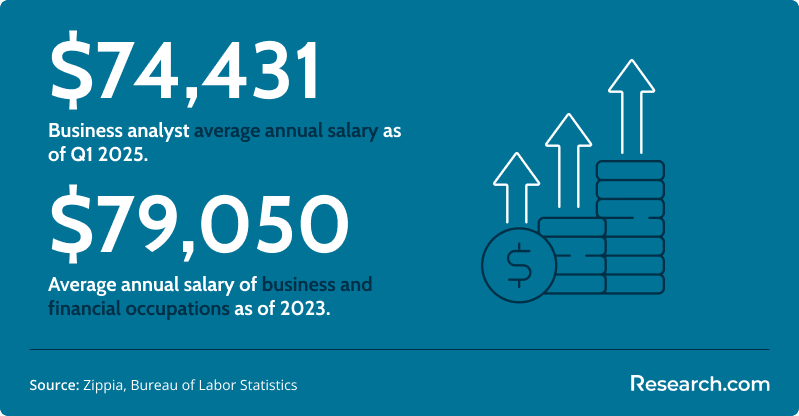
Zippia reports an average annual salary of $74,431 for business analysts. For broader context, the Bureau of Labor Statistics reported a median annual wage of $79,050 for business and financial occupations in May 2023, compared with $48,060 for all occupations.
Salary estimates for business analyst roles also differ across compensation sources:
| Source | Reported yearly pay for business analysts |
| Glassdoor | $93,765 yearly |
| Indeed | $85,290 yearly |
| Comparably | $93,527 yearly |
| Salary.com | $107,670 yearly |
| ZipRecruiter | $98,662 yearly |
| SalaryExpert | $101,259 yearly |
| CareerExplorer | $69,297 yearly |
These differences do not mean one number is automatically correct and the others are wrong. Each source may use different employer samples, job titles, locations, experience levels, and calculation methods. When planning your career or negotiating pay, compare salaries for the exact title, city, industry, tools required, and seniority level.
International roles can also pay differently because compensation depends on local labor markets, currency, industry maturity, tax systems, and assignment structure. If you are interested in cross-border business, reviewing an international business career path can help you see how analytics skills may fit global strategy, trade, market expansion, or multinational operations.
Some professionals compare analytics with entirely different fields before committing to a degree. For example, questions such as Is a master's in marriage and family therapy degree worth it? or How hard are RN to BSN programs online? reflect a broader decision: whether you want a data-centered business career, a counseling-focused career, or a healthcare pathway that may later incorporate analytics.
Top Business Analytics Careers for 2027
Business analytics is not a single job title. It is a cluster of careers that use evidence, data, modeling, financial analysis, systems thinking, or market research to improve decisions. The roles below are among the most relevant analytics-related options for 2027, with salary, education, and growth figures listed as stated.
| Career | Average annual salary | Minimum required education | Growth rate | Best fit for |
| Market Research Analysts | $74,680 | Bachelor’s degree | 8% (Faster than average) | People interested in customers, marketing, surveys, pricing, and consumer behavior |
| Operations Research Analysts | $83,640 | Bachelor's degree | 23% (Much faster than average) | Analytical problem-solvers who enjoy optimization, logistics, staffing, and efficiency |
| Budget Analysts | $84,940 | Bachelor's degree | 4% (As fast as average) | Professionals who want to work with financial planning, spending control, and resource allocation |
| Management Analysts | $99,410 | Bachelor's degree | 11% (Much faster than average) | Consulting-minded analysts who want to improve operations, strategy, and organizational performance |
| Financial Analysts | $99,890 | Bachelor's degree | 9% (Much faster than average) | Students interested in investments, markets, corporate finance, risk, and financial modeling |
| Computer Systems Analysts | $103,800 | Bachelor’s degree | 11% (Much faster than average) | Professionals who want to connect business needs with IT systems and software solutions |
| Data Scientists | $108,020 | Bachelor’s degree | 36% (Much faster than average) | Technically strong analysts who want to work with large datasets, predictive models, and advanced analytics |
Market Research Analysts
Market research analysts study customers, competitors, products, and market conditions. Their work helps organizations understand what people may buy, how demand is changing, how prices compare, and which customer segments are worth targeting. This role is a strong fit for people who like marketing strategy, survey data, consumer behavior, and data visualization.
- Average Annual Salary: $74,680
- Minimum Required Education: Bachelor’s degree
- Growth Rate: 8% (Faster than average)
Operations Research Analysts
Operations research analysts use math, data, and modeling to improve complex systems. They may optimize delivery routes, staffing schedules, supply chains, inventory, production plans, healthcare operations, or resource allocation. This role is often more quantitative than a general business analyst role.
- Average Annual Salary: $83,640
- Minimum Required Education: Bachelor's degree
- Growth Rate: 23% (Much faster than average)
Budget Analysts
Budget analysts help organizations plan and monitor spending. They review budget proposals, analyze financial needs, check compliance with rules or guidelines, and recommend how resources should be allocated. This path can be especially relevant in government, education, nonprofit, and large corporate settings.
- Average Annual Salary: $84,940
- Minimum Required Education: Bachelor's degree
- Growth Rate: 4% (As fast as average)
Management Analysts
Management analysts, also called management consultants, evaluate how organizations operate and recommend changes to improve efficiency, profitability, structure, or performance. They often interview stakeholders, analyze processes, study financial and operational data, and present recommendations to leadership.
- Average Annual Salary: $99,410
- Minimum Required Education: Bachelor's degree
- Growth Rate: 11% (Much faster than average)
Financial Analysts
Financial analysts use data to evaluate investments, business performance, economic trends, and financial risk. They may work in corporate finance, banking, investment management, insurance, or consulting. Strong spreadsheet modeling, accounting, valuation, and market analysis skills are often important.
- Average Annual Salary: $99,890
- Minimum Required Education: Bachelor's degree
- Growth Rate: 9% (Much faster than average)
Computer Systems Analysts
Computer systems analysts translate organizational needs into technology improvements. They assess existing systems, gather requirements, compare technical options, and help implement IT solutions. This role can suit people who are comfortable working between business teams and technical teams.
- Average Annual Salary: $103,800
- Minimum Required Education: Bachelor’s degree
- Growth Rate: 11% (Much faster than average)
Data Scientists
Data scientists use advanced statistical, computational, and modeling methods to extract insights from large or complex datasets. Their work may include predictive modeling, machine learning, experimentation, data engineering collaboration, visualization, and communicating results to decision-makers.
- Average Annual Salary: $108,020
- Minimum Required Education: Bachelor’s degree
- Growth Rate: 36% (Much faster than average)
The chart below compares salary levels across selected business analytics career paths.
What are the top industries for business analytics careers?
Business analytics roles appear in nearly every sector, but the work changes depending on the industry. The strongest fit is not always the industry with the highest salary; it is the industry where your interests, technical strengths, and domain knowledge create value.
| Industry | How analytics is used | Relevant roles |
| Finance and Insurance | Investment analysis, risk modeling, fraud detection, forecasting, pricing, performance reporting | Financial analysts, investment analysts, business analysts, data scientists |
| Healthcare | Patient flow, staffing, cost control, quality improvement, operations planning, claims analysis | Operations research analysts, data analysts, management analysts |
| Technology and Computer Systems Design | Product analytics, systems improvement, customer behavior analysis, platform performance, automation | Computer systems analysts, data scientists, business intelligence analysts |
| Management Consulting | Process improvement, restructuring, benchmarking, cost reduction, growth strategy | Management analysts, business analysts, operations analysts |
| Government | Program evaluation, budgeting, policy analysis, operations optimization, public service delivery | Budget analysts, operations research analysts, management analysts |
Industry specialization matters because business context affects the questions you ask and the recommendations you make. A healthcare analyst must understand operations, privacy, reimbursement, and patient outcomes. A finance analyst must understand markets, accounting, risk, and regulation. A technology analyst must understand product usage, systems, and software delivery.
Which are the best states for business analytics careers?
The best state for a business analytics career depends on the roles you are targeting, the industries clustered in the region, remote-work availability, salary levels, and cost of living. The states below are commonly relevant because of their concentrations in technology, finance, government contracting, healthcare, energy, and consulting.
- California: California can be attractive for data scientists and computer systems analysts because of its large technology, entertainment, startup, and media ecosystems, including Silicon Valley and Los Angeles.
- New York: New York is a major hub for financial analysts and market research analysts because of its finance, media, consulting, advertising, and corporate headquarters presence.
- Virginia and Maryland: These states can be strong options for operations research analysts and management analysts because of their proximity to Washington D.C., federal agencies, defense contractors, and consulting firms.
- Texas: Texas offers opportunities across technology, energy, healthcare, finance, and corporate operations, especially in cities such as Austin, Houston, and Dallas.
When comparing states, do not look only at salary. A higher salary in a high-cost metro area may not improve your financial position as much as a slightly lower salary in a state with lower housing and commuting costs. Remote and hybrid roles can also change the calculation, especially for experienced analytics professionals.
How do business analytics compare to other similar roles?
Business analytics overlaps with product management, data science, UX research, HR analytics, finance, operations, and project management. The difference is usually the main decision being supported. Business analysts focus on improving processes, requirements, reporting, and business decisions. Data scientists focus more heavily on advanced modeling and algorithms. Product managers own product direction and trade-offs. UX designers and researchers focus on user experience. HR analysts focus on workforce data.
| Role | Main focus | How it differs from business analytics | Good fit if you enjoy |
| Business Analyst | Business problems, requirements, processes, data-informed recommendations | More cross-functional and process-oriented than purely technical analytics roles | Stakeholder communication, problem definition, dashboards, workflow improvement |
| Data Scientist | Models, algorithms, predictions, large datasets | Usually requires stronger programming, statistics, and machine learning depth | Coding, experimentation, predictive modeling, technical problem-solving |
| Product Manager | Product strategy, roadmap, customer needs, business outcomes | Owns product decisions more directly and may use analytics as one input among many | Strategy, prioritization, customer discovery, leadership without direct authority |
| UX Designer or UX Researcher | User behavior, usability, experience design | Focuses on how people interact with products, not broad business operations | User interviews, design thinking, usability testing, customer empathy |
| HR Analyst | Workforce data, hiring, retention, compensation, performance | Specializes in human resources decisions rather than enterprise-wide business operations | People analytics, workforce planning, employee experience, HR strategy |
Professionals who want to move from analysis into leadership may consider graduate business training. A flexible MBA from one of the top part-time MBA schools can be useful for people who want to keep working while building management, finance, strategy, and leadership skills.
How can I negotiate a competitive salary in business analytics careers?
Salary negotiation works best when you combine market research with evidence of business impact. Do not rely on a single national average. Instead, compare salary ranges for the exact title, industry, metro area, company size, seniority level, and tools required. If you are moving into analytics from management, finance, IT, or operations, benchmark against adjacent paths such as business management salary expectations to understand how your broader experience may affect compensation.
- Collect role-specific salary data. Use multiple sources and focus on your city, experience level, and industry.
- Translate your work into measurable value. Examples include reduced reporting time, improved forecast accuracy, cost savings, revenue opportunities, process improvements, or better stakeholder adoption.
- Know your compensation package. Base salary is only one part. Consider bonus, equity, remote flexibility, tuition support, certification reimbursement, retirement contributions, and promotion path.
- Time the conversation carefully. Negotiation is strongest after an offer, after a documented performance win, or during a formal review cycle.
- Use a clear range. Present a researched target and explain the skills, outcomes, and market data supporting it.
What is the best educational pathway to enhance my business analytics career?
The best educational pathway depends on your starting point. A new student may need a bachelor’s degree with analytics coursework. A working professional may need targeted certificates or a master’s program. A senior professional may benefit more from leadership, strategy, or industry-specific education than another technical course.
| Education option | When it makes sense | What to check before enrolling |
| Bachelor’s degree | You need a foundational credential for entry-level analyst roles | Accreditation, analytics coursework, internship support, career services, transfer credit policy |
| Online business or analytics degree | You need flexibility while working or managing other responsibilities | Course format, faculty access, project requirements, employer recognition, total cost |
| Master’s degree | You want deeper analytics, management, finance, or data science training | Curriculum fit, prerequisites, capstone projects, alumni outcomes, debt burden |
| Certificate or bootcamp | You need a focused skill upgrade in SQL, visualization, Python, or business analysis | Employer value, hands-on projects, instructor quality, refund policies, realistic job claims |
Cost matters, especially if you are still building entry-level experience. Comparing options such as the cheapest online business degree can help you identify lower-cost routes, but affordability should be weighed against accreditation, curriculum quality, support services, and employer relevance.
What alternative educational paths can further enhance my business analytics career?
You do not always need a dedicated business analytics degree to build an analytics career. Depending on your goals, alternatives may include data analytics, information systems, finance, economics, statistics, computer science, project management, or an MBA with analytics electives.
- MBA programs: Useful for analysts who want management, strategy, finance, marketing, and leadership preparation.
- Data analytics programs: Strong fit for students who want more technical work with databases, dashboards, and modeling.
- Finance or accounting programs: Helpful for analytics roles in corporate finance, investment analysis, budgeting, and risk.
- Information systems programs: Good for people who want to connect business processes with software, systems, and digital transformation.
- Short certificates: Practical for filling a specific skill gap without committing to a full degree.
If you want a broad management credential in a flexible format, easy online MBA programs may be worth comparing, but make sure “easy” does not mean weak academic quality, limited support, or poor employer recognition.
What emerging trends are shaping business analytics careers?
Business analytics is changing as organizations use artificial intelligence, machine learning, automation, cloud data platforms, real-time dashboards, and advanced visualization to speed up decision-making. These technologies can reduce manual reporting work, but they also increase the need for professionals who can validate data quality, frame the right business questions, interpret outputs, and explain limitations to decision-makers.
- AI-assisted analytics: Analysts increasingly use AI tools to explore data, generate code, summarize findings, and automate repetitive tasks.
- Data governance and ethics: Companies need analysts who understand privacy, bias, responsible AI use, and data quality controls.
- Cloud-based analytics: Many organizations are moving data workflows into cloud environments, making cloud literacy more valuable.
- Real-time decision-making: Dashboards and streaming data make it possible to monitor operations and customer behavior faster than traditional reporting cycles.
- Business translation skills: As tools become more automated, the ability to define the problem and turn insights into action becomes more important.
Senior professionals who want to combine analytics, research, and executive-level strategy may also compare doctoral business options, including the best online DBA programs, before committing to a long-term academic path.
How do advanced leadership degrees impact business analytics career progression?
Advanced leadership degrees can help analytics professionals move from individual contributor roles into strategy, transformation, consulting, executive, or research-oriented positions. The value is strongest when the program supports your actual career target. A leadership doctorate may be more relevant for organizational change, consulting, higher education, or executive development than for a hands-on data science role.
For professionals interested in leading analytics teams, building data-driven cultures, or studying organizational performance, a PhD organizational leadership pathway can provide research and leadership training. Before enrolling, compare program length, dissertation expectations, tuition, faculty expertise, and whether the credential is necessary for the role you want.
How can I increase earning potential in business analytics careers?
To raise your earning potential in business analytics, focus on skills and outcomes that employers can connect to revenue, cost savings, risk reduction, customer retention, operational efficiency, or strategic growth. More education can help, but salary growth usually comes from a combination of technical skill, business judgment, communication, industry knowledge, and measurable results.
Some professionals pursue advanced study, such as a part-time PhD in business, when they want research, teaching, consulting, executive, or highly specialized roles. Others may get a better return from certifications, a master’s degree, an MBA, or focused technical training.
Certifications that may support a business analytics career include:
- Certified Scrum Master (CSM) - Scrum Alliance
- Certified Business Analysis Professional (CBAP) - IIBA
- Professional Business Analyst Certificate - Global Knowledge
- Certified Scrum Product Owner (CSPO) - Scrum Alliance
- Chartered Financial Analyst (CFA)
- Certified Management Accountant (CMA) - IMA
- Certified Associate in Project Management (CAPM) - PMI
- Software Engineering Master Certification (SEMC) - IEEE
- International Accredited Business Accountant (IABA) - ACAT
- Program Management Professional (PgMP) - PMI
| Salary growth strategy | Why it can help | Common mistake to avoid |
| Learn SQL, visualization, and analytics tools | These skills support many entry-level and mid-level analytics jobs | Listing tools on a resume without project evidence |
| Specialize by industry | Domain knowledge helps you ask better questions and make better recommendations | Assuming technical skill alone replaces business context |
| Document measurable outcomes | Employers reward work tied to cost, revenue, efficiency, or risk reduction | Describing tasks instead of results |
| Develop leadership and communication skills | Senior roles require influence across teams and executives | Overloading stakeholders with technical details |
| Negotiate with market evidence | Data-supported requests are stronger than vague expectations | Using only national averages instead of local and role-specific data |
What is the job outlook for business analytics careers?
The outlook for business analytics careers is generally strong, but it differs by role. Data Scientists show a growth rate of 36%, and Operations Research Analysts show a growth rate of 23%, both described as much faster than average. These roles benefit from demand for advanced data analysis, automation, optimization, and predictive modeling.
Management Analysts have a growth rate of 11%, Computer Systems Analysts have a growth rate of 11%, Financial Analysts have a growth rate of 9%, and Market Research Analysts have a growth rate of 8%. Budget Analysts show a growth rate of 4%, reflecting steadier demand in budgeting and financial planning functions.
The main takeaway is that analytics skills are useful across many job categories, but growth is strongest where technical depth, systems thinking, and complex decision support are central to the role. Students should choose a path based on job duties, not just the growth percentage.
The chart below summarizes projected growth rates for selected analytics-related occupations.
Are business analytics careers worth it?
Business analytics careers can be worth it for people who enjoy working with data and want a career connected to business decision-making. The value is strongest when your education cost is manageable, your skills match employer demand, and you are willing to keep learning as tools and expectations change.
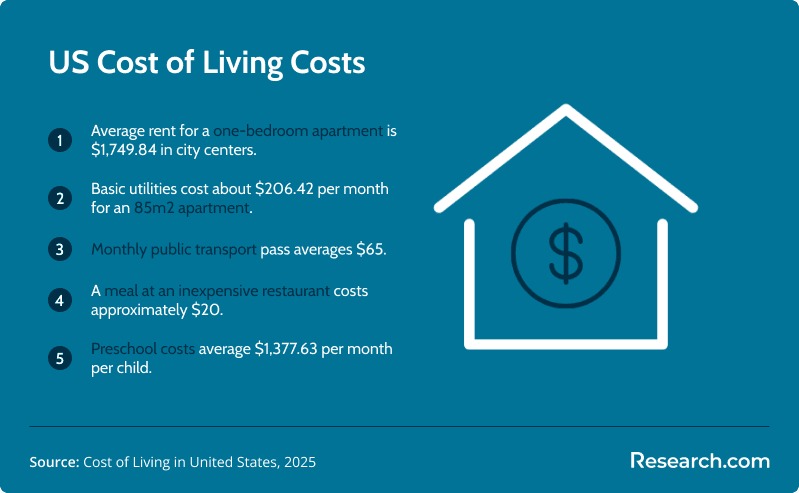
For example, Data Scientists report an average salary of $108,020, and Operations Research Analysts report an average salary of $83,640. These figures can compare favorably with the stated U.S. cost-of-living estimate of around $1,164 monthly for a single person without rent, but the real financial outcome depends heavily on housing, taxes, debt, family obligations, and location.
States such as Texas, Florida, and North Carolina may offer a more balanced cost picture for some professionals because salaries can stretch further where housing and general expenses are lower. Still, career value should include more than salary. Consider job stability, work-life fit, preferred industry, technical difficulty, advancement potential, and whether you actually like the daily work.
If you are still deciding whether to study business broadly or specialize in analytics, asking is business a good major can help you compare business administration, analytics, finance, management, and related paths.
How Can Project Management Skills Enhance Your Business Analytics Career?
Project management skills can make business analytics professionals more effective because analytics work rarely happens in isolation. Analysts often coordinate with executives, IT teams, finance departments, product teams, vendors, and frontline employees. Strong project management helps keep scope clear, timelines realistic, stakeholders aligned, and recommendations actionable.
This combination is especially valuable for analytics professionals who want to lead dashboard rollouts, data migration projects, process improvement initiatives, AI pilots, or cross-functional reporting systems. If you want formal training in planning, risk management, scheduling, and team coordination, an accelerated project management bachelor degree online may complement analytics experience.
What is the return on investment for your business analytics education?
Education ROI in business analytics depends on total cost, time to completion, debt, opportunity cost, employer tuition support, expected salary change, and whether the program helps you qualify for roles you could not access before. A low-cost program with strong career outcomes may offer better ROI than an expensive program with limited employer recognition.
- Calculate total program cost. Include tuition, fees, books, software, travel, lost work time, and loan interest.
- Compare realistic salary outcomes. Use role-specific and location-specific data, not only national averages.
- Check whether the credential is required. Some roles require a degree; others reward portfolios, tools, and experience more directly.
- Ask about career support. Internship access, employer partnerships, alumni networks, and capstone projects can affect ROI.
- Avoid assuming a degree guarantees a raise. Employers usually pay for demonstrated capability and business impact.
Students comparing graduate business routes should review online MBA programs cost to understand how tuition and program structure can affect long-term value.
How does accreditation influence career advancement in business analytics?
Accreditation matters because it helps verify that a school or program meets recognized academic standards. Employers, graduate schools, licensing bodies, and financial aid systems may treat accredited credentials differently from unaccredited ones. For business analytics students, accreditation can affect transfer credit, employer tuition reimbursement, graduate admission, and overall credential credibility.
Business students may also see programmatic business accreditation, such as AACSB, in addition to institutional accreditation. If you are comparing MBA or business analytics-related programs, reviewing AACSB accredited schools online can help you understand how accreditation and cost intersect.
| Accreditation question | Why it matters |
| Is the institution accredited? | Institutional accreditation can affect financial aid eligibility, credit transfer, and employer recognition. |
| Does the business school hold programmatic accreditation? | Programmatic accreditation may signal additional review of business curriculum and faculty standards. |
| Will credits transfer? | Transfer limits can raise the total cost and time needed to finish a degree. |
| Do employers in your target industry value the credential? | A respected credential can support advancement, but it should still be paired with skills and experience. |
How do professional networking and mentorship opportunities enhance career advancement in business analytics?
Networking and mentorship can accelerate a business analytics career because many opportunities come through referrals, internal projects, professional communities, and manager sponsorship. A mentor can help you choose tools to learn, identify role gaps, prepare for interviews, build a portfolio, and avoid career moves that do not match your goals.
Useful networking options include analytics meetups, business analysis associations, alumni groups, employer resource groups, industry conferences, webinars, LinkedIn communities, and internal cross-functional projects. For professionals who want to combine networking, business fundamentals, and leadership training in a shorter format, a fast online MBA may be worth comparing carefully against cost, accreditation, workload, and career support.
How does industry specialization affect career growth in business analytics?
Industry specialization can make an analyst more valuable because the strongest recommendations come from understanding both the data and the business environment. A retail analyst needs to understand inventory, pricing, promotions, and customer behavior. A healthcare analyst needs to understand patient flow, compliance, cost, and quality. A finance analyst needs to understand markets, risk, accounting, and regulation.
Specialization can also help you move into senior analyst, analytics manager, consultant, product analytics, strategy, or operations leadership roles. If your goal is to pair analytics with broader executive decision-making, comparing MBA programs online accredited programs can help you decide whether an MBA adds the right strategic and managerial training.
Common mistakes to avoid when pursuing a business analytics career
| Mistake | Why it hurts | Better approach |
| Choosing a program without checking accreditation | It can affect transfer credits, financial aid, employer recognition, and graduate options | Verify institutional accreditation and any relevant business accreditation before enrolling |
| Focusing only on tuition | The cheapest option may lack projects, support, or employer relevance | Compare total cost, curriculum, outcomes, flexibility, and career services |
| Learning tools without business context | Technical outputs may not solve the actual business problem | Practice translating analysis into decisions, trade-offs, and recommendations |
| Assuming salary averages are guaranteed | Pay varies by role, location, industry, experience, and employer | Use salary data as a benchmark, then build evidence of your own value |
| Ignoring communication skills | Insights are less useful if stakeholders do not understand or trust them | Practice concise writing, presentations, requirements gathering, and data storytelling |
| Relying only on rankings | A highly ranked program may not fit your schedule, budget, or career target | Use rankings as one input, not the entire decision process |
Questions to ask before choosing a business analytics program or career path
- Which role do I actually want: business analyst, data analyst, data scientist, financial analyst, systems analyst, or consultant?
- Does the program teach SQL, statistics, visualization, business communication, and applied projects?
- Are there capstones, internships, employer projects, or portfolio-building assignments?
- Is the school properly accredited?
- What is the total cost after fees, books, software, and loan interest?
- Will I study full time, part time, online, or on campus?
- Do I need a degree, or would a certificate plus portfolio be enough for my next step?
- Which industries hire graduates from this program?
- How does the program support career changers?
- What salary range is realistic for my location, experience, and target role?
Here's What Graduates Have to Say About Their Business Analytics Careers
- Moving into business analytics gave me the chance to use data on practical business problems. Seeing my work influence financial and operational decisions has been one of the most rewarding parts of the job. Reina
- Online study made the transition manageable because I could learn around my work schedule and apply new concepts immediately. The skills I gained helped me contribute more directly to my team. Jamie
- Business analytics strengthened how I think through problems. I enjoy digging into messy data, finding patterns, and turning those insights into recommendations leaders can use. Priya
Key Insights
- Business analytics is a decision-focused career field, not just a technical data field. The strongest analysts connect data to business action.
- Reported business analyst pay varies widely by source, including $74,431 from Zippia and $107,670 from Salary.com, so role-specific and location-specific salary research is essential.
- Several analytics-related careers show strong growth, including Data Scientists at 36% and Operations Research Analysts at 23%.
- A bachelor’s degree is commonly listed as the minimum education for many analytics-related roles, but certificates, portfolios, graduate degrees, and industry experience can all affect competitiveness.
- Technical skills matter, but communication, stakeholder management, business judgment, and industry knowledge often determine who advances.
- Education ROI depends on total cost, accreditation, career support, and whether the program clearly connects to your target role.
- AI and automation are changing analytics work, but they increase the importance of human skills such as problem framing, validation, ethics, interpretation, and executive communication.
References:
- Bureau of Labor Statistics. Business and Financial Occupations.
- Bureau of Labor Statistics. Budget Analysts.
- Bureau of Labor Statistics. Computer Systems Analysts.
- Bureau of Labor Statistics. Data Scientists.
- Bureau of Labor Statistics. Financial Analysts.
- Bureau of Labor Statistics. Management Analysts.
- CareerExplorer. Business Analyst Salary.
- Comparably. Salaries for Business Analyst.
- Glassdoor. Business Analyst Salary.
- Indeed. Business Analyst Salaries.
- Motto Mortgage. Ranking Each of the 50 States by Cost of Living.
- Numbeo. Cost of Living in United States.
- Salary.com. Business Analyst Salary.
- SalaryExpert. Business Analyst Salary in United States.
- ZipRecruiter. Business Analyst Salary.
- Zippia. Business Analyst Jobs.
- Zippia. Compare Business Analyst Salaries.
- Zippia. Salaries for Business Analyst.
Other Things You Should Know About Business Analytics Careers
Start with SQL, then learn Excel, Tableau or Power BI, and basic Python or R for analysis. Employers often expect candidates to query databases, clean data, and build dashboards. These tools are core for entry-level business analytics roles and appear in most job descriptions.
In 2027, business analysts will need strong skills in data visualization, machine learning, and proficiency in programming languages such as Python and R. Analytical thinking, problem-solving, and interpersonal communication will also be crucial as these skills enhance decision-making and stakeholder engagement.


