
2027 How to Become an Elementary School Teacher in Virginia: Requirements & Certification

Co-Founder and Chief Data Scientist
Becoming an elementary school teacher in Virginia is a licensure-based career decision, not just a college major choice. You need the right degree or preparation pathway, required assessments, field experience, a background check, and an active Virginia teaching license before you can teach in most public elementary classrooms. The job market is stable but not fast-growing: elementary school teaching in Virginia is projected to grow by 0.1% between 2022 and 2032, compared with the state’s overall job growth of 4.5%. Even so, the state is expected to have around 2,390 openings each year, largely because schools must replace teachers who retire, transfer, or leave the profession.
This guide is for prospective teachers, career changers, education majors, online degree students, and current educators who want to understand the Virginia elementary teaching pathway clearly. You will learn what degree you need, how licensure works, how traditional and alternative certification routes compare, whether online programs qualify, what costs to expect, and how to choose a program that supports both licensure and long-term career mobility.
Quick answer: how do you become an elementary school teacher in Virginia?
To become an elementary school teacher in Virginia, you generally need at least a bachelor’s degree, completion of a state-approved teacher preparation program, supervised student teaching or equivalent field experience, passing scores on required assessments such as the Virginia Communication and Literacy Assessment (VCLA) and relevant Praxis exams, a background check, and approval from the Virginia Department of Education for licensure. The full process commonly takes five to seven years for first-time college students, while career changers who already hold a bachelor’s degree may finish a preparation or alternative pathway more quickly.
Key facts to know before you start
- The licensure process for elementary school teachers in Virginia often takes about 1 to 2 years after a candidate has the required academic background, depending on testing, coursework, and program completion.
- Virginia issued over 5,000 initial teaching licenses in the 2022-2023 academic year, showing continuing demand for new licensed educators.
- The Virginia teaching license application fee is $100. Required Praxis exams may cost $90 to $150 per test, depending on the specific assessment.
- Virginia requires candidates to hold at least a bachelor’s degree in education or a related area and complete an approved teacher preparation program, which usually includes student teaching.
- Virginia teachers renew their licenses every five years by completing 180 professional development points and submitting a renewal application with a $50 fee.
- Education requirements for Virginia elementary teachers
- Virginia teaching license application and renewal process
- Traditional vs. alternative teacher certification in Virginia
- Timeline to become an elementary teacher in Virginia
- Online program acceptance for Virginia teacher licensure
- Online vs. campus elementary education programs in Virginia
- Average cost of elementary education programs in Virginia
- How to choose an elementary education program in Virginia
- Other teaching careers available in Virginia
- Special education certification for Virginia elementary teachers
- Advanced degrees for career growth
- Elementary education specializations in Virginia
- Mentorship and professional development
- Technology integration in elementary classrooms
- Early childhood experience and elementary teaching
- Private vs. public elementary teaching careers
- Affordable certification options
- Expanding subject expertise
- Updated certification standards
- Legal protections and union support
- Career paths for elementary teachers in Virginia
- Virginia job market for elementary school teachers
- Common challenges in Virginia elementary teaching
- Art integration in elementary education
What education do you need to become an elementary school teacher in Virginia?
Virginia elementary teachers need academic preparation in both subject matter and child-centered instruction. The goal is not only to prove that you know the content, but also that you can teach young learners, manage a classroom, assess progress, and adapt instruction for students with different needs.
- Bachelor’s degree: The usual starting point is a bachelor’s degree in education, elementary education, or a closely related field. Coursework commonly covers child development, literacy instruction, mathematics methods, assessment, classroom management, and instructional planning.
- State-approved teacher preparation: Candidates must complete a Virginia-approved teacher preparation program or another pathway accepted by the Virginia Department of Education. These programs connect education theory with classroom practice and normally include supervised fieldwork or student teaching.
- Student teaching or field experience: Practical classroom experience is essential because it allows candidates to teach under supervision, observe experienced educators, manage real classroom routines, and receive feedback before becoming the teacher of record.
- Required assessments: Prospective teachers must pass required exams, including the Virginia Communication and Literacy Assessment (VCLA) and applicable Praxis Subject Assessments for elementary education.
- Background check: Virginia requires a criminal background check before licensure and employment in school settings to help protect student safety.
| Requirement | What it means | Why it matters |
| Bachelor’s degree | Completion of an undergraduate degree in education or a related field | Establishes the academic foundation for licensure |
| Approved preparation program | A teacher education program recognized for Virginia licensure preparation | Connects coursework, pedagogy, classroom practice, and state expectations |
| Student teaching | Supervised classroom experience with real students | Helps candidates build instructional confidence before full-time teaching |
| Licensure exams | VCLA and relevant Praxis assessments | Verifies communication skills and elementary content knowledge |
| Background check | Required screening before school employment | Supports student safety and district hiring requirements |
Demand is not the same in every part of Virginia. Rural and underserved areas may face more difficulty filling vacancies, so candidates who are flexible about location, grade level, or endorsement area may find more openings than those focused only on high-demand districts.
How does the Virginia elementary teacher licensure application and renewal process work?
The Virginia teaching license process begins after you complete the required education, preparation program, assessments, and background check. Candidates submit documentation to the Virginia Department of Education, including transcripts, test scores, proof of program completion, and the required application fee. The application fee for a Virginia teaching license is $100.
If you earned your degree outside the United States, your academic records may need to be evaluated for equivalency before Virginia can determine whether your preparation meets state standards. This step is important because licensure eligibility depends on how your coursework and credentials compare with Virginia requirements.
Once licensed, teachers must keep their credentials active. Virginia requires license renewal every five years. Renewal requires 180 professional development points and a renewal application with a $50 fee. Professional development may include approved coursework, workshops, school-based training, mentoring, curriculum work, or other activities accepted under Virginia renewal rules.
| Licensure stage | Typical action | Cost or requirement stated |
| Initial application | Submit transcripts, assessment results, program verification, and background documentation | $100 application fee |
| Testing | Complete required assessments such as VCLA and Praxis exams | Praxis exams can range from $90 to $150 per test |
| Credential review | Virginia Department of Education reviews eligibility | Processing time depends on file completion and review |
| License renewal | Renew every five years | 180 professional development points and a $50 renewal fee |
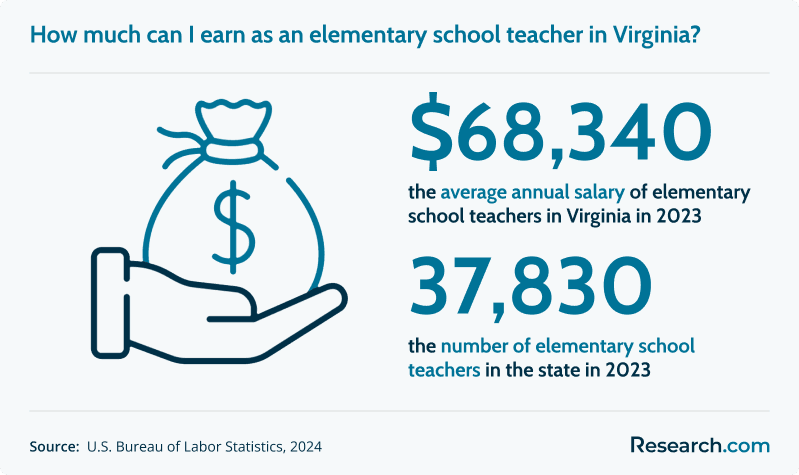
In 2023, Virginia had around 37,830 elementary school teachers, and they earned around $68,340 per year. Those figures show that elementary teaching remains a large workforce category in the state, even though projected growth is limited.
Should you choose a traditional or alternative teacher certification program in Virginia?
Virginia offers more than one route into teaching. The best option depends on whether you are a first-time college student, a career changer, a military veteran, or someone who already has substantial education but lacks teacher licensure.
Traditional teacher preparation
A traditional route usually fits students who are starting college or planning their degree around becoming a teacher from the beginning.
- Degree structure: Candidates typically earn a bachelor’s degree in education or a related field.
- Coursework: Programs include pedagogy, child development, literacy, mathematics instruction, assessment, and subject-specific methods.
- Student teaching: Candidates complete supervised classroom practice before applying for licensure.
- Examples: The University of Virginia and James Madison University are examples of Virginia institutions offering traditional preparation options.
Alternative teacher certification
Alternative routes are often designed for people who already have a bachelor’s degree and want to move into teaching without completing a second full undergraduate degree.
- Flexibility: Some pathways allow candidates to work while completing certification requirements.
- Shorter completion window: Many alternative programs may be completed in one to two years.
- Examples: Virginia recognizes pathways such as the Virginia Teaching Fellows Program and Troops to Teachers, which supports military veterans entering education.
| Pathway | Best for | Main advantage | Main trade-off |
| Traditional program | First-time degree seekers and students committed to teaching early | Integrated degree, preparation, advising, and student teaching | Usually takes longer if you already have a degree |
| Alternative certification | Career changers and degree holders from non-education fields | May offer a faster entry route into teaching | Can feel intensive because coursework, exams, and classroom responsibilities may overlap |
Choose a traditional program if you want a structured college-based pathway with built-in field placements. Consider an alternative route if you already hold a bachelor’s degree, can manage a compressed preparation schedule, and want a more direct transition into the classroom.
How long does it take to become an elementary school teacher in Virginia?
The timeline depends on where you are starting. A high school graduate entering a bachelor’s program should plan for a longer route than a career changer who already has a degree and only needs teacher preparation, testing, and licensure approval.
- Bachelor’s degree: about 4 years. A first-time college student typically spends four years completing general education, education coursework, content methods, and field experiences.
- Teacher preparation program: about 1-2 years. Candidates who complete preparation after a degree may need one to two additional years, depending on program format and student teaching requirements.
- Licensure exams: varies. Preparing for and passing the VCLA and relevant Praxis tests may take several months, especially if retesting is needed.
- Licensure application: about 1-2 months. After completing all requirements, candidates submit documentation to the Virginia Department of Education and wait for review.
For many candidates, the total path takes approximately five to seven years. Career changers may move faster if their prior coursework aligns with licensure requirements. If you are comparing state requirements, Research.com also explains Washington teacher certification.
| Starting point | Likely timeline | What to focus on |
| No bachelor’s degree | Approximately five to seven years | Choose an approved elementary education program early |
| Bachelor’s degree in another field | Often shorter, depending on program requirements | Confirm alternative pathway eligibility and missing coursework |
| Out-of-state or international preparation | Varies | Request credential review and verify Virginia-specific testing rules |
Can online elementary education programs lead to teacher licensure in Virginia?
Yes, online education programs can be accepted for Virginia teacher licensure if they meet the state’s requirements. The key issue is not whether courses are online; it is whether the institution is properly accredited, the program satisfies Virginia licensure expectations, and the program includes required fieldwork or student teaching.
- Check accreditation first: Look for institutional accreditation and, when applicable, educator preparation recognition such as CAEP. Virginia requires credentials from accredited institutions for licensure consideration.
- Verify licensure alignment: Ask whether the program is designed to prepare students for Virginia elementary teacher licensure, not just a general education degree.
- Confirm field placement support: Online students still need classroom-based experiences. Ask how the school arranges or approves local student teaching placements.
- Plan for required tests: Online coursework does not remove the need to pass the VCLA and Praxis assessments required for elementary education.
- Use online learning strategically: Once licensed, teachers may also use approved online coursework to help complete the 180 professional development points needed for five-year renewal.
Before enrolling, get written confirmation from the program that it supports Virginia licensure. This is especially important for out-of-state online programs, because a degree that meets another state’s requirements may not automatically satisfy Virginia’s rules.
Is an online or on-campus elementary education program better in Virginia?
Neither format is automatically better. Online programs work well for students who need flexibility, while on-campus programs may provide more direct access to faculty, peers, and school-based partnerships. The right choice depends on your schedule, learning preferences, finances, and need for placement support.
| Factor | Online program | On-campus program |
| Schedule | Often better for working adults, caregivers, and students far from campus | Better for students who prefer a fixed schedule and in-person structure |
| Classroom interaction | Uses discussion boards, video meetings, and virtual collaboration | Offers face-to-face interaction with faculty and classmates |
| Field experience | May require local placement coordination | May have established partnerships with nearby schools |
| Resources | Relies heavily on digital libraries, learning platforms, and remote support | Provides direct access to campus libraries, workshops, and in-person events |
| Cost considerations | May reduce commuting or housing expenses but can include technology fees | May involve commuting, housing, and campus-based costs |
If you are considering a remote pathway, compare accredited online elementary education degrees and ask each school how it handles Virginia licensure, student teaching, and test preparation.
How much do elementary education programs in Virginia cost?
The cost of becoming an elementary teacher in Virginia depends on the school, delivery format, residency status, financial aid, housing choices, and whether you need additional testing or credential review. Tuition is only one part of the budget.
- Tuition: The net price for attending a four-year institution such as William & Mary is approximately $25,688 per year after financial aid and scholarships.
- Room and board: Students living on campus should expect housing and meals to add around $12,000 to $15,000 annually, depending on the institution and personal choices.
- Books and supplies: Textbooks and education materials may cost approximately $1,000 to $1,500 each year.
- Credentialing expenses: Testing and application-related costs can range from $300 to $500, depending on the assessments and requirements involved.
| Cost category | Amount stated | Decision tip |
| Net price example | Approximately $25,688 per year at William & Mary | Compare net price after aid, not sticker tuition alone |
| Room and board | Around $12,000 to $15,000 annually | Online or commuter options may reduce this expense |
| Books and supplies | Approximately $1,000 to $1,500 each year | Ask whether digital materials are included in course fees |
| Credentialing fees | Can range from $300 to $500 | Budget for tests, applications, and possible retesting |
Students planning long-term advancement may eventually explore graduate options, including fields outside classroom teaching. For example, some professionals compare programs such as an online master's in organizational leadership no GRE when considering leadership, training, or administrative career goals.
How should you choose the best elementary education program in Virginia?
The best program is the one that gets you licensed efficiently, prepares you for real classrooms, fits your budget, and supports the type of school or student population you want to serve. Do not rely only on rankings or brand recognition.
- Confirm accreditation and state approval: Make sure the program is accredited and approved or accepted for Virginia teacher licensure.
- Review the curriculum: Strong programs should cover literacy, mathematics instruction, child development, classroom management, assessment, and inclusive teaching strategies.
- Evaluate field experience: Virginia mandates a minimum of 300 hours of field experience for licensure, so ask how early and how often you will work in classrooms.
- Ask about test preparation: Programs should help students prepare for the VCLA and required Praxis assessments.
- Study placement support: Ask about student teaching placement, district partnerships, career advising, and graduate employment outcomes.
- Compare total cost: Include tuition, fees, books, transportation, housing, testing, and lost work time if you must reduce employment during student teaching.
| Question to ask | Why it matters |
| Is this program approved or accepted for Virginia elementary teacher licensure? | A non-aligned program can delay or block your license application |
| How are student teaching placements arranged? | You need real classroom experience that satisfies state expectations |
| What support is offered for VCLA and Praxis preparation? | Testing delays can lengthen your timeline and increase costs |
| What is the total estimated cost after aid? | The net price is more useful than tuition alone |
| Does the program offer specializations or endorsements? | Specialized skills can improve flexibility in the job market |
The U.S. Bureau of Labor Statistics projected 4% growth in employment for elementary teachers through 2029. In Virginia, however, the projected growth rate for elementary school teachers between 2022 and 2032 is 0.1%, so program choice should be based on licensure quality, cost control, and employability rather than broad assumptions about rapid job expansion.
What other teaching careers can you pursue in Virginia?
Elementary teaching is not the only route into K-12 education. If you enjoy working with older students or want to specialize in a specific subject, you may also consider middle school, high school, special education, private school teaching, school counseling, instructional coaching, or educational leadership. For example, candidates who like mathematics and early adolescence can explore how to become a middle school math teacher in Virginia.
Is special education certification worth considering for Virginia elementary teachers?
Special education certification can be valuable for elementary teachers who want to support students with disabilities, learning differences, developmental delays, or individualized education plans. It can also make a teacher more versatile within a school because inclusive classrooms often require collaboration between general education and special education professionals. If this path interests you, review the steps for how to become a special education teacher in Virginia.
Can an advanced degree improve your elementary teaching career in Virginia?
An advanced degree may help teachers deepen instructional expertise, move into leadership roles, qualify for specialized positions, or transition into related education and student support careers. The best graduate path depends on your goal: a curriculum-focused degree may support instructional leadership, an educational leadership program may support administration, and a student services-oriented program may support broader child and family advocacy. Some educators also examine options outside traditional teacher education, such as the easiest MSW programs to get into, when they are interested in student welfare, family systems, and community-based support.
What specializations are available within elementary education in Virginia?
Specializations help elementary teachers build expertise beyond the general classroom license. They can be useful if you want to work with a specific student population, teach a priority subject area, or prepare for future leadership.
- Special education: Focuses on adapting instruction, accommodations, behavior supports, and collaboration for students with disabilities. It can also lead to related roles such as special education coordinator careers.
- English as a Second Language: Prepares teachers to support multilingual learners and build language development into academic instruction.
- Reading specialist: Emphasizes literacy assessment, reading intervention, and evidence-informed strategies for students who struggle with reading.
- STEM education: Helps teachers strengthen instruction in science, technology, engineering, and mathematics through inquiry-based and problem-solving approaches.
- Early childhood education: Focuses on developmentally appropriate teaching for younger children, especially in the transition from early learning to elementary grades.
- Gifted education: Prepares teachers to challenge advanced learners through enrichment, differentiation, and accelerated learning experiences.
According to the National Center for Education Statistics, approximately 25% of public school teachers in the U.S. work in elementary education. In a field this large, specialization can help teachers stand out while also meeting specific student needs.
Should you consider teaching high school instead?
High school teaching may be a better fit if you prefer deeper subject specialization and working with older students. It may also offer different salary prospects. In 2023, high school teachers earned $72,020 on average, while elementary school teachers earned around $68,340. The chart below compares salary figures.
How can mentorship and professional development support advancement for Virginia elementary teachers?
Mentorship helps new teachers survive the difficult early years by offering practical guidance on lesson planning, classroom routines, parent communication, and school culture. Professional development helps experienced teachers keep their instruction current, maintain licensure, and prepare for roles such as team lead, instructional coach, curriculum specialist, or administrator. Some educators also pursue interdisciplinary development opportunities, including creative programs such as MFA online options, when they want to strengthen writing, arts integration, or curriculum design skills.
How does technology integration affect elementary teaching in Virginia?
Technology can improve elementary instruction when it supports learning goals rather than replacing sound teaching. Digital whiteboards, learning apps, multimedia lessons, adaptive platforms, and progress-monitoring tools can help teachers personalize practice, identify learning gaps, and give students more ways to engage with content. Teachers should also be prepared to manage screen time, protect student privacy, and ensure that technology supports students with different learning needs. Educators interested in related student support services may also compare pathways such as how to be a speech therapist in Virginia.
How does early childhood education experience help elementary teachers in Virginia?
Early childhood experience can make elementary teachers more effective, especially in kindergarten through grade 3. Teachers with this background often understand developmental readiness, play-based learning, early literacy, family engagement, and social-emotional growth. Those skills help students adjust from preschool or home-based care into formal elementary classrooms. If you are interested in the earlier end of the education pipeline, review how to become a preschool teacher in Virginia.
How do public and private elementary teaching jobs compare in Virginia?
Public and private elementary schools can both offer meaningful teaching careers, but they often differ in licensure expectations, curriculum control, class culture, pay structures, benefits, and accountability requirements. Public schools generally follow state standards and licensure rules more directly, while private schools may set their own hiring criteria and instructional priorities. If you are considering independent or faith-based schools, see how to become a private school teacher in Virginia.
How can affordable certification options reduce barriers to teaching in Virginia?
Cost matters because teacher preparation can include tuition, fees, exams, transportation, unpaid or reduced-paid student teaching time, and licensure expenses. Affordable certification options can help candidates enter the profession with less debt and more flexibility. The key is to avoid choosing a low-cost option that does not meet Virginia licensure rules. Compare approved pathways, financial aid, employer support, and program completion rates before enrolling. For more cost-focused guidance, review the cheapest way to get a teaching credential in Virginia.
Can additional subject expertise help Virginia teachers advance?
Additional subject expertise can make teachers more flexible, especially in districts that need educators who can support multiple grade levels, enrichment programs, remediation, or departmentalized instruction. For example, a teacher who builds stronger mathematics preparation may later consider advanced or secondary-level roles. If that direction interests you, examine high school math teacher qualifications in Virginia.
Why do updated certification standards matter for career growth in Virginia?
Teacher certification standards can affect hiring, renewal, endorsements, and advancement. Staying current helps teachers avoid license problems and identify opportunities to add credentials in areas such as special education, reading, ESL, or leadership. Current and aspiring educators should periodically review teaching certificate requirements in Virginia so they do not rely on outdated information.
What legal protections and professional supports are available to Virginia teachers?
Virginia teachers may have access to district policies, grievance procedures, professional associations, legal resources, and advocacy organizations that support workplace rights and professional conditions. The specific protections and supports available can vary by district, role, and employment setting. New teachers should learn their contract terms, evaluation process, leave policies, reporting obligations, and available representation options early. If you are still planning your pathway, Research.com also explains how long does it take to become a teacher in Virginia.
What career paths are available for elementary school teachers in Virginia?
Elementary teaching can lead to several career directions. Some teachers remain in the classroom for decades, while others move into specialization, student support, coaching, curriculum, or administration.
- Elementary classroom teacher: Plans lessons, teaches multiple subjects, manages classroom routines, assesses student progress, and communicates with families.
- Special education teacher: Works with students who need individualized supports, accommodations, and specialized instruction.
- School counselor: Supports students’ academic, emotional, and social development; this role typically requires graduate preparation and specific licensure.
- Curriculum developer: Designs instructional materials, assessments, pacing guides, and learning resources for schools or districts.
- Educational administrator: Moves into leadership roles such as assistant principal or principal, usually after classroom experience and advanced study.
- Instructional coach: Helps teachers improve instruction through observation, feedback, modeling, and professional learning.
- Mental health professional: Supports student well-being in roles such as school psychologist or social worker, which require specialized graduate preparation.
Because projected growth for K-12 teachers in general falls below Virginia’s overall state average of 4.5%, it is smart to understand related roles and advancement options. The projected job growth for all of them is below 1%. The chart below provides additional comparison details.
What is the job market like for elementary school teachers in Virginia?
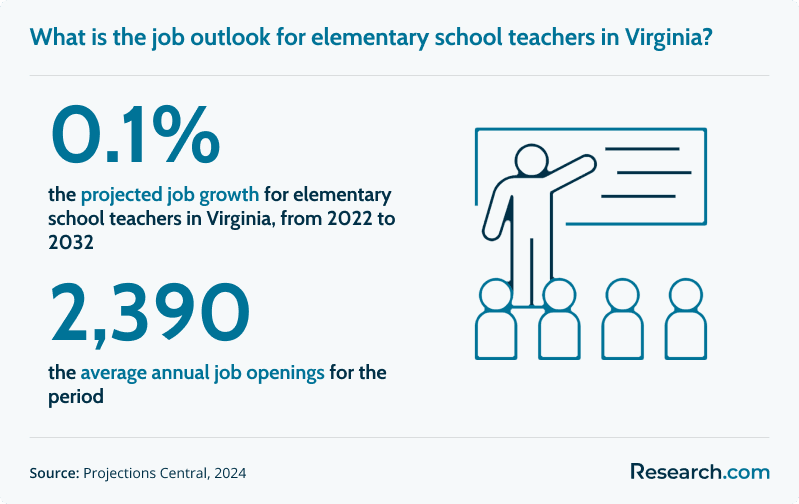
The Virginia elementary teacher labor market is steady but slow-growing. From 2022 to 2032, elementary school teacher employment is projected to grow by about 0.1%. That does not mean there are no jobs; it means most openings are expected to come from replacement needs rather than major expansion.
- Annual openings: Around 2,390 openings for elementary school teachers are expected each year from 2022 to 2032.
- Teacher workforce size: Nearly 38,000 elementary school teachers are already employed across Virginia.
- Average pay: Elementary school teachers in Virginia earn an average annual salary of $68,340.
- National salary context: The median annual salary for elementary school teachers nationally was about $63,680 as of May 2023.
- Higher-paying areas: Arlington, Fairfax County, and Virginia Beach are noted as areas where compensation packages or salary structures may be more attractive.
Candidates can improve their prospects by completing licensure requirements on time, gaining strong student teaching references, considering shortage or underserved areas, and adding endorsements in high-need specialties. If you want to compare broader options, explore other teaching careers.
What challenges should Virginia elementary teachers expect?
Elementary teaching can be meaningful, but it is also demanding. Understanding the challenges before entering the profession helps candidates make a realistic decision and prepare better support systems.
| Challenge | What it looks like | How to prepare |
| Heavy workload | Lesson planning, grading, family communication, documentation, meetings, and testing preparation can extend beyond school hours | Use planning templates, collaborate with grade-level teams, and set boundaries early |
| Diverse student needs | Students may vary widely in language background, disability status, academic readiness, behavior, and family circumstances | Build skills in differentiation, inclusive instruction, and family engagement |
| Resource gaps | Some rural or underserved schools may have limited classroom supplies, technology, or support staff | Ask districts about classroom budgets, intervention support, and instructional materials before accepting a role |
| Cost-of-living pressure | Pay may feel different depending on local housing and living costs | Compare salary with benefits, commute, housing, and district pay scales |
| Emotional strain | Teachers often support children facing bullying, food insecurity, family instability, or trauma | Use school counseling resources, peer support, and self-care routines |
| Administrative demands | Documentation, evaluations, compliance tasks, and state testing requirements can reduce instructional planning time | Learn district systems quickly and seek mentor support |
Common mistakes to avoid
- Choosing a program without confirming Virginia licensure alignment: An education degree is not enough if it does not meet state requirements.
- Looking only at tuition: Include housing, books, exams, transportation, student teaching expenses, and fees.
- Assuming online programs are automatically accepted: Accreditation, fieldwork, and state approval still matter.
- Waiting too long to prepare for exams: Failed or delayed tests can postpone licensure.
- Ignoring district differences: Salary, mentorship, class size, resources, and workload can vary by region and school system.
- Relying only on rankings: A highly ranked school may not be the most affordable or practical option for your licensure timeline.
If you are still mapping your first steps, start with a full overview of how to become a teacher in Virginia.
Can art integration improve elementary education in Virginia?
Art integration can strengthen elementary learning when it is tied to academic goals. Drawing, music, movement, storytelling, and visual design can help young students express ideas, build vocabulary, practice observation, and connect concepts across subjects. Teachers who enjoy creativity may also consider arts-focused endorsements or career options. To explore that route, review how to become an art teacher in Virginia.
Related Articles for Nearby States
- 2027 How to Become an Elementary School Teacher in West Virginia: Requirements & Certification
- 2027 How to Become an Elementary School Teacher in Maryland: Requirements & Certification
- 2027 How to Become an Elementary School Teacher in North Carolina: Requirements & Certification
- 2027 How to Become an Elementary School Teacher in Tennessee: Requirements & Certification
- 2027 How to Become an Elementary School Teacher in Kentucky: Requirements & Certification
- 2027 How to Become an Elementary School Teacher in Pennsylvania: Requirements & Certification
- 2027 How to Become an Elementary School Teacher in South Carolina: Requirements & Certification
- 2027 How to Become an Elementary School Teacher in Ohio: Requirements & Certification
- 2027 How to Become an Elementary School Teacher in Delaware: Requirements & Certification
- 2027 How to Become an Elementary School Teacher in New Jersey: Requirements & Certification
References:
- doe.virginia.gov (n.d.). Job Opportunities in Virginia Education. doe.virginia.gov
- bluefield.edu (06 Jul 2021). 6 steps to becoming a teacher in Virginia. bluefield.edu
- niche.com (22 Aug 2020). 2024 Best colleges with elementary education degrees in Virginia. niche.com
- bls.gov (17 Apr 2024). Kindergarten and elementary school teachers. bls.gov
Key Insights
- Virginia elementary teachers generally need a bachelor’s degree, an approved teacher preparation program, student teaching, required exams, a background check, and state licensure.
- The job market is stable but slow-growing: projected employment growth is 0.1% from 2022 to 2032, with around 2,390 openings expected each year.
- Average annual pay for Virginia elementary school teachers is $68,340, but salary value depends heavily on district, benefits, and local cost of living.
- Online programs can work for Virginia licensure, but only if they are accredited, include approved field experience, and satisfy Virginia requirements.
- Traditional programs fit first-time college students; alternative certification may be better for career changers who already hold a bachelor’s degree.
- Program choice should be based on licensure alignment, field placement quality, total cost, test preparation, and career support—not rankings alone.
- Specializations such as special education, ESL, reading, STEM, early childhood, and gifted education can improve flexibility and help teachers serve specific student needs.
- The smartest next step is to verify requirements directly with the Virginia Department of Education and ask each program for written confirmation that it prepares students for Virginia elementary teacher licensure.
Other Things You Should Know About Becoming an Elementary School Teacher in Virginia
Virginia elementary teacher candidates must pass the Virginia Communication and Literacy Assessment and the Elementary Education: Multiple Subjects Praxis exam. The Virginia Board of Education uses these tests to verify reading, writing, math, science, and social studies readiness before full licensure is issued.
In 2027, Virginia offers alternative certification programs like Teach For America and Virginia's Career Switcher Program for aspiring teachers who hold a bachelor's degree in another field. These programs provide a quicker route to certification by combining classroom experience with coursework.
To qualify as an elementary school teacher in Virginia in 2027, candidates must hold at least a bachelor's degree from an accredited institution, complete a state-approved teacher preparation program, and pass the necessary state licensure exams, such as the Praxis series.


