
2027 How to Become a Teacher in Washington – What Degree Do You Need to Be a Teacher in Washington?

Co-Founder and Chief Data Scientist
Becoming a teacher in Washington means making several connected decisions: which grade level or subject to teach, which preparation route to use, how to meet state certification rules, and whether the expected salary works in the region where you want to live. The process is manageable, but it is not something to approach casually. Washington has persistent needs in areas such as STEM, special education, English language learning, bilingual education, and world languages, while some regions also face affordability pressures that can affect where new teachers choose to work.
This guide explains how to become a certified teacher in Washington, what exams and certificates you may need, how student teaching works, what subjects are in demand, and how salaries compare with living costs. It also covers online and alternative routes, substitute teaching, private school expectations, certification renewal, rural versus urban teaching, and practical steps for choosing a cost-effective preparation path.
Quick answer: How do you become a teacher in Washington?
To become a public school teacher in Washington, most candidates need a bachelor’s degree, completion of a Washington State-approved teacher preparation program, student teaching or clinical practice, required basic skills and endorsement assessments, a background check, and at least one teaching endorsement. After meeting these requirements, candidates apply for a Washington teaching certificate. Career changers may be able to use alternative route programs, while substitute, private school, and out-of-state candidates may follow different procedures.
What are the key things you should know about being a teacher in Washington?
- The BLS forecasts that kindergarten and elementary school teachers are expected to see minimal employment growth, around 1% by 2033, translating to roughly 14,300 new jobs.
- High school teachers are also projected to experience little to no employment change over the same period, resulting in approximately 11,100 new jobs over the decade.
- Even with modest national growth projections, shortages continue across many Washington subject areas, including STEM, ELL, and world languages.
- In the 2024-25 school year, Washington state had 1,079,617 students and 70,612 teachers.
- The cost of living in WA for a single person is $2,573 per month, with $917 for expenses excluding rent, $1,656 for rent and utilities, and $655 for food.
- Reported salary ranges vary by source, district, experience, and credential level. On average, elementary school teachers earn around $57,667 to $70,202 per year, high school teachers earn around $52,381 to $65,220 per year, and general teachers earn around $60,101 to $87,449 per year.
- What are the basic requirements to become a teacher in Washington State?
- What is student teaching and why is it important for aspiring teachers in Washington?
- What are the WEST-B, NES, and WEST-E exams for WA teachers?
- What types of teaching certificates are available in Washington?
- What is the easiest education degree for aspiring teachers in Washington State?
- What are the professional development requirements for teachers in Washington?
- How does the cost of living affect teacher salaries in Washington?
- What subjects are in high demand for teachers in Washington?
- How do teacher mentorship and induction programs support early career success in Washington?
- What is the average teacher salary in Washington?
- How do education policies and legislative changes affect my teaching career in Washington?
- Can transitioning to a school librarian role enhance my career in Washington?
- How is digital innovation transforming classroom instruction in Washington?
- What are the private school teacher requirements in Washington?
- Can online teacher training programs effectively prepare me for success in Washington?
- What are the renewal and maintenance requirements for teaching certifications in Washington?
- What are the requirements for substitute teaching in Washington?
- What are the benefits and challenges of teaching in rural versus urban areas in Washington?
- How do teacher certification upgrades impact career growth in Washington?
- What steps should I take to start my teaching career in Washington?
- Should I pursue an advanced degree to further my teaching career in Washington?
- What is the most cost-effective way to pursue a teaching degree in Washington?
Here’s What Graduates Have to Say About Their Teacher Careers in WA
Completing my teaching degree online through WGU changed what felt possible for me. I could keep working while moving through my courses, and the mentor support helped me stay on track. By the end of the program, I felt ready to step into an elementary classroom and support students with confidence. -Carrie
I was a busy parent and unsure whether returning to school would fit my life, but Grand Canyon University's online elementary education program gave me the flexibility I needed. I could work through lessons at a manageable pace and use what I was learning right away in the classroom. The teaching experience was the most meaningful part of the program. -Charlotte
Changing careers into teaching was a major decision, but the University of Washington's secondary teacher education program helped me make the transition. The intensive one-year format gave me practical tools, confidence, and a clear path into high school math teaching. I now get to help students see what they can do with mathematics. -Sam
What are the basic requirements to become a teacher in Washington State?
Most public school teaching candidates in Washington follow a certification pathway that combines academic preparation, supervised classroom experience, exams, and state review. The exact requirements can vary by endorsement area, prior credentials, and whether you are entering through a traditional or alternative route.
| Requirement | What it means for aspiring Washington teachers | Decision point |
| Bachelor’s degree | You generally need a bachelor’s degree from a regionally accredited college or university. | If you do not have a degree yet, choose a program that also includes teacher preparation when possible. |
| Approved teacher preparation program | You must complete a Washington State-approved teacher preparation program that includes education coursework and supervised teaching practice. | Confirm approval before enrolling, especially if the program is online or based outside Washington. |
| Endorsement | An endorsement identifies what you are authorized to teach, such as elementary education, math, special education, English Language Learners, or another subject area. | Choose endorsements based on your strengths, hiring demand, and the grade levels you want to teach. |
| Assessments | Candidates may need the WEST-B and the applicable NES or WEST-E content exams for their endorsement area. | Ask your preparation program when to take each test and whether alternatives or exemptions apply to your situation. |
| Background check | You must complete a background check because teachers work directly with children and youth. | Start early so fingerprinting or clearance delays do not slow your certification timeline. |
| Certificate application | After completing degree, program, testing, endorsement, and clearance requirements, you apply for the appropriate Washington teaching certificate. | Work with your program’s certification officer or advisor before submitting documents. |
Common sequence for first-time teachers:
- Earn a bachelor’s degree, ideally through a program that includes approved teacher preparation.
- Complete required education coursework and clinical practice.
- Pass the WEST-B and any required NES or WEST-E endorsement tests.
- Complete the background check process.
- Apply for your Washington teaching certificate.
Alternative route note: Career changers and candidates who already hold a bachelor’s degree may be able to pursue an alternative certification program. These routes can be faster for some candidates, but they still require state approval, supervised preparation, and evidence that you are ready to teach.
What is student teaching and why is it important for aspiring teachers in Washington?
Student teaching, often called clinical practice, is the supervised classroom experience that allows teacher candidates to apply what they have learned in coursework. Instead of only studying lesson planning, assessment, classroom management, and child development, candidates practice those skills with real students under the guidance of an experienced mentor teacher.
Student teaching matters because it is one of the clearest tests of whether teaching is the right career fit. It also helps districts and preparation programs evaluate whether a candidate can plan instruction, communicate with students, respond to classroom behavior, adapt to learning needs, and reflect on feedback.
- It connects theory to classroom reality: Coursework becomes more meaningful when you are planning lessons, responding to student questions, and adjusting instruction in real time.
- It builds practical teaching skills: Candidates practice lesson design, classroom routines, assessment, differentiation, and communication with families and school staff.
- It provides professional mentoring: Mentor teachers help candidates understand school culture, instructional expectations, and the daily rhythm of teaching.
- It creates evidence of readiness: Successful clinical practice gives programs and districts stronger proof that a candidate can manage real teaching responsibilities.
- It reflects Washington’s emphasis on quality preparation: The state expects teacher preparation to include meaningful field-based experience, not only academic coursework.
What are the WEST-B, NES, and WEST-E exams for WA teachers?
Washington uses basic skills and endorsement assessments to verify that teacher candidates have the academic and subject-area knowledge needed for certification. The exams you need depend on your preparation route and the endorsement or endorsements you are seeking.
| Exam | Purpose | Who typically needs it | What it measures |
| WEST-B | Basic skills assessment | Candidates across subject areas, depending on program and state requirements | Reading comprehension, written communication, and basic mathematical applications |
| NES | Content knowledge assessment | Candidates seeking endorsements connected to NES subject tests | Subject-specific knowledge for areas such as Biology, Chemistry, Early Childhood Education, English Language Arts, Mathematics, and Social Studies |
| WEST-E | Washington endorsement assessment | Candidates whose endorsement areas require a WEST-E exam | Subject knowledge aligned with Washington curriculum standards, including areas such as Mathematics, Science, English Language Arts, Social Studies, World Languages, and Career and Technical Education |
WEST-B: The Washington Educator Skills Test – Basic focuses on foundational academic skills. It is designed to show that candidates have the literacy and numeracy skills needed for educator preparation and classroom instruction.
NES tests: The National Evaluation Series, offered by Pearson, measures content knowledge in many K-12 teaching fields. Candidates interested in younger learners may compare state-approved programs with options such as affordable online early childhood education colleges, but they should always verify whether the program meets Washington certification requirements.
WEST-E tests: WEST-E exams are endorsement-focused assessments tied to Washington standards. The test you take depends on the subject or specialty you want to teach.
Planning tip: Do not register for exams based only on general advice. Ask your preparation program which exam is required for your specific endorsement and when you should take it. Taking the wrong test can waste time and money.
What types of teaching certificates are available in Washington?
Washington has different certificates for teachers, substitutes, educational staff associates, administrators, out-of-state educators, and alternative route candidates. The right certificate depends on your role and career stage.
| Certificate or credential type | Best for | Key points to understand |
| Resident Teacher Certificate | New teachers entering Washington public schools | This is the initial certificate for candidates who complete a state-approved teacher preparation program, student teaching, at least one endorsement, testing, and other requirements. It allows new teachers to begin teaching while building experience. |
| Continuing Teacher Certificate | Teachers maintaining a standard long-term credential | This certificate supports ongoing public school teaching and requires professional development for renewal. |
| Continuing ESA Certificate | Educational Staff Associate roles | Used for roles such as school counselors, librarians, and speech-language pathologists. Candidates interested in counseling-related education may compare affordable online CACREP school counseling programs. |
| Administrator Certification | Future principals, assistant principals, and other school leaders | Designed for educators moving into leadership positions and usually requires additional preparation beyond classroom teaching. |
| Emergency Substitute Certificate | Short-term substitute teaching needs | A temporary option that may allow qualified individuals to fill substitute roles when districts have staffing needs. |
| Out-of-State Certificate Pathway | Educators already certified elsewhere | Washington has a process for teachers with valid out-of-state credentials to seek Washington certification. |
| Alternative Route Certificates | Career changers and nontraditional candidates | Routes 1-4 are designed for candidates entering teaching through approved alternative preparation options. |
For many first-time teachers, the central pathway is the move from an initial certificate into a longer-term credential through successful teaching experience and ongoing professional learning. Candidates who want the lowest-cost entry point should compare state-approved preparation options carefully; a list of affordable online education degree programs can be a useful starting point, but state approval and endorsement alignment matter more than price alone.
Important distinction: A degree and a teaching certificate are not the same. A bachelor’s degree shows academic completion; a teaching certificate shows that the state has authorized you to teach in a specific capacity.
What is the easiest education degree for aspiring teachers in Washington State?
There is no single “easiest” education degree for every aspiring Washington teacher. The better question is: Which degree matches your strengths, target students, and certification goal while still meeting state requirements?
Elementary education often feels more structured because programs are built around child development, literacy, math methods, classroom management, and broad K-6 teaching skills. Special education can also appeal to candidates who want a clear professional purpose and strong demand, but it requires patience, documentation skills, collaboration, and the ability to adapt instruction for diverse learner needs. Secondary subject degrees, such as math, science, English, or world languages, may be more demanding in content depth but can be a better fit if you already have strong subject expertise.
| Degree path | May be a good fit if you... | Potential challenge |
| Elementary education | Want to teach multiple subjects to younger students and prefer a broad, structured preparation program | You must be comfortable teaching literacy, math, science, social studies, and classroom routines across the school day. |
| Special education | Want to support students with disabilities and work closely with families, specialists, and general education teachers | The work can involve complex documentation, individualized plans, and high emotional demands. |
| Secondary education with a subject endorsement | Have strong interest or prior coursework in a specific subject such as math, English, science, or social studies | You may need deeper subject preparation and a content-specific exam. |
| Career and Technical Education | Bring industry experience in fields such as construction, healthcare, culinary arts, or technical trades | Requirements may differ from traditional academic routes, so program advising is essential. |
| Alternative certification | Already hold a bachelor’s degree and want a more direct transition into teaching | It can be intensive and may offer less flexibility than expected once fieldwork begins. |
If affordability is a major concern, compare program approval status, transfer policies, field placement support, and total cost. A low-tuition option such as an affordable online education degree may help, but only if it leads to the endorsement and certificate you actually need.
What are the professional development requirements for teachers in Washington?
Washington teachers must continue professional learning to maintain certification. Renewal rules are meant to keep educators current with instructional practice, student needs, subject-area knowledge, and state expectations.
- Renewal period: Teaching certificates are valid for five years.
- Clock hours: Teachers must complete 100 clock hours or equivalent college credits of professional development activities during the five-year renewal period.
Professional development activities may include:
- Approved courses, workshops, and conferences: These may focus on instructional methods, assessment, classroom management, student support, or subject-area learning.
- Professional Learning Plans: A Professional Learning Plan can help connect professional growth goals with Washington Professional Educator Standards Board expectations.
- Mentoring: Serving as a mentor or receiving mentoring can support growth and may qualify for clock hours.
- National Board Certification: Earning a valid National Boards certificate can satisfy renewal requirements and demonstrate advanced teaching practice.
Additional requirements:
- All teachers renewing certificates must complete at least 15 clock hours focused on equity-based school practices aligned with the Cultural Competency for Diverse Learners standards.
- A valid National Boards certificate may satisfy this requirement.
- STEM educators also have a separate 15-hour requirement focused on STEM integration in their classrooms.
Teachers who want to move into instructional leadership, curriculum design, or administrative work may also consider graduate study. Comparing affordable online master’s programs for teachers can help educators continue working while building additional qualifications.
How does the cost of living affect teacher salaries in Washington?
Teacher pay in Washington must be evaluated alongside housing, commuting, childcare, loan payments, and regional living costs. A salary that works in one district may feel tight in another, especially in high-cost urban areas.
- Cost-of-living adjustments: Washington law, including RCW 28A.400.206, addresses salary increases tied to inflation and compensation conditions.
- Regional salary differences: Districts in higher-cost areas may offer higher pay than some rural districts, but housing and transportation costs can absorb much of the difference.
- Collective bargaining: Cost of living can influence negotiations between teacher unions and districts.
- Housing pressure: In expensive areas, new teachers may face long commutes, shared housing, or the need to compare multiple districts before accepting an offer.
- Recruitment and retention: When salaries do not keep pace with local costs, districts may struggle to attract and keep teachers, particularly in shortage fields.
The cost of living in WA for a single person is $2,573 per month, with $917 for expenses excluding rent, $1,656 for rent and utilities, and $655 for food, as shown in the following figure.
Budgeting questions to ask before accepting a teaching job in Washington:
- What is the actual monthly take-home pay after taxes, retirement contributions, health insurance, and union dues?
- How much will rent, utilities, and transportation cost in the district or nearby communities?
- Does the district offer salary credit for prior experience, graduate credits, or additional endorsements?
- Are there stipends for hard-to-staff schools, bilingual education, special education, coaching, mentoring, or extracurricular duties?
- Will the commute affect your time, fuel costs, and long-term job satisfaction?
What subjects are in high demand for teachers in Washington?
Washington hiring needs vary by district, but shortages are often strongest in specialized or hard-to-staff areas. If you are choosing an endorsement, balancing personal interest with labor market demand can improve your options.
- Bilingual Education and English Language Learners (ELL)
- Career and Technical Education (CTE), including growing need in construction, healthcare, and culinary arts
- Early Childhood Education
- Elementary Education, especially when paired with early childhood education preparation; candidates may compare affordable online elementary education master’s programs for graduate-level advancement
- English Language Learners (ELL) / Bilingual Education
- Health and Physical Fitness; educators in this area may consider affordable exercise science degree programs for career development
- Math, including algebra, calculus, and trigonometry
- Science, including physics, chemistry, and biology
- Secondary Math and English
- Special Education
- World Languages, including Spanish, French, and Mandarin
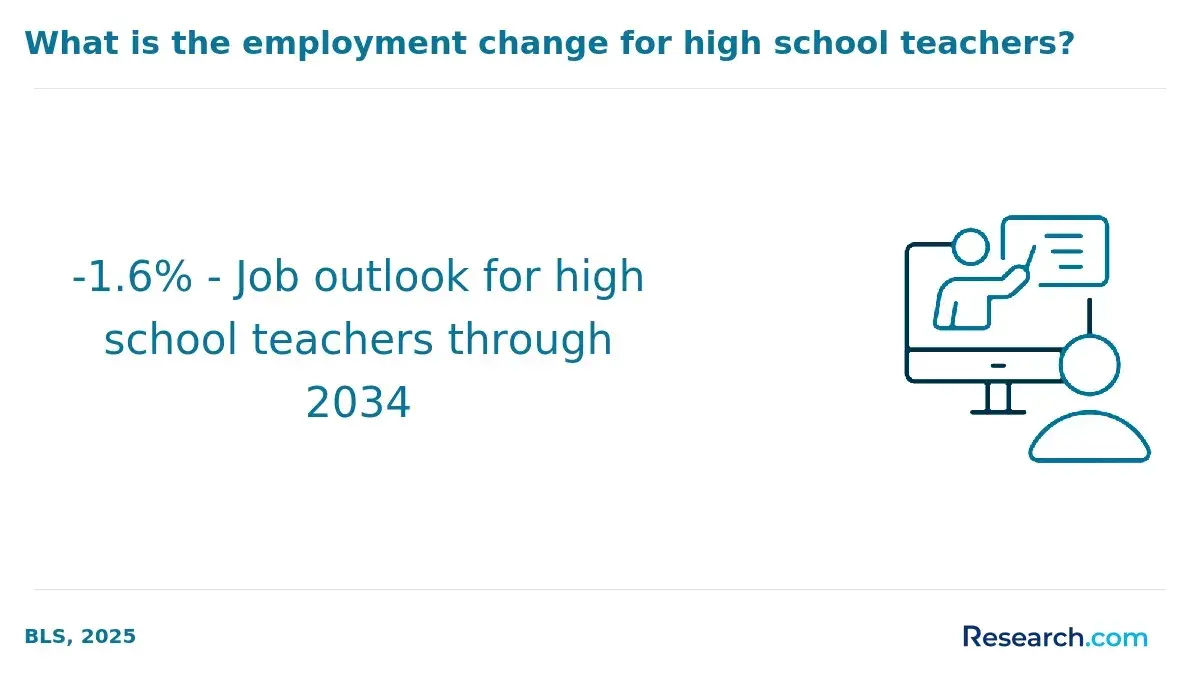
The job market for elementary and high school teachers is expected to remain fairly stable between 2024 and 2034. While the Bureau of Labor Statistics anticipates a slight overall decline of 2%, there will still be openings because teachers retire, transfer, or leave the profession. The BLS estimates roughly 103,800 new elementary school teacher jobs and 66,200 new high school teacher jobs each year, on average, over this decade, as shown in the following figure.
How do teacher mentorship and induction programs support early career success in Washington?
Mentorship and induction programs help new Washington teachers move from preparation into full classroom responsibility. A strong induction experience can reduce isolation, improve classroom management, and help early-career teachers learn district expectations faster.
These programs commonly pair a new educator with an experienced teacher who can provide feedback on lesson planning, student engagement, family communication, grading practices, and classroom routines. They are especially valuable for teachers entering shortage areas or challenging placements where support can affect retention.
If you are considering a subject-specific pathway, review resources such as how to become an English teacher in Washington to understand endorsement-specific expectations and career planning steps.
What is the average teacher salary in Washington?
Teacher salary estimates in Washington differ by source, date, job title, location, experience level, and certification status. Use salary data as a planning range rather than a guaranteed outcome.
| Source | Reported role | Reported salary or wage |
| Payscale | Elementary School Teacher | $53,481 in 2026 |
| Payscale | High School Teacher | $58,177 in 2026 |
| Indeed.com | Teacher | $25.81 per hour |
| Indeed.com | School Teacher | $20.91 per hour |
| BLS.gov | Elementary School Teachers | Median annual wage $58,775 in March 2026 |
| BLS.gov | High School Teachers | Median annual wage $64,700 in 2024 |
| DataUSA.io | Teachers | $60,101 |
| Salary.com | Public School Teacher | $62,606 as of April 24, 2024 |
| Salary.com | Teacher | $63,634 as of April 24, 2024 |
| Salary.com | Elementary School Teacher | $70,202 as of April 24, 2024 |
Based on the figures listed above, elementary school teachers earn around $57,667 to $70,202 per year, high school teachers earn around $52,381 to $65,220 per year, and general teachers earn around $60,101 to $87,449 per year. Actual pay can vary substantially by district, years of service, education level, endorsement area, additional duties, and negotiated salary schedules.
Special education candidates should look for programs with field-based experiences, coursework focused on diverse learner needs, and preparation for specialized assessments. For a more focused pathway, see special education teacher certification in Washington.
How do education policies and legislative changes affect my teaching career in Washington?
Education policy can affect your teaching career through certification rules, salary schedules, evaluation requirements, professional development expectations, school funding, class size priorities, and staffing decisions. For new teachers, policy changes may influence which endorsements are most valuable, how districts hire, and what professional learning is required for renewal.
Teachers who want long-term advancement should monitor district communications, state education agency updates, union guidance, and legislative changes connected to school funding and certification. Graduate education can also strengthen options in curriculum, leadership, and specialized instruction. If you are considering graduate study, reviewing what you can do with a master’s in elementary education can help you connect further education with practical career outcomes.
Can transitioning to a school librarian role enhance my career in Washington?
A school librarian role can be a strong next step for teachers who enjoy literacy, research skills, digital resources, instructional collaboration, and student access to information. School librarians often support curriculum, teach information literacy, help students evaluate sources, and guide the use of print and digital learning materials.
This path usually requires specialized preparation aligned with state and district expectations. Teachers considering the shift should compare the cost and time required for library-related credentials with the salary, role availability, and daily responsibilities in their target districts. For role-specific guidance, review how to become a school librarian in Washington.
How is digital innovation transforming classroom instruction in Washington?
Digital tools now affect lesson planning, assessment, communication, intervention, and classroom accessibility. Washington teachers may use learning management systems, adaptive platforms, virtual collaboration tools, educational apps, and data dashboards to support instruction. The goal is not to replace teaching judgment but to help teachers personalize learning, monitor progress, and communicate more efficiently.
Technology also creates new responsibilities. Teachers must understand student privacy, accessibility, digital citizenship, age-appropriate tools, and district policies. Early childhood educators should be especially careful about screen use, supervision, and alignment with developmental needs. Candidates focused on early grades can review kindergarten teacher requirements in Washington for grade-specific preparation context.
What are the private school teacher requirements in Washington?
Private school teaching requirements in Washington can differ from public school certification rules. Some private schools prefer or require state-certified teachers, while others may place more weight on subject expertise, faith-based mission fit, prior teaching experience, recommendations, or specialized professional background.
Because expectations vary by school, candidates should not assume that one private school’s requirements apply to all. Before applying, review the school’s accreditation status, curriculum model, background check process, salary structure, benefits, class size, and professional development expectations. For more detailed guidance, see private school teacher requirements in Washington.
Can online teacher training programs effectively prepare me for success in Washington?
Online teacher training can be effective when the program is properly approved, includes strong advising, provides supervised field placements, prepares candidates for Washington certification requirements, and offers meaningful feedback from faculty and mentor teachers. Flexibility is the main advantage, especially for working adults and career changers.
However, online does not mean fully remote in every respect. Teacher preparation still requires classroom-based experiences, student teaching, and coordination with schools. Before enrolling, confirm that the online program supports Washington certification, arranges or approves local field placements, prepares you for the correct exams, and leads to the endorsement you want. For a deeper look at this route, review how to become a teacher online in Washington.
What are the renewal and maintenance requirements for teaching certifications in Washington?
Maintaining a Washington teaching certificate requires attention to renewal deadlines, professional development documentation, equity-based learning requirements, and any endorsement-specific obligations. Missing renewal requirements can interrupt employment eligibility, so teachers should track clock hours throughout the five-year cycle rather than waiting until the end.
Keep copies of transcripts, clock hour forms, district professional development records, National Board documentation if applicable, and certificate renewal notices. For a broader overview of credential types and maintenance rules, use the guide to teacher certification requirements in Washington.
What are the requirements for substitute teaching in Washington?
Substitute teaching can be a practical way to gain classroom experience, learn district cultures, and decide whether full-time teaching is the right fit. Washington substitute requirements may include appropriate authorization, background clearance, district onboarding, and the ability to follow lesson plans while managing different classroom environments.
Substitute teachers need flexibility, reliability, classroom presence, and quick communication skills. Districts may also have their own procedures for scheduling, training, and assignment acceptance. For certification and eligibility details, see Washington substitute teacher requirements.
What are the benefits and challenges of teaching in rural versus urban areas in Washington?
Washington teaching jobs can look very different depending on whether you work in a rural community, suburban district, or urban school system. The best setting depends on your lifestyle preferences, budget, teaching style, professional goals, and desired student population.
| Factor | Rural teaching | Urban teaching |
| Community connection | Teachers may become highly visible members of close-knit communities and often build strong long-term relationships with families. | Teachers may work with larger, more diverse communities and a wider range of community partners. |
| Class size and roles | Some rural schools have smaller classes, but teachers may cover multiple subjects, clubs, or responsibilities. | Urban schools may offer more specialized roles, though class sizes and student needs can vary widely. |
| Resources | Some schools face limited access to technology, specialists, or advanced coursework options. | Urban districts may have more programs and services, though resources can still be uneven across schools. |
| Professional development | Opportunities may require travel or online participation. | Larger districts often provide more frequent training, coaching, and specialization options. |
| Salary and cost of living | Housing may be more affordable, but availability can be limited in some communities. | Salary schedules may be higher, but housing, commuting, and daily expenses can be much more expensive. |
| Career fit | Best for teachers who value community impact, flexibility, and broad responsibilities. | Best for teachers who want access to diverse programs, larger professional networks, and specialized roles. |
Before choosing a district, compare salary schedules, housing options, commute time, mentoring support, student services, and long-term advancement opportunities.
How do teacher certification upgrades impact career growth in Washington?
Upgrading your teaching credential can support career stability, professional recognition, salary movement, and access to leadership responsibilities. Moving from an initial credential to a longer-term certificate generally signals that you have met experience and professional development expectations.
Additional endorsements can also expand your employment options. For example, endorsements in special education, bilingual education, STEM-related subjects, or English language learning may make you more competitive in districts with staffing needs. Understanding the types of teaching certificates in Washington can help you plan a credential strategy instead of treating certification as a one-time task.
National Board Certification is another voluntary credential that may support professional growth and can be connected to incentives. Before investing time and money, compare the requirements, available district support, possible salary impact, and your long-term goals.
What steps should I take to start my teaching career in Washington?
A clear plan can prevent delays, unnecessary debt, and wrong-program enrollment. Use the following sequence to move from interest to certification.
- Choose your teaching goal: Decide whether you want elementary, secondary, special education, ELL, bilingual education, CTE, early childhood, or another endorsement area.
- Check Washington requirements: Confirm the certificate, endorsement, exams, and preparation route that match your goal.
- Select an approved program: Verify state approval, accreditation, field placement support, online or campus format, and total cost.
- Plan for exams: Ask the program which WEST-B, NES, or WEST-E exams apply and when to take them.
- Prepare for student teaching: Budget for reduced work hours, transportation, background checks, and classroom placement requirements.
- Build practical experience: Consider tutoring, paraeducator work, summer programs, coaching, or substitute teaching where appropriate.
- Apply strategically: Compare salary schedules, mentoring programs, endorsement needs, commuting costs, and school culture before accepting a position.
If elementary teaching is your target, start with a focused pathway such as how to become an elementary school teacher in Washington.
Should I pursue an advanced degree to further my teaching career in Washington?
An advanced degree can be worthwhile if it connects to a specific career goal: higher-level instructional expertise, curriculum leadership, administration, special education, literacy, English language learning, counseling, research, or policy work. It may also affect salary placement in some districts, but outcomes depend on district salary schedules and negotiated agreements.
Graduate school is not automatically the right next step for every teacher. Consider your debt level, expected salary change, time demands, endorsement value, and whether the program leads to a credential or role you actually want. Educators interested in research, higher education, district leadership, or advanced scholarship may compare options such as the cheapest PhD in education, but should weigh cost carefully against career plans.
What is the most cost-effective way to pursue a teaching degree in Washington?
The most cost-effective path is the one that leads to the correct Washington certification with the least unnecessary coursework, debt, and delay. Low tuition helps, but it is not enough if the program does not meet state requirements or fails to support field placement.
Affordable pathways to a teaching degree
- Online programs: Online study can reduce commuting and relocation costs. A bachelor of education online degree may offer flexibility, but candidates must verify certification alignment and student teaching requirements.
- Community college partnerships: Completing general education or transfer coursework at a community college can lower the cost before moving into a four-year teacher preparation program.
- In-state tuition: Washington residents may reduce costs by choosing public institutions where they qualify for in-state rates.
- Transfer credit planning: Confirm which credits transfer before enrolling. Lost credits can make a “cheap” path more expensive.
- Endorsement planning: Choose endorsements early so you do not need extra semesters later.
- Financial aid and district support: Ask about grants, scholarships, loan forgiveness options, paid residency models, paraeducator pathways, and district-sponsored programs.
Common mistakes to avoid when becoming a teacher in Washington
| Mistake | Why it can hurt you | Better approach |
| Choosing a program without verifying Washington approval | You may graduate without meeting certification requirements. | Confirm approval and endorsement alignment before enrolling. |
| Looking only at tuition | Fees, lost transfer credits, travel, testing, and unpaid student teaching can raise total cost. | Compare total program cost and time to completion. |
| Assuming online means no in-person requirements | Teacher preparation still requires clinical practice and classroom placements. | Ask how fieldwork and student teaching are arranged. |
| Choosing an endorsement only because it seems easy | You may enter a field that does not match your strengths or local hiring needs. | Balance interest, ability, demand, and long-term career fit. |
| Ignoring salary schedules and cost of living | A job offer may not support your budget in a high-cost region. | Compare take-home pay, housing, commute, and benefits. |
| Waiting until the last semester to plan exams | Testing delays can postpone certification and hiring. | Create an exam timeline with your advisor early. |
Questions to ask before enrolling in a Washington teacher preparation program
- Is this program approved for Washington teacher certification?
- Which endorsements can I earn through this program?
- What exams will I need, and when should I take them?
- How are student teaching placements arranged?
- Can I complete fieldwork near where I live?
- How many credits will transfer into the program?
- What is the total cost, including fees, testing, travel, books, and student teaching expenses?
- What percentage of candidates receive mentoring or job placement support?
- Does the program support alternative route, paraeducator, or career-changer candidates?
- Will the program meet requirements if I later want to teach in another state?
Related Articles for Nearby States
- 2027 How to Become a Teacher in Oregon – What Degree Do You Need to Be a Teacher?
- 2027 How to Become a Teacher in Idaho – What Degree Do You Need to Be a Teacher?
- 2027 How to Become a Teacher in Montana – What Degree Do You Need to Be a Teacher?
- 2027 How to Become a Teacher in California – What Degree Do You Need to Be a Teacher?
- 2027 How to Become a Teacher in Nevada – What Degree Do You Need to Be a Teacher?
- 2027 How to Become a Teacher in Utah – What Degree Do You Need to Be a Teacher
- 2027 How to Become a Teacher in Wyoming – What Degree Do You Need to Be a Teacher
- 2027 How to Become a Teacher in Arizona – What Degree Do You Need to Be a Teacher?
- 2027 How to Become a Teacher in Colorado – What Degree Do You Need to Be a Teacher?
- 2027 How to Become a Teacher in New Mexico – What Degree Do You Need to Be a Teacher?
Key Insights
- Most Washington public school teachers need a bachelor’s degree, an approved teacher preparation program, student teaching, required exams, a background check, and at least one endorsement.
- Endorsement choice matters. STEM, special education, bilingual education, ELL, world languages, early childhood, and CTE can offer stronger opportunities in many districts.
- Do not judge teaching jobs by salary alone. Washington’s regional cost differences, especially housing, can significantly affect your real budget.
- Online teacher preparation can work well, but only if it is approved for Washington certification and includes valid field placement and student teaching support.
- Student teaching is not just a requirement; it is the main bridge between coursework and real classroom readiness.
- Certification renewal requires planning. Teachers must complete 100 clock hours or equivalent college credits during the five-year renewal period, along with required equity-based learning and applicable STEM integration requirements.
- The cheapest route is not always the best route. The most cost-effective path is the one that gets you properly certified without lost credits, unnecessary coursework, or delayed eligibility.
References:
- Bureau of Labor Statistics. (2025). Occupational Employment and Wage Statistics: Elementary School Teachers, Except Special Education. Bureau of Labor Statistics.
- Bureau of Labor Statistics. (2025). Occupational Employment and Wage Statistics: Secondary School Teachers, Except Special and Career/Technical Education. Bureau of Labor Statistics.
- Bureau of Labor Statistics. (2024a, May 9). High school teachers. Bureau of Labor Statistics.
- Bureau of Labor Statistics. (2024b, May 10). Kindergarten and elementary school teachers. Bureau of Labor Statistics.
- Bureau of Labor Statistics. (2024). Elementary and Secondary Education Teachers. Bureau of Labor Statistics.
- Bureau of Labor Statistics. (2024). Employment Projections. Bureau of Labor Statistics.
- Bureau of Labor Statistics. (2024). Postsecondary Teachers. Bureau of Labor Statistics.
- Indeed. (2024). Average Teacher Salary in Washington State. Indeed.
- Indeed. (2024). Average School Teacher Salary in Washington State. Indeed.
- Livingcost.org. (2024, March 4). Cost of Living in Washington, US: 54 cities compared [2024]. Livingcost.org.
- Payscale. (2024). Average High School Teacher Salary in Washington, Washington. Payscale.
- Salary.com. (2024). Public School Teacher Salary in Washington. Salary.com.
- Salary.com. (2024). Teacher Salary in Washington. Salary.com.
- Salary.com. (2024). Elementary School Teacher Salary in Washington. Salary.com.
Other Things You Should Know About How to Become a Teacher in Washington
To renew a Washington teaching license in 2027, teachers must complete 100 continuing education clock hours or equivalent credits over five years. Renewal is processed through the Washington Office of Superintendent of Public Instruction (OSPI), with specific deadlines for submission.
In Washington, teachers need to complete 100 clock hours or equivalent education credits every five years to maintain their certification. This ensures they stay updated with teaching techniques and subject knowledge. The Professional Educator Standards Board sets these requirements.
Washington teacher candidates must pass the Washington Educator Skills Test-Basic (WEST-B) and a subject-area assessment such as the NES or Praxis test for the endorsement they want. The Washington Office of Superintendent of Public Instruction sets these testing rules for certification.


