2027 How to Become an Art Teacher in Delaware: Requirements & Certification

Co-Founder and Chief Data Scientist
Becoming an art teacher in Delaware means planning for three connected decisions: choosing the right teacher preparation program, meeting state certification rules, and building the classroom skills schools expect from visual arts educators. This guide is for future teachers, career changers, education majors, and current educators who want to understand Delaware’s art teaching pathway without sorting through scattered licensing pages and program descriptions. You will learn the education requirements, certification process, curriculum standards, salary context, professional development expectations, classroom strategies, career options, and common mistakes to avoid before investing time and money in this career path.
Quick Answer: How do you become an art teacher in Delaware?
To become an art teacher in Delaware, you generally need a bachelor’s degree, completion of an accredited teacher preparation program, passing scores on required Praxis II art assessments, and Delaware educator licensure. Delaware State University offers the only Bachelor of Art Education program in the state that combines studio arts preparation with education coursework for K-12 teaching. New teachers receive an initial license valid for three years and must complete induction requirements before moving toward a Continuing License.
Key Things You Should Know About Becoming an Art Teacher in Delaware
- Pay should be weighed against location. The average salary for art teachers in Delaware is approximately $60,000 per year. Teachers in areas such as Wilmington may face higher housing costs, so the practical value of that salary depends on district pay scales, benefits, commuting costs, and cost of living.
- The outlook is positive but not unlimited. The Bureau of Labor Statistics projects a 4% growth in employment for art teachers over the next decade. That suggests steady opportunity, but openings still depend on school budgets, retirements, district priorities, and whether schools expand or reduce arts programming.
- Technology is changing art instruction. Delaware schools are increasingly using digital tools in art education, which means candidates who understand digital art, multimedia, design software, and technology-supported assessment may be more competitive than applicants with only traditional studio preparation.
- Steps to become an art teacher in Delaware
- Education requirements for Delaware art teachers
- Certification and licensing process
- Delaware art standards and curriculum expectations
- Job market and salary expectations
- Professional development and continuing education
- Classroom management and teaching methods
- How to prepare for an art teaching career
- Mental health and well-being for art teachers
- Career advancement and specialization options
- Funding and grant opportunities
- Online education options for art teachers
- Additional subject certifications
- Dual certification and special education
- Integrating music education
- Resources for new Delaware art teachers
- Collaboration with early childhood educators
- Interdisciplinary research and collaboration
- Local community partnerships
- Challenges and trends in Delaware art education
- Using art history to strengthen instruction
How can you become an art teacher in Delaware?
The most reliable path to teaching art in Delaware is to complete a state-recognized teacher preparation route, pass the required exams, apply for licensure, and build evidence that you can teach both artistic technique and creative thinking. The process is manageable when broken into practical steps.
| Step | What you need to do | Why it matters |
| 1. Earn the right degree | Complete a bachelor’s degree and art education coursework through an approved preparation pathway. | Delaware certification requires academic preparation in both teaching and subject matter. |
| 2. Complete supervised teaching | Gain classroom experience through student teaching or a recognized teacher preparation program. | Schools want evidence that you can manage an art room, plan lessons, assess student work, and meet diverse learning needs. |
| 3. Pass required exams | Take the Praxis II assessments required for art education certification. | Passing scores demonstrate minimum subject-area and pedagogy readiness for licensure. |
| 4. Apply for Delaware licensure | Submit the required application materials to the Delaware licensing system after meeting education and testing requirements. | Licensure is required for public school teaching roles in Delaware. |
| 5. Complete induction | Participate in the state-required induction period while teaching under an initial license. | The initial license is valid for three years and supports the transition from preparation to professional practice. |
| 6. Build a hiring portfolio | Create a portfolio with artwork, lesson samples, student-teaching artifacts, assessment examples, and your teaching philosophy. | Art teacher hiring often depends on both instructional evidence and artistic credibility. |
- Start with the education pathway. Delaware State University offers the only Bachelor of Art Education degree in the state that combines studio arts preparation with teaching coursework for K-12 art instruction. Candidates outside that route should confirm that their program meets Delaware teacher preparation expectations before enrolling.
- Prepare early for the Praxis II exams. These exams assess art content knowledge and teaching-related competencies. Build study time into your final year rather than treating testing as an afterthought.
- Understand the licensing timeline. After meeting degree and exam requirements, candidates apply for Delaware certification. The initial license is valid for three years and includes an induction process. To move toward a Continuing License, teachers must meet renewal expectations, including satisfactory performance evaluations and required documentation.
- Develop a professional art and teaching portfolio. Include varied media, examples of creative problem-solving, lesson plans aligned with standards, and evidence that you can teach students at different skill levels.
- Use a focused job search strategy. Apply to public, charter, and private school openings, but also network through state arts education events, local museums, school art exhibitions, and programs such as the Regional Scholastic Art Awards.
The main decision is not only whether you can meet Delaware’s requirements, but whether your preparation gives you enough classroom practice, digital art experience, and standards-based assessment skill to compete for openings.
What are the educational requirements for becoming an art teacher in Delaware?
Delaware art teachers need formal preparation in both art and education. A strong program should help you become a capable artist, a clear instructor, and a classroom manager who can teach students with different abilities, backgrounds, and learning needs.
- Bachelor’s degree: A bachelor’s degree is the baseline academic requirement for initial certification. A master’s degree or PhD may strengthen long-term advancement options, but advanced study is not required for first-time licensure.
- Art education coursework: Candidates should expect coursework in studio practice, art history, visual culture, curriculum design, assessment, child development, and methods for teaching art. The best preparation connects artistic process with practical teaching decisions.
- Approved teacher preparation: Completion of an accredited teacher preparation program is important because Delaware expects candidates to demonstrate classroom readiness, not just subject knowledge. Before enrolling, ask whether the program is recognized for Delaware licensure and whether it includes supervised K-12 teaching experience.
- Subject matter competency: Candidates must show they understand artistic concepts, techniques, history, and instruction. Praxis II testing is part of that process, but candidates should also gather portfolio evidence that shows how they plan, teach, critique, and assess art.
- Program choice: Delaware State University offers a Bachelor of Art Education degree, the only program of its kind in the state. Career changers and returning students should compare in-state options with alternative preparation routes and review resources such as teaching degree programs for older students.
Questions to ask before choosing an art education program
| Question | Why it matters |
| Does the program meet Delaware teacher certification requirements? | A degree that does not align with state expectations may delay licensure. |
| How much supervised teaching is included? | Art classrooms require practice with materials, safety routines, critique, cleanup systems, and differentiated instruction. |
| Does the program include digital art or multimedia instruction? | Technology-supported art teaching is becoming more common in K-12 classrooms. |
| Will I graduate with a teaching portfolio? | Hiring teams often want proof of lesson design, standards alignment, student engagement, and artistic skill. |
| What support is available for Praxis preparation? | Testing delays can slow certification and job applications. |
The global art market also gives useful context for students considering the broader creative economy. From 2019 to 2023, market values shifted noticeably because of economic conditions and collecting trends. After a pandemic-related decline in 2020, the market recovered in 2021 and 2022, reaching $67.8 billion in 2022. In 2023, it declined slightly to $65 billion, while still remaining above the $64.4 billion level recorded in 2019. High inflation and geopolitical instability contributed to weaker high-value sales, as shown in the graph below.
What is the certification and licensing process for an art teacher in Delaware?
Delaware’s certification process is designed to confirm that art teachers are prepared to teach safely, ethically, and effectively in K-12 classrooms. Requirements can vary by applicant background, so candidates should verify current rules through the Delaware Department of Education before applying.
| Licensing stage | Typical requirement | Practical advice |
| Teacher preparation | Complete a bachelor’s degree and approved educator preparation pathway. | Keep official transcripts, student-teaching records, and program completion documents organized before graduation. |
| Testing | Pass required Praxis II exams for art education certification. | Schedule exams early enough to allow for score reporting and potential retesting. |
| Initial License | Apply after meeting degree, preparation, and exam requirements. | The initial license is valid for three years, so use this period to complete induction and gather performance evidence. |
| Induction | Participate in required support and mentoring activities as a new teacher. | Treat induction as a career-building period, not just a compliance step. |
| Continuing License | Submit renewal materials and demonstrate satisfactory performance. | Track professional development hours, evaluations, and district documentation from the start. |
Candidates who completed preparation outside Delaware should also ask about reciprocity, transcript review, and whether additional testing or coursework is required. Do not assume that a license from another state automatically meets Delaware’s full requirements.
What are the standards and curriculum requirements for teaching art in Delaware?
Delaware requires public school districts and charter schools to provide visual and performing arts instruction from kindergarten through 12th grade. For art teachers, this means lessons must do more than teach technique; they should help students create, interpret, connect, and respond to art in ways that align with state standards.
- Delaware Arts Standards: The Delaware Arts Standards were established in 2016 and align with the National Core Arts Standards. They emphasize four artistic processes: Creating, Performing, Responding, and Connecting.
- Local relevance: Delaware’s arts standards allow teachers to connect lessons to regional culture, history, local artists, community institutions, and contemporary creative practices.
- Lesson planning resources: Teachers can use professional development workshops, webinars, district curriculum teams, and partnerships with local arts organizations to interpret and apply the standards.
- Standards-based instruction: Strong art lessons should identify the artistic process being taught, the skills students will practice, the vocabulary they will use, and how learning will be assessed.
- Comprehensive curriculum: Delaware’s art curriculum encourages students to work with both traditional and contemporary art forms while developing cultural awareness, critique skills, and creative confidence.
- Assessment expectations: Teachers commonly use formative feedback during the creative process and summative assessment at the end of projects. Rubrics, artist statements, critiques, sketchbooks, and completed works can all provide evidence of learning.
- Interdisciplinary learning: Art can connect naturally with history, science, technology, language arts, and social studies. These connections should support the art objective rather than turning art class into an add-on activity for another subject.
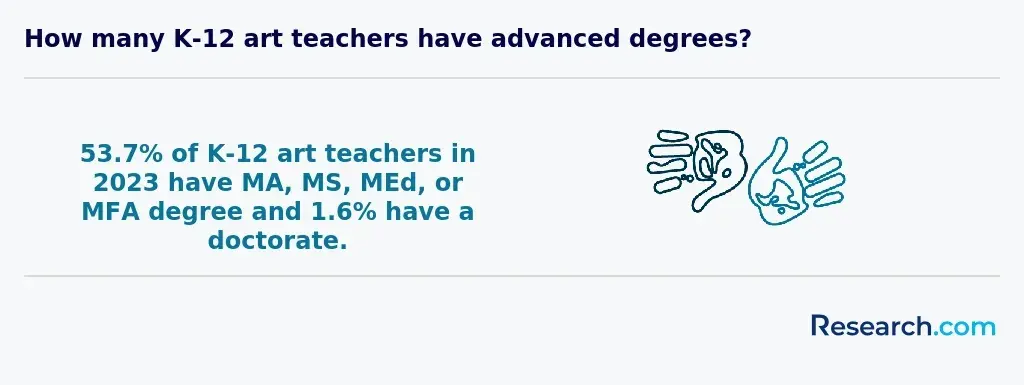
Advanced education is common across K-12 teaching. Among K-12 teachers, 53.7% have masters level degrees, including MA, MS, MEd or MFA credentials, and 1.6 % have a doctorate, as shown in the graphic below.
Teachers planning long-term academic growth may also compare graduate options, including distance education benefits for educators, especially if they want leadership, research, or curriculum roles.
What is the job market like and what are the salary expectations for art teachers in Delaware?
The Delaware art teacher job market is best described as stable but competitive. Openings may be limited in some districts because each school typically needs fewer art teachers than core subject teachers. However, candidates with strong portfolios, classroom experience, digital media skills, and flexibility across grade levels may improve their chances.
- Average salary: The average salary for art teachers in Delaware is around $60,000 per year, although district, years of experience, education level, and contract terms can change actual pay.
- Location differences: Art teachers in urban areas such as Wilmington may earn upwards of $65,000, while teachers in more rural areas may be closer to $55,000. Cost of living, especially housing, should be part of any salary comparison.
- Competition: Public, charter, and private schools may all hire art teachers, but competition can be stronger in districts with well-funded arts programs or highly visible student exhibitions.
- Benefits: Delaware teaching roles often include benefits such as health insurance, retirement plans, and paid time off. These benefits can meaningfully affect total compensation beyond base salary.
Art teacher job market factors to compare
| Factor | Why it affects your decision |
| District arts funding | Schools with stronger arts budgets may offer better supplies, facilities, exhibition opportunities, and program support. |
| Grade level | Elementary, middle, and high school art roles require different classroom management, curriculum, and assessment approaches. |
| Urban versus rural location | Salary, commute, housing costs, student needs, and community partnerships can vary widely. |
| Digital media expectations | Programs that include design, multimedia, or digital art may prefer candidates with technology skills. |
| Advanced education | A master’s degree may influence salary placement or competitiveness in some districts, but candidates should compare cost against likely benefit. |
The larger arts and design labor market includes occupations with different pay levels. Special Effects Artists and Animators have a median salary of over $100,000, followed by Fashion Designers. Industrial and Interior Designers earn around $80,000 annually. Set and Exhibit Designers and Graphic Designers report median salaries in the $60,000 range. These figures, shown in the graph below, help illustrate how specialized creative roles can differ from K-12 teaching compensation.
-
: "
One Delaware teacher described the decision this way: after graduating from the University of Delaware, she was excited to teach art but had to compare a starting salary with the cost of living in Wilmington. The benefits helped, and the support of the local arts community made the career feel sustainable, but the financial trade-off was real.
"
What professional development and continuing education opportunities are available for art teachers in Delaware?
Professional learning is not optional for Delaware teachers. It helps educators maintain licensure, adapt to new standards, improve classroom practice, and stay current with technology, assessment, and inclusive teaching strategies.
- Delaware professional learning system: The Delaware Department of Education offers a Professional Development Management System, often called PDMS, where educators can find and register for approved learning opportunities.
- Continuing education requirement: Delaware educators must complete 90 hours of professional development every five years. At least half of those hours must connect directly to work with students or staff.
- Workshops and seminars: Organizations such as the Delaware Institute for Arts in Education and local education partners may offer sessions on arts integration, lesson design, digital tools, critique methods, and curriculum development.
- Delaware Division of the Arts: The Delaware Division of the Arts supports arts education through resources, research, professional learning, and partnerships that strengthen arts instruction across the state.
- Micro-credentials: Short, targeted credentials can help teachers document specific skills, such as digital media instruction, inclusive arts practice, or standards-based assessment.
- Advocacy and leadership: Teachers who collaborate with district and state leaders may gain access to committees, curriculum projects, and advocacy work that expands their professional influence.
- Professional organizations: Groups such as the Arts Education Partnership provide research and policy guidance that can help teachers understand national arts education trends and apply them locally.
Teachers who want broader leadership preparation may also examine graduate programs outside art education, including an accredited online master's in organizational leadership, if their goals include program coordination, nonprofit arts administration, or school leadership support.
What are effective classroom management strategies and teaching methods for art teachers in Delaware?
Art classrooms are active, materials-heavy spaces. Students move, collaborate, experiment, make mistakes, and use tools that require clear routines. Effective management in an art room should protect safety and time while still giving students room to create.
- Use an authoritative management style: A balanced approach that combines clear expectations with warmth and support tends to work better than overly strict or overly permissive classroom control.
- Differentiate instruction: Students enter art class with different levels of confidence, motor skills, language ability, and prior exposure to art. Offer varied entry points, examples, tools, and extension options.
- Teach routines explicitly: Demonstrate how to collect supplies, clean brushes, store wet work, use digital tools, participate in critique, and transition between studio time and reflection.
- Build reflection into the process: Ask students to explain choices, revise work, critique respectfully, and connect their artmaking to a concept or problem.
- Create a respectful studio culture: Peer feedback, group projects, and critique circles work best when students know how to discuss art without attacking the artist.
- Use project-based learning carefully: Projects should teach specific skills and concepts, not merely keep students busy. Strong projects include a prompt, constraints, examples, checkpoints, and assessment criteria.
- Integrate technology with purpose: Digital drawing, photography, design software, and online portfolios can expand expression, but technology should serve the learning goal rather than replace hands-on artmaking.
- Assess throughout the project: Formative assessment helps teachers intervene before students reach a final product. Conferences, sketchbook checks, drafts, and critique notes can all support better outcomes.
Common classroom mistakes and better alternatives
| Mistake | Better approach |
| Assuming creativity means no structure | Use clear routines, time limits, studio expectations, and critique norms. |
| Grading only the final artwork | Assess process, planning, revision, reflection, and use of artistic concepts. |
| Using one project for every student without adaptation | Offer choices in media, complexity, theme, or presentation format. |
| Introducing too many materials at once | Teach tool use and cleanup procedures before expanding options. |
| Letting technology drive the lesson | Start with the artistic objective, then choose the tool that supports it. |
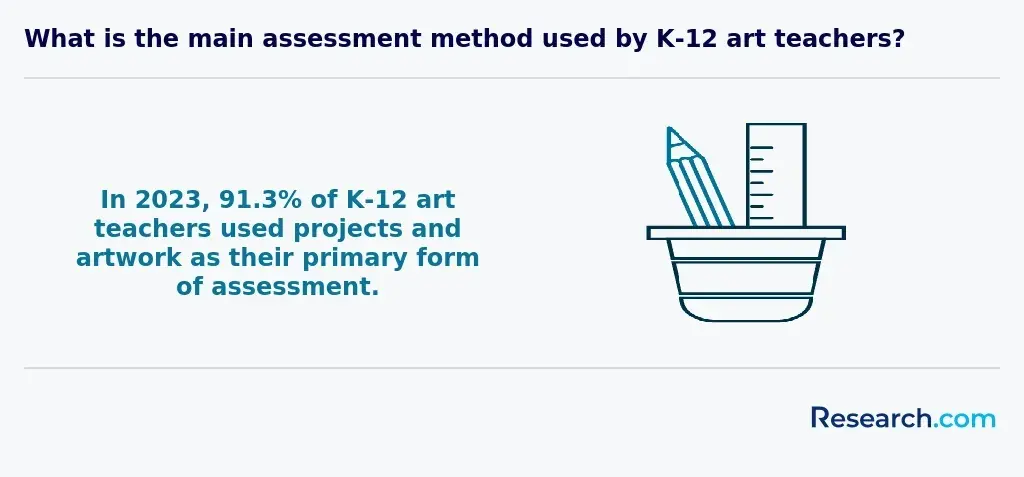
Projects and completed artwork remain central to art assessment. In 2023, 91.3% of K-12 art teachers used projects and artwork as the primary source of assessment, as shown in the graphic below.
How can I prepare for a career as an art teacher in Delaware?
Preparation should begin before you submit your first job application. Review Delaware’s certification rules, choose coursework that supports licensure, observe art classrooms at different grade levels, and build a portfolio that shows both your artistic range and your teaching judgment. If you are still comparing teaching pathways, Research.com’s guide on how to become a teacher in Delaware can help you understand the broader statewide process before focusing on art-specific requirements.
Practical preparation checklist
- Confirm that your degree or preparation route aligns with Delaware licensure expectations.
- Keep transcripts, testing records, field experience documentation, and portfolio materials organized.
- Observe elementary, middle, and high school art classrooms to understand age-level differences.
- Practice writing lesson plans aligned with Delaware Arts Standards.
- Develop comfort with at least one digital art or multimedia platform.
- Create a sample classroom management plan for studio routines, materials, cleanup, and critique.
- Network with Delaware art teachers, museum educators, and local arts organizations.
What strategies support the mental health and well-being of art teachers in Delaware?
Art teachers often manage high creative expectations, large numbers of students, limited prep time, material budgets, and emotionally expressive work. Protecting well-being is part of staying effective in the classroom.
- Set boundaries around preparation and grading: Studio projects can produce large amounts of student work. Use efficient rubrics and checkpoint assessments so grading does not become unmanageable.
- Build repeatable systems: Routines for supplies, cleanup, displays, portfolios, and parent communication reduce daily stress.
- Use peer support: Connect with other art educators for lesson sharing, troubleshooting, and emotional support.
- Seek help early: Counseling, employee assistance programs, wellness workshops, and mentoring can help prevent burnout before it disrupts teaching.
- Compare teaching roles honestly: If you are evaluating different subject areas, the guide on how to become an english teacher in Delaware can provide another view of certification and career expectations.
What are the career advancement opportunities and specializations for art teachers in Delaware?
Art teaching can lead to several growth paths beyond a first classroom role. Advancement may involve specialization, leadership, curriculum work, advocacy, or movement into related education careers.
- Specialized instruction: Teachers may focus on digital media, ceramics, photography, art history, portfolio preparation, gifted art students, or adaptive art instruction.
- Department leadership: Experienced teachers may become art department chairs, mentor teachers, curriculum leads, or district arts coordinators.
- Additional credentials: National Board Certification in Art or endorsements in areas such as gifted and talented education may strengthen professional standing.
- Curriculum and policy work: Art teachers can serve on committees, contribute to standards implementation, and advocate for equitable arts access across schools.
- Related education careers: Teachers interested in broader options can compare alternative education careers, especially if they want roles in curriculum design, museum education, nonprofit arts programming, or school administration.
Advancement is not automatic. Administrative and leadership roles can be competitive, and specialized art positions may exist only in certain districts. Teachers who want to grow should document results, mentor others, participate in professional learning, and build relationships beyond their own school.
What funding and grant opportunities are available for art teachers in Delaware?
Many art teachers rely on more than standard classroom budgets to fund materials, visiting artists, exhibitions, field trips, and special projects. Delaware educators should monitor school district announcements, state arts agency opportunities, local arts councils, cultural institutions, and private foundation programs that support arts education.
- Look for grants tied to arts integration, community engagement, student exhibitions, and underserved populations.
- Partner with museums, libraries, local artists, and nonprofits to strengthen proposals.
- Ask whether your district has rules for outside funding, donations, purchasing, and grant reporting.
- Track project outcomes with photos, student reflections, attendance data, and portfolio evidence when allowed by school policy.
- Explore related education fields, such as how to become a librarian in Delaware, if your interests include curation, research resources, archives, or school-based information programs.
Can online education options boost your art teaching credentials in Delaware?
Online education can help current and future art teachers complete prerequisite coursework, add education credits, or pursue a degree while working. However, online study must be chosen carefully. A flexible program is useful only if it aligns with certification requirements, includes appropriate field experience when needed, and is accepted by Delaware licensing authorities.
Students comparing online routes can review best online bachelors in education program options, but they should ask each school whether the program leads to Delaware teacher certification or whether additional in-state steps are required.
Online versus campus-based preparation
| Option | Best for | Watch out for |
| Campus-based art education degree | Students who want studio access, in-person critiques, and local school placements. | Less schedule flexibility and possible relocation or commuting costs. |
| Online education coursework | Working adults, career changers, or teachers adding credentials. | May not include required in-person student teaching or Delaware-specific certification alignment. |
| Hybrid program | Students who need flexibility but still want studio or field-based experiences. | Residency, practicum, or campus visit requirements may affect cost and scheduling. |
Can additional subject certifications expand career opportunities for Delaware art teachers?
Additional certifications can make an art teacher more flexible, especially in smaller schools or districts where staffing needs change. A second subject area may also support interdisciplinary teaching, club sponsorships, summer programs, or curriculum leadership. Still, extra credentials require time, testing, and possibly coursework, so they should match a realistic career goal.
Teachers considering another academic subject can compare requirements through resources such as how to be a middle school math teacher in Delaware. The right second certification depends on your strengths, district needs, and willingness to teach outside the art room if necessary.
Can dual certification, including special education, broaden your teaching opportunities in Delaware?
Dual certification can be valuable for art educators who want to work effectively with students who need accommodations, adaptive tools, behavioral support, or individualized instruction. Special education knowledge can also improve everyday art teaching because inclusive classrooms are common across Delaware schools.
Pursuing special education teacher certification in Delaware may expand opportunities in inclusive classrooms, specialized programs, and schools seeking teachers who can support a wider range of learners. Before committing, compare the coursework, testing, practicum requirements, and long-term role expectations.
Can art teachers broaden their creative impact by integrating music education?
Art and music share natural connections through rhythm, pattern, emotion, culture, performance, and historical context. Art teachers who collaborate with music educators can create richer arts experiences, such as album-cover design, stage visuals, sound-inspired painting, performance installations, or cultural studies projects.
Educators who want formal preparation in another arts discipline can explore how to become a music teacher in Delaware. Integration can be powerful, but teaching music as a certified subject requires meeting that field’s own requirements.
What resources and support are available for new art teachers in Delaware?
New art teachers should build a support network before their first school year begins. The right contacts can help with lesson planning, materials, classroom routines, exhibitions, certification questions, and professional growth.
- Delaware Department of Education: The state education agency provides professional learning information, educator resources, and guidance related to teacher requirements.
- Delaware Art Museum and cultural institutions: Museums and local arts organizations can support lesson development through exhibitions, educator programs, artist talks, and workshops.
- Delaware Art Teachers Association: DATA can help new teachers connect with experienced art educators, share classroom strategies, and locate professional learning opportunities.
- Online educator platforms: Sites such as Teachers Pay Teachers and Pinterest may offer lesson ideas, but teachers should adapt materials to Delaware standards and their students’ needs rather than using them unchanged.
- University partnerships: Institutions such as the University of Delaware may offer continuing education, guest lectures, school partnerships, or arts-related professional learning.
- Social media and forums: Art education groups can provide quick advice and resource sharing, but teachers should verify information against district and state requirements.
- Arts advocacy groups: Organizations such as the Delaware Arts Alliance can help teachers follow funding opportunities, policy updates, and statewide arts education advocacy.
How can collaboration with early childhood educators enhance art teaching effectiveness in Delaware?
Working with early childhood educators can help art teachers understand how young children develop motor skills, visual language, imagination, social confidence, and creative risk-taking. This is especially useful for elementary art teachers who introduce students to materials, routines, and self-expression for the first time.
Art teachers can strengthen early-grade lessons by studying age-appropriate practice, sensory exploration, storytelling, and play-based creativity. For related guidance, see Research.com’s guide on how to become a kindergarten teacher in Delaware.
Should art teachers invest in interdisciplinary research and collaboration?
Interdisciplinary collaboration can make art instruction more relevant and rigorous when it is designed with a clear purpose. Art teachers may work with librarians, historians, science teachers, technology instructors, archivists, or museum professionals to build projects around visual research, design thinking, cultural interpretation, or digital curation.
For example, educators interested in organizing visual resources, archives, and student research collections may learn from professionals who pursue a library science degree online. The strongest collaborations preserve art learning goals while helping students connect creative work to broader knowledge systems.
How can local community partnerships enhance art teaching in Delaware?
Community partnerships can expand what an art classroom can offer. Museums, galleries, local artists, cultural centers, libraries, nonprofits, and community festivals can provide exhibition spaces, guest speakers, mentorship, project themes, and real-world audiences for student work.
- Invite local artists for demonstrations or critique sessions.
- Connect projects to Delaware history, neighborhoods, ecology, or public art.
- Partner with museums or cultural centers for field experiences.
- Use community exhibitions to give students an authentic audience.
- Explore other school settings, including how to become a private school teacher in Delaware, if you are comparing public, charter, and private teaching environments.
What are the challenges and emerging trends in art education for Delaware teachers?
Delaware art teachers face several practical challenges: unequal access to supplies, budget pressure, limited instructional time, shifting district priorities, and the need to justify arts education in schools focused heavily on tested subjects. These issues can affect everything from class size to whether students have access to quality materials and advanced coursework.
At the same time, several trends are reshaping art education. Digital art tools, multimedia production, online portfolios, and interactive platforms are becoming more common. Some teachers are experimenting with virtual reality and augmented reality for immersive projects, while others are building STEAM lessons that connect art with science, technology, engineering, and math. These approaches can strengthen problem-solving and creative thinking when they remain grounded in meaningful art instruction.
Aspiring teachers who are still studying Delaware’s teacher preparation system can also review the broader pathway in how to become an elementary school teacher in Delaware. Understanding general teacher certification makes it easier to identify which requirements are art-specific and which apply to all educators.
How can integrating art history enrich art teaching practices in Delaware?
Art history helps students understand that artworks come from specific cultures, conflicts, technologies, beliefs, materials, and social movements. When teachers connect historical context with hands-on practice, students can see art as both personal expression and cultural evidence.
Delaware art teachers can use museum collections, local history, artist biographies, visual analysis, and cross-curricular projects to make art history more active. Educators who want deeper preparation in historical instruction may compare requirements for how to become a history teacher in Delaware.
Common mistakes to avoid when becoming an art teacher in Delaware
| Mistake | Why it can hurt you | What to do instead |
| Choosing a program without checking Delaware certification alignment | You may graduate needing extra coursework, testing, or field experience. | Ask the program and Delaware licensing authorities how the degree supports certification. |
| Focusing only on tuition | Lower tuition may not offset weak placement support, limited studio access, or poor Praxis preparation. | Compare total cost, field placements, certification outcomes, and portfolio support. |
| Assuming online programs automatically qualify | Some online programs may not meet Delaware student-teaching or licensure expectations. | Verify state authorization, accreditation, and practicum requirements before enrolling. |
| Waiting too long to build a portfolio | A rushed portfolio may not show your teaching strengths or artistic range. | Collect lesson plans, artwork, assessments, and field experience examples throughout your program. |
| Ignoring classroom management | Strong art skills do not automatically translate into safe, productive studio teaching. | Practice routines for materials, cleanup, critique, transitions, and differentiated instruction. |
| Assuming salary outcomes are guaranteed | Pay varies by district, experience, education level, and location. | Review district salary schedules and compare them with local cost of living. |
Key Insights
- Delaware art teachers generally need a bachelor’s degree, an approved teacher preparation pathway, Praxis II exam completion, and state licensure before teaching in public schools.
- Delaware State University offers the only Bachelor of Art Education program in the state that combines studio arts preparation with K-12 teaching coursework.
- The initial Delaware teaching license is valid for three years and includes induction requirements before teachers move toward a Continuing License.
- The average salary for an art teacher in Delaware is around $60,000 per year, with examples of urban salaries near $65,000 and rural salaries closer to $55,000. Cost of living should be part of the decision.
- The Delaware Department of Education reported that as of 2023, there are approximately 1,200 certified art teachers in the state, so candidates should expect a competitive market in some districts.
- A 2023 survey by the National Art Education Association reported that 78% of art teachers in Delaware hold a master’s degree, which suggests advanced education may influence competitiveness, though it may not be necessary for every candidate.
- Data from the Delaware Department of Education indicates that 85% of art teachers report high job satisfaction, often because of creative freedom and student impact; however, budget pressures can still affect long-term sustainability.
- Delaware requires art teachers to complete a teacher preparation program and pass the Praxis II exam in Art Content Knowledge.
- The Delaware Arts Standards, established in 2016, align with the National Core Arts Standards and focus on Creating, Performing, Responding, and Connecting.
- Professional development matters after hiring. Delaware educators must complete 90 hours of professional development every five years, with at least half tied directly to work with students or staff.
- In 2023, 91.3% of K-12 art teachers used projects and artwork as the primary source of assessment, reinforcing the importance of process-based and portfolio-based evaluation.
- The global art market moved from $64.4 billion in 2019 to a peak of $67.8 billion in 2022, then eased to $65 billion in 2023, showing that creative fields are influenced by broader economic conditions.
- Career growth is strongest for teachers who combine studio skill, standards-based teaching, digital media ability, inclusive instruction, and evidence of student learning.
Related Articles for Nearby States
- 2027 How to Become an Art Teacher in Maryland: Requirements & Certification
- 2027 How to Become an Art Teacher in New Jersey: Requirements & Certification
- 2027 How to Become an Art Teacher in Pennsylvania: Requirements & Certification
- 2027 How to Become an Art Teacher in Virginia: Requirements & Certification
- 2027 How to Become an Art Teacher in West Virginia: Requirements & Certification
- 2027 How to Become an Art Teacher in New York: Requirements & Certification
- 2027 How to Become an Art Teacher in Connecticut: Requirements & Certification
- 2027 How to Become an Art Teacher in Rhode Island: Requirements & Certification
- 2027 How to Become an Art Teacher in North Carolina: Requirements & Certification
- 2027 How to Become an Art Teacher in Ohio: Requirements & Certification
References:
- Art Teacher Education. Guidance on becoming an art teacher. Art Teacher Education.
- Center for Excellence and Equity in Teacher Preparation. Teacher preparation resources and support. Center for Excellence and Equity in Teacher Preparation.
- Delaware Division of the Arts. Arts education information and statewide support. Delaware Division of the Arts.
- Delaware Department of Education. Professional learning information for educators. Delaware Department of Education.
- Delaware State Education Association. Alternative certification route information. Delaware State Education Association.
- Delaware State University. Art Education, BA program information. Delaware State University.
- Delaware Visual and Performing Arts Standards. State standards for visual and performing arts. Delaware Visual and Performing Arts Standards.
- Office of the Registrar of Regulations. Delaware regulations and administrative code resources. Office of the Registrar of Regulations.
- University of Delaware Art Conservation. Program information and arts-related academic resources. University of Delaware Art Conservation.
Other Things You Should Know About Becoming an Art Teacher in Delaware
The Delaware Department of Education issues art teacher certification. Applicants must hold a bachelor’s degree, complete an approved educator preparation program, pass required tests such as Praxis art content assessments, and submit background-check and licensure paperwork through the state certification process.
In 2027, to gain art teacher certification in Delaware, candidates must pass the Praxis Art: Content Knowledge (5134) exam, demonstrating their expertise in art education. This exam is administered by the Educational Testing Service and is a key step in certification.