
2027 Special Education Teaching Certification and Requirements

Co-Founder and Chief Data Scientist
Special education certification is the credential that allows teachers to serve students with disabilities in public school settings and, in many cases, specialized private or clinical education environments. The path can feel complicated because each state sets its own rules for approved preparation programs, exams, endorsements, fieldwork, and renewal. A candidate who qualifies in one state may still need extra coursework or testing to teach in another.
This guide explains how special education teacher certification works, how it differs from a general teaching license, what training and exams are usually required, and how to compare traditional, online, and alternative certification routes. It is designed for first-time college students, career changers, licensed teachers adding an endorsement, and working educators considering graduate study or leadership roles in special education.
Quick answer: What should you know about special education certification?
- Special education certification is more specialized than a general teaching license because it prepares teachers to support students with disabilities, write and implement IEPs, adapt instruction, and use behavior and accessibility strategies.
- Most states require a bachelor’s degree, completion of a state-approved teacher preparation program, supervised student teaching, and passing scores on required licensure exams.
- Special education teachers may pursue endorsements in areas such as autism support, behavioral disorders, learning disabilities, early childhood special education, severe disabilities, deaf education, or visual impairments.
- The median annual salary for special education teachers was $65,910 as of May 2023, according to the Bureau of Labor Statistics.
- Online certification programs are available, but candidates should confirm that the program is accredited, state-approved, and includes the required in-person fieldwork or student teaching placement.
- How does special education certification differ from a general teaching license?
- What is the average salary for a certified special education teacher for 2027?
- What are the steps to become a special education teacher for 2027?
- What types of special education certifications are available?
- How long does it take to get certified as a special education teacher?
- Can you earn a special education teaching certification online?
- Do all states require the same certification exams for special education?
- What online master's degree can elevate your special education career?
- What are the state-specific special education certification requirements?
- How can advanced degrees enhance my special education career?
- What are cost-effective advanced degree options for career advancement in special education?
- Can advanced leadership credentials expand career opportunities in special education?
- How can educators compare affordable graduate pathways?
- What complementary qualifications can boost a special education career?
- Can special education credentials open doors to alternative career paths?
- What states offer the highest salary for certified special education teachers?
- Are there special education certificate programs for career changers?
- What is the job demand for special education teachers?
- How can an interdisciplinary academic background enhance special education teaching?
- How should job outlook affect your certification decision?
- What do graduates say about special education teaching?
How does special education certification differ from a general teaching license?
A general teaching license usually prepares educators to teach grade-level academic content to a broad student population. Special education certification goes further by training teachers to deliver instruction, accommodations, behavioral support, and progress monitoring for students with identified disabilities. In practice, special education teachers must understand both instruction and legal compliance because they often participate in Individualized Education Program meetings, documentation, family communication, and service coordination.
| Area | General teaching license | Special education certification |
| Primary focus | Teaching standard curriculum for a grade level or subject area | Adapting instruction and services for students with disabilities |
| Core preparation | Lesson planning, classroom management, assessment, and subject pedagogy | Disability categories, IEPs, accommodations, behavior supports, assistive technology, and inclusive instruction |
| Legal responsibilities | General compliance with school and state education rules | Direct involvement with special education law, documentation, service delivery, and individualized plans |
| Possible specializations | Elementary education, secondary education, or subject-area teaching | Autism, mild/moderate disabilities, severe/profound disabilities, early childhood special education, deaf education, visual impairments, or behavioral disorders |
- Disability-specific preparation: Certification programs typically cover learning disabilities, ADHD, autism, emotional and behavioral disorders, developmental delays, and physical or sensory disabilities.
- IEP responsibilities: Special education teachers are trained to support Individualized Education Programs, which outline a student’s goals, services, accommodations, and progress measures.
- Additional coursework and exams: Many states require special education candidates to complete targeted coursework and pass special education licensure tests in addition to general teacher assessments.
- Instructional adaptation: Teachers learn how to modify assignments, use assistive technology, collect data, manage behavior plans, and collaborate with general education teachers.
- Endorsements by population or age group: A teacher may need an added endorsement to serve a specific disability category, grade band, or instructional setting. This is similar to other specialized teaching routes, where the steps for how to become a preschool teacher can also depend on state rules and age-level preparation.
What is the average salary for a certified special education teacher for 2027?
The Bureau of Labor Statistics reports that special education teachers earned a median annual salary of $65,910 as of May 2023. Actual pay can be higher or lower depending on the state, school district, grade level, years of experience, union contract, graduate credits, and specialized assignment. Teachers working in public schools may be paid according to district salary schedules, while private schools, specialized institutions, hospitals, and therapeutic settings may use different compensation structures.
Salary also differs by school level. Special education teachers in kindergarten and elementary school earned an average of $64,910 annually, while those in preschool earned about $65,270 per year. Middle school special education teachers had an average annual salary of $66,600, and secondary school special education teachers earned approximately $66,620. For students comparing practical education routes and easy degrees that pay well, special education may be worth considering, but salary should be weighed against licensure requirements, workload, local hiring conditions, and long-term fit. The chart below summarizes average salaries across leading special education employment settings.
What are the steps to become a special education teacher for 2027?
The standard path to special education certification combines college coursework, supervised classroom practice, exams, and a state licensure application. Requirements vary, so candidates should treat the steps below as a national overview and verify details with their state education agency before enrolling in a program.
- Earn a bachelor’s degree: Most states require at least a bachelor’s degree in special education, education with a special education concentration, or a closely related field. Students who are not ready for a bachelor’s program may begin with online associate degree programs and later transfer credits, but they should confirm transferability before enrolling.
- Complete a state-approved teacher preparation program: The program should be approved for special education licensure in the state where you plan to teach. Coursework usually includes disability law, assessment, inclusive teaching, IEP development, classroom management, and instructional methods.
- Finish fieldwork or student teaching: Candidates must gain supervised experience in classrooms serving students with disabilities. This step is where future teachers practice lesson adaptation, data collection, collaboration, and behavior support.
- Pass required certification exams: Most states require one or more assessments covering teaching practice, special education knowledge, subject matter, or state-specific standards.
- Apply for state certification or licensure: After meeting education, fieldwork, and testing requirements, candidates submit an application to the state licensing authority.
- Add endorsements if needed: Teachers who want to serve a specific population, such as students with autism, severe disabilities, or early childhood developmental delays, may need an additional endorsement.
- Renew and maintain the license: Many states require professional development, continuing education, graduate credits, or renewal documentation. Educators comparing renewal or graduate options may want to review accredited non profit colleges to evaluate quality, cost, and recognition.
| Stage | What to verify before moving forward | Why it matters |
| Choosing a degree | Whether the program leads to special education licensure in your state | A degree alone may not qualify you for certification if the program is not state-approved |
| Field placement | Who arranges student teaching and where placements are available | Online programs may still require in-person supervised experience |
| Testing | Which exams, passing scores, and deadlines your state requires | Exam requirements are not the same nationwide |
| Endorsements | Whether your desired role requires an added specialization | Some positions are limited to teachers with specific disability or age-band credentials |
What types of special education certifications are available?
Special education credentials are not identical across states, but most fall into categories based on disability type, support level, and student age. The right certification depends on the students you want to serve and the school setting where you plan to work.
- Mild/moderate disabilities certification: This common credential prepares teachers to support students with learning disabilities, ADHD, mild intellectual disabilities, and emotional or behavioral needs.
- Severe/profound disabilities certification: This option focuses on students with significant intellectual, developmental, physical, or multiple disabilities and may involve life skills instruction, intensive supports, and specialized classroom settings.
- Early childhood special education certification: Teachers in this area work with infants, toddlers, and preschool children with developmental delays or disabilities. Candidates interested in young learners may also compare requirements for a teaching certificate in early childhood.
- Autism Spectrum Disorder certification or endorsement: This training emphasizes communication support, structured teaching, sensory considerations, and behavior intervention for students with autism.
- Emotional and behavioral disorders certification: Teachers learn to support students with emotional disturbances, anxiety-related challenges, and behavioral needs through structured interventions and coordinated support plans.
- Hearing impairments or deaf education certification: This route prepares educators to work with students who are deaf or hard of hearing and may include sign language, language development, speech support, and assistive listening technology.
- Visual impairments or blind education certification: Teachers in this specialty may support Braille instruction, orientation and mobility skills, assistive technology, and accessible materials for students with partial or complete vision loss.
How long does it take to get certified as a special education teacher?
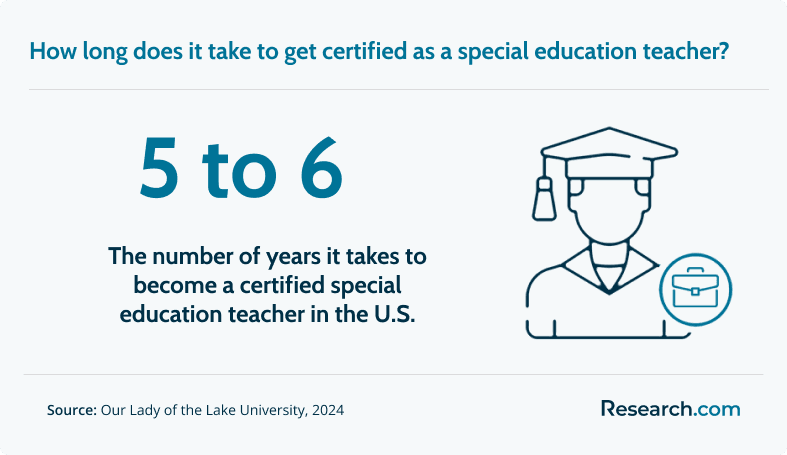
The full timeline often takes five to six years, although the exact length depends on the candidate’s starting point, state requirements, enrollment pace, and certification route. A traditional bachelor’s degree in special education generally takes about four years of full-time study. After that, candidates must complete student teaching, pass required exams, and submit licensure paperwork, which can add several months.
Career changers who already have a bachelor’s degree may qualify for an alternative certification route. In some cases, these programs allow candidates to begin teaching while finishing required coursework, and the process may take one to two years. Candidates who pursue a master’s degree in special education for initial licensure may need an additional one to two years after undergraduate study. Students trying to complete prerequisites or fill academic gaps sometimes use open enrollment online college courses, but those credits should be checked carefully for transfer and licensure applicability.
| Starting point | Common route | Typical time described in the article |
| No bachelor’s degree | Bachelor’s degree, teacher preparation, student teaching, exams, and licensure application | Five to six years |
| Bachelor’s degree in another field | Alternative certification or post-baccalaureate teacher preparation | One to two years |
| Bachelor’s degree plus graduate study | Master’s degree in special education for initial certification or advancement | An additional one to two years |
Can you earn a special education teaching certification online?
Yes. Many accredited colleges and universities offer online coursework for special education certification, including bachelor’s, post-baccalaureate, endorsement, and master’s-level options. However, online does not mean fully remote in every respect. Most licensure programs still require in-person field experiences, observations, practicum hours, or student teaching in an approved school setting.
Online certification can be a strong fit for working adults, career changers, rural students, and licensed teachers adding an endorsement. Before enrolling, confirm that the program is approved for the state where you want to teach and that the school can help arrange required placements.
| Online program advantage | What to check before enrolling |
| Flexible scheduling for working adults | Whether courses are live, self-paced, evening-based, or term-based |
| Access to programs outside your local area | Whether an out-of-state program meets your state’s licensure requirements |
| Potential savings on commuting and housing | Total cost, fees, technology requirements, and field placement expenses |
| Ability to continue working while studying | Whether student teaching requires daytime availability or unpaid time away from work |
Students comparing flexible education pathways can start by reviewing the best online degree programs for working adults, but program approval for special education licensure should be the deciding factor.
Do all states require the same certification exams for special education?
No. Every state sets its own testing rules for special education certification. Many states use the Praxis Special Education Exam, which evaluates knowledge of disability categories, teaching strategies, special education law, and IEP-related responsibilities. Other states require their own assessments, such as the California Subject Examinations for Teachers (CSET) in Special Education or the Texas Examinations of Educator Standards (TExES) Special Education Exam.
Candidates should not assume that one exam automatically qualifies them everywhere. Passing scores, test names, grade-band requirements, subject-area tests, and application steps may differ by state. The same issue applies to other specialized teaching credentials; for example, the requirements for art teacher certification can also depend heavily on state-specific testing and preparation rules.
What online master's degree can elevate your special education career?
An online master’s degree in special education can help licensed teachers deepen their expertise, prepare for specialized roles, and build skills in assessment, inclusive instruction, research-based intervention, and program coordination. It may also support advancement into leadership, coaching, curriculum, or specialist positions, depending on district policies and state rules.
The best program depends on your current credential status. Some master’s programs are designed for licensed teachers seeking advanced study, while others are built for candidates pursuing initial certification. Before applying, ask whether the degree leads to licensure, an added endorsement, salary schedule movement, or professional development credit in your state or district. Educators who want to compare flexible and budget-conscious graduate options can review the easiest master's degree for teachers as a starting point, then narrow choices by accreditation and licensure fit.
What are the state-specific special education certification requirements?
State rules can differ substantially because each education department determines the approved preparation programs, required exams, fieldwork expectations, endorsement areas, renewal rules, and reciprocity policies. A teacher prepared in one state may need additional tests, coursework, or documentation before working in another.
Before choosing a program, candidates should verify three things: whether the program is state-approved for special education licensure, whether it prepares candidates for the correct grade band or disability category, and whether field placements meet state expectations. For detailed state-by-state guidance, use the Research.com resource on how to get a teaching certificate.
How can advanced degrees enhance my special education career?
Advanced degrees can broaden a special education teacher’s professional options by building skills in instructional leadership, applied research, program design, policy, supervision, and specialized intervention. For classroom teachers, graduate study may also strengthen confidence in data-driven decision-making, collaboration with related service providers, and inclusive school improvement.
An advanced degree is not automatically necessary for every teaching role, so educators should compare the cost, time commitment, district salary policies, and career goal before enrolling. Those interested in doctoral-level leadership routes may explore 1 year EdD programs online, especially if they want a faster format while continuing to work.
What are cost-effective advanced degree options for career advancement in special education?
Cost-effective graduate study is not just about the lowest tuition. Special education professionals should compare accreditation, program approval, transfer policies, employer tuition assistance, required residencies, practicum expectations, and whether the credential aligns with their intended role. A cheaper program can become expensive if it does not meet licensure, endorsement, or advancement requirements.
Educators aiming for leadership, district-level roles, or specialized program development may consider doctoral pathways, but they should compare total cost and professional return carefully. Research.com’s guide to cheap online EdD programs can help candidates identify lower-cost options while still evaluating quality and fit.
Can advanced leadership credentials expand career opportunities in special education?
Yes, advanced leadership credentials can help experienced special education professionals move beyond direct classroom instruction into roles involving program management, instructional coaching, compliance, school improvement, policy implementation, or administrator-track responsibilities. These credentials are most useful when they align with a specific career goal rather than serving as a general résumé booster.
Leadership preparation may include data-informed decision-making, team supervision, change management, organizational strategy, and collaboration across general education, special education, families, and service providers. Educators interested in broader leadership preparation may compare online doctoral programs in organizational leadership as one possible route for building management and systems-level skills.
What complementary qualifications can boost a special education career?
Special education teachers often work across disciplines, so complementary qualifications can be valuable when they support a clear professional purpose. Useful areas may include educational technology, assistive technology, behavior intervention, counseling-related coursework, literacy intervention, curriculum design, school leadership, or information and resource management.
For example, educators interested in accessible learning materials, student research support, or resource organization may benefit from understanding what can you do with a degree in library science. The best complementary credential is one that helps you serve students more effectively or qualify for a specific role, not one chosen only because it sounds broadly useful.
Can special education credentials open doors to alternative career paths?
Special education certification can support career options outside the traditional classroom, especially for professionals with experience in accommodation planning, intervention design, compliance documentation, family collaboration, and instructional adaptation. Possible paths may include educational consulting, curriculum development, program coordination, teacher coaching, community services, education technology, disability services, or policy-related work.
Teachers considering a move outside classroom instruction should identify which skills transfer directly and which credentials employers expect. Some professionals combine special education expertise with resource management, accessibility, or information services, including roles connected to jobs with library science degree.
What states offer the highest salary for certified special education teachers?
Based on the salary information provided in the research source, the following states were identified among the top five for average annual pay for certified special education teachers. Because salaries can shift by district, contract, cost of living, and local demand, candidates should verify current state and district salary schedules before making relocation decisions.
- Washington: The listed average salary is $69,200 for special education teachers; the source text also references Wyoming, so candidates should confirm the state-specific figure before relying on it.
- New York: Special education teachers earn an average annual salary of $66,844, reflecting both the state’s education market and higher living costs in many areas.
- Massachusetts: The average salary is $66,727, which may reflect strong demand for qualified special education professionals and state investment in education.
- Alaska: Special education teachers earn an average of $65,799 per year, indicating compensation efforts tied to attracting and retaining educators.
- Vermont: The average annual salary is $64,963, suggesting continued investment in specialized educational services.
Salary should not be evaluated in isolation. A higher-paying state may also have higher housing costs, different licensure rules, or more competitive hiring. Likewise, a lower-paying state may offer stronger benefits, loan forgiveness opportunities, or a better cost-of-living balance. Teachers comparing related education specialties may also want to review secondary teaching certification to understand how salaries and requirements differ by teaching area. The chart below provides a broader state-by-state salary comparison for special education teachers.
Are there special education certificate programs for career changers?
Yes. Many states and universities offer alternative certification or post-baccalaureate programs for adults who already hold a bachelor’s degree in another field and want to become teachers. These programs can shorten the path because candidates do not need to complete a second bachelor’s degree, but they still must meet state requirements for coursework, exams, supervised teaching, and licensure.
Career changers should compare programs carefully. Some routes allow candidates to teach while completing certification requirements, while others require coursework and field placements before entering the classroom.
- Teach For America (TFA): This national program places candidates from a range of academic and professional backgrounds in high-need schools and provides training connected to certification pathways, including special education in some placements.
- American Board for Certification of Teacher Excellence (ABCTE): This self-paced online certification option is available in select states and may help career changers pursue a special education teaching license. Candidates comparing short credentials may also review certificate programs that pay well, while remembering that teacher licensure must meet state rules.
- University-based alternative certification programs: Institutions such as the University of Texas at Austin and Arizona State University offer post-baccalaureate pathways for professionals transitioning into teaching.
What is the job demand for special education teachers?
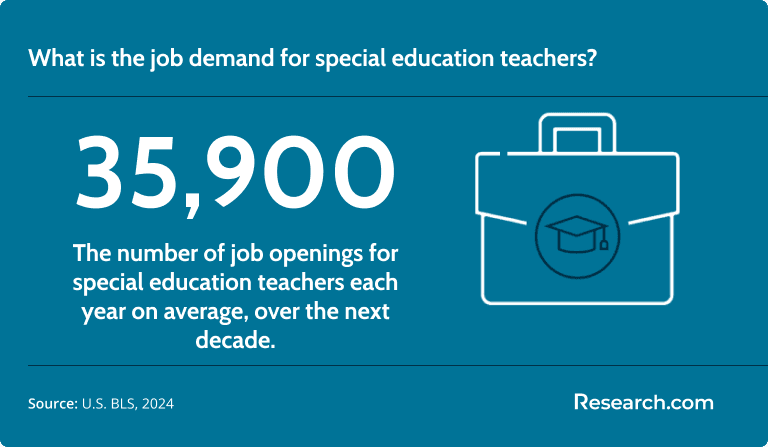
The U.S. Bureau of Labor Statistics projects little or no change in overall employment for special education teachers from 2023 to 2033. Even with limited projected growth, the occupation is expected to have about 35,900 job openings each year, on average, over the decade. Many openings are expected to come from replacement needs as teachers retire, leave the labor force, or move into other occupations.
Demand can vary by state, district, grade level, and specialization. Some schools may need teachers with multiple credentials, especially in hard-to-staff subject areas or inclusive settings. For that reason, some educators add another credential, such as math teaching certification, to improve flexibility and qualify for a wider range of roles.
Current trends affecting the field include continued emphasis on inclusive classrooms, expanded use of assistive technology, data-based intervention, and collaboration between special education and general education teachers. Artificial intelligence and digital learning tools may help with documentation, accessibility, lesson adaptation, and progress monitoring, but they do not replace the professional judgment, relationship-building, legal responsibility, and individualized support provided by certified teachers.
How can an interdisciplinary academic background enhance special education teaching?
An interdisciplinary background can strengthen special education practice when it adds relevant knowledge from psychology, communication, technology, literacy, child development, social services, health, or the arts. Students with broader academic preparation may bring flexible problem-solving skills, stronger collaboration habits, and a better understanding of how disability, family context, language, culture, and learning environments interact.
For future educators who want a broad undergraduate foundation before specializing, an interdisciplinary studies bachelor’s degree may provide exposure to multiple fields. However, candidates should confirm that any chosen degree can connect to a state-approved teacher preparation pathway if their goal is certification.
How should you choose a special education certification program?
The best certification program is the one that meets your state’s licensure rules, fits your schedule, supports your target student population, and offers strong field placement support. Rankings and tuition matter, but they should not replace licensure verification.
| Question to ask | Why it matters |
| Is the program approved for special education licensure in my state? | Without state approval, you may graduate without being eligible for certification |
| Which disability categories and grade bands does the program prepare me for? | Credentials may be limited by age level, support level, or specialization |
| Who arranges fieldwork and student teaching? | Placement support is especially important for online and out-of-state programs |
| What exams will I be prepared to take? | Exam requirements vary, and preparation should match your state’s tests |
| What is the total cost, including fees and placement-related expenses? | Tuition alone does not show the full cost of certification |
| Will credits transfer into a graduate degree or endorsement later? | Transfer and stackable-credit policies can reduce future education costs |
Common mistakes to avoid when pursuing special education certification
- Choosing a program before checking state approval: Accreditation is important, but certification also depends on whether the program is approved for licensure in your state.
- Assuming online means no classroom requirements: Most online licensure programs still require supervised in-person fieldwork or student teaching.
- Looking only at tuition: Fees, books, testing costs, background checks, travel, and unpaid student teaching time can affect the real cost.
- Ignoring endorsement limits: A special education credential may not qualify you for every disability category, grade band, or instructional setting.
- Relying only on salary averages: Pay varies by district, experience, contract, cost of living, and assignment. Averages are useful, but they are not guarantees.
- Assuming certification transfers easily between states: Reciprocity rules vary, and moving states may require additional exams, coursework, or applications.
- Skipping conversations with current teachers: Special education can be meaningful work, but it also involves documentation, meetings, emotional demands, and collaboration. Firsthand insight helps set realistic expectations.
What do graduates say about special education teaching?
-
: "
Choosing special education changed my career and my sense of purpose. I see students build skills that once felt out of reach, and those small gains often become the most meaningful moments of the week. – Martha
"
-
: "
I moved into special education after working in corporate training, and the transition gave me the stability I wanted along with work that feels deeply personal. The relationships with students make the difficult days easier to face. – Manny
"
-
: "
Special education asks for patience, creativity, and emotional stamina. It is demanding, but helping students and families feel supported makes the work matter every day. – Aisha
"
Key Insights
- Special education certification is a specialized teaching credential focused on students with disabilities, individualized instruction, IEP support, accommodations, and inclusive classroom practices.
- Most candidates need a bachelor’s degree, a state-approved teacher preparation program, student teaching experience, passing exam scores, and a state licensure application.
- The traditional certification route commonly takes five to six years, while alternative certification for candidates who already hold a bachelor’s degree may take one to two years.
- The median annual salary for special education teachers was $65,910 as of May 2023, but pay depends on location, school level, experience, specialization, and district salary schedules.
- The Bureau of Labor Statistics projects little or no change in employment from 2023 to 2033, but about 35,900 openings are expected each year, on average, largely because of replacement needs.
- Online programs can be convenient, but candidates must verify accreditation, state approval, exam alignment, and in-person fieldwork requirements before enrolling.
- The smartest certification choice is the one that matches your target state, student population, grade level, budget, and long-term career plan.
Resources:
- Our Lady of the Lake University. (2024). How to Become a Special Education Teacher: A Step-by-Step Guide. Read the OLLU guide
- U.S. Bureau of Labor Statistics. (2024). Occupational Outlook Handbook: Special Education Teachers. Review the BLS occupational profile
- ZipRecruiter. (2025). What Is the Average Special Education Teacher Salary by State? Compare salary estimates by state
Other things you should know about special education teaching
In 2027, aspiring special education teachers typically need to pass the Praxis Special Education exam or similar state-specific tests for certification. These exams evaluate knowledge in special education practices and student development, essential for gaining certification in many states.
Yes. Most states require a separate deaf or hard-of-hearing endorsement, usually through 12–18 graduate credits in audiology, language development, and communication methods, plus a supervised practicum. Many states also require the Praxis Education of Deaf and Hard of Hearing Students exam.


