
2027 How to Become a Preschool Teacher

Co-Founder and Chief Data Scientist
Becoming a preschool teacher is a meaningful career path, but it is not a decision to make on passion alone. The role requires patience, formal training, classroom experience, and a realistic understanding of pay, licensing rules, and long-term career options. Many people enter the field because they want to help children build early social, emotional, language, and problem-solving skills before kindergarten.
This guide explains what preschool teachers do, what qualifications are commonly required in 2026, how certification works, where preschool teachers work, how much they earn, and what challenges to expect. It is designed for aspiring teachers, career changers, current childcare workers, and education students who want a practical path into early childhood education.
Quick Answer: Is Becoming a Preschool Teacher a Good Career Choice?
Becoming a preschool teacher can be a strong fit if you enjoy working with young children, can manage an active classroom, and are comfortable with modest wages compared with many other education careers. The field offers steady demand, varied work settings, and meaningful work, but advancement often requires additional credentials or degrees.
- Early education participation is significant: About 59% of children aged 3 to 5 were enrolled in school, including 84% of 5-year-olds.
- Credential requirements differ: Around 50% of preschool teachers hold a college degree, while some roles accept an associate degree, early childhood coursework, or a Child Development Associate (CDA) credential.
- Pay is moderate: The median annual wage for preschool teachers was $37,130, or $17.85 per hour, with public school roles often offering stronger compensation and benefits.
- Demand is stable: Employment for preschool teachers is projected to grow by 4% from 2023 to 2033.
- Work settings vary widely: Preschool teachers may work in public schools, private preschools, childcare centers, Head Start programs, Montessori schools, nonprofit programs, or home-based early learning settings.
- What preschool teachers do each day
- Preschool teacher qualifications for 2026
- Skills that help preschool teachers succeed
- Ways to build experience before becoming a lead teacher
- How preschool teacher certification usually works
- How advanced education can expand preschool teaching options
- Preschool teacher salary and pay factors
- Leadership paths for preschool teachers and related salary considerations
- How stronger language skills support early literacy
- Where preschool teachers work
- Alternative careers that use preschool teaching skills
- Using interdisciplinary teaching in preschool classrooms
- Common challenges in preschool teaching
- Career outlook for preschool teachers
- Professional organizations for preschool teachers
- Whether a doctoral degree can change your career path, plus professional networks and job outlook
What does a preschool teacher do?
A preschool teacher supports children, usually ages 3 to 5, as they develop the foundational skills needed for kindergarten and later school success. The job combines teaching, caregiving, observation, family communication, and classroom management.
In a typical preschool classroom, teachers help children learn through structured play, stories, songs, hands-on activities, movement, art, early math, and social interaction. The goal is not simply to teach letters and numbers. Preschool teachers also help children practice cooperation, self-regulation, listening, language development, curiosity, and independence.
Common responsibilities include:
- Designing age-appropriate activities that build language, motor, social, and early problem-solving skills.
- Introducing basic concepts such as letters, numbers, colors, patterns, shapes, routines, and classroom expectations.
- Helping children learn how to share, take turns, express emotions, resolve small conflicts, and communicate needs.
- Maintaining a safe, clean, predictable classroom where children can explore under supervision.
- Observing children’s development and documenting progress, behavior, strengths, and possible areas of concern.
- Communicating with parents or guardians about classroom progress, developmental milestones, and daily routines.
- Collaborating with assistants, directors, specialists, and, in some settings, special education or family support professionals.
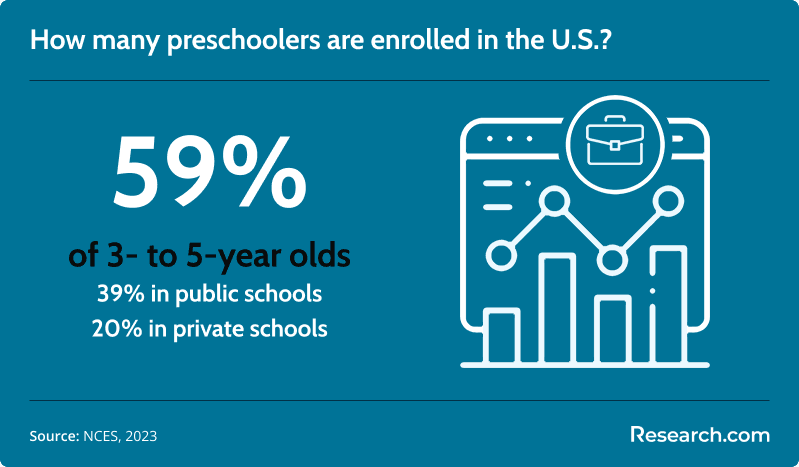
As of 2022, about 59% of children aged 3 to 5 were enrolled in school. Of those, 39% attended public preschools and 20% were enrolled in private programs. Enrollment was highest among 5-year-olds at 84%, underscoring why preschool teachers play an important role in school readiness.
| Part of the Job | What It Looks Like in Practice | Why It Matters |
| Instruction | Teaching early literacy, numeracy, routines, and classroom behaviors through play-based and structured activities. | Builds kindergarten readiness without expecting children to learn like older students. |
| Care and supervision | Monitoring safety, hygiene, transitions, meals, rest periods, and emotional needs. | Young children need close supervision and predictable routines to feel secure. |
| Developmental observation | Watching how children communicate, move, solve problems, interact, and regulate emotions. | Helps teachers adjust instruction and flag concerns early when support may be needed. |
| Family communication | Sharing updates, listening to parent concerns, and discussing progress or behavior patterns. | Consistency between home and school supports children’s development. |
What qualifications do you need to become a preschool teacher for 2026?
Preschool teacher requirements depend on the state, employer, funding source, and age group served. A childcare center may have different expectations than a public school pre-K classroom, a Head Start program, or a private Montessori setting. Before enrolling in a program or applying for jobs, check your state licensing agency and the specific employer’s requirements.
Common education requirements
Many preschool teacher roles require formal preparation in early childhood education, child development, or a closely related area. About 50% of preschool teachers have a college degree. Entry-level roles may accept an associate degree, documented early childhood coursework, or a Child Development Associate credential, while some public school and state-funded pre-K jobs require a bachelor’s degree and teacher licensure.
If your goal is to move into curriculum leadership, coaching, administration, or specialized early childhood roles, graduate study can help. For example, comparing the most affordable online master’s degrees in early childhood education can be useful if you already work in the field and need a flexible, lower-cost option.
Certification and licensing
Licensing rules vary by state. Some preschool teachers need a state teaching license or early childhood education endorsement, while others meet employer requirements through the CDA or another recognized credential. Federally funded programs such as Head Start may also set specific education and experience standards.
Preschool teachers generally do not need separate subject-area certifications for early math, art, or literacy in the same way middle school or high school teachers often do. If you are comparing teaching fields, this guide to math teaching certification requirements can help show how subject-specific certification differs from broader early childhood preparation.
Special education is different. If you want to teach children with disabilities or work in an inclusive preschool classroom that requires specialized credentials, review your state’s rules carefully. The requirements to teach special education may include additional coursework, testing, field experience, or licensure.
Experience expectations
Employers often prefer candidates who have already worked with young children. Experience can come from assistant teaching, practicum placements, childcare work, volunteer roles, tutoring, summer programs, or supervised fieldwork required by an education program.
| Credential Path | Best For | Typical Use | Important Caution |
| Child Development Associate credential | Entry-level childcare workers and assistants moving toward lead teacher roles. | Can help meet requirements in some childcare and preschool settings. | It may not qualify you for public school pre-K teaching roles in every state. |
| Associate degree in early childhood education | Students seeking a faster college route into childcare or preschool teaching. | Often supports assistant, lead teacher, or center-based roles, depending on location. | Some employers or states may still require a bachelor’s degree for licensed teaching positions. |
| Bachelor’s degree in early childhood education | Candidates aiming for public pre-K, state-funded preschool, or broader teaching options. | Often paired with student teaching and state licensure requirements. | Make sure the program aligns with your state’s licensure pathway. |
| Master’s degree or advanced credential | Current educators pursuing leadership, specialization, coaching, or higher-level roles. | May support advancement into administration, curriculum, policy, or specialist positions. | Compare total cost with likely career benefits before enrolling. |
What skills do you need to be a successful preschool teacher?
Preschool teaching requires more than enjoying children. Because 84% of 5-year-olds and 47% of 3- to 4-year-olds are enrolled in school, many teachers work with children at very different developmental stages in the same classroom. Strong teachers know how to guide behavior, communicate clearly, adapt lessons, and support early learning without overwhelming young children.
- Patience and emotional steadiness: Preschoolers are still learning impulse control, communication, and independence. Teachers must respond calmly and consistently.
- Clear communication: Teachers need to explain simple ideas to children, communicate professionally with families, and document concerns accurately.
- Creativity: Young children learn best through engaging, hands-on activities. Effective teachers can turn songs, stories, art, blocks, movement, and outdoor play into learning opportunities.
- Adaptability: A lesson may need to change quickly if children are tired, overstimulated, excited, upset, or struggling with the concept.
- Classroom management: Preschool teachers use routines, visual cues, transitions, positive reinforcement, and consistent expectations to keep the classroom safe and productive.
- Observation skills: Teachers must notice patterns in language, behavior, motor development, social interaction, and learning readiness.
- Cultural awareness: Families may have different languages, values, expectations, and communication styles. Teachers need to build trust respectfully.
- Physical stamina: The work involves sitting on the floor, moving around the room, supervising play, helping with materials, and staying alert throughout the day.
How AI and classroom technology are changing preschool teaching
Technology can help preschool teachers organize lesson plans, communicate with families, document observations, and find activity ideas. However, it does not replace the teacher’s judgment, warmth, supervision, or understanding of child development. In early childhood classrooms, technology should support planning and communication rather than reduce hands-on play, conversation, movement, and social interaction.
How do you gain experience as a preschool teacher?
The best way to prepare for preschool teaching is to spend time in real early childhood settings. Classroom experience helps you understand children’s developmental differences, daily routines, safety expectations, and the pace of the job.
Good ways to build experience include:
- Volunteer in preschool or childcare settings: This can help you confirm whether you enjoy working with young children before committing to a degree or certification path.
- Work as a teacher’s assistant: Assistant roles allow you to learn from lead teachers while practicing classroom routines, behavior support, and small-group activities.
- Complete fieldwork or student teaching: Many early childhood education programs include supervised classroom hours, observations, and lesson planning practice.
- Apply for internships: Some schools, childcare centers, and nonprofit early learning programs offer structured training experiences.
- Work in camps, after-school programs, or community programs: These roles can strengthen communication, supervision, planning, and child engagement skills.
- Babysit or tutor young children: While not the same as classroom teaching, it can help you develop patience, family communication skills, and age-appropriate activity planning.
If you want to blend early childhood teaching with a creative specialty, check whether your state or employer requires additional preparation. For example, the certification needed to be an art teacher may involve both education training and subject-specific preparation, depending on the role.
What to document while gaining experience
Keep a record of where you worked, your responsibilities, ages served, training completed, supervisor contact information, and any classroom hours required for a credential. This documentation can be useful when applying for jobs, certification, or future education programs.
How do you become a certified preschool teacher?
Certification is not identical everywhere, but the process usually follows a similar sequence: complete the required education, gain supervised experience, pass any required exams, apply for licensure or credentials, and keep your credential active through renewal or continuing education.
1. Confirm your state and employer requirements
Start with your state education department, childcare licensing agency, or the employer’s job posting. Requirements can differ for public pre-K, private preschool, childcare centers, Head Start, and faith-based or independent schools.
2. Complete the required education or credential
Depending on the role, you may need a CDA, associate degree, bachelor’s degree, or state-approved teacher preparation program in early childhood education or child development.
3. Build supervised classroom experience
Many pathways require documented fieldwork, practicum experience, student teaching, or work under the supervision of an experienced educator.
4. Pass required exams, if applicable
Some states require early childhood teacher candidates to pass content or pedagogy exams. One example is the Praxis Early Childhood Education test, which evaluates knowledge of child development, learning environments, curriculum, and instructional practices.
5. Apply for certification or licensure
You may need to submit transcripts, test scores, background check results, supervised experience documentation, fees, and application forms. Public school roles often have more formal licensure procedures than private childcare roles.
6. Renew and maintain your credential
Many states and employers require ongoing professional development. Renewal may involve workshops, college credits, training hours, or updated background checks.
Compared with early childhood roles, secondary teaching certification requirements often place greater emphasis on subject-specific coursework, exams, and student teaching in a particular content area.
How can advanced education enhance my preschool teaching career?
Advanced education can help preschool teachers move beyond classroom-only roles into curriculum design, instructional coaching, program administration, policy work, teacher training, or early childhood leadership. It may also deepen your knowledge of assessment, family engagement, child development, inclusion, and program evaluation.
Graduate education is most useful when it matches a specific career goal. If you want to become a center director, an early learning administrator, or a district-level specialist, a master’s degree, EdD, or related leadership credential may be worth considering. If you simply want to qualify for an entry-level preschool classroom role, a doctoral program is usually more education than you need.
Working educators who need a flexible route can compare options such as the shortest online EdD programs, but speed should not be the only factor. Accreditation, cost, faculty expertise, field requirements, and career relevance matter more than finishing quickly.
How much do preschool teachers make?
Preschool teachers earned a median annual wage of $37,130 as of May 2023, equal to about $17.85 per hour. Salary can vary by employer type, state, local cost of living, credentials, experience, and whether the role is in a public school, private preschool, childcare center, or publicly funded early education program. Some reports also show an average yearly wage of $33,889 in 2022.
In general, public school and specialized early education roles may offer stronger pay and benefits than some private childcare centers. Benefits can also make a major difference. Health insurance, retirement plans, paid time off, tuition support, and predictable schedules can change the real value of a job offer.
Additional education or specialization may improve advancement potential. For example, teachers interested in developmental assessment, family support, or specialized child-focused roles may explore related child psychology career paths.
| Factor | How It Can Affect Pay | Question to Ask Before Accepting a Job |
| Employer type | Public schools and funded programs may offer different pay scales than private childcare centers. | Is the role paid hourly or salaried, and what benefits are included? |
| Credentials | A CDA, associate degree, bachelor’s degree, license, or graduate degree may qualify you for different roles. | Does this credential change my pay range or only meet minimum hiring requirements? |
| Location | Pay often reflects local funding, labor market conditions, and cost of living. | How does the wage compare with local housing, transportation, and childcare costs? |
| Experience | Lead teachers, mentors, and teachers with specialized experience may have stronger bargaining power. | Is there a written pay scale for experience or annual increases? |
| Schedule | Some roles follow a school-year calendar, while others require year-round childcare hours. | Am I paid during breaks, planning time, training days, or summer months? |
How can preschool teachers advance into leadership roles?
Preschool teachers can advance by combining classroom expertise with training in supervision, curriculum planning, compliance, family engagement, and program operations. Leadership roles may include lead teacher, mentor teacher, curriculum coordinator, center director, early childhood administrator, professional development trainer, or policy advocate.
Advanced study can be helpful for educators who want to manage programs, lead teams, evaluate early learning initiatives, or influence institutional policy. A doctorate in organizational leadership may be relevant for professionals focused on administration, systems change, or education leadership beyond the classroom.
Practical steps toward leadership
- Ask your supervisor what credentials are required for lead teacher, director, or coordinator roles in your setting.
- Volunteer for curriculum planning, family events, staff mentoring, assessment projects, or accreditation preparation.
- Complete training in supervision, child assessment, inclusion, safety compliance, and early childhood program standards.
- Document measurable accomplishments, such as improving classroom routines, mentoring assistants, or supporting family engagement.
- Compare the cost of additional education with the specific roles and pay ranges it may unlock.
How Can Enhanced Language Skills Improve Classroom Effectiveness?
Strong language skills help preschool teachers give clear directions, model vocabulary, lead story time, support early literacy, and communicate with families. In multilingual or language-rich classrooms, teachers who understand literacy development can create activities that build listening, speaking, print awareness, and comprehension.
Language development is not limited to reading books aloud. It also happens during meals, play, conflict resolution, songs, routines, dramatic play, and conversations. Teachers who want deeper preparation in writing, communication, or literacy may find an affordable online English degree useful, especially if they plan to move into curriculum writing, literacy support, or education communication roles.
Where do preschool teachers work?
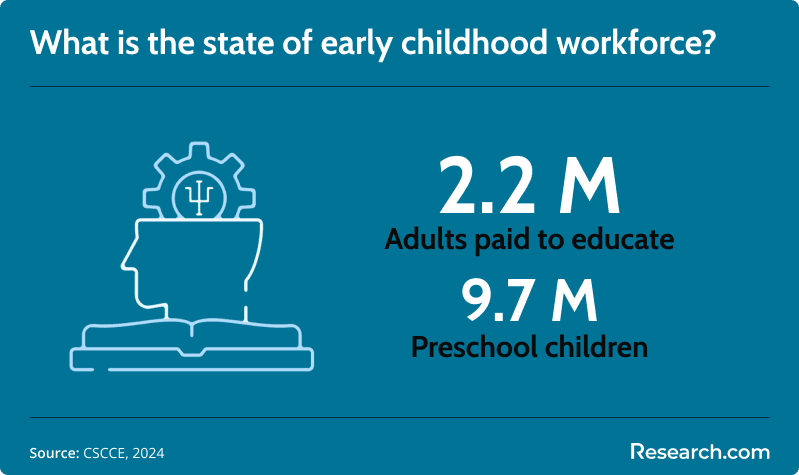
Preschool teachers work in schools, childcare programs, public initiatives, nonprofit organizations, and home-based early learning environments. Around 2.2 million adults are employed in early childhood education roles, caring for and teaching more than 9.7 million children under age five.
Common workplaces include:
- Public preschools and school-based pre-K: These programs often follow district or state early learning standards and may require teacher licensure.
- Private preschools: These schools may use their own curriculum, philosophy, tuition model, and hiring standards.
- Childcare centers: Teachers may provide both education and full-day care, often with extended schedules compared with school-year programs.
- Head Start programs: These federally funded programs serve low-income families and often combine education, family support, nutrition, and health-related services.
- Montessori schools: These environments emphasize child-directed learning, prepared materials, independence, and multi-age interaction.
- Home-based childcare: Some educators operate or work in licensed home settings that include structured early learning activities.
- Community centers and nonprofits: These organizations may offer preschool, school readiness, family literacy, or early intervention-related programs.
- Other settings: Some preschool teachers work in hospitals, religious institutions, employer-sponsored childcare programs, or specialized early learning centers.
If you are still choosing an education path, reviewing online colleges for early childhood education can help you compare program structures, fieldwork expectations, and degree options.
| Work Setting | Best Fit For | Potential Trade-Off |
| Public school pre-K | Teachers seeking structured calendars, public systems, and potentially stronger benefits. | Licensure and degree requirements may be more formal. |
| Private preschool | Teachers who prefer smaller programs, specific philosophies, or independent school environments. | Pay, benefits, and credential expectations vary widely. |
| Childcare center | Educators comfortable combining early learning with full-day care routines. | Schedules may be longer or year-round. |
| Head Start | Teachers interested in serving families through education and support services. | Programs may have specific federal and local requirements. |
| Montessori school | Teachers drawn to child-centered, self-paced learning environments. | Specialized Montessori training may be preferred or required. |
What alternative career paths complement preschool teaching skills?
Preschool teachers develop transferable skills in communication, observation, planning, behavior support, family engagement, organization, and child development. Those skills can support several related careers, especially for educators who want to move out of the daily classroom while staying connected to learning and child development.
Possible alternatives include:
- Early childhood curriculum assistant or curriculum writer.
- Childcare center director or assistant director.
- Family support worker or parent educator.
- Early literacy program coordinator.
- Children’s museum or community education program staff member.
- Educational consultant for early learning materials or programs.
- Library youth services assistant, children’s program coordinator, or related education-focused library role.
Teachers interested in learning programs, youth services, research support, and community education may also explore library science job opportunities, especially if they enjoy literacy, children’s programming, and public service.
Can Integrating Interdisciplinary Approaches Enhance Preschool Learning?
Interdisciplinary preschool teaching connects multiple learning areas in one activity. For example, a gardening lesson can include science, counting, vocabulary, motor skills, art, weather observation, and cooperation. This approach fits young children because they do not learn in isolated subject blocks; they learn through play, conversation, movement, exploration, and repetition.
Teachers can strengthen lessons by blending art, music, early math, storytelling, nature, sensory play, movement, and social-emotional learning. Educators who want a broader academic foundation for designing connected learning experiences may review interdisciplinary studies degree programs.
What are the challenges of being a preschool teacher?
Preschool teaching can be deeply rewarding, but it is demanding. The work requires constant attention, emotional control, physical energy, and strong communication. Before entering the field, understand both the positive impact and the real pressures.
Behavior and classroom management
Young children are still developing self-control, language, and social skills. Disruptions, tantrums, separation anxiety, and conflicts are normal parts of the work. Effective teachers rely on routines, positive reinforcement, redirection, visual cues, and calm consistency.
Wide developmental differences
Children in the same classroom may differ greatly in speech, motor skills, attention span, independence, social confidence, and emotional regulation. Teachers must adapt activities while still managing the whole group.
Physical and emotional workload
Preschool teachers spend much of the day moving, bending, sitting on the floor, supervising active play, comforting children, and responding to changing needs. The emotional work can also be heavy, especially when supporting families through developmental, behavioral, or personal concerns.
Pay limitations
Preschool teachers often earn less than educators in higher grade levels. Wages vary by location and employer, and some roles may offer limited benefits. Comparing total compensation is important before accepting a position.
Career advancement barriers
Moving into higher-paying or leadership roles may require additional education, licensure, or specialized credentials. Some teachers broaden their options by studying child development, counseling, or psychology. If you are considering a future transition, it may help to understand how long it takes to get a psychology degree.
Common mistakes to avoid
| Mistake | Why It Can Hurt You | Better Approach |
| Choosing a program without checking state requirements. | You may finish coursework that does not qualify you for the job or license you want. | Confirm state, employer, and age-level requirements before enrolling. |
| Looking only at tuition. | Fees, books, fieldwork costs, commuting, lost wages, and exam fees can change the true cost. | Compare total program cost and ask about financial aid, transfer credits, and payment options. |
| Assuming all online programs meet licensure rules. | Some programs may not lead to certification in your state. | Ask the school in writing whether the program meets your state’s early childhood licensure requirements. |
| Ignoring classroom experience. | Education alone may not prepare you for the pace and behavior demands of preschool teaching. | Gain experience through assistant roles, practicum placements, internships, or volunteering. |
| Expecting guaranteed salary growth from any degree. | Advanced credentials do not automatically increase pay in every setting. | Check local job postings and employer pay scales before investing in additional education. |
What is the career outlook for preschool teachers?
The employment outlook for preschool teachers is steady. Employment is projected to grow by 4% from 2023 to 2033, which is about in line with the average for all occupations. As of 2023, there were approximately 528,500 preschool teachers in the United States.
Demand is influenced by family needs, public funding, local childcare availability, school readiness initiatives, and recognition of early childhood education’s value. Job quality can vary significantly, so applicants should compare wages, benefits, staff ratios, curriculum expectations, planning time, training support, and advancement pathways.
Teachers who want to specialize in child development, assessment, research, or advanced psychological study may consider whether an online doctorate in psychology aligns with their long-term goals. For most classroom preschool roles, however, a doctorate is not required.
Overall, preschool teaching remains a viable option for people who want child-centered work and are prepared for the field’s compensation realities, credential requirements, and day-to-day demands.
Which professional organizations can benefit preschool teachers?
Professional organizations can help preschool teachers stay current, find training, understand policy changes, access classroom resources, and build a professional network. Groups such as the National Association for the Education of Young Children (NAEYC) and state early childhood education associations often provide research, standards, conferences, webinars, and communities of practice.
Membership is most valuable when it supports a specific goal: improving classroom practice, preparing for accreditation, finding continuing education, connecting with mentors, or planning career advancement. Educators considering additional academic preparation can also compare pathways and costs, including resources that explain how much it costs to get a teaching degree online.
Can a Doctoral Degree Transform My Preschool Teaching Career?
A doctoral degree can change a preschool educator’s career, but it is not necessary for most classroom teaching jobs. Doctoral study is more relevant for educators who want to lead programs, teach at the college level, conduct research, design policy, evaluate early childhood systems, or move into senior administrative roles.
An EdD may provide advanced training in leadership, research methods, curriculum improvement, organizational change, and education policy. If cost is a major concern, comparing the best affordable EdD programs can help you evaluate options. Before enrolling, ask whether the degree is required for your target role, whether the program is accredited, how much it costs, and whether graduates move into the kinds of positions you want.
Questions to Ask Before Becoming a Preschool Teacher
- Do I enjoy working with children ages 3 to 5 every day, including during difficult behaviors and transitions?
- What credential does my state require for the preschool setting where I want to work?
- Do I want to work in a childcare center, public pre-K program, private preschool, Head Start, Montessori school, or another setting?
- Can I live comfortably on the likely local wage for preschool teachers?
- Does the job include benefits, paid planning time, paid training, and predictable scheduling?
- Will I need a CDA, associate degree, bachelor’s degree, license, or graduate degree for my long-term goal?
- Does my chosen program include supervised classroom experience?
- What advancement options exist with this employer or in my local early childhood education market?
Key Insights
- Preschool teachers help children build school readiness through play-based learning, routines, early literacy, early math, social development, and emotional support.
- Requirements vary by state and employer, so check licensing rules before choosing a degree, certificate, or online program.
- The median annual wage was $37,130 as of May 2023, so salary expectations should be realistic, especially in private childcare settings.
- Public school pre-K, Head Start, childcare centers, Montessori programs, and private preschools can offer very different schedules, pay, benefits, and credential requirements.
- Hands-on experience is essential. Assistant teaching, fieldwork, internships, volunteering, and childcare work can help you prepare for the realities of the classroom.
- Advanced degrees can support leadership, administration, policy, research, or curriculum roles, but they are not always necessary for classroom preschool teaching.
- The best path is the one that matches your state’s requirements, your preferred work setting, your income needs, and your long-term career goals.
References:
- About the early childhood workforce – Early Childhood Workforce Index 2024 – CSCCE. (n.d.). https://cscce.berkeley.edu/workforce-index-2024/the-early-childhood-educator-workforce/about-the-early-childhood-workforce/
- Key findings – Early Childhood Workforce Index 2024 – CSCCE. (n.d.). https://cscce.berkeley.edu/workforce-index-2024/executive-summary/key-findings/
- National Center for Education Statistics. (n.d.-a). Fast Facts: Preprimary education enrollment (516). https://nces.ed.gov/fastfacts/display.asp?id=516
- Preschool & kindergarten teachers | Data USA. (n.d.). Data USA. https://datausa.io/profile/soc/preschool-kindergarten-teachers
- Preschool Teacher Demographics and Statistics [2025]: Number of preschool teachers in the US. (2025, January 8). https://www.zippia.com/preschool-teacher-jobs/demographics/
- Preschool teachers. (2024, August 29). Bureau of Labor Statistics. https://www.bls.gov/ooh/education-training-and-library/preschool-teachers.htm
Other Things You Should Know About Becoming a Preschool Teacher
In 2027, online early childhood education programs are widely recognized for their flexibility and accessibility. Accreditation by recognized bodies ensures program credibility. Verify that the specific program aligns with licensing requirements in your state to ensure you meet all legal teaching criteria.
The cost of an early childhood education degree varies based on factors like school type, location, and program format. On average, tuition ranges from $10,000 to $30,000 per year for a bachelor's degree, while associate degrees typically cost less. Online programs can sometimes be more affordable, with options for financial aid and scholarships. To save on tuition, consider in-state public universities or explore the cheapest online master’s degree in early childhood education for graduate-level studies.
Yes, an associate degree can qualify you to teach preschool in many settings, especially private daycare centers, Head Start programs, and some public pre-K classrooms. However, specific requirements vary by state and employer. Some states require a bachelor's degree for public school preschool teachers, while others accept an associate degree with additional certifications. Gaining experience through internships or assistant teaching roles can also improve job prospects. If you plan to advance, consider an affordable online bachelor’s degree in early childhood education to expand career options.


