
2027 Ed.D. vs. Ph.D.: Explaining the Difference

Co-Founder and Chief Data Scientist
Choosing between an Ed.D. and a Ph.D. in Education is not just a question of title. It is a decision about the kind of work you want to do after graduation: leading schools and organizations, shaping policy from practice, teaching at a university, or producing original research. Both degrees can strengthen credibility and open senior-level opportunities, but they are built for different goals.
This guide explains the practical differences between a Doctor of Education and a Doctor of Philosophy in Education, including curriculum, admissions, cost, funding, online options, research expectations, career outcomes, and long-term value. It is designed for educators, administrators, policy professionals, trainers, and graduate students who want to choose the doctoral path that best fits their career plan.
The financial stakes can be meaningful. According to the Bureau of Labor Statistics, doctoral degree holders in 2023 had median weekly earnings of $2,109 and a 1.2% unemployment rate, compared with $1,737 and 2% for workers whose highest degree was a master’s. Those figures do not guarantee an individual outcome, but they show why many education professionals consider doctoral study when planning for advancement.
Quick Answer: Ed.D. vs. Ph.D. in Education
An Ed.D. is usually the better fit if you want to apply research to improve schools, districts, colleges, nonprofits, government agencies, or corporate learning programs. A Ph.D. is usually the better fit if you want to conduct original research, publish scholarship, teach in academia, or pursue research-heavy policy work.
| Decision Point | Ed.D. | Ph.D. in Education |
| Main purpose | Applied leadership and problem-solving | Original research and scholarly contribution |
| Best for | Working professionals seeking leadership roles | Future professors, researchers, and policy scholars |
| Typical final project | Capstone project, doctoral study, or applied dissertation | Traditional dissertation based on original research |
| Typical length | 2 to 3 years | 4 to 7 years |
| Average tuition range | $15,000 to $40,000 per year | $20,000 to $50,000 per year |
| Primary outcome | Organizational change, leadership, administration | Academic research, teaching, knowledge creation |
Key Differences Between an Ed.D. and a Ph.D. in Education
- Purpose: An Ed.D. is a professional doctorate built around applying research to real education problems. A Ph.D. is an academic doctorate focused on creating new knowledge through original research.
- Career direction: Ed.D. graduates commonly move into leadership roles such as school superintendent, higher education administrator, or chief learning officer, with average salaries ranging from $80,000 to $152,750. Ph.D. graduates more often pursue roles such as university professor, educational researcher, or education policy analyst, with salaries averaging around $79,000 to $80,840.
- Cost and time: Ed.D. programs are often shorter and may cost less overall. Ed.D. tuition averages between $15,000 and $40,000 per year, while Ph.D. tuition ranges from $20,000 to $50,000 per year. Reported average debt is $79,790 for Ed.D. recipients and $81,900 for Ph.D. holders.
- Research model: Ed.D. research usually addresses practical problems in schools, colleges, or organizations. Ph.D. research typically develops theory, tests hypotheses, or fills gaps in scholarly literature.
- Labor market context: Demand for experienced education leaders remains important in districts, higher education, workforce training, and policy settings. The Bureau of Labor Statistics projects an 8% job growth rate for education administrators between 2020 and 2030.
- What is the core difference between an Ed.D. and a Ph.D.?
- What career opportunities are available for Ed.D. and Ph.D. graduates?
- How do the coursework and curriculum differ between an Ed.D. and a Ph.D.?
- What are the admission requirements and how selective are Ed.D. and Ph.D. programs?
- How do the cost, funding, and return on investment compare for each degree?
- What are the flexibility and online learning options for Ed.D. and Ph.D. programs?
- Can fast-track Ed.D. programs deliver quality outcomes?
- What accreditation and program support factors should I evaluate?
- How does the research focus differ between an Ed.D. and a Ph.D.?
- How can I craft a competitive application for a doctoral program?
- What challenges might I encounter during a doctoral program?
- What factors should I consider when choosing between an Ed.D. and a Ph.D.?
- How are Ed.D. and Ph.D. degrees recognized internationally?
- How can I assess the institutional reputation and research impact of a doctoral program?
- How can digital innovation enhance my doctoral research?
- What are the future trends in doctoral education and the evolving job market?
- How do I evaluate the affordability and flexibility of online doctoral programs?
- How can I evaluate the long-term quality and career impact of a doctoral program?
- How can I evaluate faculty mentorship and collaborative research opportunities?
What is the core difference between an Ed.D. and a Ph.D.?
The main difference is the degree’s intended use. An Ed.D. is a practice-oriented doctorate for professionals who want to lead change in education systems or learning organizations. A Ph.D. in Education is a research-oriented doctorate for students who want to produce scholarship, teach at the college level, or pursue research-intensive policy and academic roles.
Both degrees are respected, but they reward different strengths. The Ed.D. values leadership experience, applied inquiry, and the ability to implement evidence-based solutions. The Ph.D. values research design, theory, publication potential, and contribution to the academic field. Students who are still preparing for doctoral-level study may first compare online master’s programs in education to build a stronger academic foundation.
Ed.D.: Best for applied leadership
The Doctor of Education is typically designed for experienced educators, administrators, training leaders, nonprofit professionals, and policy practitioners. Students study research methods, but the goal is usually to improve practice in a real setting. For example, an Ed.D. student might evaluate a district literacy initiative, redesign a college retention strategy, or develop a leadership model for a workforce training program.
Ph.D.: Best for research and academic careers
The Ph.D. in Education prepares students to ask original research questions, analyze evidence, publish findings, and teach future educators. Ph.D. students often spend significant time studying theory, methodology, statistics, qualitative inquiry, literature review, and academic writing. The goal is not only to solve a local problem but to add knowledge that other researchers and institutions can use.
| If your goal is... | Consider this degree | Why |
| Become a superintendent, dean, director, or senior administrator | Ed.D. | The curriculum usually emphasizes leadership, systems change, and applied decision-making. |
| Become a professor or academic researcher | Ph.D. | The degree is structured around scholarship, teaching, publication, and original research. |
| Improve practice in your current workplace | Ed.D. | Applied projects can be tied directly to organizational challenges. |
| Study a theory, policy issue, or learning phenomenon in depth | Ph.D. | Research training is usually more intensive and academically focused. |
What career opportunities are available for Ed.D. and Ph.D. graduates?
Ed.D. and Ph.D. graduates can both work in education leadership, policy, research, and higher education, but employers often interpret the degrees differently. The Ed.D. signals advanced preparation for leadership and applied change. The Ph.D. signals advanced preparation for research, academic teaching, and scholarly analysis.
Common Ed.D. career paths
Ed.D. graduates often pursue roles where they manage people, programs, budgets, policy implementation, or institutional strategy.
| Role | Typical responsibilities | Average salary stated |
| School Superintendent | Leads a school district, oversees budgets, works with boards, and implements districtwide policies. | $127,310 |
| Higher Education Administrator | Manages college or university functions such as student affairs, academic programs, enrollment, or operations. | $99,940 |
| Chief Learning Officer | Builds learning and development strategy for corporations, nonprofits, or large organizations. | $152,750 |
Professionals targeting postsecondary leadership may also compare doctoral options in higher education, including an online Ph.D. in higher education or related leadership doctorate.
Common Ph.D. career paths
Ph.D. graduates are usually strongest candidates for positions that require advanced research design, publication, teaching, or policy analysis.
| Role | Typical responsibilities | Average salary stated |
| University Professor | Teaches college courses, conducts research, advises students, and publishes scholarly work. | $80,840 |
| Educational Researcher | Studies education systems, learning methods, interventions, and outcomes. | $79,000 |
| Education Policy Analyst | Evaluates education policies and advises agencies, advocacy organizations, or research institutions. | $78,460 |
If your long-term goal is faculty work, review the steps involved in becoming a college professor, because degree expectations, publication requirements, and hiring competitiveness vary widely by field and institution.
How do the coursework and curriculum differ between an Ed.D. and a Ph.D.?
Ed.D. coursework is usually built around leadership practice, organizational improvement, policy implementation, and applied research. Ph.D. coursework is usually built around theory, research methodology, statistics, literature development, and independent scholarly inquiry.
What students usually study in an Ed.D.
Ed.D. programs are commonly designed for working professionals who want to diagnose problems and lead change. Students may study educational leadership, organizational behavior, equity, program evaluation, policy, school finance, curriculum leadership, and improvement science.
- Many programs require about 60 credit hours, although students with a master’s degree may be able to apply prior graduate credit.
- The learning model often emphasizes case analysis, leadership labs, field-based projects, and applied research.
- The final requirement may be a capstone, doctoral study, or applied dissertation connected to a practical problem.
What students usually study in a Ph.D.
Ph.D. programs place heavier emphasis on developing independent researchers. Students often complete advanced courses in research design, quantitative methods, qualitative methods, theory, academic writing, and specialization-specific seminars.
- Programs typically take 4 to 6 years and culminate in a dissertation or thesis required for candidacy completion.
- Students are expected to master research methods, statistical analysis, conceptual frameworks, and scholarly literature.
- Independent research, conference presentations, teaching experience, and academic publication may be central to the program experience.
Students interested in learning theory, assessment, cognition, and human development may strengthen their preparation through a master’s in educational psychology before applying to research-focused doctoral programs.
What are the admission requirements and how selective are Ed.D. and Ph.D. programs?
Both Ed.D. and Ph.D. programs can be competitive, but they often evaluate applicants through different lenses. Ed.D. admissions committees usually look for leadership readiness, professional experience, and a clear applied problem of practice. Ph.D. committees usually look for research potential, academic writing ability, methodological fit, and alignment with faculty expertise.
Typical Ed.D. admission requirements
- A master’s degree or Education Specialist degree is commonly required.
- Most programs expect at least three years of professional experience in education, administration, or a related field.
- Applicants usually submit recommendation letters, a résumé or curriculum vitae, and a statement of purpose.
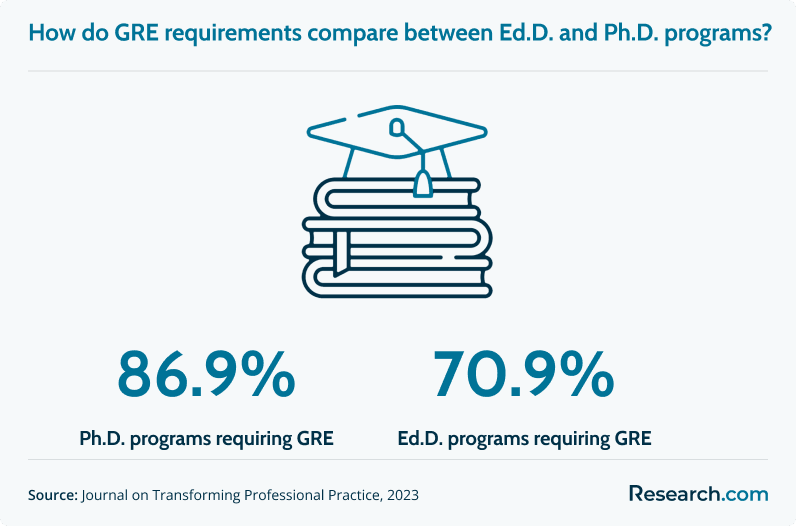
- GRE scores are rarely required, although some highly competitive programs may still ask for them.
Typical Ph.D. admission requirements
- A master’s degree in education or a related discipline is usually expected.
- Research or teaching experience can be valuable, even when professional leadership experience is not the main criterion.
- Applicants often need recommendation letters, a personal statement, and writing samples that demonstrate research ability.
- Many programs require GRE scores, particularly at selective universities.
Ph.D. programs may admit fewer students because each candidate often needs close supervision from a faculty researcher. Ed.D. programs can also be selective, but they may prioritize applicants who can show measurable leadership impact. If your goal is school or district leadership, an affordable pathway such as the most affordable online master’s in educational leadership can help you build relevant experience before the doctorate.
How do the cost, funding, and return on investment compare for each degree?
The cost difference between an Ed.D. and a Ph.D. depends on tuition, program length, funding access, residency requirements, lost work time, and whether you study full time or part time. The Ed.D. is often shorter, while the Ph.D. may offer more assistantship or fellowship opportunities at some institutions.
| Cost factor | Ed.D. | Ph.D. in Education |
| Typical duration | 2 to 3 years | 4 to 7 years |
| Average tuition stated | $15,000 to $40,000 per year | $20,000 to $50,000 per year |
| Average debt stated | $79,790 | $81,900 |
| Common funding pattern | Personal resources, loans, employer support, limited assistantships | Assistantships, fellowships, scholarships, grants, loans, personal resources |
| Best ROI scenario | You move into a higher-paying leadership role without leaving the workforce for long. | You secure funded study or enter a research or academic role that requires the credential. |
How much does an Ed.D. cost?
Ed.D. tuition averages between $15,000 and $40,000 per year. The average debt for an Ed.D. recipient is about $79,790. Many Ed.D. students continue working while enrolled, but they should still budget for fees, books, technology, travel for residencies, and reduced work hours if the program becomes demanding. Reported data show that 46.3% of doctoral students in education offset costs using personal resources.
How much does a Ph.D. cost?
Ph.D. tuition averages between $20,000 and $50,000 per year, and programs generally take longer to complete. The average debt figure stated for Ph.D. holders is $81,900. Some students receive meaningful funding, especially in research-intensive programs. Around 35% of Ph.D. students are supported by research assistantships, while 24.6% receive fellowships, scholarships, or dissertation grants.
How should you think about ROI?
Return on investment depends on more than salary. Consider whether the degree is required for the role you want, how much income you may lose while studying, whether your employer offers tuition support, and how quickly the degree could help you move into a better position. A U.S. Census study found that individuals with doctoral degrees earned 63% more than people with only a bachelor’s degree. In education leadership roles such as postsecondary education administrators or school principals, salaries can range from $97,500 to over $199,400.
What are the flexibility and online learning options for Ed.D. and Ph.D. programs?
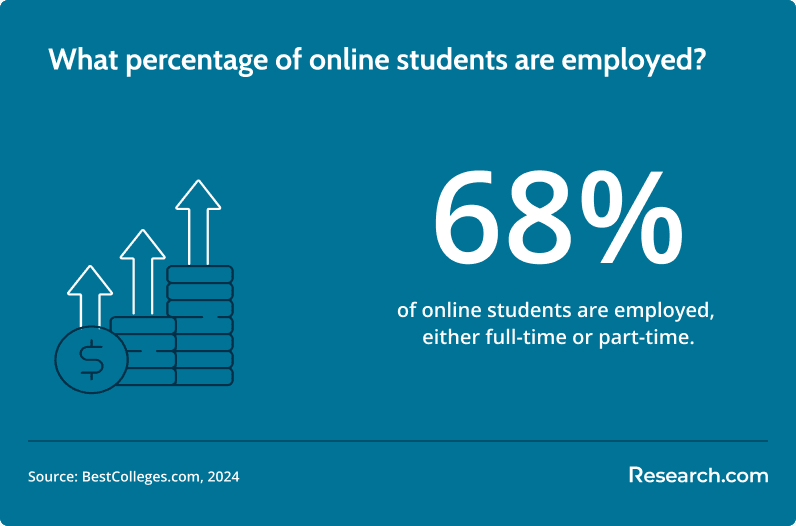
Online and hybrid doctoral programs have made advanced education more accessible for working professionals, but flexibility should not be confused with lower expectations. A credible online doctorate should still include rigorous coursework, faculty interaction, research supervision, academic support, and clear standards for the dissertation, capstone, or doctoral study.
Online and hybrid Ed.D. programs
Ed.D. programs are especially common in online and hybrid formats because many students are full-time educators or administrators. Some programs are fully online, while others require short campus residencies, synchronous sessions, or field-based work. For example, Johns Hopkins University offers an online Doctor of Education with part-time study and focus areas such as entrepreneurial leadership and neurodiversity. Liberty University offers an online Ph.D. in Education with a Curriculum and Instruction concentration.
Online Ph.D. programs
Online Ph.D. programs can be credible when they are properly accredited and provide strong research mentorship. The key question is whether the program can support your research agenda, not simply whether classes are online. Walden University offers a Ph.D. in Education with a research-oriented structure. Capella University and Arizona State University also provide online doctoral options in areas related to counselor education, supervision, leadership, and innovation.
| Question to ask | Why it matters |
| Is the institution properly accredited? | Accreditation affects credibility, transferability, employer recognition, and financial aid eligibility. |
| Are there required residencies? | Travel can add cost and scheduling pressure. |
| How are doctoral students mentored online? | Weak advising can delay dissertation or capstone completion. |
| Does the program support your specialization? | A flexible format is not useful if the faculty cannot support your research or leadership goals. |
| What is the expected weekly workload? | Working professionals need a realistic plan for coursework, research, and job responsibilities. |
Can fast-track Ed.D. programs deliver quality outcomes?
Accelerated Ed.D. programs can be valuable for experienced professionals who already have a clear leadership goal, strong academic preparation, and enough time to handle compressed coursework. A shorter timeline, however, should not be the main reason to enroll. Quality depends on accreditation, faculty access, research expectations, student support, and whether the capstone or applied dissertation receives serious review.
Fast-track formats may combine intensive courses, structured milestones, cohort learning, and focused applied projects. Before choosing one, ask whether the program reduces unnecessary scheduling delays or simply compresses the same workload into a more stressful calendar. Students comparing accelerated options can review short Ed.D. programs to understand how timelines, requirements, and formats differ.
What accreditation and program support factors should I evaluate?
Accreditation is one of the first quality checks for any doctoral program. It helps confirm that the institution has been reviewed against recognized standards. You should also examine whether the doctoral program has enough advising, research guidance, library access, writing support, and career services to help students finish the degree and use it professionally.
Support matters because doctoral students often leave programs not because they lack ability, but because they cannot get timely feedback, funding clarity, or structured guidance through the dissertation or capstone stage. When evaluating support services, compare advising models, faculty response expectations, cohort structures, alumni networks, and technology access. Similar evaluation habits are useful when comparing other graduate programs, such as an online library science degree, where accreditation and student support also affect long-term value.
How does the research focus differ between an Ed.D. and a Ph.D.?
Both degrees require advanced research, but they use research for different purposes. Ed.D. research is usually judged by whether it can improve practice in a real educational setting. Ph.D. research is usually judged by whether it contributes original knowledge to the academic field.
Ed.D. research: Applied inquiry for real settings
Ed.D. candidates often investigate a problem of practice, such as achievement gaps, retention challenges, teacher development, curriculum implementation, technology adoption, or leadership effectiveness. Methods may include action research, program evaluation, case studies, mixed methods, surveys, interviews, and data analysis. The end goal is a practical recommendation or intervention that a school, college, district, agency, or organization could use.
If your goal is administration, an online master’s in education administration can provide a direct foundation before moving into doctoral-level leadership study.
Ph.D. research: Original scholarship for the field
Ph.D. candidates identify gaps in the literature, design studies, collect and analyze evidence, and defend findings that contribute to education scholarship. Their work may influence policy, theory, curriculum, assessment, psychology, technology, or pedagogy. Publication and conference presentation are often important parts of the Ph.D. pathway.
Dissertation vs. capstone project
A Ph.D. dissertation is usually a large-scale original research study. It typically includes a literature review, research questions, methodology, data analysis, findings, and a formal defense before a faculty committee. The work is expected to add something new to scholarly understanding.
An Ed.D. capstone, doctoral study, or applied dissertation usually begins with a practical problem. The student uses research to analyze the issue and recommend evidence-based solutions. For example, an educator who first followed the path to become a kindergarten teacher might later study early literacy leadership, teacher coaching, or districtwide curriculum improvement in an Ed.D. program.
How can I craft a competitive application for a doctoral program?
A strong doctoral application should make the admissions committee confident that you understand the degree, can handle advanced study, and have a clear reason for enrolling. Avoid a generic statement that simply says you are passionate about education. Instead, connect your background to the program’s faculty, curriculum, research model, and outcomes.
| Application element | What to emphasize for an Ed.D. | What to emphasize for a Ph.D. |
| Statement of purpose | A specific leadership problem you want to solve and why the program fits. | A focused research interest and how it aligns with faculty expertise. |
| Résumé or CV | Leadership roles, program results, policy work, training, and organizational impact. | Research experience, teaching, publications, presentations, methods training, and writing. |
| Recommendations | Supervisors or senior leaders who can discuss your leadership capacity. | Faculty or researchers who can evaluate your academic and research potential. |
| Writing sample | Clear analytical writing tied to professional practice. | Research-based writing with strong argument, evidence, and citations. |
Professionals who need a working-adult format should compare online Ed.D. programs and review whether each program’s pacing, mentorship model, and project requirements match their schedule.
What challenges might I encounter during a doctoral program?
Doctoral study is demanding even for strong students. The most common pressures include time management, research design problems, slow feedback cycles, funding uncertainty, professional burnout, and difficulty narrowing a dissertation or capstone topic. Working adults may also struggle to balance family responsibilities, employment, coursework, and research milestones.
Common mistakes to avoid
- Choosing by title alone: Do not pick an Ed.D. or Ph.D. because one “sounds better.” Choose based on the work you want to do after graduation.
- Ignoring accreditation: A low-cost or fast program can become a poor investment if employers or institutions question its legitimacy.
- Underestimating the final project: The dissertation or capstone often takes longer than coursework and requires sustained faculty guidance.
- Comparing tuition only: Fees, residencies, books, technology, travel, and lost income can change the real cost.
- Assuming online means easier: A reputable online doctorate can be as demanding as an on-campus program.
- Choosing without mentor fit: Especially for Ph.D. students, weak alignment with faculty research can delay progress.
Students comparing doctoral programs in adjacent leadership fields may find it useful to review organizational leadership Ph.D. programs to see how support structures, research expectations, and professional outcomes vary across disciplines.
What factors should I consider when choosing between an Ed.D. and a Ph.D.?
The best choice depends on your career target, preferred daily work, research interests, timeline, funding plan, and tolerance for academic research. Start with the job you want, then work backward to the credential most commonly expected for that job.
| Choose an Ed.D. if... | Choose a Ph.D. if... |
| You want to lead schools, districts, colleges, nonprofits, or learning organizations. | You want to conduct original research or become a professor. |
| You prefer practical problem-solving over theory building. | You enjoy scholarly writing, methods, theory, and publication. |
| You want to keep working while earning the degree. | You can commit to a longer research-intensive path. |
| Your career advancement depends on leadership credibility. | Your career advancement depends on research credentials. |
| You want a capstone or applied dissertation connected to your workplace or field. | You want to produce a traditional dissertation that contributes to scholarship. |
Questions to ask before enrolling
- What job title do I want five years after graduation?
- Do people in that role usually hold an Ed.D., Ph.D., or either degree?
- Will the program help me build the exact skills I need?
- Can I afford the total cost without relying on unrealistic salary assumptions?
- Will I have access to faculty who understand my research or leadership interests?
- Does the program offer enough flexibility for my work and family responsibilities?
- How many students complete the dissertation, capstone, or doctoral study on time?
Some educators may not need a doctorate immediately. For example, professionals focused on language instruction may first benefit from online ESL teaching certification before deciding whether doctoral study is necessary.
How are Ed.D. and Ph.D. degrees recognized internationally?
The Ph.D. is generally more widely recognized across countries as the standard research doctorate, especially for university teaching and academic research. This can matter if you want to work internationally, apply for academic positions outside the United States, or collaborate in global research settings.
The Ed.D. is respected in many professional education settings, particularly in the United States, but its recognition can vary by country and employer. In some international contexts, hiring committees may be less familiar with the Ed.D. because it is more practice-oriented than the traditional Ph.D.
If global mobility is important, contact employers, universities, ministries of education, or credential evaluation agencies in the countries where you may work. Do not assume that all doctoral titles are interpreted the same way across borders.
How can I assess the institutional reputation and research impact of a doctoral program?
Reputation matters most when it is relevant to your goal. For a Ph.D. applicant, faculty publications, research funding, citation impact, doctoral placement, and conference presence may be critical. For an Ed.D. applicant, employer reputation, leadership networks, alumni outcomes, practitioner faculty, and partnerships with districts or colleges may matter more.
Look beyond rankings. Review faculty biographies, recent dissertations or capstones, graduate placement information, alumni roles, accreditation status, student support, and research centers. The same disciplined comparison process can be used when reviewing very different graduate options, such as affordable online MFA programs, where cost, mentorship, outcomes, and institutional credibility must all be weighed together.
How can digital innovation enhance my doctoral research?
Digital tools can improve doctoral work by supporting literature management, survey design, qualitative coding, quantitative analysis, collaboration, citation tracking, project management, and virtual advising. The strongest programs do not simply use a learning management system; they teach students how to use digital tools responsibly and effectively.
Ask whether the program provides access to research databases, statistical software, qualitative analysis tools, secure data storage, virtual library support, and technical help. Students studying technology-rich research environments may also find ideas from fields such as user-centered design; an online user experience degree can offer useful context for designing accessible surveys, digital learning tools, or research interfaces.
What are the future trends in doctoral education and the evolving job market?
Education systems are facing continued pressure around student achievement, equity, workforce preparation, technology integration, data use, and institutional accountability. These issues create demand for leaders who can make evidence-informed decisions and researchers who can study what works, for whom, and under what conditions.
Doctoral graduates may find opportunities not only in schools and universities but also in government, nonprofits, consulting, education technology, corporate learning, and workforce development. However, competition for senior leadership and tenure-track academic roles can be strong, so students should choose programs that build marketable skills, not just credentials.
Educators may also expand their qualifications through targeted credentials such as online reading specialist certification programs, especially when literacy expertise is central to their career plan.
Emerging specializations and interdisciplinary roles
| Role | Focus | Salary stated |
| Educational Technology Specialist | Helps schools and organizations integrate digital tools into instruction and training. | $87,000 |
| Organizational Leadership Consultant | Advises schools, businesses, and agencies on leadership strategy and institutional performance. | $105,000 |
| Policy Analyst in Education | Researches and evaluates policies for local, state, or federal decision-makers. | $85,000 |
| Higher Education Administrator | Manages academic affairs, student services, operations, or institutional planning. | $99,000 |
| Curriculum and Instruction Specialist | Designs, reviews, and improves instructional programs and learning outcomes. | $80,000 |
High-paying roles for doctoral graduates
| Role | Typical scope | Salary stated |
| College or University President | Leads institutional strategy, academics, operations, and external relations. | Often exceeds $150,000 |
| Chief Academic Officer | Oversees curriculum, academic programs, and instructional quality. | $140,000 |
| Education Consultant | Advises schools, companies, and public agencies on education strategy. | $100,000+ |
| Chief Learning Officer | Leads enterprise learning, training, and workforce development strategy. | $160,000 |
| Corporate Trainer | Designs and delivers employee learning programs across industries. | $110,000 |
According to the Bureau of Labor Statistics, education administrators and postsecondary administrators can expect an 8% job growth rate between 2020 and 2030. Other roles such as school principal, HR director, and instructional coordinator also show career potential, with median salaries ranging from $70,000 to $120,000 depending on experience and industry.
How do I evaluate the affordability and flexibility of online doctoral programs?
To judge an online doctorate fairly, compare total cost, not just tuition. Include fees, technology requirements, books, travel, residency expenses, dissertation or capstone continuation fees, and the cost of reducing work hours if needed. Then compare flexibility: asynchronous courses, live meeting times, fieldwork requirements, cohort pacing, leave policies, and dissertation support.
Affordable does not always mean high value, and expensive does not always mean better. The best online program is the one that is accredited, financially realistic, academically rigorous, and aligned with your career target. Students building from earlier credentials can use resources such as the cheapest online teaching degree guide as a benchmark for comparing cost structures across education programs.
How can I evaluate the long-term quality and career impact of a doctoral program?
Long-term value depends on completion support, alumni outcomes, faculty expertise, employer recognition, and the relevance of the curriculum to your goals. Ask programs for evidence, not slogans. Useful indicators include graduation timelines, dissertation or capstone completion support, alumni career progression, publication records, employer partnerships, and student satisfaction with advising.
Also consider whether the program’s network fits your intended field. A district leader, corporate learning executive, policy analyst, and future professor may need different professional communities. This same outcomes-focused review can be useful when comparing unrelated programs, including online creative writing degree programs, where mentorship and portfolio outcomes can matter as much as course lists.
How can I evaluate faculty mentorship and collaborative research opportunities?
Faculty mentorship can determine whether your doctoral experience is focused and productive or slow and frustrating. Before applying, review faculty publications, research interests, grants, projects, professional experience, and recent student work. Then ask how students are matched with advisors, how often they receive feedback, and whether co-authorship, research assistantships, or interdisciplinary projects are available.
For Ed.D. students, mentor fit may mean finding faculty with leadership, policy, organizational change, or practitioner expertise. For Ph.D. students, it often means finding a scholar whose research methods and topics align closely with your dissertation plans. Students comparing graduate mentorship models across disciplines may also review career-oriented resources such as jobs with an MFA in creative writing to see how advanced-degree outcomes vary by field.
References
- U.S. Bureau of Labor Statistics. Postsecondary teachers. U.S. Department of Labor.
- U.S. Bureau of Labor Statistics. Postsecondary education administrators. U.S. Department of Labor.
- EducationData.org. Average cost of a doctorate degree. EducationData.org.
- Northeastern University. EdD vs. PhD in education: What’s the difference? Northeastern University Graduate Programs.
- Drexel University School of Education. EdD vs. PhD in education: What’s the difference? Drexel University.
- American University School of Education. EdD vs. PhD. American University.
- Kumar, S., Johnson, M., & Hardeman, M. Examining doctoral programs in education. U.S. Department of Education.
- Additional Ed.D. and Ph.D. comparison resources: Teach.com Ed.D. vs. Ph.D. guide, Teach.com Ed.D. value guide, and BestColleges doctorate admission requirements.
Key Insights
- An Ed.D. is the stronger choice for most professionals who want to lead schools, districts, colleges, nonprofits, agencies, or corporate learning teams.
- A Ph.D. is the stronger choice for students who want to conduct original research, publish scholarship, teach at a university, or pursue academic policy work.
- The Ed.D. is often shorter, with typical completion in 2 to 3 years; the Ph.D. usually takes longer, often 4 to 7 years.
- Cost should be evaluated by total price, funding, time to completion, and opportunity cost—not tuition alone.
- Online doctoral programs can be credible, but only when they are accredited and provide strong research supervision, advising, and completion support.
- The final project is a major difference: Ed.D. students usually complete an applied capstone or doctoral study, while Ph.D. students complete a traditional dissertation built around original research.
- The best decision starts with your target job. Choose the degree that matches the work you want to do every day after graduation.
Other Things You Should Know About Pursuing an Ed.D. or Ph.D
Most programs require official transcripts, a résumé or CV, letters of recommendation, a statement of purpose, and a writing sample. Many Ph.D. programs also ask for GRE scores and proof of research experience, while Ed.D. admissions may place more weight on leadership background and a master's degree.
In 2027, Ed.D. programs typically require a dissertation focused on practical issues in education leadership, while Ph.D. programs demand a research-oriented dissertation contributing new knowledge to the field. This reflects the Ed.D.'s applied approach versus the Ph.D.'s academic focus.
An Ed.D. typically requires around 54–90 credit hours, depending on the institution, while a Ph.D. usually requires 90–120 credit hours, heavily focused on research. Specific requirements can vary, so it's essential to check individual university guidelines for accurate details.


