
2027 Best Online Teacher Certification Programs

Co-Founder and Chief Data Scientist
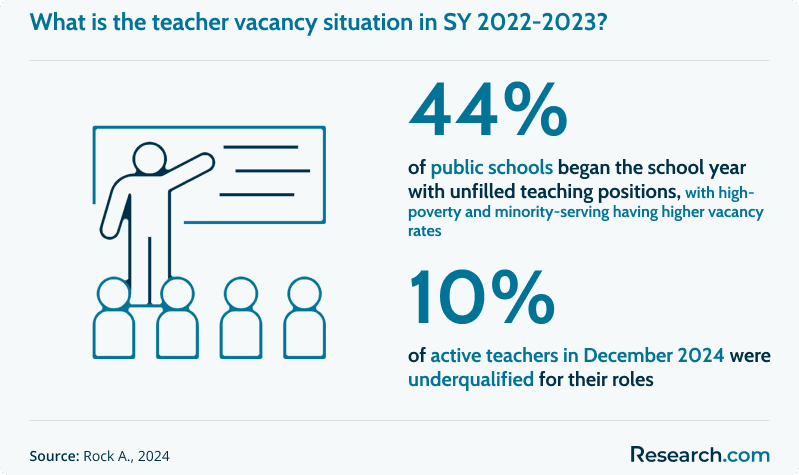
Choosing an online teacher certification program is not just about finding the fastest route into a classroom. The right program must match your state’s licensing rules, your prior education, the grade level or subject you want to teach, your budget, and the kind of school setting where you hope to work. This matters because teacher shortages remain uneven across the United States: in 2022-2023, 44% of public schools began the school year with unfilled teaching positions, with the most severe vacancies often appearing in high-poverty and minority-serving schools.
This guide explains how online teacher certification works, which specializations are most useful, what candidates should expect from coursework and field experience, how much programs can cost, and how to evaluate whether a program will actually lead to certification in your state. It is designed for career changers, bachelor’s degree holders, paraprofessionals, current educators seeking endorsements, and students comparing online routes into teaching.
Quick Answer: Are Online Teacher Certification Programs Worth Considering?
Online teacher certification programs can be a practical path into teaching if the program is approved or accepted by the state where you plan to teach. They are often best for candidates who already hold a bachelor’s degree, need a flexible schedule, and want a faster or more affordable route than a traditional campus-based teacher preparation program. However, online delivery does not remove state requirements. Candidates may still need approved coursework, background checks, certification exams, supervised field experience, student teaching, or endorsements tied to a specific grade level or subject.
- Online certification can be especially useful for career changers and working adults who need flexible coursework.
- State recognition is the most important factor. A program that works in one state may not qualify you in another.
- Costs can range from $1,900 to $2,100 through the American Board for Certification of Teacher Excellence (ABCTE), while other online programs may cost from $2,000 to $4,000 or more.
- Special education, bilingual education, ESL/TESL, STEM, and career and technical education can strengthen employment options in many districts.
- Online-certified teachers generally compete for the same roles and salary schedules as teachers from traditional programs, assuming they hold the required state credential.
- Best Online Teacher Certification Programs for 2027
- Are online teacher certification programs recognized by all states?
- What are the prerequisites for online teacher certification programs?
- What types of specializations are available in online teacher certification programs?
- How much does an online teacher certification cost?
- Are there any financial aid options available for online teacher certification programs?
- What can I expect in an online teacher certification program?
- What technology and resources are needed for online teacher certification programs?
- How can I verify the accreditation and quality standards of an online teacher certification program?
- What are the salary expectations for teachers with online certifications?
- How can online teacher certification programs lead to advanced degrees and leadership opportunities?
- How do online teacher certification programs compare to traditional programs?
- What challenges do candidates face in online teacher certification programs?
- How do teachers maintain and renew their online certifications?
- What are the job outlook and career growth potential for online-certified teachers?
- What alternative career pathways can online teacher certification lead to?
- How can I choose the right specializations or endorsements for my career goals?
- Do online programs fully address state-specific certification requirements?
- How can accelerated online certification programs expedite my teaching career?
- Are online certification programs a gateway to diverse advanced academic opportunities?
- What mistakes should I avoid before enrolling?
- Key Insights
Best Online Teacher Certification Programs for 2027
The “best” online teacher certification program depends on your goal. A future preschool teacher, a high school math teacher, a special education teacher, and a career changer entering teaching through an alternative route may all need different credentials. Instead of choosing a program only because it is online or inexpensive, start by identifying the certification area that matches your intended students, subject, and state requirements.
Many candidates also compare certification-only programs with broader affordable online education degree options, especially if they need both academic preparation and a credential pathway. The sections below explain the most common online certification areas and when each one makes sense.
1. Early Childhood Education (ECE)
Early childhood education certification prepares teachers to work with young children, typically from birth through about age eight. This route is most relevant for candidates who want to teach in preschools, childcare centers, early learning programs, or the lower elementary grades where state rules allow it. Coursework usually emphasizes child development, play-based learning, family engagement, early literacy, social-emotional development, and age-appropriate assessment.
ECE can be a strong fit for people who enjoy working with young learners and want to support foundational development before later academic milestones. It may be less suitable for candidates who prefer subject-specific teaching or adolescent learners.
2. Elementary Education Certification
Elementary education certification is designed for teachers who want to teach multiple subjects to children in kindergarten through fifth grade. Candidates usually study reading instruction, mathematics methods, science and social studies teaching, classroom management, assessment, and child development. Because elementary teachers often cover several subjects, this path requires broad instructional preparation rather than deep specialization in one academic field.
This route is a good choice if you want to build students’ academic foundations and prefer a self-contained or team-based elementary classroom. Before enrolling, confirm which grades your state includes under elementary certification.
3. Secondary Education Certification
Secondary education certification is intended for middle school and high school teachers. Unlike elementary certification, this path usually requires a subject focus such as mathematics, science, history, English, literature, or another approved content area. Candidates learn how to teach adolescents, plan standards-aligned lessons, assess subject mastery, and prepare students for college, careers, or technical pathways.
This option is best for candidates with strong content knowledge in a specific field. If your bachelor’s degree is not in the subject you want to teach, check whether your state requires additional coursework or a content exam.
4. Special Education
Special education certification prepares teachers to support students with disabilities, learning differences, behavioral needs, or other identified support requirements. Programs often cover individualized education plans, legal and ethical responsibilities, accommodations, assistive technology, behavior supports, collaboration with families, and inclusive instruction.
This path can be demanding but meaningful. It is especially appropriate for candidates who are patient, organized, collaborative, and comfortable adapting instruction to individual student needs. Special education teachers earn around $65,910 annually, making this one of the higher-paid K-12 teaching areas cited in this article.
5. Teaching English as a Second Language (TESL)
TESL certification prepares educators to teach English to students whose first language is not English. Coursework commonly includes language acquisition, grammar instruction, academic vocabulary, pronunciation, culturally responsive teaching, and strategies for helping English learners access grade-level content.
This specialization is useful for teachers who want to work in linguistically diverse schools, adult education settings, community programs, or international education contexts. Candidates should check whether their state uses the terms TESL, ESL, ESOL, or English learner endorsement, because naming and requirements vary.
6. Bilingual Education
Bilingual education certification prepares teachers to teach academic content in English and another language or to support students as they develop literacy and subject knowledge across two languages. Programs often focus on dual-language instruction, biliteracy, culturally responsive pedagogy, language development, and assessment for multilingual learners.
This path is a strong fit for candidates who are proficient in another language and want to serve multilingual communities. Some states or districts may require language proficiency exams in addition to education coursework.
7. Instructional Design and Technology
Instructional design and technology certification is usually best for educators who want to design digital learning experiences, improve online courses, support teachers with classroom technology, or move into curriculum and learning design roles. Coursework may include digital assessment, learning management systems, multimedia design, accessibility, online pedagogy, and technology integration.
This certification may not always lead directly to initial classroom licensure, so candidates should distinguish between a teaching license and a professional certificate in instructional design. It can be valuable for licensed teachers who want to expand into hybrid learning, online education, or district-level technology support.
8. Online Teaching
Online teaching certification focuses on how to teach effectively in virtual, hybrid, or remote classrooms. Candidates learn how to manage online discussions, design interactive lessons, assess student work digitally, build presence in a virtual classroom, and support learners who may need additional structure.
This option is useful for licensed educators who want to teach in virtual schools, online academies, tutoring platforms, or blended programs. Candidates seeking initial licensure should confirm whether the program includes all state-required teacher preparation components, not just online teaching methods.
9. Career and Technical Education (CTE)
Career and technical education certification prepares teachers to teach career-focused subjects such as healthcare, technology, engineering, trades, business, agriculture, or other occupational areas. CTE teachers may work in high schools, vocational schools, technical centers, or community college settings, depending on credential rules.
This pathway can be attractive for professionals with industry experience who want to move into education. Requirements may differ from traditional academic subject certification, so candidates should ask whether work experience, industry credentials, or technical exams are required.
10. Alternative Teaching Certification
Alternative teaching certification is built for people who already hold a bachelor’s degree in a non-education field and want to become teachers. These programs usually focus on essential pedagogy, classroom management, lesson planning, subject-specific teaching methods, and supervised practice. Some routes allow candidates to begin teaching while completing remaining certification requirements, depending on state policy.
This is often the most direct online pathway for career changers. It can be a strong option if you already have a degree and relevant subject knowledge, but it requires careful state-by-state verification.
11. Literacy Education
Literacy education certification focuses on reading, writing, comprehension, language development, and interventions for students who struggle with literacy. This pathway can support classroom teachers, reading specialists, interventionists, and educators working with students across grade levels.
Literacy credentials can be useful because reading and writing affect nearly every academic subject. Candidates should check whether the credential qualifies them for a classroom role, a reading specialist position, or an add-on endorsement only.
In 2023, there were a total of 4,431,500 K-12 teachers in the US. The two largest teaching groups were elementary school teachers, with 1,441,000 employed, and high school teachers, with 1,071,400.
Online Teacher Certification Specializations Compared
| Certification area | Best for | Important decision point |
| Early childhood education | Candidates who want to teach very young children in preschool or early grades | Check which ages and settings your state credential covers |
| Elementary education | Future teachers who want to teach multiple subjects in kindergarten through fifth grade | Confirm required reading, math, science, and classroom practice components |
| Secondary education | Candidates with strong subject knowledge who want to teach middle or high school | Verify subject exam and coursework requirements |
| Special education | Educators who want to support students with disabilities or individualized learning needs | Ask how the program prepares you for IEPs, legal duties, and supervised practice |
| TESL or ESL | Teachers who want to work with English learners | State terminology and endorsement rules may differ |
| Bilingual education | Teachers who can instruct in English and another language | Language proficiency testing may be required |
| Instructional design and technology | Licensed teachers or education professionals interested in digital learning design | May not be an initial teacher licensure route |
| Online teaching | Educators preparing for virtual or blended classrooms | Confirm whether it is a teaching license, endorsement, or professional certificate |
| Career and technical education | Industry professionals and teachers who want to prepare students for careers | Work experience or industry credentials may matter |
| Alternative certification | Bachelor’s degree holders transitioning from another field into teaching | State approval is essential before enrollment |
| Literacy education | Teachers focused on reading, writing, and intervention | Clarify whether it is a classroom credential or add-on endorsement |
Are Online Teacher Certification Programs Recognized by All States?
No. Online teacher certification programs are not automatically recognized by every state. A program may be legitimate, accredited, and useful, yet still fail to meet the exact certification requirements where you want to teach. States control teacher licensure, and they may require specific exams, supervised teaching hours, background checks, content coursework, or state-approved educator preparation.
Many candidates begin by reviewing online colleges that offer teaching degrees, but degree format is only one part of the decision. You should verify state approval before comparing tuition, speed, or convenience.
Some providers, including the American Board for Certification of Teacher Excellence (ABCTE), offer self-paced online certification routes. These can be attractive for working adults, but candidates still need to confirm whether the route is accepted in their intended state, subject, and grade band.
The need for qualified teachers remains significant. In the 2022-2023 school year, 44% of public schools began with unfilled teaching positions, and the shortages were especially visible in high-poverty and minority-serving schools. In December 2024, 10% of active teachers were underqualified for their roles, reinforcing why state-aligned preparation matters.
Questions to Ask Before Assuming a Program Will Lead to Certification
- Is this program approved by the state education agency where I plan to teach?
- Does it prepare me for the exact grade level and subject area I want?
- Are student teaching, field experience, or clinical practice included?
- Which exams must I pass before, during, or after the program?
- Will the program help with placement for required classroom experience?
- If I move to another state, what reciprocity or additional requirements may apply?
What Are the Prerequisites for Online Teacher Certification Programs?
Prerequisites vary by state and program type, but most online teacher certification routes require a bachelor’s degree, a background check, and proof that the candidate can meet subject or grade-level standards. The exact requirements depend heavily on whether your bachelor’s degree is already in education or in another discipline.
For Candidates with a Teaching Bachelor’s Degree
If you already completed an education-related bachelor’s degree, you may have satisfied some foundational requirements. Common prerequisites include:
- Education-related bachelor’s degree: Many programs expect a bachelor’s degree in education or a closely connected field.
- Minimum GPA: A GPA of 2.5 to 3.0 is commonly required.
- State-specific conditions: States may require exams, fieldwork, student-teaching hours, or approved coursework.
- Background check: Criminal background screening is generally part of the certification process.
For Candidates with a Non-Teaching Bachelor’s Degree
If your degree is outside education, such as a philosophy degree, you may still qualify for alternative certification. Typical prerequisites include:
- Bachelor’s degree in any field: The degree usually must come from an accredited institution.
- Bridge or prerequisite coursework: Some programs require introductory education courses before full admission.
- Alternative certification pathway: These routes are built for career changers who need pedagogy and classroom training.
- State exams: Candidates usually need to pass required content, pedagogy, or grade-level exams.
- Field experience or student teaching: Many states require supervised classroom experience even when coursework is online.
If you want a credential that may also support salary advancement or future graduate study, compare certification-only pathways with a master’s option. Research.com also reviews one-year online master’s in education programs for candidates who want a broader academic credential.
What Types of Specializations Are Available in Online Teacher Certification Programs?
Online teacher certification programs may offer grade-level, subject-area, student-support, or professional practice specializations. The right choice should be based on three factors: what you are qualified to teach, what your state allows, and where local schools have hiring needs.
- Age or grade-level specializations: These include early childhood, elementary, middle school, secondary, and sometimes special education by grade band.
- Subject-area specializations: Common options include English, mathematics, science, social studies, computer science, bilingual education, and other secondary teaching fields.
- Student-support specializations: These include special education, ESL, TESL, bilingual education, gifted education, and literacy intervention.
- Professional or technical specializations: These may include instructional technology, online teaching, career and technical education, curriculum design, or leadership preparation.
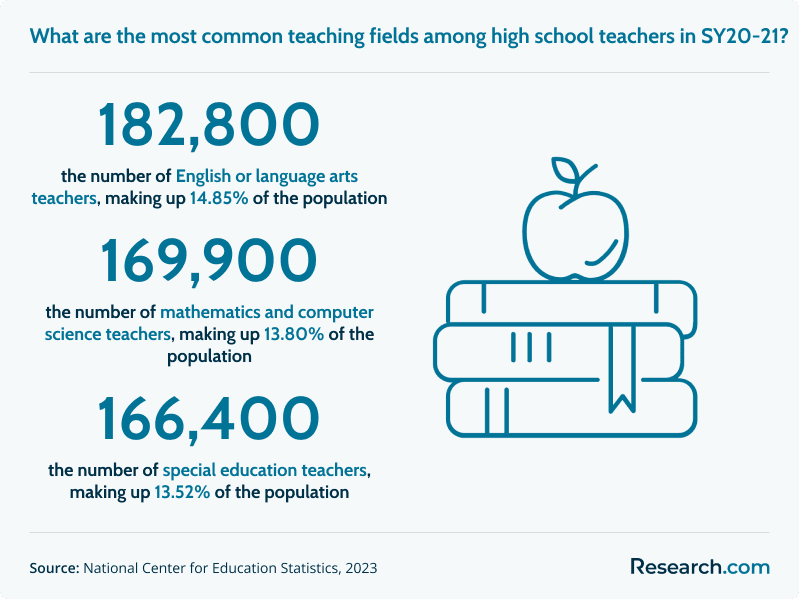
In SY 2020-2021, the most popular teaching fields among high school teachers were English, with 182,800 teachers (14.85%), followed closely by mathematics and computer science, with 169,900 teachers (13.80%).
Candidates interested in student support careers beyond classroom teaching may also compare teacher certification with related graduate options, such as NASP-accredited online school psychology programs.
How Much Does an Online Teacher Certification Cost?
Online teacher certification costs vary by provider, state, program length, included support services, and whether the route is certification-only or part of a degree. ABCTE programs typically range from $1,900 to $2,100, depending on whether a candidate chooses the standard or premium package. Other online teacher certification programs may cost from $2,000 to $4,000 or more.
Tuition is not the only cost to compare. Candidates should also ask about exam fees, background checks, transcript evaluations, technology fees, student teaching placement fees, textbooks, and whether retake support is included. If cost is a major concern, it can help to compare certification routes with the cheapest accredited online college options that still meet state requirements.
| Cost factor | Why it matters | What to ask before enrolling |
| Program tuition | This is the advertised price, but it may not include all required expenses | What is included in the total program cost? |
| Certification exams | State exams may be required before certification | Are exam preparation materials included? |
| Field experience or student teaching | Online coursework may still require in-person classroom practice | Does the program arrange placements or must I find my own? |
| Background check and application fees | These are often required for licensure and school placements | Which fees are paid to the state, school, or program? |
| Technology and materials | Online learning may require specific hardware, software, or proctoring tools | Are there additional platform, proctoring, or resource fees? |
Are There Any Financial Aid Options Available for Online Teacher Certification Programs?
Some online teacher certification programs offer financial aid, but eligibility depends on the institution, program structure, and whether the program qualifies for federal aid. Candidates should not assume that every certificate program is FAFSA-eligible. Instead, verify aid eligibility directly with the school or provider before enrolling.
Research.com’s guide to online colleges that accept FAFSA can help candidates understand how federal aid works in online education. It is also useful to review common financial aid misconceptions, including the belief that aid is only available for traditional campus-based degree programs.
Common Funding Options
- Federal grants: Need-based grants, such as the Pell Grant, do not have to be repaid when eligibility requirements are met.
- Federal student loans: These must be repaid but may offer lower interest rates and more flexible repayment options than some private loans.
- Scholarships: Institutions, professional associations, employers, and community organizations may offer awards based on need, merit, subject area, or service commitment.
- Employer tuition assistance: Some employers reimburse or help pay for education that supports career advancement.
Because certification programs cited in this article can range from $1,900 to $4,000, even modest aid or employer support can change the affordability calculation. Still, candidates should avoid borrowing without confirming that the program leads to the credential they need.
What Can I Expect in an Online Teacher Certification Program?
Most online teacher certification programs combine asynchronous coursework with deadlines, assessments, instructor interaction, and field-based requirements. The online portion may be flexible, but certification itself is structured. You should expect regular assignments, exams, lesson planning, discussion participation, and documentation of classroom practice where required.
Typical Coursework
- Educational psychology: How students learn, develop, and vary in cognitive, social, emotional, and academic needs.
- Teaching methods: Instructional strategies, differentiated teaching, project-based learning, inquiry-based learning, and technology-supported instruction.
- Classroom management: Building a productive classroom culture, preventing disruptions, responding to behavior concerns, and supporting engagement.
- Assessment: Designing formative and summative assessments, interpreting results, grading fairly, and using data to adjust instruction.
- Special education foundations: IEPs, accommodations, inclusion, disability categories, and legal responsibilities.
- Curriculum development: Planning lessons and units that align with standards and support varied learners.
- Learning technologies: Using digital tools, learning platforms, virtual collaboration, and online teaching resources.
- Legal and ethical issues: Student privacy, mandatory reporting, discrimination, professional conduct, and ethical decision-making.
Learning Activities and Certification Requirements
Programs may include readings, recorded lectures, live sessions, simulations, case studies, discussion boards, quizzes, written assignments, and portfolio work. Some programs also require virtual teaching demonstrations or in-person classroom experiences. Even if coursework is self-paced, candidates typically must meet deadlines and pass required assessments.
Certification may also require state exams and a teaching portfolio. Before you enroll, ask how the program supports exam preparation, field placement, mentor feedback, and documentation for your state education agency.
What Technology and Resources Are Needed for Online Teacher Certification Programs?
At minimum, candidates usually need a reliable computer, stable internet connection, webcam, microphone, word processing software, and access to the program’s learning management system, such as Blackboard or Canvas. Some programs may also require video recording tools, virtual meeting software, online proctoring systems, or access to digital teaching platforms used for assignments and field experiences.
Technology readiness matters because online certification requires more than watching lectures. You may need to upload teaching videos, participate in synchronous meetings, complete timed exams, collaborate with peers, and manage digital classroom tools. If you are also exploring technology-focused career options outside teaching, Research.com’s guide on data science degree pathways can help you compare education and technology routes.
How Can I Verify the Accreditation and Quality Standards of an Online Teacher Certification Program?
To evaluate quality, first confirm whether the program is recognized by the state education agency where you intend to teach. Accreditation matters, but state approval is usually the deciding factor for licensure. A reputable program should clearly state its approval status, certification outcomes, required exams, clinical practice expectations, and whether it meets requirements in specific states.
Quality Checks Before You Apply
- Confirm institutional accreditation through recognized accrediting bodies.
- Check state educator preparation approval, not just general school accreditation.
- Ask for certification exam pass-rate information when available.
- Review field placement policies and mentor qualifications.
- Ask whether credits transfer into graduate programs.
- Request written confirmation of which certification areas the program supports.
- Read student outcomes carefully, but remember that employment and salary are never guaranteed.
If your long-term plan includes graduate study, an accredited certification program may make it easier to move into affordable online master’s programs for teachers.
What Are the Salary Expectations for Teachers with Online Certifications?
Teachers who earn certification online generally follow the same district or employer salary schedules as teachers who completed campus-based programs, provided they hold the same state credential. Salary depends more on role, location, experience, district pay scale, union agreements where applicable, and advanced credentials than on whether coursework was online.
Among the salary figures cited in this article, special education teachers earn around $65,910 annually, while high school teachers earn around $65,220. Middle school, kindergarten, and elementary teachers fall in the range of $63,670 to $64,290. Preschool teachers earn $37,130, and teacher assistants earn $35,550.
| Role | Median annual salary cited | Decision note |
| Special education teacher | $65,910 | Often requires specialized preparation and strong compliance knowledge |
| High school teacher | $65,220 | Usually tied to a specific content area |
| Middle school, kindergarten, and elementary teachers | $63,670 to $64,290 | Requirements vary by grade band and state |
| Preschool teacher | $37,130 | Credential expectations vary by setting and funding source |
| Teacher assistant | $35,550 | May be a steppingstone for candidates pursuing teacher certification |
How Can Online Teacher Certification Programs Lead to Advanced Degrees and Leadership Opportunities?
Online teacher certification can be an entry point into classroom teaching, but it can also support longer-term academic and leadership goals. After gaining classroom experience, some teachers pursue master’s degrees, endorsements, administrative credentials, or doctoral programs to move into roles such as instructional coach, curriculum specialist, department chair, principal, district administrator, or education consultant.
Teachers interested in advanced leadership may later consider accelerated EdD programs or other graduate pathways. Certification alone does not guarantee advancement, but it can provide the classroom foundation that many leadership roles require.
How Do Online Teacher Certification Programs Compare to Traditional Programs?
Online and traditional teacher certification programs can both lead to licensure if they meet state requirements. The difference is usually the delivery model, not the professional standard. Online programs offer flexibility and may be better for working adults, while campus-based programs may provide more face-to-face mentoring, local school partnerships, and structured peer interaction.
| Factor | Online certification | Traditional certification |
| Schedule | Often more flexible and sometimes self-paced | Usually follows a fixed academic calendar |
| Class format | Delivered through online platforms, videos, discussions, and virtual meetings | Delivered mainly in person, often with campus-based coursework |
| Field experience | May still require in-person classroom placement | Often integrated through local school partnerships |
| Best fit | Career changers, working adults, rural candidates, and candidates needing flexibility | Students who want campus support, in-person networking, and structured mentoring |
| Main risk | Choosing a program that does not meet state requirements | Higher time or location constraints for some students |
For educators who want to continue into administration or advanced practice while working, affordable online EdD programs may be worth comparing after initial certification and classroom experience.
What Challenges Do Candidates Face in Online Teacher Certification Programs?
Online certification can be flexible, but it is not effortless. Candidates often underestimate the workload, the need for self-direction, and the complexity of meeting state documentation requirements. The most successful students treat the program like a professional commitment, not a side project.
Common Challenges
- Time management: Asynchronous courses require candidates to plan weekly study time without a fixed classroom schedule.
- Field placement logistics: Student teaching or observations may need to happen in approved schools and during school hours.
- Technology issues: Poor internet, outdated devices, or unfamiliar learning platforms can delay assignments and exams.
- State alignment confusion: Candidates may misunderstand whether a program is accepted for their intended license.
- Limited in-person networking: Online students may need to be more intentional about building mentor and peer relationships.
- Classroom readiness: Learning theory online is different from managing real students in a real classroom.
Candidates who expect to move into management or leadership later may also explore broader leadership study, including a doctorate in organizational leadership, after gaining experience.
How Do Teachers Maintain and Renew Their Online Certifications?
Once certified, teachers must keep their credentials active according to state renewal rules. Renewal commonly involves professional development hours, continuing education units, refresher coursework, classroom performance documentation, or additional training. Requirements vary, so teachers should track deadlines through their state education agency rather than relying only on district reminders.
Some teachers use graduate coursework to meet renewal requirements while also expanding career options. For example, teachers with a language arts background may consider affordable online English master’s degrees if the coursework aligns with their professional development goals and state renewal rules.
What Are the Job Outlook and Career Growth Potential for Online-Certified Teachers?
Employment outlook differs by teaching level and specialty. Preschool teacher jobs are expected to grow by 4% between 2023 and 2033, adding approximately 23,300 jobs. However, several K-12 roles are projected to show slight declines over the same period, including kindergarten, elementary, middle, and high school teachers. Special education and career and technical education teachers are expected to see little to no change in demand.
These projections do not mean teaching opportunities are disappearing everywhere. Shortages are often local and subject-specific. Schools with higher poverty levels, minority-serving schools, rural areas, and hard-to-staff subjects may still have significant needs even when national projections are flat or declining.
Retention is also a major issue. A recent study found that 75% of teachers considering leaving their jobs in the next five years cited improved salary as a key factor, while 43% emphasized better work-life balance and 34% pointed to stronger support for managing student behavior. Candidates should evaluate not only job availability but also school culture, mentoring, planning time, classroom support, and compensation.
Educators who want to move toward administrative or organizational roles may consider credentials such as an affordable online BS in organizational leadership, depending on their previous education and career goals.
| Teaching area | Outlook information cited | What candidates should consider |
| Preschool teachers | Expected to grow by 4% between 2023 and 2033, adding approximately 23,300 jobs | Requirements differ by setting, state, and employer |
| Kindergarten teachers | Projected loss of 800 jobs | Local district needs may differ from national projections |
| Elementary teachers | Projected loss of 10,700 jobs | Strong classroom management and literacy preparation remain important |
| Middle school teachers | Projected loss of 4,700 jobs | Subject area and location can affect prospects |
| High school teachers | Projected loss of 6,900 jobs | Content specialization is a major hiring factor |
| Special education and career and technical education teachers | Expected to see little to no change in demand | Specialized credentials may still be valuable in hard-to-staff schools |
What Alternative Career Pathways Can Online Teacher Certification Lead To?
Teacher certification can support careers beyond traditional classroom instruction, especially when paired with classroom experience, graduate study, or specialized skills. Possible paths include curriculum design, instructional coaching, education consulting, tutoring program management, online course development, assessment coordination, academic advising, educational publishing, and school leadership.
Some educators also move into library and information fields, where teaching experience can support research, instruction, and academic services. Research.com’s guide to careers available with a master’s in library science explains one possible direction outside the standard classroom path.
How Can I Choose the Right Specializations or Endorsements for My Career Goals?
Choose a specialization by working backward from the job you want. Look at actual job postings in your target state or district, identify the required credential, then confirm which online programs prepare you for that exact license or endorsement. Interest matters, but state eligibility and employer demand matter just as much.
Specialization Decision Guide
- Special education: Choose this if you want to work with students with disabilities and are prepared for documentation, collaboration, and individualized support responsibilities.
- ESL or TESL: Choose this if you want to support English learners and work in linguistically diverse schools.
- STEM: Choose this if you have strong preparation in science, technology, engineering, mathematics, or computer science and want to teach high-demand content areas.
- Leadership and administration: Choose this later if you want roles such as department head, instructional coordinator, principal, or education administrator.
- Career and technical education: Choose this if you have industry knowledge and want to prepare students for specific occupations.
- Gifted and talented: Choose this if you want to design advanced learning experiences for high-achieving students.
- Literacy: Choose this if you want to focus on reading, writing, intervention, and academic language development.
If your interests include people operations, training, or workforce development outside K-12 schools, you may also compare teaching with human resources pathways. Research.com’s article on whether a human resources degree is worth it can help you think through that alternative.
Do Online Programs Fully Address State-Specific Certification Requirements?
Some do, and some do not. The safest approach is to verify state requirements before applying, again before paying tuition, and again before beginning field experience. State certification rules can include required coursework, content exams, pedagogy exams, supervised clinical practice, ethics training, background checks, and application steps that are separate from program completion.
For a state-by-state starting point, review Research.com’s guide to teacher certification requirements by state. Then confirm details with your state education agency because licensure rules can change and may depend on grade level, subject, and prior experience.
How Can Accelerated Online Certification Programs Expedite My Teaching Career?
Accelerated online certification programs can shorten the time between deciding to teach and becoming eligible for classroom roles, especially for candidates who already have a bachelor’s degree and can handle intensive coursework. These programs may compress pedagogy courses, exam preparation, and practical training into a faster schedule.
Speed should not be the only priority. A faster program is useful only if it meets state requirements, prepares you for real classroom demands, and provides enough support for exams and field placement. Candidates comparing expedited options can read Research.com’s guide to the quickest way to get a teaching degree online.
Are Online Certification Programs a Gateway to Diverse Advanced Academic Opportunities?
Online certification can help educators move into advanced academic work, especially when they want to combine teaching with another discipline. Some teachers pursue graduate study in curriculum, leadership, technology, literacy, special education, counseling, history, or humanities to broaden their expertise and qualify for specialized roles.
For example, teachers with an interest in humanities or social studies may compare certification with graduate options such as affordable online master’s degrees in history. The best next step depends on whether your goal is classroom advancement, subject expertise, leadership, research, or a career outside K-12 teaching.
What Mistakes Should I Avoid Before Enrolling?
The biggest mistakes in online teacher certification usually happen before enrollment. Candidates often focus on speed, convenience, or price before confirming whether the program leads to the credential they need.
| Common mistake | Why it can hurt you | Better approach |
| Choosing a program without checking state approval | You may complete coursework that does not qualify you for licensure | Confirm approval with your state education agency before enrolling |
| Looking only at tuition | Exam fees, placement costs, and materials can change the total cost | Ask for a full cost breakdown in writing |
| Assuming online means no field experience | Many states still require supervised classroom practice | Ask how placements are arranged and documented |
| Ignoring certification area details | A general education credential may not match the grade or subject you want | Match the program to actual job postings and state license categories |
| Relying only on rankings or marketing claims | A highly visible program may not be the right fit for your state or goals | Compare approval, outcomes, support, cost, and placement requirements |
| Assuming salary outcomes are guaranteed | Teacher pay depends on district, state, role, experience, and credentials | Review local salary schedules and hiring requirements |
Questions to Ask an Admissions Advisor
- Which state licenses or endorsements does this program prepare candidates for?
- Is the program approved by my state education agency?
- What exams are required, and when should I take them?
- Does the program arrange student teaching or field placements?
- What happens if I do not pass a certification exam the first time?
- Are there additional fees beyond tuition?
- Can I transfer credits into a master’s program later?
- What support is available for online students, career changers, and first-generation graduate students?
References
- Lovison, V. S., & Mo, C. H. (2024, November 12). What’s a special education aide worth? A $9,607 raise, to the average teacher. Retrieved December 30, 2024, from Education Next.
- Rock, A. (2024, December 9). Teacher shortages by state and how schools are trying to fix the problem. Retrieved December 30, 2024, from Campus Safety.
- U.S. Bureau of Labor Statistics. (2024). Career and technical education teachers. Occupational Outlook Handbook. Retrieved December 30, 2024, from BLS.
- U.S. Bureau of Labor Statistics. (2024). Educational instruction and library occupations. Retrieved December 30, 2024, from BLS.
- U.S. Bureau of Labor Statistics. (2024). High school teachers. Retrieved December 30, 2024, from BLS.
- U.S. Bureau of Labor Statistics. (2024). Kindergarten and elementary school teachers. Retrieved December 30, 2024, from BLS.
- U.S. Bureau of Labor Statistics. (2024). Middle school teachers. Retrieved December 30, 2024, from BLS.
- U.S. Bureau of Labor Statistics. (2024). Preschool teachers. Retrieved December 30, 2024, from BLS.
- U.S. Bureau of Labor Statistics. (2024). Special education teachers. Retrieved December 30, 2024, from BLS.
- National Center for Education Statistics. (2023). Table 209.50 - Percentage of public school teachers of grades 9 through 12, by field of main teaching assignment and selected demographic and educational characteristics: School year 2020-21. Retrieved December 30, 2024, from NCES.
Key Insights
- Online teacher certification can be a strong option for working adults and career changers, but only if the program is accepted by the state where the candidate plans to teach.
- The most important enrollment question is not “Is this program online?” but “Will this program qualify me for the exact license, grade level, and subject area I need?”
- ABCTE programs typically cost $1,900 to $2,100, while other online certification programs may cost from $2,000 to $4,000 or more. Candidates should compare total cost, not just tuition.
- Special education, ESL/TESL, bilingual education, STEM, literacy, and CTE endorsements can be valuable when they align with district hiring needs and state rules.
- Online-certified teachers generally follow the same salary structures as traditionally certified teachers when they hold the same state credential; salary depends on role, location, experience, and employer pay scale.
- Preschool teaching is projected to grow by 4% between 2023 and 2033, adding approximately 23,300 jobs, while several K-12 categories show slight projected declines nationally.
- Teacher shortages remain highly localized. High-poverty and minority-serving schools may face significant staffing challenges even when national projections are flat.
- Avoid programs that cannot clearly explain accreditation, state approval, field placement, exam requirements, and total costs in writing.
Other Things You Should Know About Online Teacher Certification Programs
Most 2027 online teacher certification programs require a student teaching experience to be completed in a local school. This generally involves a semester-long placement, supervised by a qualified teacher, to fulfill practical teaching requirements for licensure.
Yes, in 2027, it is possible to obtain a US teaching license entirely through online programs. However, requirements vary by state, so it is crucial to ensure that the program you choose is accredited and meets your state's specific licensure criteria.
Most candidates must pass their state’s required licensure tests, such as Praxis Core or Praxis Subject Assessments, plus any state-specific pedagogy exam. Some states also require edTPA or a similar performance assessment before issuing a full teaching license.


