2027 Online Electrical Engineering Degrees for Students Who Want Broad Electrical Systems Preparation

Co-Founder and Chief Data Scientist
Choosing an online electrical engineering degree is a high-stakes decision because the field now touches power grids, semiconductors, robotics, communications, vehicles, and AI-enabled systems. The U.S. Bureau of Labor Statistics projects 9% employment growth for electrical and electronics engineers from 2023 to 2033, signaling strong demand for systems-minded talent.
This guide is for students comparing online bachelor's or master's programs who want broad preparation rather than a narrow technical niche. You will learn how accreditation, curriculum, cost, format, and career outcomes affect whether a program fits your goals.
Key Things You Should Know
- For broad electrical systems preparation, prioritize ABET-accredited bachelor's programs or reputable engineering master's programs with coursework in circuits, signals, power, controls, electronics, embedded systems, and communications.
- Online electrical engineering programs can work well for working adults, but students should verify lab delivery, proctored exams, hardware kits, transfer policies, and whether any campus visits are required before enrolling.
- BLS data published in 2024 projects 9% growth for electrical and electronics engineers from 2023 to 2033, while May 2024 wage data places the median annual wage for electrical engineers at $111,910.
What is an online electrical engineering degree and how does it prepare you for broad electrical systems?
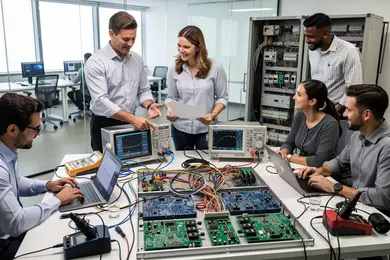
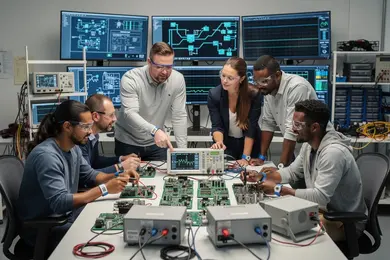
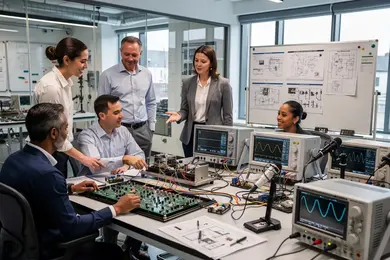
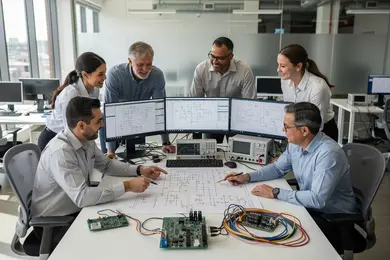
An online electrical engineering degree is a bachelor's or graduate program that teaches students how to design, analyze, test, and improve electrical and electronic systems through remote coursework, digital labs, simulations, hardware kits, and sometimes short campus residencies. The "broad electrical systems" focus matters because many engineering jobs require understanding how components interact across an entire system, not just how one device works in isolation.
At the bachelor's level, the degree usually starts with calculus, physics, programming, circuits, electronics, electromagnetics, and digital logic. From there, students move into systems-level subjects such as signals, controls, power conversion, communication systems, microprocessors, and design projects. At the master's level, students usually build on an engineering or closely related STEM background and choose advanced courses that support technical leadership, research, or specialization.
Broad preparation is especially useful for students who are not yet sure whether they want to work in power, defense, aerospace, automation, semiconductors, transportation, telecommunications, or embedded systems. Instead of training for only one product category, a systems-oriented degree helps students connect theory, hardware, software, testing, safety, and reliability.
The table below summarizes common online electrical engineering degree types and how each typically supports systems-focused preparation. Use it to match your current education level with the kind of engineering responsibility you want to pursue:
| Degree type | Typical student profile | Systems preparation | Best fit |
| Online bachelor's in electrical engineering | First-time degree seekers, transfer students, military students, and career changers with strong math readiness | Full foundation in engineering science, labs, design, and broad technical electives | Students seeking entry-level engineering roles or future PE licensure eligibility |
| Online bachelor's completion program | Students with an associate degree or substantial transfer credit | Upper-division circuits, systems, electronics, controls, and capstone design | Students who want to finish faster while preserving engineering depth |
| Online master's in electrical engineering | Engineers or STEM graduates seeking advancement | Advanced coursework in power, signal processing, communications, controls, photonics, or embedded systems | Professionals targeting senior engineering, technical specialist, or research-adjacent roles |
| Online engineering management or systems engineering master's | Technical professionals moving toward leadership | Less circuit depth, more systems integration, project control, risk, and lifecycle thinking | Engineers who want program management or systems integration roles rather than design-heavy EE roles |
A strong online electrical engineering program should not feel like a collection of isolated math and electronics courses. The best fit is usually a program that repeatedly asks students to model, build, test, debug, and explain how electrical subsystems behave inside larger engineered products.
How do online electrical engineering programs compare to campus-based options for systems-focused training?
Online and campus-based electrical engineering programs can cover the same theory, but they differ in delivery, access to equipment, peer interaction, scheduling, and the way students complete labs. The better option depends less on prestige alone and more on whether the format supports your learning style, work schedule, and need for hands-on practice.
Online programs are often strongest for disciplined students who can study consistently, communicate with instructors early, and use simulation tools or hardware kits without constant in-person supervision. Campus programs may be stronger for students who want daily lab access, face-to-face tutoring, student design teams, or close interaction with faculty research labs.
The table below compares online and campus formats for students who want broad electrical systems preparation. It highlights the trade-offs most likely to affect learning quality and career readiness:
| Factor | Online electrical engineering | Campus-based electrical engineering | Decision point |
| Lecture delivery | Recorded, live, or hybrid online classes | In-person lectures and recitations | Online works well if you can manage independent study and ask questions proactively |
| Labs | Simulation software, mailed hardware kits, remote labs, or limited residencies | Dedicated campus labs with instruments and technician support | Check whether online labs cover measurement, debugging, safety, and design validation |
| Scheduling | Often more flexible for working adults | More structured weekly schedule | Flexibility helps only if deadlines and support are clear |
| Networking | Virtual teams, online office hours, employer webinars, and discussion boards | Student chapters, research labs, design competitions, and campus recruiting | Online students may need to build networking into their weekly plan intentionally |
| Systems design practice | Possible through virtual collaboration and capstone projects | Often supported by makerspaces, labs, and team-based facilities | Review capstone examples before assuming one format is stronger |
Online programs can be academically rigorous, but students should avoid assuming that convenience equals ease. Electrical engineering is math-heavy and cumulative, so weak preparation in calculus, differential equations, physics, or programming can slow progress in either format.
Before choosing online study, ask the school exactly how students complete labs and design projects. The most important format questions are practical, not promotional:
- Are labs completed through physical hardware kits, simulation only, remote instrumentation, campus visits, or a combination?
- Do students use industry-relevant tools such as circuit simulation, MATLAB-style computing, CAD tools, FPGA development boards, or embedded systems platforms?
- Are group projects required, and how are time zones, team communication, and prototype testing handled?
- Are exams proctored online, completed on campus, or administered through approved testing centers?
- Can online students access tutoring, faculty office hours, career services, and engineering student organizations?
A campus program may be the better choice if you need daily structure, frequent in-person lab help, or access to specialized facilities. An online program may be the better choice if you already work in a technical setting, need geographic flexibility, or can use transfer credit to reduce time and cost.
Which accreditation and ABET standards should online electrical engineering degrees meet?
Accreditation is one of the most important quality checks for any online electrical engineering degree. Institutional accreditation confirms that the college or university meets recognized academic and administrative standards. Programmatic accreditation, especially ABET accreditation for engineering programs, is often the key signal that an electrical engineering bachelor's degree meets industry-recognized expectations.
ABET accreditation is especially important at the bachelor's level because many employers, graduate schools, and state engineering boards use it as evidence that a program includes appropriate math, science, engineering design, ethics, experimentation, teamwork, and problem-solving outcomes. ABET does accredit some online engineering programs, so online delivery alone is not a reason to dismiss a degree.
Students should understand what accreditation can and cannot do. It can help verify baseline quality and may support licensure eligibility, but it does not guarantee admission, employment, salary, or a specific career outcome.
The table below explains the major accreditation and approval checks to complete before applying. These checks are especially important for students who may want professional engineering licensure later:
| Quality check | What it confirms | Why it matters |
| Institutional accreditation | The college or university is reviewed by a recognized accreditor | Often required for federal financial aid, credit transfer, graduate admission, and employer tuition assistance |
| ABET accreditation for the specific program | The electrical engineering program meets recognized engineering education standards | Important for many engineering employers and commonly relevant to PE licensure pathways |
| State authorization for online students | The school is allowed to enroll students in your state | Online availability may vary by state, even for reputable institutions |
| Licensure alignment | The curriculum supports requirements for engineering licensure where applicable | PE requirements vary by state, so students should check their state board before enrolling |
Do not rely only on a school's general accreditation page. Search for the exact program name, degree level, and delivery format, because a university may have ABET accreditation for one engineering program but not another.
To avoid accreditation mistakes, take these steps before you submit an application:
- Confirm the institution's accreditation status through recognized accreditation directories or the school's official accreditation page.
- Verify whether the specific online electrical engineering bachelor's program is ABET-accredited, not merely housed within an accredited university.
- Ask whether the program name on the transcript matches the accredited program name.
- If PE licensure matters to you, contact your state licensing board and ask how it evaluates online engineering degrees.
- Save written confirmation from admissions or the department about accreditation, labs, and state authorization.
A common red flag is vague wording such as "aligned with ABET principles" or "designed around ABET outcomes" when the program is not actually ABET-accredited. That language may describe curriculum intent, but it is not the same as formal accreditation.
What core courses and concentrations emphasize broad electrical systems in online programs?
Broad electrical systems preparation comes from a curriculum that connects math, physics, hardware, software, signals, control, power, and design. Students should look for programs that build from fundamentals to integrated projects rather than offering only scattered technical electives.
At the bachelor's level, core courses usually provide the widest systems foundation. At the master's level, students should choose electives that strengthen the systems domain most relevant to their target industry.
The table below shows common course areas and how each contributes to systems-level electrical engineering preparation. It can help you read program curricula with more confidence:
| Course area | What students learn | Systems value |
| Circuit analysis | Voltage, current, resistance, impedance, transient response, and network behavior | Forms the foundation for nearly all electrical and electronic systems |
| Electronics | Diodes, transistors, amplifiers, power devices, and analog circuits | Helps students understand how signals are conditioned, amplified, converted, and controlled |
| Digital systems and microprocessors | Logic, processors, memory, embedded programming, and interfaces | Connects hardware and software in modern devices and automation systems |
| Signals and systems | Time-domain and frequency-domain analysis, filtering, sampling, and transforms | Essential for communications, controls, audio, imaging, sensing, and data acquisition |
| Control systems | Feedback, stability, dynamic response, controllers, and modeling | Supports robotics, aerospace, manufacturing, vehicles, and energy systems |
| Power systems | Generation, transmission, distribution, machines, converters, and grid behavior | Prepares students for energy, utilities, electrification, and power electronics work |
| Electromagnetics | Fields, waves, transmission lines, antennas, and propagation | Supports RF, communications, sensors, power equipment, and high-speed electronics |
| Capstone design | Team-based problem definition, design, testing, documentation, and presentation | Shows whether students can integrate multiple subsystems into a working solution |
Concentrations are useful when they deepen your goals without making your education too narrow. For broad preparation, choose a concentration that still includes design, modeling, and cross-domain problem-solving.
The most relevant concentration choices often include:
- Power and energy systems for students interested in utilities, renewable integration, grid modernization, battery systems, electric vehicles, and industrial power.
- Controls and robotics for students interested in automation, aerospace, manufacturing, mechatronics, autonomous systems, and process control.
- Communications and signal processing for students interested in wireless systems, radar, sensing, audio, imaging, and data acquisition.
- Embedded systems for students interested in hardware-software integration, microcontrollers, IoT devices, instrumentation, and product development.
- Electronics and semiconductor devices for students interested in analog design, power electronics, chip-related industries, and advanced hardware development.
AI and automation are also changing the way electrical engineers work. Students do not need to turn an EE degree into a data science degree, but they should value programs that include programming, numerical methods, simulation, model-based design, and exposure to machine learning applications in controls, sensing, or signal processing.
For students who later move deeply into advanced analytics research, a doctorate in data analytics online may be a separate path, but it is not a substitute for the engineering design foundation of an EE program.
What are typical admission requirements for online electrical engineering bachelor's and master's degrees?
Admission requirements vary by school and degree level, but electrical engineering programs usually pay close attention to math readiness, science preparation, academic performance, and prior technical coursework. Because the curriculum is sequential, missing prerequisites can add time even after admission.
Bachelor's programs may admit first-year students, transfer students, or degree-completion students. Master's programs often require a bachelor's degree in electrical engineering, computer engineering, or a closely related field; applicants from physics, math, or other engineering disciplines may need bridge courses.
The table below summarizes common admission expectations. Use it as a planning tool, but always verify the exact requirements with each school:
| Program level | Common academic requirements | Common application materials | Possible gaps to address |
| Online bachelor's in electrical engineering | High school diploma or equivalent, strong math and science preparation, and placement into calculus or precalculus depending on the program | Application, transcripts, test scores if required, personal statement, and financial aid forms | Calculus readiness, physics preparation, programming experience, and study time for lab-heavy courses |
| Online bachelor's completion program | Transfer credits in calculus, physics, chemistry, programming, or lower-division engineering courses | Application, college transcripts, course descriptions, and transfer credit evaluation | Non-equivalent credits, outdated technical courses, missing labs, and minimum grade requirements |
| Online master's in electrical engineering | Bachelor's degree in EE or related STEM field, prerequisite coursework, and minimum GPA set by the school | Application, transcripts, resume, statement of purpose, recommendations, and sometimes GRE scores | Signals, circuits, electromagnetics, probability, programming, or advanced math prerequisites |
Applicants can improve readiness by checking prerequisites early rather than waiting for an admissions decision. This is especially important for working adults who may need to refresh calculus, differential equations, or circuit analysis before attempting upper-division courses.
Before applying, complete this practical readiness checklist:
- Request an unofficial transfer review if you have prior college credit, military training, or an associate degree.
- Compare your completed math sequence with the program's first required engineering courses.
- Ask whether labs from previous institutions transfer or must be repeated.
- Confirm whether courses are offered every term or only once per year, because missing a prerequisite can delay graduation.
- For master's programs, ask whether bridge courses count toward the degree or add extra credits outside the program.
A common mistake is choosing a program because admission looks easier while ignoring whether you are ready to succeed in the first engineering sequence. A better approach is to choose the most supportive program that honestly matches your current math and science preparation.
How long do online electrical engineering degrees take and what do they cost?
Online electrical engineering timelines depend on degree level, transfer credit, course load, lab sequencing, and whether classes are offered year-round. Cost depends on tuition, fees, residency status, technology requirements, textbooks, lab kits, software, and the opportunity cost of reducing work hours.
College Board's 2024 pricing data shows average published tuition and fees of $11,610 for in-state students at public four-year institutions and $43,350 at private nonprofit four-year institutions for the 2024-25 academic year. Those figures are not electrical-engineering-specific, but they help frame why students should compare total cost instead of relying on per-credit tuition alone.
The table below gives typical completion patterns and major cost drivers for online electrical engineering students. Use it to estimate affordability before asking schools for formal cost sheets:
| Path | Typical time to complete | Main cost drivers | Best affordability strategy |
| Full online bachelor's degree | About four years full time; longer part time | Tuition, engineering fees, lab kits, software, textbooks, and proctoring | Use in-state public options, transfer credit, scholarships, and employer tuition assistance when available |
| Bachelor's completion after associate degree | Often two to three years depending on accepted credits | Upper-division tuition, repeated prerequisites, lab requirements, and course availability | Get a written transfer evaluation before enrolling |
| Online master's degree | Often one to three years depending on pace | Graduate tuition, technology fees, textbooks, and possible prerequisite courses | Choose a course load that avoids burnout and preserves employer reimbursement eligibility |
| Graduate certificate before a master's | Often several courses over one year or less | Graduate per-credit tuition and limited financial aid options | Confirm whether certificate credits will transfer into a full master's later |
Students comparing engineering options may also find it useful to benchmark affordability across related online engineering fields, such as a cheapest civil engineering degree online, because the same cost questions often apply: accreditation, lab delivery, transfer credit, tuition by residency, and total fees.
To estimate the true cost of an online electrical engineering degree, ask each school for a program-level cost breakdown rather than a general tuition page. Important questions include:
- What is the total estimated tuition for the full degree at my expected course load?
- Are online students charged in-state, out-of-state, flat-rate, or program-specific tuition?
- Which courses require lab kits, special software, proctored exams, travel, or campus residencies?
- How many of my credits will transfer directly into the degree plan?
- Will employer tuition assistance, military benefits, scholarships, or federal aid apply to this program?
- What happens financially if I need to repeat a prerequisite or reduce my course load?
The cheapest program is not always the best value if it lacks needed accreditation, delays graduation through poor course availability, or provides weak lab support. The strongest value usually comes from a program that is accredited, transparent about total cost, realistic about time demands, and aligned with your target role.
What electrical engineering careers can you pursue with broad electrical systems preparation?
A broad online electrical engineering degree can prepare students for roles that involve designing, testing, integrating, maintaining, or improving electrical and electronic systems. Specific eligibility depends on degree level, experience, employer requirements, security clearance needs, location, and whether the job involves licensed engineering work.
Bachelor's graduates often pursue entry-level design, test, applications, controls, power, or manufacturing engineering roles. Master's graduates may pursue more specialized or senior positions in areas such as signal processing, power electronics, communications, embedded systems, RF systems, or controls.
The table below connects broad EE preparation to common career paths. It focuses on responsibilities rather than job titles alone, because employers often use different titles for similar work:
| Career path | Typical responsibilities | Helpful coursework | Common employers |
| Electrical design engineer | Designs circuits, panels, systems, or components; reviews specifications; supports testing and documentation | Circuits, electronics, power, electromagnetics, and capstone design | Manufacturing firms, engineering services, utilities, aerospace, defense, and product companies |
| Power systems engineer | Analyzes generation, distribution, protection, load flow, grid reliability, and power quality | Power systems, machines, power electronics, controls, and energy systems | Utilities, renewable energy firms, grid operators, industrial facilities, and consulting firms |
| Controls engineer | Develops feedback systems, automation logic, control panels, and industrial or robotic control solutions | Control systems, programming, signals, electronics, and embedded systems | Manufacturing, robotics, automotive, aerospace, process industries, and automation vendors |
| Embedded systems engineer | Integrates microcontrollers, sensors, firmware, interfaces, and real-time hardware behavior | Digital logic, microprocessors, programming, electronics, and signals | Consumer electronics, medical devices, automotive, aerospace, IoT, and industrial equipment companies |
| Test or validation engineer | Builds test plans, troubleshoots prototypes, analyzes measurements, and verifies performance against requirements | Circuits, instrumentation, statistics, electronics, and capstone design | Hardware manufacturers, defense contractors, semiconductor firms, and engineering labs |
| Communications or RF engineer | Works with antennas, wireless links, modulation, signal quality, and transmission behavior | Signals, electromagnetics, communications, probability, and RF courses | Telecommunications, aerospace, defense, satellite, and wireless technology firms |
Students who want a broader technical career should also build skills beyond the minimum degree plan. Employers often value engineers who can communicate trade-offs, document design decisions, analyze data, and work across mechanical, software, safety, and manufacturing teams.
Useful career-building steps include:
- Build a portfolio of lab reports, simulation projects, capstone work, code repositories, or hardware demonstrations that you can discuss in interviews.
- Use electives to support a target industry, such as power for utilities or embedded systems for product development.
- Seek internships, co-ops, part-time technical work, or employer-sponsored projects whenever possible.
- Join professional student chapters or online engineering communities to practice explaining technical work.
- Learn common tools used in your target area, such as circuit simulation, Python, MATLAB-style computing, CAD packages, PLC software, or microcontroller platforms.
If your interests shift away from engineering design and toward information access, archives, or knowledge organization, adjacent online education research may point you toward fields such as online library schools. That is a different career direction, but comparing program formats can still help you evaluate online student support, accreditation, and flexibility.
What is the salary potential for electrical engineers with systems-focused online degrees?
Salary potential for electrical engineering graduates depends on role, industry, degree level, experience, geography, security clearance, technical specialization, and employer size. An online degree does not automatically lower salary potential if the program is reputable and the graduate can demonstrate engineering competence, but employers may scrutinize accreditation, projects, internships, and technical skills.
The U.S. Bureau of Labor Statistics reported a May 2024 median annual wage of $111,910 for electrical engineers. Median wage is not a starting salary and does not predict what any individual graduate will earn, but it shows that established electrical engineering roles generally sit well above many entry-level bachelor's degree fields.
The table below shows how different factors can influence salary outcomes. Use it to think about return on investment more realistically than comparing tuition against one headline wage figure:
| Salary factor | How it can affect earnings | What students can do |
| Industry | Defense, semiconductor, utilities, aerospace, and advanced manufacturing roles may pay differently for similar skills | Research employers in your target region before choosing electives |
| Location | Pay often varies by metro area and cost of living | Compare wages and living costs together, especially before relocating |
| Experience | Internships, co-ops, military technical work, and prior technician roles can strengthen entry-level competitiveness | Prioritize practical projects and work-integrated learning |
| Degree level | A master's may support specialized or senior roles, but it is not required for every engineering job | Choose graduate study when it clearly supports a target specialization or promotion path |
| Technical depth | Skills in power electronics, RF, embedded systems, controls, or signal processing may open specialized roles | Align electives, projects, and software tools with a specific technical market |
Students should avoid treating median wages as guaranteed outcomes. A better ROI analysis compares total program cost, time to completion, income during study, debt, regional opportunities, and the type of engineering role you realistically plan to pursue.
For many students, the strongest financial case for an online electrical engineering degree appears when the program lets them keep working, use employer tuition benefits, transfer credits, or pursue a promotion without relocating.
The financial case becomes weaker if the program is expensive, lacks accreditation, requires repeated prerequisites, or does not provide the lab and project experience needed for the student's target role.
What is the job outlook and industry demand for electrical engineers in the United States?
Demand for electrical engineers is supported by several U.S. trends: grid modernization, electrification, electric vehicles, semiconductor investment, automation, defense systems, communications infrastructure, and the growth of connected devices. Systems-focused preparation is valuable because many of these areas require engineers who can connect power, electronics, controls, software, sensors, and reliability.
The BLS Occupational Outlook Handbook published in 2024 projects 9% employment growth for electrical and electronics engineers from 2023 to 2033. For students, this means the occupation has a favorable national outlook, but job availability will still vary by region, industry cycle, security clearance requirements, and specialization.
Technology is changing job expectations rather than eliminating the need for engineers. AI-assisted design tools, simulation, digital twins, automated testing, and model-based systems engineering can improve productivity, but engineers still need to define requirements, validate results, understand physical constraints, and make safety-conscious design decisions.
The table below summarizes major demand drivers and the systems skills they tend to reward. It can help students choose electives and projects with labor-market relevance:
| Demand driver | Why it matters | Relevant systems skills |
| Grid modernization and renewable integration | Utilities and energy firms need engineers who can support reliability, power quality, storage, and distributed energy resources | Power systems, controls, protection, power electronics, and data analysis |
| Semiconductor and electronics manufacturing | Hardware supply chains and advanced manufacturing require testing, process control, and device-level understanding | Electronics, instrumentation, cleanroom awareness, statistical analysis, and automation |
| Automation and robotics | Manufacturers need systems that combine sensors, actuators, controllers, safety systems, and software | Controls, embedded systems, PLCs, signal conditioning, and feedback design |
| Transportation electrification | Electric vehicles, charging infrastructure, and battery systems require power and control expertise | Power electronics, machines, battery systems, thermal coordination, and embedded controls |
| Defense, aerospace, and communications | Complex mission systems depend on RF, signal processing, reliability, and systems integration | Signals, communications, electromagnetics, testing, documentation, and systems engineering |
Students interested in technical-adjacent leadership, analytics, or knowledge systems should be clear about whether they want to remain in engineering design or move into another professional domain. For example, a masters in library science online program serves a very different labor market, even though both types of online degrees require careful evaluation of accreditation, cost, and outcomes.
The practical takeaway is to choose an EE program that gives you portable engineering fundamentals plus at least one marketable technical direction. A broad but unfocused transcript is less powerful than a broad foundation paired with coherent projects in power, controls, embedded systems, communications, or electronics.
How can you choose a reputable online electrical engineering program aligned with your career goals?
Choosing a reputable online electrical engineering program requires more than comparing rankings or tuition. The right program should match your desired role, current academic preparation, preferred learning format, financial limits, and long-term licensing or graduate school plans.
Start with career fit. If you want to become an electrical engineer in a design-heavy or licensure-relevant role, an ABET-accredited bachelor's degree is usually the safest choice.
If you are already an engineer and want deeper technical knowledge, an online master's with strong electives and faculty expertise may be more efficient. If you need only a narrow skill upgrade, a graduate certificate or employer-sponsored training may be enough.
The table below lists common program selection criteria and what each reveals. Use it to compare schools consistently rather than relying on one attractive feature:
| Selection criterion | What to verify | Why it matters |
| Program accreditation | Institutional accreditation and ABET status for the exact program when relevant | Protects degree credibility and may affect licensure, transfer, graduate school, and employer acceptance |
| Curriculum breadth | Coverage of circuits, electronics, signals, controls, power, digital systems, labs, and capstone design | Supports broad systems preparation rather than narrow training |
| Lab model | Hardware kits, simulation, remote labs, campus residencies, and measurement tools | Electrical engineering requires practical testing and troubleshooting, not theory alone |
| Course availability | Whether required courses are offered every term, annually, or on rotation | Course sequencing can affect graduation time and cost |
| Student support | Tutoring, advising, office hours, technical help, library access, and career services | Online students need responsive support to stay on track |
| Career alignment | Electives, capstone options, employer connections, internship support, and alumni outcomes | Improves the connection between coursework and target roles |
Once you have a shortlist, use a structured process to reduce the risk of choosing the wrong program. These steps are especially important if you are comparing online programs across states:
- Define your target outcome first, such as entry-level electrical engineer, power systems engineer, controls engineer, embedded systems engineer, or technical manager.
- Eliminate programs that do not meet your accreditation or licensure needs.
- Request a degree plan showing your expected transfer credits, remaining courses, prerequisites, and projected graduation term.
- Ask for a complete cost estimate that includes fees, lab kits, software, books, proctoring, and travel.
- Review sample syllabi or course descriptions for labs, projects, and design work.
- Ask how online students access faculty, tutoring, advising, and career services.
- Compare capstone or project examples to the kind of systems work you want to do professionally.
Watch for red flags such as unclear accreditation language, no detailed lab explanation, aggressive enrollment pressure, vague total cost estimates, poor transfer transparency, or a curriculum that lacks design projects. A reputable program should be willing to answer detailed questions in writing.
The best online electrical engineering degree is not simply the fastest or cheapest option. It is the program that gives you credible engineering preparation, realistic completion terms, manageable cost, and evidence that you can graduate with the systems knowledge your target employers expect.
Other Things You Should Know About Electrical Engineering
It can, but requirements vary by state. Students interested in becoming a Professional Engineer should check whether their degree, exams, experience, and supervision will satisfy their state engineering board before enrolling.
Many programs require hardware kits, components, measurement tools, or software licenses, while others use remote labs or simulations. Ask for a course-by-course list of required materials so you can budget accurately.
Yes. Most ABET-accredited online electrical engineering programs require the same prerequisites as campus programs, including calculus I–III, differential equations, calculus-based physics, and chemistry. Students usually must also complete programming and circuit analysis before upper-division major courses.
Yes, many technicians use online degrees to move toward engineering roles, especially if they already have electronics, maintenance, manufacturing, or military technical experience. The key is confirming transfer credit, calculus readiness, lab requirements, and whether the degree meets employer expectations for engineering positions.
References
- Inside the Best Online Bachelor's in Electrical Engineering Degrees https://www.onlinecolleges.me/engineering-degrees/bachelors/electrical-engineering/
- Online Electrical Engineering Degrees - BSEE, MSEE https://www.onlineengineeringprograms.com/electrical
- Accreditation - ABET https://www.abet.org/accreditation/
- What Can You Do with an Electrical Engineering Degree? - Muhammad Ali Jinnah University https://jinnah.edu/what-can-you-do-with-an-electrical-engineering-degree/
- Exploring Electrical Engineering: Pathways to Innovation and Careers https://www.amanengineering.com.sg/electrical-engineering-complete-guide-to-career-paths-and-specializations/
- Online Electrical Engineering Degree | Programs And Career Options https://www.learnhowtobecome.org/best-online-bachelors-in-electrical-engineering-degree-programs/
- What can you do with an electrical engineering degree? - People of Pacific https://www.pacific.edu/blog/2025/01/24/what-can-you-do-with-an-electrical-engineering-degree/
- Electrical and Computer Engineering Courses | University at Albany https://www.albany.edu/graduate-bulletin/electrical-computer-engineering-courses.php