Balancing Cost and Long-Term Value: The Economics of an ACE Master's Degree

Co-Founder and Chief Data Scientist
For working professionals in America’s largest foundational industries, the job market is expanding, but the baseline for career advancement is shifting. According to the U.S. Bureau of Labor Statistics (BLS), the healthcare sector is projected to see 1.9 million openings annually, with practitioners earning a median wage of $83,090 as of May 2024. Business and financial operations will see roughly 942,500 annual openings with a median wage of $80,920. Meanwhile, despite slower overall growth, education and library occupations will still generate 890,300 annual openings to replace exiting workers, anchored by a median wage of $59,220.
While these baseline salaries are higher than the national average, maximizing earning potential in these fields frequently requires a master’s degree. For the adult learner, the primary hurdle is figuring out how to acquire that degree without taking on crippling debt.

The Graduate Degree Math Problem
For most working adults, the decision to pursue a master’s degree comes down to a straightforward math problem: Will the future salary increase outweigh the immediate cost of tuition? At many universities, it can take a graduate several years just to break even.
American College of Education (ACE) presents a distinct financial counter-model. According to the institution's 2023 Economic Impact Report, ACE master’s degree graduates realize significant average annual salary premiums compared to those with only a bachelor's degree in the U.S.:
- Average earnings of an associate degree graduate: $43,500
- Average earnings of a bachelor’s degree graduate: $62,900
- Average earnings of a master’s degree graduate from ACE: $79,100
The data found that, on average, ACE master’s degree graduates saw an increase of $16,200 in earnings each year compared to someone with a bachelor’s degree [3].
The $10,000 ROI Equation
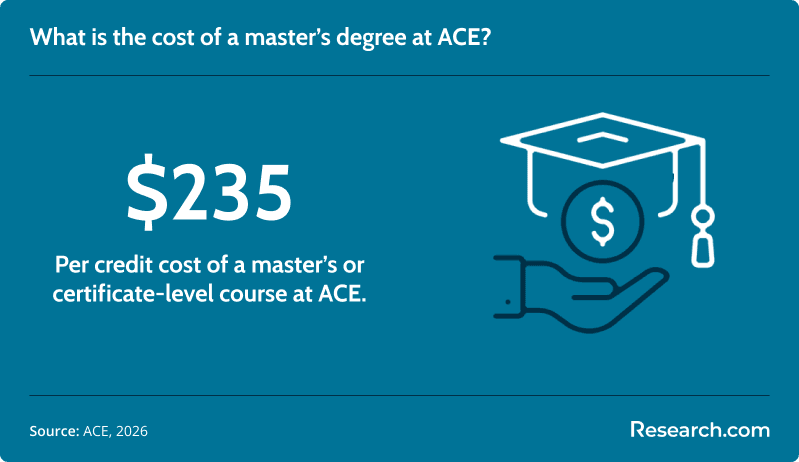
These salary premiums become especially relevant when compared with ACE's tuition structure. Master’s and certificate-level courses are priced at $235 per credit hour. Because of this, most ACE master’s degrees are under $10,000 [1]—roughly one-third the cost of comparable programs nationwide.
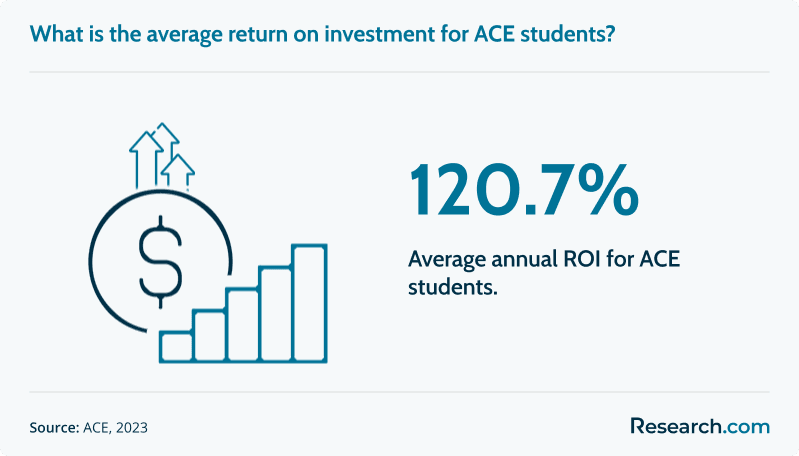
When you compare a $10,000 total out-of-pocket cost against an annual salary bump of $16,200, the traditional timeline of educational debt collapses. According to the institution's 2023 Economic Impact Report, the annual internal rate of return on a student's investment in an ACE degree is 120.7%, yielding a benefit-cost ratio of 19.2 for the graduate [3].
Institutional Footprint and Accreditation
For adult learners evaluating online colleges, the biggest fear is investing in a degree that employers won't respect. This is where institutional scale and accreditation become critical risk mitigators.
ACE is regionally accredited by the Higher Learning Commission (HLC)—the same tier of accreditation held by traditional state universities. Furthermore, ACE is not a niche startup; it supports over 14,000 students and ranks No. 3 in the nation for the most master’s degrees conferred in education [2]. For a prospective student, this institutional scale and regional accreditation demonstrate that ACE is an established institution with a significant national presence.
Degree Pathways Built by Practitioners
The curriculum at ACE is defined by a "practitioner-first" philosophy. The programs are designed by an in-house curriculum production team, who work with faculty members actively working in the field as educational leaders, nurses, and business professionals. This ensures the coursework focuses on practical application alongside foundational concepts that can be applied on the job the next day. Furthermore, ACE utilizes a stackable credential system. Students can earn micro-credentials and certificates that may seamlessly transfer into full master's or doctoral degrees, ensuring no completed coursework goes to waste.
To serve the specific needs of these foundational industries, ACE divides its program offerings into four highly specialized verticals:
- Education Programs: Ranked among the top national providers, ACE offers specializations in Curriculum and Instruction, Special Education, Educational Leadership, and Instructional Technology. A standout feature is their partnership with NISE and STEMScopes, which provides a dedicated pathway for educators seeking specialized STEM certification. For many of the educator and school leadership certification exams reported in ACE's Annual Student Right to Know Report, ACE graduates achieved pass rates that exceeded the applicable state average [4].
- Nursing Programs: Built specifically to accommodate the demanding shifts of registered nurses, ACE offers CCNE-accredited nursing degree programs with fully online coursework and hands-on clinical components that can be completed locally. These low-cost pathways focus heavily on unlocking leadership and administrative potential for RNs looking to move away from the bedside and into management.
- Healthcare Programs: For non-nursing medical professionals, ACE offers degrees focused on the administrative side of the industry, including Healthcare Administration, Public Health, and Health and Wellness Education. These programs align with the in-demand skills required to manage the rapidly growing healthcare support facilities sector.
- Business Programs: Ranging from bachelor’s-completion programs to a full Master of Business Administration (MBA) to an online Doctor of Business Administration (DBA), this vertical offers working professionals access to fast and affordable business degrees with in-demand skills applicable to a wide range of industries.
The Maturity of the Doctoral Programs
While ACE is heavily utilized for its low-cost, high-quality master’s degrees, its doctoral pathways offer a unique proposition for advanced professionals. Priced at an accessible $306 per credit hour - with a total cost under $25,000 [1] - the real value lies in the program's maturity.
ACE launched its doctoral programs in 2013, recently crossing the critical 10-year completion threshold for its first cohorts. For prospective doctoral students, this is a vital metric. Completing a doctoral degree requires a long-term commitment, particularly during the dissertation phase. ACE's Annual Student Right to Know Report reflects doctoral completion rates over a 10-year completion window, demonstrating the institution's sustained support for students from coursework through dissertation completion [4].
Learning on a Professional Schedule
The primary reason working adults fail to finish graduate programs is a clash between rigid academic schedules and unpredictable career demands. ACE bypasses this friction by engineering a highly predictable, asynchronous learning model. There are no mandatory login times or scheduled virtual lectures to attend. Instead, courses are delivered in accelerated 5-week or 10-week formats with built-in breaks between terms.
While the pacing is self-directed, it is not unstructured. Students follow a predictable weekly schedule consisting of:
- Watching presentation-based video modules.
- Engaging in peer discussions.
- Completing written assignments and routine assessments to demonstrate mastery.
This structure allows a registered nurse to study after a 12-hour shift or a teacher to complete modules during a weekend, all without falling behind the cohort.
An Ecosystem Designed to Protect Your ROI
For a working adult, time is the hidden cost of higher education. Getting bogged down by confusing technology or a lack of administrative guidance delays graduation and, consequently, delays the financial return. ACE protects a student's ROI by providing a frictionless digital ecosystem entirely dedicated to student success. By unifying the learning management system with robust human support, ACE allows students to focus strictly on their specialization.
This comprehensive safety net includes:
- The Virtual Classroom: Coursework is delivered via Canvas, allowing students to seamlessly study on a web browser or mobile app. Within Canvas, ACE utilizes Harmonize, an intuitive platform that facilitates peer-to-peer networking, allowing a business professional in Texas to easily collaborate with a healthcare administrator in Ohio.
- Student Success Coaches: Every student is paired with a dedicated coach to navigate scheduling, degree planning, and administrative hurdles, ensuring they stay on the fastest path to graduation.
- Academic and Research Support: Students have 24/7 access to Student Commons, which houses a massive online library, virtual complementary tutoring, and a dedicated Writing Center.
- Dissertation Boot Camps: For doctoral candidates, ACE provides specialized faculty guidance and intensive support events to ensure complex research projects are completed on schedule.
Driving Down the Cost: Grants and Partnerships
While the fact that most master's degrees cost less than $10,000 already disrupts the traditional tuition model, ACE provides several structural avenues to reduce students' out-of-pocket expenses even further. By leveraging employer and institutional partnerships, eligible students may qualify for reduced tuition.
Key tuition reduction and financial management programs include:
- School District Partnerships: Full-time employees of participating school districts are eligible for reduced tuition rates.
- Military Support Grants: Veterans (active, retired, or veteran status) and their spouses receive reduced tuition across certificate, micro-credential, and degree programs.
- Payroll Deduction: To simplify financing, students employed by specific systems (including Chicago Public Schools, Waukegan Community Unit SD 60, Schuyler, and West Aurora) can have tuition payments withheld and remitted directly from their paychecks.
- In-School Deferment: Working adults carrying prior federal student loans from previous degrees can defer those payments while actively enrolled at ACE, easing immediate financial pressure.
The Macro Impact of ACE Alumni
The ultimate proof of ACE’s workforce-alignment strategy is found not just in individual salary premiums but in the macro-economic footprint of its graduates. The education provided by ACE translates directly into massive economic productivity.
According to the college's 2023 Economic Impact Report, ACE alumni generated $587.7 million in added income for the U.S. national economy in a single calendar year—an impact equivalent to supporting 9,786 jobs. Because the curriculum is heavily concentrated in foundational industries, this impact is deeply felt in critical sectors. For example, among non-education sectors, ACE alumni working in the Health Care and Social Assistance industries alone supported 1,329 jobs in 2022.
By translating affordable, highly specialized online education into documented career earnings, American College of Education has built a model where the student, the employer, and the broader economy all realize an immediate and lasting return on investment.
References:
- This is an estimated value of the cost for tuition and fees. Amounts may vary depending on number of transfer credits applied to the selected program hours, the pace and satisfactory completion of the selected program, receipt of institutional scholarship and/or grant amounts, or adjustments to tuition or fees as described in the Catalog Right to Modify Tuition section. State sales and use tax will apply where required by law.
- Integrated Postsecondary Education Data System. Accessed July 29, 2026.
- Lightcast Study
- Student Right to Know. Accessed July 29, 2026.