
2027 Best Online Ed.S Degree in Special Education Programs

Co-Founder and Chief Data Scientist
Did you know that 7.5 million U.S. students received special education services under IDEA in 2022–23? Choosing the right online Ed.S. in Special Education can accelerate your career by offering advanced expertise, flexible learning, and leadership pathways.
This article will explore the top 10 fully online Ed.S. programs for 2025, explain our ranking methodology, and show how these degrees translate into real-world impact—helping you make an informed decision and boost your professional trajectory.
What are the benefits of completing an online Ed.S degree in special education program?
- Graduates often surpass teacher pay, earning a median salary of $64,270 per year.
- Approximately 35,900 annual openings projected from 2023–33, despite “little or no change” in overall employment.
- Opens doors to roles such as special education coordinator, behavior specialist, and program director.
What can I expect from an online Ed.S degree in special education program?
An online Ed.S. in Special Education equips you with advanced strategies for supporting students with diverse needs, focusing on leadership and evidence-based interventions. Expect in-depth coursework on individualized education plans (IEPs), behavior management, and assistive technology, all delivered via interactive digital platforms. You’ll engage in virtual practicums, collaborate with peers nationwide, and emerge ready to lead special education initiatives in varied educational settings.
Where can I work with an online Ed.S degree in special education program?
Graduates with an Ed.S. in Special Education are prepared for roles across K–12 schools, district leadership, and specialized educational settings. Many serve as master teachers, program coordinators, or instructional coaches, driving curriculum design and compliance with IDEA mandates.
Top-employing industries:
- Elementary and Secondary Schools: 88,660 employed
- Other Schools and Instruction: 40 employer
Top states for employment:
- Texas: 8,470 employed
- New York: 7,780 employed
- California: 7,240 employed
- New Jersey: 7,240 employed
- Ohio: 6,230 employed
How much can I make with an online Ed.S degree in special education program?
According to the U.S. Bureau of Labor Statistics, the median annual wage for special education teachers was $64,270 in May 2024. Salaries vary by role and setting, but Ed.S. graduates typically earn at the higher end of the spectrum.
- Zippia: $53,565 / year
- Salary.com: $62,843 / year
- ZipRecruiter: $92,340 / year
- Indeed: $99,956 / year
- PayScale: $48,268 / year
- Glassdoor: $74,742 / year
- Best Online Ed.S Degree in Special Education Programs for 2027 List of Programs
- How long does it take to complete an online Ed.S degree in special education program? Program Duration
- How does an online Ed.S degree in special education compare to an on-campus program? Online vs Campus
- What is the average cost of an online Ed.S degree in special education program? Program Cost
- What are the financial aid options for students enrolling in an online Ed.S degree in special education program? Financial Aid
- What are the prerequisites for enrolling in an online Ed.S degree in special education program? Admission Requirements
- What types of specializations are available in an online Ed.S degree in special education programs? What types of specializations are available in an online Ed.S degree in special education programs?
- How do you choose the best online Ed.S degree in special education program? How do you choose the best online Ed.S degree in special education program?
- What accreditation standards should you consider for online Ed.S. programs? What accreditation standards should you consider for online Ed.S. programs?
- What career paths are available for graduates of an online Ed.S degree in special education programs? Career Paths
- What is the job market like for graduates of online Ed.S degree in special education programs? Job Outlook
- Can complementary online credentials enhance my career opportunities? career
- What challenges might I encounter in an online Ed.S. program and how can I address them? What challenges might I encounter in an online Ed.S. program and how can I address them?
Best Online Ed.S. Degree in Special Education Programs for 2026
An online Education Specialist degree in special education is designed for licensed educators who already have graduate-level preparation and want to move into advanced practice, district leadership, assessment, program coordination, or specialized intervention roles. For working teachers, the main question is not simply “Which school is best?” It is whether the program fits your license, schedule, budget, career goals, and state requirements.
This guide compares online Ed.S. in Special Education programs offered by reputable U.S. universities, explains how long these degrees usually take, what they cost, what admissions teams expect, and how graduates may use the credential in special education careers. It also highlights the practical questions educators should ask before enrolling, especially around accreditation, fieldwork, licensure, and return on investment.
Quick Answer: Is an Online Ed.S. in Special Education Worth It?
An online Ed.S. in Special Education can be worth it for experienced teachers who want advanced expertise without committing to a doctorate. The degree is most useful for educators pursuing roles such as lead special education teacher, special education coordinator, district-level specialist, behavior specialist, diagnostician, or director of special education. It is less useful for someone who does not already hold a teaching credential, does not need a post-master’s credential, or wants a research doctorate or university faculty pathway.
Most online Ed.S. programs in this field require 27–36 credit hours and are built for licensed educators who need flexibility. Completion commonly takes 12 to 24 months, depending on pacing, transfer credits, practicum requirements, and course format.
How Research.com Ranked Online Ed.S. in Special Education Programs
Research.com evaluates programs using a structured ranking methodology that combines institutional quality, program availability, affordability, student support, reputation, and outcome indicators. For this list, we considered data from the IPEDS database maintained by the National Center for Education Statistics, program and distance-learning information from Peterson’s database, and cost and outcome indicators from the College Scorecard database.
Rankings should be used as a starting point, not as the only deciding factor. The best program for one educator may not be the best for another if state licensure rules, practicum requirements, tuition policies, or specialization options differ.
Best Online Ed.S. in Special Education Programs
| Rank | University | Program | Credits | Estimated Pace | Accreditation Listed |
| 1 | University of Florida | Online Ed.S. in Special Education, Teach Well | 36 credits | ~2 years part-time | SACSCOC, CAEP |
| 2 | University of West Georgia | Ed.S. in Special Education | 27 credits | Typically 1–2 years | SACSCOC |
| 3 | Valdosta State University | Ed.S. in Special Education | 30 credits beyond the master’s | ~18–24 months part-time | SACSCOC |
| 4 | University of the Cumberlands | Ed.S. in Special Education | Approx. 30 credits, depending on prior coursework | Just over 1 year | SACSCOC |
| 5 | Arkansas State University | Ed.S. in Educational Leadership, Special Education Director | 33 credits | As few as 18 months | HLC |
| 6 | Kennesaw State University | Ed.S. in Special Education | 27 credits | Flexible; many finish in ~2 years | SACSCOC |
| 7 | Liberty University | Ed.S. in Special Education | 30 credit hours | ~1.5 years | SACSCOC, CAEP |
| 8 | Northern Kentucky University | Ed.S. in Teaching and Leading, Learning & Behavior Disorders | 30 credits | As few as 18 months | CAEP, SACSCOC |
| 9 | National University | Ed.S. in Special Education | 33 credits | ~18 months | WSCUC |
| 10 | Pittsburg State University | Ed.S. in Special Education Leadership | 36 credits | 2–3 years part-time | CAEP, HLC |
1. University of Florida — Online Ed.S. in Special Education, Teach Well
University of Florida is a public land-grant research university in Gainesville, Florida. Established in 1853, UF serves as the state’s flagship institution and is widely known for research activity, broad academic offerings, and a strong College of Education. Its online Ed.S. option is especially relevant for educators who want a research-informed specialist credential from a large public university.
- Program cost: Approx. $449/credit, tuition only; additional fees may apply
- Program duration: ~2 years, part-time
- Total credits: 36 credits
- Accreditation: SACSCOC, CAEP
2. University of West Georgia — Ed.S. in Special Education
University of West Georgia is a public university in Carrollton, Georgia, and part of the University System of Georgia. Founded in 1906, UWG now enrolls about 14,000 students and has built a strong reputation for teacher preparation and online learning for adult students. This program may appeal to educators seeking a shorter 27-credit specialist pathway.
- Program cost: ~$321/credit, in-state eTuition
- Program duration: Varies by student pace, typically 1–2 years
- Total credits: 27 credits
- Accreditation: SACSCOC
3. Valdosta State University — Ed.S. in Special Education
Valdosta State University is a public university in Valdosta, Georgia, founded in 1906. VSU is known for education, nursing, and arts programs, as well as online support designed for working professionals. Its all-inclusive tuition model can make budgeting easier for educators comparing total program costs.
- Program cost: All-inclusive tuition model; eTuition about $293/credit, including materials and no extra fees
- Program duration: Varies; students often complete in ~18–24 months part-time
- Total credits: 30 credits beyond the master’s
- Accreditation: SACSCOC
4. University of the Cumberlands — Ed.S. in Special Education
University of the Cumberlands is a private Christian university in Williamsburg, Kentucky. Founded in 1888, it has long offered teacher training and now serves over 20,000 students, many of them online. The program is a potential fit for educators seeking a flexible graduate route that can be completed in just over 1 year.
- Program cost: $315/credit hour, 30 hours max
- Program duration: Just over 1 year, as few as 6 eight-week terms
- Total credits: Varies, approximately 30 credits depending on prior coursework
- Accreditation: SACSCOC
5. Arkansas State University — Ed.S. in Educational Leadership, Special Education Director
Arkansas State University is a public research university in Jonesboro, Arkansas. Founded in 1909, A-State is the second-largest university in Arkansas and offers online programs for working professionals. This pathway is especially relevant for educators who want leadership preparation tied to special education director responsibilities.
- Program cost: starts at $11,220
- Program duration: As few as 18 months, accelerated format
- Total credits: 33 credits
- Accreditation: HLC, institutional
6. Kennesaw State University — Ed.S. in Special Education
Kennesaw State University is a public research university in Georgia with campuses in Kennesaw and Marietta in the metro Atlanta area. Founded in 1963, KSU has grown into the third-largest university in Georgia with over 47,000 students. Its Bagwell College of Education offers advanced programs for educators who want flexible pacing and a large-university support system.
- Program cost: Approx. $530.00/credit, online tuition and student fees
- Program duration: Varies; many finish in ~2 years
- Total credits: 27 credits
- Accreditation: SACSCOC, institutional
7. Liberty University — Ed.S. in Special Education
Liberty University is a private evangelical Christian university in Lynchburg, Virginia. Founded in 1971, Liberty has one of the largest online enrollments in the U.S. Its Ed.S. in Special Education is a faith-based option for educators who want accelerated 8-week courses and a non-licensure track.
- Program cost: $390/Credit, Undergraduate Full Time; $455/Credit, Undergraduate Part Time; $250/Credit, Military Undergraduate
- Program duration: ~1.5 years, accelerated 8-week courses
- Total credits: 30 credit hours, non-licensure track
- Accreditation: SACSCOC, CAEP
8. Northern Kentucky University — Ed.S. in Teaching and Leading, Learning & Behavior Disorders
Northern Kentucky University is a public university in Highland Heights, Kentucky, near Cincinnati. Established in 1968, NKU is the youngest public university in Kentucky and is known for applied programs in education, informatics, and business. Its Learning & Behavior Disorders pathway is a strong match for educators focused on intervention, leadership, and support for students with behavioral and learning needs.
- Program cost: starts at $13,365
- Program duration: As few as 18 months, accelerated schedule
- Total credits: 30 credits
- Accreditation: CAEP, program; SACSCOC, institutional
9. National University — Ed.S. in Special Education
National University is a private nonprofit university based in San Diego, California. Founded in 1971, NU specializes in adult education and offers year-round four-week classes. Its Sanford College of Education is one of the largest producers of teaching credentials in California, making this option especially relevant for working professionals who prefer an accelerated online calendar.
- Program cost: Approx. $442/credit; WSCUC regionally accredited; tuition may include some fees
- Program duration: ~18 months, accelerated online format
- Total credits: 33 credits
- Accreditation: WSCUC
10. Pittsburg State University — Ed.S. in Special Education Leadership
Pittsburg State University is a public university in Pittsburg, Kansas. Founded in 1903, the university began as a manual training school and has a long history in teacher education and technology. With an enrollment of about ~5,700 students, Pitt State may appeal to educators who want more personalized interaction and a flexible leadership-focused specialist degree.
- Program cost: $410/credit, tuition; additional fees may be minimal
- Program duration: 2–3 years, flexible part-time study
- Total credits: 36 credits
- Accreditation: CAEP; HLC, institutional
How Long Does It Take to Complete an Online Ed.S. in Special Education?
Most fully online Ed.S. in Special Education programs take 12 to 24 months to complete. Full-time students in accelerated formats may finish in about 12 months, while part-time educators balancing classroom responsibilities often need closer to 24 months. Programs generally require 27–36 credit hours, and many universities offer several start dates per year.
Your timeline depends on more than the published program length. Transfer credits, course load, asynchronous versus synchronous scheduling, capstone requirements, and practicum placement rules can all affect completion time. Some schools allow up to 9–12 transferred credits, while others require students to complete nearly all specialist coursework through the institution.
| Program Format | Typical Timeline | Best For | Potential Trade-Off |
| Accelerated online | About 12 to 18 months | Educators who can handle intensive 8-week terms | Less schedule flexibility during heavy terms |
| Part-time online | About 18 to 24 months | Full-time teachers, coordinators, and parents | Longer time before credential completion |
| Cohort-based online | Usually follows a fixed calendar | Students who prefer peer continuity and structure | Fewer chances to speed up or slow down |
| Flexible-paced online | Varies by course load and advising plan | Educators with changing school-year workloads | Requires strong self-management |
Accelerated education programs share some planning issues across fields. For example, guides to the shortest online AGPCNP graduate certificate programs show why short timelines require careful attention to course sequencing, clinical or field expectations, and workload. The same logic applies to an Ed.S.: shorter is not always better if the pace creates stress or limits applied learning.
Online Ed.S. vs. On-Campus Ed.S. in Special Education
An online Ed.S. can offer the same advanced credential as an on-campus program, but the experience is different. Online formats reduce commuting, expand access beyond the local area, and allow teachers to complete coursework around school schedules. On-campus formats provide face-to-face discussion, immediate access to campus facilities, and in-person networking that some educators prefer.
| Factor | Online Ed.S. | On-Campus Ed.S. | Decision Guidance |
| Schedule | Often asynchronous or partly asynchronous | Class meetings occur at set campus times | Choose online if your teaching schedule is unpredictable |
| Cost | May reduce commuting and campus-related costs | May include more campus-based fees or travel expenses | Compare total cost, not just tuition |
| Networking | Virtual peer groups, online faculty access, digital events | In-person cohorts, campus workshops, local connections | Choose based on how you build professional relationships best |
| Fieldwork | Often completed locally with remote supervision | May be tied to local partner districts | Ask how placements work before enrolling |
| Learning style | Requires independence and strong time management | Provides more built-in weekly structure | Be honest about your preferred learning environment |
Online programs can be especially useful for educators in rural districts, high-need schools, or states where local specialist options are limited. However, students who want extensive in-person coaching, campus lab access, or local district partnerships may prefer a campus or hybrid program.
Educators focused on literacy intervention may also compare Ed.S. options with online reading and literacy programs, especially if their goal is to strengthen inclusive instruction rather than move into administrative leadership.
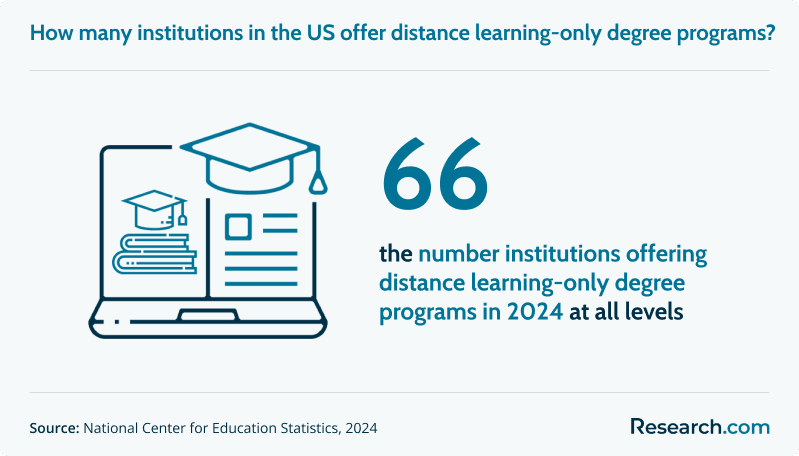
The graphic below notes that 66 U.S. institutions now offer fully distance-learning degrees. That availability gives educators more program choice, but it also makes careful comparison more important.
What Is the Average Cost of an Online Ed.S. in Special Education?
Cost varies by university, state residency, fee structure, and whether the school charges a flat online rate. According to CollegeTuitionCompare, the 2024–25 average graduate tuition & fees for Special Education and Teaching programs was $11,373 in-state and $20,024 out-of-state. A broader IPEDS-based analysis reported average graduate tuition & fees across U.S. colleges of $11,950 in-state and $20,678 out-of-state for 2023–24.
Online Ed.S. programs in special education often fall near these graduate cost ranges. Many charge between $300 and $450 per credit, though some programs on this list are lower or higher. For a 30-credit Ed.S., base tuition may be approximately $9,000–$13,500 for in-state students or $12,000–$18,000 for out-of-state students, before required fees.
| Cost Item | Why It Matters | Question to Ask |
| Per-credit tuition | This is the largest visible cost | Is the online rate the same for in-state and out-of-state students? |
| Mandatory fees | Technology, student services, graduation, and assessment fees can add up | Are fees included in the advertised price? |
| Materials | Some programs include digital resources; others do not | Are books and course materials bundled? |
| Practicum or supervision costs | Fieldwork may involve extra coordination or documentation | Are field placement fees separate? |
| Travel | Fully online programs usually avoid travel, but hybrid programs may not | Are any campus visits required? |
| Time away from work | Intensive formats may affect teaching, tutoring, or summer income | Can I maintain my work schedule during peak terms? |
Salary context can help with planning, but it should not be treated as a guarantee. The salary figures connected to this field show average special education teacher earnings ranging from $66,600 to $67,190 annually, while individual pay depends on district salary schedules, state funding, union contracts, credentials, and years of experience.
Financial Aid Options for Online Ed.S. in Special Education Students
Graduate students often use several funding sources rather than relying on one form of aid. Before applying, ask each university whether the Ed.S. program is eligible for federal aid, scholarships, employer reimbursement, and state-based incentives for special education professionals.
- Federal Student Aid through the FAFSA: 74% of graduate students received federal aid in 2019–20.
- Federal Direct Loans: Graduate students may qualify; average borrowing was $26,000 per graduate borrower.
- Graduate Assistantships: 12% of graduate students held assistantships, with an average value of $18,800.
- Scholarships and fellowships: Universities, professional organizations such as the Council for Exceptional Children, and state departments may offer awards.
- Institutional grants: 28% of undergraduates received institutional aid; graduate-specific awards depend on school policy.
- State aid and tuition waivers: Some states provide targeted support for special education practitioners, though eligibility varies.
- Employer tuition reimbursement: Many K–12 districts and education agencies reimburse part of an advanced degree when it aligns with workforce needs.
- Federal TEACH Grants: Eligible students may receive up to $4,000 per year if they commit to teaching in a high-need field, including special education.
Do not assume the lowest tuition produces the lowest out-of-pocket cost. A higher-tuition program with strong district reimbursement, grants, or included materials may cost less than a cheaper program with limited aid and separate fees.
Admissions Requirements for an Online Ed.S. in Special Education
Most Ed.S. in Special Education programs are post-master’s options for practicing educators. Admissions requirements vary, but schools usually look for evidence that applicants have the academic background, teaching experience, and licensure foundation needed for specialist-level coursework.
- Master’s degree in Special Education or a related area such as Curriculum & Instruction
- Current teaching certificate or license in Special Education, K–12, or an equivalent state credential
- Minimum graduate GPA of 3.0–3.2 on a 4.0 scale in prior master’s coursework
- Official transcripts from all colleges and universities attended
- Statement of purpose or professional goals explaining why the Ed.S. fits your career plan
- Letters of recommendation, typically 2–3, from academic or professional references
- Resume or CV showing teaching, intervention, leadership, or related experience
- Background clearance or fingerprinting if the program includes fieldwork or practicum placements
If you are still comparing education pathways, Research.com’s guide to education degree types can help clarify how bachelor’s, master’s, specialist, and doctoral credentials differ.
Typical Courses in an Online Ed.S. in Special Education Program
Ed.S. coursework is more advanced than a master’s program and usually emphasizes leadership, applied research, legal compliance, assessment, and specialized intervention. While course titles vary by school, common topics include the following.
- Advanced behavior management: Assessment and intervention strategies for students with significant behavioral needs.
- Legal foundations and special education policy: Advanced study of IDEA, ADA, compliance requirements, and state-level rules.
- Research methods and data analysis: Applied research design, program evaluation, and interpretation of student and service data.
- Assistive technology for inclusion: Tools and implementation strategies that improve access for learners with disabilities.
- Leadership and program development: Planning, managing, and evaluating special education programs at the school or district level.
- Curriculum design for diverse learners: Instructional adaptation, universal design, and individualized supports.
- Collaboration and consultation models: Working with families, general education teachers, administrators, and related-service providers.
- Practicum or capstone project: A final applied experience, portfolio, or research project demonstrating specialist-level competence.
The chart below connects these courses to workplace skills. Resume data show special education administrators citing competencies such as IEP development at 14.9% and program leadership at 37.3%, which helps explain why leadership, policy, behavior, and assessment courses are central to many Ed.S. curricula.
Common Online Ed.S. Special Education Specializations
Specializations matter because they influence your practicum experience, licensure alignment, and career direction. A teacher who wants to become a behavior specialist should compare different programs than an educator preparing for a district leadership or early childhood role.
| Specialization | Focus | Best Fit |
| Applied Behavior Analysis, ABA | Behavior assessment and intervention, often for autism and related needs | Educators pursuing behavior support or autism-focused roles |
| Early Childhood Special Education | Services for learners from birth to age 8 | Teachers with or seeking an early childhood education online foundation |
| Educational Diagnostician | Assessment, eligibility, and evaluation under IDEA | Educators interested in testing and eligibility roles |
| Learning & Behavior Disorders | Interventions for learning, emotional, and behavioral challenges | Teachers supporting students with complex academic and behavioral needs |
| Assistive Technology | Devices, software, and access strategies for students with disabilities | Educators supporting inclusive classrooms and accessibility initiatives |
| Curriculum & Instruction Leadership | Program improvement, instructional leadership, and policy implementation | Teachers preparing for coordinator or district-level leadership |
| Autism Spectrum Support | Evidence-based supports for learners with ASD | Teachers and specialists working in autism programs |
| Reading & Literacy Specialist | Advanced literacy assessment and intervention | Educators supporting students with reading disabilities or literacy gaps |
| Transition Services & Vocational Planning | Planning for postsecondary education, employment, and independent living | Secondary educators and transition coordinators |
The chart below shows why specialization choice matters. Specific learning disabilities account for 33.8% of identified cases, followed by speech/language impairments at 17.96% and other health impairments at 16.55%. Those patterns help explain continued demand for expertise in literacy, communication supports, behavior, assistive technology, and transition planning.
How to Choose the Best Online Ed.S. in Special Education Program
The right Ed.S. program should match your state license, professional goals, schedule, and financial limits. Start with career intent: do you want to remain an expert classroom practitioner, become a behavior or assessment specialist, lead special education services, or prepare for district administration?
- Confirm institutional accreditation. Look for recognized institutional accreditation such as SACSCOC, HLC, or WSCUC.
- Check program-level recognition. If listed, review CAEP or other education-related accreditation and confirm whether it matters for your state or employer.
- Verify licensure alignment. Ask your state education agency whether the program supports any endorsement, certification, or salary-lane advancement you expect.
- Compare specialization options. Match concentrations such as ABA, learning and behavior disorders, diagnostician, literacy, or leadership to your intended role.
- Review fieldwork requirements. Find out whether practicum, internship, capstone, or supervision can be completed in your district.
- Evaluate the online format. Ask whether courses are asynchronous, synchronous, cohort-based, accelerated, or self-paced.
- Calculate total cost. Include tuition, fees, books, technology charges, travel, and possible lost income.
- Ask about advising and support. Strong online programs should provide academic advising, library access, technical help, financial aid counseling, and career guidance.
- Review outcomes carefully. Use NCES, College Scorecard, faculty profiles, and alumni feedback, but remember that salary outcomes are not guaranteed.
- Talk to your district. Before enrolling, confirm whether the degree affects salary placement, leadership eligibility, or reimbursement.
Accreditation Standards to Check Before Enrolling
Accreditation is one of the most important quality and risk-control checks for an online Ed.S. program. At minimum, confirm that the university holds recognized institutional accreditation. Then review whether the education school or program lists specialized accreditation such as CAEP, and ask whether the program meets your state’s requirements for any endorsement or leadership credential you plan to pursue.
Do not assume that every online Ed.S. leads to the same professional outcome. Some programs are non-licensure, some are designed for already licensed teachers, and some are tied to state-specific leadership or director pathways. Educators comparing efficient graduate options may also review the fastest EdD online program options, but an Ed.D. serves a different purpose than an Ed.S. and may require a larger research or leadership commitment.
Questions to Ask an Online Ed.S. Program Advisor
| Question | Why It Matters |
| Is this program licensure, endorsement, or non-licensure? | Prevents enrolling in a program that does not match your professional goal |
| Will this Ed.S. be recognized by my state or district? | Salary-lane movement and leadership eligibility are often local decisions |
| Can I complete fieldwork in my current school or district? | Reduces scheduling and travel complications |
| Are courses asynchronous, synchronous, or mixed? | Determines whether the program fits your teaching schedule |
| What fees are not included in the advertised tuition? | Protects against underestimating total cost |
| How many credits can I transfer? | May reduce cost and time to completion |
| What support is available to online students? | Advising, library access, tutoring, and technical support affect completion |
| What roles do graduates typically move into? | Helps determine whether the program has a strong fit with your career plan |
Career Paths With an Online Ed.S. in Special Education
An Ed.S. in Special Education can support advancement within K–12 schools, district offices, educational support services, and related education organizations. It is not usually an entry-level teaching credential; it is more commonly used by educators who want to deepen expertise or move toward leadership.
- Instructional assistant or paraprofessional: Supports students under teacher supervision; this role often requires an associate’s or bachelor’s degree.
- Special education teacher: Develops and delivers individualized instruction; median pay was $64,270 in May 2024.
- Lead special education teacher or mentor: Supports colleagues, models effective practice, and assists with IEP development.
- Special education coordinator: Helps manage compliance, service delivery, staff training, and family communication.
- District-level specialist: May work as a behavior specialist, diagnostician, intervention specialist, or assessment-focused professional.
- Director of special education: Oversees districtwide special education services, policy, staffing, and budgets.
- State or regional consultant: Advises districts on regulations, program improvement, training, and service models.
Some educators combine specialist preparation with broader instructional expertise. For example, an online elementary teaching degree can strengthen early-grade inclusive instruction, while an online Masters in Education may support broader curriculum, policy, or leadership roles.
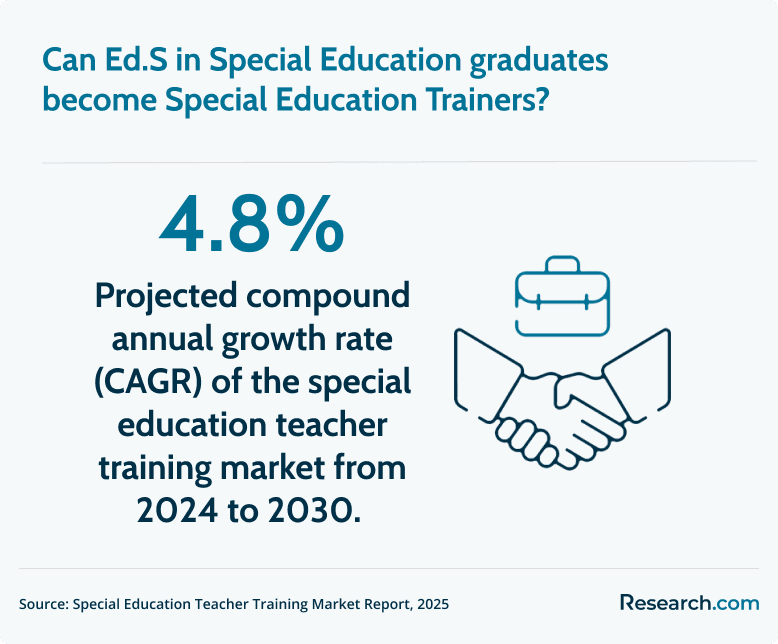
The projection below points to opportunities in training and professional development. A 4.8% CAGR in the special education teacher training market through 2030 suggests that experienced specialists may find growing opportunities to support other educators, design training, or lead professional learning initiatives.
Job Market Outlook for Online Ed.S. in Special Education Graduates
The special education labor market remains essential but complex. There were roughly 531,600 special education teacher positions in 2023, with 35,900 annual openings linked largely to retirements and transfers. BLS projects little or no change, 0% growth, in overall employment from 2023 to 2033.
That flat headline projection does not mean there is no opportunity. Schools continue to need qualified teachers, specialists, coordinators, and leaders who can address compliance, staffing, behavior support, inclusive services, early intervention, and IEP quality. Specialized roles can also differ from classroom teaching positions in responsibility and compensation. Educational Support Services roles, such as those in behavior clinics, reported an annual mean wage of $92,830.
Regional opportunity also varies. California, Texas, and Florida lead in special education employment, reflecting large student populations and extensive support-service needs. Educators should compare local district openings, state certification rules, and salary schedules before assuming that a national outlook applies to their market.
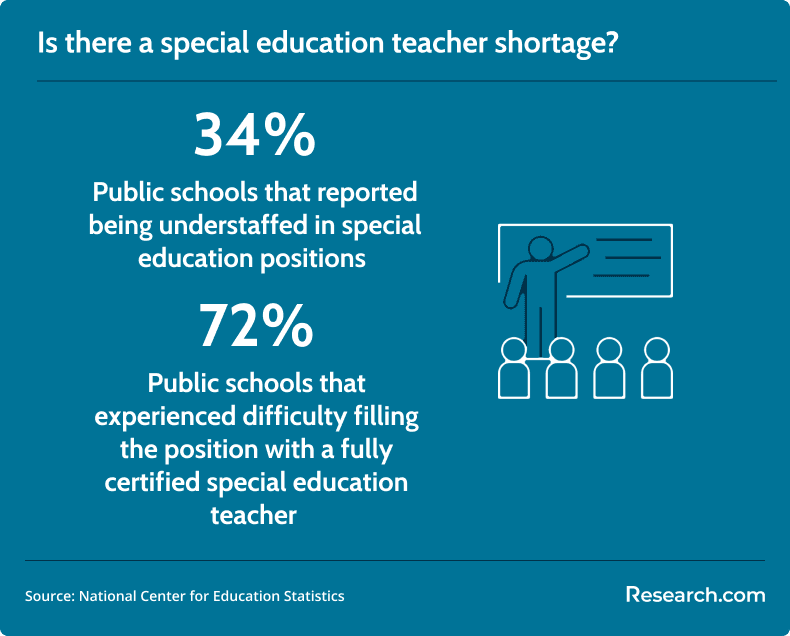
The staffing data below shows why advanced preparation still matters. 34% of public schools report being understaffed, and 72% struggle to fill roles with fully certified teachers. Ed.S.-trained educators may be positioned to help schools strengthen programs, mentor teachers, and improve service delivery in difficult staffing conditions.
Common Challenges in Online Ed.S. Programs and How to Manage Them
Online Ed.S. programs are flexible, but they are not easy. Many students are full-time educators taking graduate courses after long school days. The most common challenges include time pressure, limited face-to-face interaction, practicum coordination, technology issues, and the need to stay self-directed across multiple terms.
| Challenge | Why It Happens | Better Strategy |
| Falling behind during the school year | Teaching workload rises during IEP season, testing, and grading periods | Choose a realistic course load and map major assignments before each term starts |
| Weak peer connection | Online students may not naturally interact outside required discussions | Join study groups, attend optional synchronous sessions, and use professional networks |
| Practicum confusion | Fieldwork rules may differ by state, district, and program | Ask for placement requirements in writing before enrollment |
| Technology interruptions | Virtual platforms, video meetings, and remote supervision require stable systems | Test platforms early and confirm technical support hours |
| Unclear career payoff | Districts differ in how they reward advanced degrees | Confirm salary-lane, stipend, and promotion policies with your employer |
Online-program comparison skills are useful across fields, although program fit varies widely by discipline. For example, Research.com’s guide to the fastest online bachelors in mathematics degree programs illustrates why students should review pacing, transfer policies, and support services rather than choosing only by speed.
Can Additional Online Credentials Improve Career Options?
Complementary credentials can be useful when they support a specific career goal. For special education professionals, logical add-ons may include behavior intervention, assistive technology, literacy, educational leadership, transition planning, autism support, or data-based decision-making. The value depends on whether the credential is recognized by your employer, state, or target role.
Some educators also build broader administrative or resource-management skills. For instance, the cheapest MLIS online options may be relevant for professionals who want to work at the intersection of information access, learning resources, disability support, and academic services. Before adding another credential, compare cost, time, and career relevance carefully.
Common Mistakes to Avoid When Choosing an Online Ed.S. in Special Education
- Assuming every Ed.S. changes your license. Some programs are non-licensure and will not add an endorsement or administrative credential.
- Looking only at per-credit tuition. Fees, materials, practicum costs, and transfer policies can change the real price.
- Ignoring state rules. Online programs may not meet requirements in every state, especially for director, diagnostician, or leadership roles.
- Choosing speed over fit. An accelerated program can save time, but it may not be sustainable during a demanding school year.
- Skipping employer verification. Districts vary in how they treat Ed.S. degrees for salary movement and promotions.
- Relying only on rankings. Rankings help narrow options, but accreditation, licensure fit, specialization, and advising quality matter more for your personal outcome.
- Overestimating salary impact. Advanced credentials may support advancement, but pay depends on local salary schedules, role availability, and experience.
What Graduates Say About Online Ed.S. Study
- Marisol: "Completing the Ed.S. online let me test new behavior-support strategies in my classroom right away. The assignments were demanding, but they connected directly to my students and IEP work. I could keep teaching full time and still learn from classmates in other districts."
- Thaddeus: "I worried that an online program would feel disconnected, but the virtual practicum and faculty feedback were much stronger than I expected. I received detailed guidance on IEP development, assistive technology, and collaboration with families, even though I was not on campus."
- Zephyr: "The online format helped me move from co-teaching into a program coordination role. The leadership courses made district planning, compliance, and staff support feel more manageable, and the flexible schedule helped me avoid stepping away from my school."
References
- Arkansas State University. Ed.S. in Leadership – SPED.
- Bureau of Labor Statistics. Special Education Teachers.
- Bureau of Labor Statistics. Occupational Employment and Wages, May 2023: Special Education Teachers.
- Bureau of Labor Statistics. Occupational Employment and Wages, May 2023 25-2059 Special Education Teachers, All Other.
- Bureau of Labor Statistics. Occupational Employment and Wages, May 2023 25-2057 Special Education Teachers, Middle School.
- Bureau of Labor Statistics. Occupational Employment and Wages, May 2023 25-2051 Special Education Teachers, Preschool.
- Bureau of Labor Statistics. Occupational Employment and Wages, May 2023 25-2058 Special Education Teachers, Secondary School.
- College Tuition Compare. Graduate Special Education and Teaching Tuition.
- Glassdoor. United States Special Education Specialist Salary.
- Indeed. Special Education Teacher Salaries.
- Kennesaw State University. Ed.S. in Special Education.
- Liberty University. Online Ed.S. in Special Education.
- National Center for Education Statistics. Graduate Degrees Awarded by Field.
- National University. Ed.S. in Special Education.
- Northern Kentucky University. Ed.S. in Teaching and Leading – Learning & Behavior Disorders.
- PayScale. Special Education Teacher Salary.
- Pittsburg State University. Ed.S. in Advanced Studies in Leadership.
- Salary.com. Special Education Salary Research.
- UnivStats. Cost of Attendance.
- University of the Cumberlands. Ed.S. Special Education Certification.
- University of Florida. Online Ed.S. in Special Education.
- Valdosta State University. Ed.S. in Special Education.
- University of West Georgia. Ed.S. in Special Education.
- Zippia. Special Educator Salary.
- ZipRecruiter. Education Specialist Salary.
Key Insights
- An online Ed.S. in Special Education is best suited for licensed, master’s-prepared educators who want specialist-level preparation without pursuing a doctorate.
- Most programs require 27–36 credit hours and can often be completed in 12 to 24 months, but practicum rules, transfer credits, and pacing can change the timeline.
- Cost comparisons should include tuition, fees, materials, fieldwork expenses, and employer reimbursement—not just the advertised per-credit rate.
- Accreditation and licensure alignment are non-negotiable. Always confirm institutional accreditation, program recognition, and state requirements before enrolling.
- Specialization choice should match your target role. Behavior support, diagnostician, literacy, assistive technology, leadership, and transition services lead to different career paths.
- The job market shows stable overall employment projections, but staffing shortages and specialized service needs create opportunities for educators who can lead, mentor, assess, and improve programs.
- The best program is not automatically the highest-ranked or fastest option. It is the program that fits your license, district requirements, career goal, schedule, and budget.
Other Things You Should Know About Online Ed.S Degree in Special Education Programs
Many are, and CAEP accreditation is the main quality marker for educator-preparation programs. A program may also need approval from a state education department, especially if it leads to licensure or endorsement. Always verify both institutional accreditation and program approval before enrolling.
Online Ed.S. programs in Special Education typically require 1-2 years to complete, depending on part-time or full-time enrollment. Institutions may offer accelerated options, allowing completion closer to the one-year mark, contingent upon the student's prior academic and professional experience.


